







How to Coach at Your Best: The Importance of Self Coaching

Do you have leaky gutters when it comes to coaching yourself?
It is interesting how plumbers often seem to have leaking gutters and, to my amazement, cleaners have messy houses. I have also noticed, working as a coach mentor, that a lot of coaches are not aware they have missed an area in their life where they could improve themselves through coaching.
Most of us come to the profession of coaching because we have overcome adversity or experienced being coached in some way to propel ourselves forward. We would like to do the same for others.
You will be familiar with the process of being coached and have experienced the power of coaching in your life. Being coached would most likely have been a part of your study journey also.
Key Takeaways
- Coaches need coaching too. Your ability to spot a client’s limiting beliefs, avoidance, or lack of follow-through does not automatically make those patterns easy to recognize in yourself.
- Self-coaching works best when it produces action. Reflection should eventually lead to a decision, experiment, conversation, deadline, or other observable next step.
- Your coaching business is a legitimate subject for self-coaching. Confidence, niche, pricing, visibility, client attraction, boundaries, and business follow-through can all benefit from the same questions you use with clients.
- A framework keeps self-coaching from becoming circular thinking. A structured model such as GROW can move you from identifying what you want to examining reality, generating options, and committing to action.
- Self-coaching has limits. If you repeatedly reach the same conclusion without changing your behavior, outside coaching, mentoring, or expertise may give you the perspective you cannot create alone.
Why Is Self-Coaching Important for Coaches?
Self-coaching helps coaches apply their own coaching skills to the goals, decisions, beliefs, and behaviors affecting their life and coaching business. It creates a deliberate way to step outside your normal thinking, question your assumptions, and decide what you will do next.
It is particularly useful when you know the coaching principles intellectually but are not applying them to yourself. You may challenge a client who keeps postponing an important decision, for example, while spending months postponing your own decision about your niche, prices, offer, or marketing.
SEE ALSO: If you’re a coach looking to streamline your administrative tasks and save time, check out our Coaching Administration Software. It’s a simple, effective solution designed to help you focus less on paperwork and more on what matters—coaching your clients. From scheduling to client management, our software gives you the tools to run your business efficiently. Ready to reclaim your time and boost productivity? Click or tap here.
Self-coaching is not a replacement for being coached by someone else. It is another way to practice what you already ask clients to do: increase awareness, challenge the thinking that keeps you stuck, consider alternatives, and turn insight into action.
Leaky Gutters” in Your Own Coaching Life?
I have noticed that many coaches get through their training and then struggle to move forward with the next steps to create their dream life or business as a coach. They seem to miss the power they have to coach themselves in their niche area, or get someone else to coach them. It’s like the Plumber who walks under their own leaking gutters every day without noticing them. (I have a friend whose husband is a plumber and she ended up calling in someone else to fix her gutters after waiting many months).
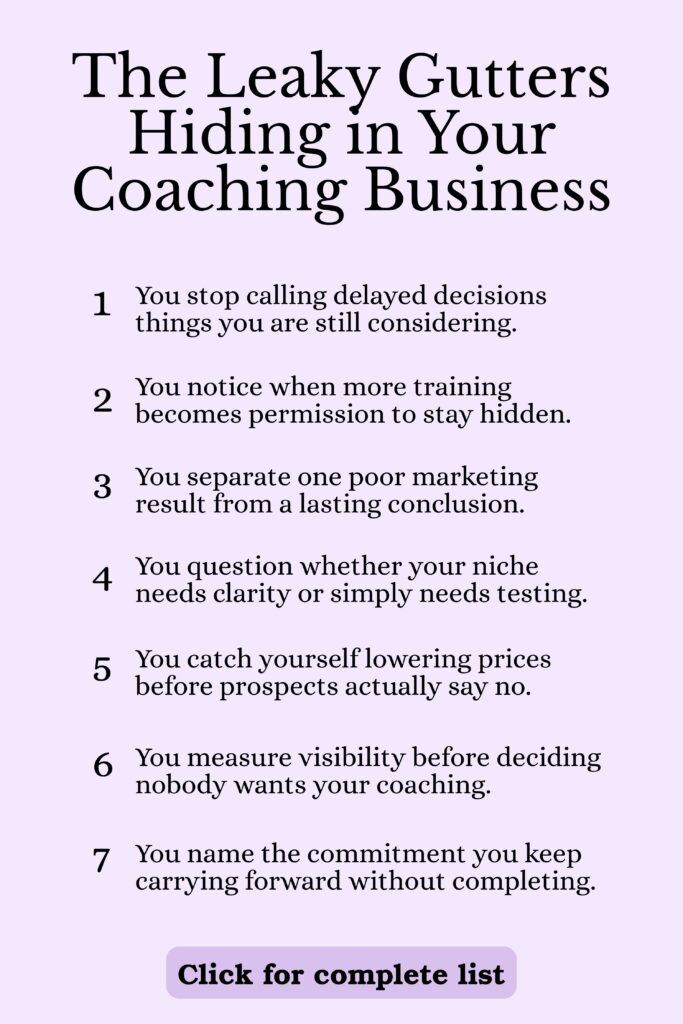
I know many of you coaches work on yourselves in lots of ways, but so often creating your ideal life as a coach one an area that gets missed. You know you want to make a big difference, you have big plans, but you allow yourself to become blocked by limiting beliefs that you have the tools to remove. Have you just had an “Aha”?
I suggest you coach yourself around topics such as—
- Being the most confident and successful coach you know,
- The steps you need to take to have the ultimate coaching business, or
- Getting clear about your area of expertise.
Has the light bulb gone on? Remember you don’t have to have an emotional issue or a big problem to benefit from coaching. You can be coached to move from something that is “ok” to making it “awesome”. You can be coached to gain more clarity. You can be coached to experience confidence WITHOUT having to get more training or more experience. That is right, you can be confident RIGHT NOW!!! Imagine how great your coaching sessions will be when you experience that level of confidence.
Why Can Coaches See a Client’s Blind Spots but Miss Their Own?
You can be highly skilled at identifying a client’s blind spots and still have difficulty seeing your own because you are not observing yourself from the same distance.
SEE ALSO: If you’re a coach looking to streamline your administrative tasks and save time, check out our Coaching Administration Software. It’s a simple, effective solution designed to help you focus less on paperwork and more on what matters—coaching your clients. From scheduling to client management, our software gives you the tools to run your business efficiently. Ready to reclaim your time and boost productivity? Click or tap here.
Psychologists Emily Pronin, Daniel Lin, and Lee Ross called a related phenomenon the bias blind spot. Across three studies, they found that people tended to recognize cognitive and motivational biases more readily in other people than in themselves.
That does not mean every coaching-business problem is caused by cognitive bias. It does give coaches a useful warning: expertise in questioning other people’s thinking does not make your own thinking automatically objective.
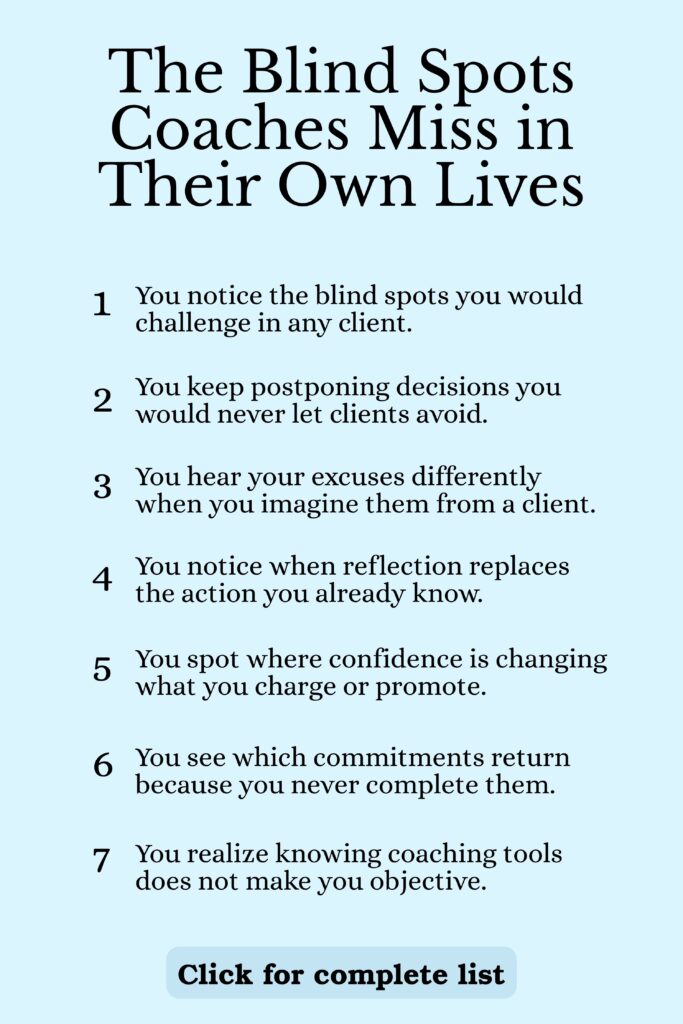
You might immediately notice that a client is:
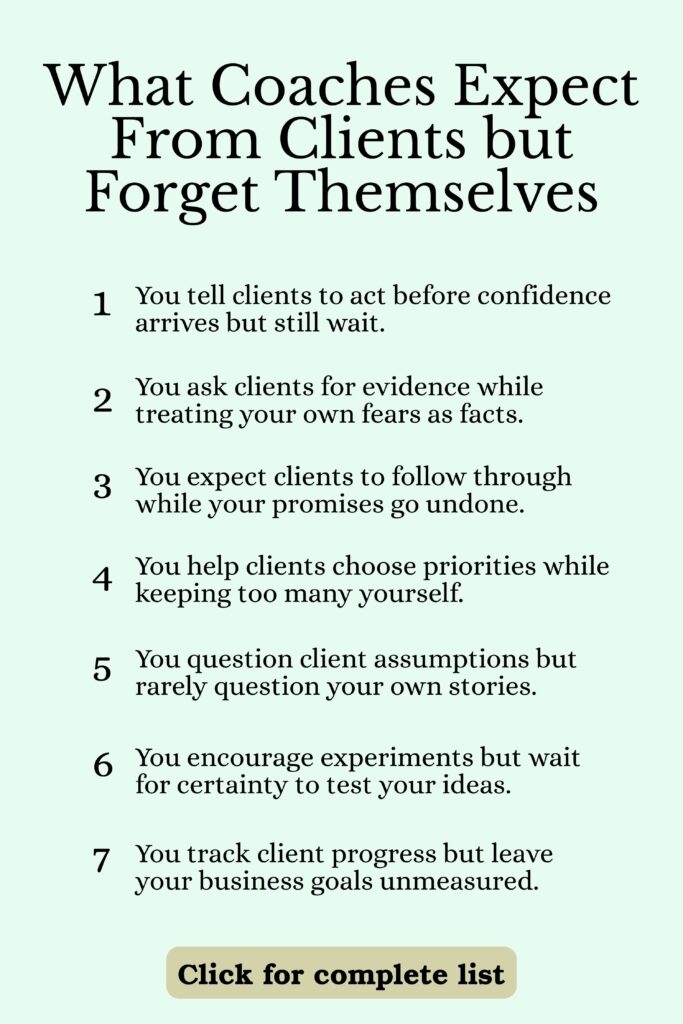
- Waiting to feel confident before taking action.
- Collecting more information to postpone a decision.
- Setting vague goals that cannot be measured.
- Interpreting one disappointing result as proof that something will never work.
- Avoiding a difficult conversation while insisting they are still “thinking about it.”
Then look at your coaching business.
Have you delayed putting your offer in front of people because it needs “a little more work”?
Have you taken another course because you think one more qualification will finally make you confident enough to promote yourself?
SEE ALSO: If you’re a coach looking to streamline your administrative tasks and save time, check out our Coaching Administration Software. It’s a simple, effective solution designed to help you focus less on paperwork and more on what matters—coaching your clients. From scheduling to client management, our software gives you the tools to run your business efficiently. Ready to reclaim your time and boost productivity? Click or tap here.
Have you spent months thinking about your niche without testing a clear positioning statement with actual prospects?
Have you told yourself marketing “doesn’t work” when what you actually know is that one particular marketing attempt did not produce the result you wanted?
Those are your gutters.
One powerful self-coaching question is therefore:
If one of my clients described exactly what I have been doing for the last three months, what would I notice?
Answer that before you explain your behavior. You may see something you have been walking underneath every day.
SEE ALSO: If you’re a coach looking to streamline your administrative tasks and save time, check out our Coaching Administration Software. It’s a simple, effective solution designed to help you focus less on paperwork and more on what matters—coaching your clients. From scheduling to client management, our software gives you the tools to run your business efficiently. Ready to reclaim your time and boost productivity? Click or tap here.
What Should Coaches Actually Self-Coach On?
The best subjects for self-coaching are the areas where there is a gap between what you say you want and what your behavior is currently producing.
You do not need to invent a problem. Look for evidence.
Confidence
Ask yourself where lack of confidence is changing your behavior.
Perhaps you avoid mentioning your fee until late in the conversation. Maybe you keep rewriting your website instead of publishing it. Maybe you introduce yourself vaguely because saying, “I am a coach who specializes in X” still feels uncomfortable.
The useful question is not simply, “How can I become more confident?”
Try: What would I do differently this week if I already trusted my ability to coach well?
SEE ALSO: If you’re a coach looking to streamline your administrative tasks and save time, check out our Coaching Administration Software. It’s a simple, effective solution designed to help you focus less on paperwork and more on what matters—coaching your clients. From scheduling to client management, our software gives you the tools to run your business efficiently. Ready to reclaim your time and boost productivity? Click or tap here.
That gives you behavior to work with.
Your niche and expertise
If you have been “working on your niche” for six months, self-coaching can help you separate a real positioning problem from fear of choosing.
Ask:
What problem am I particularly good at helping people solve?
Who already responds strongly to my coaching?
What evidence would tell me this niche is worth pursuing?
SEE ALSO: If you’re a coach looking to streamline your administrative tasks and save time, check out our Coaching Administration Software. It’s a simple, effective solution designed to help you focus less on paperwork and more on what matters—coaching your clients. From scheduling to client management, our software gives you the tools to run your business efficiently. Ready to reclaim your time and boost productivity? Click or tap here.
Then design a small test rather than demanding permanent certainty from yourself.
Pricing and offers
Pricing becomes a useful self-coaching subject when what you believe about value conflicts with what you actually do.
Imagine you believe a six-session coaching package should cost $1,200, but every time a prospect hesitates you immediately offer it for $800.
The interesting coaching question is not “What should I charge?”
It is: What happens in my thinking in the few seconds between hearing hesitation and lowering my price?
That is where the gutter may be.
SEE ALSO: If you’re a coach looking to streamline your administrative tasks and save time, check out our Coaching Administration Software. It’s a simple, effective solution designed to help you focus less on paperwork and more on what matters—coaching your clients. From scheduling to client management, our software gives you the tools to run your business efficiently. Ready to reclaim your time and boost productivity? Click or tap here.
Visibility and getting clients
If you want more coaching clients, examine your actual visibility before deciding that people are not interested.
How many potential clients encountered your coaching last month? How many were given a clear way to contact you? How many could book a conversation without exchanging emails with you first? How many times did you directly explain what you help people achieve?
If the answer is “hardly any,” you may not have a demand problem yet. You may have a visibility problem.
Once you identify that gap, make the next action concrete. You might publish a useful article, create a lead magnet, put a discovery call in front of your audience, or create a free life coach directory listing so potential clients have another place to find you.
If booking friction is one of the gutters you uncover, LCH Core also gives you a Public Booking Page where prospects can choose a public session from your actual availability. The Public Booking Page setup guide explains how to configure and publish it.
Follow-through
Finally, compare the accountability you expect from clients with the accountability you expect from yourself.
SEE ALSO: If you’re a coach looking to streamline your administrative tasks and save time, check out our Coaching Administration Software. It’s a simple, effective solution designed to help you focus less on paperwork and more on what matters—coaching your clients. From scheduling to client management, our software gives you the tools to run your business efficiently. Ready to reclaim your time and boost productivity? Click or tap here.
If a client told you for four consecutive sessions that they were going to contact three prospects, but never did it, you would probably explore the pattern.
Do the same for yourself.
What commitment have I carried forward week after week without completing it?
That question can expose a leaky gutter very quickly.
How Can You Use Your Own Coaching Process on Your Business?
You can make self-coaching much more useful by applying a structured coaching framework to a real business problem instead of simply thinking harder about it.
One option is the GROW model, developed by Sir John Whitmore and colleagues. GROW moves through Goals, Reality, Options, and Will, taking a person from defining the desired outcome through to deciding what they will actually do.
SEE ALSO: If you’re a coach looking to streamline your administrative tasks and save time, check out our Coaching Administration Software. It’s a simple, effective solution designed to help you focus less on paperwork and more on what matters—coaching your clients. From scheduling to client management, our software gives you the tools to run your business efficiently. Ready to reclaim your time and boost productivity? Click or tap here.
Performance Consultants, the organization co-founded by Whitmore, specifically identifies self-coaching as one application of the model.
Suppose your problem is: “I need more clients.”
That is not yet specific enough to coach.
Goal: What do you actually want?
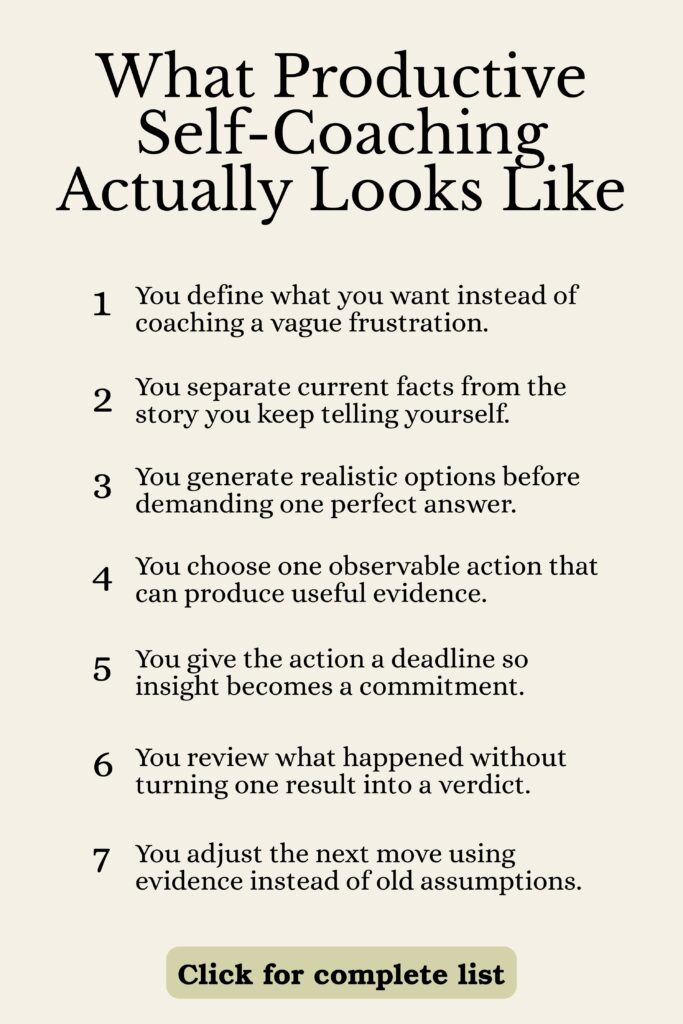
Turn the general desire into an outcome.
Instead of “I want more clients,” you might decide:
I want to sign three new clients into my six-session package during the next eight weeks.
SEE ALSO: If you’re a coach looking to streamline your administrative tasks and save time, check out our Coaching Administration Software. It’s a simple, effective solution designed to help you focus less on paperwork and more on what matters—coaching your clients. From scheduling to client management, our software gives you the tools to run your business efficiently. Ready to reclaim your time and boost productivity? Click or tap here.
Now there is something to coach.
Reality: What is actually happening now?
This is where you separate facts from the story you are telling yourself.
How many inquiries did you receive last month?
How many discovery calls did you hold?
How many people saw your offer?
How many calls converted?
SEE ALSO: If you’re a coach looking to streamline your administrative tasks and save time, check out our Coaching Administration Software. It’s a simple, effective solution designed to help you focus less on paperwork and more on what matters—coaching your clients. From scheduling to client management, our software gives you the tools to run your business efficiently. Ready to reclaim your time and boost productivity? Click or tap here.
How consistently did you market?
Perhaps you discover that your problem is not that you “can’t get clients.” You held only two discovery calls in the entire month.
That changes the coaching conversation.
Options: What could you do?
Generate several possible routes before choosing one.
Could you publish content aimed at your niche? Ask past clients for referrals? Create a useful lead magnet? Improve your directory profile? Make your discovery call easier to book? Follow up with old inquiries? Attend two relevant networking events?
Do not ask which idea is perfect. Ask which ideas are realistic enough to test.
SEE ALSO: If you’re a coach looking to streamline your administrative tasks and save time, check out our Coaching Administration Software. It’s a simple, effective solution designed to help you focus less on paperwork and more on what matters—coaching your clients. From scheduling to client management, our software gives you the tools to run your business efficiently. Ready to reclaim your time and boost productivity? Click or tap here.
If you want a deeper framework for this part of your business, the Life Coach Hub guide How to Master Funnels as a Coach (and Why You Need To) looks at attraction, nurturing, conversion and retention as one connected client journey.
Will: What will you actually do?
This is where self-coaching becomes useful.
Choose the action.
Give it a deadline.
Decide what completion looks like.
For example:
SEE ALSO: If you’re a coach looking to streamline your administrative tasks and save time, check out our Coaching Administration Software. It’s a simple, effective solution designed to help you focus less on paperwork and more on what matters—coaching your clients. From scheduling to client management, our software gives you the tools to run your business efficiently. Ready to reclaim your time and boost productivity? Click or tap here.
By Friday, I will update my discovery-call page and personally invite five warm contacts to book.
Now you have something that can succeed, fail, or teach you something.
If you use LCH Core, this is also where its coaching tools can support your own discipline. The same kinds of goals, action items, journals, worksheets, and resources you use to support client follow-through can help you think more concretely about how insight becomes action. The Coaching Tools tutorial library shows how these tools work inside the platform.
The point is not to turn every business decision into homework. It is to stop ending a useful self-coaching conversation with, “That’s interesting.”
Finish with: What am I going to do now?
How Do You Coach Yourself Effectively?
A great exercise is to put your coaching hat on and coach yourself. Use your strengths to get you to where you want to be. This is how you will “walk your talk.” This works really well when you do it like this:
SEE ALSO: If you’re a coach looking to streamline your administrative tasks and save time, check out our Coaching Administration Software. It’s a simple, effective solution designed to help you focus less on paperwork and more on what matters—coaching your clients. From scheduling to client management, our software gives you the tools to run your business efficiently. Ready to reclaim your time and boost productivity? Click or tap here.
- Sit in the spot you would if you were your client (If you coach on the phone just sit somewhere else other then the seat you coach from). After a few moments move to the seat you would sit in if you were being the coach. Look at where you were sitting as though you are still there and role play…. be your own coach. This means you will address your issues from a completely different part of the mind then you usually do. This can be amazingly powerful on so many fronts.
Don’t continue walking under your leaky gutter. Take steps today to fix it yourself or call in the professionals. And like gutters this too needs to be maintained. Whether you continue to coach yourself or you have other sources that give you inspiration everyday to “walk your talk,” make sure you keep it up.
When Does Self-Coaching Become Another Form of Avoidance?
Self-coaching stops being productive when reflection repeatedly replaces the action the reflection is supposed to produce.
Coaches can be especially good at this because we have a large vocabulary for thinking about behavior. We can journal, reframe, question beliefs, explore values, revisit goals, and examine resistance.
All of that can be useful.
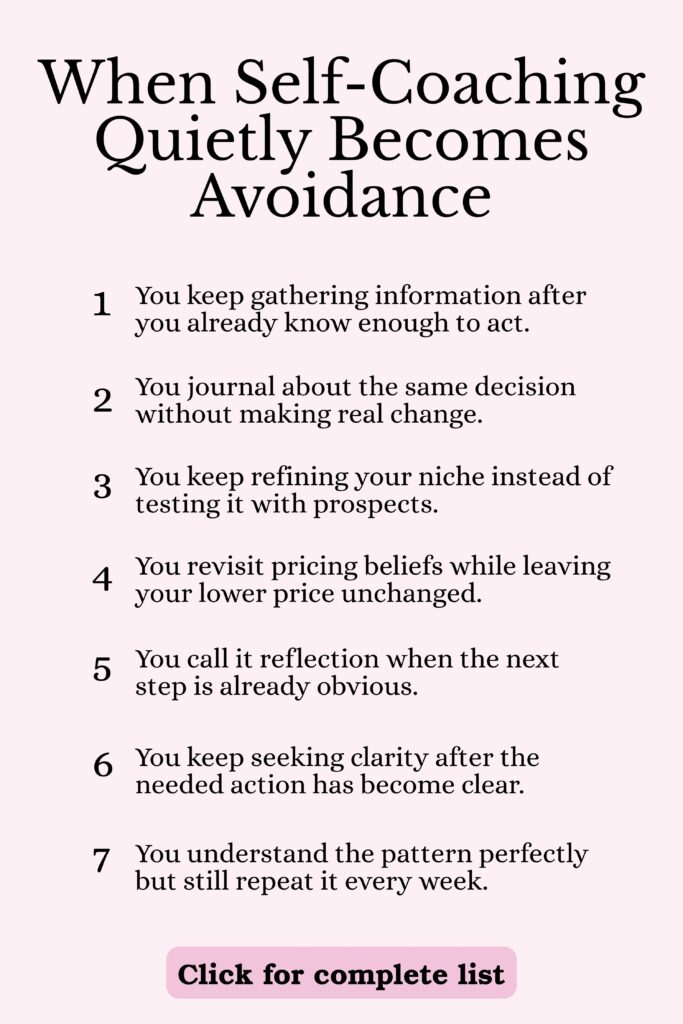
It can also become an extremely sophisticated way of not sending the email.
Imagine a coach who has spent four months exploring why choosing a niche feels restrictive. She has journaled about it, brainstormed possibilities, examined her beliefs about excluding people, and repeatedly revisited her ideal client.
SEE ALSO: If you’re a coach looking to streamline your administrative tasks and save time, check out our Coaching Administration Software. It’s a simple, effective solution designed to help you focus less on paperwork and more on what matters—coaching your clients. From scheduling to client management, our software gives you the tools to run your business efficiently. Ready to reclaim your time and boost productivity? Click or tap here.
At some point, another hour of reflection may produce less useful information than choosing one positioning statement and testing it for 30 days.
Or imagine a coach who keeps self-coaching around pricing. He knows why he undercharges. He knows when he does it. He knows what he believes his package is worth.
But the price on his website has not changed.
The test is simple:
What observable action should come out of this self-coaching?
It might be:
SEE ALSO: If you’re a coach looking to streamline your administrative tasks and save time, check out our Coaching Administration Software. It’s a simple, effective solution designed to help you focus less on paperwork and more on what matters—coaching your clients. From scheduling to client management, our software gives you the tools to run your business efficiently. Ready to reclaim your time and boost productivity? Click or tap here.
- Publish the price.
- Contact five prospects.
- Ask three previous clients for referrals.
- Choose the niche for a 30-day test.
- Send the proposal.
- Create the package.
- Book the conversation.
- Stop taking calls outside your stated hours.
If you cannot identify an action, you may still need reflection.
If you have identified the same action five times and keep returning to reflection instead of doing it, the coaching problem has changed. You no longer need more clarity about what to do. You need to coach the gap between knowing and doing.
A simple way to make that gap visible is to record the commitment as a goal or action item rather than leaving it inside your journal. LCH Core supports reusable and assignable goals, action items, journals, worksheets, and resources, and its action-item support guide shows the same accountability principle in client work.
When Should a Coach Stop Self-Coaching and Get Outside Help?
You should bring in another coach, mentor, consultant, or appropriate professional when you keep reaching the same conclusion but cannot see or change the pattern that is keeping you there.
Self-coaching has a built-in limitation: the coach and the client are the same person.
That matters when you are strongly attached to one interpretation of the problem.
SEE ALSO: If you’re a coach looking to streamline your administrative tasks and save time, check out our Coaching Administration Software. It’s a simple, effective solution designed to help you focus less on paperwork and more on what matters—coaching your clients. From scheduling to client management, our software gives you the tools to run your business efficiently. Ready to reclaim your time and boost productivity? Click or tap here.
Look for these signals:
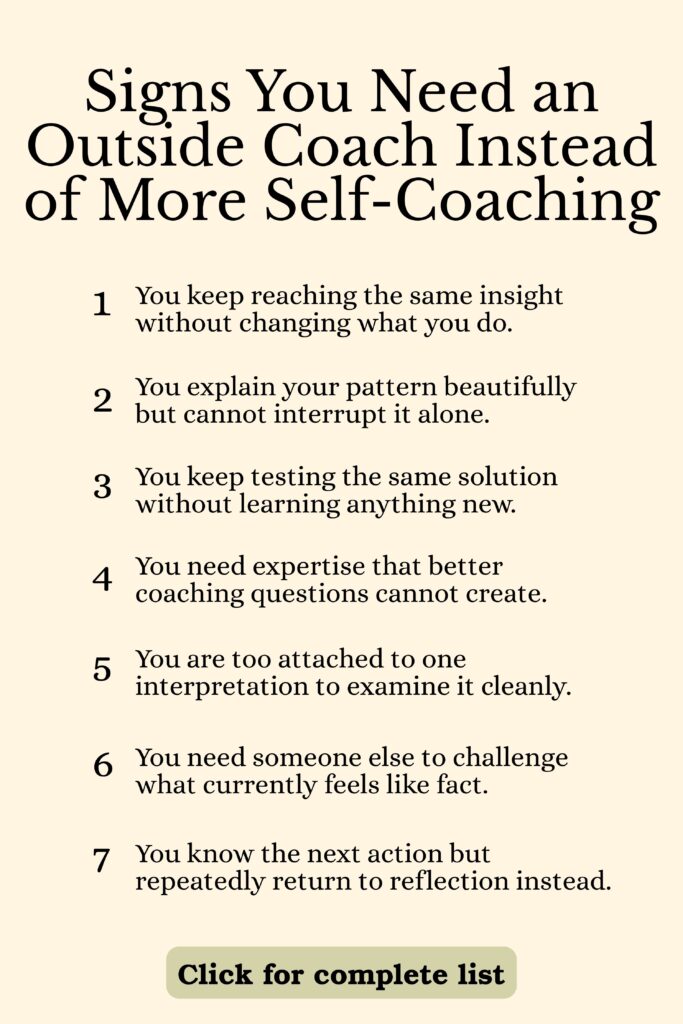
- You keep reaching the same insight without changing your behavior.
- You have tried essentially the same solution several times and are not learning anything new from the result.
- You can explain your behavior beautifully but still cannot interrupt it.
- You need expertise rather than coaching. If you do not understand tax, advertising, contracts, or a technical system, better self-coaching questions will not magically create that knowledge.
- The decision is so closely tied to your identity that you cannot examine it cleanly.
- You need someone to challenge an assumption you currently experience as a fact.
Pricing gives you a good example.
You may know that you habitually discount your package when a prospect hesitates. You may have coached yourself around confidence, value, money beliefs, and fear of rejection.
If you still lower the price every time, another coach can work with the behavior you keep rationalizing from the inside.
Knowing when to ask for outside perspective is not evidence that self-coaching failed. It is good coaching judgment.
After all, you would not expect your clients to solve every problem alone. You do not need to set that standard for yourself either.
SEE ALSO: If you’re a coach looking to streamline your administrative tasks and save time, check out our Coaching Administration Software. It’s a simple, effective solution designed to help you focus less on paperwork and more on what matters—coaching your clients. From scheduling to client management, our software gives you the tools to run your business efficiently. Ready to reclaim your time and boost productivity? Click or tap here.
How Do You Run a Monthly “Leaky Gutters” Review?
A monthly “leaky gutters” review helps you catch the gap between what you teach, what you intend, and what you are actually doing before that gap becomes normal.
Put 30 minutes on your calendar once a month and answer five questions:
- What am I asking clients to do that I am currently avoiding myself?
- What business decision have I postponed this month?
- Where am I gathering more information when I already have enough to act?
- What result has not moved, and what have I actually done to move it?
- What is the next observable action?
The fourth question is particularly important.
Suppose you wanted more clients this month and nothing changed.
Do not immediately write, “Marketing isn’t working.”
Look at what happened.
SEE ALSO: If you’re a coach looking to streamline your administrative tasks and save time, check out our Coaching Administration Software. It’s a simple, effective solution designed to help you focus less on paperwork and more on what matters—coaching your clients. From scheduling to client management, our software gives you the tools to run your business efficiently. Ready to reclaim your time and boost productivity? Click or tap here.
Perhaps you posted 12 times on social media but never asked anyone to book. Perhaps 200 people downloaded a free resource but there was no next step. Perhaps four people inquired and nobody received a follow-up. Perhaps discovery calls were plentiful but your offer was unclear.
Each situation is a different gutter.
If the problem is follow-up, work on follow-up.
If the problem is visibility, work on visibility.
If the problem is conversion, work on conversion.
If the problem is an offer people do not understand, work on the offer.
SEE ALSO: If you’re a coach looking to streamline your administrative tasks and save time, check out our Coaching Administration Software. It’s a simple, effective solution designed to help you focus less on paperwork and more on what matters—coaching your clients. From scheduling to client management, our software gives you the tools to run your business efficiently. Ready to reclaim your time and boost productivity? Click or tap here.
This is the same reason it helps to think about your coaching business as a connected journey rather than a collection of isolated activities. How to Master Funnels as a Coach explores that client journey in more detail.
End your monthly review with one commitment, not 17 improvements.
Then put that commitment somewhere you will see it.
That is maintenance.
You are no longer waiting until water is pouring through the ceiling to remember the gutter.
What Does “Walking Your Talk” Look Like as a Coach?
I have podcasts that I listen to, people I speak with, and I continue to coach myself as well as having my own coach to make sure my gutters are shinny and fully functional and I encourage you to do the same. If you are feeling unconfident, you can fix it. If you don’t know what step to take next in your business, you can fix it. If you need more clarity, you can fix it. You know you have all the resources you need AND you know how to unlock them or have them unlocked.
SEE ALSO: If you’re a coach looking to streamline your administrative tasks and save time, check out our Coaching Administration Software. It’s a simple, effective solution designed to help you focus less on paperwork and more on what matters—coaching your clients. From scheduling to client management, our software gives you the tools to run your business efficiently. Ready to reclaim your time and boost productivity? Click or tap here.
Where LCH Core Fits
LCH Core fits this process when your self-coaching identifies a gap that needs a system, not another round of thinking.
For example, you might realize that your coaching itself is strong but your client experience is scattered. Client profiles, notes, and intake forms can keep client information together. A Welcome Package can organize the welcome letter, coaching agreement with electronic signature, and forms that need to be handled when a client begins.
You might discover that follow-through is the weak point in your coaching process. Journals, worksheets, goals, action items, and resources can make the work between sessions more concrete. The Progress Stream can then help you review client activity over time rather than treating each session as an isolated conversation. The guide to using worksheets and forms with coaching clients shows how these can be assigned and reviewed.
Or your leaky gutter may be on the business side. You may have decided to package your coaching more clearly, make it easier for prospects to book, or create additional ways for people to experience your expertise. LCH Core supports coaching packages and billing, a Public Booking Page, lead magnets, and courses and digital products through a Public Store.
The important order is still the same: diagnose the gutter first.
Do not add a tool because you hope it will tell you what your business needs. Work out what is not working, decide what the better process should look like, and then use the appropriate tool to make that process easier to repeat.
SEE ALSO: If you’re a coach looking to streamline your administrative tasks and save time, check out our Coaching Administration Software. It’s a simple, effective solution designed to help you focus less on paperwork and more on what matters—coaching your clients. From scheduling to client management, our software gives you the tools to run your business efficiently. Ready to reclaim your time and boost productivity? Click or tap here.
If you want to see how those pieces connect, the LCH Core client-journey guide walks through the wider workflow. You can also review the full LCH Core coaching software when you want to see how the different parts fit together.
Frequently Asked Questions About Self-Coaching for Coaches
What is self-coaching?
Self-coaching is the deliberate use of coaching questions, frameworks, reflection, and accountability on your own goals, decisions, beliefs, and behavior. For a professional coach, it means temporarily treating your own situation as the coaching subject rather than assuming that knowing the coaching process means you are already applying it to yourself.
Can a life coach coach themselves effectively?
Yes, a life coach can use self-coaching effectively for many goals, decisions, habits, and business challenges. It works particularly well when you can create enough distance to examine evidence, question your assumptions, generate alternatives, and commit to a specific action.
How do you self-coach using the GROW model?
Use GROW by defining your Goal, examining your current Reality, generating Options, and deciding what you Will do. The final stage matters because the process should finish with a clear commitment rather than insight alone.
What questions should coaches ask themselves when they feel stuck?
Start by asking what outcome you want, what is actually happening, what evidence supports your interpretation, what you would notice if a client described the same situation, what options you have not tested, and what action you are avoiding. These questions move the conversation from a vague feeling of being stuck toward something you can examine and change.
How often should a coach practice self-coaching?
A coach can self-coach whenever a meaningful decision, recurring pattern, or gap between intention and behavior needs attention. A short monthly review is also useful because it catches neglected issues before you become accustomed to them.
SEE ALSO: If you’re a coach looking to streamline your administrative tasks and save time, check out our Coaching Administration Software. It’s a simple, effective solution designed to help you focus less on paperwork and more on what matters—coaching your clients. From scheduling to client management, our software gives you the tools to run your business efficiently. Ready to reclaim your time and boost productivity? Click or tap here.
When should a coach hire their own coach instead of self-coaching?
A coach should seek outside coaching when they repeatedly reach the same insight without changing the pattern, cannot get sufficient distance from an issue, or need another person to challenge assumptions they cannot see themselves. If the problem requires specialist knowledge rather than coaching, the better choice may be a mentor, consultant, accountant, lawyer, clinician, or another appropriate professional.
Can self-coaching help you grow a coaching business?
Yes, self-coaching can help you make clearer decisions about your coaching business when it is tied to observable behavior and business evidence. It can be particularly useful for examining confidence, niche, pricing, visibility, offers, follow-through, boundaries, and the gap between the business you say you want and the actions you are currently taking.
I would love to hear from you. Comment below on how you have used your skills to coach you.
Sources
Performance Consultants. “The GROW Model: A Complete Guide to Goals, Reality, Options and Will.” Performance Consultants, https://www.performanceconsultants.com/resources/the-grow-model/. Accessed 21 Sept. 2026.
Pronin, Emily, Daniel Y. Lin, and Lee Ross. “The Bias Blind Spot: Perceptions of Bias in Self Versus Others.” Personality and Social Psychology Bulletin, vol. 28, no. 3, 2002, pp. 369–381. SAGE Publications, https://doi.org/10.1177/0146167202286008.

Read this next

How to Set Your Life Coaching Fees
Learn the art of setting the right price for your coaching practice from a sales pro
Read More
5 Tricks to Combine Social Media and Life Coaching Business Successfully
These five social media tips will help you propel your coaching business to the next level
Read More
How Online Dating Teaches You to Run a Business
Online dating and running a business have more in common than you would think.
Read More