







How to Scale a Coaching Business (Four Killer Strategies)

What Does Scaling a Coaching Business Actually Mean?
So, you have taken the risk, started a business as a coach and you are profitable.
- You have developed the right systems and processes to deliver consistent and reliable results to your customers.
- You have survived the first years after countless hours of doing everything from accounting to IT to customer service and operations.
- You are exhausted, but you love what you have built and dream of expanding it to reach more people. You plan to scale, yet there are not possibly enough hours in the day for you to run your business yourself at multiple locations.
- You may be working 80, 90 + hours a week and simply don’t have time for more.
Don’t worry, you are not alone, this is common for entrepreneurs looking to scale. And more importantly, there are ways to survive or even thrive through your business growth.
Key Takeaways
- Scale the constraint, not the whole business. Find whether demand, delivery, operations, or owner capacity is limiting growth before adding people, software, or offers.
- Build repeatable delivery before adding coaches. Standardize onboarding, records, between-session work, progress reviews, and handoffs while leaving room for professional coaching judgment.
- Run the math before expanding. Measure utilization, revenue per client, admin hours, delivery hours, and contribution margin so growth adds useful capacity rather than hidden workload.
- Use leverage when one-to-one hours are the bottleneck. Move repeatable teaching into groups, courses, worksheets, or digital products while keeping high-judgment coaching personal.
- Measure quality as you grow. Track client progress, renewals, service consistency, founder dependency, and financial performance so more revenue does not quietly weaken the client experience.
How Do You Scale a Coaching Business?
You scale a coaching business by increasing profitable capacity without requiring your own working hours to rise at the same rate. Start by identifying what currently limits growth: not enough qualified demand, too little coaching capacity, inefficient operations, or too many decisions that still depend on you.
Then choose the scaling move that addresses that constraint. If you have empty coaching slots, more delivery capacity will not help. If your calendar is booked out, adding another marketing channel may simply create a longer waiting list. If administration consumes hours every week, improving the operating system may create capacity before you need another coach.
Scaling is working when the business can serve more clients or generate more revenue without service quality, margins, and your available time deteriorating. That means watching the economics and the client experience together.
What Can Go Wrong When You Scale a Coaching Business?
It is likely that no one will perfectly fit the mold of where you are now and where you want to go from day one, yet they may have the potential to be a perfect fit. That is where coaching comes in!
There are several risks to scaling a business: having the right capital reserves to effectively scale as well as hiring and training the right team. As a business coach, I have witnessed failures in both areas.
SEE ALSO: If you’re a coach looking to streamline your administrative tasks and save time, check out our Coaching Administration Software. It’s a simple, effective solution designed to help you focus less on paperwork and more on what matters—coaching your clients. From scheduling to client management, our software gives you the tools to run your business efficiently. Ready to reclaim your time and boost productivity? Click or tap here.
Business owners who had a very successful model yet did not anticipate the costs of doing business in a new area, during different economic times, who struggled to gain a firm footing and, in many cases, lost control of their entire enterprise. Also, all too common at the scaling stage, is hiring and training a team that does not understand or share your entrepreneurial values or vision.
Having even the most talented team in place is not a recipe for success, if they do not go in the same direction as the rest of your enterprise. Quite the opposite… it is chaos. At this point, you also risk diluting your brand image if you hire an ineffective team, which will stop your business growth dead in its tracks.
Besides selecting a team that shares your vision, make sure they are coachable.
It is likely that no one will perfectly fit the mold of where you are now and where you want to go from day one, yet they may have the potential to be a perfect fit. That is where coaching comes in!
What Is Actually Constraining Your Coaching Business?
Your first scaling move should solve the part of your coaching business that is currently limiting everything else.
This follows the logic behind Eliyahu Goldratt’s Theory of Constraints. ASQ describes the method as finding the weakest link in a system, getting more from that constraint, aligning the rest of the system around it, adding capacity where necessary, and then identifying the next constraint.
SEE ALSO: If you’re a coach looking to streamline your administrative tasks and save time, check out our Coaching Administration Software. It’s a simple, effective solution designed to help you focus less on paperwork and more on what matters—coaching your clients. From scheduling to client management, our software gives you the tools to run your business efficiently. Ready to reclaim your time and boost productivity? Click or tap here.
For a coaching business, the constraint usually sits in one of four places:
- Demand: You have coaching capacity, but not enough qualified prospects are reaching you, booking calls, or becoming clients.
- Delivery: You have more demand than available coaching hours.
- Operations: Scheduling, billing, onboarding, notes, forms, follow-up, or other administration consumes capacity that should be available for coaching or growth.
- Owner capacity: Clients, team members, and routine decisions continually come back to you, so the business cannot move faster than you do.
The distinction matters.
Suppose you coach three days a week and still have five open session slots. Hiring another coach creates more capacity you cannot currently sell. Your constraint is more likely to be demand or conversion.
Now imagine your calendar is full, but you spend Friday afternoon chasing forms, checking payments, booking appointments, and finding client notes. Hiring another coach may increase the administrative burden. Your operations constraint deserves attention first.
Or perhaps you already have an associate coach, but every unusual client question, scheduling exception, refund decision, and program change still requires your approval. You have delegated tasks without removing yourself as the decision bottleneck.
Run a simple constraint check before spending money:
SEE ALSO: If you’re a coach looking to streamline your administrative tasks and save time, check out our Coaching Administration Software. It’s a simple, effective solution designed to help you focus less on paperwork and more on what matters—coaching your clients. From scheduling to client management, our software gives you the tools to run your business efficiently. Ready to reclaim your time and boost productivity? Click or tap here.
If I created 20% more capacity here tomorrow, could the rest of the business use it profitably?
If the answer is no, you probably have the wrong constraint.
Demand constraints also need a complete client-getting path, not simply more exposure. How to Master Funnels as a Coach explains how attraction, nurturing, conversion, and retention connect rather than operating as isolated marketing activities.
Once you know the constraint, tools become much easier to judge. If operations are consuming your capacity, LCH Core can bring client profiles, notes, intake forms, scheduling, payments, and onboarding into one coaching system. If visibility is the issue, a free life coach directory listing gives potential clients another place to find you, while a Public Booking Page gives interested prospects a direct way to book.
The tool comes after the diagnosis. Fix the constraint that is actually stopping growth.
Strategy 1: Who Should You Hire as Your Coaching Business Grows?
As you know, recruiting is more than hiring the most experienced individual. You need someone, especially at management levels, who understands and embraces your brand.
SEE ALSO: If you’re a coach looking to streamline your administrative tasks and save time, check out our Coaching Administration Software. It’s a simple, effective solution designed to help you focus less on paperwork and more on what matters—coaching your clients. From scheduling to client management, our software gives you the tools to run your business efficiently. Ready to reclaim your time and boost productivity? Click or tap here.
The process of building your brand starts long before the scaling to multiple locations stage. You must communicate a consistent and compelling message from day 1 that tells your story and resonates with consumers.
When your company values, culture and mission are established, it is more manageable to hire the right person who gets it.
Ideally, your brand image is so strong in the community, that potential hires are attracted to you because of your IMAGE not just for a job.
What Should You Standardize Before Another Coach Delivers Your Method?
Standardize the repeatable client experience before you ask another coach to deliver under your brand.
That does not mean scripting every question or forcing every coach into the same conversation. Coaching requires judgment. What you need to standardize are the handoffs, expectations, records, and recurring pieces surrounding the coaching itself.
Build a simple Coaching Delivery Blueprint that answers five questions.
SEE ALSO: If you’re a coach looking to streamline your administrative tasks and save time, check out our Coaching Administration Software. It’s a simple, effective solution designed to help you focus less on paperwork and more on what matters—coaching your clients. From scheduling to client management, our software gives you the tools to run your business efficiently. Ready to reclaim your time and boost productivity? Click or tap here.
1. What happens when someone becomes a client?
Define what they receive, which agreement applies, what information you collect, and what needs to be completed before the first session.
2. What should be available before every session?
Decide what the coach needs to know before the call. That may include previous notes, current goals, unfinished action items, or a short client reflection.
3. What gets recorded after a session?
Specify which information belongs in the client record, what remains private, what is shared with the client, and what follow-up actions need to be assigned.
4. What happens between sessions?
If your method regularly uses worksheets, journal prompts, goals, resources, or action items, decide when those tools are used and what follow-up is expected.
5. How do you review progress?
Define points in the engagement where coach and client look back at goals, progress, completed actions, and what needs to happen next.
Consider two clients who buy the same package from the same coaching company.
SEE ALSO: If you’re a coach looking to streamline your administrative tasks and save time, check out our Coaching Administration Software. It’s a simple, effective solution designed to help you focus less on paperwork and more on what matters—coaching your clients. From scheduling to client management, our software gives you the tools to run your business efficiently. Ready to reclaim your time and boost productivity? Click or tap here.
One receives intake questions before starting, leaves each session with clear action items, and periodically reviews progress. The other receives none of those things because their coach has developed a completely different administrative routine.
That is not healthy personalization. It is inconsistent delivery.
Your blueprint should define the minimum standard, while leaving each coach room to listen, challenge, question, and coach in their own professional voice.
This also makes hiring easier. Instead of asking a new coach to somehow absorb everything in your head, you can show them how the client journey works and identify exactly where their judgment begins.
Once that blueprint exists, LCH Core can support the repeatable pieces. A reusable Welcome Package can contain the welcome letter, coaching agreement with electronic signature, and forms. Client profiles, notes, journals, worksheets, goals, action items, and resources can then keep the shared process visible without scripting the actual coaching.
The goal is not to make every coach identical. It is to make sure clients are not receiving a different standard of business simply because a different person is coaching them.
SEE ALSO: If you’re a coach looking to streamline your administrative tasks and save time, check out our Coaching Administration Software. It’s a simple, effective solution designed to help you focus less on paperwork and more on what matters—coaching your clients. From scheduling to client management, our software gives you the tools to run your business efficiently. Ready to reclaim your time and boost productivity? Click or tap here.
Strategy 2: Which Coaching Systems Need to Work Before You Scale?
Also, examine your systems and processes. They worked great to get you where you are now. Yet will your processes and systems effectively scale or even work at a new location? Examine everything from technology to accounting/finances and especially customer service and operations.
Additionally, remember to create appropriate incentives for hires. Management hires who have performance based financial incentives often are most effective. However, be careful on what you set as an incentive. You get what you reward often in unexpected ways.
For instance, short term sales incentives may look great, yet do they lead to tactics that burn your reputation in the long run? Make sure your performance metrics link to your company mission and values.
As a small business coach, I have witnessed far too many times executives that are puzzled by why employees do not share their company mission and values and in many cases are unaware of them all together. Besides posting your mission statement in the break room bulletin board, live it, embrace it, and incentivize it.
Be careful on what you set as an incentive. You get what you reward often in unexpected ways.
What Does the Math Say About Whether You Are Ready to Scale?
You are financially ready to scale when the numbers show that additional capacity can create enough profitable revenue to justify its cost.
Revenue alone does not tell you that.
SEE ALSO: If you’re a coach looking to streamline your administrative tasks and save time, check out our Coaching Administration Software. It’s a simple, effective solution designed to help you focus less on paperwork and more on what matters—coaching your clients. From scheduling to client management, our software gives you the tools to run your business efficiently. Ready to reclaim your time and boost productivity? Click or tap here.
A $1,200 coaching package may sound strong until you calculate everything required to deliver it. If the package includes six one-hour sessions, two total hours of preparation and follow-up, and another hour of onboarding and administration, you are delivering roughly nine hours of work.
That puts revenue at about $133 per delivery hour before payment fees, software, marketing, contractor costs, taxes, or other expenses.
You do not need complicated financial modeling to make better scaling decisions. Start with five numbers.
Utilization rate
Paid coaching hours ÷ coaching hours available.
If you have 20 session hours available each week but consistently sell 12, your utilization is 60%. More coaching capacity is unlikely to be the first thing you need.
Revenue per delivery hour
Package revenue ÷ total hours required to serve the client.
SEE ALSO: If you’re a coach looking to streamline your administrative tasks and save time, check out our Coaching Administration Software. It’s a simple, effective solution designed to help you focus less on paperwork and more on what matters—coaching your clients. From scheduling to client management, our software gives you the tools to run your business efficiently. Ready to reclaim your time and boost productivity? Click or tap here.
Include sessions, preparation, follow-up, onboarding, and recurring administration. This exposes packages that look profitable only because invisible work has been ignored.
Admin load per active client
Monthly client administration hours ÷ number of active clients.
If administration rises almost one-for-one with each new client, the current process is not scaling.
Contribution margin
Revenue from the offer minus the direct costs required to deliver it.
This becomes especially important when you hire associate coaches, facilitators, or contractors. A larger revenue number is not necessarily a stronger business if most of the additional revenue disappears into delivery costs.
Owner dependency
Count how many routine decisions in a normal week cannot happen without you.
SEE ALSO: If you’re a coach looking to streamline your administrative tasks and save time, check out our Coaching Administration Software. It’s a simple, effective solution designed to help you focus less on paperwork and more on what matters—coaching your clients. From scheduling to client management, our software gives you the tools to run your business efficiently. Ready to reclaim your time and boost productivity? Click or tap here.
This is not a traditional accounting metric, but it exposes a serious scaling problem. A business with a team can still be completely dependent on one person.
Run the numbers before assuming the answer is “hire.”
Sometimes removing five hours of weekly administration creates more profitable capacity than adding another coach. Sometimes the calendar truly is the bottleneck, and another coach is exactly what is needed. Sometimes the answer is changing the delivery model.
The same logic applies to the value of the clients you already have. Looking at client lifetime value can reveal whether stronger retention and well-timed next offers would create more profitable growth than continually acquiring new clients.
Scaling decisions get much clearer when you can say exactly which number you expect the investment to change.
Strategy 3: How Do You Lead Your Team Through Growth?
Scaling a business is an exciting and nerve-wracking pursuit. Yet with a properly selected team that embraces your mission and is incentivized properly; anything is possible. Remember to recognize, reward and Coach your team. Coaching is important, not just for you as the leader, yet for your employees.
SEE ALSO: If you’re a coach looking to streamline your administrative tasks and save time, check out our Coaching Administration Software. It’s a simple, effective solution designed to help you focus less on paperwork and more on what matters—coaching your clients. From scheduling to client management, our software gives you the tools to run your business efficiently. Ready to reclaim your time and boost productivity? Click or tap here.
Do you use a coaching approach when you talk with your employees, or do you skip right to the problem-solving? Employees are full of ideas and potential and the right management/leadership style really brings the best out in them. The key is to bring out the best in your employees in a way that it may be applied to your organization and broader mission!
How Can You Scale Beyond One-to-One Coaching?
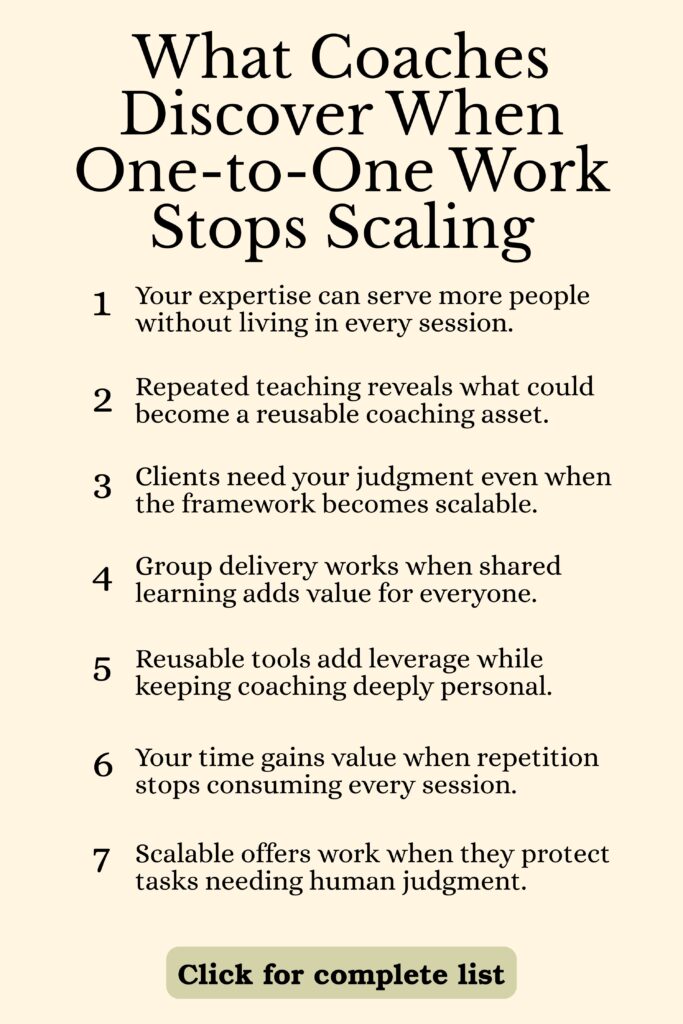
You can scale beyond one-to-one coaching by separating the parts of your method that require your live judgment from the parts you repeatedly teach, explain, demonstrate, or assign.
One-to-one coaching is valuable precisely because it is responsive. A client brings a complicated decision, blind spot, conflict, or goal into the room, and you adapt.
That does not mean every part of your delivery needs to happen privately and live.
Imagine a career coach who spends part of sessions two and three explaining the same interview-preparation framework to nearly every client. The individual application of that framework may still require coaching, but the basic teaching does not need to be recreated from scratch every week.
That gives you a simple delivery leverage ladder.
SEE ALSO: If you’re a coach looking to streamline your administrative tasks and save time, check out our Coaching Administration Software. It’s a simple, effective solution designed to help you focus less on paperwork and more on what matters—coaching your clients. From scheduling to client management, our software gives you the tools to run your business efficiently. Ready to reclaim your time and boost productivity? Click or tap here.
Keep high-judgment work one-to-one.
Use private coaching where the value comes from listening, questioning, interpreting, challenging, or adapting to the individual.
Move shared learning into groups when interaction adds value.
If multiple clients need the same teaching and could benefit from hearing one another’s questions, a small group or structured program can increase delivery capacity without stripping away live interaction.
Turn repeatable teaching into reusable material.
A framework you explain repeatedly might become a worksheet, resource, mini-course, recorded lesson, or digital product.
Combine both in a hybrid offer.
Clients could complete structured teaching or worksheets independently, then use coaching sessions for the decisions and obstacles that genuinely require you.
This is already a normal pattern across the profession. According to the 2025 ICF Global Coaching Study, 60% of coach practitioners provide training, 57% consulting, 55% facilitation, and 49% mentoring alongside coaching.
The point is not to manufacture products because “passive income” sounds attractive. Start with repetition.
SEE ALSO: If you’re a coach looking to streamline your administrative tasks and save time, check out our Coaching Administration Software. It’s a simple, effective solution designed to help you focus less on paperwork and more on what matters—coaching your clients. From scheduling to client management, our software gives you the tools to run your business efficiently. Ready to reclaim your time and boost productivity? Click or tap here.
For two weeks, keep a tally every time you think:
I explain this to nearly every client.
Those repeated explanations are candidates for leverage.
If you decide a course or digital resource belongs in the mix, LCH Core can house courses and digital products in a Public Store. That lets the reusable part of your expertise become a distinct offer while your personal coaching time remains focused on work that benefits from live coaching.
A scalable offer should remove unnecessary repetition without removing the part clients are actually paying you to think about.
What Should You Measure So Growth Does Not Damage the Coaching?
Measure growth across money, client results, delivery consistency, and capacity so a stronger revenue number cannot hide a weaker coaching business.
This follows the logic of Kaplan and Norton’s Balanced Scorecard. Their model combines financial measures with customer, internal-process, and learning-and-growth measures because financial results alone can give an incomplete picture of performance.
SEE ALSO: If you’re a coach looking to streamline your administrative tasks and save time, check out our Coaching Administration Software. It’s a simple, effective solution designed to help you focus less on paperwork and more on what matters—coaching your clients. From scheduling to client management, our software gives you the tools to run your business efficiently. Ready to reclaim your time and boost productivity? Click or tap here.
A coaching business can use the same principle without building a corporate dashboard.
Create a one-page Scaling Scorecard with four areas.
Financial
Track revenue, contribution margin, average revenue per client, and recurring or renewal revenue.
These numbers tell you whether growth is financially useful rather than merely bigger.
Client
Track renewals, referrals, progress reviews, early exits, and recurring signs that clients are completing the work they agreed to do.
You are looking for changes in the client experience as volume increases.
SEE ALSO: If you’re a coach looking to streamline your administrative tasks and save time, check out our Coaching Administration Software. It’s a simple, effective solution designed to help you focus less on paperwork and more on what matters—coaching your clients. From scheduling to client management, our software gives you the tools to run your business efficiently. Ready to reclaim your time and boost productivity? Click or tap here.
Delivery
Track incomplete onboarding, missed follow-ups, overdue notes, delayed client responses, and inconsistent use of your core delivery process.
These are often the first signs that a business has added volume faster than its systems can handle.
Capacity
Track coach utilization, admin hours, available session capacity, and routine decisions that still require you.
These numbers expose whether the business is becoming less dependent on you or simply giving you more people and processes to supervise.
This becomes especially important when incentives are involved.
Suppose an associate coach receives a bonus only for package sales. You may get exactly what you rewarded: more packages. But that metric alone says nothing about whether the clients were a good fit, stayed engaged, renewed, or completed the work.
SEE ALSO: If you’re a coach looking to streamline your administrative tasks and save time, check out our Coaching Administration Software. It’s a simple, effective solution designed to help you focus less on paperwork and more on what matters—coaching your clients. From scheduling to client management, our software gives you the tools to run your business efficiently. Ready to reclaim your time and boost productivity? Click or tap here.
A better scorecard forces you to look at the second-order effect.
Did sales rise while early exits also rose?
Did the team add clients while onboarding delays doubled?
Did revenue increase while your own working hours increased even faster?
Growth should improve the business as a system. Your scorecard makes deterioration visible before the headline revenue number convinces you everything is working.
Strategy 4: How Far Should You Scale Your Coaching Business?

Finally, yet not by any means least important, look at your quality of life and work-life balance.
SEE ALSO: If you’re a coach looking to streamline your administrative tasks and save time, check out our Coaching Administration Software. It’s a simple, effective solution designed to help you focus less on paperwork and more on what matters—coaching your clients. From scheduling to client management, our software gives you the tools to run your business efficiently. Ready to reclaim your time and boost productivity? Click or tap here.
- Where do you hope to be personally?
- Do you get enjoyment out of your business or is it constant stress, worry and chaos?
More than likely, it is a combination of both. Yet, it may be a good idea to examine the tradeoffs.
- What level can your business scale to is not the only question I ask?
- What level should your business scale to for your own personal achievement and well-being?
Also, look at your legacy. There are tradeoffs to consider between current hustle and bustle, future retirement and what you may leave for your family. As a business coach, it is not my job to give you the answers, yet instead to ask the right questions to help you discover what is right for you…
Where LCH Core Fits
LCH Core fits scaling when the constraint is the operating system around your coaching, not as a substitute for deciding what should be scaled.
If administration is consuming capacity, client management can keep client profiles, notes, and intake forms together. A Public Booking Page can reduce scheduling back-and-forth, while payments, coaching packages, and billing keep the commercial side of client delivery connected.
If repeatability is the challenge, a Welcome Package can create a consistent starting point with a welcome letter, coaching agreement with electronic signature, and forms. Reusable journals, worksheets, goals, action items, and resources can support consistent between-session work without making the coaching conversation formulaic.
If keeping quality visible becomes harder as the client roster grows, the Progress Stream provides a view of client activity and the Engagement Report can help you review engagement. These are operational signals to inform your judgment, not substitutes for talking with the client.
SEE ALSO: If you’re a coach looking to streamline your administrative tasks and save time, check out our Coaching Administration Software. It’s a simple, effective solution designed to help you focus less on paperwork and more on what matters—coaching your clients. From scheduling to client management, our software gives you the tools to run your business efficiently. Ready to reclaim your time and boost productivity? Click or tap here.
If one-to-one delivery is the constraint, courses and digital products can be sold through a Public Store. That supports the leverage model described above, where repeatable teaching is separated from the work that deserves live coaching time.
A platform cannot tell you whether your business needs more demand, more delivery capacity, better economics, or less owner dependency. Once you have made that diagnosis, LCH Core can help you run the client management, booking, billing, onboarding, delivery, progress-tracking, and scalable-offer systems behind the decision. Coaches comparing that broader role with standalone tools may also find this guide to coaching software for life coaches useful.
Frequently Asked Questions About Scaling a Coaching Business
How do you know when your coaching business is ready to scale?
Your coaching business is ready to scale when demand, delivery, and economics show that additional capacity has somewhere profitable to go. Check utilization, margins, client demand, admin load, and owner dependency before adding people or offers.
Should I hire another coach or improve my systems first?
Improve your systems first when administration and inconsistent processes are limiting capacity. Hire another coach when your delivery process is working reliably, demand is strong, and coaching hours themselves have become the constraint.
How can a life coach scale beyond one-to-one coaching?
A life coach can scale beyond one-to-one work by moving repeatable teaching into groups, courses, worksheets, resources, or digital products. Keep individual coaching for problems that benefit from live judgment, questioning, and personalization.
How many coaching clients can one coach realistically manage?
A coach can manage only as many clients as fit inside their true delivery capacity, not simply the visible session calendar. Count preparation, notes, follow-up, onboarding, rescheduling, and administration as well as coaching hours.
SEE ALSO: If you’re a coach looking to streamline your administrative tasks and save time, check out our Coaching Administration Software. It’s a simple, effective solution designed to help you focus less on paperwork and more on what matters—coaching your clients. From scheduling to client management, our software gives you the tools to run your business efficiently. Ready to reclaim your time and boost productivity? Click or tap here.
How do you maintain coaching quality when hiring associate coaches?
Maintain quality by defining a minimum Coaching Delivery Blueprint before associate coaches begin serving clients. Standardize onboarding, documentation, handoffs, follow-up, and progress reviews while preserving professional freedom inside the coaching conversation.
What numbers should you track while scaling a coaching business?
Track utilization, revenue per delivery hour, contribution margin, admin load, renewals, client progress, delivery consistency, and owner dependency. Together they show whether growth is creating real capacity or simply creating more work.
Can coaching software help scale a coaching business?
Coaching software can help scale the repeatable operational parts of a coaching business. It is most useful when scheduling, client records, onboarding, billing, progress tracking, or reusable delivery tools are consuming capacity that could otherwise go toward coaching or growth.

You have made it this far with your coaching business. You are capable of achieving even more! There is no limit.
Sources
Hein, Kevin. “Continuous Improvement Using Theory of Constraints.” World Conference on Quality and Improvement, vol. 52, May 1998, pp. 969-974. American Society for Quality. ASQ source
International Coaching Federation. “2025 ICF Global Coaching Study.” International Coaching Federation, 2025. ICF Global Coaching Study
SEE ALSO: If you’re a coach looking to streamline your administrative tasks and save time, check out our Coaching Administration Software. It’s a simple, effective solution designed to help you focus less on paperwork and more on what matters—coaching your clients. From scheduling to client management, our software gives you the tools to run your business efficiently. Ready to reclaim your time and boost productivity? Click or tap here.
Kaplan, Robert S., and David P. Norton. “The Balanced Scorecard: Measures That Drive Performance.” Harvard Business Review, July-Aug. 2005. Harvard Business Review source
Read this next

Coaching Business Resource: Private Practice Hub
Coaching Business Resource: Private Pracitce Hub
Read More
A Step-By-Step Guide on How to Build A High-Revenue Life Coaching Business
Learn the BEST way to start your life coaching business
Read More
The 3 Questions Every Coach Should Answer Before Building Their Business
Figure out how you are serving your life purpose in order to serve your clients. Ask yourself, “What’s in it for me?”
Read More