







What No One Tells You About Stress When You Become a Life Coach

As a life coach, you spend your days improving the lives of others.
Key Takeaways
- Stress management starts with changing the work itself. Look at workload, emotional demands, schedule design, admin friction, recovery time, and the resources available to you.
- Client progress is not a coach performance score. You are responsible for the quality of the coaching process, while the client remains responsible for choices, follow-through, and action outside the session.
- Recovery between sessions matters. A short Close, Record, Reset routine can help you finish one coaching conversation before entering the next.
- Business stress deserves operational fixes. Repeated scheduling, scattered client information, payment admin, and inconsistent visibility are business-system problems, not personal resilience failures.
- Watch for stress that is becoming persistent or impairing. Ongoing exhaustion, growing cynicism, reduced effectiveness, disrupted sleep, or increasing reliance on substances are signals to seek more support.
How Can Life Coaches Manage Stress?
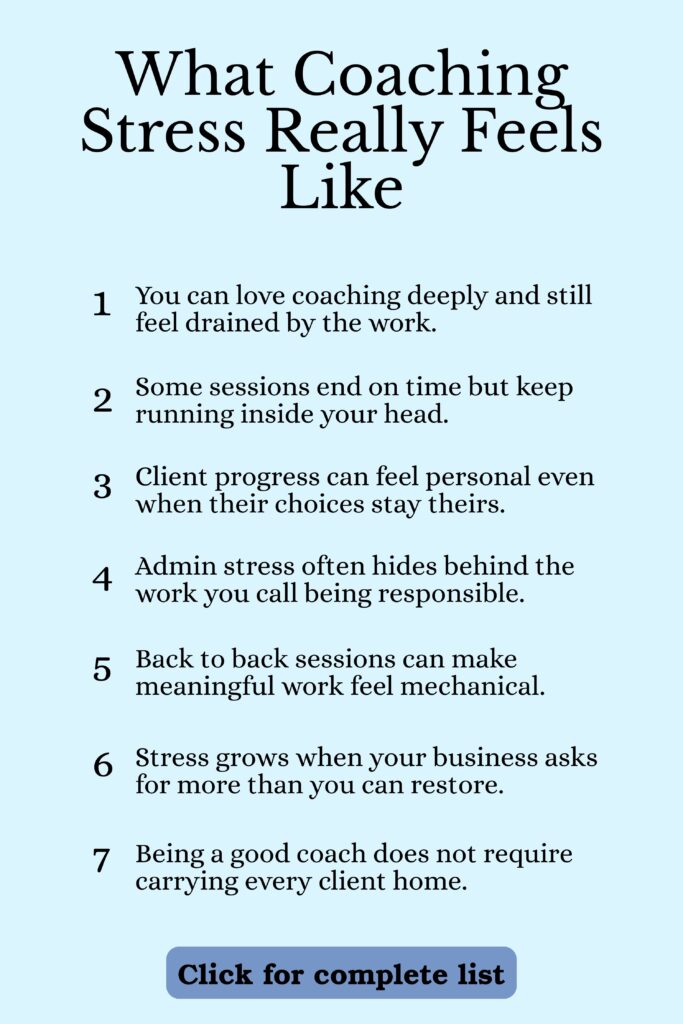
Life coaches can manage stress more effectively by working on both sides of the problem: reducing unnecessary demands and increasing the resources that make those demands manageable. That means looking beyond exercise and relaxation to examine your client load, emotional boundaries, session schedule, business systems, recovery time, and expectations around client progress.
A useful rule is to ask two questions when stress keeps recurring: What is repeatedly draining me, and what could change about the way this work is designed? A breathing exercise can help you settle after a difficult session. It cannot fix six back-to-back clients, an evening spent chasing payments, or a week in which every client record lives somewhere different.
Managing stress as a coach is therefore partly personal recovery and partly business design.
What Causes Stress for Life Coaches?
Becoming a life coach is a great career path if you love helping people. A life coach can help someone manage and succeed in various aspects of their personal and professional lives. One part of being a life coach is helping clients manage stress and various mental health challenges.
However, while you’re working to help their clients manage their own stress, you may find that this role and career path comes with its own stress. There are various sources of stress that you should be aware of.
SEE ALSO: If you’re a coach looking to streamline your administrative tasks and save time, check out our Coaching Administration Software. It’s a simple, effective solution designed to help you focus less on paperwork and more on what matters—coaching your clients. From scheduling to client management, our software gives you the tools to run your business efficiently. Ready to reclaim your time and boost productivity? Click or tap here.
Why Does Coaching Stress Build Up?
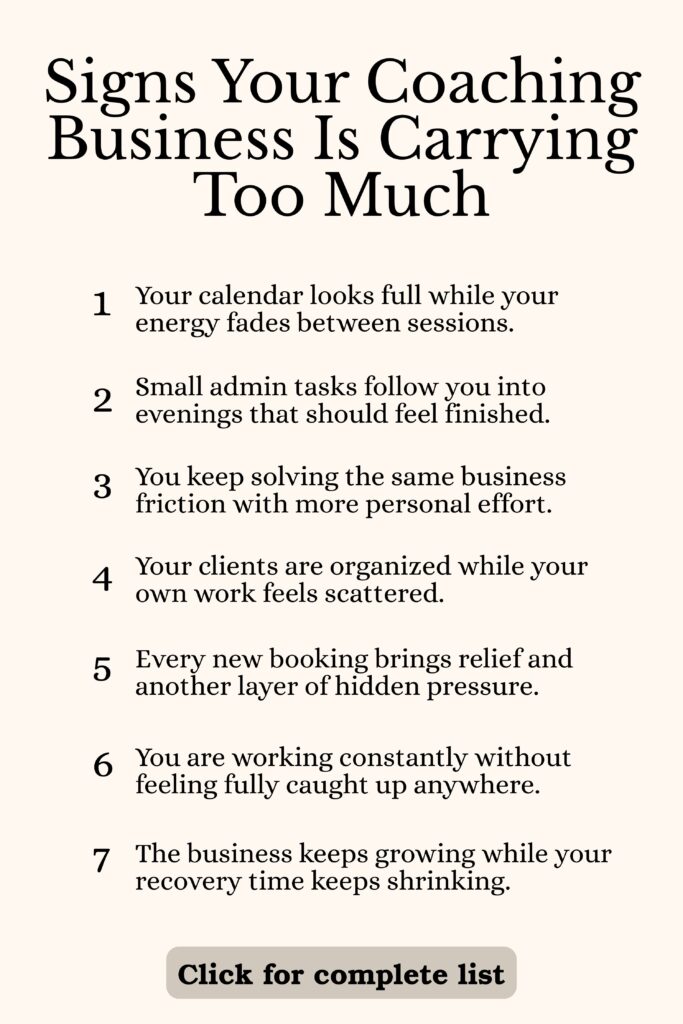
Coaching stress tends to build when the demands of your work repeatedly exceed the resources available to handle them.
The Job Demands-Resources model, commonly called the JD-R model, gives you a useful way to look at this. Job demands are parts of work that require sustained physical, cognitive, or emotional effort. Job resources are the things that help you meet those demands, recover from them, or do the work effectively.
A 2023 review by Arnold Bakker, Evangelia Demerouti, and Ana Sanz-Vergel describes the JD-R framework as a way of understanding how job demands, job resources, burnout, work engagement, and job design interact.
For a coach, demands might include:
- Five emotionally intensive sessions in one day
- A client who repeatedly arrives in crisis
- Worry about whether clients are making progress
- Preparing for sessions while answering prospect emails
- Rescheduling appointments
- Trying to market the business between client calls
- Administrative work that spills into evenings
Resources might include defined working hours, protected gaps between sessions, clear coaching boundaries, peer consultation, reliable client records, predictable business processes, and enough time to recover.
This explains why two coaches can each see six clients in a day and finish in very different states.
SEE ALSO: If you’re a coach looking to streamline your administrative tasks and save time, check out our Coaching Administration Software. It’s a simple, effective solution designed to help you focus less on paperwork and more on what matters—coaching your clients. From scheduling to client management, our software gives you the tools to run your business efficiently. Ready to reclaim your time and boost productivity? Click or tap here.
One coach sees six people consecutively, takes notes from memory at 7 p.m., handles rescheduling between calls, and keeps thinking about a difficult client during dinner. Another sees the same number of clients in defined blocks, finishes notes immediately, protects breaks, and has a clear cutoff at the end of the coaching day.
The number of sessions is identical. The work design is not.
That is why recurring stress deserves more than another coping technique. It deserves a look at the demands your business keeps creating and the resources you have built around them.
Why Is Lack of Client Progress So Stressful?
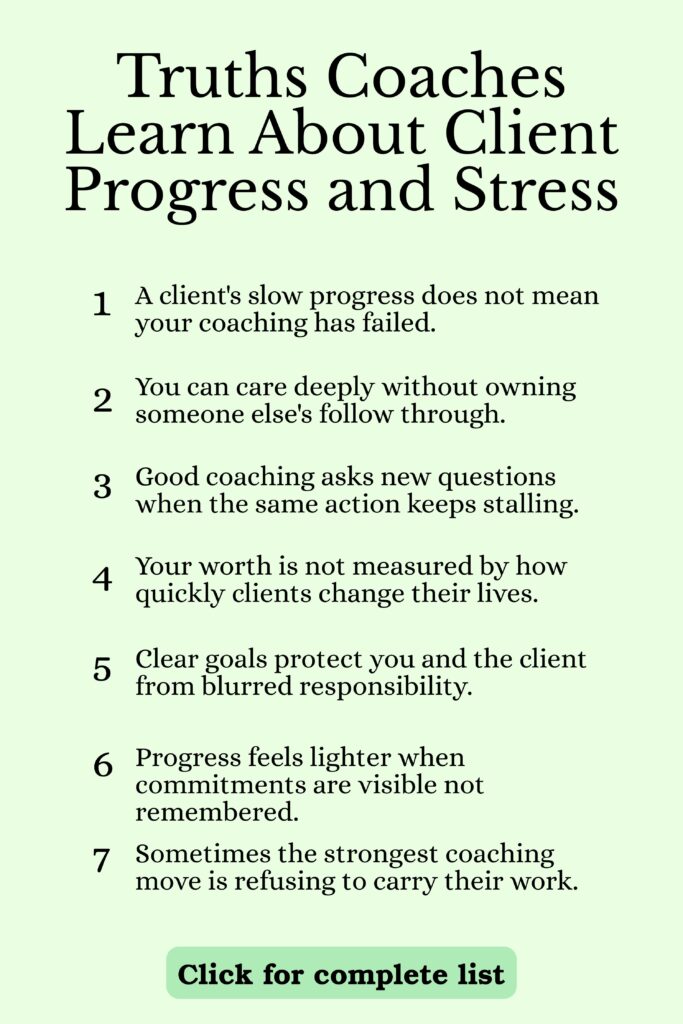
It’s common to be stressed out if you’re putting a lot of effort into your clients and not seeing progress. You work hard to help people succeed. So if they’re not following your advice, or not progressing even though they are, it’s frustrating. That’s why it’s important to separate your mental health and sense of self-worth from your clients’ performance.
What Part of a Client’s Progress Is Actually Yours to Carry?
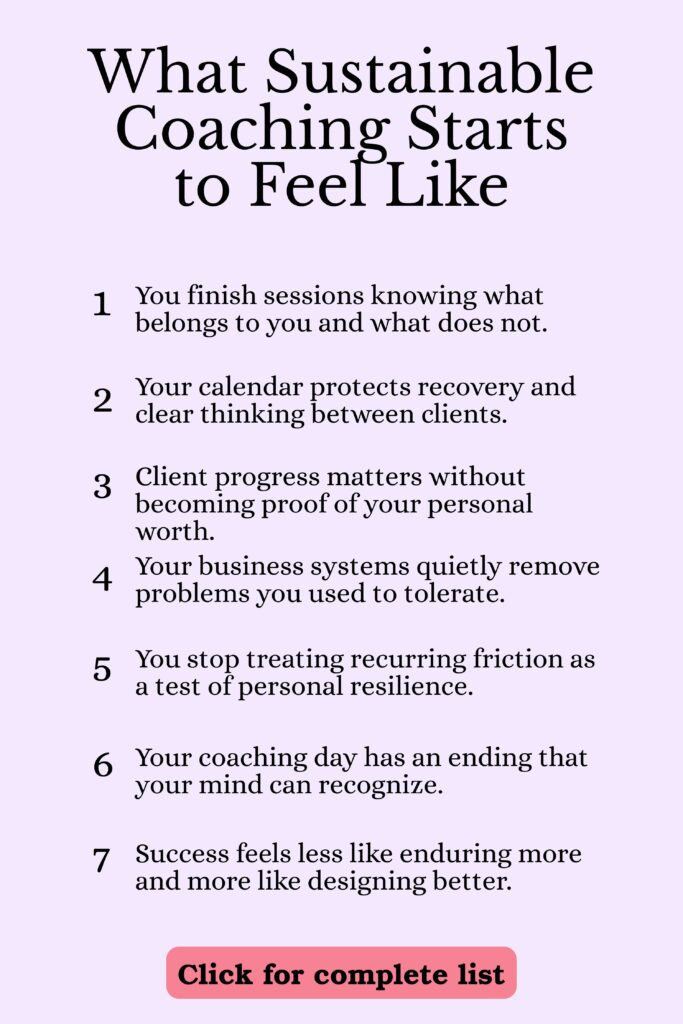
You are responsible for the quality of your coaching process, but you are not responsible for making the client’s decisions or completing their actions for them.
That distinction matters when a client is not progressing.
SEE ALSO: If you’re a coach looking to streamline your administrative tasks and save time, check out our Coaching Administration Software. It’s a simple, effective solution designed to help you focus less on paperwork and more on what matters—coaching your clients. From scheduling to client management, our software gives you the tools to run your business efficiently. Ready to reclaim your time and boost productivity? Click or tap here.
Your side of the work includes preparing well, listening closely, asking useful questions, helping the client clarify goals, challenging assumptions appropriately, agreeing on meaningful next steps, and noticing when the current approach is not producing useful movement.
The client’s side includes deciding what to do, taking action outside the session, telling you when something is not working, and making choices in their own life.
Suppose a client says for three sessions that they are going to have a conversation with their manager, then repeatedly does not do it.
Your job is not to force the conversation to happen. Your job is to become curious about the pattern.
What happens when they imagine starting the conversation? Is the action too large? Are they actually committed to it? Has the coaching uncovered a different problem? Does the goal still matter?
That is useful coaching.
SEE ALSO: If you’re a coach looking to streamline your administrative tasks and save time, check out our Coaching Administration Software. It’s a simple, effective solution designed to help you focus less on paperwork and more on what matters—coaching your clients. From scheduling to client management, our software gives you the tools to run your business efficiently. Ready to reclaim your time and boost productivity? Click or tap here.
Sitting at home wondering whether their lack of follow-through means you failed is not.
It can also help to make responsibilities visible. If you use LCH Core, goals and action items can record what the client actually committed to, while the Progress Stream support guide explains how sessions, notes, and coaching activity can be reviewed together.
That gives you evidence to coach from instead of asking yourself to remember every promise a client has made.
Can Talking About Stress All Day Affect You as a Coach?
Another reason for stress in your job is that you’re constantly discussing stress with your clients. Spending time discussing stress and stress management with clients might cause you to take on some of that stress yourself. If not managed properly, this could make the job much more stressful.
How Do You Stop Carrying One Session Into the Next?
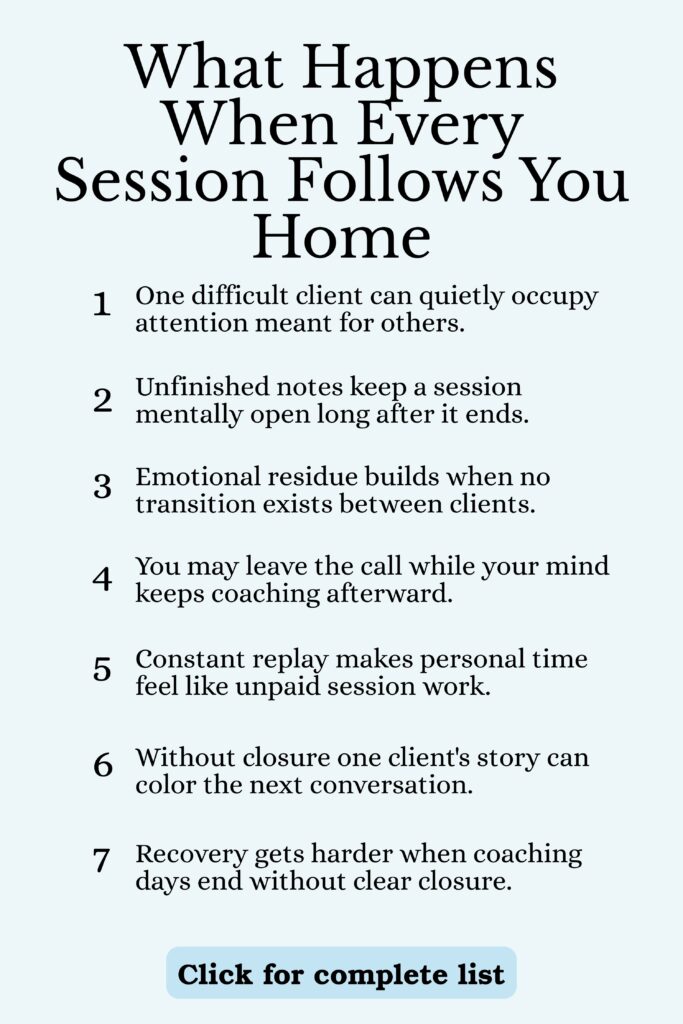
A deliberate transition between clients can help your brain register that one coaching conversation has finished before another begins.
Psychological detachment is the ability to mentally disengage from work when the work period is over. In a 2023 systematic review, Anastasiia Agolli and Brian Holtz examined 159 empirical studies on factors that help or hinder detachment from work. The review describes psychological detachment as an important recovery experience connected with health, well-being, and work performance.
SEE ALSO: If you’re a coach looking to streamline your administrative tasks and save time, check out our Coaching Administration Software. It’s a simple, effective solution designed to help you focus less on paperwork and more on what matters—coaching your clients. From scheduling to client management, our software gives you the tools to run your business efficiently. Ready to reclaim your time and boost productivity? Click or tap here.
For coaches, you do not necessarily need a long ritual. Try Close, Record, Reset.
Close: Identify where the session actually ended.
What did the client decide? What remains unresolved? What belongs to the client now?
A clear ending reduces the temptation to continue coaching them silently in your head.
Record: Capture only what you genuinely need for continuity.
Write the important note. Record the agreed action. Update the relevant goal. Do it while the session is still clear rather than carrying a vague mental reminder into the rest of the day.
SEE ALSO: If you’re a coach looking to streamline your administrative tasks and save time, check out our Coaching Administration Software. It’s a simple, effective solution designed to help you focus less on paperwork and more on what matters—coaching your clients. From scheduling to client management, our software gives you the tools to run your business efficiently. Ready to reclaim your time and boost productivity? Click or tap here.
Reset: Create a short change of state before the next client.
Stand up. Get water. Walk for two minutes. Look away from the screen. Breathe slowly. Step outside if your schedule allows it.
The point is not to erase the previous client from your mind. It is to stop their session from occupying the attention the next client is paying you for.
This becomes especially valuable after a difficult conversation.
If your 10 a.m. client leaves you thinking about a painful situation they described, and your 11 a.m. client arrives while half your attention is still replaying it, the lack of transition affects both you and the next coaching conversation.
Close the loop you can close. Record what you need. Then deliberately change gears.
SEE ALSO: If you’re a coach looking to streamline your administrative tasks and save time, check out our Coaching Administration Software. It’s a simple, effective solution designed to help you focus less on paperwork and more on what matters—coaching your clients. From scheduling to client management, our software gives you the tools to run your business efficiently. Ready to reclaim your time and boost productivity? Click or tap here.
Which Business Pressures Add to a Coach’s Stress?
On top of stress from coaching, you’ve also got to juggle normal stress that comes from running a business. You have to build your business and your brand, which means finding and maintaining the right clients. If one of your clients isn’t doing well, they may want to fire you, which could threaten your business’ bottom line.
Is Your Schedule Creating Stress Before the Session Even Starts?
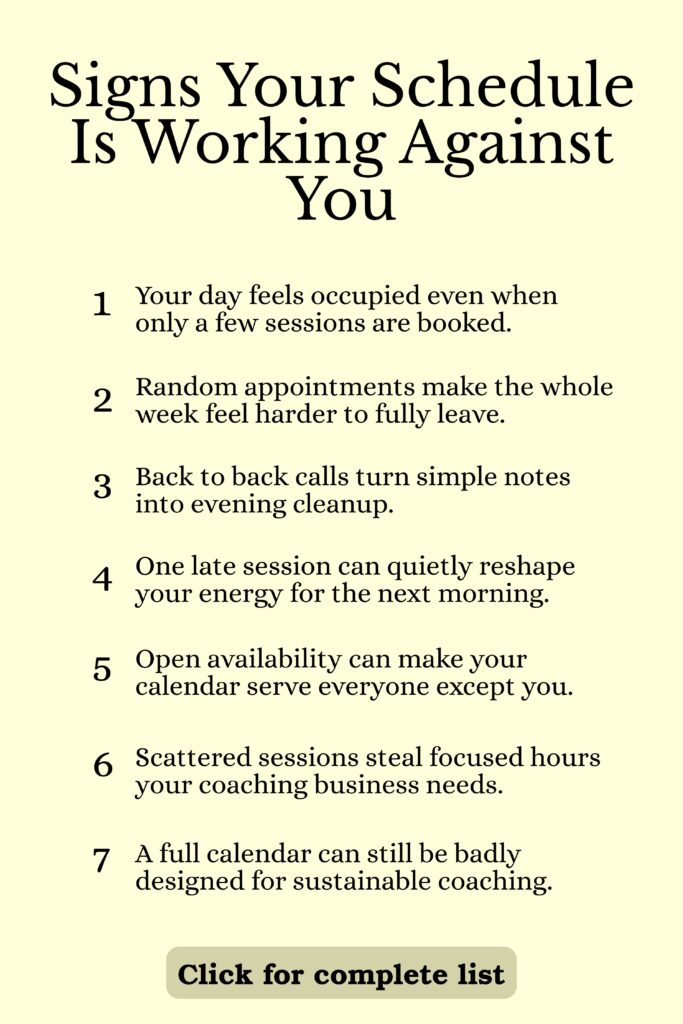
A badly designed coaching calendar can create stress even when the individual sessions themselves are going well.
Look at the shape of your week, not just the total number of clients.
Six sessions spread from 8 a.m. to 7 p.m. can consume an entire day because you never fully leave work mode. Six sessions grouped into two intentional coaching blocks may leave you with the same client revenue and substantially more usable time.
Run a quick calendar audit.
Look for patterns such as:
SEE ALSO: If you’re a coach looking to streamline your administrative tasks and save time, check out our Coaching Administration Software. It’s a simple, effective solution designed to help you focus less on paperwork and more on what matters—coaching your clients. From scheduling to client management, our software gives you the tools to run your business efficiently. Ready to reclaim your time and boost productivity? Click or tap here.
- Back-to-back sessions with no time to finish notes
- Clients scattered across the entire day
- Evening appointments immediately followed by early mornings
- Discovery calls dropped randomly into deep-work time
- Business admin squeezed into tiny gaps that are too short for meaningful work
- Too many days that contain “just one” client and therefore never feel like non-coaching days
Then decide what a good coaching day actually looks like.
You might choose a maximum number of intensive sessions, group similar appointments together, create a minimum transition period, or reserve specific days for coaching and other days for business development.
Do that thinking before handing control of your calendar to a booking tool.
Once you have decided when you want to coach, scheduling through a Public Booking Page can make that structure easier to maintain because prospects have a defined place to book available sessions. The Public Booking Page setup guide covers the practical setup, and the LCH Core video tutorial library includes a walkthrough of scheduling and booking.
The system should enforce the schedule you designed. It should not design your working life for you.
Which Stress-Coping Habits Can Make Things Worse?
Managing stress is difficult. So it might be tempting to deal with it by adopting unhealthy habits that can make the situation worse. There are several unhealthy ways to cope with stress in particular you should look to avoid.
SEE ALSO: If you’re a coach looking to streamline your administrative tasks and save time, check out our Coaching Administration Software. It’s a simple, effective solution designed to help you focus less on paperwork and more on what matters—coaching your clients. From scheduling to client management, our software gives you the tools to run your business efficiently. Ready to reclaim your time and boost productivity? Click or tap here.
Why Is Substance Use a Risky Stress Response?
One of the worst ways to cope with stress is through substance abuse. When under a lot of stress, the use of alcohol, drugs, or even unhealthy food can provide some temporary relief.
But substance use can lead to addiction and a variety of physical and emotional health challenges in the future. For many, it can even make anxiety and stress worse once the numbing effects are gone.
Why Can Withdrawing From Other People Backfire?
When you’re stressed out, it’s normal to want to get away from others as much as possible. There can be a sense of escape that comes with isolation. But after a while, being alone can be a source of stress itself. And without a shoulder to cry on or a listening ear, you’ll feel more alone and more stressed.
Why Can Stress Make You Lash Out at Others?
When you’re stressed, you might become short-tempered. You could start getting into the habit of lashing out at others. While this can be difficult to control in some situations, reacting too negatively and emotionally will continue to have a negative impact on your personal life.
How Can Life Coaches Manage Stress in Healthy Ways?
While there are some unhealthy ways to manage personal stress that you should avoid, there are healthy options that you should try when you’re feeling under stress. Here are some healthy ways to manage stress that can provide great relief.
How Can Exercise Help With Stress?
One of the most effective ways of beating stress is by getting in some good exercise on a regular basis. Exercise is an effective way to manage and reduce stress and release endorphins, your brain’s “good-mood hormones.” Working out will also give you something productive to focus on besides whatever’s causing you stress.
SEE ALSO: If you’re a coach looking to streamline your administrative tasks and save time, check out our Coaching Administration Software. It’s a simple, effective solution designed to help you focus less on paperwork and more on what matters—coaching your clients. From scheduling to client management, our software gives you the tools to run your business efficiently. Ready to reclaim your time and boost productivity? Click or tap here.
Which Daily Habits Make Stress Easier to Manage?
You can also manage stress by following healthy habits when at home. Some of the tips that you can follow to properly manage your stress can include getting plenty of sleep, following a healthy diet, and avoiding the use of alcohol, tobacco, and other stimulants.
Can Breathing and Relaxation Help in the Moment?
To reduce stress, finding the time you need to relax and breathe is important. While you may not have a ton of time throughout the day, even taking 15 minutes for meditation and breathing exercises can go a long way. Proper breathing techniques can help immediately reduce the feelings of anxiety.
What Does a 10-Minute Weekly Coach Stress Audit Look Like?
A useful weekly stress audit identifies the recurring demand behind the stress and gives you one concrete change to test the following week.
Set aside ten minutes at the end of your coaching week and answer four questions.
1. What drained me repeatedly this week?
Be specific.
“Work was stressful” tells you very little.
SEE ALSO: If you’re a coach looking to streamline your administrative tasks and save time, check out our Coaching Administration Software. It’s a simple, effective solution designed to help you focus less on paperwork and more on what matters—coaching your clients. From scheduling to client management, our software gives you the tools to run your business efficiently. Ready to reclaim your time and boost productivity? Click or tap here.
“Three clients ran over time, I had to search old emails for intake information twice, and I spent Thursday evening rearranging appointments” gives you something you can work with.
2. What helped me do good work without draining myself?
Maybe morning sessions worked better than evening calls. Maybe a 20-minute gap between clients stopped sessions blurring together. Maybe a prepared worksheet made one recurring coaching conversation easier to run.
Those are resources. Protect them.
3. Which demand can I remove, reduce, or redesign?
Choose one.
If late appointments leave you exhausted, test an earlier cutoff.
If every new client generates the same five manual emails, examine the onboarding process.
SEE ALSO: If you’re a coach looking to streamline your administrative tasks and save time, check out our Coaching Administration Software. It’s a simple, effective solution designed to help you focus less on paperwork and more on what matters—coaching your clients. From scheduling to client management, our software gives you the tools to run your business efficiently. Ready to reclaim your time and boost productivity? Click or tap here.
If client information lives across your inbox, calendar, documents, and handwritten notes, consolidate the information you genuinely need.
If inconsistent client inquiries are the stressor, the answer may be a clearer client-getting process rather than spending more hours posting randomly online.
4. What resource would make next week easier?
The answer may be time, a boundary, a template, a conversation, peer support, or a better business system.
For example, client management in a CRM can keep client profiles, notes, and intake forms together rather than making you reconstruct the relationship before each session. Life Coach Hub’s client management support guide shows how client information, coaching tools, notes, and progress can be kept connected.
The purpose of the audit is not to produce a perfect stress-free business. It is to catch recurring friction before you quietly accept it as “just part of being a coach.”
Ten minutes of diagnosis can be more useful than repeatedly recovering from the same preventable problem.
SEE ALSO: If you’re a coach looking to streamline your administrative tasks and save time, check out our Coaching Administration Software. It’s a simple, effective solution designed to help you focus less on paperwork and more on what matters—coaching your clients. From scheduling to client management, our software gives you the tools to run your business efficiently. Ready to reclaim your time and boost productivity? Click or tap here.

When Should a Coach Get Professional Support for Stress?
A coach should seek professional support when stress is persistent, is interfering with everyday functioning, or is changing how they feel about themselves, their work, or the people around them.
Burnout is more specific than having a difficult week. The World Health Organization describes burnout in ICD-11 as an occupational phenomenon resulting from chronic workplace stress that has not been successfully managed. Its three dimensions are exhaustion, increased mental distance or cynicism toward the job, and reduced professional efficacy.
Pay attention when you notice patterns such as:
- Exhaustion that does not improve after ordinary rest
- Dreading nearly every client interaction
- Becoming increasingly cynical, detached, or resentful about coaching
- Feeling unable to work as effectively as you normally do
- Sleep or concentration problems that persist
- Withdrawing substantially from friends, family, or colleagues
- Increasing your use of alcohol, drugs, or other substances to get through or recover from work
- Stress interfering with relationships or everyday responsibilities
You do not need to wait until the situation fits a label before asking for help.
A physician or licensed mental health professional can help you assess symptoms that extend beyond ordinary work pressure. Professional peer consultation or supervision can also be useful when the strain is closely tied to difficult coaching work, ethical concerns, or recurring client situations.
Business changes still matter, but business systems are not a substitute for healthcare when your health is being affected.
SEE ALSO: If you’re a coach looking to streamline your administrative tasks and save time, check out our Coaching Administration Software. It’s a simple, effective solution designed to help you focus less on paperwork and more on what matters—coaching your clients. From scheduling to client management, our software gives you the tools to run your business efficiently. Ready to reclaim your time and boost productivity? Click or tap here.
Where LCH Core Fits
LCH Core fits where a recurring source of coaching stress is operational rather than something you can solve through personal recovery alone.
Start by identifying the actual friction. Then use a tool only if it removes or organizes that friction.
If client information is scattered: Client management (CRM) can keep client profiles, notes, and intake forms together. That reduces the need to reconstruct a client’s history from email threads, documents, and memory.
If client follow-through feels vague: Journals, worksheets, goals, action items, and reusable resources can make the work between sessions more explicit. The Progress Stream and Engagement Report can then help you review progress and engagement rather than carrying every client update in your head.
If scheduling is eating into your week: A Public Booking Page can give prospects and clients a defined booking route instead of making every appointment an email negotiation. The Public Booking Page setup guide explains the setup.
If onboarding keeps repeating the same admin: A Welcome Package can bring together a welcome letter, coaching agreement with electronic signature, and forms. Life Coach Hub’s Welcome Package support guide shows how that workflow works.
SEE ALSO: If you’re a coach looking to streamline your administrative tasks and save time, check out our Coaching Administration Software. It’s a simple, effective solution designed to help you focus less on paperwork and more on what matters—coaching your clients. From scheduling to client management, our software gives you the tools to run your business efficiently. Ready to reclaim your time and boost productivity? Click or tap here.
If payments and package administration keep creating small interruptions: Keeping payments, coaching packages, and billing connected to the client process can reduce the number of separate systems you have to check.
If inconsistent visibility is the stressor: Do not turn that into a requirement to market everywhere. Build one or two repeatable ways for suitable prospects to find you and take a next step. A free life coach directory listing can give you another place to be discovered, while How to Master Funnels as a Coach goes deeper into building the path from initial awareness to an ongoing client relationship.
The common principle is simple: fix the source of recurring friction rather than asking yourself to become endlessly better at tolerating it.
For a wider look at the systems behind a growing coaching practice, Best Coaching Software for Life Coaches explains how client management, scheduling, payments, onboarding, coaching delivery, and progress tracking fit together. LCH Core is one way to keep those operational pieces connected after you have decided how you want your coaching business to run.
Frequently Asked Questions About Stress for Life Coaches
Why is life coaching stressful even when you love coaching?
Life coaching can be stressful because meaningful client work still requires sustained concentration, emotional attention, decision-making, and business administration. Enjoying the work does not remove those demands, especially when sessions, marketing, scheduling, and client management compete for the same time and attention.
How do I stop taking on my coaching clients’ stress?
You can reduce how much client stress follows you by creating clearer endings to sessions, recording what needs to be carried forward, and deliberately transitioning out of the conversation. You can care deeply about what a client is experiencing without continuing to process their problem on their behalf after the session ends.
SEE ALSO: If you’re a coach looking to streamline your administrative tasks and save time, check out our Coaching Administration Software. It’s a simple, effective solution designed to help you focus less on paperwork and more on what matters—coaching your clients. From scheduling to client management, our software gives you the tools to run your business efficiently. Ready to reclaim your time and boost productivity? Click or tap here.
What should I do when a coaching client is not making progress?
When a coaching client is not making progress, examine the process without assuming their lack of progress is proof that you are failing. Revisit the goal, identify what is blocking action, check whether the client is genuinely committed to the next step, and change the coaching approach when the evidence suggests it is needed.
How can I decompress between coaching sessions?
You can decompress between coaching sessions with a short Close, Record, Reset routine. Finish the mental loop from the previous session, capture the essential note or action, then use a brief physical change such as walking, stretching, getting water, or stepping away from your screen before the next client.
How can I tell if my coaching schedule is creating too much stress?
Your coaching schedule may be creating unnecessary stress if sessions regularly run back-to-back, appointments fragment the entire day, notes spill into evenings, or you never have enough time to shift attention between clients. Look at the pattern of the week rather than simply counting the number of sessions.
How can I reduce admin stress in my coaching business?
You can reduce admin stress by identifying repetitive tasks and consolidating information that you currently handle in multiple places. Start with the tasks that recur every week, such as finding client information, scheduling, onboarding, recording agreed actions, or handling payments, rather than attempting to reorganize the entire business at once.
What are the warning signs of burnout for a life coach?
Warning signs associated with burnout include persistent exhaustion, growing distance or cynicism toward your work, and feeling less professionally effective. Those are the three dimensions used in the World Health Organization’s ICD-11 description of occupational burnout.
When should a life coach seek professional help for stress?
A life coach should seek professional help when stress persists, disrupts sleep or relationships, interferes with daily functioning, substantially changes their behavior, or leads to increasing reliance on alcohol or other substances. You do not need to wait until the situation becomes severe before speaking with a physician or licensed mental health professional.
SEE ALSO: If you’re a coach looking to streamline your administrative tasks and save time, check out our Coaching Administration Software. It’s a simple, effective solution designed to help you focus less on paperwork and more on what matters—coaching your clients. From scheduling to client management, our software gives you the tools to run your business efficiently. Ready to reclaim your time and boost productivity? Click or tap here.
As a life coach, you spend your days improving the lives of others. But it’s important to make yourself a priority too. Finding remedies for the stress that comes with your business is important to maintaining your mental and physical health so you can focus on helping your clients reach their goals.
Sources
Agolli, Anastasiia, and Brian C. Holtz. “Facilitating Detachment from Work: A Systematic Review, Evidence-Based Recommendations, and Guide for Future Research.” Journal of Occupational Health Psychology, vol. 28, no. 3, 2023, pp. 129-159. American Psychological Association DOI record.
Bakker, Arnold B., Evangelia Demerouti, and Ana Sanz-Vergel. “Job Demands–Resources Theory: Ten Years Later.” Annual Review of Organizational Psychology and Organizational Behavior, vol. 10, 2023, pp. 25-53. Annual Reviews.
World Health Organization. “Burn-out an ‘Occupational Phenomenon’: International Classification of Diseases.” World Health Organization, 28 May 2019. World Health Organization.
Read this next

A Step-By-Step Guide on How to Build A High-Revenue Life Coaching Business
Learn the BEST way to start your life coaching business
Read More
Take Your Coaching Business to the Next Level
If you want greater success and abundance as a life coach, you need to take your business to the next level.
Read More
5 Tricks to Combine Social Media and Life Coaching Business Successfully
These five social media tips will help you propel your coaching business to the next level
Read More