






How to Master Funnels as a Coach (and Why You Need To)
If you’re like most coaches, you became a coach because you wanted to help people transform their lives, not because you wanted to learn marketing jargon like “funnels.”
But here’s the truth: funnels are just your client journey. They are the “know-like-trust” secret sauce, and how you go from dreaming of that coaching business to actually running a thriving one.
Funnels are the path someone takes from discovering you, to trusting you, to becoming a paying client, and ultimately to sticking with you long-term.
Mastering funnels isn’t just for tech-savvy entrepreneurs, it’s the foundation of running a sustainable coaching business. And the best part? You don’t need to reinvent the wheel. With the right tools, (like LCH Core), funnels can actually run in the background while you focus on what you love: coaching.
Key Takeaways
- A coaching funnel is your client journey. It moves people from discovering you, to trusting you, to booking, staying, and buying the next right offer.
- More leads are not enough without a conversion system. Coaches need clear next steps: a profile, lead magnet, booking page, follow-up process, and offer path.
- Nurturing turns interest into booked clients. Email, blog content, social posts, and free resources keep prospects connected until they are ready to book.
- Retention depends on visible progress. Goals, action items, journals, notes, and check-ins help clients see the value of coaching and stay engaged longer.
- Scaling starts with more than one offer. Courses, digital products, group programs, and bundles help coaches grow income without relying only on one-to-one sessions.
What is a Coaching Funnel?
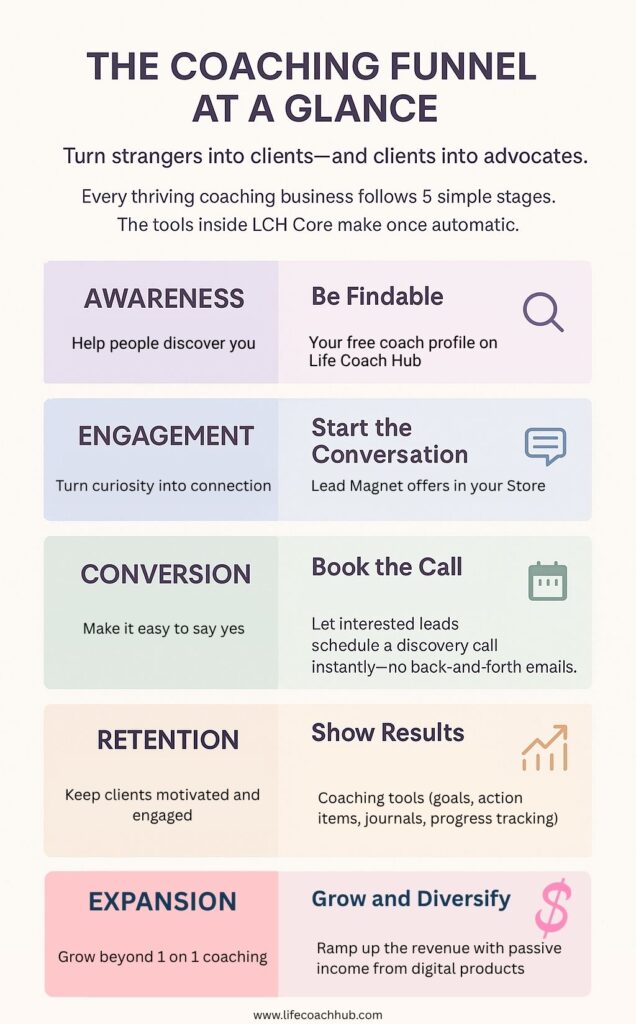
A funnel is a guided experience. Instead of throwing random marketing tactics at the wall, you’re creating a structured process that moves people from:
- Awareness (they hear about you)
- Engagement (they interact with you or your content)
- Conversion (they sign up for coaching)
- Retention (they stay with you long-term)
- Expansion (they buy your other offers, like courses or group programs)
In other words, a funnel is about making it easy for people to say yes to you.
SEE ALSO: If you’re a coach looking to streamline your administrative tasks and save time, check out our Coaching Administration Software. It’s a simple, effective solution designed to help you focus less on paperwork and more on what matters—coaching your clients. From scheduling to client management, our software gives you the tools to run your business efficiently. Ready to reclaim your time and boost productivity? Click or tap here.
Inside LCH Core, this flow is already built in. You get a free profile (awareness), client lead alerts (engagement), a discovery call booking page (conversion), progress tracking tools (retention), and even a built-in course builder (expansion).
Stage One: Attracting Leads

The top of the funnel is all about visibility. Many coaches spend hours networking and posting on social media without seeing consistent results. Instead, think of funnels as a magnet. Where can people find you? How can you invite them into your world with something valuable?
When most coaches start out, they spend more time hoping for clients than actually talking to them. You post an update on LinkedIn, refresh your inbox, and wonder if maybe everyone just already has a coach.
Attracting leads isn’t about luck or personality. It’s about being easy to find, easy to trust, and easy to reach. You don’t need to master every social platform or build a website that rivals Apple. You just need a few well-placed doors people can walk through when they’re ready.
On Life Coach Hub, this might look like:
- Setting up your directory profile.
- Offering a free lead magnet in your Public Store, like an ebook or mini-course.
- Signing up for client lead alerts, which deliver real coaching requests straight to your inbox.
Don’t forget the lead magnet!

A lot of coaches skip the basics. They’ll have an Instagram account, maybe a website, but nowhere that actually converts interest into connection.
SEE ALSO: If you’re a coach looking to streamline your administrative tasks and save time, check out our Coaching Administration Software. It’s a simple, effective solution designed to help you focus less on paperwork and more on what matters—coaching your clients. From scheduling to client management, our software gives you the tools to run your business efficiently. Ready to reclaim your time and boost productivity? Click or tap here.
That’s where something like Life Coach Hub can do a lot of heavy lifting. When you sign up, we give you a professional profile that’s already optimized for how people search for coaches. You can list your specializations, show your photo, and make your coaching tangible to someone who’s never met you.
From there, your Public Booking Page becomes the bridge between curiosity and conversation. Instead of “DM me” or “email me for details,” it lets someone book a discovery call instantly. If you’ve ever lost a lead because they couldn’t find your calendar link, you know why this matters.
Then you also get a Public store, where you can post free resources or short guides (as well as so many other kinds of lead magnets and of course paid offers for later on down the funnel). It’s like a preview of your coaching style.
When considering your lead magnets, remember at this stage they are not there to sell. They are there to start a relationship with someone who doesn’t know you yet. You need to build up that know-like-trust factor. When someone downloads your freebie, you’ve just started the process of warming up that contact. It’s not the end of the story, but it’s a VERY important start.

Use social media intentionally
Social media can be both a megaphone and a time sink. The secret is to make it part of your funnel instead of your full-time job.
Choose one or two platforms you actually enjoy using. Then set them up with intention. On Instagram, for example, your link in bio should always lead somewhere real. For example, this is a perfect time to provide your discovery call Public Booking Page or a link to your Store. You can rotate which one you highlight, but keep both available. You can also swap in a particularly hot lead magnet, linking directly to that Offer page.
SEE ALSO: If you’re a coach looking to streamline your administrative tasks and save time, check out our Coaching Administration Software. It’s a simple, effective solution designed to help you focus less on paperwork and more on what matters—coaching your clients. From scheduling to client management, our software gives you the tools to run your business efficiently. Ready to reclaim your time and boost productivity? Click or tap here.
From there, think of every post as either a conversation starter or a next step. Some posts show who you are — what you stand for, what kind of transformation you help people with. Others point to something useful: “Here’s a short guide I made for people struggling with [problem]. Grab it free here.”
You can post about each lead magnet individually. A single resource can turn into several posts: a short video about why you created it, a quick tip from inside it, or a real story about someone who used it. Each time, link straight to the resource in your store.
The point isn’t to flood the feed. It’s to let people meet you, learn from you, and take an easy next step when they’re ready.

Why your website still matters
Your website doesn’t have to be fancy, but it does need to do something. Most coaching websites feel like brochures — all information, no invitation.
At the top of your homepage, you need two clear options:
- Book a free discovery call — linked to your Public booking page.
- Get a free resource — linked to your lead magnet, wherever it lives.
That’s it. Everything else — testimonials, about section, photos — should support those two actions.
SEE ALSO: If you’re a coach looking to streamline your administrative tasks and save time, check out our Coaching Administration Software. It’s a simple, effective solution designed to help you focus less on paperwork and more on what matters—coaching your clients. From scheduling to client management, our software gives you the tools to run your business efficiently. Ready to reclaim your time and boost productivity? Click or tap here.
If you’re using LCH Core, you can plug those same links right into your site. It keeps everything connected and saves you from juggling multiple systems.

In-person still works
The internet didn’t replace relationships. It just made them easier to maintain. If you host a workshop, speak at an event, or meet someone through a friend, make it simple for them to follow up.
You can print a small card with two links: one to your discovery call page and one to your free resource.
When you follow up, don’t try to sell coaching immediately. Send a short message: “It was great meeting you. Here’s the resource I mentioned — hope it helps. If you ever want to talk about where you’re headed next, here’s my link to set up a call.”
That’s it. You’ve started a relationship.

Leads aren’t numbers on a spreadsheet. They’re people who’ve raised their hand because something you said resonated. Your job isn’t to close them; it’s to keep the door open. The rest of the funnel will do its work when the time is right.
SEE ALSO: If you’re a coach looking to streamline your administrative tasks and save time, check out our Coaching Administration Software. It’s a simple, effective solution designed to help you focus less on paperwork and more on what matters—coaching your clients. From scheduling to client management, our software gives you the tools to run your business efficiently. Ready to reclaim your time and boost productivity? Click or tap here.
Stage Two: Nurturing Relationships
Leads are just the start. The real magic happens in how you follow up.
If Stage One is about being findable, Stage Two is about being memorable. It’s about showing up in ways that make people feel like they already know you before you’ve ever had a call. Nurturing isn’t about “warming them up to buy.” It’s about building trust through genuine connection.
The simplest way to nurture: keep in touch via an email list
Once someone has downloaded a resource, filled out a form, or booked a discovery call, they’ve told you something important: they’re interested. The worst thing you can do at this stage is go silent.
Make sure to add them to your email list. If you’re using an email platform like Mailchimp or AWeber, set up a short welcome sequence that introduces who you are and what you do.
Then, send occasional updates or reflections that feel personal and relevant. Think of it as writing to one person. The kind of message you’d send a client between sessions to keep them motivated.
What you want is to create a comfortable rhythm of communication. It doesn’t have to be complicated. Even one thoughtful email a week or every other week makes a difference. The key is to talk to your audience like real people, not “leads.”
SEE ALSO: If you’re a coach looking to streamline your administrative tasks and save time, check out our Coaching Administration Software. It’s a simple, effective solution designed to help you focus less on paperwork and more on what matters—coaching your clients. From scheduling to client management, our software gives you the tools to run your business efficiently. Ready to reclaim your time and boost productivity? Click or tap here.
Here are a few simple ideas for nurturing emails:
- A short insight or mindset shift that came up in your own coaching work.
- A story about a client breakthrough (shared anonymously).
- A personal experience that connects to a challenge your audience faces.
- A resource you’ve created — a worksheet, journal prompt, or video — with a short note on why it might help.
You can host any of these resources inside your LCH Core Public store and link to them in your emails. That way, each message you send continues the funnel: your subscribers get something valuable, and you get deeper engagement.
Use blog content as long-term nurturing
Email is great for connection, but blog content keeps the conversation going in public. Each post you publish is like a permanent touchpoint that can bring new people into your world and remind existing leads why they trust you.
You can write articles on your own website that expand on common coaching questions — “How to Stop Second-Guessing Yourself” or “What Coaching Actually Looks Like in the First Month.” Every blog post should end with a clear next step, such as linking to your free resource or your discovery call booking page.
You can also apply to publish a guest blog post here with us at LCH. These give you a double bang for your buck. They help attract new readers who find you through the platform (top of the funnel) and they nurture your existing leads by showing your expertise in a credible, professional space (middle of the funnel). Each guest article includes your author bio, so readers can explore more of your work.
Blog content works especially well for leads who aren’t ready to book yet. It gives them a reason to stay connected and a deeper understanding of your approach, without any pressure. Over time, that steady presence builds trust in a way few marketing tactics can.
SEE ALSO: If you’re a coach looking to streamline your administrative tasks and save time, check out our Coaching Administration Software. It’s a simple, effective solution designed to help you focus less on paperwork and more on what matters—coaching your clients. From scheduling to client management, our software gives you the tools to run your business efficiently. Ready to reclaim your time and boost productivity? Click or tap here.
You can also, of course, send links to any new blog content out to your email list! And don’t forget to add an email sign up list to your blog, so you can collect leads that way (top of funnel). You’ll want to entice them with some kind of lead magnet relevant to the blog article they are reading about.

Lead magnets as ongoing conversation starters
Most coaches think a lead magnet is something you create once and forget. But it can actually be the centerpiece of your entire nurturing system.
Let’s say you created a short guide or video training and offered it as a freebie on your Public store. You can keep bringing it to life by referencing it in your emails and social posts. For example:
- “If you’ve been struggling with follow-through, I cover this in section two of my free guide. Here’s the link if you haven’t grabbed it yet.”
- “Several readers told me they loved the journal prompt in the free workbook, so I created a second one. You can download it here.”
This approach keeps your lead magnets fresh and relevant. You’re reminding your audience that you have resources to help — without needing to constantly create new content.
When to invite people to take the next step
Not every email or message needs a call to action, but every few weeks it’s smart to open the door again. You can say something like, “If what we’ve been talking about sounds like where you are right now, let’s jump on a free discovery call and see if coaching is the right fit.”
That one sentence does a lot. It shows you’re available, confident in what you offer, and not trying to pressure anyone. If you’ve built trust through consistent communication, people will take that step when they’re ready.
SEE ALSO: If you’re a coach looking to streamline your administrative tasks and save time, check out our Coaching Administration Software. It’s a simple, effective solution designed to help you focus less on paperwork and more on what matters—coaching your clients. From scheduling to client management, our software gives you the tools to run your business efficiently. Ready to reclaim your time and boost productivity? Click or tap here.
If you’re using LCH Core, that’s where your public booking page comes in again. You can include the link in your email signature or at the end of your newsletters so it’s always visible but never intrusive.
Other ways to nurture outside of email
Email isn’t the only channel that works. Coaches often forget how powerful social and real-world touchpoints can be for staying in front of their audience.
On social media, you can post client insights, short lessons, or even reflections about your own growth as a coach. End those posts with an invitation to connect: “If you’d like more resources like this, you can grab my free guide here,” or “I talk about this more in my latest newsletter — you can sign up at the link in my bio.”
If you speak at events, teach workshops, or host small group sessions, think of those as nurturing opportunities too. Everyone who attends is already warm. You can mention your email list or offer a printed card with your resource link so they can stay connected afterward.
Nurturing is the relationship
If you take nothing else from this stage, remember this: your leads are real people who might be nervous, curious, or unsure. They don’t want a pitch, they want a person.
Show up with genuine stories, useful tools, and small reminders that change is possible. When someone finally books that call, they won’t feel like they’re talking to a stranger . They’ll feel like they already know you.
SEE ALSO: If you’re a coach looking to streamline your administrative tasks and save time, check out our Coaching Administration Software. It’s a simple, effective solution designed to help you focus less on paperwork and more on what matters—coaching your clients. From scheduling to client management, our software gives you the tools to run your business efficiently. Ready to reclaim your time and boost productivity? Click or tap here.
That’s the power of nurturing done right.
Stage Three: Converting Prospects
By this point in the funnel, you’ve done the heavy lifting. You’ve been visible, you’ve built trust, and you’ve given people a reason to stick around. Now a few of them are ready to take that next step and talk with you directly.
This stage is where a lot of coaches freeze. Selling can feel awkward, especially when what you’re “selling” is something as personal as coaching. But conversion doesn’t have to feel transactional. It’s really about helping someone decide whether this partnership is the right fit.
If you focus on clarity and structure instead of pressure, conversion becomes the natural next step, not a hard sell.
The purpose of a discovery call
A discovery call isn’t about convincing anyone. It’s a space for curiosity on both sides. The goal is to learn more about the person’s goals, explore whether coaching can help, and see if you’re a good match.
This is also the moment when your funnel becomes personal. Until now, your marketing has been talking to many people at once. A discovery call shifts the focus to one person, one story, one conversation.
SEE ALSO: If you’re a coach looking to streamline your administrative tasks and save time, check out our Coaching Administration Software. It’s a simple, effective solution designed to help you focus less on paperwork and more on what matters—coaching your clients. From scheduling to client management, our software gives you the tools to run your business efficiently. Ready to reclaim your time and boost productivity? Click or tap here.
Keeping that process simple helps you stay confident and professional.

Making it easy to book
When someone is ready to talk, they shouldn’t have to dig around to figure out how. Your public booking page inside LCH Core makes this step frictionless. You can share it in your emails, social posts, website, or even directly in your DMs. Once they click, they’ll see your availability and can schedule instantly.
If you’re not using LCH Core, you can use any calendar tool that integrates with your email. What matters is that the process feels smooth and welcoming. A person’s first impression of working with you begins here.
Your booking page description should briefly explain what the call covers:
“During this 20-minute call, we’ll talk about what you want to achieve, what’s been getting in the way, and what next steps might help you move forward. No pressure, just a conversation.”
This kind of language immediately sets a collaborative tone rather than a sales one.
How to hold the call
Every coach has their own rhythm, but here’s a structure that works well:
SEE ALSO: If you’re a coach looking to streamline your administrative tasks and save time, check out our Coaching Administration Software. It’s a simple, effective solution designed to help you focus less on paperwork and more on what matters—coaching your clients. From scheduling to client management, our software gives you the tools to run your business efficiently. Ready to reclaim your time and boost productivity? Click or tap here.
- Connect first. Start by getting to know them. Ask what prompted them to reach out and listen fully before jumping into coaching talk.
- Explore their goals. Help them clarify what they want to change and why it matters. This isn’t a mini session, it’s about clarity.
- Reflect what you hear. Paraphrase their words so they feel understood. This is often the moment when they realize you “get” them.
- Offer a path forward. Share how your coaching could help them reach those goals. Keep it simple and specific: “Here’s what working together would look like.”
You don’t need a script. You just need to stay focused on listening more than you talk. Most people sign up for coaching not because of a perfect pitch, but because they felt seen and understood during that first conversation.

Inviting them to work with you
When it’s clear the fit is right, invite them directly. A simple line like:
“I’d love to work with you on this if it feels right to you. Here’s how we could start.”
Then explain the structure: how many sessions, what’s included, and the investment. The more transparent you are, the more comfortable people will feel saying yes.
With LCH Core, this next step happens naturally. Once they agree to move forward, you can send an invitation to join your coaching program or package right from your dashboard. Payment, agreements, and onboarding materials can all go out automatically.
If you’re managing things manually, just make sure you have a clean follow-up system. Send an email right after the call summarizing what you discussed and include a clear link to sign up or schedule their first session.
Handling hesitation gracefully
Not everyone will be ready to sign up right away, and that’s okay. Sometimes they need time to think, check finances, or simply process the idea of working with a coach.
SEE ALSO: If you’re a coach looking to streamline your administrative tasks and save time, check out our Coaching Administration Software. It’s a simple, effective solution designed to help you focus less on paperwork and more on what matters—coaching your clients. From scheduling to client management, our software gives you the tools to run your business efficiently. Ready to reclaim your time and boost productivity? Click or tap here.
Instead of pushing, keep the relationship open. You can say something like, “No rush at all. I’ll send a quick recap of what we talked about so you have everything in one place. If you have questions or want to revisit this later, my door’s open.”
That one small step keeps trust intact. And if you’re nurturing consistently (from Stage Two), they’ll keep hearing from you anyway, so the connection doesn’t fade.

Keep the follow-up simple
Every discovery call should have one clear next step — even if it’s “not yet.”
If they said yes, send the onboarding details right away through LCH Core so the momentum continues.
If they said maybe, follow up once in a week or two with a short note: “Just checking in to see if you had any more thoughts after our call.”
If they said no, thank them sincerely and stay on your newsletter list so they still benefit from your content.
The goal here isn’t to close every prospect. It’s to handle every interaction so gracefully that even a “no” feels like a positive experience. That kind of professionalism often leads to referrals later on.
What conversion really is
Conversion isn’t a single moment when someone says yes. It’s the natural outcome of everything you’ve built so far: the visibility, the trust, the ongoing value. By the time someone books that first call, most of the “selling” has already happened. The call just confirms what they already feel — that you’re the right person to help them.
Tools like LCH Core simply make the process seamless: booking, follow-up, payments, and onboarding all flow in one place. But what actually turns a prospect into a client is something simpler. It’s clarity. Confidence. And the genuine sense that this is a partnership worth starting.
SEE ALSO: If you’re a coach looking to streamline your administrative tasks and save time, check out our Coaching Administration Software. It’s a simple, effective solution designed to help you focus less on paperwork and more on what matters—coaching your clients. From scheduling to client management, our software gives you the tools to run your business efficiently. Ready to reclaim your time and boost productivity? Click or tap here.
Stage Four: Retaining Clients
Attracting and converting clients can feel like a victory, but the truth is that your business really grows by what happens next. Retention is where coaching becomes sustainable, both for your clients and for you.
It’s what turns a one-month engagement into six months. It’s what leads to referrals, testimonials, and long-term income stability. The good news is, retention doesn’t come from gimmicks or “locking people in.” It comes from helping clients see their progress and feel supported in between sessions.

Why clients stay (and why they don’t)
When clients drop off, it’s rarely because they stopped liking you. More often, they stop feeling connected to their progress. Coaching is a process of growth, and growth can be uneven. If clients can’t see how far they’ve come, they start to question whether it’s working.
That’s why retention starts with visibility. Clients need to see their wins, not just feel them. They need small moments of proof: reminders that they’re moving forward, even on the hard weeks.
Keeping clients engaged between sessions
One of the simplest ways to increase retention is to stay connected outside of session time. If the only communication happens during calls, the relationship can start to feel transactional.
LCH Core helps solve this gap by giving you tools that make engagement part of the coaching process. You can send clients action items, reflection prompts, or short worksheets between sessions, all stored in their private dashboard. You can also track their goals and progress over time, which makes it easy to show results during reviews or check-ins.
SEE ALSO: If you’re a coach looking to streamline your administrative tasks and save time, check out our Coaching Administration Software. It’s a simple, effective solution designed to help you focus less on paperwork and more on what matters—coaching your clients. From scheduling to client management, our software gives you the tools to run your business efficiently. Ready to reclaim your time and boost productivity? Click or tap here.
When clients can log in and literally see their goals, completed tasks, and past session notes, the value of coaching becomes tangible. And tangible progress is what keeps people coming back.
Even outside of LCH Core, small touchpoints matter. Send a short note after a great session: “I loved what you said about setting boundaries today. Try journaling on that this week and let me know how it goes.” These small gestures remind clients that you’re invested in their success.
Measuring and celebrating progress
One mistake many coaches make is waiting until the end of a package to talk about results. But progress is the heartbeat of retention. Build in regular check-ins — monthly, quarterly, or whenever fits your model — to reflect on what’s changed since the start.
Inside LCH Core, coaches can easily track how clients are interacting with their coaching tools. You can see when they’ve completed a worksheet, updated an action item, or checked off a goal. That activity tells a story all by itself. A client who’s logging progress each week, filling out reflections, and showing up prepared for sessions is a client who can see the value of coaching in real time.
Encourage clients to stay engaged by assigning clear next steps at the end of each session, whether it’s a journal prompt, a new goal, or an action plan. These small commitments turn coaching from a once-a-week conversation into an ongoing process.
Over time, this level of interaction makes the return on coaching obvious. Clients don’t have to wonder if they’re making progress; they can feel it in how they’re showing up, taking action, and following through. That’s what keeps them invested, not just in you, but in themselves.
SEE ALSO: If you’re a coach looking to streamline your administrative tasks and save time, check out our Coaching Administration Software. It’s a simple, effective solution designed to help you focus less on paperwork and more on what matters—coaching your clients. From scheduling to client management, our software gives you the tools to run your business efficiently. Ready to reclaim your time and boost productivity? Click or tap here.
If you don’t use software to track this, you can still build your own system. Keep simple progress notes and recap them regularly. Ask questions like, “What’s changed for you since we started?” or “What feels easier now than it did two months ago?” These conversations reinforce momentum and create natural renewal points.

Building renewal into your process
Retention doesn’t mean keeping clients forever. It means designing an experience so positive that when one chapter ends, the next begins naturally.
At the end of a package, schedule a review session to reflect on wins, learning, and what’s next. Sometimes that “next” is a new package. Other times, it’s a maintenance or accountability plan. LCH Core makes this transition seamless. You can easily send a follow-up offer — a shorter series of sessions, a group program, or even a digital product from your store.
Renewals feel effortless when clients already see the return on their investment. You’re not re-selling them; you’re simply helping them take the next step in their growth.
Turn clients into advocates
The best marketing you’ll ever have is a happy client who talks about their experience. When people see real transformation, they naturally want to share it. You can encourage this gently by asking for testimonials or by featuring anonymous success stories in your content.
Inside LCH Core, you can collect feedback through quick surveys and easily display testimonials on your public profile. These stories not only strengthen your reputation but also remind current clients of what’s possible.
SEE ALSO: If you’re a coach looking to streamline your administrative tasks and save time, check out our Coaching Administration Software. It’s a simple, effective solution designed to help you focus less on paperwork and more on what matters—coaching your clients. From scheduling to client management, our software gives you the tools to run your business efficiently. Ready to reclaim your time and boost productivity? Click or tap here.
Retention isn’t just about keeping clients longer. It’s about deepening their results and turning their success into proof of the value of coaching itself.
When clients feel seen, supported, and proud of their progress, they don’t just stay — they become your biggest advocates.

Stage Five: Expanding and Scaling
Once you’ve built a steady base of clients and systems that run smoothly, the next question usually comes up on its own: how do I grow without working more hours?
That’s where expansion and scaling come in. This stage isn’t about chasing massive numbers or “automating your business” until it feels impersonal. It’s about finding ways to serve more people, diversify your income, and build stability into your coaching career.
You can think of scaling as creating new pathways for transformation — ways people can work with you beyond your one-on-one time.

Create a ladder of offers
A healthy coaching business gives people different entry points. Not everyone is ready for private coaching right away, but that doesn’t mean they’re not interested in learning from you.
SEE ALSO: If you’re a coach looking to streamline your administrative tasks and save time, check out our Coaching Administration Software. It’s a simple, effective solution designed to help you focus less on paperwork and more on what matters—coaching your clients. From scheduling to client management, our software gives you the tools to run your business efficiently. Ready to reclaim your time and boost productivity? Click or tap here.
You might start by creating a group program, a short course, or a self-paced version of your signature process. These options let clients experience your coaching at different levels of depth and investment.
Inside LCH Core, you can build and deliver these directly through your digital products and courses. The same tools you use for private clients, (action items, plans, journaling, and goals), also work beautifully for courses and group formats. It keeps everything organized in one place, while still giving each participant a personal experience.
If you’re not ready to launch a full course, you can start smaller. Turn one of your most used tools into a mini-offer. Bundle a worksheet or set of journal prompts as a low-cost resource in your LCH Core store, or offer it for free as a lead magnet to grow your list. Over time, these small offers build credibility and visibility while adding passive income.
Go beyond coaching hours
Scaling doesn’t just mean “adding more clients.” It also means finding ways to make your knowledge work for you.
Maybe you record a short video training on a topic that always comes up in sessions. Or you create a template bundle that helps clients stay accountable. Once you’ve built it, it can keep generating income in the background while you focus on your live coaching.
The idea isn’t to replace your one-to-one work but to support it. The more tools and resources you offer, the more value clients get from your ecosystem. And the stronger your brand becomes.
SEE ALSO: If you’re a coach looking to streamline your administrative tasks and save time, check out our Coaching Administration Software. It’s a simple, effective solution designed to help you focus less on paperwork and more on what matters—coaching your clients. From scheduling to client management, our software gives you the tools to run your business efficiently. Ready to reclaim your time and boost productivity? Click or tap here.

Use your systems to buy back time
Growth doesn’t come from doing more; it comes from doing less of what drains you.
If you’re using LCH Core, you already have automation built into your day. Scheduling, payments, onboarding, progress tracking: all of it runs quietly in the background. That time adds up. Every hour you save on admin is an hour you can reinvest in building new offers, nurturing your community, or simply resting.
Coaches who scale well aren’t hustling harder; they’re designing their systems to carry the weight. That’s what allows you to serve more clients without burning out.
Build visibility through teaching
As you grow, sharing your expertise becomes just as important as delivering it. Writing blog posts, guest articles, or even short videos that teach simple concepts positions you as a thought leader in your niche.
You can publish these on your own site, or contribute guest posts. Guest posts on LCH do double duty: they introduce you to new potential clients and reinforce your authority with the audience you already have. It’s one of the most natural ways to attract and nurture at the same time.
Teaching publicly creates a ripple effect. People start to associate your name with clarity and results, and that makes every offer you create easier to sell.
SEE ALSO: If you’re a coach looking to streamline your administrative tasks and save time, check out our Coaching Administration Software. It’s a simple, effective solution designed to help you focus less on paperwork and more on what matters—coaching your clients. From scheduling to client management, our software gives you the tools to run your business efficiently. Ready to reclaim your time and boost productivity? Click or tap here.

Scale without losing connection
The biggest fear many coaches have about growth is that it will make their work feel less personal. But the best systems don’t replace the relationship — they protect it.
Whether you’re running a group program, selling a course, or managing a larger client base, the key is to keep interaction and feedback at the heart of what you do. Use the tools inside LCH Core to stay connected: post updates, check in through messages, or assign reflection forms that bring clients back into dialogue.
Scaling isn’t about reaching more people for the sake of numbers. It’s about extending your impact while staying grounded in the reason you started coaching in the first place — helping people create meaningful change.
That’s the full funnel. From attracting leads to retaining and expanding your reach, the pattern stays the same: create simple, human systems that make it easy for people to find you, connect with you, and keep growing with you.
Why Funnels Matter Now More Than Ever

Without funnels, coaches end up overworked, underpaid, and constantly searching for clients. Established coaches often feel stuck because they’re doing everything manually: chasing leads, reinventing onboarding, relying on referrals.
With funnels, everything changes. You free up time, raise your rates, diversify your income, and build a steady flow of clients who value your work.
SEE ALSO: If you’re a coach looking to streamline your administrative tasks and save time, check out our Coaching Administration Software. It’s a simple, effective solution designed to help you focus less on paperwork and more on what matters—coaching your clients. From scheduling to client management, our software gives you the tools to run your business efficiently. Ready to reclaim your time and boost productivity? Click or tap here.
That’s the difference between working in your business and working on your business.
How to Get Started

Here’s how you can start mastering funnels this week:
Day 1: Be findable
Finish your Life Coach Hub profile and specializations. Turn on lead alerts so qualified coaching requests reach you automatically. Add your public booking page to your website header and social bios so people can book a discovery call in one click.
Day 2: Publish your freebie
Create one lead magnet that solves a real problem and publish it in your LCH Core store. Share that freebie as its own post on social and add the link to your bio. Remember, leads at this stage aren’t about closing a sale — they’re about starting a relationship.
Day 3: Set up nurturing
Connect your email platform (Mailchimp or AWeber works well). Write a short three-email welcome sequence. Publish one blog post that teaches something practical and ends with two clear next steps: book a discovery call or get the free resource. If you can, submit a guest article on Life Coach Hub to reach new readers and keep current leads engaged.
Day 4: Make conversion smooth
Refine your discovery-call flow. Add a friendly, specific description on your booking page. Prepare a one-page outline of your coaching package, pricing, and start steps. In LCH Core, confirm your onboarding, agreements, and payments are ready so momentum doesn’t stall after a “yes.”
SEE ALSO: If you’re a coach looking to streamline your administrative tasks and save time, check out our Coaching Administration Software. It’s a simple, effective solution designed to help you focus less on paperwork and more on what matters—coaching your clients. From scheduling to client management, our software gives you the tools to run your business efficiently. Ready to reclaim your time and boost productivity? Click or tap here.
Day 5: Keep clients engaged and set up your next offer
Build simple weekly templates for action items and coaching plans inside LCH Core so clients show up with purpose and keep doing the work between sessions. Add one low-lift digital product to your store or outline a small group program — the first rung of your expansion ladder.
With LCH Core, you can complete this five-day sprint and have a working funnel by the end of the week.
It’s a system that keeps doing the quiet work — attracting clients, converting them, retaining them, and helping your business grow.
So ask yourself: are you ready to stop chasing and start leading clients through a journey that works?
👉 Start your free trial of LCH Core and build a funnel that works as hard for your business as you do for your clients.
SEE ALSO: If you’re a coach looking to streamline your administrative tasks and save time, check out our Coaching Administration Software. It’s a simple, effective solution designed to help you focus less on paperwork and more on what matters—coaching your clients. From scheduling to client management, our software gives you the tools to run your business efficiently. Ready to reclaim your time and boost productivity? Click or tap here.
Read this next

Selling Coaching: Why Coaches Hate Selling
Here is #1 reason many coaches hate selling and how to change that perspective.
Read More
Ultimate Coach Social Media Strategy Guide (What, When and How to Post)
Want your business’ socials up and running effectively? Take a look at these pointers for your coach social media strategy.
Read More
13 In Demand Lead Magnet Ideas for Coaches to Get Clients Fast
Effectively market your coaching business using these 13 in demand lead magnet ideas!
Read More