








Take Your Coaching Business to the Next Level

There are many different levels to conquer in the world of life coaching.
Life coaching is a fun and rewarding career. The odds are great that you started your coaching business because you love seeing other people living happy, fulfilling, meaningful lives. You probably also wanted to make a bit of money too.
As you watch your clients develop, you probably want to see your business develop too. You can be a fantastic coach, but without a bit of know-how it can be nearly impossible to grow your coaching business. This doesn’t mean that you need to hire a marketing guru, but you do need to learn a little bit to take your life coaching business to the next level. The following tips are a great place to start.
Key Takeaways
- Build a clear offer ladder. A free resource, starter offer, core coaching package, and scalable next step give prospects a logical way to deepen their work with you.
- Add offers because clients need them. Repeated questions, recurring sticking points, and requests for extra support are stronger signals than creating a course or workshop simply because other coaches have one.
- Bundle around an outcome, not a discount. A package becomes more valuable when sessions, exercises, feedback, and resources work together to solve one defined problem.
- Know the economics before you price. Count live coaching, preparation, follow-up, admin, and any included support so a fuller package does not quietly reduce what you earn for your time.
- Measure the path from interest to revenue. Track leads, consultations, conversions, renewals, and average client value so you can see which offers actually move your coaching business forward.
How Do You Take Your Coaching Business to the Next Level?
You take a coaching business to the next level by giving people clearer ways to start working with you, continue working with you, and buy more appropriate support as their needs change. That usually means developing a small range of connected offers rather than relying on individual coaching sessions alone.
A practical growth system might include a free entry point, a lower-commitment starter offer, a core coaching package, and a higher-value or scalable offer. You can then track which parts of that path generate consultations, paying clients, renewals, and additional revenue.
What Does Your Coaching Offer Ladder Look Like?
A coaching offer ladder gives clients a logical path from first contact to deeper levels of support. Instead of creating unrelated services and hoping something sells, each offer answers the question, “What would make sense for this person next?”
SEE ALSO: If you’re a coach looking to streamline your administrative tasks and save time, check out our Coaching Administration Software. It’s a simple, effective solution designed to help you focus less on paperwork and more on what matters—coaching your clients. From scheduling to client management, our software gives you the tools to run your business efficiently. Ready to reclaim your time and boost productivity? Click or tap here.
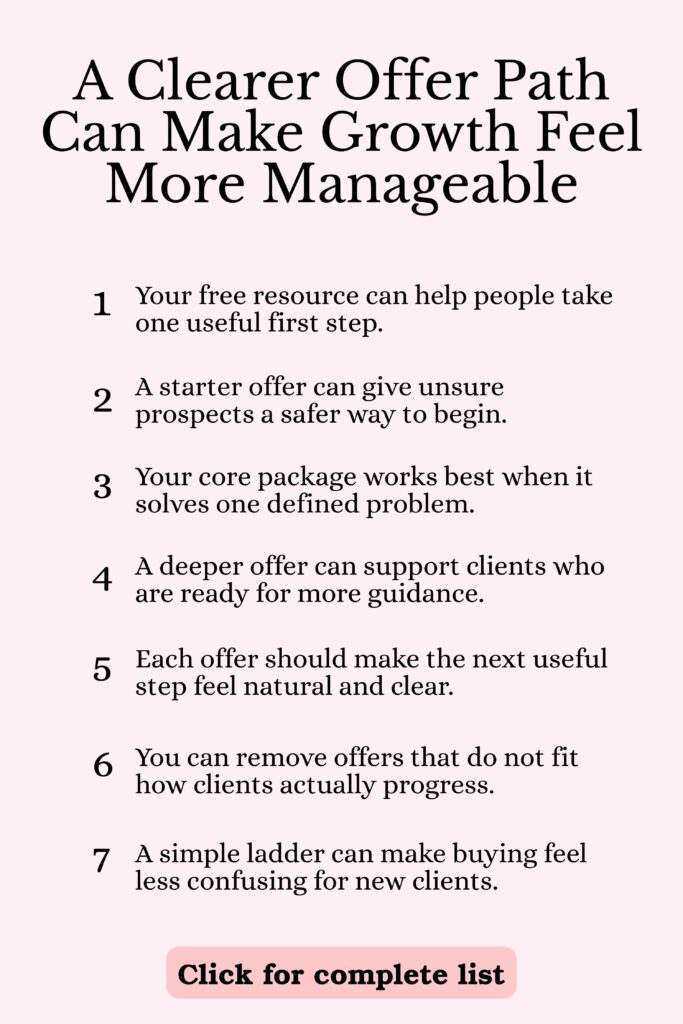
A simple offer ladder might have four levels:
- Free entry point: A checklist, assessment, short guide, webinar, or introductory consultation.
- Starter offer: A single strategy session, mini-workshop, assessment plus feedback session, or short program.
- Core offer: Your main coaching package, usually built around a defined problem or outcome.
- Scalable or advanced offer: Group coaching, a course, ongoing support, a higher-level program, training, or another service that fits your expertise.
A career coach, for example, could offer a free career-change worksheet, followed by a paid career strategy session. Someone who needs more support could move into a six-session career transition package, then later join a group interview program.
This kind of diversification is already common across the profession. According to the International Coaching Federation’s 2025 Global Coaching Study, 60% of coaches surveyed offered training in addition to coaching, 57% offered consulting, 55% facilitation, and 49% mentoring.
The goal is not to create as many offers as possible. It is to make the next useful step obvious.
What Else Can You Offer Coaching Clients?
By expanding your current services, you can attract more clients and entice current clients to use more services. If you already don’t offer one or more of the following services, think about offering them: group coaching, eBooks, podcasts, workbooks, retreats, career coaching or life coach training.
There are so many things you can offer, so put yourself out there and see who bites. Don’t over extend yourself or take on too much new business at once, but do give new and existing clients more options.
SEE ALSO: If you’re a coach looking to streamline your administrative tasks and save time, check out our Coaching Administration Software. It’s a simple, effective solution designed to help you focus less on paperwork and more on what matters—coaching your clients. From scheduling to client management, our software gives you the tools to run your business efficiently. Ready to reclaim your time and boost productivity? Click or tap here.
How Do You Decide Which Coaching Offer to Add Next?
Choose your next coaching offer by looking for a repeated client need that fits your expertise and can be delivered profitably. A new product is much easier to justify when you have already seen evidence that people want the result.
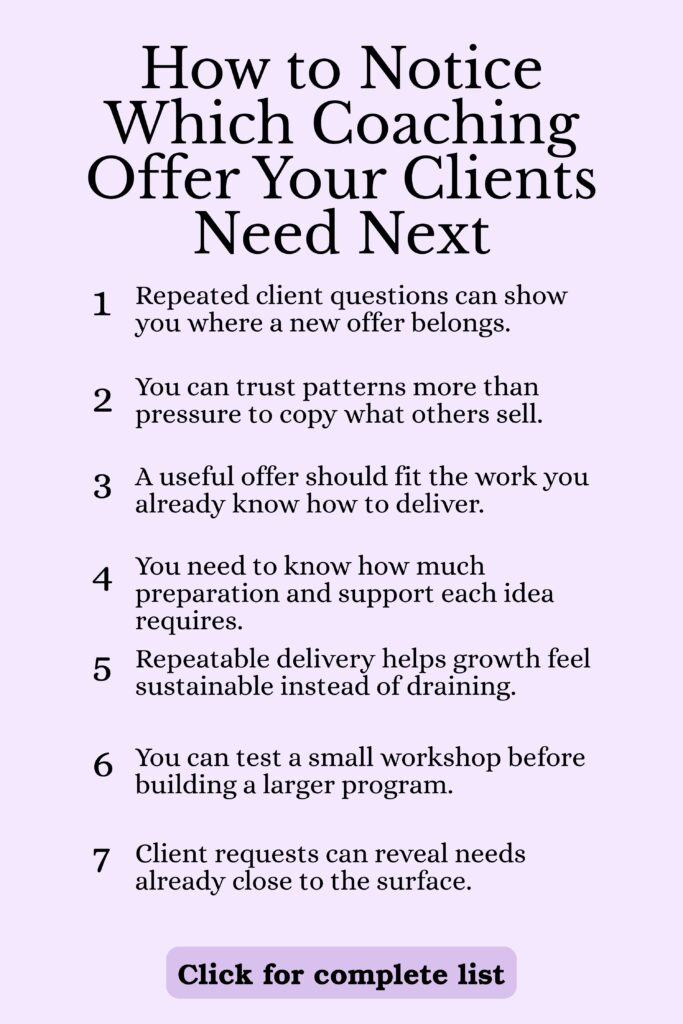
Run the idea through four filters:
- Demand: Are clients or prospects already asking about this problem?
- Fit: Does solving it naturally connect with the work you already do?
- Delivery load: How much coaching, preparation, feedback, and administration will it require?
- Repeatability: Can you deliver it again without rebuilding everything from scratch?
Suppose you are a leadership coach and several clients keep bringing difficult employee conversations into sessions. That is a stronger signal for a communication workshop than deciding to create a course simply because courses seem scalable.
You could test the idea with one 90-minute workshop first. Include a framework, a realistic workplace scenario, role-play, and feedback. If people buy it and ask for more support, you have evidence for developing the offer further.
Client conversations can reveal these opportunities too. When several clients need practice around the same situation, whether that is salary negotiation, dating conversations, leadership feedback, or career interviews, pay attention to the pattern.
Should You Bundle Coaching Services?
Offer multiple services or sessions together for a lower price. This will entice clients to buy more of your services. Not only will this make you more money, but they will see more value in what they get from you. Your services will also become more embedded for them in their personal development path.
SEE ALSO: If you’re a coach looking to streamline your administrative tasks and save time, check out our Coaching Administration Software. It’s a simple, effective solution designed to help you focus less on paperwork and more on what matters—coaching your clients. From scheduling to client management, our software gives you the tools to run your business efficiently. Ready to reclaim your time and boost productivity? Click or tap here.
If you don’t know what to bundle, start small. You could offer four sessions for the price of three. You may choose to give motivational DVDs to clients who sign up with you for a duration. Whatever you do decide to bundle, be sure that it results in a package that your clients will find valuable and worthwhile.
How Do You Price a Coaching Bundle Without Undercutting Yourself?
Price a coaching bundle by calculating the full amount of work required to deliver it, not just the number of coaching sessions included. A package that looks more profitable on the sales page can earn you less per hour if it quietly adds preparation, messaging, feedback, and administration.
One useful calculation is:
Effective revenue per delivery hour = package price ÷ total hours required to deliver the package
Imagine you sell a six-session package for $900. The six sessions take six hours, but you also spend 15 minutes preparing or following up after each one, plus another hour on onboarding and administration.
That package requires about 8.5 hours of your time. Your effective revenue per delivery hour is about $106.
SEE ALSO: If you’re a coach looking to streamline your administrative tasks and save time, check out our Coaching Administration Software. It’s a simple, effective solution designed to help you focus less on paperwork and more on what matters—coaching your clients. From scheduling to client management, our software gives you the tools to run your business efficiently. Ready to reclaim your time and boost productivity? Click or tap here.
Compare that with a $150 single session requiring one hour of coaching and 15 minutes of administration. That produces $120 per delivery hour.
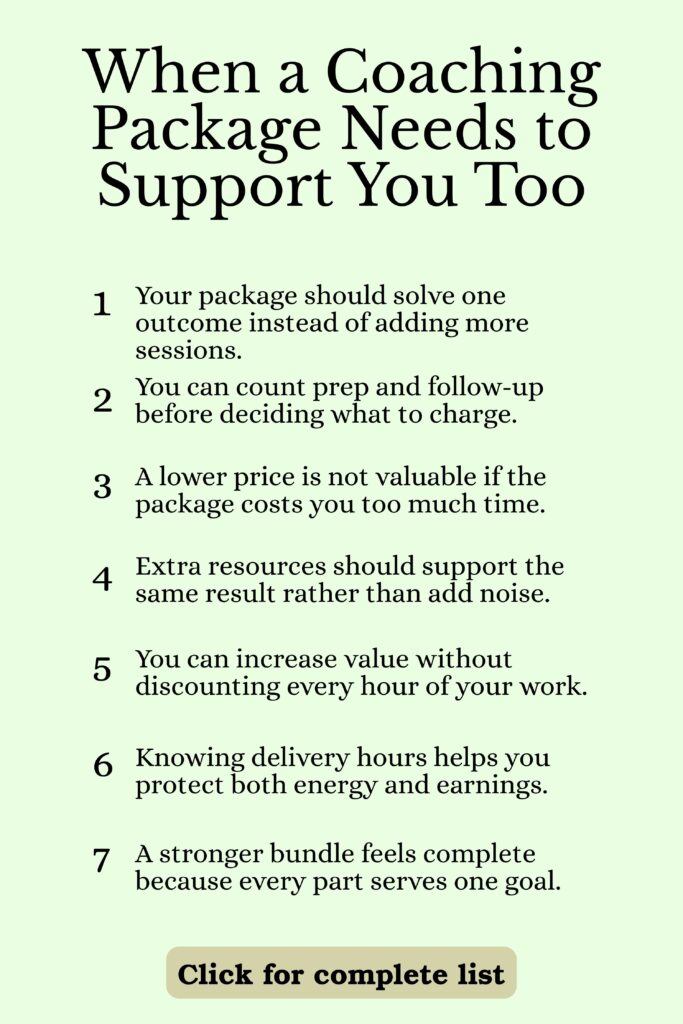
The package may still be worthwhile because it improves continuity, commitment, or predictable revenue. But now you can see the tradeoff instead of assuming that selling more sessions automatically means earning more.
You also do not have to discount heavily to make a bundle attractive. You can increase value by combining things that support the same outcome, such as:
- Coaching sessions
- A structured assessment
- Worksheets or exercises
- Between-session action steps
- A progress review
- Limited feedback between sessions
A relationship coach might package four sessions with a conflict-pattern assessment and structured conversation practice. A career coach might combine interview sessions with mock interviews, feedback, and a preparation workbook.
The strongest bundle feels more complete because its pieces work together, not simply because several items have been marked down.
Should You Offer Free Coaching or Free Resources?
So many people can benefit so much from life coaching, but they just don’t do it. Usually this is because they can’t warrant spending money on coaching because they don’t understand what they would get from it. If you offer a sample, potential clients will get the gist.
You could do a newsletter to get the word out. Offering a free introductory half hour session is a great option. Whatever freebie you choose, it should be a great demonstration of what life coaching is and how it could benefit clients.
SEE ALSO: If you’re a coach looking to streamline your administrative tasks and save time, check out our Coaching Administration Software. It’s a simple, effective solution designed to help you focus less on paperwork and more on what matters—coaching your clients. From scheduling to client management, our software gives you the tools to run your business efficiently. Ready to reclaim your time and boost productivity? Click or tap here.
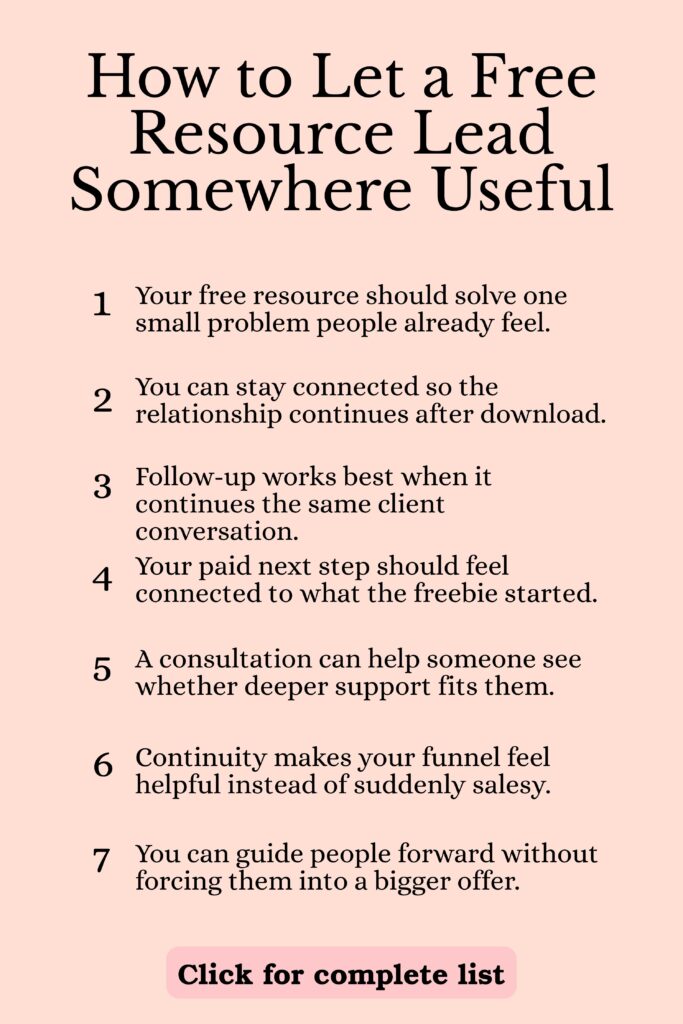
How Does a Freebie Turn Into a Paying Coaching Client?
A free resource is most useful when it leads naturally to one clear next step. Giving someone useful information without deciding what happens afterward may create goodwill, but it does not create much of a client pathway.
A simple freebie funnel looks like this:
- Step 1: Solve one small problem. Give the person a checklist, assessment, worksheet, short training, or introductory session.
- Step 2: Capture the relationship. Give them a way to stay connected rather than disappearing after the download or session.
- Step 3: Follow up around the same problem. Add another useful example, question, or insight rather than abruptly changing topics.
- Step 4: Offer the logical next step. This could be a consultation, workshop, starter session, or small paid product.
- Step 5: Connect the starter offer to your core coaching. Make clear who needs deeper support and what that support involves.
For example, a career coach could offer a free interview-preparation checklist. The follow-up might invite the reader to book a paid mock interview where they practice answers and receive direct feedback.
Someone who discovers that their main problem is not knowing what to say, but freezing when challenged, now has a reason to consider a more substantial interview coaching package.
That path works because each step continues the same conversation.
A free resource about interview preparation followed by an unrelated offer about productivity creates a disconnect. A free resource followed by relevant practice, feedback, and deeper coaching creates continuity.
SEE ALSO: If you’re a coach looking to streamline your administrative tasks and save time, check out our Coaching Administration Software. It’s a simple, effective solution designed to help you focus less on paperwork and more on what matters—coaching your clients. From scheduling to client management, our software gives you the tools to run your business efficiently. Ready to reclaim your time and boost productivity? Click or tap here.
Which Numbers Tell You Whether Your Coaching Business Is Actually Growing?
The most useful coaching business metrics show where people enter your business, where they become clients, and how much value each client relationship creates. Revenue alone cannot tell you which part of the system is working.
Start with a small monthly scorecard:
- Qualified leads: How many people showed genuine interest in your coaching?
- Consultations booked: How many moved from interest to a conversation?
- Consult-to-client conversion: How many consultations became paying clients?
- Package renewals: How many clients chose to continue after their initial work?
- Average revenue per client: How much did the average client spend with you?
- Revenue by offer: Which services or products actually generated money?
You can also track client lifetime value, which is the total revenue a client generates across the full relationship with your business.
Imagine two coaches each attract 10 new clients. One sells a single $150 session to each person. The other has some clients continue into a $900 package and later purchase a $200 workshop.
The lead count alone makes those businesses look similar. Client value tells a very different story.
This matters when you are deciding where to put your effort. The 2025 ICF Global Coaching Study found that 59% of surveyed coaches expected their revenue to increase over the following year, with that growth expected to come more from additional clients and coaching sessions than from higher fees.
SEE ALSO: If you’re a coach looking to streamline your administrative tasks and save time, check out our Coaching Administration Software. It’s a simple, effective solution designed to help you focus less on paperwork and more on what matters—coaching your clients. From scheduling to client management, our software gives you the tools to run your business efficiently. Ready to reclaim your time and boost productivity? Click or tap here.
More activity can certainly grow revenue, but your own numbers will tell you whether that activity is producing a healthier business or simply a fuller calendar.
Frequently Asked Questions
How can I grow my coaching business without taking on more one-to-one clients?
You can grow beyond one-to-one capacity by adding offers that serve more people or require less live delivery time. Group coaching, workshops, courses, digital resources, training, and carefully designed packages can all extend the same expertise into different formats.
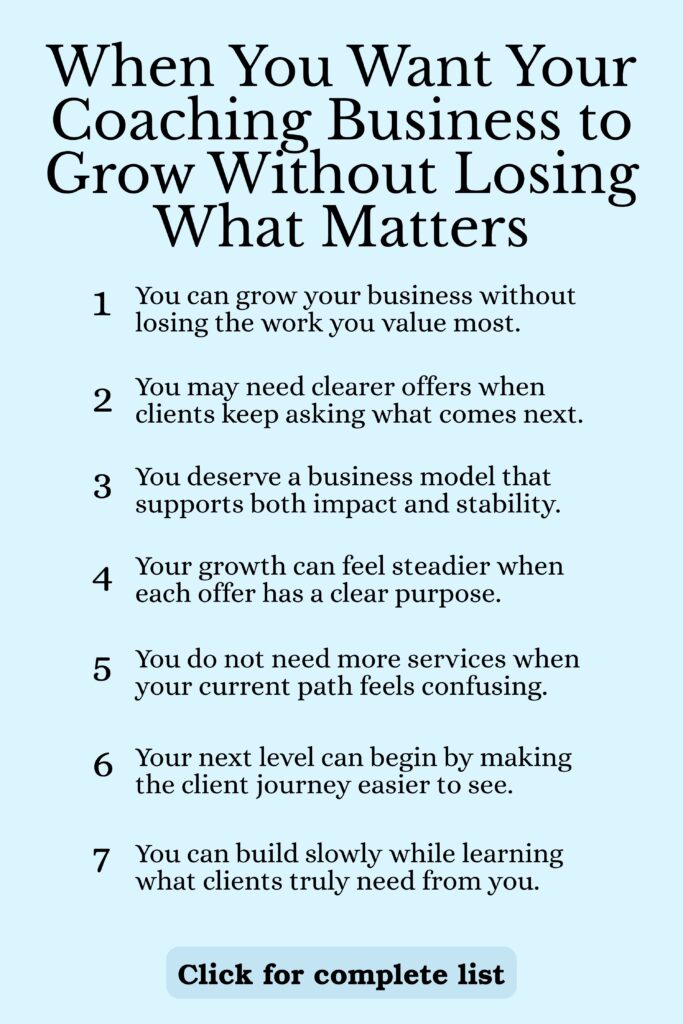
Start with a problem your existing clients already bring to you rather than inventing an entirely new topic.
What services can a life coach offer besides one-to-one coaching?
Life coaches can offer group coaching, workshops, courses, assessments, workbooks, digital resources, retreats, training, speaking, and other services that fit their qualifications and area of practice.
The useful question is not how many formats you could offer. It is which format helps your clients solve a recurring problem in a way that also makes business sense for you.
How do I create coaching packages clients understand and value?
Create a coaching package around one recognizable outcome and include only the components that help clients reach it. A package called “Six Coaching Sessions” explains quantity, while a structured career-transition package can explain the journey, support, practice, and result the client is buying.
SEE ALSO: If you’re a coach looking to streamline your administrative tasks and save time, check out our Coaching Administration Software. It’s a simple, effective solution designed to help you focus less on paperwork and more on what matters—coaching your clients. From scheduling to client management, our software gives you the tools to run your business efficiently. Ready to reclaim your time and boost productivity? Click or tap here.
Sessions are the delivery method. The client is usually buying progress on a problem.
Should I discount coaching packages?
You do not have to discount coaching packages to make them attractive. A package can create additional value through structure, resources, assessments, follow-up, or progress reviews rather than simply reducing the price of your time.
If you do discount, calculate the total delivery hours first so you know what the discount does to your effective hourly revenue.
Are free coaching sessions a good way to attract clients?
Free introductory sessions can work when they have a defined purpose and a clear next step. They are less useful when they become full coaching sessions with no connection to a paid offer.
A short diagnostic or consultation may sometimes make more sense because it lets both you and the prospect identify the problem before discussing deeper work.
How do I know which coaching offer to create next?
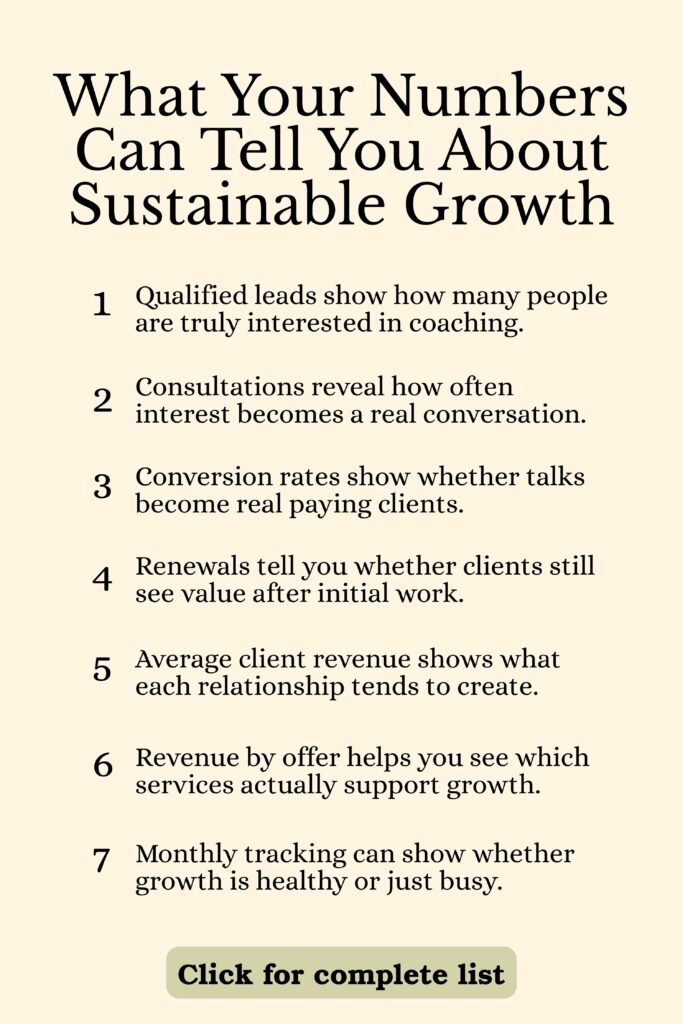
Create the offer that addresses a repeated client problem, fits your expertise, and can be delivered at a sustainable cost. Look through consultation notes, client questions, session themes, and requests for additional support.
SEE ALSO: If you’re a coach looking to streamline your administrative tasks and save time, check out our Coaching Administration Software. It’s a simple, effective solution designed to help you focus less on paperwork and more on what matters—coaching your clients. From scheduling to client management, our software gives you the tools to run your business efficiently. Ready to reclaim your time and boost productivity? Click or tap here.
Repeated behavior is useful evidence. One interesting idea is not.
What numbers should I track when growing a coaching business?
Track qualified leads, consultations, conversion rate, renewals, average revenue per client, and revenue by offer. These numbers show whether your problem is attracting interest, converting prospects, retaining clients, or creating enough value from each relationship.
A simple monthly spreadsheet is enough to start. Consistent numbers are more useful than a complicated dashboard you rarely review.
What Should You Try First?
There are many strategies you could try for growing your coaching business—these marketing tips are just a start. Incorporate tips like these slowly, one at a time, so you can see what is working the best for you and your coaching business. By continuing to try new methods and working toward bettering your business, you are likely to see more clients and higher profits in no time.
Sources
International Coaching Federation. “Coaching Industry Continues Global Growth with $5.34 Billion USD Revenue, New Research Reveals.” International Coaching Federation, 16 Sept. 2025. International Coaching Federation source. Accessed 17 Sept. 2026.

Read this next

Life Coaching Business Plan: A Quick Template
Do you have a business plan in place for your coaching business?
Read More
How to Scale a Coaching Business (Four Killer Strategies)
Your business is profitable at a small scale, now what? Learn how to establish a management team that shares your values.
Read More
Best Coaching Software for Life Coaches: What to Look For Before You Choose
Most life coaches do not start looking for coaching software because they love tech. They start looking because something in the business is getting harder to manage. Client notes are […]
Read More