






How to Manage your Transition into Life Coaching

A smooth transition into any big step in your life can make the experience less stressful.
Becoming a life coach is probably one of the greatest choices you can make for yourself. Life coaches enjoy a fulfilling, rewarding career. Essentially an entrepreneurial opportunity, life coaching allows you to work from home and set your own schedule, with the potential to build a profitable business around helping others.
Becoming a life coach certainly sounds fantastic, and it certainly can be, but transitioning from your previous employment can be a bit tough for many. This transition can be stressful, and it may even scare some folks away from their new life as a coach.
The following tips are designed to make this transition into your new life and career smoother, while helping you build the financial resources, client base, and working routines that will support your coaching business.
Key Takeaways
- Keep your current income while building your coaching business. Starting part-time gives you the opportunity to develop your coaching skills, test your services, and attract paying clients before depending entirely on coaching revenue.
- Calculate your financial runway before leaving employment. Know your essential household expenses, business operating costs, savings, and monthly revenue requirements so you can make the transition based on financial evidence rather than enthusiasm alone.
- Test a focused coaching offer with paying clients. A small paid pilot helps you find out whether people will purchase your services, what they expect from coaching, and whether your pricing supports a viable business.
- Build a repeatable process for attracting and booking clients. Track where inquiries originate, how many prospects book consultations, and how many become paying clients before investing more time in marketing.
- Use measurable milestones to decide when to transition full-time. Consistent client demand, sufficient financial reserves, realistic working capacity, and an organized coaching process provide stronger evidence of readiness than one successful month.
How Do You Transition Into Life Coaching While Still Working?
You can transition into life coaching while keeping your current job by building your coaching business part-time, testing a paid coaching offer, and gradually increasing your client base. The goal is to establish reliable demand and workable business routines before making coaching your primary source of income.
Start by calculating your financial requirements, choosing a specific coaching audience, setting aside regular business hours, and offering a focused coaching package. Use your first paying clients to test your pricing, client acquisition process, and the amount of time required to deliver your services.
SEE ALSO: If you’re a coach looking to streamline your administrative tasks and save time, check out our Coaching Administration Software. It’s a simple, effective solution designed to help you focus less on paperwork and more on what matters—coaching your clients. From scheduling to client management, our software gives you the tools to run your business efficiently. Ready to reclaim your time and boost productivity? Click or tap here.
Once you have sufficient financial reserves, evidence of ongoing client demand, and the capacity to manage a full-time coaching practice, you can consider reducing your employment hours or leaving your job entirely. A staged transition allows you to make each decision using actual business results.
Should You Keep Your Job While Starting a Coaching Business?
You are surely excited about starting your coaching business, but don’t jump right in with two feet. It can be tempting to leave your old life behind and fully embrace this entrepreneurial opportunity, but that probably isn’t wise.
Unless you have savings and additional financial resources, you may not want to completely quit your old job. As a life coach, you may be working at home and making your own schedule. Until you build up a client base, you probably will want to hang on to your previous employment on at least a part-time basis.
Once you build up your client base and your economic resources, it may be time to dive in. Be sure that you can support yourself financially before you quit your other employment and begin focusing on life coaching.
You can also make the transition in stages. For example, you might begin by offering two evening coaching sessions each week, then reduce your regular employment hours once those appointments become consistently booked.
This lets you learn how much work is involved in running a coaching business while maintaining the dependable income you already have.
SEE ALSO: If you’re a coach looking to streamline your administrative tasks and save time, check out our Coaching Administration Software. It’s a simple, effective solution designed to help you focus less on paperwork and more on what matters—coaching your clients. From scheduling to client management, our software gives you the tools to run your business efficiently. Ready to reclaim your time and boost productivity? Click or tap here.
How Much Financial Runway Do You Need Before Quitting Your Job?
You need enough financial runway to cover your essential living expenses and coaching business costs while your practice develops into a reliable source of income.
Financial runway is the length of time your available savings can support you if your coaching business earns less than expected.
Start by calculating three numbers:
- Essential living expenses: Housing, groceries, utilities, insurance, transportation, debt payments, and other necessary household costs.
- Business operating costs: Coaching software, professional insurance, website expenses, marketing, training, and other recurring business costs.
- Available financial reserves: Money you can use during the transition without relying on credit cards or funds already committed to other obligations.
Suppose your household expenses are $3,000 per month and running your coaching business costs another $300.
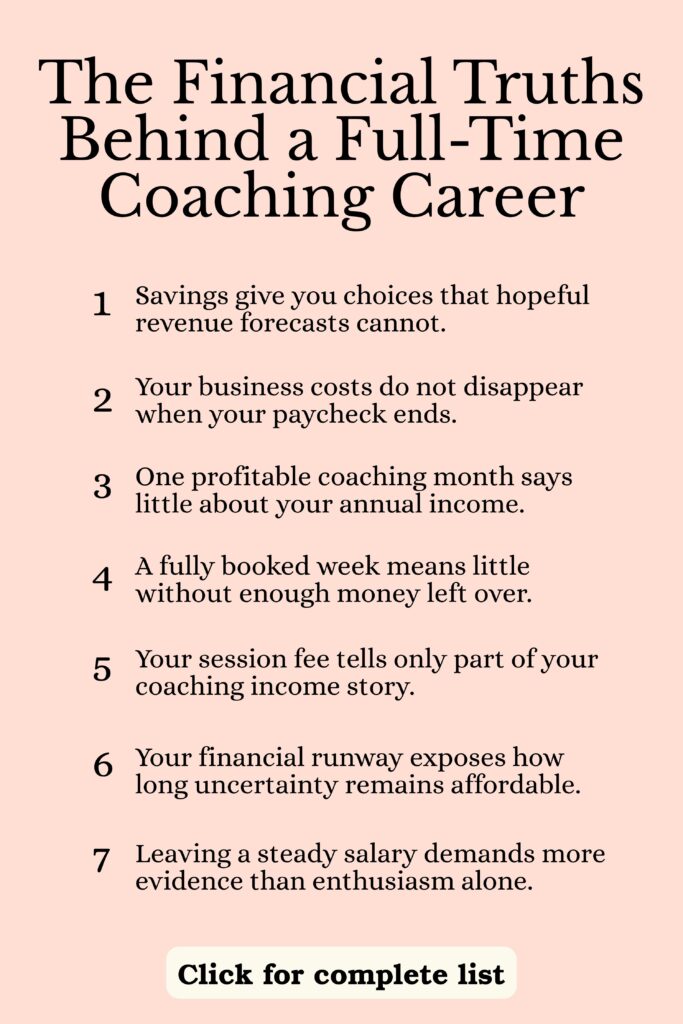
Your combined monthly requirement is $3,300. Six months of those expenses would require $19,800 in reserves, before accounting for taxes, irregular expenses, or a separate emergency fund.
Six months is an example rather than a universal requirement. Your circumstances, household income, financial obligations, and tolerance for uncertainty will determine the amount you need.
SEE ALSO: If you’re a coach looking to streamline your administrative tasks and save time, check out our Coaching Administration Software. It’s a simple, effective solution designed to help you focus less on paperwork and more on what matters—coaching your clients. From scheduling to client management, our software gives you the tools to run your business efficiently. Ready to reclaim your time and boost productivity? Click or tap here.
You also need to calculate how much coaching revenue your business must generate.
The U.S. Small Business Administration explains that break-even analysis helps business owners determine the sales required to cover operating costs. Its basic formula divides fixed costs by the selling price minus the variable cost per sale.
For a coach, this means looking beyond the price of a session.
Imagine you charge $150 per coaching session. If you need $4,500 in monthly revenue before transaction costs and other adjustments, that represents 30 sessions per month. You would need additional revenue to cover any per-session fees and other costs not already included.
The calculation becomes more useful when you compare the revenue target with your actual schedule.
Can you consistently book that many paid sessions? Do you have time to prepare, manage clients, and continue marketing your services?
SEE ALSO: If you’re a coach looking to streamline your administrative tasks and save time, check out our Coaching Administration Software. It’s a simple, effective solution designed to help you focus less on paperwork and more on what matters—coaching your clients. From scheduling to client management, our software gives you the tools to run your business efficiently. Ready to reclaim your time and boost productivity? Click or tap here.
And will the resulting income cover business expenses, taxes, and the amount you need to take home?
A coach who understands these numbers can make a much stronger decision about leaving employment than one who simply hopes that more clients will arrive.
How Can You Test Your Coaching Offer Before Going Full Time?
The most practical way to test a new coaching offer is to sell a small, clearly defined paid program to the type of client you want to serve.
You may have completed your coaching training and feel confident about helping people make meaningful changes. But confidence in your coaching ability is not the same as evidence that people will purchase your services.
Before building an entire business around an offer, find out whether there is demand for it.
Start with one coaching audience and one specific problem.
SEE ALSO: If you’re a coach looking to streamline your administrative tasks and save time, check out our Coaching Administration Software. It’s a simple, effective solution designed to help you focus less on paperwork and more on what matters—coaching your clients. From scheduling to client management, our software gives you the tools to run your business efficiently. Ready to reclaim your time and boost productivity? Click or tap here.
For example, instead of offering general life coaching to anyone interested in personal development, you could offer a six-session career transition package for professionals considering a change of direction.
The package might help clients clarify their career priorities, explore realistic options, identify obstacles, and develop a practical transition plan.
Then test the offer with a small group of paying clients.
A coach who previously worked in human resources might begin by offering this package to three professionals while continuing their regular employment.
During the pilot, pay attention to:
- Whether your intended audience understands the offer and is willing to pay for it.
- Which concerns and desired outcomes appear repeatedly in discovery conversations.
- Whether the package length and price make sense for the work involved.
- How much preparation and follow-up time each client requires.
- What clients find valuable and where the coaching experience could improve.
Actual purchases tell you more about demand than compliments from people who say your business idea sounds interesting.
SEE ALSO: If you’re a coach looking to streamline your administrative tasks and save time, check out our Coaching Administration Software. It’s a simple, effective solution designed to help you focus less on paperwork and more on what matters—coaching your clients. From scheduling to client management, our software gives you the tools to run your business efficiently. Ready to reclaim your time and boost productivity? Click or tap here.
Credibility matters, too. According to the International Coaching Federation’s 2025 ICF Global Coaching Study, 73% of surveyed coaches agreed that clients and organizations expect coaches to hold a certification or credential.
That is not evidence that every coaching client requires certification, but it is a useful reminder to present your training, experience, and professional qualifications accurately.
Once you have tested your package, make adjustments based on what you have learned.
You might discover that clients prefer six sessions over three, that your original offer is too broad, or that one particular coaching problem generates more interest than the others.
If you use LCH Core, you can create coaching packages and manage payments while testing your offer. Its support guide on creating coaching packages and sessions explains the setup.
Start with one offer that people understand and are prepared to buy. You can expand your services once you have evidence of what works.
SEE ALSO: If you’re a coach looking to streamline your administrative tasks and save time, check out our Coaching Administration Software. It’s a simple, effective solution designed to help you focus less on paperwork and more on what matters—coaching your clients. From scheduling to client management, our software gives you the tools to run your business efficiently. Ready to reclaim your time and boost productivity? Click or tap here.
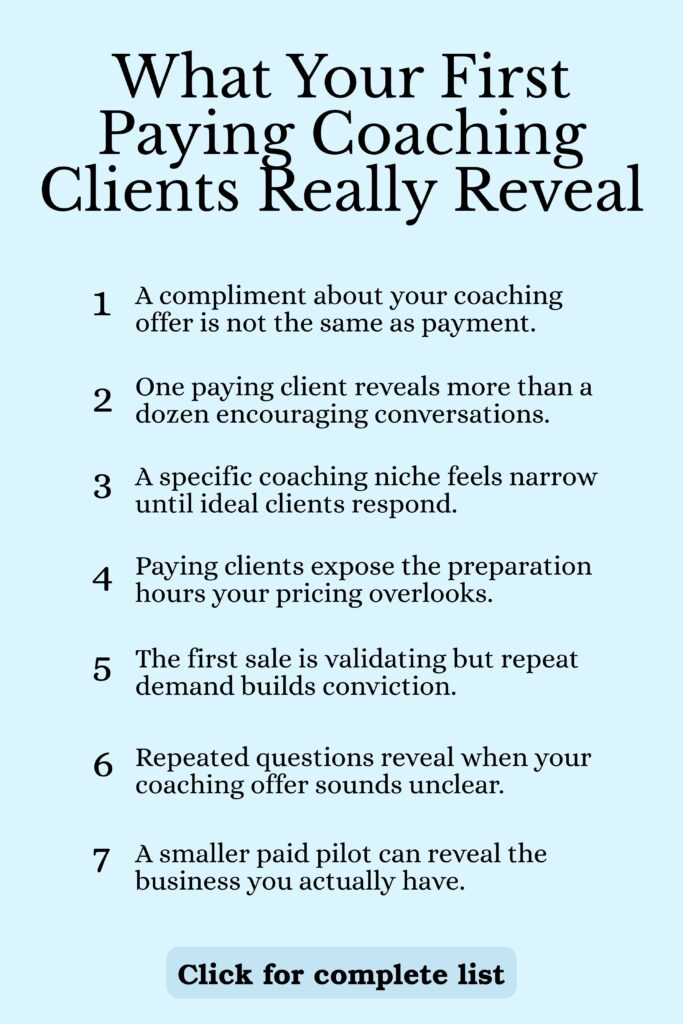
How Do You Get Your First Paying Coaching Clients While Still Employed?
Getting your first paying coaching clients while employed requires a repeatable process for reaching the right people, starting conversations, and turning genuine interest into booked sessions.
You do not need to market your coaching business everywhere at once.
In fact, spreading your limited time across too many marketing channels can make it difficult to identify which activities produce clients.
Start with one audience, one offer, and one or two channels where you can realistically reach potential clients.
For example, a career coach might use LinkedIn to share useful career transition advice and reconnect with professionals in their existing network.
A parenting coach might develop relationships with local parent organizations and offer an introductory workshop on a specific parenting challenge.
SEE ALSO: If you’re a coach looking to streamline your administrative tasks and save time, check out our Coaching Administration Software. It’s a simple, effective solution designed to help you focus less on paperwork and more on what matters—coaching your clients. From scheduling to client management, our software gives you the tools to run your business efficiently. Ready to reclaim your time and boost productivity? Click or tap here.
Both approaches create opportunities for conversations with people who may benefit from coaching.
The next step is making it easy for interested people to work with you.
A simple client acquisition process looks like this:
- Visibility: A potential client discovers you through a referral, directory profile, professional network, or useful content.
- Interest: They recognize that your coaching addresses a problem they want to solve.
- Conversation: They contact you or book a discovery call to discuss their situation.
- Decision: They receive a clear explanation of your offer and decide whether to purchase a coaching package.
- Follow-up: You maintain appropriate contact with interested prospects who are not ready to commit immediately.
This is a basic coaching funnel. For a more detailed explanation, see How to Master Funnels as a Coach (and Why You Need To).
Your goal is not simply to attract more attention. It is to understand which activities produce qualified inquiries and paying clients.
Keep a simple record of how many people contact you, how many discovery calls take place, and how many clients purchase coaching.
SEE ALSO: If you’re a coach looking to streamline your administrative tasks and save time, check out our Coaching Administration Software. It’s a simple, effective solution designed to help you focus less on paperwork and more on what matters—coaching your clients. From scheduling to client management, our software gives you the tools to run your business efficiently. Ready to reclaim your time and boost productivity? Click or tap here.
Suppose you receive 12 inquiries in a month, six people book consultations, and three purchase a package.
That gives you a starting point for evaluating your marketing. Over several months, you can see whether the results are consistent or depend on occasional referrals.
You can also make your services easier to discover by creating a free life coach directory listing on Life Coach Hub.
A directory profile gives potential clients another way to learn about your background, specialties, and coaching services.
When someone is ready to speak with you, a Public Booking Page can provide a direct appointment-booking option. The Public Booking Page setup guide explains how to make selected sessions available for prospects to book.
One important lesson: a prospect who does not book immediately is not necessarily a lost opportunity.
SEE ALSO: If you’re a coach looking to streamline your administrative tasks and save time, check out our Coaching Administration Software. It’s a simple, effective solution designed to help you focus less on paperwork and more on what matters—coaching your clients. From scheduling to client management, our software gives you the tools to run your business efficiently. Ready to reclaim your time and boost productivity? Click or tap here.
Someone may be considering their options, comparing coaches, or waiting until they have time to commit.
A thoughtful follow-up message or useful resource can give them a reason to reconnect.
The more consistently you can attract, follow up with, and convert suitable prospects, the more confidently you can plan your transition into full-time coaching.
How Do You Make Time for Life Coaching While Working Another Job?
Becoming a life coach means that you have started a business. You are your own boss, and you set your own schedule. It can be tempting to work whenever you want, but no matter how much fun life coaching is, you probably won’t work as much as you need to if you don’t create a schedule for yourself.
Keep a calendar and schedule regular working hours for yourself. If you are building your practice while employed, those hours may initially fall on two or three evenings or during designated weekend periods.
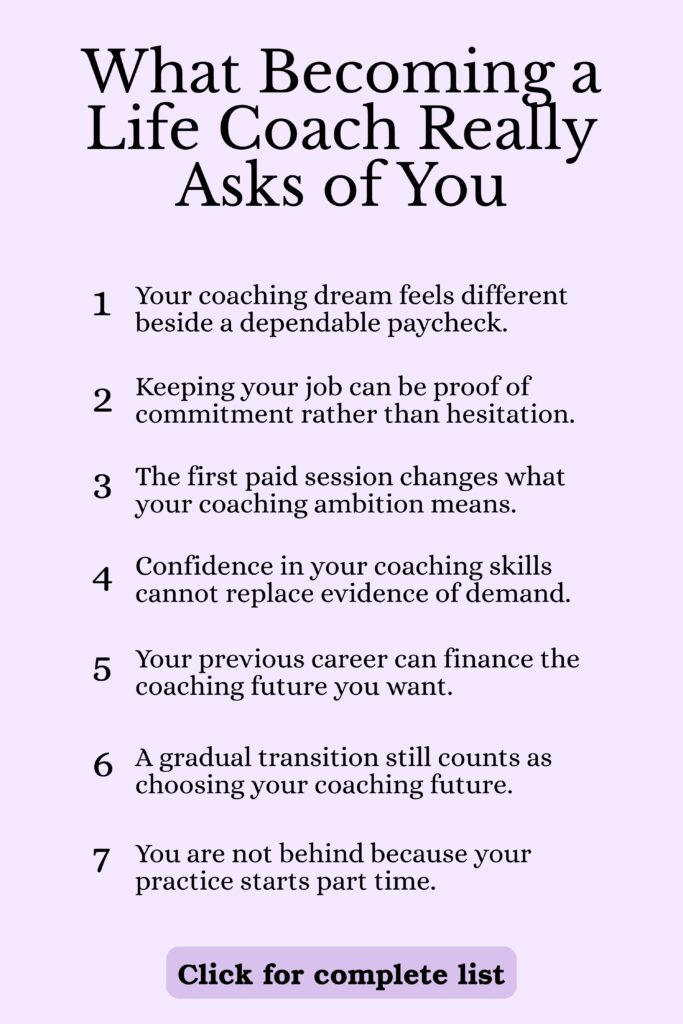
Do what you can to stick to your work schedule. If you don’t protect time for building your coaching business and working with your clients, it will be difficult to turn your coaching business into a successful full-time job.
SEE ALSO: If you’re a coach looking to streamline your administrative tasks and save time, check out our Coaching Administration Software. It’s a simple, effective solution designed to help you focus less on paperwork and more on what matters—coaching your clients. From scheduling to client management, our software gives you the tools to run your business efficiently. Ready to reclaim your time and boost productivity? Click or tap here.
Treat these working periods as appointments with your business, even when you do not yet have enough clients to fill them.
For example, you might reserve Tuesday evenings for coaching sessions, Thursday evenings for client follow-up, and Saturday mornings for marketing and business administration.
A regular schedule also helps prospective clients understand when they can book appointments with you.
How Many Coaching Clients Can You Realistically Fit Into Your Week?
Your realistic coaching capacity is the number of clients you can serve after accounting for session time, preparation, administration, and the work required to keep attracting new clients.
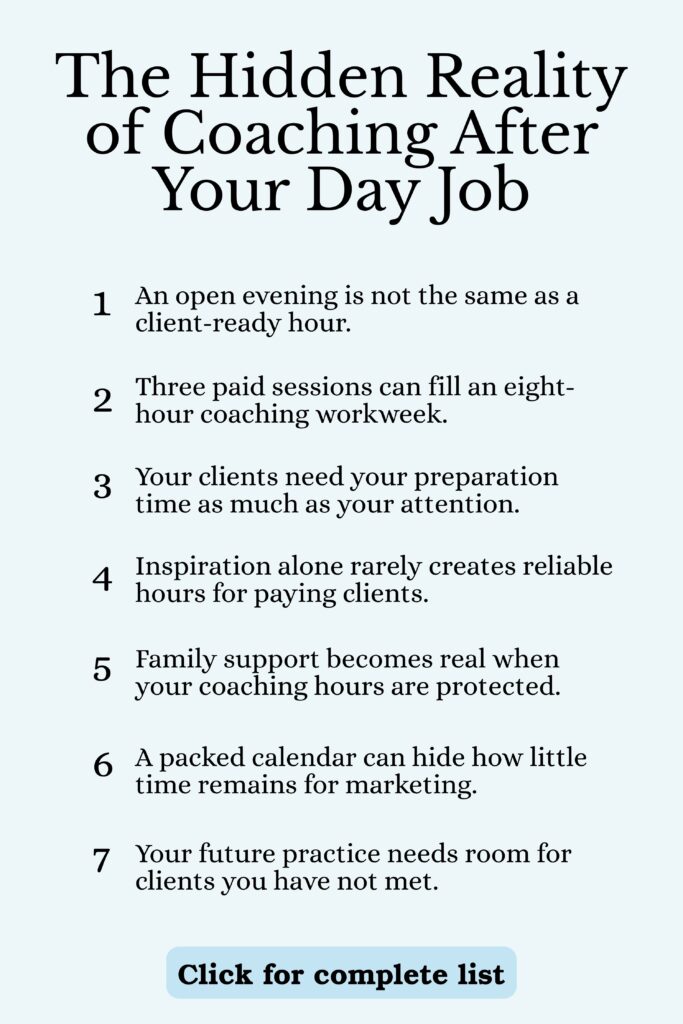
Having eight hours available for your coaching business does not mean you can automatically schedule eight one-hour client appointments.
Coaching involves considerably more than the time you spend speaking with clients.
SEE ALSO: If you’re a coach looking to streamline your administrative tasks and save time, check out our Coaching Administration Software. It’s a simple, effective solution designed to help you focus less on paperwork and more on what matters—coaching your clients. From scheduling to client management, our software gives you the tools to run your business efficiently. Ready to reclaim your time and boost productivity? Click or tap here.
Imagine you have eight hours available each week while working another job.
Your weekly time budget might look like this:
- 3 hours: Paid coaching sessions with three clients.
- 1 hour: Session preparation and coaching notes.
- 1 hour: Client follow-up and reviewing agreed action items.
- 2 hours: Marketing, networking, and discovery conversations.
- 1 hour: Scheduling, payments, and business administration.
That leaves room for three one-hour coaching sessions, not eight.
If you fill every available hour with appointments, you may have no time left to find the clients who will replace those who finish their packages.
Your capacity can also change depending on how you deliver coaching.
A coach working with clients on a structured six-session package may need time to review worksheets, prepare questions, and document client progress.
SEE ALSO: If you’re a coach looking to streamline your administrative tasks and save time, check out our Coaching Administration Software. It’s a simple, effective solution designed to help you focus less on paperwork and more on what matters—coaching your clients. From scheduling to client management, our software gives you the tools to run your business efficiently. Ready to reclaim your time and boost productivity? Click or tap here.
Another coach offering shorter, focused sessions might use a different schedule.
Calculate the actual time involved before deciding how many clients you can take on.
You should also consider the type of client experience you want to provide. Taking on more appointments than you can properly prepare for may affect the quality of your coaching.
This is where basic systems become useful.
LCH Core allows you to manage scheduling and booking through a Public Booking Page. You can define the appointment times you want to make available instead of negotiating every booking individually.
Coaching tools such as reusable worksheets, goals, and action items can also reduce the need to recreate materials for each client.
SEE ALSO: If you’re a coach looking to streamline your administrative tasks and save time, check out our Coaching Administration Software. It’s a simple, effective solution designed to help you focus less on paperwork and more on what matters—coaching your clients. From scheduling to client management, our software gives you the tools to run your business efficiently. Ready to reclaim your time and boost productivity? Click or tap here.
The aim is not to fill every hour. It is to develop a sustainable schedule that supports both your clients and your business.
What Support Do You Need While Building Your Coaching Business?
As you transition into your coaching business, you will want to get support from your friends, family, and other loved ones. Their support will help give you the confidence to start your business and stick with it if you have difficulties during your transition.
To get support from the people in your life, you need to let others know how important this is to you.
If people look at your new life coaching role as just another job, they may not understand why they need to be there for you more than they normally are. Express to those who are close to you that this is a business you are starting and that the good you can do in this new position is worth the effort involved.
You may also need to be specific about the support you are asking for.
For example, if you plan to coach clients on Tuesday and Thursday evenings, explain that those hours need to remain available for appointments. If you share family responsibilities, discuss how household arrangements may need to change during those periods.
SEE ALSO: If you’re a coach looking to streamline your administrative tasks and save time, check out our Coaching Administration Software. It’s a simple, effective solution designed to help you focus less on paperwork and more on what matters—coaching your clients. From scheduling to client management, our software gives you the tools to run your business efficiently. Ready to reclaim your time and boost productivity? Click or tap here.
Professional support can be useful as well.
Another coach may be able to give you feedback on the clarity of your first coaching package, while an accountant can help you understand how self-employment will affect your taxes and financial planning.
Support does not mean handing responsibility for your business to someone else.
It means making sure the people and professional resources around you understand what you are trying to build and where their assistance would be useful.
How Do You Know When You’re Ready to Leave Your Job for Coaching?
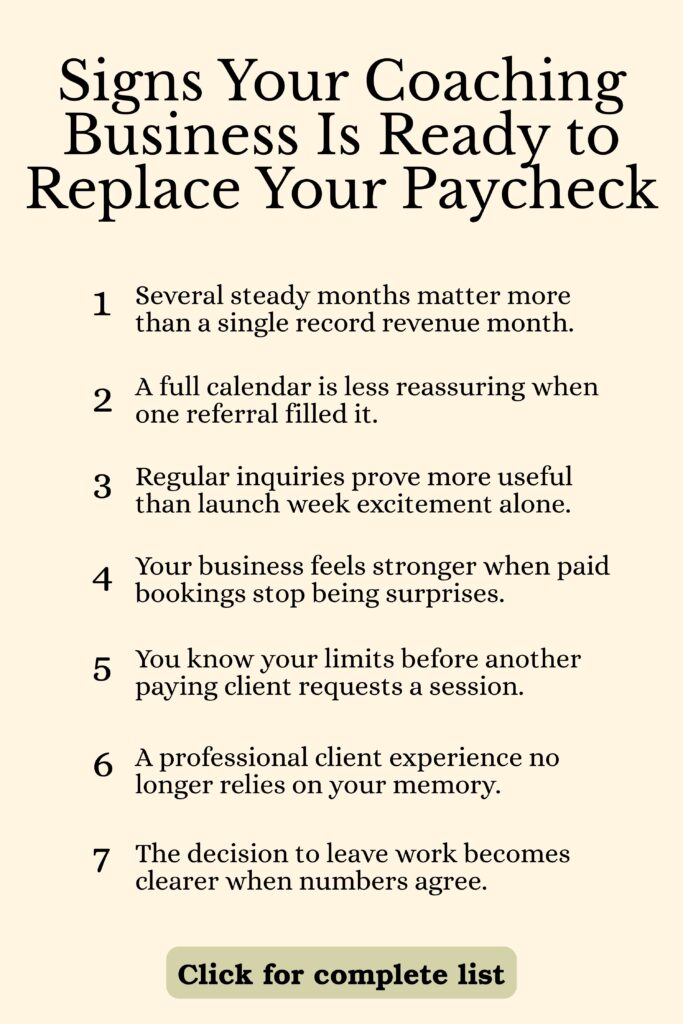
You are ready to consider leaving your job for coaching when your finances, paying-client demand, and business capacity show that the transition is reasonably sustainable.
Excitement about coaching is valuable, but it should not be the deciding factor when giving up a dependable paycheck.
SEE ALSO: If you’re a coach looking to streamline your administrative tasks and save time, check out our Coaching Administration Software. It’s a simple, effective solution designed to help you focus less on paperwork and more on what matters—coaching your clients. From scheduling to client management, our software gives you the tools to run your business efficiently. Ready to reclaim your time and boost productivity? Click or tap here.
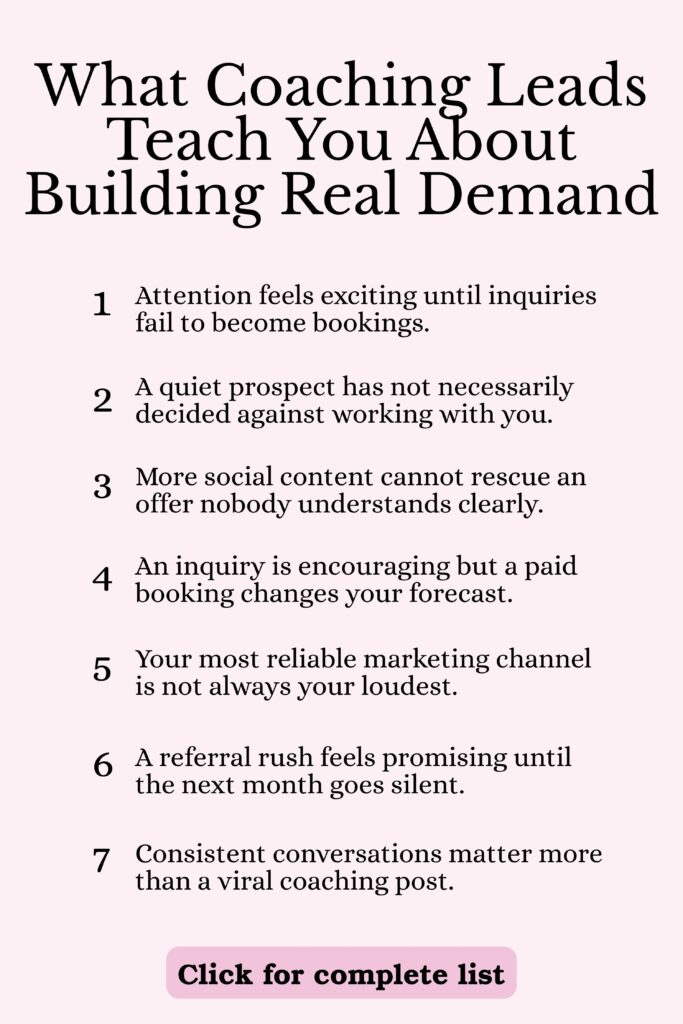
Instead, assess your readiness using three separate tests.
1. Financial readiness
Can your savings and expected coaching income support your household while allowing for business expenses, taxes, and fluctuations in revenue?
Compare your current income requirements with the money your coaching business is actually generating.
A coach who earns $3,000 one month and $500 the next has a very different financial position from someone earning similar amounts consistently.
2. Client demand
SEE ALSO: If you’re a coach looking to streamline your administrative tasks and save time, check out our Coaching Administration Software. It’s a simple, effective solution designed to help you focus less on paperwork and more on what matters—coaching your clients. From scheduling to client management, our software gives you the tools to run your business efficiently. Ready to reclaim your time and boost productivity? Click or tap here.
Are you attracting paying clients through a process you can repeat?
Look at your paid bookings, recent inquiries, discovery calls, active coaching packages, and likely future demand.
A full calendar created by one large referral is encouraging, but it does not necessarily demonstrate a dependable flow of new clients.
Pay attention to whether your marketing continues to produce inquiries after the initial excitement of launching your business.
3. Business capacity
Can you manage more coaching clients without losing control of appointments, payments, client information, and your personal working hours?
SEE ALSO: If you’re a coach looking to streamline your administrative tasks and save time, check out our Coaching Administration Software. It’s a simple, effective solution designed to help you focus less on paperwork and more on what matters—coaching your clients. From scheduling to client management, our software gives you the tools to run your business efficiently. Ready to reclaim your time and boost productivity? Click or tap here.
Consider whether you have established a repeatable way to onboard clients, keep records, deliver coaching, and follow up between sessions.
You should also know how many additional clients you could realistically serve if you stopped working at your previous job.
These three tests provide a useful decision framework.
Suppose a coach has six active clients, a successful coaching package, and enough savings to cover several months of expenses.
However, most clients came from one workshop, and there have been no new inquiries for the past six weeks.
The coach has demonstrated that people will pay for the service, but has not yet established reliable ongoing demand.
SEE ALSO: If you’re a coach looking to streamline your administrative tasks and save time, check out our Coaching Administration Software. It’s a simple, effective solution designed to help you focus less on paperwork and more on what matters—coaching your clients. From scheduling to client management, our software gives you the tools to run your business efficiently. Ready to reclaim your time and boost productivity? Click or tap here.
In that situation, continuing to work part-time while improving client acquisition may be the stronger decision.
By contrast, a coach with sufficient financial reserves, several months of steady bookings, and a manageable operating process may be in a position to reduce their employment hours.
You do not have to make the entire transition in one decision.
You might first negotiate a four-day employment week, then move to three days once your coaching business supports the additional time.
This approach allows you to reassess your position as your business develops.
The question is not simply whether you are ready to become a coach. It is whether your coaching business is ready to become your primary source of income.
SEE ALSO: If you’re a coach looking to streamline your administrative tasks and save time, check out our Coaching Administration Software. It’s a simple, effective solution designed to help you focus less on paperwork and more on what matters—coaching your clients. From scheduling to client management, our software gives you the tools to run your business efficiently. Ready to reclaim your time and boost productivity? Click or tap here.
What Should Your First 90 Days as a Full-Time Life Coach Look Like?
Your first 90 days as a full-time life coach should focus on maintaining client demand, delivering a reliable coaching experience, and reviewing the numbers that determine whether your business is sustainable.
Leaving your previous job creates more time for coaching, but that time needs to be managed deliberately.
Without a clear plan, it is possible to spend entire working days refining your website, creating content, or reorganizing files without generating additional income.
A simple 30/60/90-day plan can keep your attention on the work that matters.
Days 1 to 30: Establish your full-time working routine
Start by defining when you will coach clients, conduct consultations, market your services, and manage the business.
SEE ALSO: If you’re a coach looking to streamline your administrative tasks and save time, check out our Coaching Administration Software. It’s a simple, effective solution designed to help you focus less on paperwork and more on what matters—coaching your clients. From scheduling to client management, our software gives you the tools to run your business efficiently. Ready to reclaim your time and boost productivity? Click or tap here.
Review your existing clients and packages to understand how much of your expected income is already committed.
Choose a manageable number of marketing activities to perform consistently.
For example, a coach might dedicate two mornings each week to networking and prospect follow-up, while reserving afternoons for paid sessions.
Track the number of inquiries, discovery calls, and paid bookings generated by those activities.
Days 31 to 60: Improve your client acquisition and delivery process
Use the results of your first month to identify where the business needs attention.
SEE ALSO: If you’re a coach looking to streamline your administrative tasks and save time, check out our Coaching Administration Software. It’s a simple, effective solution designed to help you focus less on paperwork and more on what matters—coaching your clients. From scheduling to client management, our software gives you the tools to run your business efficiently. Ready to reclaim your time and boost productivity? Click or tap here.
If you are attracting inquiries but very few people purchase coaching, review your offer and discovery conversations.
Perhaps your package description is unclear, your pricing does not match what the audience expects, or prospects do not understand what happens after booking.
If new clients are purchasing but administration is consuming too much time, examine how you handle intake forms, appointments, payments, and coaching records.
This is also a good time to review how clients are progressing through their packages.
Are they completing agreed actions? Are they attending sessions consistently? Can they identify meaningful progress toward the goals they established?
For more on developing longer coaching relationships, see A Bird in the Hand: The Simple Math of Client Lifetime Value (for Coaches).
SEE ALSO: If you’re a coach looking to streamline your administrative tasks and save time, check out our Coaching Administration Software. It’s a simple, effective solution designed to help you focus less on paperwork and more on what matters—coaching your clients. From scheduling to client management, our software gives you the tools to run your business efficiently. Ready to reclaim your time and boost productivity? Click or tap here.
Days 61 to 90: Review the business and adjust your next quarter
By the third month, you should have enough activity to begin identifying useful patterns, although three months of results cannot guarantee long-term performance.
Compare your actual revenue with your financial targets.
Review the number of inquiries, consultations, new clients, and completed coaching packages.
Also examine how much time you spend on paid sessions compared with unpaid business activities.
A simple monthly scorecard might contain:
SEE ALSO: If you’re a coach looking to streamline your administrative tasks and save time, check out our Coaching Administration Software. It’s a simple, effective solution designed to help you focus less on paperwork and more on what matters—coaching your clients. From scheduling to client management, our software gives you the tools to run your business efficiently. Ready to reclaim your time and boost productivity? Click or tap here.
- Revenue collected from coaching.
- Number of new paying clients.
- Number of consultations completed.
- Number of clients continuing or renewing coaching.
- Hours spent on client delivery and business development.
Use these numbers to decide what to change.
If your client bookings are strong but you have little time left for marketing, you may need to adjust your schedule.
If your calendar has empty spaces but inquiries are increasing, you may need to improve how you turn those conversations into bookings.
If current clients are completing their packages without taking another step, consider whether an appropriate follow-on coaching offer would serve their next goal.
Your first 90 days should establish a regular habit of reviewing what is producing clients, revenue, and useful client outcomes.
That gives you a stronger foundation for planning the next three months.
SEE ALSO: If you’re a coach looking to streamline your administrative tasks and save time, check out our Coaching Administration Software. It’s a simple, effective solution designed to help you focus less on paperwork and more on what matters—coaching your clients. From scheduling to client management, our software gives you the tools to run your business efficiently. Ready to reclaim your time and boost productivity? Click or tap here.
Where LCH Core Fits
LCH Core can support your transition into professional coaching by bringing client management, scheduling, payments, onboarding, and coaching delivery into one system.
You do not need complicated software to start a coaching business, but you do need dependable processes for handling the work that comes with paying clients.
When you are also managing another job, repeating administrative tasks can consume time that would otherwise be available for coaching and business development.
A useful starting point is to organize the client journey around a few practical steps.
Make it easy for prospects to book.
A Public Booking Page gives interested people a way to schedule available coaching sessions or consultations.
SEE ALSO: If you’re a coach looking to streamline your administrative tasks and save time, check out our Coaching Administration Software. It’s a simple, effective solution designed to help you focus less on paperwork and more on what matters—coaching your clients. From scheduling to client management, our software gives you the tools to run your business efficiently. Ready to reclaim your time and boost productivity? Click or tap here.
You can decide which appointments to offer and when they can be booked.
Organize your clients and payments.
Client management features allow you to maintain client profiles, notes, and intake forms, while payments, coaching packages, and billing help you keep your financial transactions organized.
This is particularly useful when you begin managing several clients at different stages of their coaching packages.
Give new clients a professional start.
A Welcome Package can include a welcome letter, coaching agreement with electronic signature, and intake forms.
SEE ALSO: If you’re a coach looking to streamline your administrative tasks and save time, check out our Coaching Administration Software. It’s a simple, effective solution designed to help you focus less on paperwork and more on what matters—coaching your clients. From scheduling to client management, our software gives you the tools to run your business efficiently. Ready to reclaim your time and boost productivity? Click or tap here.
That provides a repeatable process for collecting information and establishing expectations before the first session.
The guide to onboarding clients with Welcome Packages explains how the process works.
Support client progress between sessions.
Reusable journals, worksheets, goals, action items, and resources can help clients continue working toward their objectives outside their appointments.
The Progress Stream provides a view of client activity and coaching progress, while the Engagement Report helps you identify clients whose participation may be declining.
These tools become more useful as your client list grows and it becomes harder to keep every detail in your head.
SEE ALSO: If you’re a coach looking to streamline your administrative tasks and save time, check out our Coaching Administration Software. It’s a simple, effective solution designed to help you focus less on paperwork and more on what matters—coaching your clients. From scheduling to client management, our software gives you the tools to run your business efficiently. Ready to reclaim your time and boost productivity? Click or tap here.
Create additional offers when your business is ready.
Once you have established consistent demand for your coaching services, you may decide to develop a course, digital product, or lead magnet.
A Public Store provides a place to make those offers available.
There is no need to build all of these products when you are still testing your first coaching package.
For a practical walkthrough of setting up the essential business processes, see How to Use the LCH Core Launchpad to Set Up Your Coaching Business, which also includes the Launchpad video tutorial.
The most useful approach is to begin with the systems you need for your current clients, then add more as the business develops.
SEE ALSO: If you’re a coach looking to streamline your administrative tasks and save time, check out our Coaching Administration Software. It’s a simple, effective solution designed to help you focus less on paperwork and more on what matters—coaching your clients. From scheduling to client management, our software gives you the tools to run your business efficiently. Ready to reclaim your time and boost productivity? Click or tap here.
Frequently Asked Questions About Transitioning Into Life Coaching
Can I Become a Life Coach While Working a Full-Time Job?
Yes, you can start a life coaching business while working a full-time job by offering appointments during designated evenings or weekends. Begin with a manageable number of clients and set aside separate time for marketing, administration, and professional development. Check your employment agreement for any restrictions on outside work.
How Much Money Should I Save Before Becoming a Full-Time Life Coach?
You should save enough to cover your essential living expenses and business costs during the period when coaching income may be inconsistent. Calculate your monthly requirements, choose an appropriate financial cushion, and consider how much household income will continue from other sources. Avoid making the decision based on expected sales that have not yet occurred.
How Long Does It Take to Get Your First Paying Life Coaching Clients?
Getting your first paying coaching clients can take weeks or months, depending on your audience, offer, pricing, credibility, and marketing activities. There is no reliable universal timetable. Testing a focused paid package and tracking inquiries and bookings will give you more useful information than relying on industry averages.
Do I Need a Certification to Start Working as a Life Coach?
A life coaching certification is not universally required to begin practicing, but legal requirements vary by location and by the services you provide. Training and recognized credentials can help demonstrate professional preparation and credibility. Check applicable local rules, particularly where your services could overlap with licensed professions such as mental health counseling.
How Should I Price My First Life Coaching Package?
Price your first coaching package by considering your delivery time, business expenses, financial targets, target audience, and the value of the service being offered. Include preparation and follow-up work in your calculations rather than pricing only the hours spent in sessions. Test your initial price with paying clients and review whether it supports a sustainable business.
How Many Coaching Clients Do I Need Before Quitting My Job?
The number of coaching clients you need depends on your package prices, expenses, available working hours, and the income you require. Calculate your monthly revenue target and divide it by the average monthly revenue earned per active client. Then assess whether your current client base and new-client pipeline can support that number consistently.
SEE ALSO: If you’re a coach looking to streamline your administrative tasks and save time, check out our Coaching Administration Software. It’s a simple, effective solution designed to help you focus less on paperwork and more on what matters—coaching your clients. From scheduling to client management, our software gives you the tools to run your business efficiently. Ready to reclaim your time and boost productivity? Click or tap here.
How Can I Find Coaching Clients If I Don’t Have an Audience?
You can find coaching clients without an existing online audience by focusing on professional networking, referrals, directory visibility, relevant communities, and direct conversations with potential clients. Start with one clearly defined coaching niche and a specific offer. Track which activities generate qualified consultations and paying clients before expanding your marketing.
What Tools Do I Need to Start a Life Coaching Business?
You need a reliable way to schedule appointments, collect payments, manage client information, document agreements, and organize coaching notes. A calendar, secure recordkeeping process, and payment method may be sufficient initially. As your practice grows, an integrated coaching platform can help you manage these activities alongside onboarding and client progress tracking.
What Should You Do Next?
As you start your coaching business, be prepared for not everything to be smooth sailing at first.
Some life coaches have trouble finding and retaining clients, others may have to adjust to making less money than they are used to, and certain coaches may have trouble adapting to being their own boss.
While those are just some difficulties you may experience, other life coaches encounter fewer problems as they get their coaching business up and running.
The difference often comes down to how carefully you prepare for the transition and how quickly you respond to what your business is telling you.
SEE ALSO: If you’re a coach looking to streamline your administrative tasks and save time, check out our Coaching Administration Software. It’s a simple, effective solution designed to help you focus less on paperwork and more on what matters—coaching your clients. From scheduling to client management, our software gives you the tools to run your business efficiently. Ready to reclaim your time and boost productivity? Click or tap here.
Start by identifying where you currently stand.
If you have not yet tested your coaching offer, begin with a small paid pilot.
If you have paying clients but uncertain finances, calculate your runway and revenue requirements.
If your coaching income is growing, review your client acquisition process and make sure you have enough time to support a larger practice.
By following these steps, you can reduce avoidable financial and operational risks while creating stronger opportunities for success as a life coach.
You do not need to abandon your previous career overnight to build a worthwhile coaching business. You can use the skills, experience, financial resources, and professional relationships you already have as the foundation for what comes next.
SEE ALSO: If you’re a coach looking to streamline your administrative tasks and save time, check out our Coaching Administration Software. It’s a simple, effective solution designed to help you focus less on paperwork and more on what matters—coaching your clients. From scheduling to client management, our software gives you the tools to run your business efficiently. Ready to reclaim your time and boost productivity? Click or tap here.
And when you are ready to organize your bookings, clients, and coaching delivery in one place, you can explore LCH Core and start with the tools that fit your current stage.
Sources
International Coaching Federation. 2025 ICF Global Coaching Study. International Coaching Federation, 2025, https://coachingfederation.org/resources/research/global-coaching-study/.
U.S. Small Business Administration. “Break-Even Point.” U.S. Small Business Administration, https://legacy.sba.gov/business-guide/plan-your-business/calculate-your-startup-costs/break-even-point. Accessed 12 Oct. 2026.

Read this next

Is it Time to Start Your Coaching Business?
You want to start your own coaching business, but is it the right time?
Read More
Becoming a Life Coach is a Very Simple Affair
Starting a business as a life coach can be as simple as letting your skills shine.
Read More
How to Become a Christian Life Coach
Eight Steps to Becoming a Christian Life Coach
Read More