






How to Become a Self-Love Coach: Definitive Guide

Self-love… where to begin?
Some of us are fortunate to have witnessed love in others and ourselves when we were young. But there are some who remain in the dark about what love feels like. Some of us are faced with doubt and hatred for ourselves day by day. Some of us diminish our self-image based on what others think and how they make us feel. Some of us mistake attention for affection. Some of us put others first before ourselves to make them happy.
People don’t deserve to beat themselves up. They deserve healing in the best way – self-love. The art of loving yourself cannot be taught but it can be learned. As Buddha once said, “You yourself, as much as anybody in the entire universe, deserve your love and affection.”
Key Takeaways
- Use a defined coaching framework. Self-love becomes coachable when you translate it into observable patterns such as self-judgment, isolation, over-identification, boundary avoidance, and values-based action.
- Know where coaching stops. A self-love coach can support goals, habits, choices, and accountability, but should refer when a client needs diagnosis, trauma treatment, crisis support, or care beyond the coach’s competence.
- Measure behavior, not vague feelings. Track how clients respond to setbacks, communicate limits, keep commitments, and make decisions without relying on approval.
- Package a specific result. A clear offer names the client, recurring problem, coaching method, duration, between-session work, and evidence of progress.
- Build a professional client pathway. Give prospects a clear route from useful content or a lead magnet to booking, onboarding, coaching tools, progress reviews, and an appropriate next offer.
How Do You Become a Self-Love Coach?
You become a self-love coach by developing strong coaching skills, learning how to work within an ethical scope, choosing a clear client problem, and building a repeatable method that helps clients change observable patterns.
Your method might help clients recognize harsh self-talk, recover from mistakes, set boundaries, make values-based decisions, or stop depending on external approval. The goal is not to persuade clients to feel positive all the time. It is to help them respond to themselves differently when disappointment, doubt, or conflict appears.
You also need a professional business structure around the coaching. That includes a defined package, an intake process, a coaching agreement, a way to measure progress, and a referral plan for needs that fall outside coaching.
SEE ALSO: If you’re a coach looking to streamline your administrative tasks and save time, check out our Coaching Administration Software. It’s a simple, effective solution designed to help you focus less on paperwork and more on what matters—coaching your clients. From scheduling to client management, our software gives you the tools to run your business efficiently. Ready to reclaim your time and boost productivity? Click or tap here.
What Does Self-Love Mean?
We cannot always expect to find love from other people because when we try, we exhaust ourselves searching for something that will complete us. Nothing can complete us but ourselves because we are not the other half of another; we’re our own whole. A person who embodies the art of self-love doesn’t feel the need to depend on others to fulfill a hollow void within. They simply don’t need others to be happy because just being themselves and by themselves is an empowering feeling on its own.
Self-love is not some narcissistic characteristic but a feeling of admiration for yourself that stems from actions that bring about positive changes in the way we think and act. Self-love means prioritizing your own happiness and well-being over anything. Self-love means supporting and keeping up to your needs instead of compromising your own well-being to oblige others. Self-love means saying no to the things you know are less than what you deserve because you know your worth. Last but not least, self-love means accepting yourself for the emotions that you feel and for everything that you are.
Although we all need love, we are all so different. We have our own ways to appease ourselves. Self-love isn’t some one size fits all clothing piece. Self-love comes in many forms:
- Speaking to and about yourself with love
- Setting your own priorities
- Giving yourself a break from self-criticism
- Believing in yourself
- Being honest with yourself
- Being kind to yourself
- Setting healthy limits
- Forgiving yourself when you aren’t being true or nice to yourself
Why Is Self-Love Important?
We hear “Love yourself!” all the time. We see it plastered on shirts, popped up on screens, and dangled on keychains. Everyone and everything seems to promote self-love but do we do it? Do we act on loving ourselves when we’re reminded? Why do people insist on telling us love is the best thing we can do for ourselves?
Because when you love yourself, it becomes easier to love others. It’s conventional wisdom, much like teaching a subject. How can a teacher lecture a certain topic when they don’t know it by heart? How can they inspire passion and impart knowledge when there’s nothing to give out to students? You see, you’ll find it easier to love others when you know how it feels because you do it enough for yourself. And in a healthy relationship, the exchange of love necessitates concrete self-love.
Just think of how much effort it takes to show love and affection, to be emotionally available, or to be thoughtful. If you don’t have reserves of self-love within you, your ability to give love will suffer.
SEE ALSO: If you’re a coach looking to streamline your administrative tasks and save time, check out our Coaching Administration Software. It’s a simple, effective solution designed to help you focus less on paperwork and more on what matters—coaching your clients. From scheduling to client management, our software gives you the tools to run your business efficiently. Ready to reclaim your time and boost productivity? Click or tap here.
Because loving yourself has the power of healing layers of old wounds. Many of us have faced challenges in our lives that have had an impact on the way we think about ourselves and the world. Traumas frequently leave us feeling as if we are less valuable than we were before the incident. Perhaps, traumas are indeed irreversible but that doesn’t mean we can’t overcome them. Although healing takes time, fostering a strong, unshakeable sense of self-love allows us to get the better of these horrible experiences of the past and live better lives.
Because loving yourself helps you envision and set more achievable goals for yourself. Self-love makes you understand yourself more, in turn, you get a clearer sight of who you want to be, where you want to go, and how you want to get there. You probably have made lists of goals for yourself that are unconsciously made based on gloom and defeatism. You may have felt you hated your body, were helpless at work, or failed in working on a hobby or passion. So you may have thought of putting in grueling work at the gym or giving up on your career, interests, and hobbies.
When we learn to love ourselves, we see less of the things we hate about ourselves and realize that these thoughts are just guided by pure pessimism. When we love ourselves, we seek to improve, not fix, ourselves with unreachable standards, standards that aren’t even real.
The things society tells us about aspects of ourselves such as beauty and normality, never hold true, so they shouldn’t guide the way we see ourselves. When we love ourselves, we see our worth and recognize our abilities, despite what society deems acceptable.
Most importantly, because you deserve the love you freely give to others. Here’s the truth, the only truly lifelong relationship you’ll ever have is with yourself. When you love yourself, you become comfortable in your own company. In the same way you think others deserve love, know that you’re just as worthy, no more, no less.
Loving yourself does not make you selfish. Self-love is simply recognizing that you have needed much like others. You prioritize yourself when you realize that things are weighing you down or if the situation has gotten too much for you. You work on being nicer to yourself and don’t beat yourself up for a single mistake.
SEE ALSO: If you’re a coach looking to streamline your administrative tasks and save time, check out our Coaching Administration Software. It’s a simple, effective solution designed to help you focus less on paperwork and more on what matters—coaching your clients. From scheduling to client management, our software gives you the tools to run your business efficiently. Ready to reclaim your time and boost productivity? Click or tap here.
The only truly lifelong relationship you’ll ever have is with yourself. When you love yourself, you become comfortable in your own company. In the same way you think others deserve love, know that you’re just as worthy, no more, no less.
There will be instances that will challenge your self-love. You will have self-limiting thoughts about not being good enough or that you’ll never reach your dreams. People will question you and your principles. No matter what happens, remember to ignore the things that shake you down, and focus on getting better and loving yourself more and more.
What Framework Can Self-Love Coaches Use?
A practical framework for self-love coaching is Kristin Neff’s three-part model of self-compassion: self-kindness, common humanity, and mindfulness.
Self-love can become vague when it is reduced to affirmations or positive thinking. These three components give you something more concrete to listen for during a session.
Self-kindness versus self-judgment
Self-kindness means responding to a mistake with honesty and support instead of insult or punishment.
A client who misses a goal might say, “I am lazy. I never finish anything.” Rather than immediately replacing that statement with a positive affirmation, ask:
- What happened before the commitment was missed?
- What would a fair assessment of the situation sound like?
- What response would help you take the next useful action?
- What would accountability look like without humiliation?
Self-kindness does not remove responsibility. It changes the tone from attack to constructive correction.
SEE ALSO: If you’re a coach looking to streamline your administrative tasks and save time, check out our Coaching Administration Software. It’s a simple, effective solution designed to help you focus less on paperwork and more on what matters—coaching your clients. From scheduling to client management, our software gives you the tools to run your business efficiently. Ready to reclaim your time and boost productivity? Click or tap here.
Common humanity versus isolation
Common humanity means recognizing that failure, rejection, uncertainty, and imperfection are part of being human.
A client may interpret a difficult experience as evidence that something is uniquely wrong with them. You can help the client separate the event from that conclusion.
For example, a client who was rejected after an interview might say, “Other people know how to succeed. I am the only one who cannot get this right.”
A coach can ask:
- What part of this experience is common among people pursuing difficult goals?
- What facts show that rejection is not a complete judgment of your ability?
- What would you say to another capable person in the same position?
The purpose is not to minimize the disappointment. It is to challenge the isolation that makes the disappointment heavier.
Mindfulness versus over-identification
Mindfulness means noticing a painful thought or emotion without treating it as the whole truth.
SEE ALSO: If you’re a coach looking to streamline your administrative tasks and save time, check out our Coaching Administration Software. It’s a simple, effective solution designed to help you focus less on paperwork and more on what matters—coaching your clients. From scheduling to client management, our software gives you the tools to run your business efficiently. Ready to reclaim your time and boost productivity? Click or tap here.
A client who thinks, “Nobody respects me,” can learn to name what is happening more accurately: “I felt dismissed in that conversation, and I am having the thought that nobody respects me.”
That small distinction creates room for inquiry. What happened? What interpretation followed? What boundary or conversation is needed next?
Neff’s original model presents these three elements as interconnected parts of self-compassion. A 2023 meta-analysis by Areum Han and Tae Hui Kim reviewed 56 randomized controlled trials and found small to medium immediate effects from self-compassion-focused interventions on depression, anxiety, and stress. The researchers also reported a high overall risk of bias, so the findings should not be treated as proof that coaching can diagnose or treat mental health conditions.
You can turn the framework into reusable journals or worksheets and coaching forms for clients. One journal might ask the client to record the event, the self-critical interpretation, the shared human experience, and the next kind but accountable action.
In LCH Core, journals, worksheets, goals, action items, and resources can be assigned and reused between sessions.
Why Might Someone Hire a Self-Love Coach?
There are over 7.97 billion people in the world as we speak. And a fraction of those people have skewed ideas of love, ideas that leave them hurting, deprecating, and degrading themselves. We know that love comes in many shapes and forms but to some people, the love that they know is different. The love that feels most familiar to them is conditional, toxic, and selfish.
SEE ALSO: If you’re a coach looking to streamline your administrative tasks and save time, check out our Coaching Administration Software. It’s a simple, effective solution designed to help you focus less on paperwork and more on what matters—coaching your clients. From scheduling to client management, our software gives you the tools to run your business efficiently. Ready to reclaim your time and boost productivity? Click or tap here.
The world needs self-love coaches because there are people who are emotionally neglected and continue to feel that way day after day. They feel an unhealthy need for attention. They quest tirelessly for real connection. They want to be looked at without being shamed and laughed at. They want to be heard and understood. They want to feel enough. They hide away their true selves behind fear.
There are people trapped in their false perceptions of themselves. And if there’s anything to get them out of their shells, it’s self-love. Perhaps, people will get tired of chasing after love that would see them for who they are, love that would accept them, love that would bring them genuine happiness. So when that time comes, they may need life coaches to support them through their self-love journey.
There are people trapped in their false perceptions of themselves. And if there’s anything to get them out of their shells, it’s self-love.
Is Self-Love Coaching the Right Niche for You?
- You want work that doesn’t feel like an exhaustive job because you simply enjoy supporting other people.
- You look forward day by day to helping others achieve their best selves and accompanying them in the journey.
- You are excited about starting a business that will provide you with a lot of time, location, and financial freedom.
- You are committed to continuing to get better so you can coach other people into becoming their true, best selves.
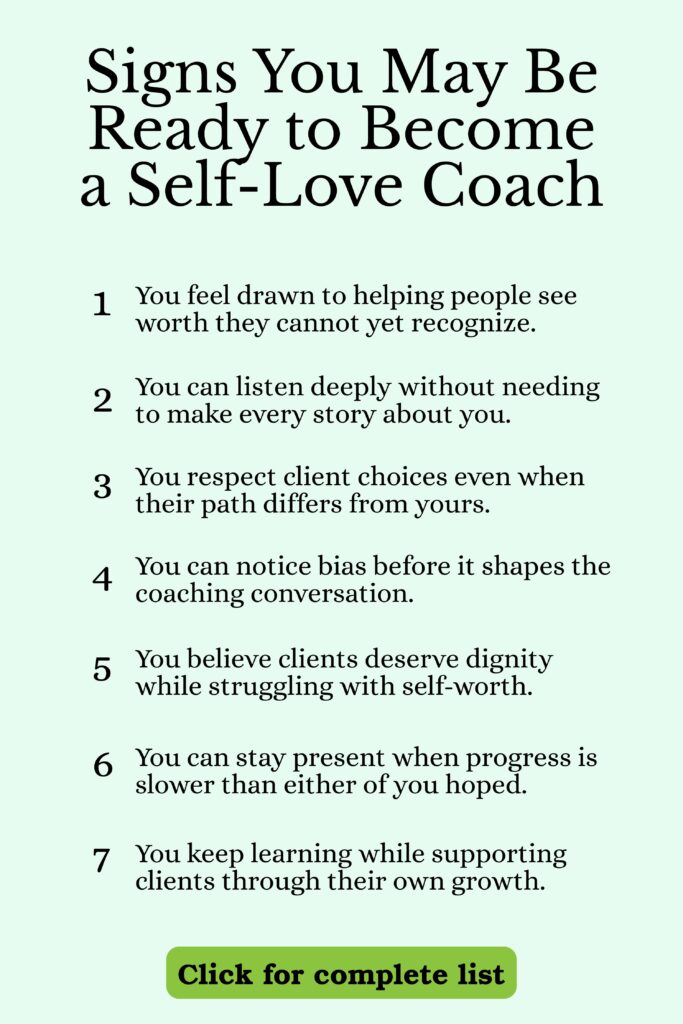
What Qualities Does a Self-Love Coach Need?
How Do You Protect Client Confidentiality?
When a client confides in you as a self-love coach, it is because they put their faith in personal development with the help of coaching. They trust the process, but most importantly, they trust you. However, you must maintain confidentiality in order to keep your client’s trust. It doesn’t matter who asks for the information or how grave the circumstance is. This is also necessary to maintain the credibility of your life coaching business.
For instance, consider this scenario: the payor of the sessions, a close family member, or simply anyone other than the client reaches out to you. When this happens, it may be tempting to lean towards a more profitable relationship. But keep in mind that you were hired for a reason and that is to help your client learn the epitome of self-love. When your clients confide in you, they put their trust in you so they can freely let out their deepest emotions and thoughts. And it is your utmost responsibility to maintain confidentiality regardless of what happens.
To keep yourself from disclosing information to an unknown or authoritative person and being in an uncomfortable situation, you may set things straight from the start which means you set your own boundaries. Yes, you’re a self-love coach and yes, you can also specify your limitations in the workplace. You need to communicate with the third party and set firm and clear boundaries for what information will be shared. In this way, you maintain your client’s trust, confidence, and respect.
How Do You Stay Objective Without Becoming Detached?
As a self-love coach, one of the most important coaching skills is empathy. That is the only way to truly comprehend what your client is going through. However, empathy may have the disadvantage of making you emotionally attached to a specific client and their problems. This can muddle any decision-making and make it difficult to coach effectively, negating any positive impact you could have had on your client’s life.
SEE ALSO: If you’re a coach looking to streamline your administrative tasks and save time, check out our Coaching Administration Software. It’s a simple, effective solution designed to help you focus less on paperwork and more on what matters—coaching your clients. From scheduling to client management, our software gives you the tools to run your business efficiently. Ready to reclaim your time and boost productivity? Click or tap here.
Remember, you don’t have to deal with the problem firsthand. It is your responsibility to support the client, so the best way to help them is to listen intently to their concerns, analyze their situation, and slightly detach yourself. Sometimes, you just need to take a step back to see the bigger picture because when you’re too near, you lose sight of the nitty-gritty in the situation. When you’re not emotionally invested and involved, when you stay objective, you can successfully help your client in addressing the problem.
To start off, you have to accept that it is innate for you to form your own opinions and biases; it’s normal for most people. And sometimes, they can seep into the way we resolve problems and determine a solution. With your unique point of view, you may or may not have opposite opinions to that of your client but it is important for you to distance those thoughts. Don’t let them guide the way you support your client.
Once you’ve accepted your tendencies to form your own thoughts, the next step is to learn how to keep your biases out of coaching so you can be objective in how you assist your client in moving forward. This may be easier said than done, but that doesn’t mean it’s impossible. Begin by being aware of when your bias is leaking into your coaching. Set apart your bias from the recommendations you give to your clients so you can remain objective when supporting them.
How Do You Coach Without Imposing Your Judgments?
Speaking of having your own opinions, It is natural to have biases and beliefs that you disagree with. There will be topics on which you are passionate, and your clients may irritate you and test your patience. This rule holds true regardless of your life coaching niche!
However, as a self-love coach, the best way to retain mutual respect with your clients is to recognize that you have something to learn from them. On your end of coaching, you still have the opportunity to acquire knowledge. Your clients will always have something to teach you so indulge in that chance to gain experience and skills with every client you meet. With this principle, you not only maintain respect, you also become a better self-love coach.
If you want to be a successful self-love coach, you must be able to accept people for who they are, regardless of how strong your internal biases are. Even if you notice your biases emerging, it is critical that you suppress them and maintain a cordial and respectful relationship with your client.
SEE ALSO: If you’re a coach looking to streamline your administrative tasks and save time, check out our Coaching Administration Software. It’s a simple, effective solution designed to help you focus less on paperwork and more on what matters—coaching your clients. From scheduling to client management, our software gives you the tools to run your business efficiently. Ready to reclaim your time and boost productivity? Click or tap here.
Your clients are the best people to pinpoint what they want to achieve; they know themselves better than anyone. And so, it is best to let them guide the journey. Let them lead the sessions with you. Your job is to accompany them to where they want to be. Never force a client to take a particular path unless you are certain that they can take on such challenges or changes in their lives. They have to understand the many paths they can take toward their best selves and you can help shed light on that. Because you cannot instill that in them; it must come from within.
Your clients are the best people to pinpoint what they want to achieve; they know themselves better than anyone. And so, it is best to let them guide the journey.
So keep your cool and serve as a support system for your clients. You will notice a difference in how your client transitions into someone they truly want to be, someone they love – the end goal. By the end, they will appreciate you for assisting them in becoming more connected to their inner, true selves.
Where Does Self-Love Coaching End and Therapy Begin?
Self-love coaching ends where the client needs diagnosis, clinical treatment, trauma recovery, crisis intervention, or support beyond your qualifications and coaching agreement.
You do not need to avoid every discussion of emotion, childhood experience, or pain. Those topics often affect present choices. The distinction is what you are being asked to do with them.
A practical way to make that distinction is to use three levels.
Level 1: Continue coaching
Continue coaching when the client can reflect, make decisions, test new behavior, and take responsibility for agreed actions.
SEE ALSO: If you’re a coach looking to streamline your administrative tasks and save time, check out our Coaching Administration Software. It’s a simple, effective solution designed to help you focus less on paperwork and more on what matters—coaching your clients. From scheduling to client management, our software gives you the tools to run your business efficiently. Ready to reclaim your time and boost productivity? Click or tap here.
Appropriate coaching topics may include:
- Changing habitual self-criticism
- Practicing clearer boundaries
- Making decisions without constant reassurance
- Recovering from a professional setback
- Identifying personal values
- Following through on commitments
- Preparing for a difficult conversation
For example, a client may want to stop agreeing to extra work every time a manager asks. You can help the client identify the approval-seeking pattern, prepare boundary language, choose a real situation in which to practice, and review the outcome afterward.
Level 2: Refer or collaborate
Discuss a referral when the client needs support outside your expertise, qualifications, or contract.
The International Coaching Federation advises coaches not to diagnose or offer treatment. Its referral guidance says coaches should draw the line when a client’s needs fall outside their qualifications, experience, or agreement.
Referral may be appropriate when the client is seeking trauma treatment, asking for a diagnosis, experiencing serious impairment, or repeatedly unable to engage in the forward-moving work coaching requires.
You can say:
SEE ALSO: If you’re a coach looking to streamline your administrative tasks and save time, check out our Coaching Administration Software. It’s a simple, effective solution designed to help you focus less on paperwork and more on what matters—coaching your clients. From scheduling to client management, our software gives you the tools to run your business efficiently. Ready to reclaim your time and boost productivity? Click or tap here.
“Some of what you are describing appears to need support beyond the work we agreed to do in coaching. I would like us to discuss whether a qualified mental health professional could give you the right level of care.”
A referral does not always require coaching to end. Coaching and therapy may sometimes continue alongside each other when the roles are clear and the client’s providers agree that the arrangement is appropriate.
Level 3: Follow your safety and legal procedures
Take immediate concerns seriously when a client indicates an imminent or likely risk of danger to themselves or another person.
Your coaching agreement should explain the nature and limits of confidentiality before work begins. The ICF Code of Ethics calls for a clear agreement about information sharing and about circumstances in which disclosure may be required, including legal requirements, a valid court order, or imminent or likely danger.
Confidentiality also needs to be clarified when another person pays for the coaching. A parent, partner, employer, or sponsor does not automatically receive access to everything the client shares. Decide in advance what may be reported, to whom, and in what form.
A Welcome Package can help you put these boundaries in writing before the first session. It can include a welcome letter, a coaching agreement with electronic signature, and intake forms.
SEE ALSO: If you’re a coach looking to streamline your administrative tasks and save time, check out our Coaching Administration Software. It’s a simple, effective solution designed to help you focus less on paperwork and more on what matters—coaching your clients. From scheduling to client management, our software gives you the tools to run your business efficiently. Ready to reclaim your time and boost productivity? Click or tap here.
Your client profiles and notes can then keep the agreed information connected to the correct client record. If you want a practical overview of how that information stays organized, see how LCH Core keeps track of client data, session notes, and progress.
What Techniques Do Self-Love Coaches Use?
Self-love coaching can begin with the client identifying his or her own strengths and weaknesses and you help them in the process. You probe their thoughts by asking them questions about the things they admire about themselves and the things they are proud of. You may open the discussion for insecurities and perceived imperfections.
Now that the clients have pointed out the things they want to work on, you help them create a specific list of goals to achieve in each coaching session and by the end. This will help guide your client’s direction. You should also discuss how your clients would describe success and what it means to them to gauge if the self-love coaching techniques to be implemented are working.
You can urge your clients to make a powerful elevator pitch about themselves. You may wonder, this isn’t business, why do we need to ask the clients to market themselves? Elevator pitches are used by entrepreneurs to give an overview of their ideas or business. The important thing to remember is to encourage the client to make an immediate positive impression. Ask your client to market him- or herself in eight seconds or less. It’s actually a clever and creative way of letting your client focus on their “assets” and good qualities.
The most important thing to remember in self-love coaching is being there with the client. As someone appointed to be their self-love coach, be present, and be the confidant for your clients. Self-love coaching isn’t always easy and not everyone will be able to get to their journey fast. Everything that needs healing takes time. Although the clients avail coaching, this will not guarantee that they will feel positive about themselves. You need to expect that they will have their downtimes and doubt themselves. They might even feel like admitting defeat or they want to stop trying to get better. At times like these, you have to support them and open their eyes to their worth. Like what Charles Dickens said, “No one is useless in this world who lightens the burdens of another.”
How Do You Measure Progress in Self-Love Coaching?
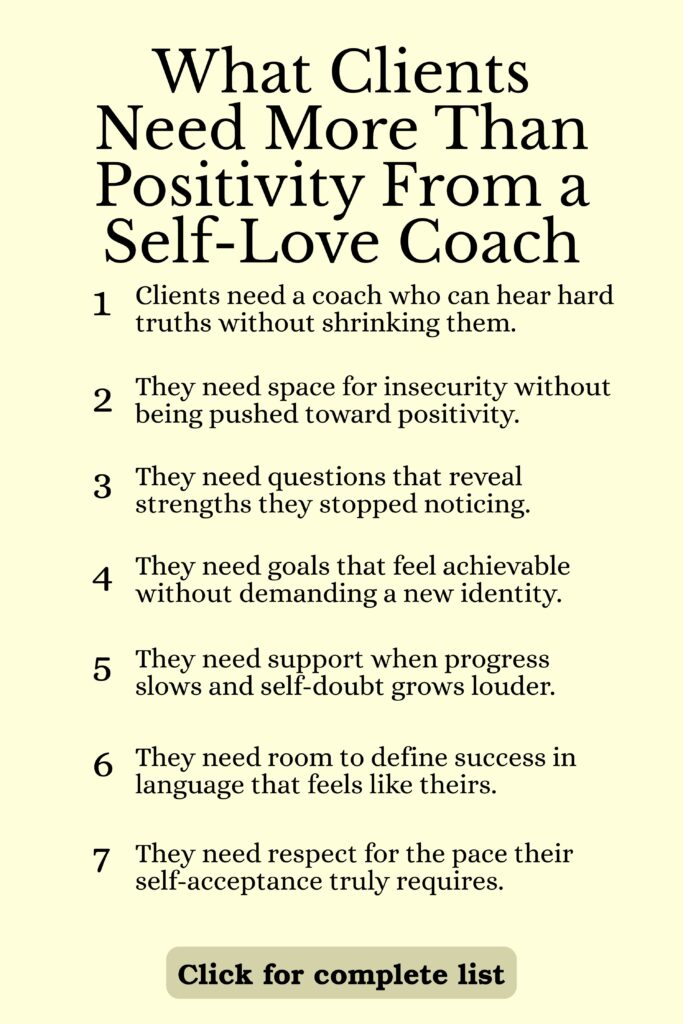
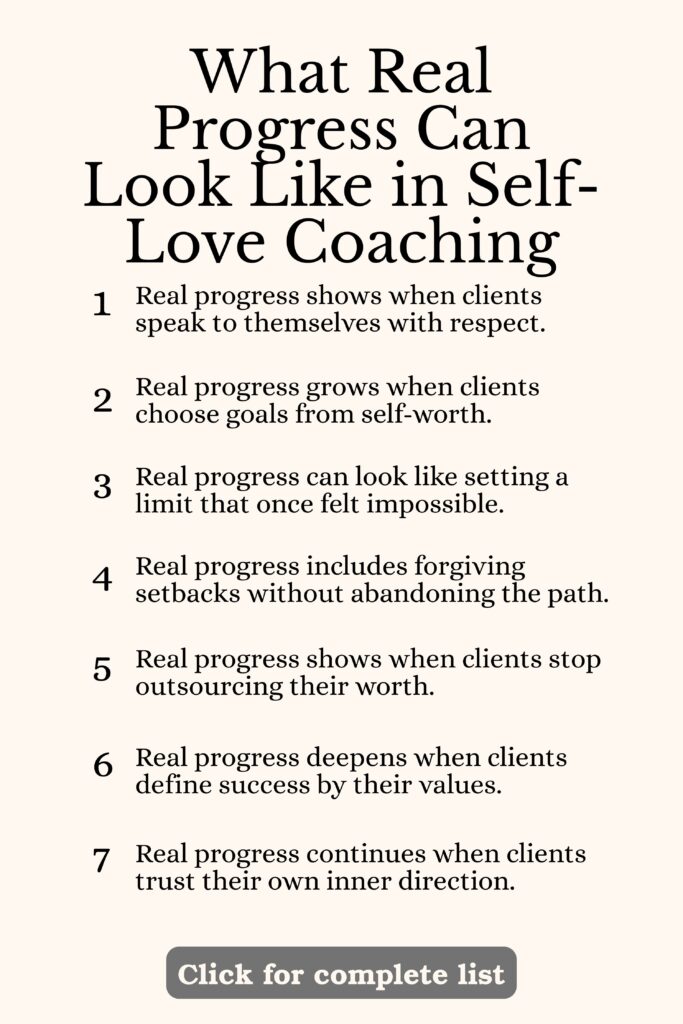
Progress in self-love coaching should be measured through observable choices and responses, not through a vague instruction to “feel better about yourself.”
SEE ALSO: If you’re a coach looking to streamline your administrative tasks and save time, check out our Coaching Administration Software. It’s a simple, effective solution designed to help you focus less on paperwork and more on what matters—coaching your clients. From scheduling to client management, our software gives you the tools to run your business efficiently. Ready to reclaim your time and boost productivity? Click or tap here.
A client may still experience disappointment or self-doubt while making meaningful progress. The evidence appears in what the client does next.
A simple Self-Love Progress Scorecard can track four areas.
1. Response to self-criticism
Ask how quickly the client notices harsh internal language and whether they can replace attack with an accurate, constructive response.
Possible evidence:
- The client catches an absolute statement such as “I ruin everything”
- The client separates a mistake from their identity
- The client chooses a corrective action instead of punishment
- The client resumes a goal after a missed day
2. Response to setbacks
Track what happens after rejection, embarrassment, conflict, or a broken commitment.
Possible evidence:
SEE ALSO: If you’re a coach looking to streamline your administrative tasks and save time, check out our Coaching Administration Software. It’s a simple, effective solution designed to help you focus less on paperwork and more on what matters—coaching your clients. From scheduling to client management, our software gives you the tools to run your business efficiently. Ready to reclaim your time and boost productivity? Click or tap here.
- The client recovers within a shorter period
- The client reviews what happened without spiraling
- The client asks for feedback
- The client adjusts the plan and tries again
- The client stops abandoning an entire goal after one difficult result
3. Boundary behavior
Measure what the client says and does when their needs conflict with someone else’s request.
Possible evidence:
- The client pauses before agreeing
- The client asks for time to decide
- The client states a limit clearly
- The client tolerates another person’s disappointment
- The client follows through after communicating the boundary
4. Values-based action
Track whether the client makes decisions based on personal values rather than approval, comparison, or fear of judgment.
Possible evidence:
- The client voices a preference
- The client makes one decision without polling several people
- The client protects time for a stated priority
- The client pursues a goal that matters to them
- The client declines an opportunity that conflicts with their values
Begin with a baseline. Ask the client to describe one recent situation in each relevant area, what they thought, what they did, and what happened next.
Then choose two or three behaviors to track for a defined period. Avoid tracking ten things at once. A focused scorecard creates clearer evidence.
SEE ALSO: If you’re a coach looking to streamline your administrative tasks and save time, check out our Coaching Administration Software. It’s a simple, effective solution designed to help you focus less on paperwork and more on what matters—coaching your clients. From scheduling to client management, our software gives you the tools to run your business efficiently. Ready to reclaim your time and boost productivity? Click or tap here.
For example, a client working on people-pleasing might track:
- How often they ask for time before saying yes
- Whether they express one preference each week
- How they respond when someone is unhappy with a boundary
- How long it takes them to recover from the resulting guilt
Review the evidence at a scheduled point, such as session four or session eight. The purpose is not to grade the client. It is to identify what is changing, where the pattern still appears, and what the next coaching experiment should be.
In LCH Core, goals and action items can hold the agreed behaviors, while journals and worksheets capture examples between sessions.
The Progress Stream and client progress workflow can help you review activity over time. The Engagement Report can add another layer when you assess participation and prepare for a structured progress conversation.
Is Certification Required to Become a Self-Love Coach?
Certification to practice self-love coaching isn’t mandatory. The coaching industry is vast, one of the reasons could possibly be that it doesn’t have any regulations or laws. Everyone who wishes to practice life coaching can do so. However, your experience, skills to market yourself and your skills, and referrals from past clients will help determine if you’ll become successful in this area.
So to strengthen your credentials, you can pursue certification for a payable amount of $19 to $4,750. Although courses on life coaching can vary, the usual duration of one course is up to 21 weeks. There are also courses available online which can be achieved in seven hours.
SEE ALSO: If you’re a coach looking to streamline your administrative tasks and save time, check out our Coaching Administration Software. It’s a simple, effective solution designed to help you focus less on paperwork and more on what matters—coaching your clients. From scheduling to client management, our software gives you the tools to run your business efficiently. Ready to reclaim your time and boost productivity? Click or tap here.
How Do You Build a Clear Self-Love Coaching Offer?
A clear self-love coaching offer names a specific client, a recurring pattern, a measurable result, a coaching method, a delivery structure, and a logical next step.
“Learn to love yourself” is too broad to guide the client or distinguish your work. A client needs to understand what will change in everyday life.
Use this six-part offer framework.
1. Choose a defined client
Do not begin with “anyone who struggles with self-love.”
Choose a group whose situation you understand. Examples include:
- Professionals who overcommit because they fear disappointing people
- Newly single clients rebuilding their identity after a relationship
- High-performing clients whose self-worth depends on achievement
- Parents who have stopped making room for their own priorities
- Creatives who abandon work after criticism or comparison
2. Name the recurring pattern
Choose a problem that appears in decisions and behavior.
SEE ALSO: If you’re a coach looking to streamline your administrative tasks and save time, check out our Coaching Administration Software. It’s a simple, effective solution designed to help you focus less on paperwork and more on what matters—coaching your clients. From scheduling to client management, our software gives you the tools to run your business efficiently. Ready to reclaim your time and boost productivity? Click or tap here.
Examples include:
- Saying yes automatically
- Seeking repeated reassurance
- Treating mistakes as proof of personal failure
- Avoiding visibility because criticism feels intolerable
- Abandoning goals after imperfect progress
- Staying silent to preserve approval
3. Define an observable result
Describe what the client will be able to do differently.
Instead of promising “complete self-love,” define outcomes such as:
- Communicate a boundary without overexplaining
- Recover from a mistake without abandoning the goal
- Make decisions with less reassurance
- Recognize self-critical thoughts before acting on them
- Follow through on one personal priority each week
4. Choose a coaching method
Your method might combine the three-part self-compassion framework with boundary practice, values clarification, behavioral experiments, and progress reviews.
Give the process an order. For example:
- Identify the self-critical pattern
- Separate facts from interpretation
- Clarify the client’s values and needs
- Choose one new response
- Practice it in a real situation
- Review the result
- Adjust and repeat
5. Set the delivery structure
Decide how many sessions the client needs, what happens between sessions, and when progress will be reviewed.
SEE ALSO: If you’re a coach looking to streamline your administrative tasks and save time, check out our Coaching Administration Software. It’s a simple, effective solution designed to help you focus less on paperwork and more on what matters—coaching your clients. From scheduling to client management, our software gives you the tools to run your business efficiently. Ready to reclaim your time and boost productivity? Click or tap here.
An eight-week program for approval-seeking professionals might include:
- Intake and baseline assessment
- Self-criticism pattern mapping
- Values and needs clarification
- Boundary language practice
- Two real-world behavior experiments
- Weekly journal prompts
- A midpoint progress review
- A final plan for maintaining the new behavior
6. Define the next step
Decide what happens after the program.
The next step might be completion, a maintenance session, a longer coaching package, a group program, or a focused course. The recommendation should follow the client’s goals and progress rather than being forced into every engagement.
Your visibility strategy should lead people toward this specific offer. A short Boundary Pattern Checklist could work as a lead magnet, followed by a discovery call and the eight-week package.
A coaching funnel gives each interested person a clear next action instead of relying on random social posts.
You can also create a free life coach directory listing so prospective clients can find your niche, understand who you help, and decide whether to contact you.
SEE ALSO: If you’re a coach looking to streamline your administrative tasks and save time, check out our Coaching Administration Software. It’s a simple, effective solution designed to help you focus less on paperwork and more on what matters—coaching your clients. From scheduling to client management, our software gives you the tools to run your business efficiently. Ready to reclaim your time and boost productivity? Click or tap here.
If you use LCH Core to run the pathway, the Public Booking Page can give prospects a direct way to book a discovery call, while your Public Store can hold free lead magnets and paid offers.
Credentials can support trust as the coaching market grows. According to the 2025 ICF Global Coaching Study, 73 percent of coaches agreed that clients and organizations expect coaches to hold a coaching certification or credential. A credential does not replace a specific offer or a clear method, but it can strengthen the professional foundation behind them.
How Much Can a Self-Love Coach Earn?
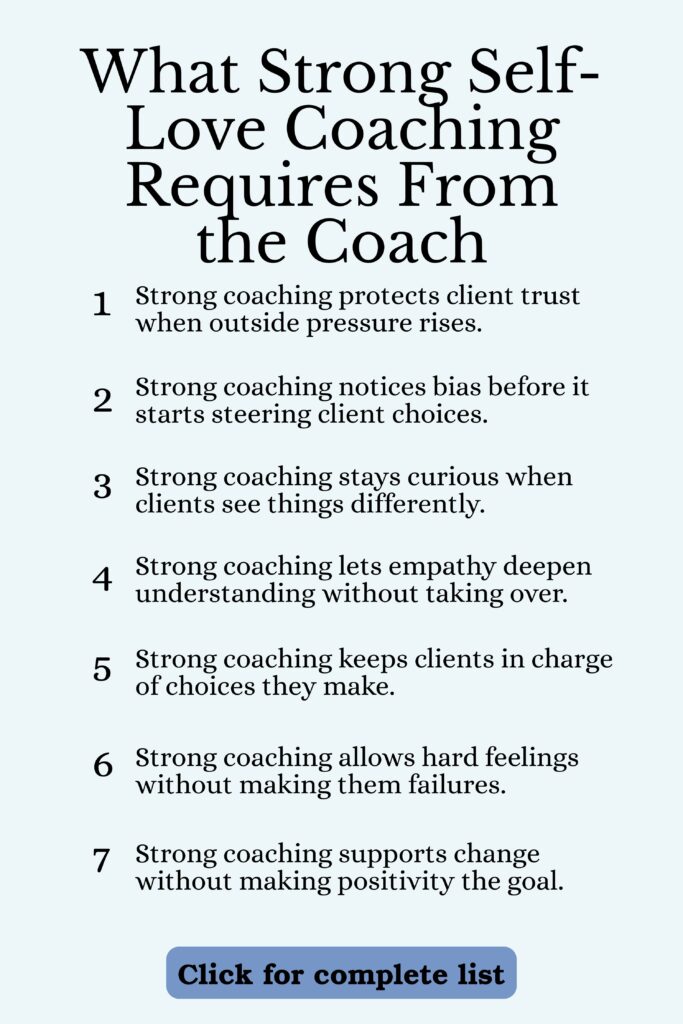
Coaching for self-love has been growing and getting in high demand. As mentioned before, you need assets such as professional experience, great marketing skills, and good credibility and referrals to have more clients. On average, a session can earn $300.
Ultimately, the key to self-love is to unconditionally love yourself. You must develop a loving relationship with yourself. As a life coach, do you still need to learn self-love? Yes, because you can best support other people when you have self-love and when you know how to achieve it.
The most important aspect of self-love coaching is the ability to assist people in accepting and owning who they have become. After all, helping others appreciate and love themselves more and knowing that you have successfully played your part gives you a sense of fulfillment, don’t you think?
Where LCH Core Fits
LCH Core fits where a self-love coaching method needs to become a consistent client process.
SEE ALSO: If you’re a coach looking to streamline your administrative tasks and save time, check out our Coaching Administration Software. It’s a simple, effective solution designed to help you focus less on paperwork and more on what matters—coaching your clients. From scheduling to client management, our software gives you the tools to run your business efficiently. Ready to reclaim your time and boost productivity? Click or tap here.
The software should not define your coaching method. Your framework, judgment, and relationship with the client come first. The tools help you deliver that work without rebuilding the process for every person.
Booking and intake
A prospect can use your Public Booking Page to schedule a discovery call and complete an intake form. This gives you useful context before the conversation without a long chain of scheduling emails.
Agreement and onboarding
After the client chooses a coaching package, a Welcome Package can deliver the welcome letter, coaching agreement with electronic signature, and required forms.
This gives the client one clear starting point and helps you establish scope, confidentiality, expectations, and responsibilities before the first session.
Coaching delivery
Client management keeps the client profile, intake information, and notes together. Journals, worksheets, goals, action items, and resources can support the work between sessions.
For example, a client practicing boundaries might receive:
SEE ALSO: If you’re a coach looking to streamline your administrative tasks and save time, check out our Coaching Administration Software. It’s a simple, effective solution designed to help you focus less on paperwork and more on what matters—coaching your clients. From scheduling to client management, our software gives you the tools to run your business efficiently. Ready to reclaim your time and boost productivity? Click or tap here.
- A boundary preparation worksheet
- A weekly journal prompt
- One scheduled action item
- A goal tied to a real conversation
- A resource containing sample boundary language
Progress reviews
The Progress Stream can help you review the client’s activity, coaching tools, notes, and progress over time. The Engagement Report can add structure when you assess participation and prepare for a progress conversation.
These tools do not decide whether the client is succeeding. They give you evidence to discuss alongside the client’s lived experience.
Payments and offers
Payments, coaching packages, billing, and scheduling can be managed as part of the same client pathway. If your business later expands, courses and digital products can be sold through a Public Store.
You can also use a lead magnet to give prospective clients a useful, low-commitment way to experience your approach before they book.
For a broader view of how these pieces work together, see the LCH Core coaching software features.
Frequently Asked Questions About Self-Love Coaching
What does a self-love coach do?
A self-love coach helps clients change patterns that affect how they treat themselves, make decisions, set boundaries, and respond to mistakes.
SEE ALSO: If you’re a coach looking to streamline your administrative tasks and save time, check out our Coaching Administration Software. It’s a simple, effective solution designed to help you focus less on paperwork and more on what matters—coaching your clients. From scheduling to client management, our software gives you the tools to run your business efficiently. Ready to reclaim your time and boost productivity? Click or tap here.
The work may include identifying self-critical thoughts, clarifying values, practicing new behavior, setting goals, and reviewing real situations between sessions. A coach does not diagnose or treat mental health conditions unless separately qualified and working within that professional role.
How do you become a self-love coach?
You become a self-love coach by completing solid coach training, learning ethical boundaries, developing a clear method, practicing your skills, and defining the client problem you are equipped to address.
You also need a coaching agreement, intake process, referral plan, progress method, and specific coaching offer. Personal experience with self-love can inform your work, but it does not replace professional competence.
Do you need certification to become a self-love coach?
Certification is not universally required to use the title “self-love coach,” but professional training and recognized credentials can strengthen competence and client trust.
Requirements vary by location and by the services you provide. Check the laws and protected professional titles that apply where you and your clients are located.
What is the difference between self-love coaching and therapy?
Self-love coaching focuses on goals, choices, behavior, accountability, and forward movement, while therapy can diagnose and treat mental health conditions and support clinical healing.
SEE ALSO: If you’re a coach looking to streamline your administrative tasks and save time, check out our Coaching Administration Software. It’s a simple, effective solution designed to help you focus less on paperwork and more on what matters—coaching your clients. From scheduling to client management, our software gives you the tools to run your business efficiently. Ready to reclaim your time and boost productivity? Click or tap here.
Coaching may discuss the past when it helps explain a present pattern. It should not become unqualified trauma treatment, diagnosis, or crisis care.

Can a self-love coach work with clients who have experienced trauma?
A self-love coach can work with a client who has experienced trauma when the coaching remains within the coach’s competence and does not attempt to treat the trauma.
The client may also need a licensed mental health professional. The coach should discuss referral or collaboration when trauma-related needs fall outside the coaching agreement.
How do you structure a self-love coaching program?
A self-love coaching program should move from assessment to pattern recognition, new behavior, real-world practice, and progress review.
A program might include intake, baseline examples, self-compassion work, values clarification, boundary practice, weekly journals, action items, and a final maintenance plan. Each component should connect to a defined client outcome.
How much should a self-love coach charge?
A self-love coach should set prices based on the client, market, experience, credentials, package length, delivery format, support included, and value of the defined outcome.
SEE ALSO: If you’re a coach looking to streamline your administrative tasks and save time, check out our Coaching Administration Software. It’s a simple, effective solution designed to help you focus less on paperwork and more on what matters—coaching your clients. From scheduling to client management, our software gives you the tools to run your business efficiently. Ready to reclaim your time and boost productivity? Click or tap here.
Avoid copying an isolated hourly rate from another coach. Calculate the time required for sessions, preparation, administration, between-session support, and business costs before setting the package price.
How do self-love coaches find clients?
Self-love coaches find clients by making their niche and offer easy to understand, publishing useful content, building referral relationships, using lead magnets, and giving interested people a direct booking path.
The message should name a recognizable problem and outcome. “I help professionals stop automatically saying yes and communicate firm boundaries” gives a prospective client more information than “I help people love themselves.”
Sources
Han, Areum, and Tae Hui Kim. “Effects of Self-Compassion Interventions on Reducing Depressive Symptoms, Anxiety, and Stress: A Meta-Analysis.” Mindfulness, 2023, doi:10.1007/s12671-023-02148-x. PubMed, https://pubmed.ncbi.nlm.nih.gov/37362192/.
International Coaching Federation. “2025 ICF Global Coaching Study.” International Coaching Federation, 2025, https://coachingfederation.org/resources/research/global-coaching-study/.
International Coaching Federation. “ICF Code of Ethics.” International Coaching Federation, https://coachingfederation.org/credentialing/coaching-ethics/icf-code-of-ethics/. Accessed 5 Aug. 2026.
SEE ALSO: If you’re a coach looking to streamline your administrative tasks and save time, check out our Coaching Administration Software. It’s a simple, effective solution designed to help you focus less on paperwork and more on what matters—coaching your clients. From scheduling to client management, our software gives you the tools to run your business efficiently. Ready to reclaim your time and boost productivity? Click or tap here.
International Coaching Federation. Referring a Client to Therapy: A Set of Guidelines. International Coaching Federation, https://coachingfederation.org/wp-content/uploads/2024/12/icf-research-guide-referring-client-to-therapy.pdf. Accessed 5 Aug. 2026.
Life Coach Hub. “Coaching Software Features.” Life Coach Hub, https://coaching-software.lifecoachhub.com/features/. Accessed 5 Aug. 2026.
Neff, Kristin D. “Self-Compassion: An Alternative Conceptualization of a Healthy Attitude toward Oneself.” Self and Identity, vol. 2, no. 2, 2003, pp. 85–101. Taylor & Francis Online, https://doi.org/10.1080/15298860309032.
Read this next

Becoming a Life Coach is a Very Simple Affair
Starting a business as a life coach can be as simple as letting your skills shine.
Read More
How to Become a Christian Life Coach
Eight Steps to Becoming a Christian Life Coach
Read More
The Life Coaching Opportunities Most Coaches Never Think to Explore
There is a great big world of opportunity for life coaches and many don’t realize how easy it is to get involved.
Read More