






Three Secrets to Getting Coaching Clients

You are unique.
Always remember you are absolutely unique, just like everybody else. Margaret Mead
So, you may be a skilled and talented certified life coach, but you can’t seem to generate enough clients. What can you do to bring more of the right people into your coaching practice?
There are three things successful client-getting strategies consistently need: people must understand what you do, see why it is valuable, and recognize why you are a relevant coach for them.
Then they need a clear way to take the next step.
Key Takeaways
- Clarity comes before visibility. A prospect should quickly understand who you help, what situation brings someone to you, and what useful change you help them work toward. More traffic will not fix an offer people cannot explain.
- Value needs evidence. Show how coaching works through a clear process, relevant credentials, specific examples, and observable progress rather than relying on broad promises about transformation.
- Differentiation should be relevant, not clever. A focused audience, recurring situation, desired result, and point of view can make your coaching easier to choose without inventing an entirely new methodology.
- Discovery calls need a specific job. Decide whether the conversation is designed to assess fit or provide a small coaching experience, then structure it around that purpose.
- Interest needs a client path. Give prospects one clear next step, gather useful context, continue the conversation, and make an appropriate offer instead of treating every inquiry as a one-shot opportunity.
How Do You Get Coaching Clients?
You get coaching clients by making it easy for the right person to understand your coaching, believe it is relevant to their situation, see credible evidence of your value, and take a clear next step.
SEE ALSO: If you’re a coach looking to streamline your administrative tasks and save time, check out our Coaching Administration Software. It’s a simple, effective solution designed to help you focus less on paperwork and more on what matters—coaching your clients. From scheduling to client management, our software gives you the tools to run your business efficiently. Ready to reclaim your time and boost productivity? Click or tap here.
A useful way to think about the process is clarity → proof → differentiation → conversion. First, clarify who you help and what changes. Next, give people enough evidence to trust the process. Then make your specific fit obvious. Finally, create a simple path from interest to a conversation or offer.
You do not need dozens of disconnected marketing tactics. You need each part of that path to make sense to the person considering working with you.
1. How Do You Explain What You Do as a Coach?
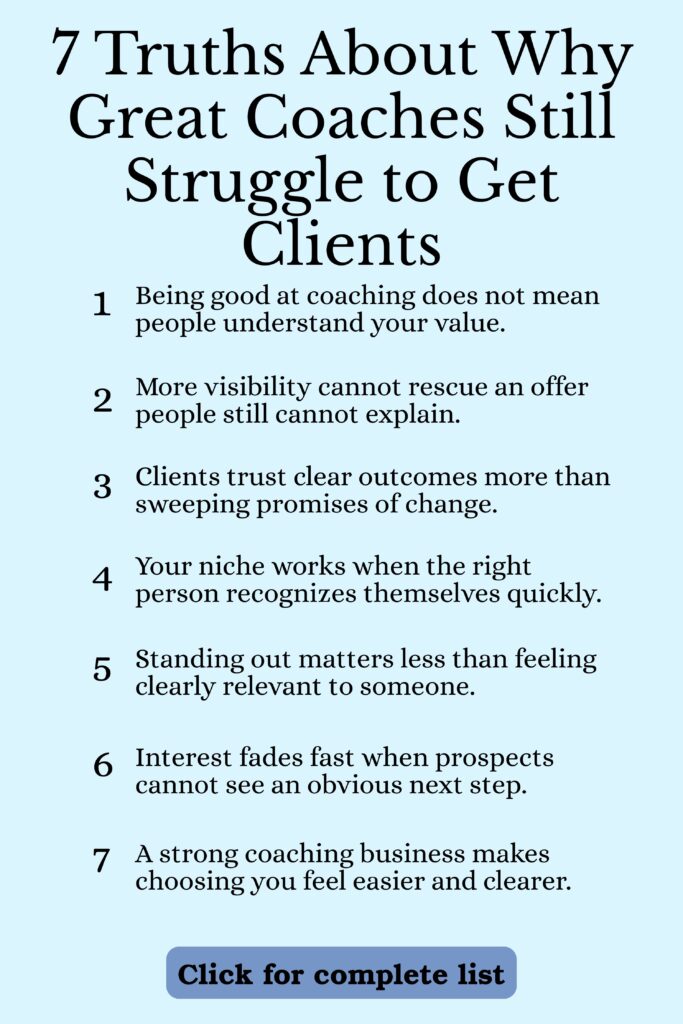
Many coaches assume potential clients understand coaching simply because they have heard the word. Awareness, however, is not the same thing as understanding what a particular coach actually helps someone accomplish.
According to the International Coaching Federation’s 2022 Global Consumer Awareness Study, 73% of respondents were aware of the coaching profession. That is encouraging, but it also changes the marketing challenge. You may not need to explain that coaching exists. You still need to explain why your coaching matters to this person.
Think about it this way. If I said to you, “I have a pizza restaurant,” you immediately know that I am talking about food.
I may be selling only deep-dish pepperoni pizza while you are imagining Mediterranean thin-crust pizza. We are not picturing exactly the same thing, but you still understand the category and what I sell.
SEE ALSO: If you’re a coach looking to streamline your administrative tasks and save time, check out our Coaching Administration Software. It’s a simple, effective solution designed to help you focus less on paperwork and more on what matters—coaching your clients. From scheduling to client management, our software gives you the tools to run your business efficiently. Ready to reclaim your time and boost productivity? Click or tap here.
“Coach” is less specific. One person may picture executive coaching. Another may think about accountability, career decisions, confidence, health, relationships, or something much closer to counseling.
That is why coaches need a short, clear way to describe what they do. An elevator statement such as, “I bring hope and healing to a hurting world through life coaching,” can create curiosity, but it still leaves an important business question unanswered.
What do you actually help someone change?
Can a Prospect Explain Your Coaching in One Sentence?
A prospect should be able to explain your coaching in one sentence without relying on vague words like transformation, empowerment, or potential.
A simple test is:
I help [specific person] who is dealing with [specific situation or problem] work toward [specific useful change].
SEE ALSO: If you’re a coach looking to streamline your administrative tasks and save time, check out our Coaching Administration Software. It’s a simple, effective solution designed to help you focus less on paperwork and more on what matters—coaching your clients. From scheduling to client management, our software gives you the tools to run your business efficiently. Ready to reclaim your time and boost productivity? Click or tap here.
Compare these:
“I help people become the best version of themselves.”
“I help mid-career professionals who feel stuck in the wrong role figure out their next career move and build a practical transition plan.”
The second version gives the prospect something to recognize. They can either say, “That’s me,” or, “That’s not what I need.”
Both answers are useful.
Your wording does not have to cover every possible client you could coach. Its job is to make the right prospect understand why they should keep listening.
SEE ALSO: If you’re a coach looking to streamline your administrative tasks and save time, check out our Coaching Administration Software. It’s a simple, effective solution designed to help you focus less on paperwork and more on what matters—coaching your clients. From scheduling to client management, our software gives you the tools to run your business efficiently. Ready to reclaim your time and boost productivity? Click or tap here.
Try saying your sentence to someone who knows nothing about your business. Then ask them three questions:
- Who do you think I help?
- What do you think they come to me for?
- What do you think changes through the coaching?
If their answers are far from what you intended, your message needs more work.
2. How Do You Show Potential Clients the Value of Coaching?
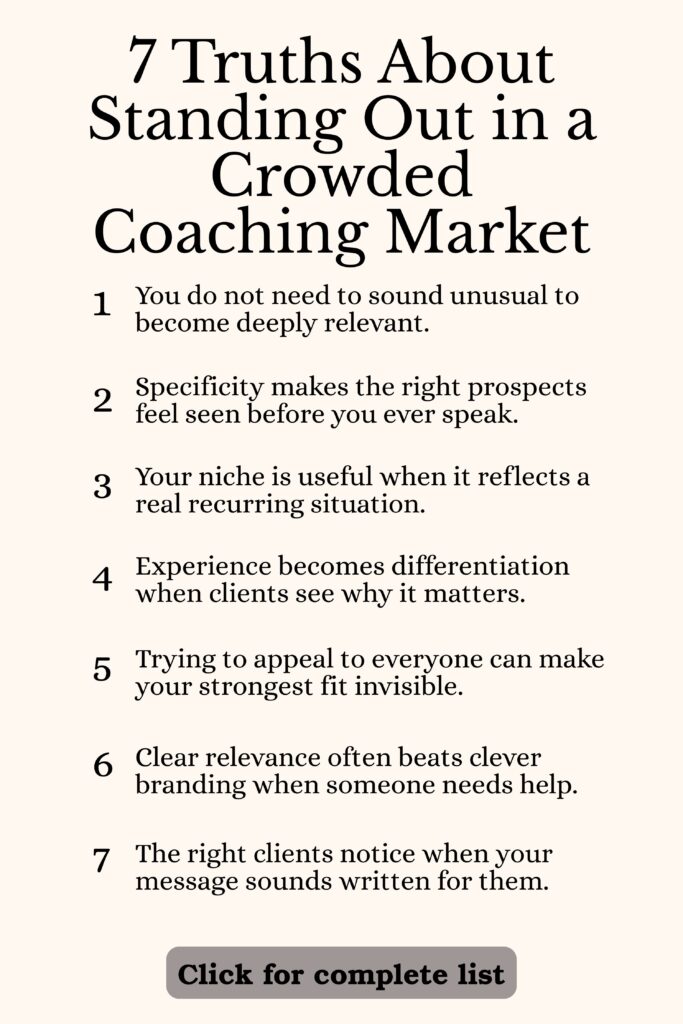
Potential clients understand coaching value more easily when they can see what the experience actually involves and connect it to a result they care about.
Coaching is an intangible service. A person cannot pick it up, inspect it, or test its features in the way they can examine a physical product.
That creates uncertainty.
A prospect may be interested in changing careers, becoming a stronger leader, rebuilding confidence, or getting serious about a goal. They may still wonder what happens once they pay you.
SEE ALSO: If you’re a coach looking to streamline your administrative tasks and save time, check out our Coaching Administration Software. It’s a simple, effective solution designed to help you focus less on paperwork and more on what matters—coaching your clients. From scheduling to client management, our software gives you the tools to run your business efficiently. Ready to reclaim your time and boost productivity? Click or tap here.
What will you talk about? What will you ask them to do? How will they know whether they are moving forward?
One way to reduce that uncertainty is to let prospects experience enough of your approach to understand it. That may mean a discovery call, a short sample coaching experience, a useful worksheet, a lead magnet, a workshop, or a clear explanation of your coaching process.
The goal is not to give away your entire service.
It is to replace vagueness with something the prospect can understand.
Should You Offer a Free Coaching Session or a Discovery Call?
A discovery call and a free coaching session do different jobs, so choose the format based on what you need the prospect to understand.
A discovery call is primarily about fit. You learn what the person wants, what is happening now, what they have already tried, and what kind of support they are looking for. You can then explain how your coaching works and decide whether there is a sensible next step.
SEE ALSO: If you’re a coach looking to streamline your administrative tasks and save time, check out our Coaching Administration Software. It’s a simple, effective solution designed to help you focus less on paperwork and more on what matters—coaching your clients. From scheduling to client management, our software gives you the tools to run your business efficiently. Ready to reclaim your time and boost productivity? Click or tap here.
A sample coaching session lets the prospect experience a small piece of the coaching itself. It should have a narrow boundary.
For example, a career coach talking to someone considering resignation does not need to solve the person’s entire career decision for free. A short coaching experience might instead help the prospect identify the three criteria they need to evaluate before making the decision.
That gives them a real taste of the coach’s thinking without pretending one short conversation can solve the whole problem.
If you use LCH Core, the Public Booking Page can give prospects a direct way to schedule that first conversation. You can also use intake forms to gather context beforehand. The Life Coach Hub support guide on free initial coaching appointments explains the setup.
Whichever format you choose, give the conversation a job. Do not simply put “free call” on your website and hope something useful happens.
What Proof Helps a Potential Coaching Client Say Yes?
Prospects need proof that reduces uncertainty, not promises that pretend uncertainty can disappear.
SEE ALSO: If you’re a coach looking to streamline your administrative tasks and save time, check out our Coaching Administration Software. It’s a simple, effective solution designed to help you focus less on paperwork and more on what matters—coaching your clients. From scheduling to client management, our software gives you the tools to run your business efficiently. Ready to reclaim your time and boost productivity? Click or tap here.
A useful proof stack includes five things:
- Relevant credibility. Your training, credentials, experience, or subject-matter background should make sense for the kind of coaching you offer.
- A clear process. Explain what working together looks like. A six-session package with an intake, goal-setting process, between-session actions, and progress reviews is easier to picture than “six transformational sessions.”
- Specific language. “Clients work on career decision-making, interview confidence, and a 90-day transition plan” communicates more than “I help clients unlock their full potential.”
- Relevant examples. Testimonials, case examples, and anonymized scenarios can help prospects understand the types of changes your work supports. Keep them truthful and avoid implying that one client’s outcome guarantees another’s.
- Visible progress. Show how you and the client will recognize movement. That may be completed actions, decisions made, goals reached, habits practiced, or milestones reviewed.
This is especially useful when the result itself is not immediate.
A leadership coach may not be able to promise that a client will receive a promotion. They can explain that the engagement will focus on behaviors the client can observe and practice, such as giving clearer feedback, delegating more effectively, preparing for high-stakes conversations, and tracking agreed leadership goals.
That is a stronger value proposition because the client can see what the work contains.
3. How Do You Stand Out From Other Coaches?
You stand out by making your relevance obvious to the right client, not by trying to sound completely unlike every other coach.
Margaret Mead knew what she was talking about. There are a lot of coaches out there, and every coach brings a different mix of training, experience, interests, style, and perspective.
SEE ALSO: If you’re a coach looking to streamline your administrative tasks and save time, check out our Coaching Administration Software. It’s a simple, effective solution designed to help you focus less on paperwork and more on what matters—coaching your clients. From scheduling to client management, our software gives you the tools to run your business efficiently. Ready to reclaim your time and boost productivity? Click or tap here.
Maybe you coach in a niche area. For example, I coach people who are stuck at a crossroads in their lives after the death of a loved one. Grief is not simply a label attached to my coaching. It tells a prospective client something meaningful about the situations I understand and the conversations I am prepared to have.
Think about the coaching you want to do.
Do you work with business leaders or entrepreneurs? New moms returning to work? Professionals who have been made redundant? People moving into management for the first time? Couples preparing for a major transition?
A niche becomes useful when it helps someone recognize themselves.
How Specific Does Your Coaching Niche Need to Be?
Your coaching niche is specific enough when the right prospect can recognize themselves in it and broad enough to give you a repeatable market to serve.
Use three elements:
SEE ALSO: If you’re a coach looking to streamline your administrative tasks and save time, check out our Coaching Administration Software. It’s a simple, effective solution designed to help you focus less on paperwork and more on what matters—coaching your clients. From scheduling to client management, our software gives you the tools to run your business efficiently. Ready to reclaim your time and boost productivity? Click or tap here.
Person + Situation + Desired Change
“Life coaching” tells me almost nothing.
“Career coaching” tells me more.
“Career coaching for professionals returning to work after a long caregiving break” tells me who, when, and why.
You can apply the same test in other niches:
“Leadership coach for newly promoted technical managers who need to lead former peers.”
SEE ALSO: If you’re a coach looking to streamline your administrative tasks and save time, check out our Coaching Administration Software. It’s a simple, effective solution designed to help you focus less on paperwork and more on what matters—coaching your clients. From scheduling to client management, our software gives you the tools to run your business efficiently. Ready to reclaim your time and boost productivity? Click or tap here.
“Business coach for established wellness professionals building their first group program.”
“Relationship coach for couples trying to rebuild trust after a major life transition.”
The International Coaching Federation’s 2025 Global Coaching Study reports a record 122,974 coach practitioners worldwide, up 15% from 2023. That does not mean every coach competes with every other coach. It does mean generic positioning has more opportunities to disappear into a very large marketplace.
You do not need to invent a new coaching philosophy just to sound different.
Your differentiation may come from the combination of who you coach, the situation they are in, the change they want, your relevant experience, and the way you approach the work.
Specific beats unusual.
SEE ALSO: If you’re a coach looking to streamline your administrative tasks and save time, check out our Coaching Administration Software. It’s a simple, effective solution designed to help you focus less on paperwork and more on what matters—coaching your clients. From scheduling to client management, our software gives you the tools to run your business efficiently. Ready to reclaim your time and boost productivity? Click or tap here.
What Happens After Someone Becomes Interested in Your Coaching?
Interest becomes a client opportunity only when the prospect has a clear next step and you have a repeatable way to continue the relationship.
A simple client path looks like this:
Visibility → Action → Context → Conversation → Offer → Onboarding
Visibility is how the person discovers you. That might be an article, referral, social post, speaking event, podcast appearance, search result, professional network, or a free life coach directory listing.
Then give them an action that matches their level of readiness.
Someone who is actively looking for a coach might be ready to book a discovery call.
SEE ALSO: If you’re a coach looking to streamline your administrative tasks and save time, check out our Coaching Administration Software. It’s a simple, effective solution designed to help you focus less on paperwork and more on what matters—coaching your clients. From scheduling to client management, our software gives you the tools to run your business efficiently. Ready to reclaim your time and boost productivity? Click or tap here.
Someone who is interested but not ready to talk might prefer a lead magnet, short guide, assessment, worksheet, or other useful resource.
The next step is context. What do you know about this person? What did they download? What problem did they mention? What did they tell you when they booked?
Then comes the conversation and, if there is a genuine fit, the appropriate offer.
Consider a career coach whose prospect downloads a checklist called “7 Signs It May Be Time to Change Careers.” The prospect is not yet a client, but their action tells the coach something specific about what they are thinking about.
A useful next step might be an invitation to book a career clarity conversation. If they book, the coach can ask about their current role, what has changed, what they have already considered, and what kind of decision they are trying to make.
Now the offer is connected to a real problem, not thrown at a stranger.
SEE ALSO: If you’re a coach looking to streamline your administrative tasks and save time, check out our Coaching Administration Software. It’s a simple, effective solution designed to help you focus less on paperwork and more on what matters—coaching your clients. From scheduling to client management, our software gives you the tools to run your business efficiently. Ready to reclaim your time and boost productivity? Click or tap here.
If you want to develop this client journey more deeply, How to Master Funnels as a Coach (and Why You Need To) walks through attraction, nurturing, conversion, and retention as one connected system.
Inside LCH Core, lead magnets can provide that lower-commitment first step, while a Public Store can give prospects somewhere to find courses and digital products. The support guides explain how lead magnets can be used to gather prospective client interest and how the Public Store works.
The principle matters more than the software.
Do not treat every person who fails to buy immediately as a dead lead. Give interested people a sensible next step.
Where LCH Core Fits
LCH Core fits after your client-getting strategy is clear, because software can run the operational pieces but cannot decide who you should coach or why someone should choose you.
Once those decisions are made, the client path becomes easier to organize.
SEE ALSO: If you’re a coach looking to streamline your administrative tasks and save time, check out our Coaching Administration Software. It’s a simple, effective solution designed to help you focus less on paperwork and more on what matters—coaching your clients. From scheduling to client management, our software gives you the tools to run your business efficiently. Ready to reclaim your time and boost productivity? Click or tap here.
- Booking: Use the Public Booking Page when a prospect is ready for a conversation.
- Context: Use client management (CRM) with client profiles, notes, and intake forms to keep the information surrounding the relationship organized.
- Buying: Use payments, coaching packages, and billing when the prospect chooses an appropriate paid offer.
- Starting well: A Welcome Package can contain a welcome letter, coaching agreement with electronic signature, and forms so the new client starts with a defined process. The support guide on client onboarding explains the workflow.
- Delivering the work: Journals, worksheets, goals, action items, and resources give you concrete tools to use between and around coaching sessions. Life Coach Hub also has a support guide covering coaching forms and tools.
- Making progress visible: The Progress Stream and Engagement Report can help you review what is happening across the coaching relationship rather than treating each conversation as an isolated event.
- Creating other entry points: Lead magnets, courses, and digital products sold through a Public Store can give prospects different ways to engage before or alongside private coaching.
For hands-on setup guidance, the LCH Core tutorial videos walk through the platform.
The strategic order stays the same: decide what your client path should be first, then use tools to make that path easier to repeat.

Frequently Asked Questions About Getting Coaching Clients
How do life coaches get their first clients?
Life coaches can get their first clients by combining a specific offer with direct conversations, referrals, relevant visibility, and one easy next step. Start with people and channels where some trust or relevance already exists rather than trying to be visible everywhere at once.
Do you need a niche to get coaching clients?
No, you do not need an ultra-narrow niche, but you do need enough specificity for prospects to recognize when your coaching is relevant. A useful niche identifies a person, recurring situation, or desired change clearly enough to shape your message and offers.
Should life coaches offer free discovery calls?
Yes, a free discovery call can be useful when its purpose is clearly defined. Use it to understand the prospect’s situation, assess fit, answer questions about your process, and establish the appropriate next step rather than turning it into an unfocused free coaching session.
How do you explain the value of coaching to potential clients?
Explain coaching value by connecting your process to a concrete problem or goal the prospect already cares about. Show what clients actually do during the engagement, what progress looks like, and what kinds of decisions, actions, or milestones you will help them work through.
SEE ALSO: If you’re a coach looking to streamline your administrative tasks and save time, check out our Coaching Administration Software. It’s a simple, effective solution designed to help you focus less on paperwork and more on what matters—coaching your clients. From scheduling to client management, our software gives you the tools to run your business efficiently. Ready to reclaim your time and boost productivity? Click or tap here.
How can a life coach stand out from other coaches?
A life coach can stand out by becoming more relevant to a particular client rather than simply becoming louder. A recognizable audience, situation, desired result, credible background, and clear process usually create stronger differentiation than generic claims about being unique.
Where can life coaches find clients online?
Life coaches can find potential clients anywhere their target audience already searches, learns, or asks for help. Depending on the niche, that might include Google, LinkedIn, relevant communities, social platforms, podcasts, email, professional networks, directories, and niche publications.
Can a coach directory help you get clients?
A coach directory can help create visibility, but it works best as one entry point into a larger client-getting system. Your profile still needs a clear positioning message and an obvious next step for someone who becomes interested.
What should you do when a coaching prospect shows interest but does not buy?
Give the prospect a useful next step instead of assuming the opportunity is over. That might be a relevant resource, lead magnet, follow-up conversation, discovery call, or lower-commitment offer that matches where they are in the decision process.
What Should You Do Next?
Start by fixing the first weak link in your client path rather than adding another marketing channel.
Ask yourself:
SEE ALSO: If you’re a coach looking to streamline your administrative tasks and save time, check out our Coaching Administration Software. It’s a simple, effective solution designed to help you focus less on paperwork and more on what matters—coaching your clients. From scheduling to client management, our software gives you the tools to run your business efficiently. Ready to reclaim your time and boost productivity? Click or tap here.
- Can the right prospect explain what I do after reading one sentence?
- Can they see credible evidence of how my coaching creates value?
- Can they recognize why I am particularly relevant to their situation?
- Is there one obvious action they can take if they are interested?
- Do I have a clear process for what happens after that action?
If the first answer is no, work on clarity.
If the second is no, build better proof.
If the third is no, sharpen your positioning.
If the fourth or fifth is no, build the conversion path.
Once those pieces are clear, technology can make the process easier to repeat. LCH Core can support the operational side through booking, client management, payments, onboarding, coaching tools, progress tracking, lead magnets, and offers, while the strategy still begins with giving the right prospect a clear reason to choose you.
Sources
International Coaching Federation. “ICF Consumer Awareness Study.” International Coaching Federation, 2022. ICF Consumer Awareness Study. Accessed 5 Oct. 2026.
SEE ALSO: If you’re a coach looking to streamline your administrative tasks and save time, check out our Coaching Administration Software. It’s a simple, effective solution designed to help you focus less on paperwork and more on what matters—coaching your clients. From scheduling to client management, our software gives you the tools to run your business efficiently. Ready to reclaim your time and boost productivity? Click or tap here.
International Coaching Federation. “ICF Global Coaching Study.” International Coaching Federation, 2025. ICF Global Coaching Study. Accessed 5 Oct. 2026.
Read this next
The 3 Step Dance for Getting Coaching Clients
You’ve Heard of the 2 Step, Right? Well here’s the 3-step dance (process) for getting coaching clients!
Read More
Coaches Who Get Clients Online Don’t Just Post More. They Build This
Discover important marketing tips that can help you to attract clients and give your coaching business a boost.
Read More
New Coach? This Is the Client-Getting System You Need Before You Post More Content
Follow these three simple steps to start generating new clients as a new coach
Read More