





Coaches Who Get Clients Online Don’t Just Post More. They Build This
With the right strategy, the Internet can help the right potential clients discover your coaching business, understand how you can help them, and take the next step.
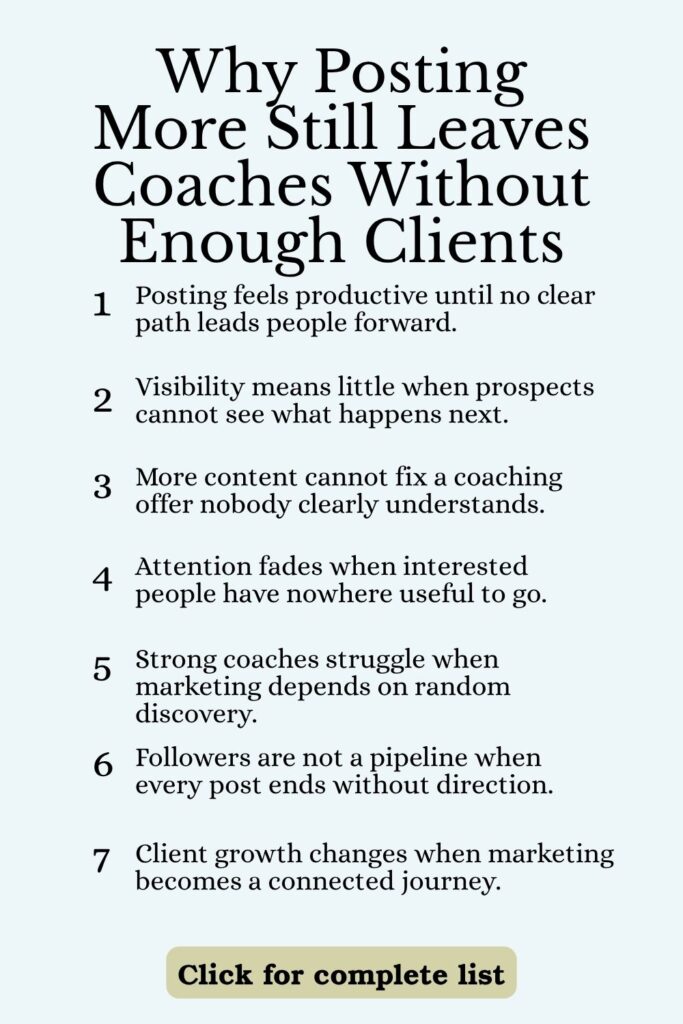
Being a life coach can be a meaningful and rewarding career. You get to help people make changes that matter to them. But the business only works when enough of the right people can find you and understand why they should work with you.
Online marketing gives you several ways to make that happen. The strongest approach is not simply to post more often or build a prettier website. It is to create a clear path from first discovery to becoming a client.
Key Takeaways
- Build a client path, not disconnected marketing tactics. Your content, social media, website, lead capture, and booking process should move an interested person toward a logical next step.
- Create content around problems your ideal coaching clients already recognize. Useful, specific content lets prospects experience your thinking before they decide whether to contact you.
- Give interested people an easy action to take. A useful resource, consultation, booking page, or relevant offer is stronger than leaving people to figure out what to do next.
- Nurture prospects who are interested but not ready. Someone who downloads a resource or asks a question is not necessarily a lost lead because they do not book immediately.
- Measure movement through the funnel. Track whether visibility becomes contacts, consultations, clients, and ongoing relationships instead of judging marketing by likes or traffic alone.
How Do You Attract Coaching Clients Online?
You attract coaching clients online by creating useful visibility around a specific problem, giving interested people a clear way to engage further, building trust over time, and making it easy to book or buy when they are ready.
A practical client-getting path looks like this: Attract → Capture → Nurture → Convert → Retain. Articles, search visibility, social media, directory profiles, referrals, and your website can attract attention. A lead magnet, inquiry, or consultation can capture that interest. Useful follow-up builds trust, a clear offer converts the right prospects, and strong coaching delivery gives clients reasons to continue, renew, or refer others.
You do not need dozens of marketing tactics. You need a small number of channels that connect to a clear next step.
SEE ALSO: If you’re a coach looking to streamline your administrative tasks and save time, check out our Coaching Administration Software. It’s a simple, effective solution designed to help you focus less on paperwork and more on what matters—coaching your clients. From scheduling to client management, our software gives you the tools to run your business efficiently. Ready to reclaim your time and boost productivity? Click or tap here.
Why Do Coaches Need a Client-Attraction System?
You probably chose to become a life coach because you want to help others. Your coaching business allows you to build a career around helping people develop, change, and grow.
If you do not have enough clients, however, the problem affects more than revenue. Your coaching skills cannot create much impact if the people who need them never discover you or never understand how to work with you.
A client-attraction system gives your marketing a repeatable purpose. Instead of hoping that an occasional social post, referral, or website visitor happens to turn into a client, you build several clear ways for the right people to find you and move forward.
What Does an Online Client-Getting Funnel Look Like for a Coach?
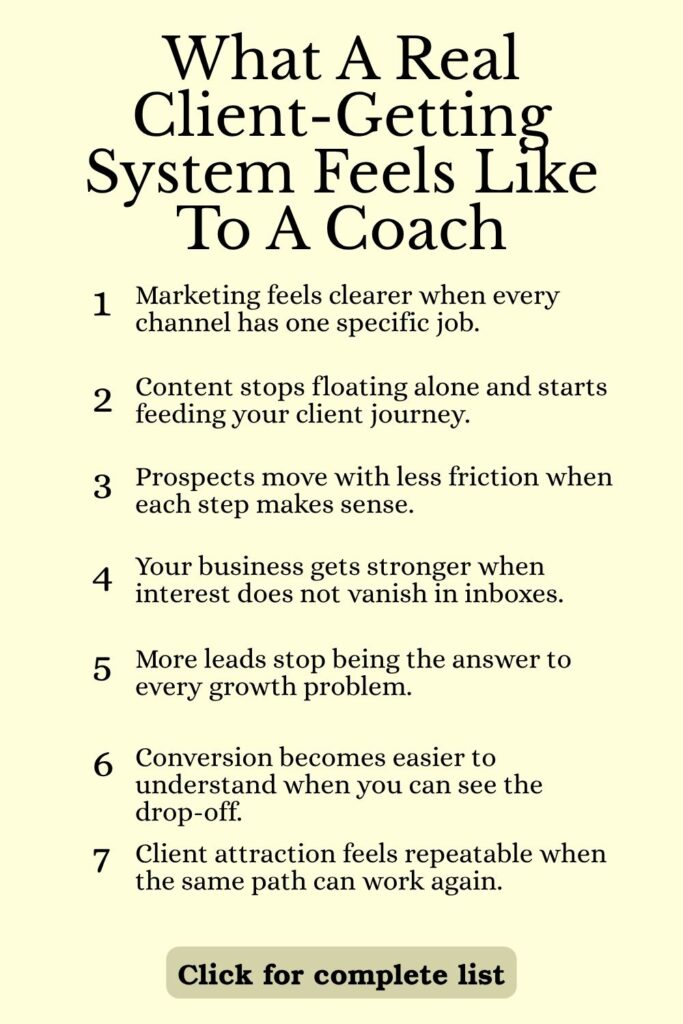
A coaching funnel is the path that moves someone from discovering you to becoming, and ideally remaining, a client.
A simple version has five stages:
- Attract: The person discovers you through search, an article, social media, a referral, a directory, a podcast appearance, or another visibility channel.
- Capture: They take an identifiable action, such as downloading a resource, contacting you, or booking a consultation.
- Nurture: You continue giving them relevant reasons to trust your expertise rather than expecting an immediate purchase.
- Convert: They choose a coaching session, package, program, or another paid offer.
- Retain: Your coaching experience helps them stay engaged, see progress, renew when appropriate, and refer other people.
For example, imagine a career coach who publishes an article about the signs that someone has outgrown their role. A reader finds it through Google, downloads a career-change worksheet, later books a discovery call, buys a six-session package, and eventually refers a colleague.
SEE ALSO: If you’re a coach looking to streamline your administrative tasks and save time, check out our Coaching Administration Software. It’s a simple, effective solution designed to help you focus less on paperwork and more on what matters—coaching your clients. From scheduling to client management, our software gives you the tools to run your business efficiently. Ready to reclaim your time and boost productivity? Click or tap here.
Each step has a job. The article attracts. The worksheet captures. Follow-up nurtures. The consultation helps convert. The coaching relationship creates the opportunity for retention and referral.
This matters in an increasingly populated profession. The International Coaching Federation’s 2023 Global Coaching Study estimated 109,200 coach practitioners worldwide in 2022, a 54% increase from its 2019 estimate. The number does not tell you how many coaches compete in your specific niche, but it does underline why simply being qualified is not the same as being discoverable.
You can learn more about structuring the full journey in How to Master Funnels as a Coach (and Why You Need To).
Visibility can also come from places where prospective clients are already looking for coaches. A free life coach directory listing gives you another potential entry point into the Attract stage.
After the funnel itself is clear, tools can make the path easier to run. LCH Core can support different stages with lead magnets, a Public Booking Page, client management, coaching packages, and coaching tools. The system should support your funnel, not substitute for having one.
How Can Writing Help You Attract Coaching Clients?
Writing useful articles can help potential clients understand how you think before they ever speak with you.
SEE ALSO: If you’re a coach looking to streamline your administrative tasks and save time, check out our Coaching Administration Software. It’s a simple, effective solution designed to help you focus less on paperwork and more on what matters—coaching your clients. From scheduling to client management, our software gives you the tools to run your business efficiently. Ready to reclaim your time and boost productivity? Click or tap here.
Choose subjects that connect directly to your coaching niche and to situations your prospective clients already recognize. A leadership coach might write about a first-time manager who keeps solving problems for the team instead of delegating. A divorce coach might explain the decisions that become harder when someone is trying to negotiate while emotionally activated.
Specificity does more for you than publishing generic motivation.
Your content should give readers something useful even if they never hire you. At the same time, it should make your coaching perspective visible. Someone reading several of your articles should start to understand what you notice, what you ask, and how you help people move forward.
Link useful content to a clear profile, service page, resource, or next step. Do not make a reader who is already interested search your entire website to figure out whether you actually work with clients.
How Do You Turn Coaching Content Into Leads Instead of Just Traffic?
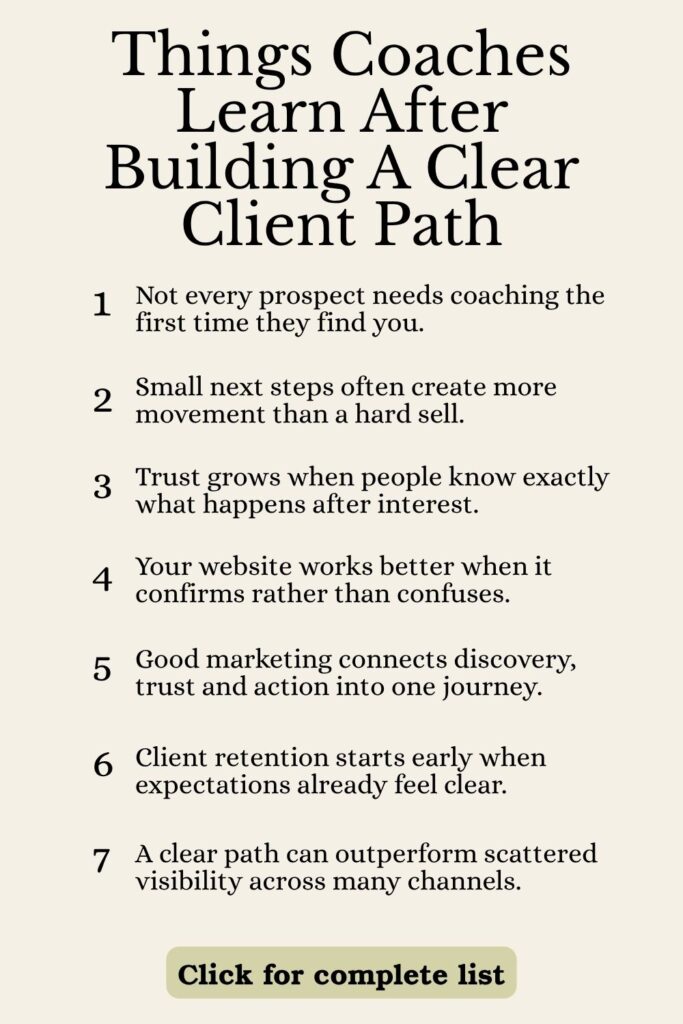
Coaching content becomes a lead-generation asset when the reader has a relevant next step after consuming it.
The simplest path is:
SEE ALSO: If you’re a coach looking to streamline your administrative tasks and save time, check out our Coaching Administration Software. It’s a simple, effective solution designed to help you focus less on paperwork and more on what matters—coaching your clients. From scheduling to client management, our software gives you the tools to run your business efficiently. Ready to reclaim your time and boost productivity? Click or tap here.
Useful content → relevant resource or action → contact → conversation or offer
The next step should match what the person has just read. If a career coach publishes an article about deciding whether to leave a job, a “Career Change Decision Worksheet” is a logical resource. A generic newsletter box saying “Join my list” is much weaker because it does not continue the same problem.
The resource also needs to be useful enough to earn the person’s contact information. It does not need to be huge. A focused worksheet, checklist, short assessment, reflection guide, or mini resource can be enough when it solves the next small problem.
If you coach corporate leaders, founders, or other B2B buyers, useful expertise can also play a role in how organizations evaluate providers. In the 2025 Edelman-LinkedIn B2B Thought Leadership Impact Report, 56% of surveyed U.S. target decision-makers agreed that reviewing an organization’s thought leadership was an important way they vetted potential vendors. That finding applies specifically to B2B decision-makers, not to every individual life-coaching buyer.
Inside LCH Core, lead magnets can create this kind of bridge between useful content and a warmer prospect. The Create Coaching Offers and Lead Magnets That Bring in Clients tutorial shows how those resources can fit into a coach’s offer setup.
How Should Coaches Use Social Media to Attract Clients?
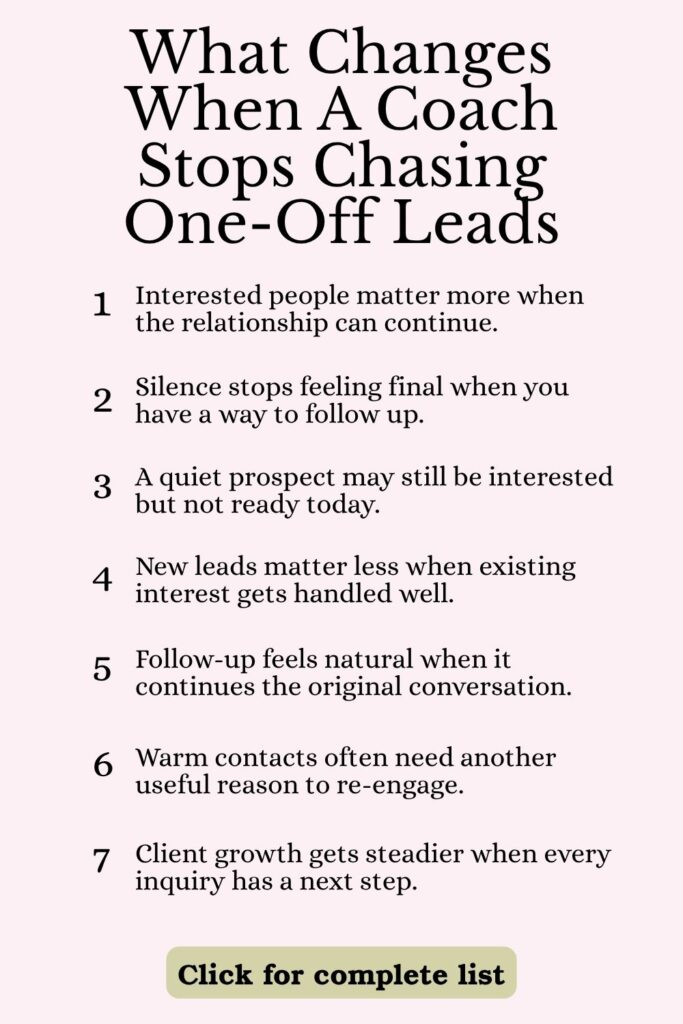
Social media works best when you use it intentionally rather than trying to maintain a presence everywhere.
SEE ALSO: If you’re a coach looking to streamline your administrative tasks and save time, check out our Coaching Administration Software. It’s a simple, effective solution designed to help you focus less on paperwork and more on what matters—coaching your clients. From scheduling to client management, our software gives you the tools to run your business efficiently. Ready to reclaim your time and boost productivity? Click or tap here.
Choose one or two platforms where the people you coach are realistically likely to spend time. For a coach serving executives or business owners, LinkedIn may make sense. Another coach may find their audience through Facebook, Instagram, YouTube, TikTok, or X.
Then connect what you publish to problems your clients actually bring into coaching.
A useful post might explain one mistake you repeatedly see, challenge an assumption, show a before-and-after decision, or unpack a situation that prospective clients recognize immediately. Those posts give people a reason to visit your profile, read more, save your ideas, or take a next step.
Social media is most useful when it feeds a relationship you can continue. A growing follower count by itself does not tell you whether anyone is moving closer to working with you.
How Do You Move Social Media Followers Into Your Client Funnel?
You move social media followers into your client funnel by giving relevant posts one clear next step that matches the reader’s level of interest.
A first-time follower may not be ready for a high-priced coaching package. They may be ready to read a useful guide, complete a worksheet, visit your website, or book a short discovery call.
SEE ALSO: If you’re a coach looking to streamline your administrative tasks and save time, check out our Coaching Administration Software. It’s a simple, effective solution designed to help you focus less on paperwork and more on what matters—coaching your clients. From scheduling to client management, our software gives you the tools to run your business efficiently. Ready to reclaim your time and boost productivity? Click or tap here.
For example, an executive coach could post about three signs a manager is accidentally creating team dependence. The next step might be a longer article on delegation or a leadership assessment. Someone actively looking for help could be directed to a consultation.
The sequence matters:
Post → useful next step → contact or booking → conversation
Avoid giving people five competing actions in every post. “Read this, join this, buy this, book me, DM me, and subscribe” creates more decisions when you want to create fewer.
When a consultation is the right next step, LCH Core’s Public Booking Page can give an interested prospect a direct way to choose a time. The Public Booking Page tutorial walks through setting up free discovery calls and intake forms.
What Does a Coaching Website Need to Turn Visitors Into Clients?
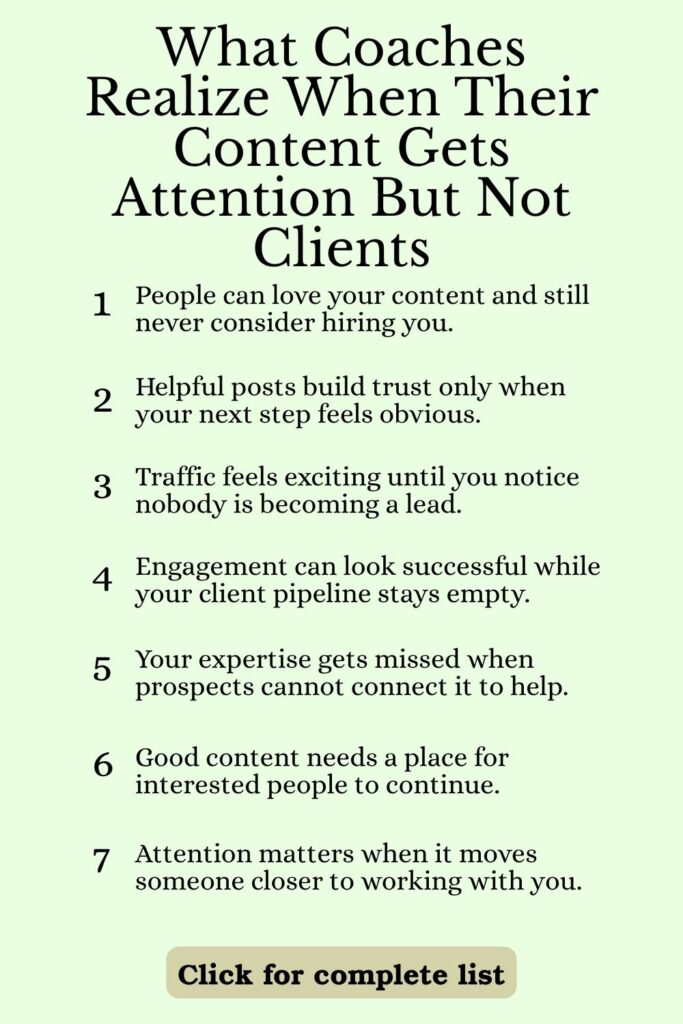
A coaching website needs to answer a few basic questions quickly: who you help, what problem or outcome you work on, what you offer, why someone should trust you, and what they should do next.
SEE ALSO: If you’re a coach looking to streamline your administrative tasks and save time, check out our Coaching Administration Software. It’s a simple, effective solution designed to help you focus less on paperwork and more on what matters—coaching your clients. From scheduling to client management, our software gives you the tools to run your business efficiently. Ready to reclaim your time and boost productivity? Click or tap here.
It does not have to be flashy or complicated.
A visitor should not need to decode vague language to work out whether your coaching is meant for them. “I help mid-career professionals decide what comes next without making a rushed career move” tells a visitor far more than a broad promise about unlocking unlimited potential.
At minimum, make it easy to find:
- Who you coach
- The problems or goals you work on
- Your coaching services or packages
- Credibility or evidence that helps someone evaluate you
- A clear next step
Your website also gives people somewhere to verify what you do after discovering you elsewhere. Someone may hear your name from a colleague, see a social post, find you in a directory, or read an article, then visit your website before deciding whether to contact you.
That makes the website an important conversion point even when it was not the original source of the lead.
What Should Happen When Someone Is Interested but Not Ready to Book?
An interested prospect who does not book immediately should have a useful way to stay connected to you.
SEE ALSO: If you’re a coach looking to streamline your administrative tasks and save time, check out our Coaching Administration Software. It’s a simple, effective solution designed to help you focus less on paperwork and more on what matters—coaching your clients. From scheduling to client management, our software gives you the tools to run your business efficiently. Ready to reclaim your time and boost productivity? Click or tap here.
Coaches lose opportunities when they treat every interaction as a binary result: the person books now, or the lead is dead. Real buying behavior is often messier.
Someone may download your worksheet today and need coaching three months from now. Another person may inquire, get busy, and disappear. Someone else may read five pieces of your content before they feel ready to speak with you.
The practical response is not to chase them repeatedly. Give them another useful reason to engage.
A prospect who downloaded a leadership worksheet could receive another relevant resource later. Someone who asked about coaching but did not schedule could receive a brief follow-up with the booking link and an answer to the question they originally asked. A previous consultation that did not convert might be invited to a lower-commitment resource or offer that genuinely fits their situation.
Keep the path simple enough that you know who these people are and what happened. If you use LCH Core, client management can keep client and prospect information, notes, and intake information organized so an interested person does not disappear into an old inbox thread.
How Do You Know Which Online Marketing Is Actually Bringing You Clients?
You know whether your online marketing is working by tracking movement between stages, not by looking at attention numbers alone.
SEE ALSO: If you’re a coach looking to streamline your administrative tasks and save time, check out our Coaching Administration Software. It’s a simple, effective solution designed to help you focus less on paperwork and more on what matters—coaching your clients. From scheduling to client management, our software gives you the tools to run your business efficiently. Ready to reclaim your time and boost productivity? Click or tap here.
Use a simple five-number view:
Reach or visitors → interested contacts → consultations → paying clients → retained or repeat clients
Suppose a coach receives 2,000 social impressions and no profile visits, clicks, or inquiries. The problem is probably near the top of the funnel.
Another coach might get only 200 article visitors, but 12 download a worksheet, four book a consultation, and two become clients. That smaller traffic source may be far more valuable to the business.
The numbers also help identify the actual bottleneck.
If many people visit but nobody downloads, the next step may not be compelling or relevant. If plenty of people book consultations but almost nobody buys, getting more traffic will not fix the conversion problem. If clients frequently finish one short package and disappear, the acquisition funnel may be working while retention needs attention.
SEE ALSO: If you’re a coach looking to streamline your administrative tasks and save time, check out our Coaching Administration Software. It’s a simple, effective solution designed to help you focus less on paperwork and more on what matters—coaching your clients. From scheduling to client management, our software gives you the tools to run your business efficiently. Ready to reclaim your time and boost productivity? Click or tap here.
Track enough to find the broken stage. You do not need a dashboard full of vanity metrics.
Where LCH Core Fits
LCH Core fits after you have decided what client journey you want people to move through.
A simple setup might look like this:
Attract: Publish useful content, build visibility, and use a coach profile.
Capture: Offer lead magnets or let prospects book through a Public Booking Page.
Convert: Use payments and coaching packages when someone decides to work with you.
SEE ALSO: If you’re a coach looking to streamline your administrative tasks and save time, check out our Coaching Administration Software. It’s a simple, effective solution designed to help you focus less on paperwork and more on what matters—coaching your clients. From scheduling to client management, our software gives you the tools to run your business efficiently. Ready to reclaim your time and boost productivity? Click or tap here.
Onboard: Send a Welcome Package with a welcome letter, coaching agreement with electronic signature, and forms.
Retain: Use journals, worksheets, goals, action items, resources, the Progress Stream, and the Engagement Report to support the coaching relationship and make progress easier to review.
Expand: Offer relevant courses or digital products through a Public Store when they make sense for your coaching model.
The point is not to add software to a weak marketing process. It is to make a clear process easier to run once you know what should happen at each stage.
For a wider look at what belongs in a connected coaching system, see the guide to coaching software for life coaches. If onboarding is the stage you are improving, the Welcome Package walkthrough shows how that part of the client journey works inside LCH Core.
Frequently Asked Questions
How do life coaches get clients online?
Life coaches get clients online by combining targeted visibility with a clear path from interest to contact, conversation, and paid coaching. Useful content, search visibility, social media, referrals, directories, lead magnets, and discovery calls can all contribute, but they work better when they connect rather than operate as isolated tactics.
SEE ALSO: If you’re a coach looking to streamline your administrative tasks and save time, check out our Coaching Administration Software. It’s a simple, effective solution designed to help you focus less on paperwork and more on what matters—coaching your clients. From scheduling to client management, our software gives you the tools to run your business efficiently. Ready to reclaim your time and boost productivity? Click or tap here.
What is the best way to market a coaching business online?
The most useful approach is to choose a small number of channels that reach your specific coaching audience and connect each one to a relevant next step. A career coach may benefit from search content and LinkedIn, while another niche may respond better to video, referrals, Facebook communities, or other channels.
Do life coaches need a website to get clients?
A website is not the only way to get coaching clients, but it gives prospects a reliable place to understand your positioning, services, credibility, and next step. It also supports people who discover you through referrals, social media, directories, speaking, or search and want to investigate further.
Does social media actually help coaches get clients?
Social media can help coaches get clients when it reaches the right audience and directs interested people toward a useful next step. Likes and follower counts alone do not show whether the channel is contributing to consultations or clients.
What should a life coach write about to attract clients?
A life coach should write about specific problems, decisions, patterns, and goals that prospective clients already recognize. The strongest topics demonstrate how you think about the situations your clients actually bring into coaching.
How do I turn website visitors or followers into coaching leads?
You turn visitors or followers into leads by offering a relevant action that lets an interested person identify themselves. That could be a useful lead magnet, an inquiry, an assessment, or a discovery call.
How long does it take to start getting coaching clients online?
There is no reliable universal timeline for getting coaching clients online because results depend on your existing audience, niche, offer, traffic, trust, and conversion process. Track each stage of the funnel instead of waiting for a particular number of weeks to tell you whether the strategy is working.
SEE ALSO: If you’re a coach looking to streamline your administrative tasks and save time, check out our Coaching Administration Software. It’s a simple, effective solution designed to help you focus less on paperwork and more on what matters—coaching your clients. From scheduling to client management, our software gives you the tools to run your business efficiently. Ready to reclaim your time and boost productivity? Click or tap here.
What Should You Do First to Attract Coaching Clients Online?
Start by building one complete path from discovery to conversation before adding more marketing channels.
Choose one problem your ideal client already knows they have. Create one useful piece of content around it. Give the reader one logical next step, such as a worksheet or consultation. Make that next step easy to complete. Then track what happens.
For example:
Article about a recognizable problem → focused lead magnet → follow-up → discovery call → coaching package
Once that path works, add more ways for the right people to enter it. Another article. A social platform. A directory profile. A referral source.
That is a stronger foundation than publishing everywhere and hoping attention eventually turns into clients.
SEE ALSO: If you’re a coach looking to streamline your administrative tasks and save time, check out our Coaching Administration Software. It’s a simple, effective solution designed to help you focus less on paperwork and more on what matters—coaching your clients. From scheduling to client management, our software gives you the tools to run your business efficiently. Ready to reclaim your time and boost productivity? Click or tap here.
If you want to manage more of that client journey in one coaching-focused system, you can try LCH Core free.
Sources
International Coaching Federation. “Global Coaching Study.” International Coaching Federation, 2023, https://coachingfederation.org/research/global-coaching-study. Accessed 28 Sept. 2026.
Edelman and LinkedIn. 2025 B2B Thought Leadership Impact Report: Invisible Influence: Unlocking the Power of Hidden Buyers. Edelman, 2025, https://www.edelman.com/expertise/Business-Marketing/2025-b2b-thought-leadership-report. Accessed 28 Sept. 2026.
Read this next

How To Write a Life Coaching Marketing Plan (With Free PDF Template)
Use this ultimate guide in creating your life coaching marketing plan to better position your brand and capture your clients!
Read More
Marketing for Life Coaches: 20 Unique Tips for Your Marketing Strategy
Scale up your coaching business with these on point life coaching marketing strategies.
Read More
Life Coaching Hashtags: 337 Best Hashtags for Life Coaches
Check out these topical hashtags for coaching that can help you grow your audience and client base
Read More