







The Business Mentor Test Every Coach Should Take Before Paying for Help

There is nothing wrong with asking for a little help from time to time.
Do you want to work fewer hours without letting important parts of your coaching business slide? Would you like to make more from the work you already do? Have you reached a point where you know something needs to change, but you are not sure what your next move should be?
A business mentor can be valuable when you have reached a problem that experience, outside perspective, or accountability can help you solve. The key is knowing what kind of help you actually need.
That distinction matters. A coach who has no clear offer needs different support from an established coach whose calendar is full but whose income has stopped growing. A coach seeking feedback on coaching competency needs something different again.
The smartest investment is not automatically “hire a mentor.” It is identifying the bottleneck first, then choosing the right kind of support for it.
Key Takeaways
- A mentor should solve a defined problem. Identify whether you need help with direction, business strategy, execution, or understanding what is actually producing results before choosing someone.
- Business mentoring and ICF Mentor Coaching are different. Business mentoring can address offers, pricing, marketing, capacity, and growth. ICF Mentor Coaching specifically focuses on developing coaching skills through observed coaching and competency-based feedback.
- Your stage changes the support you need. A new coach may need help creating a viable offer, while an established coach may need stronger conversion, retention, pricing, or scalable income systems.
- A useful mentoring engagement should produce observable change. Set a business objective, baseline, actions, and review point so you can judge whether the relationship is creating value.
- Some mentor problems are really systems problems. If you already know what needs to happen but cannot execute it consistently, the missing piece may be a repeatable process rather than more advice.
Do You Need a Mentor Coach for Your Coaching Business?
You may benefit from a mentor for your coaching business if you have a specific direction, strategy, execution, or evidence gap that an experienced person can help you close. You do not need to hire a mentor simply because you are serious about becoming a successful coach.
SEE ALSO: If you’re a coach looking to streamline your administrative tasks and save time, check out our Coaching Administration Software. It’s a simple, effective solution designed to help you focus less on paperwork and more on what matters—coaching your clients. From scheduling to client management, our software gives you the tools to run your business efficiently. Ready to reclaim your time and boost productivity? Click or tap here.
There is also an important terminology distinction. The International Coaching Federation defines Mentor Coaching as a process in which coaches receive feedback based on observed or recorded coaching sessions to develop their coaching skills in alignment with the ICF Core Competencies. ICF explicitly distinguishes this from practice-building and other business-development topics.
If you want help choosing a niche, improving your offers, filling coaching slots, raising fees, building a referral strategy, or deciding how to scale, you are usually looking for a business mentor for coaches, not ICF Mentor Coaching.
What Kind of Mentor Support Does Your Coaching Business Actually Need?
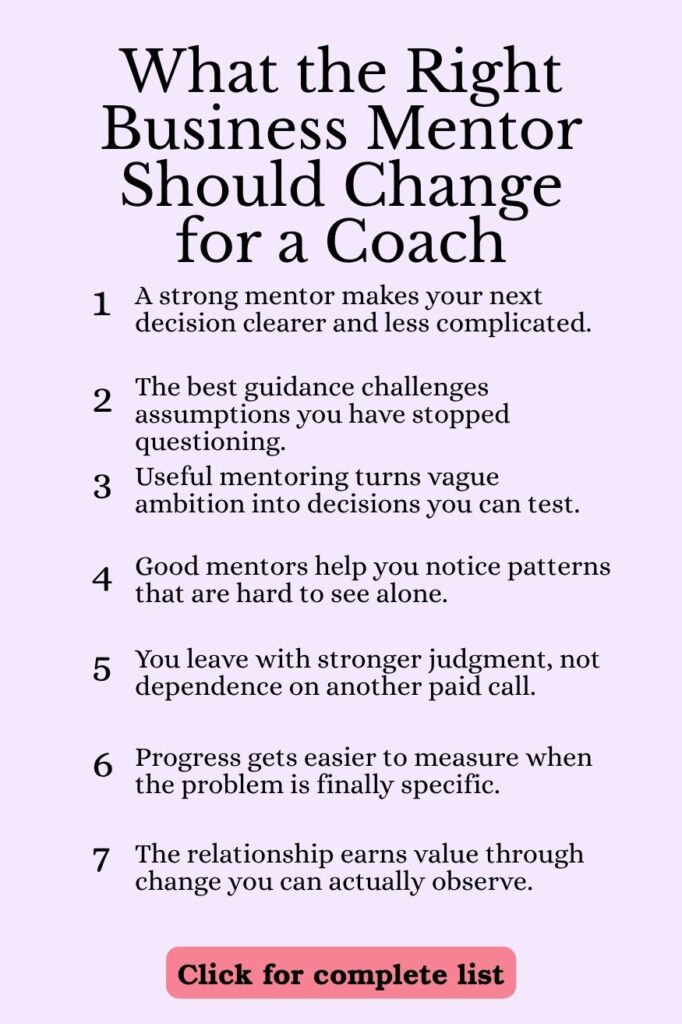
The right support depends on the problem you need solved, because “mentor coach” is not one universal job.
A useful first step is to name the problem in one sentence. Not “I want my business to grow.” Something observable.
For example:
- “My discovery calls are getting booked, but too few prospects become clients.”
- “I have reached my one-to-one coaching capacity and do not know what to offer next.”
- “I keep changing my niche and cannot commit to one market.”
- “I need competency-based feedback on recorded coaching sessions for my professional development.”
- “A difficult client situation is raising questions about my professional judgment and boundaries.”
Those problems call for different people.
SEE ALSO: If you’re a coach looking to streamline your administrative tasks and save time, check out our Coaching Administration Software. It’s a simple, effective solution designed to help you focus less on paperwork and more on what matters—coaching your clients. From scheduling to client management, our software gives you the tools to run your business efficiently. Ready to reclaim your time and boost productivity? Click or tap here.
A business mentor for coaches is a logical fit when the issue involves business judgment. That might include positioning, pricing, offers, marketing, capacity, referrals, or deciding which opportunity deserves your attention.
ICF Mentor Coaching is appropriate when you want structured feedback on how you actually coach. The emphasis is your coaching competency and style, not your marketing plan or revenue model.
Coach supervision may be the better route when you need reflective space around difficult client work, ethical questions, professional boundaries, or patterns showing up in your practice.
A consultant or specialist makes more sense when you need expertise applied to a technical business problem. If your bookkeeping is a mess, you probably need an accountant. If paid ads are producing terrible economics, a specialist who understands paid acquisition may be more useful than a general business mentor.
A peer group or mastermind can work when the main need is perspective, idea-sharing, contacts, and accountability rather than expert guidance.
The question is not, “Should coaches have mentors?” It is, “What problem am I trying to solve, and who is qualified to help me solve that problem?”
SEE ALSO: If you’re a coach looking to streamline your administrative tasks and save time, check out our Coaching Administration Software. It’s a simple, effective solution designed to help you focus less on paperwork and more on what matters—coaching your clients. From scheduling to client management, our software gives you the tools to run your business efficiently. Ready to reclaim your time and boost productivity? Click or tap here.
Which of the Four Mentor Gaps Is Holding Your Coaching Business Back?
Most reasons for seeking a business mentor fall into four useful categories: Direction, Strategy/Skill, Execution, and Evidence.
Use these as a Mentor Support Fit Matrix.
1. Direction gap: You do not know what decision to make.
You may have three niches under consideration, six half-built offers, and three different marketing channels competing for your attention.
The problem is not effort. It is choice.
A business mentor can help you challenge the assumptions behind those options and commit to a direction. For example, instead of endlessly debating whether to offer career coaching or leadership coaching, you might examine which audience you understand best, which problems people already ask you to solve, and which offer you can credibly sell now.
SEE ALSO: If you’re a coach looking to streamline your administrative tasks and save time, check out our Coaching Administration Software. It’s a simple, effective solution designed to help you focus less on paperwork and more on what matters—coaching your clients. From scheduling to client management, our software gives you the tools to run your business efficiently. Ready to reclaim your time and boost productivity? Click or tap here.
2. Strategy or skill gap: You know the destination but not the path.
You know you want more discovery calls, but you have no reliable path from “someone found me” to “someone booked.”
Or perhaps you know you want to raise your fees, but you have not worked out how the offer, positioning, package length, and sales conversation need to change with the price.
This is where experienced guidance can save months of random experimentation.
If the problem is client acquisition, it can also help to understand your entire coaching funnel instead of treating every marketing tactic as an isolated activity.
3. Execution gap: You know what to do but do not do it consistently.
SEE ALSO: If you’re a coach looking to streamline your administrative tasks and save time, check out our Coaching Administration Software. It’s a simple, effective solution designed to help you focus less on paperwork and more on what matters—coaching your clients. From scheduling to client management, our software gives you the tools to run your business efficiently. Ready to reclaim your time and boost productivity? Click or tap here.
You already know that new clients need a clear onboarding process. You know follow-up matters. You know prospects should have an obvious booking path.
Yet every new client still produces a scramble through old emails, forms, calendar messages, and payment links.
That is an execution problem.
Sometimes a mentor helps by holding you accountable to building the process. Sometimes the missing piece is the system itself. Once you have decided what your process should be, LCH Core can help you put repeatable pieces in place through client management, intake forms, a Public Booking Page, payments, coaching packages, and billing.
4. Evidence gap: You cannot tell what is working.
You may feel busy without knowing which activity produces clients, which clients are progressing, or which offer deserves more attention.
SEE ALSO: If you’re a coach looking to streamline your administrative tasks and save time, check out our Coaching Administration Software. It’s a simple, effective solution designed to help you focus less on paperwork and more on what matters—coaching your clients. From scheduling to client management, our software gives you the tools to run your business efficiently. Ready to reclaim your time and boost productivity? Click or tap here.
A mentor cannot make a good strategic recommendation from vague impressions alone. Bring evidence.
Track things such as discovery calls booked, clients converted, average package value, renewals, referrals, hours spent delivering each offer, and the progress clients are making.
Once you can see the numbers and patterns, the mentoring conversation gets much sharper.
Which Coaches Benefit Most From a Business Mentor?
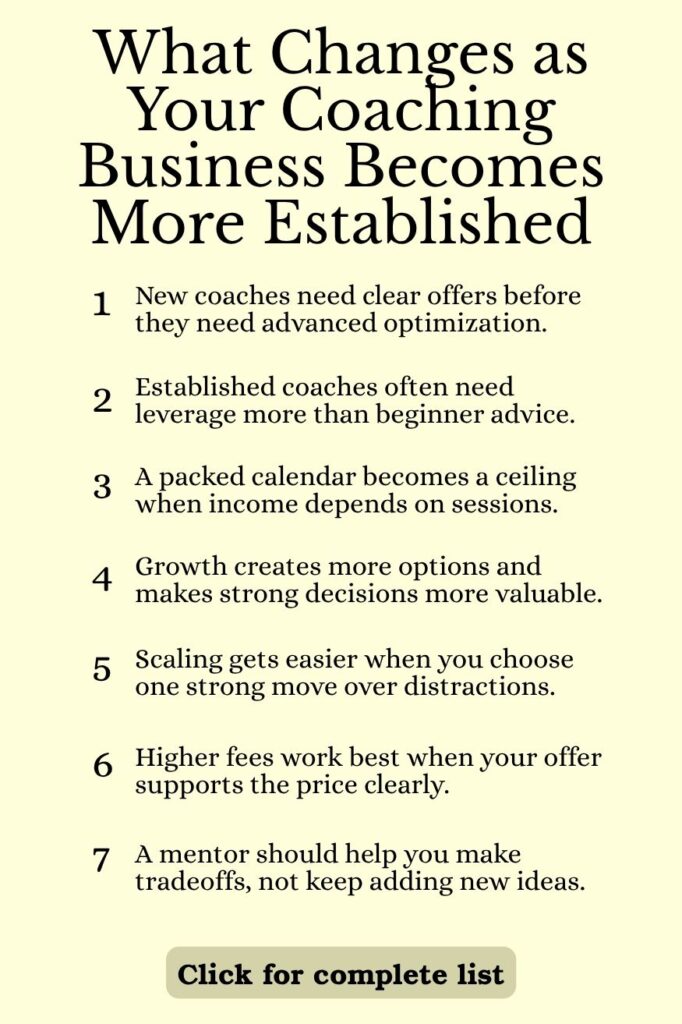
Coaches at different stages can benefit from business mentoring, but the problem worth paying to solve changes as the business matures.
New coaches often need decisions before they need optimization.
A newer coach may need to define who they help, what problem they solve, what their first offer includes, how much they will charge, and how a prospect can take the next step.
SEE ALSO: If you’re a coach looking to streamline your administrative tasks and save time, check out our Coaching Administration Software. It’s a simple, effective solution designed to help you focus less on paperwork and more on what matters—coaching your clients. From scheduling to client management, our software gives you the tools to run your business efficiently. Ready to reclaim your time and boost productivity? Click or tap here.
Consider a coach who has completed training, built an Instagram account, and created a website, but still cannot explain what someone can actually buy. More social posts will not fix that. The immediate issue is offer clarity.
If being found is part of the problem, a free life coach directory listing can create another visibility point while the coach works on positioning, offers, and conversion.
Established coaches usually need leverage rather than basic startup advice.
Imagine you coach eight to twelve clients each week and referrals come in reasonably often. The business works, but your schedule is getting crowded and your income is still closely tied to the number of private sessions you personally deliver.
Your mentoring questions may now be:
- Should I raise my fees?
- Should I change from individual sessions to packages?
- Which clients are most profitable and satisfying to serve?
- Could part of my method become a course or digital product?
- What should I stop doing personally?
- Where is client retention weaker than it should be?
That is a different mentoring engagement from “How do I get my first client?”
SEE ALSO: If you’re a coach looking to streamline your administrative tasks and save time, check out our Coaching Administration Software. It’s a simple, effective solution designed to help you focus less on paperwork and more on what matters—coaching your clients. From scheduling to client management, our software gives you the tools to run your business efficiently. Ready to reclaim your time and boost productivity? Click or tap here.
Scaling coaches often need help making tradeoffs.
Growth creates options. Group coaching, speaking, courses, corporate work, a book, licensing, additional coaches, or a more premium private offer may all look attractive.
The danger is trying to build all of them at once.
A useful mentor at this stage should help you evaluate capacity, economics, strategic fit, and opportunity cost. The goal is not more ideas. It is choosing the few moves capable of making the business stronger.
How Can the Right Mentor Improve Your Coaching Business?
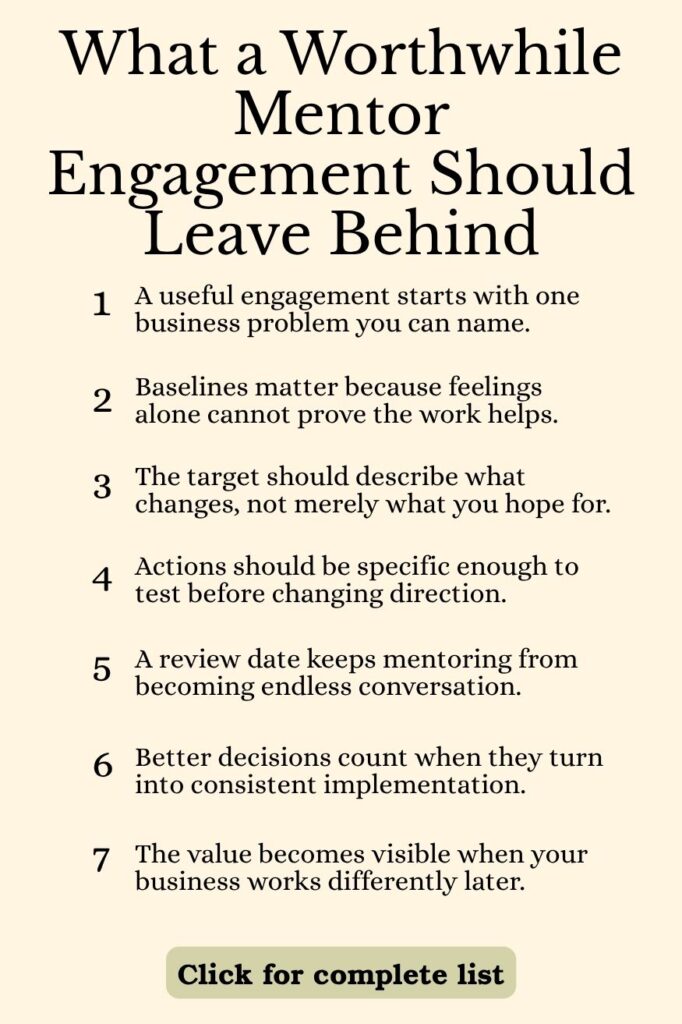
The right mentor can improve your business by helping you recognize patterns faster, challenge weak assumptions, make cleaner decisions, and follow through on priorities you have already chosen.
Experience matters because business problems often repeat in recognizable forms.
SEE ALSO: If you’re a coach looking to streamline your administrative tasks and save time, check out our Coaching Administration Software. It’s a simple, effective solution designed to help you focus less on paperwork and more on what matters—coaching your clients. From scheduling to client management, our software gives you the tools to run your business efficiently. Ready to reclaim your time and boost productivity? Click or tap here.
A new coach may think their problem is “not enough Instagram followers.” An experienced mentor may notice that the coach has no clear offer or meaningful call to action, so additional reach would simply send more people into a broken conversion path.
Another coach may assume they need more clients. A closer look may show that clients are finishing a short package and leaving despite having more work they would happily continue. The better business problem could be retention and client lifetime value, not lead generation. The simple math of client lifetime value for coaches is useful here.
Mentoring research also supports using measured language rather than promising dramatic business outcomes. A meta-analysis by Tammy D. Allen and colleagues found mentoring was generally associated with beneficial career outcomes, although effects on objective measures such as compensation were small.
That is a useful expectation to bring into a mentoring relationship.
A mentor should not magically create your success. A strong relationship can improve the quality and speed of your decisions, give you informed feedback, expose blind spots, and make it harder to quietly abandon the work you committed to doing.
What Should a 90-Day Mentor Engagement Actually Produce?
A focused mentor engagement should produce observable decisions and implementation, not simply three months of interesting conversations.
SEE ALSO: If you’re a coach looking to streamline your administrative tasks and save time, check out our Coaching Administration Software. It’s a simple, effective solution designed to help you focus less on paperwork and more on what matters—coaching your clients. From scheduling to client management, our software gives you the tools to run your business efficiently. Ready to reclaim your time and boost productivity? Click or tap here.
Before beginning, define five things:
- The bottleneck: What specific problem are you solving?
- The baseline: What is happening now?
- The target: What should be meaningfully different?
- The actions: What will you actually change or test?
- The review point: When will you evaluate what happened?
Suppose your problem is weak discovery-call conversion.
“Get better at sales” is too vague.
A useful 90-day objective might be to review how prospects currently reach you, tighten the offer, revise the questions you ask on discovery calls, track how many qualified prospects become clients, and compare the result after a meaningful number of conversations.
Or suppose your coaching calendar is already close to capacity.
Your 90-day goal might be to design one coaching package with clearer outcomes, review pricing, determine which parts of your process can be supported between sessions, and decide whether a course or digital product belongs in your next offer layer.
SEE ALSO: If you’re a coach looking to streamline your administrative tasks and save time, check out our Coaching Administration Software. It’s a simple, effective solution designed to help you focus less on paperwork and more on what matters—coaching your clients. From scheduling to client management, our software gives you the tools to run your business efficiently. Ready to reclaim your time and boost productivity? Click or tap here.
Some goals are operational.
You might want to reduce the number of separate emails and manual steps required to onboard each new client. Track how many steps the process currently takes, design the new workflow, implement it, and compare.
The exact target will vary. The discipline should not.
You should be able to say what you are trying to change and what evidence will tell you whether you changed it.
How Do You Choose a Mentor Who Can Actually Help With Your Bottleneck?
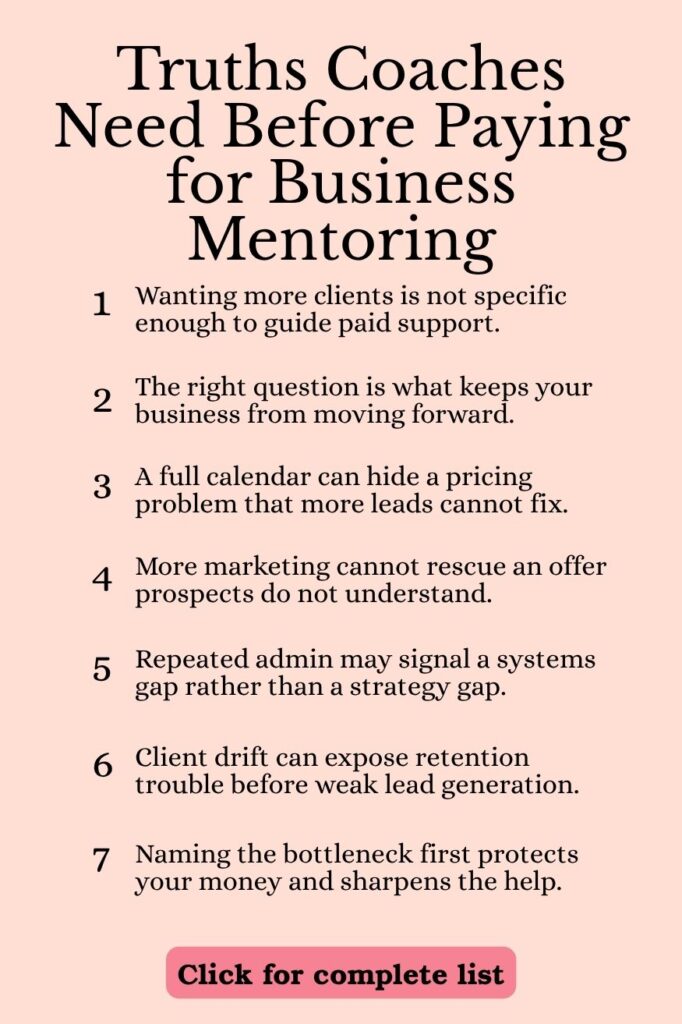
Choose a mentor based on their relevance to the problem you need solved, not simply the size of their audience or the impressiveness of their personal brand.
A practical Mentor Fit Scorecard can help.
SEE ALSO: If you’re a coach looking to streamline your administrative tasks and save time, check out our Coaching Administration Software. It’s a simple, effective solution designed to help you focus less on paperwork and more on what matters—coaching your clients. From scheduling to client management, our software gives you the tools to run your business efficiently. Ready to reclaim your time and boost productivity? Click or tap here.
Relevant experience: Have they dealt with the stage and problem you are facing?
Someone may have built a very successful certification company but know little about building a sustainable solo coaching practice. Another mentor with a smaller public profile may have helped dozens of independent coaches move from scattered one-off sessions into clearer packages.
The second person may be far more relevant.
A method you can understand: Can they explain how they approach the problem?
Be cautious if every explanation collapses into “mindset,” “alignment,” or “just trust the process.” You should be able to understand what will actually be examined and worked on.
Evidence that matches the claim: What proof exists that they understand this problem?
SEE ALSO: If you’re a coach looking to streamline your administrative tasks and save time, check out our Coaching Administration Software. It’s a simple, effective solution designed to help you focus less on paperwork and more on what matters—coaching your clients. From scheduling to client management, our software gives you the tools to run your business efficiently. Ready to reclaim your time and boost productivity? Click or tap here.
Look beyond revenue screenshots. If they claim to help coaches improve retention, ask how they diagnose retention problems and what indicators they monitor.
Clear role boundaries: Are they mentoring you, consulting, coaching you, or doing the work for you?
Those can all be useful services, but you should know which one you are buying.
Useful challenge: Will this person disagree with you when the evidence says you are wrong?
Paying someone to approve every idea is expensive validation.
Independent thinking: Does their approach make you more capable of making future decisions yourself?
SEE ALSO: If you’re a coach looking to streamline your administrative tasks and save time, check out our Coaching Administration Software. It’s a simple, effective solution designed to help you focus less on paperwork and more on what matters—coaching your clients. From scheduling to client management, our software gives you the tools to run your business efficiently. Ready to reclaim your time and boost productivity? Click or tap here.
A useful mentor should increase your business judgment, not make every future decision dependent on another paid call.
Defined outcomes: Can you agree on what the engagement is meant to accomplish?
You do not need a guaranteed financial return. You do need a shared understanding of the problem, the work, and how progress will be reviewed.
How Do You Know If You’re Ready to Hire a Business Mentor?
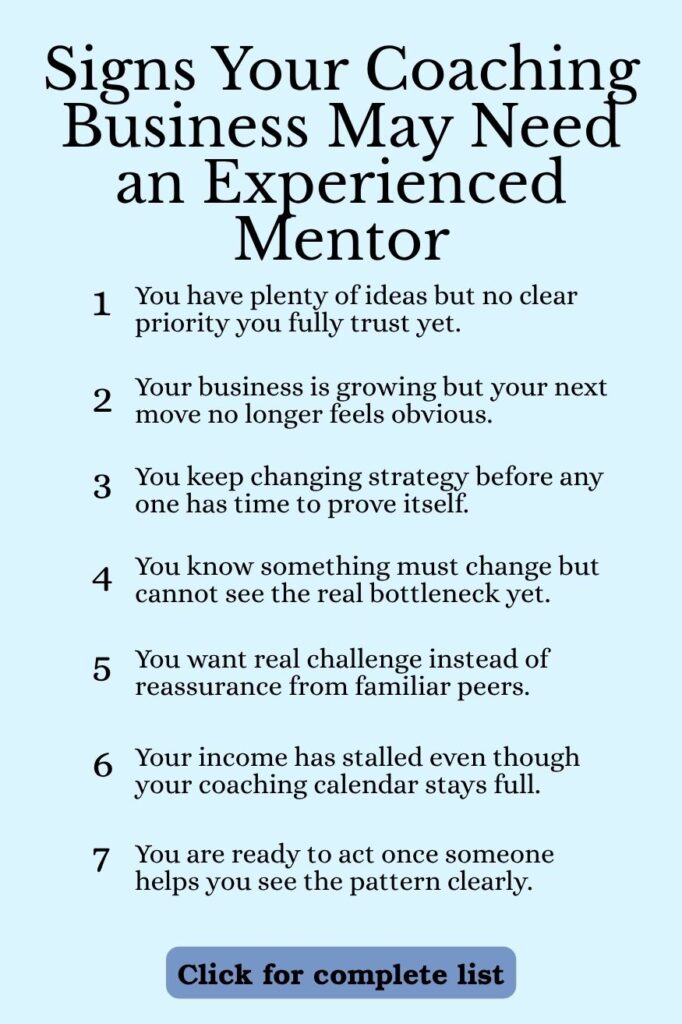
You are ready to consider a business mentor when you can identify a meaningful gap and are prepared to act on the decisions the mentoring process produces.
The original questions below make a strong self-check when you connect them to the four mentor gaps.
1. How will I know when I have achieved my life and business goals?
SEE ALSO: If you’re a coach looking to streamline your administrative tasks and save time, check out our Coaching Administration Software. It’s a simple, effective solution designed to help you focus less on paperwork and more on what matters—coaching your clients. From scheduling to client management, our software gives you the tools to run your business efficiently. Ready to reclaim your time and boost productivity? Click or tap here.
This tests your evidence gap.
Do you have a way to review what is changing? If your goal is a more profitable coaching business, what does that mean in observable terms?
More retained clients? Higher package revenue? Fewer unpaid admin hours? More qualified consultations? Greater income from offers that do not require another private coaching hour?
If you cannot describe the result, your mentor cannot help you evaluate progress toward it.
2. How can I get what I want?
This tests your strategy and skill gap.
SEE ALSO: If you’re a coach looking to streamline your administrative tasks and save time, check out our Coaching Administration Software. It’s a simple, effective solution designed to help you focus less on paperwork and more on what matters—coaching your clients. From scheduling to client management, our software gives you the tools to run your business efficiently. Ready to reclaim your time and boost productivity? Click or tap here.
You may know the outcome but lack the method.
For example, you want four new package clients each quarter, but you do not have a clear visibility, lead capture, consultation, and follow-up path. That is concrete enough to work on.
3. Will I be able to stay committed in the long run?
This tests your execution gap.
Look at your behavior, not your intentions.
Have you created three marketing plans in the last year and abandoned each after two weeks? Do you keep buying new programs instead of implementing the one you already chose? Do important follow-up tasks disappear as soon as client work gets busy?
SEE ALSO: If you’re a coach looking to streamline your administrative tasks and save time, check out our Coaching Administration Software. It’s a simple, effective solution designed to help you focus less on paperwork and more on what matters—coaching your clients. From scheduling to client management, our software gives you the tools to run your business efficiently. Ready to reclaim your time and boost productivity? Click or tap here.
A mentor may be useful if external challenge and accountability help you stay with a sound strategy long enough to evaluate it.
4. What do I want in my life and business?
This tests your direction gap.
Your business model should fit the kind of coaching practice you actually want.
A coach who wants twenty-five private sessions each week should make different decisions from a coach who wants ten premium clients plus speaking, a course, and a book.
Neither model is automatically better. They require different priorities.
SEE ALSO: If you’re a coach looking to streamline your administrative tasks and save time, check out our Coaching Administration Software. It’s a simple, effective solution designed to help you focus less on paperwork and more on what matters—coaching your clients. From scheduling to client management, our software gives you the tools to run your business efficiently. Ready to reclaim your time and boost productivity? Click or tap here.
A “no” to one question does not automatically mean you need a mentor. It tells you where the gap is.
Your next question is whether mentoring is the right intervention for that gap.
When Is a Mentor Not the Right Next Step?
A mentor is not the right next step when the problem is better solved by a specialist, a professional-development process, or a stronger operating system.
Match the intervention to the problem.
You need feedback on your coaching competency: Look for qualified ICF Mentor Coaching rather than general business mentoring.
You are dealing with difficult professional or ethical dynamics in client work: Consider qualified coach supervision.
SEE ALSO: If you’re a coach looking to streamline your administrative tasks and save time, check out our Coaching Administration Software. It’s a simple, effective solution designed to help you focus less on paperwork and more on what matters—coaching your clients. From scheduling to client management, our software gives you the tools to run your business efficiently. Ready to reclaim your time and boost productivity? Click or tap here.
Your taxes, bookkeeping, or business structure are wrong: Talk to an appropriately qualified accountant, bookkeeper, or legal professional.
Your paid advertising campaigns are losing money: Find someone with specific expertise in the channel and economics involved.
Your problem is lack of prospects: Diagnose your positioning, visibility, offer, funnel, and conversion path before assuming you need general motivation.
Your problem is repetitive administration: Build a clearer operating process. Another month of strategic discussion will not fix a process you already know how to run but keep executing manually.
Your problem is lack of implementation: Decide whether you need accountability, a system, or both.
This distinction protects your money.
SEE ALSO: If you’re a coach looking to streamline your administrative tasks and save time, check out our Coaching Administration Software. It’s a simple, effective solution designed to help you focus less on paperwork and more on what matters—coaching your clients. From scheduling to client management, our software gives you the tools to run your business efficiently. Ready to reclaim your time and boost productivity? Click or tap here.
Do not hire a broad solution for a narrow problem simply because “successful coaches have mentors.” Diagnose first.
Where LCH Core Fits
LCH Core fits after you know what business process needs to change, because software can support a system but it cannot choose your strategy for you.
Suppose a mentor helps you diagnose weak discovery-call conversion. You decide prospects need one clearer next step and better information before the conversation. A Public Booking Page can provide the booking path, while intake forms can give you useful context before the call.
Suppose the problem is inconsistent onboarding. Your mentor helps you define what every new client should receive before session one. A Welcome Package can bring together the welcome letter, coaching agreement with electronic signature, and forms in a repeatable client onboarding process.
Suppose the issue is client follow-through. Your strategy might call for one action item after every session, a journal prompt at a specific point in the program, or a worksheet tied to a milestone. Coaching tools such as journals, worksheets, goals, action items, and reusable resources can support that process.
If the problem is the evidence gap, client profiles and notes can preserve context while the Progress Stream and Engagement Report can help you review client activity and engagement rather than relying only on memory.
SEE ALSO: If you’re a coach looking to streamline your administrative tasks and save time, check out our Coaching Administration Software. It’s a simple, effective solution designed to help you focus less on paperwork and more on what matters—coaching your clients. From scheduling to client management, our software gives you the tools to run your business efficiently. Ready to reclaim your time and boost productivity? Click or tap here.
If the growth decision involves your business model, payments, coaching packages, and billing can support packaged coaching. Courses and digital products sold through a Public Store can support a strategy that expands beyond private coaching hours. Lead magnets can support the beginning of a client-getting path.
That is the cleanest role for LCH Core. Your mentor helps you make better decisions about the business you want to build. Your systems help you run those decisions consistently.
Frequently Asked Questions About Mentor Coaches for Coaching Businesses

Do life coaches need a business mentor?
No, life coaches do not automatically need a business mentor. A mentor becomes useful when you have a specific direction, strategy, execution, or evidence gap that their experience can help you close.
What is the difference between a business mentor and an ICF Mentor Coach?
A business mentor helps with business decisions, while ICF Mentor Coaching focuses specifically on developing coaching skills through observed or recorded coaching and competency-based feedback. If your issue is pricing or client acquisition, you are looking for business guidance. If your issue is how you coach, ICF Mentor Coaching may be the relevant route.
SEE ALSO: If you’re a coach looking to streamline your administrative tasks and save time, check out our Coaching Administration Software. It’s a simple, effective solution designed to help you focus less on paperwork and more on what matters—coaching your clients. From scheduling to client management, our software gives you the tools to run your business efficiently. Ready to reclaim your time and boost productivity? Click or tap here.
How do I choose a mentor for my coaching business?
Choose a mentor whose experience directly matches your business stage and current bottleneck. Ask how they diagnose the problem, what you will work on, what role they will play, and how you will review progress.
What should I work on with a coaching-business mentor?
Work on a defined business problem such as positioning, offers, pricing, discovery-call conversion, client retention, referrals, capacity, or scalable offers. “Grow my business” is too broad to produce a focused mentoring engagement.
How often should I meet with a business mentor?
Meet often enough to make decisions, implement them, collect evidence, and review the result before changing direction again. Weekly meetings may suit an intensive implementation period, while monthly meetings may work better when meaningful testing needs time between conversations.
SEE ALSO: If you’re a coach looking to streamline your administrative tasks and save time, check out our Coaching Administration Software. It’s a simple, effective solution designed to help you focus less on paperwork and more on what matters—coaching your clients. From scheduling to client management, our software gives you the tools to run your business efficiently. Ready to reclaim your time and boost productivity? Click or tap here.
When is coach supervision better than mentoring?
Coach supervision is a better fit when your primary need is reflective professional work around client dynamics, ethics, boundaries, or how your own reactions may be affecting your practice. Business mentoring serves a different purpose.
Can a business mentor help me get more coaching clients?
A business mentor can help you diagnose and improve the system behind client acquisition. That might involve your positioning, offer, visibility, lead path, discovery calls, follow-up, or referral strategy, rather than simply telling you to market more.
How do I know whether mentoring is worth the cost?
Mentoring is easier to evaluate when you define the problem, baseline, intended outcome, actions, and review date before you begin. The value may show up through better decisions, stronger execution, avoided mistakes, improved business metrics, or a combination of these.
SEE ALSO: If you’re a coach looking to streamline your administrative tasks and save time, check out our Coaching Administration Software. It’s a simple, effective solution designed to help you focus less on paperwork and more on what matters—coaching your clients. From scheduling to client management, our software gives you the tools to run your business efficiently. Ready to reclaim your time and boost productivity? Click or tap here.
Sources
International Coaching Federation. ICF Mentor Coaching Handbook: Mentor Coaching Definition, Competencies, and Traits. International Coaching Federation, Apr. 2026. ICF Mentor Coaching Handbook.
Allen, Tammy D., Lillian T. Eby, Mark L. Poteet, Elizabeth Lentz, and Lizzette Lima. “Career Benefits Associated with Mentoring for Protégés: A Meta-Analysis.” Journal of Applied Psychology, vol. 89, no. 1, Feb. 2004, pp. 127-136. PubMed, doi:10.1037/0021-9010.89.1.127. PubMed record.
Read this next

Why You’re Not Greedy For Charging Higher Fees & 6 Reasons Undercharging Hurts Your Business
Find out why it’s time to value your services and start charging more for coaching
Read More
Safeguard Your Practice: The Ultimate Life Coaching Disclaimer Template Guide
A caution? A warning? What is a life coaching disclaimer template exactly and how do you make one for your website?
Read More
When Being A Good Coach Isn’t Enough
How to create a powerful and sustainable practice as a coach.
Read More