


Talk to a coach about Organizational coaching

Crystal Faulk
ACC
I help overwhelmed women in transition gain clarity, confidence, and...

Terrie Hein
Certified Life Coach, Certified Insight Coach Practitioner
Coaching to declutter your life, organize your goals, and cook...

Dr Charlene Ashley
Doctorate - Behaviours
I coach individuals to design fulfilling lives through structure, clarity,...

Paloma Chiara

Lana's Gymnastics Club
"Where the best in gymnastics meets fun. Where every child is a star"
lgclubny.com

Anna Sosnina
ICF (ACC)
ICF ACC certified coach, founder of EssorVie Coaching, passionate about...

Tyler Fink
B.A. in Religion, Anthropology, and Philosophy. Master of Divinity (M.Div.) in Missiology
Pastor, husband, and father helping Christian men pursue faithful growth...

Travis Brown
Professional Life coach
With experience in guiding clients to achieve goals, build confidence,...
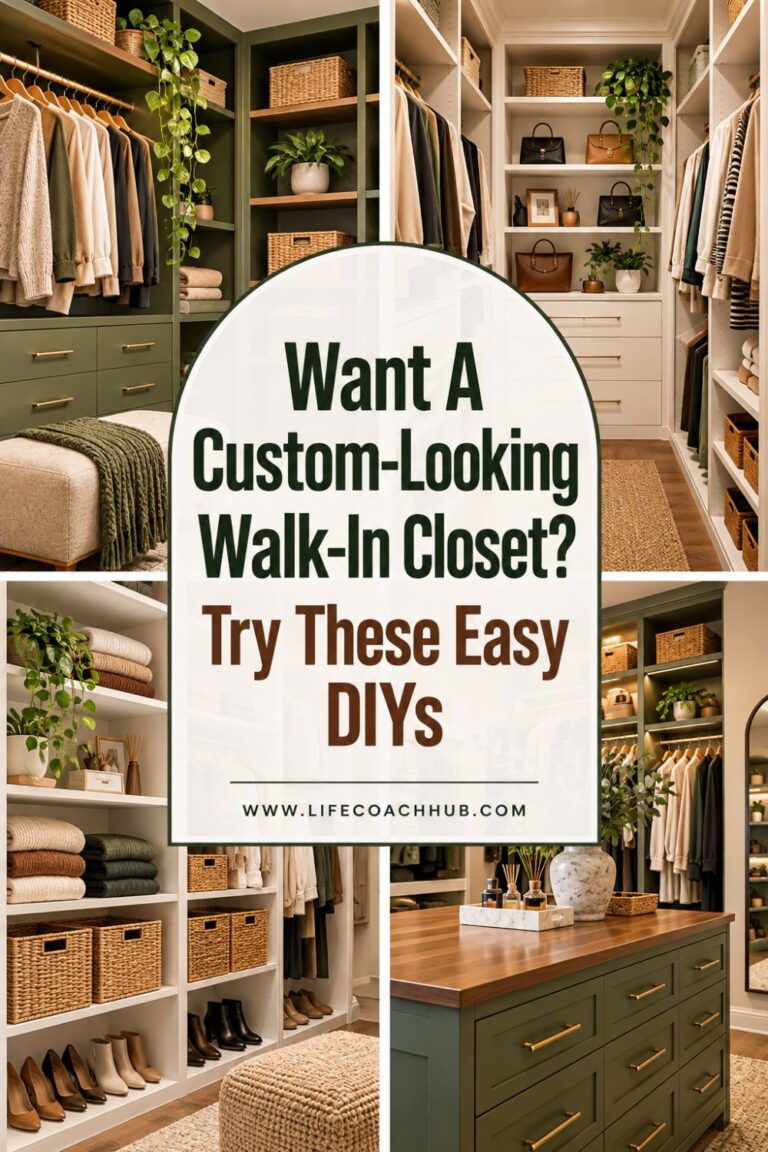



Open Shelf Sweater Zone for Boutique Closet Storage
Are you all about style, decor and organization? Download a copy of our Clutter Reset Guide.
*****
The Secret to Making Open Closet Shelves Look Like a Boutique
There’s something satisfying about walking into a closet where every sweater is neatly folded, every pair of jeans has its place, and the shelves look like they belong in a stylish clothing boutique. Unfortunately, open shelving doesn’t always deliver that picture-perfect result.
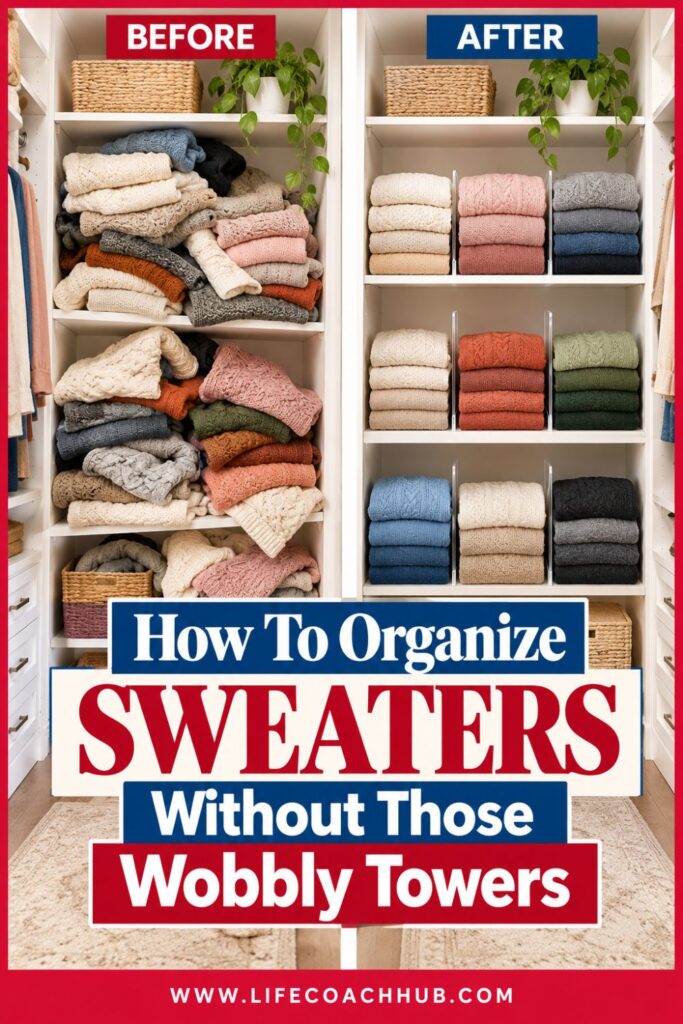
Without a clear organization system, those beautiful shelves can quickly become a collection of leaning sweater piles, mismatched denim stacks, and clothes stuffed into whatever space is available. Instead of making your closet feel spacious and organized, everything ends up on display.
The good news is that creating boutique-style closet storage doesn’t require expensive cabinetry or a professional closet makeover. Often, the difference comes down to how you arrange your clothing, divide your shelves, and manage the space between stacks.
Open shelving works best when every visible item has a purpose and a designated place. Sweaters and denim are particularly well suited to this type of storage because they can be folded into neat shapes and organized into distinct categories.
However, there’s a difference between shelves that look beautiful for a photograph and shelves that stay organized when you’re getting dressed on a busy morning. A practical system needs to make it easy to find, remove, and return clothes without disturbing everything around them.
That’s why the smartest approach combines visual styling with everyday functionality. Instead of simply stacking clothing by color, you’ll create dedicated zones, establish consistent folding methods, and use simple organizers to prevent piles from spreading.
If you want to get more from your life, and are looking for concrete action steps to get you there, check out our Request a Coach page. It’s a “cut the fence-sitting and take action” way to tackle your issues and actually find success. To get off the fence and start to take action, click or tap here.
You don’t need a huge walk-in closet to make this work, either. A narrow shelving unit, a few built-in closet shelves, or one open section of a wardrobe can become an attractive storage area with the right layout.
The following steps will show you how to turn ordinary shelving into an intentional sweater and denim display that looks polished, makes getting dressed easier, and doesn’t require constant rearranging.
Need some in depth help with organization and productivity ? Drop on by our directories choc full of productivity coaches, minimalist coaches, and work/life balance coaches to get your life organized! Or click here to have us match you to the best.
Start With a Shelf Layout That Fits Your Actual Wardrobe
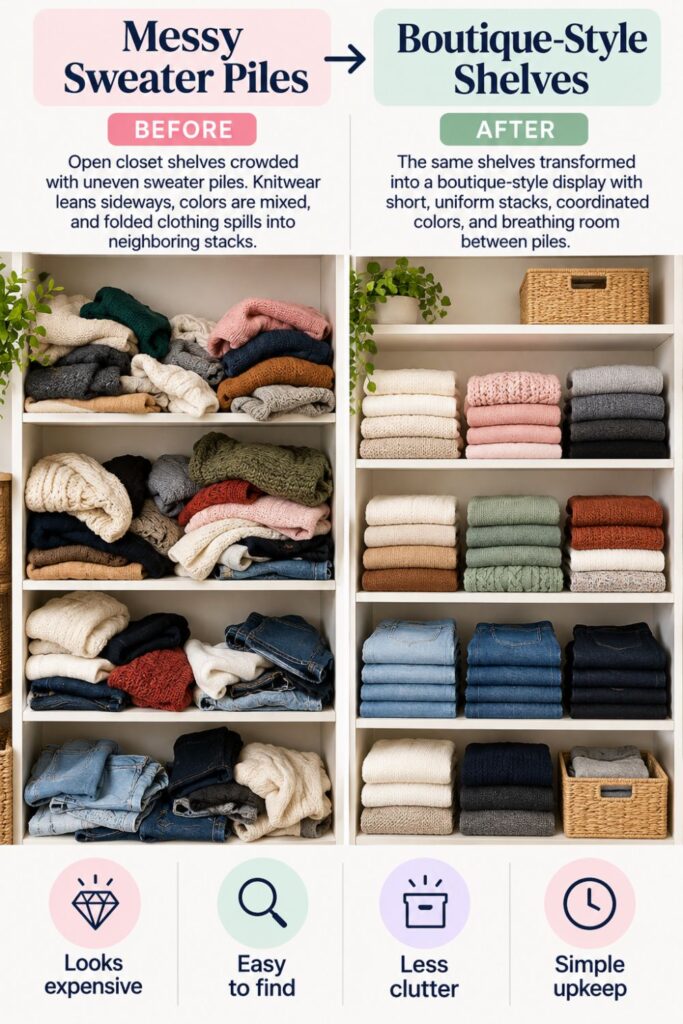
The biggest mistake you can make when organizing open closet shelves is buying attractive storage accessories before figuring out what needs to fit. A boutique-style arrangement starts with understanding your wardrobe and designing the shelves around the clothing you actually own.
Before moving anything, take a few minutes to evaluate your available space.
- Take inventory of your folded clothes: Gather the sweaters, cardigans, and jeans you want to store on the shelves. Separate everyday favorites from seasonal clothing and pieces you rarely wear. This helps you see how much space each category requires and prevents you from designing a beautiful arrangement that only accommodates half your wardrobe.
- Measure your available shelving: Record the width, depth, and vertical clearance of each shelf opening. Pay particular attention to bulky sweaters, which need more room than lightweight knits or folded denim. Measuring also helps you determine whether shelf dividers, small risers, or open-front bins will fit without making the space feel crowded.
- Assign each shelf a specific purpose: Give frequently worn sweaters and jeans the most accessible locations, ideally between waist and shoulder height. Reserve upper shelves for seasonal knitwear or clothing you don’t need every day. If you have limited shelving, dedicate separate sections of one long shelf to different categories rather than mixing everything together.
- Test your proposed layout before buying organizers: Fold a few representative sweaters and jeans, then place them on the shelves to estimate how many stacks fit comfortably. Practice removing an item from the middle or bottom of each pile. If reaching one garment knocks over another stack, you’ll need wider spacing or a different arrangement.
A simple shelf map can help you visualize the finished setup. For example, you might dedicate the upper shelf to seasonal sweaters, the middle shelf to everyday knitwear, and the lower shelf to denim.
The goal isn’t to fill every shelf perfectly. It’s to create enough structure that the clothes fit naturally, remain accessible, and have room to stay organized.
Divide Sweaters and Denim Into Separate Boutique-Style Zones
One of the reasons clothing boutiques look so organized is that they rarely treat an entire shelving unit as one big storage area. Instead, each section has a recognizable purpose, making the clothing feel intentionally displayed rather than randomly stacked.
If you want to get more from your life, and are looking for concrete action steps to get you there, check out our Request a Coach page. It’s a “cut the fence-sitting and take action” way to tackle your issues and actually find success. To get off the fence and start to take action, click or tap here.
You can recreate that effect by dividing your open shelves into clear sweater and denim zones.
- Give sweaters their own dedicated section: Choose a shelf or group of compartments specifically for knitwear. Separate chunky sweaters from lightweight cardigans when space allows, since combining different thicknesses can create unstable piles. Keeping knitwear together also protects softer fabrics from being compressed or pulled when you reach for heavier clothing.
- Create a separate denim storage zone: Place jeans on another shelf or in clearly defined sections beside your sweaters. If you own several denim styles, organize them into smaller groups such as straight-leg, wide-leg, and casual jeans. This makes it easier to locate the pair you want without searching through an entire stack.
- Organize categories around how you get dressed: Think about whether you choose clothing by style, color, or occasion. Someone who wears jeans almost every day might prefer denim organized by fit, while someone with a large sweater collection may benefit from separate workwear and casual knitwear sections. Choose categories that reflect your actual habits rather than copying a display that looks attractive but feels inconvenient.
- Create visible boundaries between categories: Leave a small gap between stacks or add simple shelf dividers to keep each section contained. On longer shelves, try grouping two sweater stacks on one side and two denim stacks on the other. These boundaries prevent clothing from gradually spreading across the shelf.
The most important detail is consistency. Once you’ve decided where each category belongs, avoid using empty spaces as temporary storage for unrelated clothing.
Clearly defined zones make shelves look more polished, but they also reduce the decisions required to put clothes away. Every sweater and pair of jeans has an obvious home.
Use Folding Methods That Make Every Stack Look Uniform
You can have the most beautiful shelves in the world, but uneven folds will still make them look cluttered. Boutique-style clothing displays rely heavily on consistent shapes, aligned edges, and stacks that hold together when someone removes an item.
The trick is choosing folding methods that work with the fabric rather than forcing every garment into exactly the same shape.
- Fold sweaters without stretching their shape: Lay each sweater face down on a clean, flat surface and smooth out major wrinkles. Fold the sleeves inward, bring the sides toward the center, and fold the body into a compact rectangle. Avoid pulling the shoulders or neckline tightly, especially with delicate knitwear that can stretch or lose its shape.
- Use consistent folding widths for sweaters: Choose a finished width that fits comfortably on your shelf, then use the first neatly folded sweater as a visual guide for the others. Lightweight knitwear may need additional folds to match the width of bulkier pieces. The goal is to create aligned front edges without compressing thick sweaters into unnaturally small bundles.
- Fold denim into stable rectangles: Lay jeans flat, smooth the fabric, and fold one leg over the other. Bring the lower portion of the legs upward, then fold again according to the shelf depth. Because denim is relatively structured, consistent folds usually create sturdy stacks that are easier to maintain than irregularly folded piles.
- Choose the display method that suits your shelves: Horizontal stacks create the classic boutique appearance, especially when folded edges face outward. Upright folding can work for denim stored in supportive open-front bins, allowing you to see several pairs at once. Avoid unsupported vertical arrangements that collapse whenever one item is removed.
For a cohesive appearance, keep the folded edges facing the same direction throughout each shelf.
You don’t need every garment to form a mathematically perfect rectangle. Slight variations are normal, particularly with oversized sweaters and textured knits.
What matters is creating enough consistency that the stacks look intentional while remaining easy to use.
If you want to get more from your life, and are looking for concrete action steps to get you there, check out our Request a Coach page. It’s a “cut the fence-sitting and take action” way to tackle your issues and actually find success. To get off the fence and start to take action, click or tap here.
Build Short, Balanced Stacks Instead of Clothing Towers
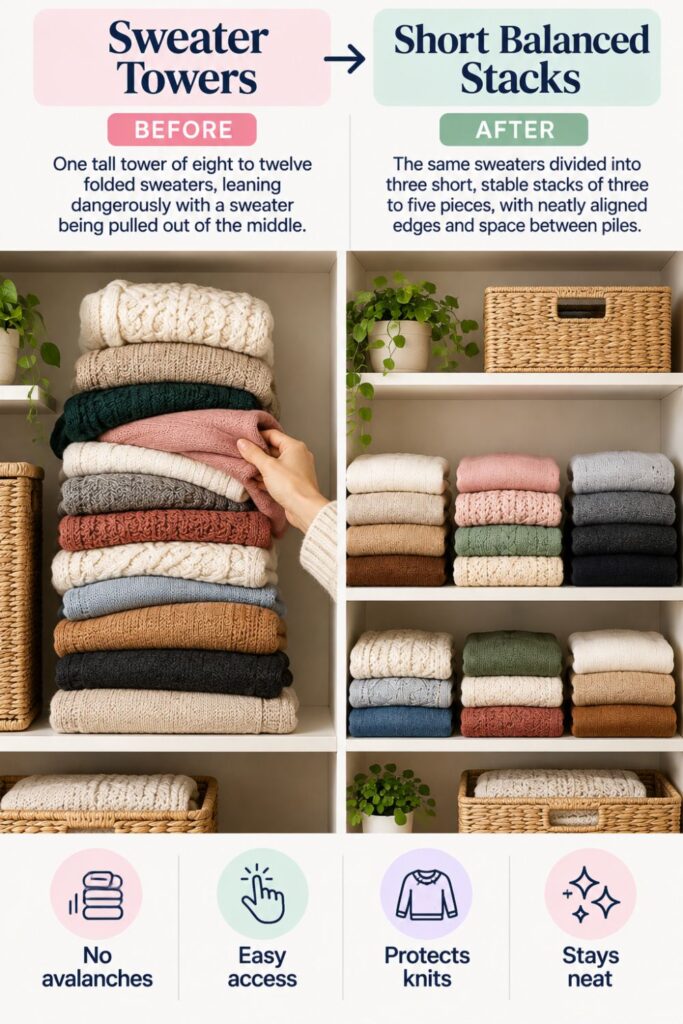
Tall sweater towers might seem like an efficient way to maximize vertical storage, but they often create more problems than they solve. Once a stack becomes too high, the weight of the clothing can compress garments, and removing something from the bottom becomes frustrating.
Shorter, balanced piles generally look more attractive and are much easier to maintain.
- Limit how many garments go into each stack: Start with approximately three to five folded pieces, adjusting for the thickness of the fabric and the height of your shelf opening. Three bulky sweaters might occupy as much space as six lightweight knits. The right height is one that allows you to retrieve an item without pulling the entire pile forward.
- Keep heavier pieces at the bottom of each category: Arrange sturdy denim so heavier jeans support lighter pairs rather than creating an unstable stack. For sweaters, place relatively substantial knits beneath lighter pieces when appropriate, but avoid crushing delicate fabrics. Heavily textured or particularly delicate sweaters may need their own short stacks to maintain their shape.
- Align the front edges of every pile: Position the folded sides consistently toward the shelf opening, then gently adjust each garment so the stack forms a clean visual line. You don’t need to line everything up with a ruler. Simply keeping the front edges relatively even creates the organized appearance associated with clothing displays.
- Leave enough space around each stack: Avoid pushing piles tightly against neighboring clothing or filling every gap with additional garments. Allow room to slide your hands beside a stack and lift an item without dragging another pile along with it. A little visible shelf surface can make the entire arrangement feel calmer.
Consider the difference between one towering pile of twelve sweaters and three shorter stacks organized by category. The shorter arrangement may use more horizontal space, but it provides better visibility and makes individual garments easier to access.
If your shelves are too narrow for several short stacks, use fewer visible garments and store seasonal overflow elsewhere.
The goal is organized storage, not squeezing the maximum possible number of clothes into every available inch.
Add Simple Shelf Dividers and Risers for a Built-In Look
You don’t need custom cabinetry to make ordinary closet shelves feel more structured. A few carefully chosen organizational accessories can create distinct compartments, keep stacks upright, and give basic shelving a more finished appearance.
The key is choosing accessories that solve specific problems instead of adding products simply because they look attractive.
- Install removable dividers between clothing stacks: Look for shelf dividers designed to fit your shelf material and thickness. Clear acrylic dividers can create subtle boundaries, while wood or neutral finishes may suit a warmer closet design. Place them between sweater and denim sections to prevent stacks from leaning together, making sure they remain secure when clothing is removed.
- Use low shelf risers where extra height is useful: If you have deep shelves with generous vertical clearance, a sturdy riser can create an additional level for a smaller stack of folded clothing. For example, keep everyday sweaters in front and less frequently worn pieces behind or above. Check the riser’s dimensions and weight capacity, and avoid arrangements that make clothing difficult to see or reach.
- Introduce open-front bins for awkward categories: Some garments don’t stack neatly, particularly soft cardigans, lightweight accessories, or unusually shaped knitwear. An open-front bin can contain these items while keeping them accessible. Choose a bin that fits the shelf without protruding into the opening, and avoid hiding all your clothing inside containers if you want a boutique-style display.
- Coordinate your organizational materials: Select one or two finishes that complement your existing closet, such as white shelving with clear dividers or natural wood shelves with cream storage bins. Using consistent materials helps inexpensive accessories look like part of a planned system instead of a collection of unrelated products.
Before purchasing anything, identify which stacks actually need support. If your denim already stays neatly folded, additional dividers might not improve the arrangement.
If you want to get more from your life, and are looking for concrete action steps to get you there, check out our Request a Coach page. It’s a “cut the fence-sitting and take action” way to tackle your issues and actually find success. To get off the fence and start to take action, click or tap here.
Focus your budget on the areas where clothing repeatedly tips, shifts, or spreads.
Simple accessories can make a noticeable difference, but the clothes should remain the focus. The most attractive setup is often the one with fewer, better-chosen organizers.
Arrange Colors and Textures So the Shelves Look Styled
Once your shelves have a practical layout, you can begin refining how they look. This is where ordinary folded clothing starts to resemble a carefully arranged boutique display.
Color and texture play a major role in how organized a shelf appears, even when the number of garments stays exactly the same.
- Choose a consistent color arrangement: Try organizing sweaters from light to dark, beginning with cream and beige, moving into warmer tones, and finishing with darker shades. For denim, you might arrange jeans from light washes to dark indigo and black. Keeping similar colors together creates a more cohesive appearance and makes it easier to find specific pieces.
- Group similar textures where possible: Place chunky cable-knit sweaters together rather than mixing them randomly with thin, smooth cardigans. You can also separate ribbed knits, lightweight pullovers, and oversized sweaters into smaller categories. Similar textures tend to produce more consistent stack heights, making the overall display look neater.
- Balance darker and lighter sections: Step back and look at how color is distributed across the entire shelving unit. If all your dark denim sits on one side and every light sweater is concentrated on the other, the arrangement may feel visually uneven. Try distributing categories across shelf levels while preserving their assigned zones and keeping frequently used clothing accessible.
- Keep decorative objects to a minimum: A small storage basket or one simple accessory can help a large shelving unit feel finished, but too many decorative items compete with the clothing. Prioritize the useful space your wardrobe needs. Boutique-inspired storage should feel intentional without sacrificing room for the sweaters and jeans you actually wear.
It’s also worth remembering that an attractive closet doesn’t require a perfectly neutral wardrobe. Bright sweaters, patterned knits, and contrasting denim can look beautiful when arranged with consistent spacing and folding.
If color sorting makes it harder to find clothing, prioritize familiar categories first and use color as a secondary organizing method.
The goal is a visually calm display that still reflects your personal style and supports the way you get dressed.
Set Up the Shelves for Easy Everyday Access
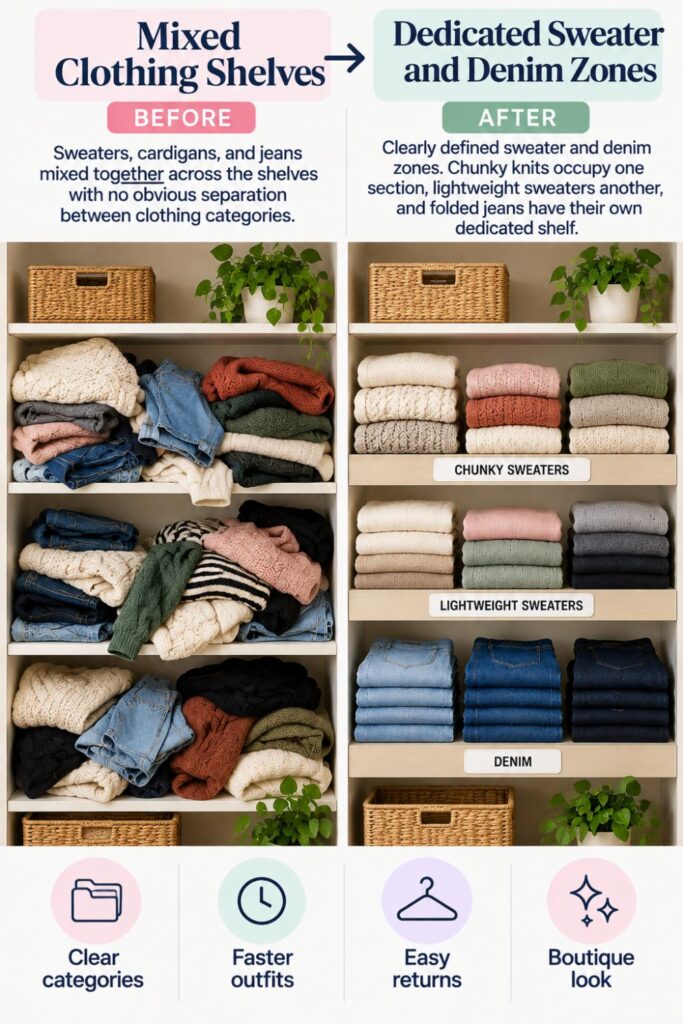
A closet can look flawless after an afternoon of organizing and still become frustrating the very next morning. If your favorite sweater is buried beneath a tall pile or your everyday jeans are stored above your head, the arrangement probably won’t stay tidy for long.
If you want to get more from your life, and are looking for concrete action steps to get you there, check out our Request a Coach page. It’s a “cut the fence-sitting and take action” way to tackle your issues and actually find success. To get off the fence and start to take action, click or tap here.
The most practical boutique-style shelves make frequently used clothing easy to see, retrieve, and return.
- Place everyday favorites within comfortable reach: Keep your most frequently worn sweaters and jeans on shelves you can access without stretching or bending awkwardly. Waist-to-shoulder-height storage is often convenient for daily clothing. Reserve lower or upper shelves for pieces you use less often, while accounting for your height, mobility, and the closet’s layout.
- Keep seasonal clothing outside the primary display: Heavy winter sweaters may not need prime shelf space during warmer months. Move off-season pieces to a separate storage area, using appropriate breathable storage for knitwear and ensuring garments are clean and dry. This creates room for the clothing you’re actually wearing and reduces unnecessary crowding.
- Create an obvious return-home system: Give each category a permanent location so putting away clean laundry becomes straightforward. For example, everyday pullovers might belong on the middle left shelf, cardigans on the middle right, and jeans on the shelf below. When the system is easy to understand, you’re less likely to place clothing in random openings.
- Test your shelves during a normal dressing routine: Choose an outfit using the newly organized sections, then put the clothes back as though you’re following your usual routine. Notice whether stacks move, dividers interfere, or you have to rearrange other garments to retrieve one piece. Make small adjustments wherever the system creates unnecessary work.
For particularly busy mornings, consider keeping a small selection of your most frequently worn items at the front of their assigned stacks.
You can also reserve a separate basket for clothing that needs folding or sorting rather than placing it temporarily on the display shelves.
The best setup should feel natural to use. If retrieving and returning clothes takes only a few simple movements, your open shelving is much more likely to remain organized.
Why Boutique Shelves Get Messy Again and How to Prevent It
Even the most thoughtfully arranged closet can gradually return to clutter. It often happens so slowly that you don’t notice the change until the sweater piles are leaning, jeans are crammed into empty corners, and the original organization system has disappeared.
Fortunately, keeping open shelves tidy doesn’t have to involve regularly reorganizing your entire wardrobe.
- Watch for early signs of overcrowding: Pay attention when stacks begin growing taller, garments get pushed toward the back, or folded clothes repeatedly fall into neighboring sections. These are signs that a category may have outgrown its assigned space. Address the problem early by reducing the visible inventory or adjusting the shelf layout before everything becomes difficult to manage.
- Establish a realistic storage limit for each zone: Decide how many stacks can comfortably fit within a particular shelf section. If that zone is full, avoid creating another pile in an unrelated area simply because there’s an empty corner. Instead, review whether seasonal pieces can move elsewhere or whether some clothing no longer deserves accessible storage space.
- Build a short weekly shelf reset into your routine: Spend a few minutes straightening stacks, returning misplaced garments, and checking whether the category boundaries are still clear. This can be done while putting away laundry or preparing outfits for the coming week. A quick adjustment is much easier than rebuilding several collapsed piles after weeks of neglect.
- Reevaluate the arrangement when your wardrobe changes: Seasonal transitions, new purchases, and changes in your daily routine can all affect how much space different categories require. If you start wearing cardigans more frequently or add several pairs of jeans, reconsider the shelf allocation rather than forcing everything into the original layout.
One helpful habit is to leave a little unused capacity in each section. That extra room accommodates freshly laundered clothing and minor wardrobe changes without immediately making the shelves look overcrowded.
Remember that maintenance should be simple enough to fit into an ordinary week.
If you want to get more from your life, and are looking for concrete action steps to get you there, check out our Request a Coach page. It’s a “cut the fence-sitting and take action” way to tackle your issues and actually find success. To get off the fence and start to take action, click or tap here.
You aren’t trying to preserve a perfect retail display. You’re creating a practical system that stays attractive because it’s easy to maintain.
How an Organization Coach Can Help You Build a Closet System That Sticks
Sometimes the hardest part of closet organization isn’t figuring out where the clothes belong. It’s understanding why previous systems haven’t lasted, especially when you’ve already tried new baskets, folding techniques, and complete wardrobe reorganizations.
An organization coach can help you examine the habits behind recurring clutter and create a setup that fits your everyday life.
- Identify what’s making your existing system difficult: A coach can help you notice patterns you might overlook, such as keeping too much clothing in one section, choosing complicated storage methods, or consistently placing clean laundry wherever there’s room. Understanding these patterns makes it easier to address the actual problem instead of repeatedly purchasing new organizers.
- Define what an organized closet means to you: Not everyone needs perfectly aligned clothing or an elaborate boutique display. You may care most about finding outfits quickly, keeping delicate sweaters protected, or making a small closet feel more spacious. A coach can help you turn those preferences into realistic goals so your system reflects your priorities rather than someone else’s expectations.
- Build routines that support your organization goals: Working with a coach can help you develop manageable habits around folding laundry, returning clothes to assigned zones, and rotating seasonal pieces. Instead of relying on occasional major closet cleanouts, you can create small routines that fit naturally into your week and don’t require excessive motivation.
- Use accountability to maintain progress: If you’ve struggled to maintain organization in the past, scheduled check-ins can help you evaluate what’s working. A coach might encourage you to track which shelves repeatedly become disorganized, identify the reasons, and experiment with practical adjustments. Over time, the goal is to develop a system you can manage independently.
An organization coach may be particularly useful if clutter is part of a broader challenge involving routines, time management, or difficulty following through on household projects.
For hands-on advice about shelf construction or physical storage installation, a professional organizer or qualified installer may be more appropriate.
The real benefit of coaching is learning how to create habits that support the organized space you want, rather than depending on a one-time makeover to solve everything.
Your Boutique Closet Starts With One Well-Organized Shelf
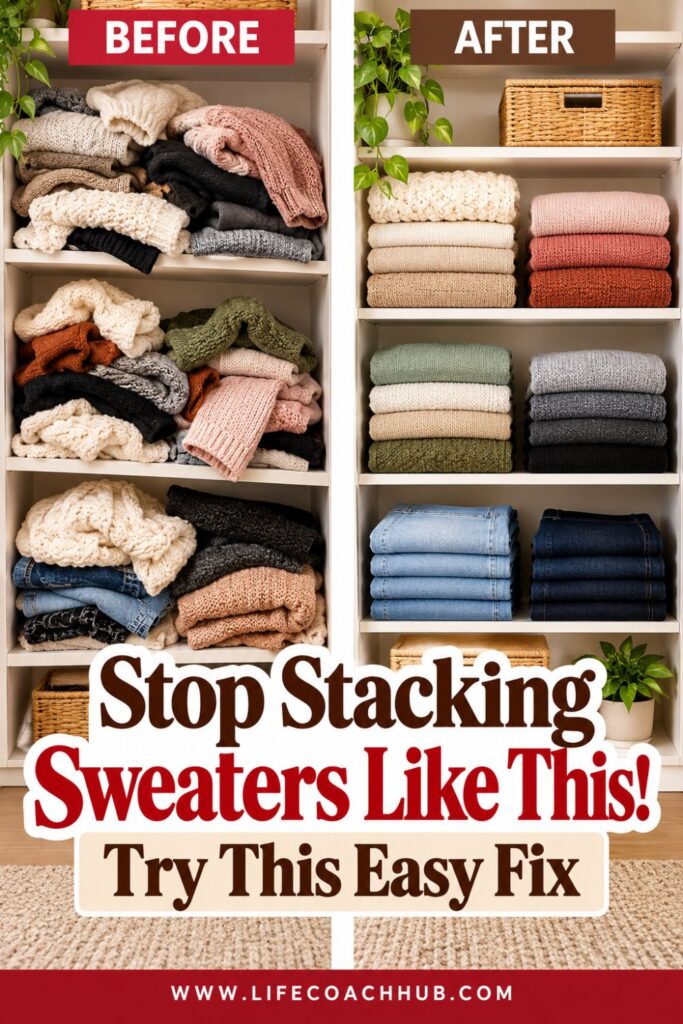
Creating beautiful open closet storage doesn’t have to begin with a complete wardrobe overhaul. In fact, starting with one small section is often a more practical way to discover which folding methods, shelf arrangements, and storage boundaries work best for you.
Choose the shelf that currently causes the most frustration. Perhaps your sweaters are stacked so high that removing one causes an avalanche, or your jeans are mixed together in a pile that makes finding the right fit unnecessarily difficult.
If you want to get more from your life, and are looking for concrete action steps to get you there, check out our Request a Coach page. It’s a “cut the fence-sitting and take action” way to tackle your issues and actually find success. To get off the fence and start to take action, click or tap here.
Instead of reorganizing the entire closet at once, focus on transforming that single area into a functional boutique-inspired zone.
- Start with one manageable shelf: Remove the clothing, group it into useful categories, and assess how much space each stack requires. Refold garments consistently, create clear boundaries, and leave enough room for easy access. Once that shelf feels comfortable to use, apply the same principles to the next section.
- Prioritize practicality over perfect styling: Beautiful color arrangements and matching organizers can make shelves feel polished, but they shouldn’t interfere with your daily routine. If a visually impressive stack becomes difficult to use, shorten it, rearrange the categories, or move less frequently worn items elsewhere.
- Keep the system simple enough to repeat: Choose folding methods you can maintain, assign every category a clear home, and avoid filling every available inch. The less effort your system requires, the easier it becomes to return clothes to their designated places after laundry or a busy morning.
As your closet takes shape, step back occasionally and evaluate both its appearance and functionality. Look for balanced stacks, clearly defined sections, and open spaces that make clothing easy to retrieve.
You may discover that your shelves look better with fewer accessories, shorter piles, or a different arrangement than you originally imagined. That’s part of creating a personalized organization system rather than copying a display that wasn’t designed for your wardrobe.
The secret to boutique-style closet storage isn’t making every sweater and pair of jeans look perfect. It’s giving everything a clear, practical place where it can stay organized.
With thoughtful shelving zones, consistent folding, and a few simple maintenance habits, your closet can feel polished and intentional every day, not just immediately after you organize it.
*****
Are you all about style, decor and organization? Download a copy of our Clutter Reset Guide.
Need some in depth help with organization and productivity ? Drop on by our directories choc full of productivity coaches, minimalist coaches, and work/life balance coaches to get your life organized! Or click here to have us match you to the best.
If you want to get more from your life, and are looking for concrete action steps to get you there, check out our Request a Coach page. It’s a “cut the fence-sitting and take action” way to tackle your issues and actually find success. To get off the fence and start to take action, click or tap here.
If you want to get more from your life, and are looking for concrete action steps to get you there, check out our Request a Coach page. It’s a “cut the fence-sitting and take action” way to tackle your issues and actually find success. To get off the fence and start to take action, click or tap here.
Read this next
Sidecar Cart System for Desks With No Drawer Space
No desk drawers? This sidecar cart setup keeps supplies close, clears the desktop, and makes tiny workspaces feel instantly easier.
Read More
Easter Decor Ideas That Feel Intentional (Not Overdone)
Simple Easter decor formulas for porches, doors, mantels, and entryways that feel collected, cozy, and easy to reuse every spring.
Read More
Organizing the Kitchen: How to Save Time and Space
Get your kitchen clutter under control with these handy tips!
Read More