


Talk to a coach about Organizational coaching

Crystal Faulk
ACC
I help overwhelmed women in transition gain clarity, confidence, and...

Terrie Hein
Certified Life Coach, Certified Insight Coach Practitioner
Coaching to declutter your life, organize your goals, and cook...

Dr Charlene Ashley
Doctorate - Behaviours
I coach individuals to design fulfilling lives through structure, clarity,...

Paloma Chiara

Lana's Gymnastics Club
"Where the best in gymnastics meets fun. Where every child is a star"
lgclubny.com

Anna Sosnina
ICF (ACC)
ICF ACC certified coach, founder of EssorVie Coaching, passionate about...

Tyler Fink
B.A. in Religion, Anthropology, and Philosophy. Master of Divinity (M.Div.) in Missiology
Pastor, husband, and father helping Christian men pursue faithful growth...

Travis Brown
Professional Life coach
With experience in guiding clients to achieve goals, build confidence,...



Desk Drawer Maintenance Checklist for Supplies That Drift
Are you all about style, decor and organization? Download a copy of our Clutter Reset Guide.
*****
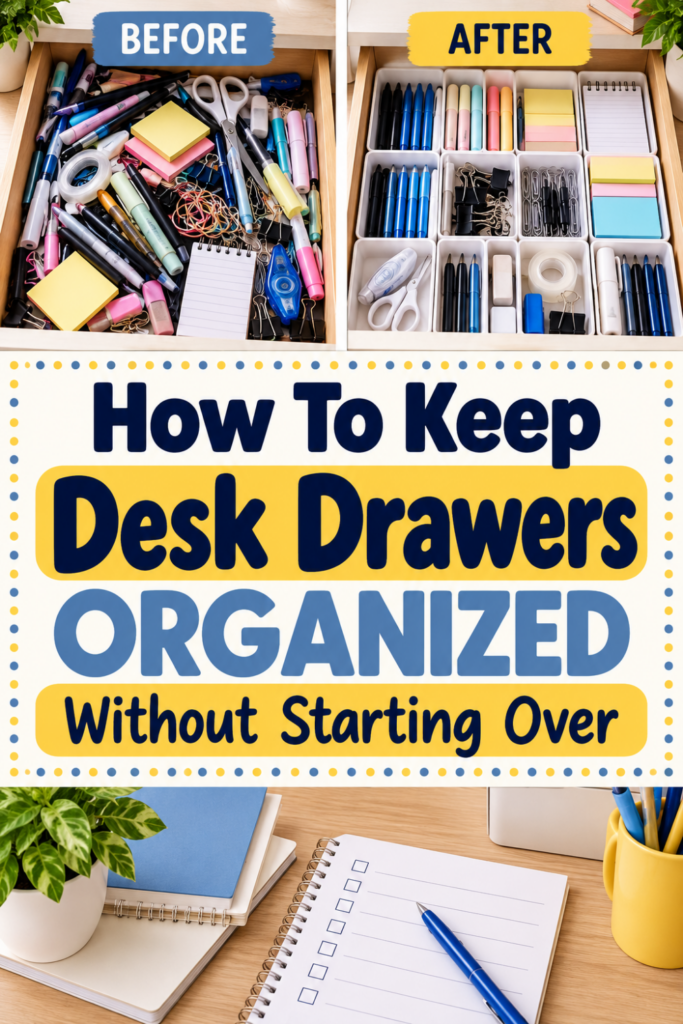
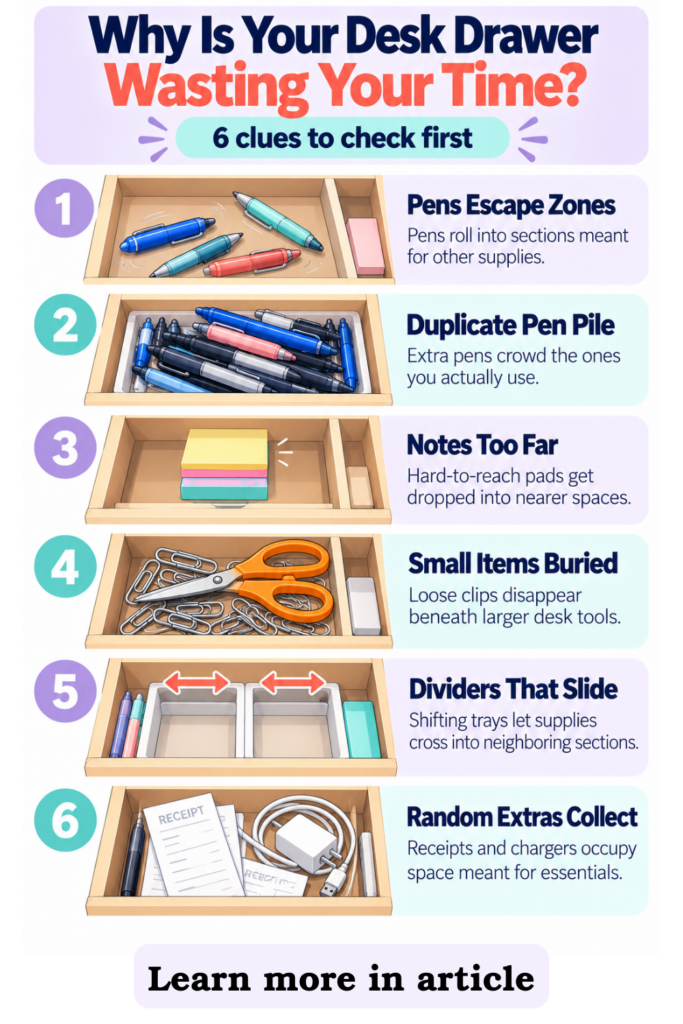
Your desk drawer looked perfect when you first organized it. Every pen had a place, paper clips stayed in their little compartment, and your sticky notes were neatly stacked. But a few weeks later, everything seems to have moved.
Pens have rolled into the wrong sections. Loose supplies are covering the bottom of the drawer, and you have to dig around to find something as simple as a highlighter. Somehow, the organizing system you worked so hard to create has stopped working.
It’s tempting to pull everything out and start over. You might even think you need better drawer dividers, more containers, or a completely different storage setup.
But the problem usually isn’t that your desk drawer was organized incorrectly. It’s that everyday use gradually changes how supplies are arranged, and nobody has a simple plan for putting things back.
Think about how often you reach into your desk drawer while working. You grab a pen during a phone call, pull out sticky notes while planning your week, or drop a charger inside when you’re rushing to finish something. Small actions like these can gradually undo even a carefully arranged system.
The solution is a desk drawer maintenance checklist that helps you spot problems early and correct them before clutter takes over. Instead of treating drawer organization as a major project, you’ll learn how to maintain it through small, manageable actions.
If you want to get more from your life, and are looking for concrete action steps to get you there, check out our Request a Coach page. It’s a “cut the fence-sitting and take action” way to tackle your issues and actually find success. To get off the fence and start to take action, click or tap here.
You don’t need to spend an entire afternoon sorting office supplies. Most maintenance tasks can be completed in just a few minutes, especially when you know what to look for.
The key is identifying the single next step that will make your drawer easier to use. Once you’ve corrected that problem, you can move on to the next one or simply get back to work.
Need some in depth help with organization and productivity ? Drop on by our directories choc full of productivity coaches, minimalist coaches, and work/life balance coaches to get your life organized! Or click here to have us match you to the best.
1. Find the First Thing That’s Making Your Drawer Hard to Use
Before you start rearranging supplies, take a moment to look at what’s actually happening inside your drawer. An organized workspace can become frustrating for several different reasons, and identifying the main problem helps you avoid unnecessary work.
For example, you might think your drawer needs more compartments when the real problem is that you have too many duplicate pens. Or perhaps everything fits comfortably, but the supplies you use most often are stored in inconvenient places.
Instead of immediately emptying the drawer, try this simple assessment.
- Open the drawer and observe its current condition: Look at where supplies have collected and which compartments are no longer serving their intended purpose. Pay particular attention to items that have spilled into neighboring sections or become difficult to reach.
- Identify the problem that interrupts your work most often: Maybe you waste time searching for scissors, or perhaps loose paper clips keep getting caught underneath other supplies. Choose the issue that causes the most frequent frustration rather than the one that looks the messiest.
- Check whether the problem involves quantity or placement: An overflowing pen compartment might contain too many writing instruments, while scattered sticky notes could simply need a better location. Understanding the difference helps you decide whether to remove items or rearrange them.
- Choose one specific corrective action: Instead of telling yourself to organize the entire drawer, decide to collect all loose pens and return them to their designated section. A clearly defined task is easier to begin and gives you an obvious stopping point.
- Complete that action before evaluating anything else: Resist the urge to start sorting every compartment while you’re fixing the first problem. Once you’ve finished, check whether your drawer is already easier to use before deciding what else needs attention.
This approach is particularly useful when clutter feels overwhelming. A drawer containing dozens of misplaced objects can seem like a complicated project, but collecting ten scattered pens is a straightforward task.
You may discover that correcting one or two problems makes the entire drawer feel functional again. That’s the advantage of maintenance over constant reorganization: you’re fixing what isn’t working instead of rebuilding everything that already does.
If you want to get more from your life, and are looking for concrete action steps to get you there, check out our Request a Coach page. It’s a “cut the fence-sitting and take action” way to tackle your issues and actually find success. To get off the fence and start to take action, click or tap here.
2. Use This Five-Step Desk Drawer Maintenance Checklist
Once you’ve identified the biggest problem, it’s helpful to have a consistent checklist for reviewing the rest of your drawer. Without one, you might spend your time rearranging containers while overlooking the small issues that are actually causing clutter.
This five-step process moves from removing unnecessary objects to restoring the supplies you use every day. Follow the entire checklist during your weekly maintenance session, or complete only the steps your drawer currently needs.
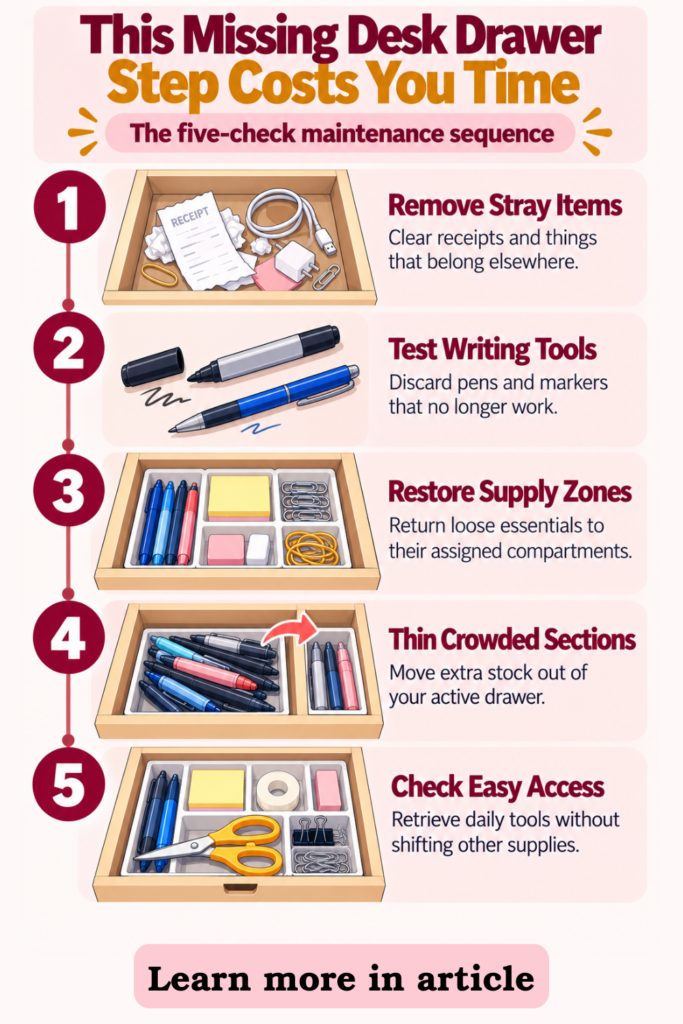
Your Five-Step Maintenance Checklist
- Step 1: Remove anything that doesn’t belong: Look for receipts, snack wrappers, hair ties, loose paperwork, or household objects that have found their way into your office supplies. Return useful items to their proper locations and throw away obvious rubbish before rearranging anything else.
- Step 2: Check for supplies that no longer work: Test questionable pens, markers, and highlighters before putting them back into their compartments. Discard dried-out writing instruments, empty correction tape dispensers, and other supplies that are taking up valuable space without serving a purpose.
- Step 3: Return displaced items to their designated zones: Gather loose paper clips, sticky notes, erasers, writing tools, and small accessories. Put each category back into its assigned compartment, making sure that frequently used items remain easy to see and retrieve.
- Step 4: Correct compartments that are becoming overcrowded: Look for sections where supplies are stacked too tightly or spilling into neighboring spaces. Remove unnecessary duplicates and transfer extra stock to a separate storage location so your everyday drawer contains only what you realistically need.
- Step 5: Test whether your essentials are easy to access: Close the drawer, reopen it, and try retrieving several frequently used supplies. If you need to move multiple objects to reach something important, adjust its position so using the drawer feels natural.
The entire process should become faster as your system improves. During the first review, you might discover several overflowing compartments or supplies that need new locations.
During later maintenance sessions, you may only need to return a handful of items and remove an empty pen. The checklist is designed to prevent small problems from growing, not to create another demanding household chore.
Keep a copy of these five steps near your workspace until the sequence becomes familiar. A simple routine makes it easier to maintain your drawer even when you’re busy or distracted.
3. Fix the Drawer Zones That Keep Letting Supplies Drift
If the same supplies keep ending up in the wrong places, your drawer layout might be contributing to the problem. Good drawer organization isn’t just about fitting everything into containers. It’s about arranging supplies so they’re easy to retrieve and equally easy to put away.
For example, imagine that your sticky notes are stored in the back corner of a deep drawer. You use them constantly, but returning them requires reaching around several other compartments. Eventually, you start dropping them wherever there’s space.
Rather than purchasing a completely new organizer, make a few targeted changes.
If you want to get more from your life, and are looking for concrete action steps to get you there, check out our Request a Coach page. It’s a “cut the fence-sitting and take action” way to tackle your issues and actually find success. To get off the fence and start to take action, click or tap here.
- Group supplies according to how you actually use them: Create separate zones for writing instruments, paper products, small fasteners, and everyday desk tools. Keeping related items together makes it easier to identify where something belongs without searching through several compartments.
- Move frequently used supplies toward the front: Place your favorite pens, sticky notes, and other daily essentials in the easiest positions to reach. Reserve less convenient spaces for occasional items such as spare staples, specialty markers, or extra adhesive supplies.
- Use dividers that prevent accidental mixing: Shallow trays, adjustable separators, and small repurposed containers can keep paper clips, erasers, and other loose objects from sliding around. Choose organizers that fit securely instead of moving every time the drawer opens.
- Leave enough space for supplies to return comfortably: A compartment shouldn’t be so full that putting away a pen requires rearranging everything inside. Create a little breathing room so objects can be dropped into their designated sections without careful positioning.
- Move problem categories instead of rebuilding the entire layout: If a particular item repeatedly ends up outside its compartment, experiment with a more convenient location. Keep successful zones exactly as they are and adjust only the sections that continue causing trouble.
After making a change, use your drawer normally for several days. Pay attention to whether supplies naturally return to their new locations or continue collecting elsewhere.
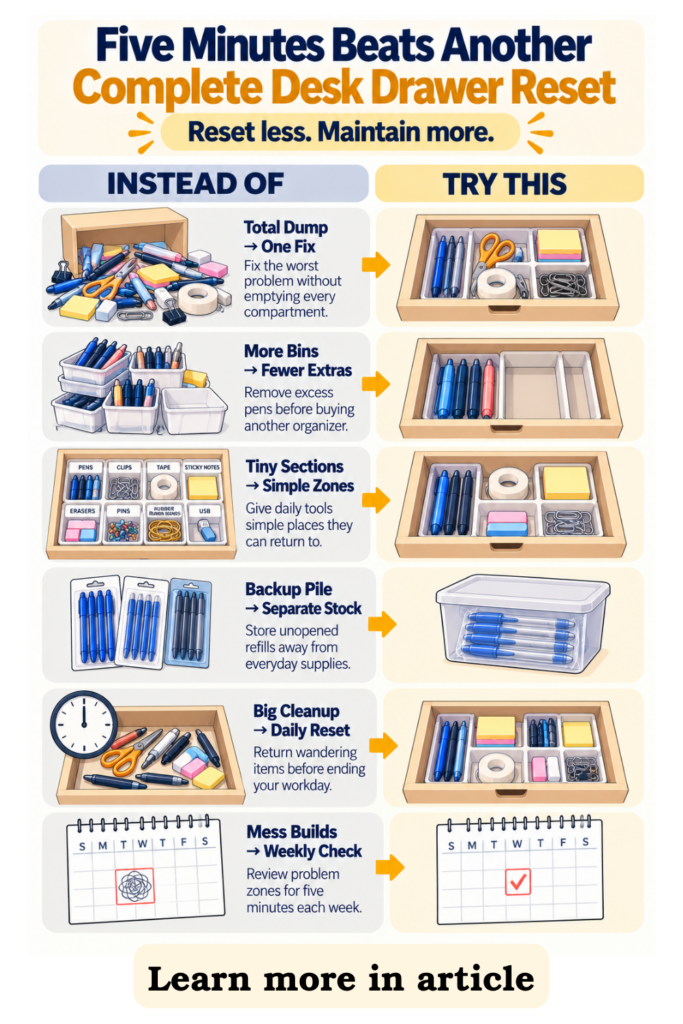
This small testing period can reveal problems that aren’t obvious during a one-time organizing session. A layout that looks perfectly balanced may still be inconvenient during a busy workday.
The best desk drawer arrangement isn’t necessarily the most attractive one. It’s the layout that supports your everyday habits while requiring the least effort to maintain.
4. Set Simple Rules That Keep Everyday Supplies in Place
Even an excellent drawer layout can become disorganized if supplies don’t have consistent places to return to. The goal isn’t to develop strict rules for every tiny object. It’s to remove the small decisions that make tidying feel unnecessarily complicated.
Think about the last time you finished using a highlighter or pair of scissors. If you had to decide where to put it, you probably chose the closest available space. Repeated throughout the week, those little decisions gradually create clutter.
A few simple rules can make your drawer easier to maintain.
- Give frequently used supplies one permanent home: Assign consistent compartments to pens, scissors, sticky notes, erasers, and other everyday essentials. When each category has a clear location, returning supplies becomes a quick action instead of another organizing decision.
- Keep active supplies separate from backup stock: Store the pens, notebooks, adhesive products, and accessories you’re currently using inside your desk drawer. Move unopened packages and extra quantities elsewhere so they don’t compete with the supplies you need during your workday.
- Avoid creating a permanent miscellaneous compartment: A small space for temporary items can be useful, but it shouldn’t become an excuse to keep everything indefinitely. Review unidentified objects during your weekly maintenance session and decide where they actually belong.
- Make returning items as convenient as retrieving them: Avoid using complicated containers, tight-fitting lids, or stacked boxes for supplies you reach for repeatedly. Open compartments and accessible dividers generally make everyday cleanup simpler because nothing needs to be unpacked or rearranged.
- Use labels when categories aren’t immediately obvious: Add simple labels for supplies that share similar containers or are frequently confused. Labels can be particularly helpful when several people use the same workspace and need to understand the system without asking questions.
The purpose of these rules is to make your drawer easier to use, not to create more responsibilities. If a rule feels unnecessarily complicated, simplify it until following it becomes natural.
For example, you don’t need separate compartments for every type of pen if you regularly grab whichever one is closest. A single writing tools section might work better than five carefully divided categories.
If you want to get more from your life, and are looking for concrete action steps to get you there, check out our Request a Coach page. It’s a “cut the fence-sitting and take action” way to tackle your issues and actually find success. To get off the fence and start to take action, click or tap here.
Start with the rules that solve your most common problems. Once those become automatic, your drawer will require fewer decisions and less maintenance throughout the week.
5. Build a Maintenance Schedule That Takes Only Minutes
One of the biggest reasons organization systems fall apart is that maintenance doesn’t happen until the clutter becomes impossible to ignore. By then, a few misplaced supplies have turned into an entire drawer that feels like it needs another makeover.
A simple maintenance schedule prevents that buildup. Instead of waiting until you’re frustrated, you’ll check your drawer at predictable intervals and correct small problems before they become larger ones.
The trick is matching different maintenance tasks to how frequently they need attention.
- Complete a one-minute end-of-day reset: Before finishing work, return loose pens, sticky notes, and other visible supplies to their assigned compartments. You don’t need to inspect every section or test individual supplies during this quick reset.
- Schedule a five-minute weekly drawer check: Once a week, open your drawer and follow the five-step maintenance checklist. Remove misplaced objects, correct overflowing compartments, and check whether the supplies you use regularly are still easy to access.
- Conduct a monthly supply inventory: Look for items that are running low, duplicates that have accumulated, and tools you no longer use. This is also a good opportunity to replace dried-out markers or transfer excess supplies to another storage location.
- Attach maintenance to an existing work habit: Try checking your drawer before Monday planning, after your Friday wrap-up, or while preparing your desk for the following day. Connecting the task to something you already do makes it easier to remember.
- Keep the schedule flexible when work gets busy: If you miss a weekly review, simply complete it during your next available opportunity. Avoid compensating with an unnecessarily large cleaning session unless the drawer genuinely needs one.
You can make the schedule even simpler by using a recurring reminder on your phone or adding desk maintenance to your regular workspace checklist. A small reminder reduces the need to remember another task during an already demanding week.
Remember that these time frames are guidelines rather than strict requirements. Someone who uses the same drawer all day might need frequent resets, while an occasional-use workspace may stay organized much longer.
Choose a maintenance frequency based on how quickly your supplies tend to drift. The best schedule is one you can comfortably repeat without feeling that desk organization has become another major obligation.
6. Troubleshoot the Supplies That Keep Ending Up in the Wrong Place
Sometimes you can follow your maintenance checklist perfectly, only to discover that the same items keep drifting into the wrong compartments. This can feel discouraging, especially when you’ve already spent time creating what seemed like a sensible organization system.
If you want to get more from your life, and are looking for concrete action steps to get you there, check out our Request a Coach page. It’s a “cut the fence-sitting and take action” way to tackle your issues and actually find success. To get off the fence and start to take action, click or tap here.
But recurring clutter often provides useful information about how your workspace functions. Instead of assuming you need to become more disciplined, look for patterns that suggest your drawer arrangement needs a small adjustment.
Think of repeated maintenance problems as clues rather than failures.
- Track which supplies repeatedly move out of place: During your weekly review, notice whether the same pens, charging cables, sticky notes, or accessories appear in unexpected locations. If one category causes most of the mess, focus your attention there instead of reorganizing unrelated sections.
- Look for obstacles that make returning supplies inconvenient: Check whether a compartment is difficult to reach, too small, or blocked by another organizer. Even a minor inconvenience can encourage you to drop something into the nearest available space when you’re concentrating on work.
- Determine whether the category needs more room: A frequently overflowing compartment might contain too many items, or it might simply be too small for the supplies stored inside. Try reducing duplicates or swapping containers before purchasing additional storage products.
- Change only one part of the layout at a time: Move your sticky note compartment closer to the front, replace an unstable divider, or give loose cables a dedicated pouch. Making one adjustment helps you understand whether that particular change solves the recurring problem.
- Evaluate the adjustment after several workdays: Notice whether the supplies now return to their assigned locations more naturally. If the problem continues, try another small adjustment rather than immediately deciding that the entire organizing system has failed.
For example, suppose your scissors always end up lying diagonally across the drawer. You might discover that their designated compartment is slightly too short, making them awkward to put away.
Replacing that compartment with a longer tray could solve the problem without changing anything else. The solution is small because you’ve identified the actual cause.
This troubleshooting approach helps you build a system around your behavior instead of expecting your behavior to fit an inconvenient system. Over time, fewer items should require repeated correction.
A drawer that stays organized through ordinary use is more valuable than one that only looks tidy immediately after a cleanup.
7. Adapt the Checklist for Shared Desks and Small Drawers
Not every desk has the luxury of several spacious drawers. Some workspaces have a single shallow compartment, while others are shared between coworkers, family members, or multiple people working from home.
These situations can make maintenance more challenging because supplies compete for limited space or get moved by different users. Fortunately, the same basic checklist works with a few practical adjustments.
If you want to get more from your life, and are looking for concrete action steps to get you there, check out our Request a Coach page. It’s a “cut the fence-sitting and take action” way to tackle your issues and actually find success. To get off the fence and start to take action, click or tap here.
The goal is to create clear locations and realistic expectations for the space available.
- Prioritize daily essentials in smaller drawers: Identify the supplies you genuinely use during a normal workday and give those items the easiest positions to reach. Store occasional tools, unopened refills, and seasonal materials elsewhere to prevent the drawer from becoming overcrowded.
- Choose organizers that match the drawer’s dimensions: Use shallow dividers or low-profile trays that allow the drawer to close comfortably without catching on supplies. Avoid tall containers that create unused gaps or force you to stack frequently used items on top of one another.
- Create clearly defined categories for shared supplies: Give communal pens, sticky notes, scissors, and paper clips obvious locations that everyone can recognize. Simple categories are usually easier for multiple people to maintain than highly detailed arrangements with numerous small compartments.
- Agree on one basic return routine: Encourage everyone using the drawer to put supplies back after finishing a task. Keep the system straightforward enough that returning an item takes only a moment and doesn’t require remembering complicated instructions.
- Designate a separate location for overflow supplies: Keep extra notebooks, replacement pens, unopened stationery, and other backup materials in a nearby cabinet, shelf, or supply box. This prevents the active drawer from becoming a storage space for everything related to the desk.
Shared drawers may need slightly more frequent maintenance because several people contribute to how supplies move. A brief weekly review can reveal which categories are becoming crowded and whether the arrangement still works for everyone.
If one person consistently has to reorganize the drawer, consider whether the system is too complicated or unclear. A shared arrangement should be intuitive enough that everyone can participate without extensive instructions.
For compact workspaces, remember that accessibility matters more than maximizing the number of objects you can squeeze into a drawer. Keeping fewer supplies nearby can make the entire desk feel more functional.
8. How an Organization Coach Can Help You Build Systems That Stick
Sometimes a disorganized desk drawer is part of a larger pattern. You organize a space, enjoy the results for a few days, and then watch everything gradually return to its previous condition. The same cycle might happen with your paperwork, kitchen counters, digital files, or daily schedule.
When this pattern keeps repeating, an organization or productivity coach can help you look beyond the immediate clutter. Rather than focusing only on where supplies should go, coaching can explore the routines and decisions that make maintaining an organized space difficult.
This can be particularly helpful when you struggle to turn good intentions into consistent action.
- Identify patterns behind repeated organizing problems: A coach can help you examine why previous systems stopped working and which situations tend to disrupt your routines. You might discover that your maintenance expectations are unrealistic or that certain tasks have too many unnecessary steps.
- Turn broad goals into specific behaviors: Instead of setting the vague goal of keeping your office organized, a coach can help you identify an achievable action. For example, you might commit to checking one drawer every Friday before shutting down your computer.
- Create routines around your actual workday: A coach can help you find natural opportunities for small maintenance tasks without adding complicated schedules. This might involve connecting a drawer reset to your existing end-of-day routine or weekly planning session.
- Build accountability without expecting perfection: Regular coaching conversations can provide opportunities to review progress, discuss recurring obstacles, and adjust strategies that aren’t working. The emphasis is on building consistency through realistic actions rather than maintaining an immaculate workspace every day.
- Apply successful strategies to other organizational challenges: Once you’ve developed a manageable drawer maintenance routine, you can use similar principles for desktop clutter, email management, paperwork, and household storage. Identifying one problem and taking one corrective action is a transferable skill.
You don’t need a coach to organize a desk drawer, and many people can develop effective maintenance routines independently. Coaching becomes more relevant when disorganization repeatedly interferes with productivity or when you’re struggling to establish sustainable habits across several areas of life.
If you want to get more from your life, and are looking for concrete action steps to get you there, check out our Request a Coach page. It’s a “cut the fence-sitting and take action” way to tackle your issues and actually find success. To get off the fence and start to take action, click or tap here.
The most useful support focuses on helping you understand what works for your circumstances. A system that fits your actual routines is far more likely to remain useful than one built around unrealistic expectations.
Whether you’re working independently or with a coach, start with one manageable change. Small actions create opportunities to learn, adjust, and gradually develop more reliable organizational habits.
Keep Your Desk Drawer Organized One Small Fix at a Time
A desk drawer doesn’t need to look perfect every time you open it. Pens will occasionally end up in the wrong compartments, sticky notes might slide out of place, and extra supplies will sometimes accumulate during a busy week.
That’s normal. An effective organization system isn’t one that prevents every object from moving. It’s one that makes returning things to their proper places quick and straightforward.
The most important shift is learning to recognize maintenance as part of everyday organization. Instead of waiting until your drawer becomes frustrating to use, you can correct small problems as they appear.
Remember the basic maintenance sequence:
- Identify the most noticeable problem: Open your drawer and look for the issue that’s making it difficult to use. Choose one specific problem rather than trying to correct everything at the same time.
- Remove unnecessary or unusable supplies: Take out misplaced objects, obvious rubbish, dried-out pens, and duplicates that are crowding your compartments. Clearing unnecessary items often makes the remaining organization work much better.
- Return everyday essentials to their zones: Gather loose supplies and put them back into their designated sections. Make sure the items you use most frequently remain easy to reach and return.
- Adjust the layout when problems keep repeating: If supplies consistently migrate to the same inconvenient places, investigate whether their assigned compartments need to change. A small adjustment may prevent weeks of unnecessary maintenance.
- Repeat your checklist at realistic intervals: Use brief daily resets, weekly maintenance sessions, or monthly reviews depending on how frequently your drawer gets used. Consistency matters more than following a perfectly rigid schedule.
You also don’t need to buy expensive drawer organizers to make the system successful. Existing containers, simple dividers, and thoughtfully arranged compartments can work perfectly well when they match your daily habits.
Most importantly, avoid turning a small maintenance task into an overwhelming project. If you notice that your drawer is becoming cluttered, you don’t have to empty every compartment and reorganize your entire workspace.
If you want to get more from your life, and are looking for concrete action steps to get you there, check out our Request a Coach page. It’s a “cut the fence-sitting and take action” way to tackle your issues and actually find success. To get off the fence and start to take action, click or tap here.
Open the drawer, identify the single thing that’s causing the most frustration, and fix that first.
Maybe it’s returning five loose pens to their tray. Maybe it’s removing old receipts or relocating a charger that never seems to stay where it belongs.
Whatever the problem, completing one useful action is progress. And when you make those small corrections part of your routine, keeping your desk drawer organized becomes much easier than repeatedly starting from scratch.
*****
Are you all about style, decor and organization? Download a copy of our Clutter Reset Guide.
Need some in depth help with organization and productivity ? Drop on by our directories choc full of productivity coaches, minimalist coaches, and work/life balance coaches to get your life organized! Or click here to have us match you to the best.
If you want to get more from your life, and are looking for concrete action steps to get you there, check out our Request a Coach page. It’s a “cut the fence-sitting and take action” way to tackle your issues and actually find success. To get off the fence and start to take action, click or tap here.
Read this next

Why Your Galentine’s Aesthetic Should Be the First Decision You Make
Are you all about style, decor and organization? Download a copy of our Decluttering Workbook.**** A Galentine’s night isn’t just about pink décor or matching pajamas — it’s about creating […]
Read More
Closet Wall Organization Ideas That Use Vertical Space Better
Blank closet walls can do so much more. See the clever vertical storage ideas that make bags, shoes, shelves, and corners finally work.
Read More
9 Christmas Staircase Decor Upgrades Designers Love (Super Easy to Copy)
Are you all about style, decor and organization? Download a copy of our Decluttering Workbook. **** Your staircase is one of the first things guests see, but it’s usually the […]
Read More