




How To Write A Life Coaching Bio That Attracts New Clients
How Does Your Life Coach Bio Fit Into Your Marketing?
One of the best things about being a life coach is that you can help people pursue their dreams, realize their worth, and solve their problems. One of the worst things about being a life coach is that you have to find these people first.
Indeed, marketing yourself effectively can be a challenge, especially if you are new to being a life coach. However, it’s not impossible. And the first thing you should do is write a great bio. Hence, here’s how to write a life coaching bio that attracts new clients.
Key Takeaways
- Make relevance obvious quickly. A potential client should be able to tell who you coach, what you help with, and whether your work fits the situation they are facing.
- Build your bio around a clear conversion path. Recognition, relevance, credibility, proof, and a next step give your bio a practical job beyond simply introducing you.
- Use specific proof instead of impressive-sounding claims. Relevant credentials, professional experience, coaching experience, testimonials, or other verifiable evidence make your expertise easier to evaluate.
- Adapt your bio to where people find you. A website About page, directory profile, social bio, and guest-post bio serve different readers and should not simply repeat identical copy.
- Give interested prospects somewhere logical to go. A consultation, useful free resource, coaching offer, or contact option turns interest in your bio into a measurable next action.
How Do You Write a Life Coach Bio That Attracts Clients?
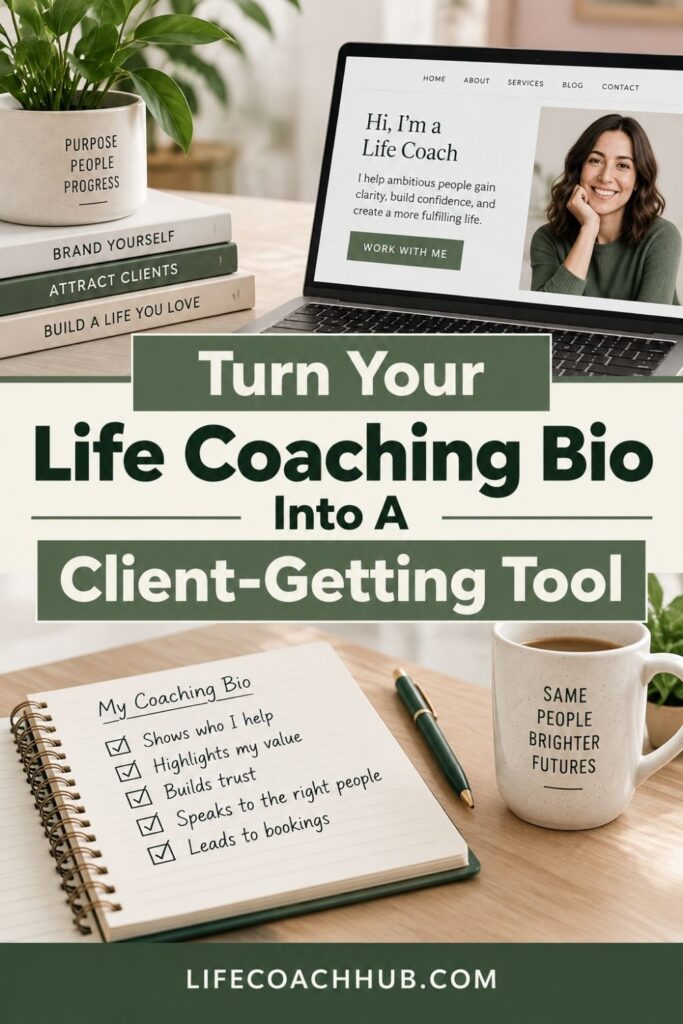
A life coach bio that attracts clients should tell the right person who you help, what you help them work toward, why your background is relevant, what evidence supports your credibility, and what they should do next. It should answer the potential client’s real question: “Is this coach a good fit for what I need?”
A useful structure is Recognition → Relevance → Credibility → Proof → Next Step. Your prospect recognizes themselves or their problem, sees why your coaching is relevant, understands why you are credible, finds enough proof to take you seriously, and gets a clear way to continue the conversation.
That structure also stops your bio from becoming a miniature résumé. The goal is not to fit your entire professional history into 150 words. It is to give a potential client enough relevant information to make the next decision.
Why Do You Need A Life Coaching Bio?
Before you start writing any life coaching bios, you need to understand why you need one in the first place. As a life coach, you will likely be using multiple channels to market yourself. For most of these channels, you will have the chance to include your bio – and that’s where the interesting part begins.
SEE ALSO: If you’re a coach looking to streamline your administrative tasks and save time, check out our Coaching Administration Software. It’s a simple, effective solution designed to help you focus less on paperwork and more on what matters—coaching your clients. From scheduling to client management, our software gives you the tools to run your business efficiently. Ready to reclaim your time and boost productivity? Click or tap here.
A short bio can help you attract the attention of potential clients and persuade them to buy your coaching seminars, personal sessions, and any other life coaching products or services you offer. Your bio could be the first point when a potential client gets to know you as a person. That’s why it’s so important to make the most out of it.
For example, if you guest blog, including a short bio at the end of your posts could encourage your readers to check out your website and the life coaching you offer. Likewise, you will need to use your bio when working with other channels and platforms, including your own website (your “About” page).
Sometimes, your bio could help your audience decide whether or not they want to purchase your life coaching products and services. That’s why you need to put yourself in your customers’ shoes when writing your bio. Other things you should consider include:
- Who you are, what your story is, and why this is relevant to your audience
- What your area of expertise (or coaching niche) is and why this is relevant
- How your life coaching skills will help your client solve their problems
- How your potential client can get in touch with you or find out more about you
If you remember these four aspects while writing your life coaching bio, you will be able to make it the best it can be. If you cover each point, you will be able to provide your audience with every essential detail they should know before they decide to find out more about your products and/or services (e.g. through your website) or get in touch with you directly.

What Does a Potential Client Need to Learn From Your Bio?
A potential client needs five answers from your bio: Is this for someone like me? Can this coach help with my situation? Why should I trust them? What backs that up? What do I do next?
Think of those questions as a Bio Conversion Path:
SEE ALSO: If you’re a coach looking to streamline your administrative tasks and save time, check out our Coaching Administration Software. It’s a simple, effective solution designed to help you focus less on paperwork and more on what matters—coaching your clients. From scheduling to client management, our software gives you the tools to run your business efficiently. Ready to reclaim your time and boost productivity? Click or tap here.
- Recognition: The reader can identify themselves in the people or situations you describe.
- Relevance: They can see the connection between their problem or goal and your coaching.
- Credibility: Your experience, training, approach, or specialization gives them a reason to take you seriously.
- Proof: Specific evidence supports the claims you make.
- Next Step: They know exactly how to continue if they are interested.
For example, “I am passionate about empowering people to live their best lives” gives a prospect almost nothing to evaluate.
Compare that with: “I coach mid-career professionals who know their current role no longer fits but are unsure what they want to do next. After 12 years in corporate recruitment and leadership development, I now help clients clarify their next move and build a practical career-change plan.”
The second version does not need more hype. It gives the reader more information.
That is the standard to use when deciding what earns space in a short bio. If a sentence does not improve recognition, relevance, credibility, proof, or the next step, ask whether you really need it.
#1 How Long Should a Life Coach Bio Be?
First and foremost, always remember to make your bio as short and sweet as possible. After all, this isn’t an autobiography you are writing. It’s just a bio you need for marketing yourself online. And when people use the Internet, they don’t usually do it because they want to read a lengthy book – they want bite-sized pieces of content.
That’s why the shorter your bio is, the better. Of course, this will mean that you will have to get rid of many important details along the process. However, doing so will teach you to be more precise with your wording which is a valuable skill for marketing yourself (and for writing in general).
SEE ALSO: If you’re a coach looking to streamline your administrative tasks and save time, check out our Coaching Administration Software. It’s a simple, effective solution designed to help you focus less on paperwork and more on what matters—coaching your clients. From scheduling to client management, our software gives you the tools to run your business efficiently. Ready to reclaim your time and boost productivity? Click or tap here.
#2 Who Is Your Life Coach Bio Actually Written For?
When you sit down to write your life coaching bio, imagine your dream client. This is the person you would ideally like to coach. Most of the time, there will be different people you’d like to work with, so it’s okay to have several dream clients. In fact, this is one of the reasons why you would have to follow the next tip about writing multiple bios.
Once you have your dream client (you can even outline their profile for reference), you can start writing your bio with an aim to appeal specifically to this kind of client. This person will prefer a particular type of wording, will have certain values and interests, etc. Your goal will be to use these details to make the bio that strikes a chord with this kind of client.
How Specific Should You Get About Your Coaching Niche?
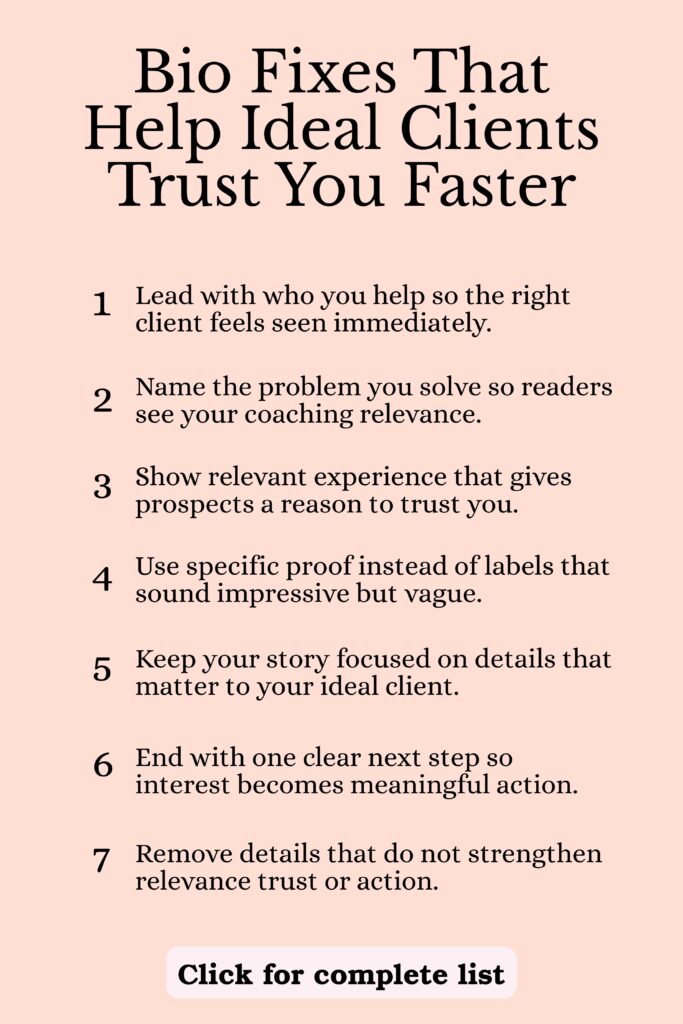
Your coaching niche should be specific enough for the right prospect to recognize themselves without requiring you to describe every possible client you could coach.
One practical formula is:
Who you help + the situation they are facing + what they want to change
For example:
SEE ALSO: If you’re a coach looking to streamline your administrative tasks and save time, check out our Coaching Administration Software. It’s a simple, effective solution designed to help you focus less on paperwork and more on what matters—coaching your clients. From scheduling to client management, our software gives you the tools to run your business efficiently. Ready to reclaim your time and boost productivity? Click or tap here.
“I help people reach their potential.”
That could describe thousands of coaches.
Now compare:
“I help first-time managers who are struggling to lead former peers build the confidence, boundaries, and management habits they need in their new role.”
The second version gives the prospect something concrete to recognize. The coach can still work with other managers, but the marketing message has a clear center.
Your niche can also be built around a recurring situation rather than a demographic. A career coach might work with “professionals considering a major career change.” A relationship coach might specialize in “couples rebuilding trust after a difficult period.” A business coach might work with “new consultants trying to turn expertise into a clear paid offer.”
SEE ALSO: If you’re a coach looking to streamline your administrative tasks and save time, check out our Coaching Administration Software. It’s a simple, effective solution designed to help you focus less on paperwork and more on what matters—coaching your clients. From scheduling to client management, our software gives you the tools to run your business efficiently. Ready to reclaim your time and boost productivity? Click or tap here.
If you are still defining yours, getting clear about your coaching niche can help you work through the decision.
Once you know the niche you want your bio to communicate, use the same positioning wherever potential clients are actively looking for coaches. A free life coach directory listing gives you another place to make that niche visible to people searching for coaching support.
#3 Do You Need More Than One Coaching Bio?
As mentioned above, it’s a good idea to write multiple bios instead of only writing a single one. The first reason to do this is that you will likely have different dream clients in mind. In other words, there will be different segments of your audience to appeal to. The second reason to do this is that you will be working with different channels and platforms.
Jett Mendoza explains it this way, “Writing multiple bios allows you to adapt each one to a certain type of reader and platform that you are working with. Moreover, you can also experiment with details and see what works better.”
What Should Change Between Your Website, Directory, Social, and Guest-Post Bios?
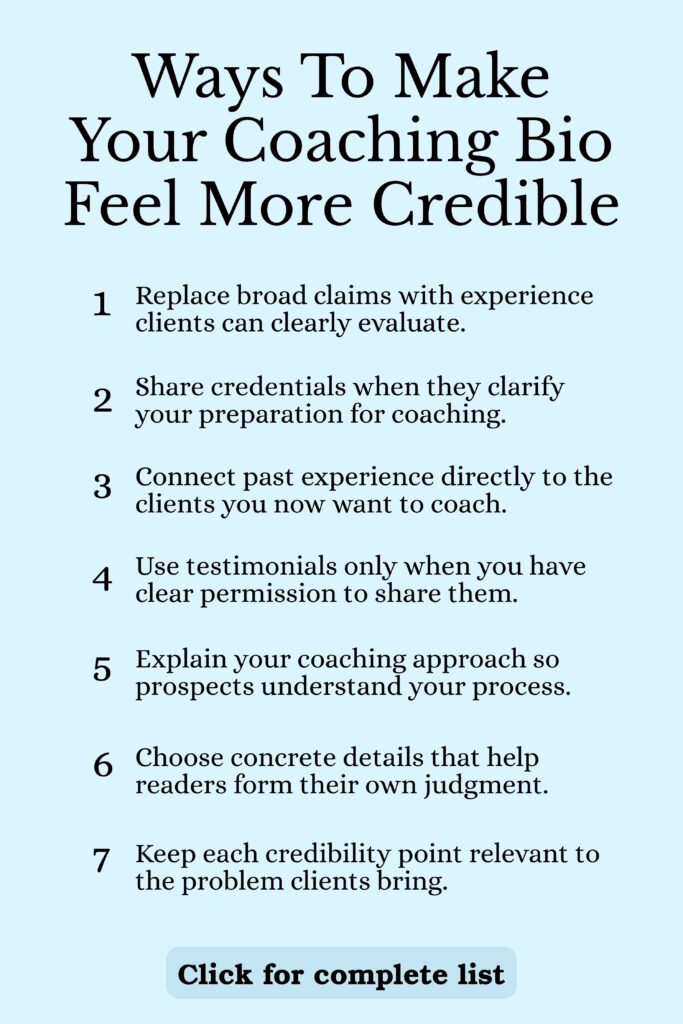
Your core positioning should stay consistent across platforms, but the length, emphasis, and next step should change according to why someone is reading your bio.
SEE ALSO: If you’re a coach looking to streamline your administrative tasks and save time, check out our Coaching Administration Software. It’s a simple, effective solution designed to help you focus less on paperwork and more on what matters—coaching your clients. From scheduling to client management, our software gives you the tools to run your business efficiently. Ready to reclaim your time and boost productivity? Click or tap here.
A simple Bio Matrix can keep this straight:
| Location | Reader’s likely question | What to emphasize | Useful next step |
|---|---|---|---|
| Website About page | “Do I want to work with this person?” | Story, niche, approach, credibility, proof | Explore services or book |
| Coach directory | “Is this coach relevant to my problem?” | Niche, specialties, credentials, differentiators | Contact or book |
| Social profile | “What does this person do?” | Audience, problem, outcome | One clear link |
| Guest-post bio | “Who wrote this, and why should I listen?” | Expertise relevant to the topic | Read more or visit your site |
Imagine you are a career coach specializing in women returning to work after a career break.
Your website bio can explain why you specialize in that transition, how you coach it, and the experience behind your work. Your directory bio should make the specialization obvious quickly because the reader may be comparing several coaches.
Your social bio may have room for little more than “Career coach helping women return to work after a career break.” A guest post about negotiating a return-to-work salary should emphasize the experience that makes you credible on that particular subject.
Same coach. Same positioning. Different job.
This is why writing multiple bios does not mean inventing multiple professional identities. Build one strong core message, then change the amount of context and the next action to match the platform.
SEE ALSO: If you’re a coach looking to streamline your administrative tasks and save time, check out our Coaching Administration Software. It’s a simple, effective solution designed to help you focus less on paperwork and more on what matters—coaching your clients. From scheduling to client management, our software gives you the tools to run your business efficiently. Ready to reclaim your time and boost productivity? Click or tap here.
#4 How Can Your Bio Create Curiosity Without Becoming Vague?
One of the most important things you should do as a marketer when promoting your life coaching products and services is spark curiosity. When your readers are curious about who you are, what you do, and what you can offer, they will be more likely to take the next steps to find out more (e.g. check out your website, get in touch with you via social media, etc.)
To build curiosity, try to give out hints without giving away all the knowledge you have to offer. You can even use humor to spice things up. Just make sure that the wording you use for all of this is appropriate.
#5 How Does a Coaching Bio Build Trust?
While you should spark curiosity with your bio, you should also aim to build trust. Remember that your bio will often be the first impression your potential client gets of you. That’s why it’s so important to instantly make them trust you. Otherwise, they will be more likely to simply move on without trying to find out more about you.
Make sure to use the right wording and avoid raising any red flags that could scare people away. Remember that you are a life coach, and some people won’t take your products or services seriously. Consequently, you need to show that you are a true professional in your field and can be trusted.
#6 What Proof Should You Put in a Coaching Bio?
This tip directly relates to the previous one because building trust largely depends on proving your worth as a life coach. The best way to do this is to use social proof. Any reviews and testimonials from past clients can help you out. Likewise, recommendations from established experts in your niche could also be useful.
Sahara Daughert puts it this way, “You should never lie in your bio if you want people to trust you. But you also shouldn’t brag because that could create a negative image for you. The solution here is obviously social proof, but you should still use it sparingly (especially in your bio which is meant to be short).”
SEE ALSO: If you’re a coach looking to streamline your administrative tasks and save time, check out our Coaching Administration Software. It’s a simple, effective solution designed to help you focus less on paperwork and more on what matters—coaching your clients. From scheduling to client management, our software gives you the tools to run your business efficiently. Ready to reclaim your time and boost productivity? Click or tap here.

What Counts as Credible Proof When You Are a New Coach?
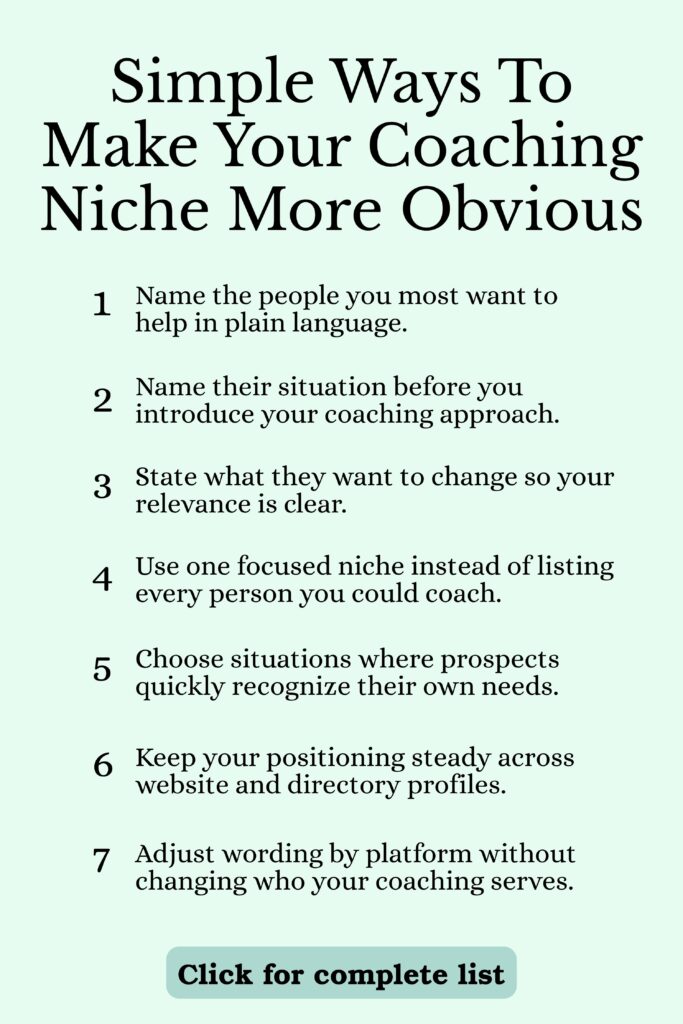
New coaches can build a credible bio without pretending to have a long coaching track record by using the strongest relevant evidence they actually have.
Think of proof as a ladder rather than a single requirement:
- Relevant coaching training or credentials
- Professional or specialist experience connected to your niche
- Firsthand experience that genuinely informs your specialization
- A specific coaching approach or process you can explain clearly
- Coaching experience and hours as they accumulate
- Client testimonials or outcomes you have permission to share
- Relevant speaking, writing, teaching, or professional recognition
You do not need every rung.
Suppose you are a new executive coach who spent 15 years managing teams before completing your coach training. Writing “new executive coach” and stopping there ignores experience that is directly relevant to the people you want to coach.
You could instead explain that your coaching work is informed by 15 years of leading teams, handling performance conversations, developing managers, or navigating organizational change, depending on what is actually true.
The same rule applies in reverse. A certification does not automatically prove expertise in every coaching problem. Include credentials where they help a potential client understand your preparation, then add the experience most relevant to the work you are offering.
SEE ALSO: If you’re a coach looking to streamline your administrative tasks and save time, check out our Coaching Administration Software. It’s a simple, effective solution designed to help you focus less on paperwork and more on what matters—coaching your clients. From scheduling to client management, our software gives you the tools to run your business efficiently. Ready to reclaim your time and boost productivity? Click or tap here.
Most importantly, replace unsupported labels with evidence. “Highly experienced,” “leading,” “transformational,” and “results-driven” ask the reader to accept your judgment about yourself.
Specific experience lets them make their own judgment.
#7 How Can You Make Your Bio More Action-Oriented?
As mentioned earlier, wording can play a key role in how good your bio is. That’s exactly why you need to choose your words so carefully. One technique to always keep in mind is using active voice. As opposed to passive voice, active voice inspires action and encourages your readers to do something.
At the same time, it’s a good idea to include a CTA at the end of your bio. It should be a simple action such as “Find out more on my website” or “Follow me on social media.” Just something the reader can do right after they finish reading your bio to continue interacting with you and your brand in some way.
#8 Which Coaching Bio Buzzwords Should You Avoid?
Speaking of your wording, it’s a good idea to avoid buzzwords. It can be very tempting to keep on using them, but you could easily end up sounding like someone who wants to look like an expert while not actually being one.
The same goes for jargon. Using some terms from your niche or industry will show that you know what you are talking about. But if you overuse them, you will just confuse your audience and maybe even end up looking needy.
SEE ALSO: If you’re a coach looking to streamline your administrative tasks and save time, check out our Coaching Administration Software. It’s a simple, effective solution designed to help you focus less on paperwork and more on what matters—coaching your clients. From scheduling to client management, our software gives you the tools to run your business efficiently. Ready to reclaim your time and boost productivity? Click or tap here.
Can a Potential Client Understand Your Bio in 10 Seconds?
A strong coaching bio should communicate its essential positioning in one quick read, even if the full bio contains more detail.
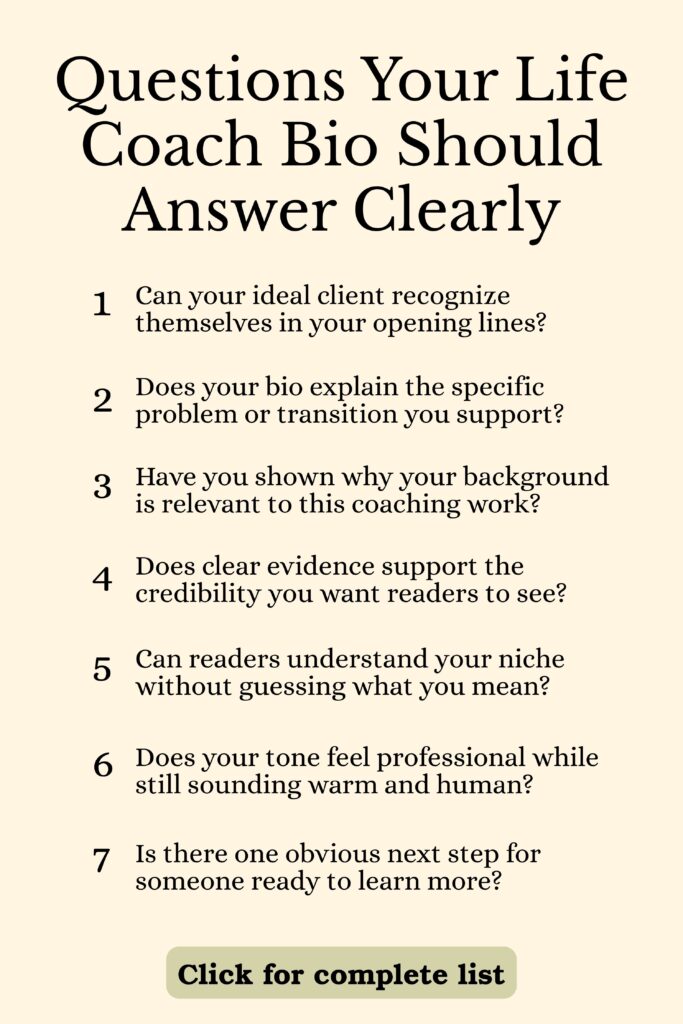
Use this 10-Second Bio Test. Read only the opening portion of your bio, then answer four questions:
- Who does this coach help?
- What problem, transition, or goal do they coach around?
- Why might this coach be credible for that work?
- What can an interested person do next?
If you cannot answer the first two, the opening is probably too generic.
For example:
“I’m a certified coach passionate about helping people unlock their full potential, overcome limiting beliefs, and create the life they deserve.”
You know this person is a coach, but little else.
SEE ALSO: If you’re a coach looking to streamline your administrative tasks and save time, check out our Coaching Administration Software. It’s a simple, effective solution designed to help you focus less on paperwork and more on what matters—coaching your clients. From scheduling to client management, our software gives you the tools to run your business efficiently. Ready to reclaim your time and boost productivity? Click or tap here.
Now try:
“I help newly promoted leaders make the jump from strong individual contributor to confident manager. My coaching focuses on delegation, difficult conversations, boundaries, and leading people who may have been your peers six months ago.”
You immediately know who the coach works with and what situations are likely to bring someone to them.
Run the same test on your website, directory profile, and social bio. If the answer changes dramatically from one platform to another, your positioning may have drifted.
#9 Should You Include a Photo With Your Coaching Bio?
This isn’t exactly about writing your bio but rather enriching it. One of the best ways to show that you are a real human being who can be trusted is to do exactly that – show yourself. That’s why you should include a photo of yourself whenever you use your bio as long as it is appropriate for the channel/platform.
Make sure that your photo looks professional and is of high quality. It’s a good idea to dress up in professional attire and groom yourself before heading for the photoshoot. Smile and stand in a welcoming pose, but don’t be too happy because that could make you look too casual. Show yourself as a confident life coach ready to help out your clients.
SEE ALSO: If you’re a coach looking to streamline your administrative tasks and save time, check out our Coaching Administration Software. It’s a simple, effective solution designed to help you focus less on paperwork and more on what matters—coaching your clients. From scheduling to client management, our software gives you the tools to run your business efficiently. Ready to reclaim your time and boost productivity? Click or tap here.
#10 How Do You Make Your Coaching Bio Easier to Find?
Last but not least, let your readers discover you. It should be easy for your audience to find you if you want to get as many clients as possible. When writing your bio, include some relevant keywords to optimize it for search engines. However, try to also think beyond that.
Provide ways to contact you (e.g. website, social media, email, etc.) Likewise, encourage people to find out more and get in touch with you (as mentioned earlier, add a call to action). And always make sure to use a bio when guest blogging because that’s the best way for potential clients to discover you when reading such posts.
Where Should Your Bio Send an Interested Prospect Next?
Your bio should send an interested prospect to one clear next step that matches how ready they are to engage with you.
There are three useful levels of readiness.
“I want to understand this coach better.” Send this person to a focused service page, useful resource, or deeper explanation of your approach.
“I’m interested, but I’m not ready for a conversation.” Give them something useful and relevant to the problem that brought them to you. A career coach, for example, could offer a short career-change checklist or decision worksheet rather than asking every visitor to book immediately.
SEE ALSO: If you’re a coach looking to streamline your administrative tasks and save time, check out our Coaching Administration Software. It’s a simple, effective solution designed to help you focus less on paperwork and more on what matters—coaching your clients. From scheduling to client management, our software gives you the tools to run your business efficiently. Ready to reclaim your time and boost productivity? Click or tap here.
“I want to talk about working together.” Make booking or contacting you straightforward.
The mistake is creating a strong bio and then giving the reader six competing actions. Visit the website. Follow Instagram. Join the newsletter. Download something. Email. Book a call. Browse three packages.
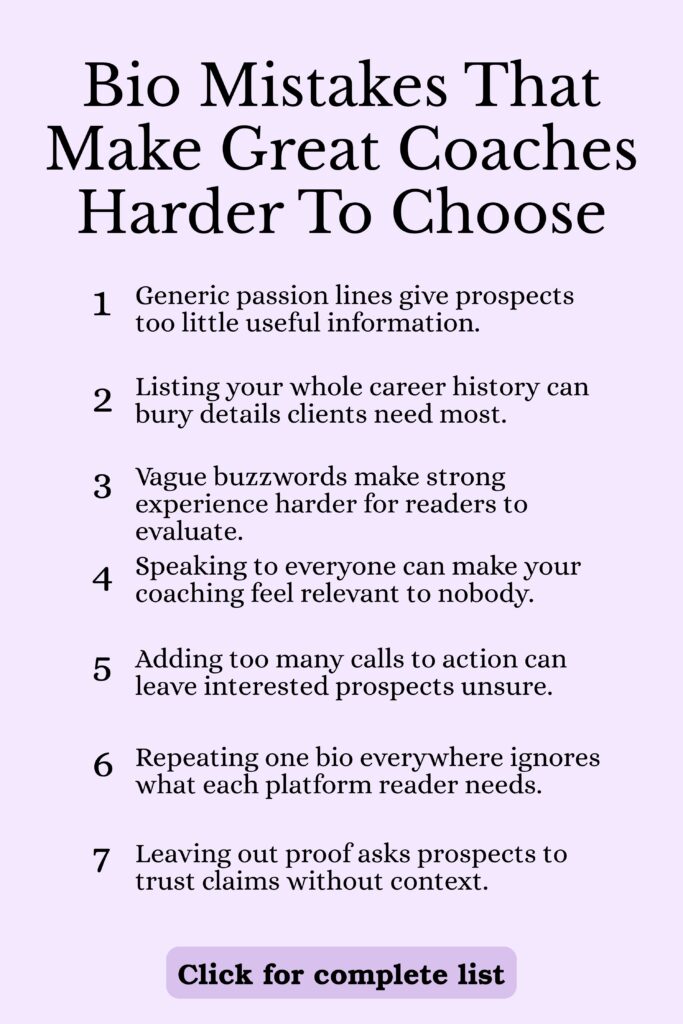
Choose the next step that makes the most sense for that particular bio.
If you use LCH Core, that path can be connected to the way you already run your coaching business. A consultation CTA can point to your Public Booking Page, where prospects can choose an available time and, if you use one, complete an intake form. This Public Booking Page guide explains the setup.
For someone who is not ready to talk, you can use lead magnets such as a relevant PDF, worksheet, or other free resource. LCH Core can make lead magnets available through your Public Store, alongside courses and digital products. The lead magnet guide shows how that path works.
The tool comes after the decision. First decide what the logical next step is for this reader. Then make that step easy to take.
SEE ALSO: If you’re a coach looking to streamline your administrative tasks and save time, check out our Coaching Administration Software. It’s a simple, effective solution designed to help you focus less on paperwork and more on what matters—coaching your clients. From scheduling to client management, our software gives you the tools to run your business efficiently. Ready to reclaim your time and boost productivity? Click or tap here.
How Do You Know Whether Your Coaching Bio Is Working?
A coaching bio is working when the right people move from reading it to taking the next useful action, not simply when other people tell you it sounds professional.
Use a simple Bio Conversion Check:
Profile or page views → CTA clicks → bookings, contacts, or downloads → qualified conversations
You do not need complicated analytics to learn from that sequence.
If plenty of people see your bio but almost nobody takes the next step, inspect the bio itself. Is the niche obvious? Is the problem specific? Is there credible proof? Is the CTA clear?
If people click through but do not book, contact you, or download the resource, the bio may have done its job. The problem could be on the page they reached next.
SEE ALSO: If you’re a coach looking to streamline your administrative tasks and save time, check out our Coaching Administration Software. It’s a simple, effective solution designed to help you focus less on paperwork and more on what matters—coaching your clients. From scheduling to client management, our software gives you the tools to run your business efficiently. Ready to reclaim your time and boost productivity? Click or tap here.
If people regularly contact you but they are consistently the wrong type of prospect, look closely at your positioning. A bio that says “I help ambitious people create change” leaves far more room for mismatch than one explaining the particular people, problems, and outcomes your practice is built around.
Track the pattern over time rather than rewriting your bio after one quiet week. You are looking for a repeated break in the path.
That makes the diagnosis much more useful than asking, “Do I like my bio?”
Ask instead, “Can the right prospect recognize themselves, trust what they see, and take the next step?”
How Do You Know Whether Your Coaching Bio Is Working?
A coaching bio is working when the right people move from reading it to taking the next useful action, not simply when other people tell you it sounds professional.
Use a simple Bio Conversion Check:
SEE ALSO: If you’re a coach looking to streamline your administrative tasks and save time, check out our Coaching Administration Software. It’s a simple, effective solution designed to help you focus less on paperwork and more on what matters—coaching your clients. From scheduling to client management, our software gives you the tools to run your business efficiently. Ready to reclaim your time and boost productivity? Click or tap here.
Profile or page views → CTA clicks → bookings, contacts, or downloads → qualified conversations
You do not need complicated analytics to learn from that sequence.
If plenty of people see your bio but almost nobody takes the next step, inspect the bio itself. Is the niche obvious? Is the problem specific? Is there credible proof? Is the CTA clear?
If people click through but do not book, contact you, or download the resource, the bio may have done its job. The problem could be on the page they reached next.
If people regularly contact you but they are consistently the wrong type of prospect, look closely at your positioning. A bio that says “I help ambitious people create change” leaves far more room for mismatch than one explaining the particular people, problems, and outcomes your practice is built around.
Track the pattern over time rather than rewriting your bio after one quiet week. You are looking for a repeated break in the path.
SEE ALSO: If you’re a coach looking to streamline your administrative tasks and save time, check out our Coaching Administration Software. It’s a simple, effective solution designed to help you focus less on paperwork and more on what matters—coaching your clients. From scheduling to client management, our software gives you the tools to run your business efficiently. Ready to reclaim your time and boost productivity? Click or tap here.
That makes the diagnosis much more useful than asking, “Do I like my bio?”
Ask instead, “Can the right prospect recognize themselves, trust what they see, and take the next step?”
Where LCH Core Fits
LCH Core fits after your bio has done its first job: helping the right prospect recognize that your coaching may be relevant to them.
Think of the client path as:
Find you → understand your fit → take a next step → become a contact or prospect → book or buy → begin coaching
Your bio handles the “understand your fit” part. The rest requires somewhere for that interest to go.
SEE ALSO: If you’re a coach looking to streamline your administrative tasks and save time, check out our Coaching Administration Software. It’s a simple, effective solution designed to help you focus less on paperwork and more on what matters—coaching your clients. From scheduling to client management, our software gives you the tools to run your business efficiently. Ready to reclaim your time and boost productivity? Click or tap here.
Your free Life Coach Hub coach profile can support the discovery stage. A Public Booking Page can give someone who is ready to talk a direct booking path. Lead magnets can give someone at an earlier stage a useful first step. Your Public Store can house courses and digital products for people who want another way to engage with your work.
LCH’s support documentation makes the distinction useful: the directory profile is primarily for discovery, the Public Booking Page is designed for scheduling, and the Public Store provides a place for prospects to browse free and paid offers. The guide to profiles, booking pages, and stores explains the different jobs each one performs.
That is the larger principle. Your bio should not be expected to complete the whole client journey. Its job is to make the right person interested enough, and confident enough, to take the next appropriate step.
Frequently Asked Questions About Life Coach Bios
What should a life coach bio include?
A life coach bio should include who you help, what you help them with, relevant experience or credentials, useful proof of your credibility, and a clear next step. Personal details belong when they help explain your connection to the work, your coaching approach, or why a particular client might choose you.
How long should a life coach bio be?
A life coach bio should be long enough to establish relevance and credibility without trying to tell your entire professional story. The appropriate length changes by platform, so create a fuller website version and shorter versions for directories, social profiles, guest posts, speaker introductions, and similar uses.
How do I write a life coach bio if I am a new coach?
A new coach should lead with relevant specialization, training, professional experience, and other truthful evidence rather than trying to disguise a short coaching track record. A former HR leader moving into career coaching, for example, may have years of directly relevant experience even if the coaching practice itself is new.
SEE ALSO: If you’re a coach looking to streamline your administrative tasks and save time, check out our Coaching Administration Software. It’s a simple, effective solution designed to help you focus less on paperwork and more on what matters—coaching your clients. From scheduling to client management, our software gives you the tools to run your business efficiently. Ready to reclaim your time and boost productivity? Click or tap here.
Should I mention my coaching niche in my bio?
Yes, your coaching niche should usually be visible in your bio because it helps the right potential clients identify whether your work is relevant to them. Describe the people or situations you specialize in clearly enough that a reader can recognize a fit.
Should I include coaching certifications and credentials in my bio?
Yes, include coaching certifications and credentials when they provide useful evidence of your preparation or expertise. Do not let a list of initials replace the explanation of who you help and what you actually coach.
Should I write my coaching bio in first person or third person?
Use first person when the bio appears on your own website or profile and third person when a publication, event organizer, podcast host, or professional context needs to introduce you. Keep both versions available so you are not rewriting from scratch every time someone requests a bio.
What should I put at the end of my life coach bio?
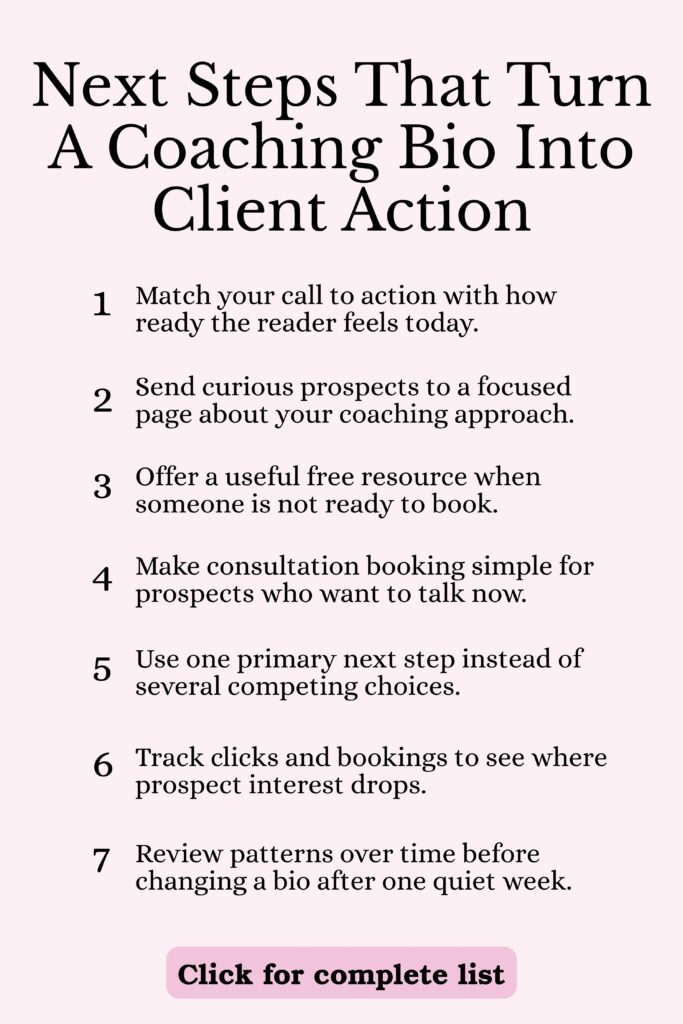
End your life coach bio with one clear action that fits the reader’s likely level of interest. That could be booking a consultation, contacting you, exploring your coaching services, or accessing a relevant free resource rather than presenting several competing calls to action.
What Should You Do Next?
The bottom line is that being a life coach is not just about your own skills as a coach but also about your skills as a marketer. That’s why you need to pay special attention to writing a bio (or several bios) that will stand out and attract the attention of potential clients. Use the tips in this article to help you get started and begin creating your own life coaching bios.
Get even more tips, and an analysis of life coach bios with real examples in our definitive guide to writing a life coach bio.
SEE ALSO: If you’re a coach looking to streamline your administrative tasks and save time, check out our Coaching Administration Software. It’s a simple, effective solution designed to help you focus less on paperwork and more on what matters—coaching your clients. From scheduling to client management, our software gives you the tools to run your business efficiently. Ready to reclaim your time and boost productivity? Click or tap here.
Sources
Google. “SEO Starter Guide: The Basics.” Google Search Central, Google, https://developers.google.com/search/docs/fundamentals/seo-starter-guide. Accessed 17 Sept. 2026.
Life Coach Hub. “How Do I Set Up My Public Booking Page?” Life Coach Hub Support, https://lifecoachhub.com/support/coaches/leads/setting-up-your-public-booking-page/. Accessed 17 Sept. 2026.
Life Coach Hub. “How to Use Lead Magnets to Attract Coaching Clients.” Life Coach Hub Support, https://lifecoachhub.com/support/coaches/getting-clients/how-to-use-lead-magnets-to-attract-coaching-clients/. Accessed 17 Sept. 2026.
Life Coach Hub. “What’s the Difference Between My Profile Listing, My Public Booking Page, and My Public Store?” Life Coach Hub Support, https://lifecoachhub.com/support/coaches/getting-clients/whats-the-difference-between-my-profile-listing-my-public-booking-page-and-my-public-store/. Accessed 17 Sept. 2026.
Read this next

Life Coach SEO 101: How To Get Your Coaching Business Found in Google (2022 Update)
Reach the top of search engine rankings as a coach with our SEO suggestions for life coaching
Read More
How to Master Funnels as a Coach (and Why You Need To)
If you’re like most coaches, you became a coach because you wanted to help people transform their lives, not because you wanted to learn marketing jargon like “funnels.” But here’s […]
Read More
Three Secrets to Getting Coaching Clients
Find out the three secrets all successful coaches use to get clients to grow their coaching practice.
Read More