




7 Proofs That Strong Public Speaking Can Attract Coaching Clients

Can Public Speaking Really Help You Attract Coaching Clients?
Public speaking is one of the best ways that you can use to create awareness for yourself and also attract new coaching clients as a life coach.
You can use public speaking to show your expertise and personality to the whole world. Public speaking is also an essential tool that you can use to gain insight into the problems and issues that your audience is facing, and you can use this to refine the kind of service you render to them. There are so many things that come with public speaking that goes beyond the speaking itself. So, it becomes surprising that many people claim that they can’t go into public speaking because of fear. People fear public speaking. It’s funny, but this is true.
The funny thing is fear has no discrimination. It is possible for someone who has done so much with their life and career and has achieved huge and phenomenal success in their career not to be able to stand before an audience to speak to them about his achievement and career. This is not for fear of how their career has turned out but for fear of expressing itself. Almost everyone has been in a similar position or will be there at some point.
However, when you think about the public speaking possibilities and know how much it has to offer you or what you stand to gain, you will overcome the fear and do what you have to do. The proofs are there for you to see how you can attract coaching clients through strong public speaking.
As a coach, no one is likely to invite you to speak about their event if you sell yourself to them only as a coach and not a speaker. That is why you need to put yourself in the position of a speaker. This way, you will be able to take the opportunity to showcase your expertise to a broader audience as a coach and attract coaching clients.
But first of all, you have to create awareness as a speaker, and here’s how to do it.
SEE ALSO: If you’re a coach looking to streamline your administrative tasks and save time, check out our Coaching Administration Software. It’s a simple, effective solution designed to help you focus less on paperwork and more on what matters—coaching your clients. From scheduling to client management, our software gives you the tools to run your business efficiently. Ready to reclaim your time and boost productivity? Click or tap here.
Key Takeaways
- Public speaking builds trust at scale. A strong talk lets potential clients experience your expertise, communication style, and coaching approach before deciding whether to contact you.
- Audience fit matters more than audience size. A smaller room filled with people who experience the problem you solve can produce more qualified leads than a large general audience.
- Every talk needs one clear next step. A lead magnet, assessment, workshop, or consultation gives interested attendees a practical way to continue the relationship.
- Follow-up converts attention into opportunity. Most attendees will not hire you immediately, so a relevant post-event sequence is essential for maintaining interest and building trust.
- Speaking results must be measured. Track consultations, clients, revenue, referrals, and reusable credibility assets rather than judging an event by applause, photographs, or social engagement alone.
How Can Public Speaking Attract Coaching Clients?
Public speaking attracts coaching clients by allowing the right audience to experience your expertise before they are asked to buy anything. A useful talk shows how you think, how clearly you explain problems, and what it might feel like to receive guidance from you.
Speaking produces clients only when it is connected to a clear conversion path. The audience needs a relevant problem, a useful presentation, a simple next step, and thoughtful follow-up after the event. This is the same principle behind a coaching funnel, where awareness is only the first stage of the relationship.
The complete path is: attract the right audience, teach a memorable method, capture interested contacts, invite them to an appropriate next step, and track which conversations become clients.
Which Speaking Opportunities Are Most Likely to Produce Coaching Clients?
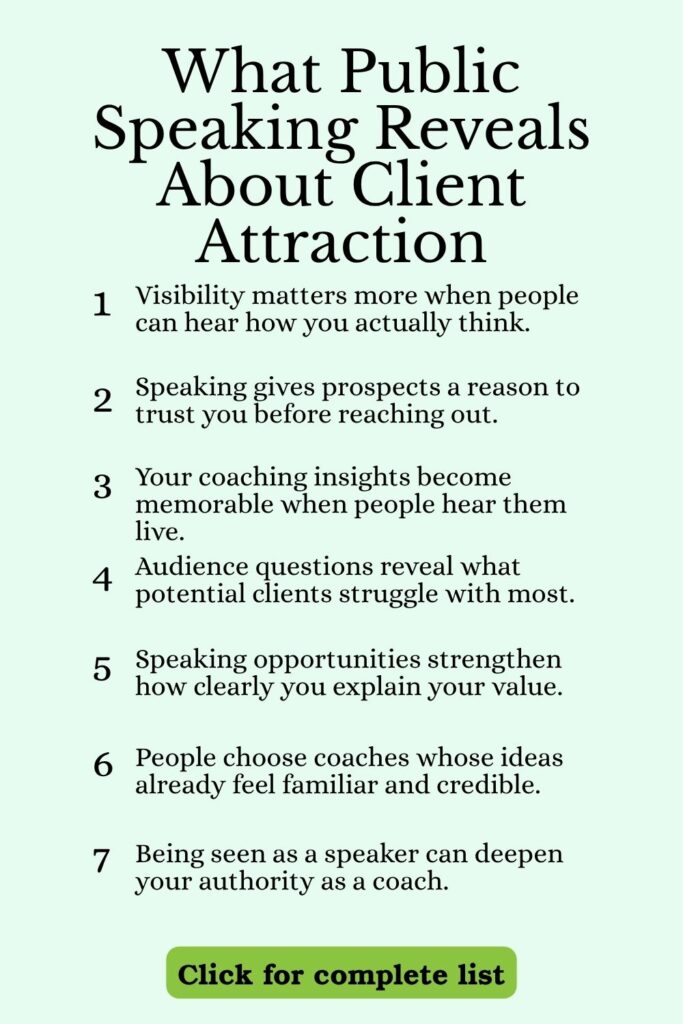
The speaking opportunities most likely to produce coaching clients are the ones where the audience, problem, and coaching offer closely match.
A large audience can create visibility, but visibility alone does not make an event commercially useful. A room of 40 ideal prospects may be more valuable than a conference hall of 400 people who have little reason to need your coaching.
Use an Audience-Offer Fit Scorecard before accepting or pursuing an event:
SEE ALSO: If you’re a coach looking to streamline your administrative tasks and save time, check out our Coaching Administration Software. It’s a simple, effective solution designed to help you focus less on paperwork and more on what matters—coaching your clients. From scheduling to client management, our software gives you the tools to run your business efficiently. Ready to reclaim your time and boost productivity? Click or tap here.
- Audience problem: Do attendees experience the problem your coaching addresses?
- Audience authority: Can they choose, recommend, or pay for coaching?
- Offer relevance: Do you have a service that logically follows the talk?
- Access: Are you allowed to share a resource, booking link, or next step?
- Long-term value: Could the event produce footage, testimonials, referrals, partnerships, or repeat invitations?
For example, a career coach may receive a better return from speaking to 50 professionals affected by an organizational restructure than from giving a broad motivational presentation to 500 students. The first group has an immediate, relevant problem. The second may enjoy the talk without becoming qualified prospects.
This does not mean every speaking engagement must generate clients directly. Some events are useful because they build skill, credibility, relationships, or content. The mistake is accepting an event without deciding which result would make it worthwhile.
Make it easy for people who hear your name to verify your coaching expertise afterward. A free life coach directory listing can give prospective clients another place to find you. If they are ready for a conversation, a Public Booking Page can provide a direct route from interest to a scheduled consultation.
What Should Your Signature Talk Make the Audience Believe and Do?
A client-getting signature talk should help the audience recognize a specific problem, understand your method, believe change is possible, and know what to do next.
Use the Problem, Method, Proof, Next Step structure.
Problem: Name a recurring situation the audience recognizes.
SEE ALSO: If you’re a coach looking to streamline your administrative tasks and save time, check out our Coaching Administration Software. It’s a simple, effective solution designed to help you focus less on paperwork and more on what matters—coaching your clients. From scheduling to client management, our software gives you the tools to run your business efficiently. Ready to reclaim your time and boost productivity? Click or tap here.
Do not begin with a subject as broad as confidence, leadership, relationships, or career success. Focus on a problem people can see in their behavior.
A leadership coach might speak about why newly promoted managers delay difficult feedback conversations. A career coach might address why capable professionals remain stuck in roles they have already outgrown.
Method: Teach a clear framework the audience can remember and apply.
Give the method a simple structure. Three questions. Four stages. One decision tree. A memorable framework makes your expertise easier to understand and easier to describe to someone else.
Proof: Show how the framework works in a realistic situation.
Use a personal experience, a composite client example, a demonstration, or a before-and-after decision. Protect client confidentiality and avoid presenting exceptional outcomes as typical results.
SEE ALSO: If you’re a coach looking to streamline your administrative tasks and save time, check out our Coaching Administration Software. It’s a simple, effective solution designed to help you focus less on paperwork and more on what matters—coaching your clients. From scheduling to client management, our software gives you the tools to run your business efficiently. Ready to reclaim your time and boost productivity? Click or tap here.
Stories are most useful when the audience can recognize themselves in the situation. A 2022 meta-analysis by Meng Chen and Robert Bell found that first-person narratives produced slightly stronger identification than third-person narratives in the health messages studied. That research does not prove that stories sell coaching, but it supports using relatable first-person experiences when they genuinely clarify the lesson.
Next Step: Give the audience one appropriate action.
The next step might be completing an assessment, downloading a worksheet, attending a workshop, or booking a consultation. It should continue the subject of the talk rather than introduce an unrelated offer.
For example, you might turn part of your signature framework into a useful lead magnet for coaches to offer prospective clients. The resource gives an interested attendee a way to continue applying what they learned after leaving the room.
A strong talk gives attendees a useful result before asking them to continue. That is what separates a valuable presentation from a sales pitch disguised as education.
Do You Need a Separate Speaker Website?
An S-A-M (Speaker-Author-Mentor) website is one of the most important things that you need to market yourself as an industry expert. You wouldn’t be able to make as much impact if you only add a page, introducing you as a speaker to a business website you already use for a different purpose.
SEE ALSO: If you’re a coach looking to streamline your administrative tasks and save time, check out our Coaching Administration Software. It’s a simple, effective solution designed to help you focus less on paperwork and more on what matters—coaching your clients. From scheduling to client management, our software gives you the tools to run your business efficiently. Ready to reclaim your time and boost productivity? Click or tap here.
You have to create a separate website for it to create an impression that lasts longer, and make sure the website is yourname.com. Then mention the companies where you have worked at (adding their logos make it more valid) and past events that you spoke at. Add photos of the event, testimonials of your speech, and videos/clips of you speaking at an event.
If you haven’t had any event where you spoke, then create a video or film yourself. You need to provide evidence for the claim that you are an effective speaker. Keep the website updated at all times, as this will increase the possibility of you getting speaking gigs.
Does a Coach Need a Book to Become a Credible Speaker?
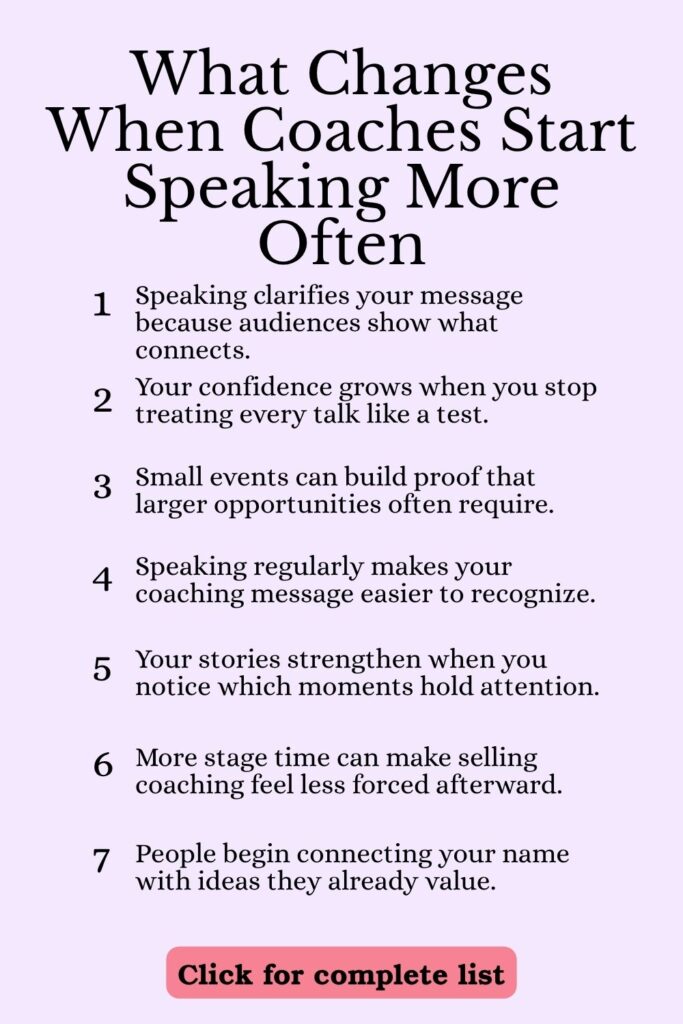
Writing a book can help you build trust. It is a compelling and effective way for you to emphasize the extent of your knowledge. It is also more comfortable for people to know you, what you stand for, and the message you preach. Once you start writing the book or even before you start, you can create a cover design and start publicizing it on your website homepage, social media, and other available platforms. This will help you generate interest in the book.
Should You Accept Every Speaking Opportunity?
Be ever prepared to speak anywhere and at any time. You must never say no to an opportunity to speak even if it is at a small event. It would help if you got as much engagement with speaking as you possibly can.
This means that you will also do many unpaid public speaking. The idea is for you to get it started. Speak at as many events as you can pay or unpaid. The more of it you do, the more expertise you get at it, the more popular you get, the more events you can boast of speaking at. It gives you a bigger resume of speaking gigs.
Those paid speaking gigs will come rolling. But first, create an excellent public speaking CV for yourself. Then watch your expertise rise.
SEE ALSO: If you’re a coach looking to streamline your administrative tasks and save time, check out our Coaching Administration Software. It’s a simple, effective solution designed to help you focus less on paperwork and more on what matters—coaching your clients. From scheduling to client management, our software gives you the tools to run your business efficiently. Ready to reclaim your time and boost productivity? Click or tap here.
What Should Be Included in a Speaker One-Sheet?
Have a flyer of yourself as a keynote speaker and make sure that people can download it easily from your website. This makes it evident that you don’t see speaking as a side hustle, but you are serious about it. Add topics that you speak on, and your presentation inclusions, then a brief bio of you.
How Do You Turn Every Speaking Event Into Credibility Proof?
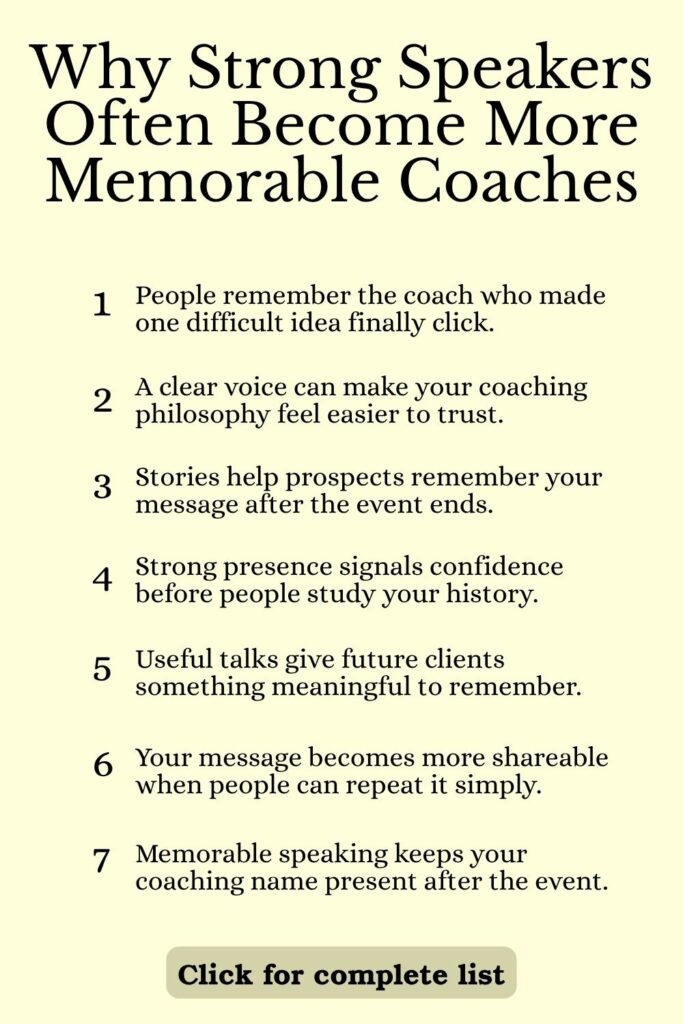
At all times and at all events you are asked to speak, make sure that you have someone who can take pictures of you speaking on stage. Then you can share these pictures on your different social media platforms to increase your awareness. Your profile banners have to have images that show you speaking at an event. You might need to hire a designer to help you create a LinkedIn background image that you can use for your profile and includes a photo of you as a speaker at an event.
What Should You Ask the Audience to Do Next?
You have to make it extremely easy for other people who might want to engage you to be a speaker at any of their events. You can use your email signature so that the people know that you are available and add a hyperlinked tagline. For example, click here if you need James to be a speaker at your event. Make sure that this tagline is in your letterheads and newsletter. You have to create awareness with every opportunity that you can.
How Do You Capture Leads Without Turning the Talk Into a Sales Pitch?
You capture leads without weakening the talk by teaching something useful first and offering one relevant continuation at the end.
Use the Teach, Bridge, Invite framework.
Teach: Deliver a complete insight the audience can use immediately.
SEE ALSO: If you’re a coach looking to streamline your administrative tasks and save time, check out our Coaching Administration Software. It’s a simple, effective solution designed to help you focus less on paperwork and more on what matters—coaching your clients. From scheduling to client management, our software gives you the tools to run your business efficiently. Ready to reclaim your time and boost productivity? Click or tap here.
Do not withhold the basic answer to force a click or consultation. Give attendees a framework, question, diagnostic, or action that helps them make progress.
Bridge: Identify the next problem they will encounter.
The bridge connects your teaching to a natural continuation. A career coach might explain how to identify career priorities during the talk, then note that comparing those priorities against real opportunities requires a more detailed decision process.
Invite: Offer one simple way to continue.
Useful next steps include:
- A talk-specific worksheet
- A short assessment
- A checklist
- A resource mentioned during the presentation
- A focused workshop
- A consultation
- A short digital product that applies the method
For example, a wellness coach speaking about decision fatigue could offer a Decision Load Audit. The resource helps attendees identify where unnecessary decisions consume their attention. People who complete it can then decide whether they want additional coaching support.
SEE ALSO: If you’re a coach looking to streamline your administrative tasks and save time, check out our Coaching Administration Software. It’s a simple, effective solution designed to help you focus less on paperwork and more on what matters—coaching your clients. From scheduling to client management, our software gives you the tools to run your business efficiently. Ready to reclaim your time and boost productivity? Click or tap here.
Keep the invitation narrow. Asking attendees to follow five social accounts, join a newsletter, buy a course, download a guide, and book a call creates unnecessary choice.
You also need permission. Confirm the event organizer’s rules before collecting attendee information, displaying QR codes, or mentioning paid services. Never assume the organizer’s attendee list can be added to your email marketing.
If you use LCH Core, a talk-specific resource can become one of your Lead magnets and be offered through the Public Store. Life Coach Hub’s support guides explain both how to offer a free resource to gather leads and how the Public Store works. Qualified prospects can then be directed to your Public Booking Page when a consultation is the right next step.
This is one piece of a larger client journey. The guide to mastering funnels as a coach goes deeper into how attraction, nurturing, conversion, retention, and future offers work together.
How Do You Turn One Speaking Engagement Into the Next One?
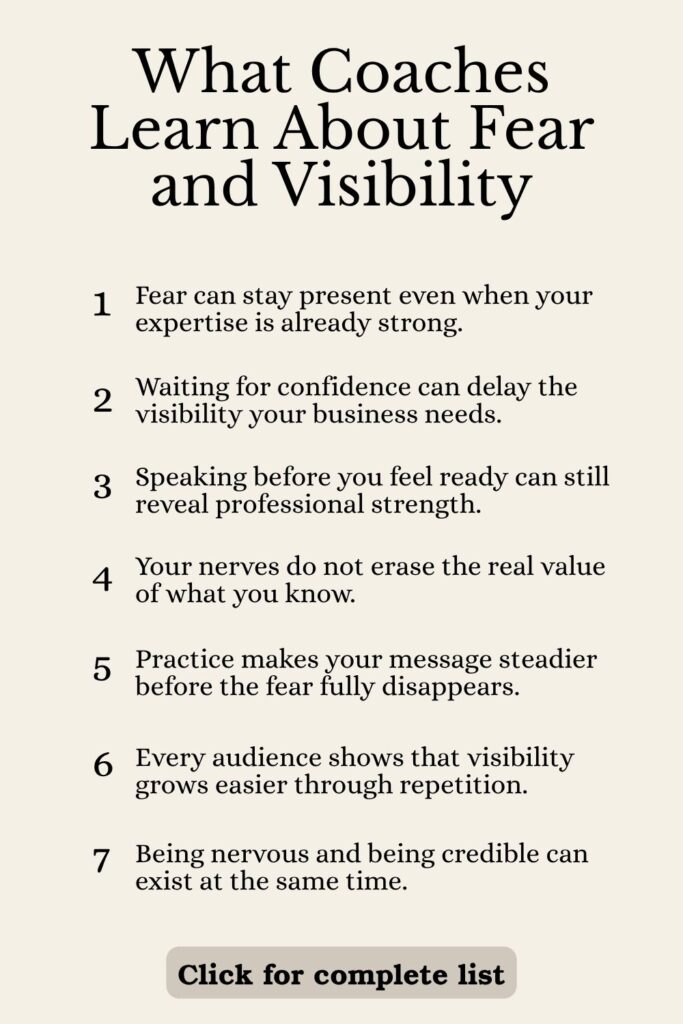
This is something that you have to put out even on social media. Make sure to create posts on social media, asking if people need your service as a speaker in an upcoming event. After speaking at an event, ask the managers for referrals if they have someone else to refer you to.
What Follow-Up Sequence Turns Audience Interest Into Consultations?
The most effective follow-up sequence delivers what you promised quickly, demonstrates how to apply it, and then offers an appropriate next step.
SEE ALSO: If you’re a coach looking to streamline your administrative tasks and save time, check out our Coaching Administration Software. It’s a simple, effective solution designed to help you focus less on paperwork and more on what matters—coaching your clients. From scheduling to client management, our software gives you the tools to run your business efficiently. Ready to reclaim your time and boost productivity? Click or tap here.
Use a 24 Hours, 3 Days, 7 Days sequence as a practical starting point.
Within 24 hours: Deliver the promised resource.
Send the worksheet, assessment, slides, or guide mentioned during the talk. Restate the talk’s central idea in one or two sentences so the recipient immediately remembers why the resource matters.
Do not begin with a long sales email. The first message should fulfill the promise you made from the stage.
Around day 3: Show the method in action.
Share a short example, common mistake, or realistic application. A relationship coach might show how one conflict pattern sounds in an everyday conversation. A leadership coach might demonstrate the difference between vague and useful feedback.
This message should help the prospect use the original resource more effectively.
Around day 7: Invite the next step.
Offer the most logical continuation. That could be a consultation, workshop, coaching package, digital resource, or reply to a focused question.
SEE ALSO: If you’re a coach looking to streamline your administrative tasks and save time, check out our Coaching Administration Software. It’s a simple, effective solution designed to help you focus less on paperwork and more on what matters—coaching your clients. From scheduling to client management, our software gives you the tools to run your business efficiently. Ready to reclaim your time and boost productivity? Click or tap here.
The invitation should reflect the prospect’s likely level of readiness. Someone who downloaded a one-page checklist may not be ready for a six-month package, but they may be ready for a focused consultation or introductory workshop.
This is why treating every new contact as part of a coaching funnel is more useful than thinking only in terms of one-off leads. Interest can develop across several useful touchpoints before someone is ready to become a client.
Follow up with the organizer separately. Thank them, ask what feedback they received, provide any promised materials, and request a testimonial or introduction only after the event’s value has been established.
If someone is ready to talk, your Public Booking Page can remove scheduling back-and-forth. Once they enter your coaching process, client management (CRM) can keep their profile, notes, and intake forms connected. Life Coach Hub also has a support guide on keeping track of client data, session notes, and progress as that relationship develops.
How Do You Measure Whether Speaking Is Actually Bringing Clients?
You measure the business value of public speaking by tracking what happens after the event, not by relying on audience size or applause.
Create a simple Speaker ROI Dashboard for every engagement. Record:
SEE ALSO: If you’re a coach looking to streamline your administrative tasks and save time, check out our Coaching Administration Software. It’s a simple, effective solution designed to help you focus less on paperwork and more on what matters—coaching your clients. From scheduling to client management, our software gives you the tools to run your business efficiently. Ready to reclaim your time and boost productivity? Click or tap here.
- The event and audience type
- The number of attendees
- The number of resource downloads or contacts collected
- Consultation bookings
- Consultation attendance
- New coaching clients
- Revenue connected to the event
- Organizer referrals
- Testimonials or usable footage
- Preparation, travel, and delivery costs
- Time invested
Use a unique link, QR code, form, or booking page for each event. Without a distinct path, you may know that new inquiries arrived but not which talk generated them.
Suppose one conference talk reaches 250 attendees and produces 70 downloads, but no consultations. Another workshop reaches 35 people, produces eight downloads, five consultations, and two clients. The smaller event created less visibility but a stronger business result.
Not every event must produce immediate revenue. A speaking engagement may still be worthwhile if it results in strong footage, an organizer testimonial, access to a valuable network, or invitations to better-matched events.
Decide what success means before the event. Then evaluate the outcome against that objective.
Avoid using universal conversion benchmarks. Audience type, offer price, event format, speaker credibility, and the strength of the next step all affect results. Your own data across five to ten engagements will be more useful than a broad number taken from an unrelated industry.
As your coaching business grows, this same measurement mindset should extend beyond speaking. Client acquisition is only one part of profitability. Tracking retention, repeat purchases, and referrals helps you understand the longer-term value of the relationships you create. The guide to client lifetime value for coaches explains that wider business picture.
SEE ALSO: If you’re a coach looking to streamline your administrative tasks and save time, check out our Coaching Administration Software. It’s a simple, effective solution designed to help you focus less on paperwork and more on what matters—coaching your clients. From scheduling to client management, our software gives you the tools to run your business efficiently. Ready to reclaim your time and boost productivity? Click or tap here.
How Can Coaches Build Speaking Confidence Through an Exposure Ladder?
Coaches can build speaking confidence by practicing in gradually more demanding situations rather than waiting to feel fearless before they begin.
Use a speaking exposure ladder:
- Record a private five-minute explanation of your framework.
- Deliver it to one trusted colleague.
- Teach it during a small online group.
- Facilitate a short workshop.
- Join a panel or moderated discussion.
- Deliver a ten-minute in-person presentation.
- Present the complete signature talk.
Each stage should stretch you without making the task so difficult that you avoid repeating it. Stay at one level until you can complete it consistently, then move to the next.
Repetition matters because confidence grows from evidence. You begin to see that you can lose your place, answer an unexpected question, recover from a pause, and continue speaking.
A 2019 meta-analysis by Omid Ebrahimi and colleagues reviewed 30 randomized controlled trials involving 1,355 participants. It found that psychological interventions were effective in reducing fear of public speaking, with cognitive and behavioral interventions making up most of the research.
You do not need to treat ordinary presentation nerves as a clinical problem. The practical lesson is that avoidance tends to preserve fear, while structured practice gives you opportunities to develop skill and gather corrective experience.
SEE ALSO: If you’re a coach looking to streamline your administrative tasks and save time, check out our Coaching Administration Software. It’s a simple, effective solution designed to help you focus less on paperwork and more on what matters—coaching your clients. From scheduling to client management, our software gives you the tools to run your business efficiently. Ready to reclaim your time and boost productivity? Click or tap here.
Make each practice round specific. Instead of asking a colleague whether the talk was “good,” ask:
- What was the main idea?
- Which part was difficult to follow?
- Where did your attention drop?
- Did the example make the framework clearer?
- Was the next step obvious?
- Which section should be shorter?
That feedback gives you something concrete to improve before the next event.
How Can You Become a More Confident Public Speaker?
What Is the One Idea Your Audience Must Remember?
there is a confidence that comes with knowing what you are saying or what to say. Tap into this confidence by preparing a message and master it. There has to be something that your audience walks away with after all.
Which Coaching Stories Build Trust Without Breaching Confidentiality?
stories have a way of calming the nerves of both speaker and hearer. Also, by telling your personal stories to your audience, you can’t create a bond with them quickly, and they relate better with you.
How Do You Make a Coaching Talk Easy to Follow?
don’t be too quiet or too fast while speaking; otherwise, your audience will lose interest. Make yourself audible. Be loud and clear.
When Do Visuals Strengthen a Coaching Presentation?
this helps you gain the attention of the audience as you speak and helps them understand you. But also, it takes their eyes off you to your graphics.
SEE ALSO: If you’re a coach looking to streamline your administrative tasks and save time, check out our Coaching Administration Software. It’s a simple, effective solution designed to help you focus less on paperwork and more on what matters—coaching your clients. From scheduling to client management, our software gives you the tools to run your business efficiently. Ready to reclaim your time and boost productivity? Click or tap here.
How Should You Rehearse a Talk Before the Event?
practice makes perfect, remember? So, practice!
Where LCH Core Fits

LCH Core fits where a speaking opportunity needs to become an organized path from audience interest to an active coaching relationship.
Public speaking can create visibility and trust, but the talk itself does not manage contacts, schedule consultations, collect intake information, onboard clients, or deliver coaching. Those steps need a reliable system behind them.
If you want the broader business-system view first, the guide to choosing coaching software for life coaches explains how lead generation, booking, onboarding, client management, coaching delivery, progress tracking, and scalable offers connect.
Here is where LCH Core can support the speaker-to-client path:
- After the talk: Offer Lead magnets through your Public Store or direct qualified attendees to a Public Booking Page.
- When someone expresses interest: Use client management (CRM) to keep client profiles, notes, and intake forms organized.
- When someone wants a conversation: Use the Public Booking Page for scheduling and booking.
- When someone buys: Manage payments, coaching packages, and billing.
- When a prospect becomes a client: Send a Welcome Package containing a welcome letter, coaching agreement with electronic signature, and forms. Life Coach Hub’s support guide explains how to onboard clients with a Welcome Package.
- During coaching: Assign reusable journals, worksheets, goals, action items, and resources. The support guide on using coaching tools to keep clients engaged between sessions explains how those tools fit into ongoing delivery.
- As the relationship develops: Review client activity and progress through the Progress Stream and Engagement Report.
- For additional ways to work together: Sell courses and digital products through a Public Store.
You can see the complete set of LCH Core coaching software features if you want to compare how these pieces work together.
SEE ALSO: If you’re a coach looking to streamline your administrative tasks and save time, check out our Coaching Administration Software. It’s a simple, effective solution designed to help you focus less on paperwork and more on what matters—coaching your clients. From scheduling to client management, our software gives you the tools to run your business efficiently. Ready to reclaim your time and boost productivity? Click or tap here.
The software does not replace a relevant audience, useful talk, or thoughtful follow-up. It gives you one place to manage what happens after an attendee decides to take the next step.
Frequently Asked Questions About Public Speaking for Coaches
How can public speaking help me get coaching clients?
Public speaking helps you get coaching clients by letting potential clients experience your expertise before booking a conversation. It works most effectively when you address a problem your ideal clients already recognize and provide one relevant next step. If speaking is one of several ways people discover you, build it into a wider client-getting funnel rather than treating each event as a standalone marketing tactic.
What should a life coach speak about?
A life coach should speak about a specific recurring problem connected to their niche and coaching method. A career coach might address decision paralysis during a career change, while a relationship coach might explain a recognizable conflict pattern.
Do I need a book before I can become a professional speaker?
You do not need a book before becoming a professional speaker. A clear framework, relevant expertise, strong presentation footage, credible testimonials, and useful talk outcomes can establish authority without a published book.
Should coaches accept unpaid speaking engagements?
Coaches should accept unpaid speaking engagements when the opportunity offers clear strategic value. That value might include access to ideal clients, useful footage, organizer relationships, testimonials, referrals, or practice with a relevant audience.
How do I collect leads during a speaking event?
Collect leads by offering one relevant resource that attendees voluntarily request. Use a QR code or short link leading to a worksheet, assessment, Lead magnet, workshop registration, or Public Booking Page, subject to the organizer’s rules. If you want to use a free resource, Life Coach Hub explains how to offer a free gift to collect prospective client leads.
SEE ALSO: If you’re a coach looking to streamline your administrative tasks and save time, check out our Coaching Administration Software. It’s a simple, effective solution designed to help you focus less on paperwork and more on what matters—coaching your clients. From scheduling to client management, our software gives you the tools to run your business efficiently. Ready to reclaim your time and boost productivity? Click or tap here.
How soon should I follow up after a speaking event?
Follow up within 24 hours when you promised the audience a resource. Deliver it first, provide an application example a few days later, and invite the next appropriate step after you have reinforced the value of the talk.
How do I calculate the ROI of a speaking engagement?
Calculate the ROI by comparing the event’s measurable value against the money and time invested. Include consultations, clients, revenue, referrals, testimonials, footage, preparation hours, travel costs, and delivery costs.
How can I overcome fear of public speaking?
You can reduce public-speaking fear through structured preparation and gradually more challenging practice. Begin with recorded talks and small groups, then progress toward workshops, panels, short presentations, and full speaking engagements.
Building up your reputation as a public speaker might not be an easy thing to do, but it also is not a very difficult or impossible one. Once you can market yourself to people as a public speaker, you will get the platform to showcase your personality and expertise as a coach to a broader audience and use this opportunity to attract coaching clients.
Sources
Chen, Meng, and Robert A. Bell. “A Meta-Analysis of the Impact of Point of View on Narrative Processing and Persuasion in Health Messaging.” Psychology & Health, vol. 37, no. 5, May 2022, pp. 545-562. https://doi.org/10.1080/08870446.2021.1894331.
Ebrahimi, Omid V., et al. “Psychological Interventions for the Fear of Public Speaking: A Meta-Analysis.” Frontiers in Psychology, vol. 10, 15 Mar. 2019, article 488. https://doi.org/10.3389/fpsyg.2019.00488.
SEE ALSO: If you’re a coach looking to streamline your administrative tasks and save time, check out our Coaching Administration Software. It’s a simple, effective solution designed to help you focus less on paperwork and more on what matters—coaching your clients. From scheduling to client management, our software gives you the tools to run your business efficiently. Ready to reclaim your time and boost productivity? Click or tap here.
Read this next

Who Are The Best Life Coaches on Instagram: Our Top 15 (Inspiration Guide!)
Find out why these are the 15 best coaches on instagram, and what you can learn from them.
Read More
Life Coaching Hashtags: 337 Best Hashtags for Life Coaches
Check out these topical hashtags for coaching that can help you grow your audience and client base
Read More
Life Coach SEO 101: How To Get Your Coaching Business Found in Google (2022 Update)
Reach the top of search engine rankings as a coach with our SEO suggestions for life coaching
Read More