






What Successful Coaches Put in Their Bio That Most Coaches Leave Out

In the United States alone, there are over 23,000 life coaches with market size of a billion dollars. The personal development industry is expected to explode with a 5.5% compounded annual growth rate through 2030.
What does this mean for coaches?
Well, it means more people will require the services of life coaches to help them through various aspects of life. Life coaching will become a mainstream service as more people search for ways to improve and refine themselves.
Who wouldn’t want a piece of that pie? That’s where a life coaching bio comes in.

Key Takeaways
- Make relevance obvious first. A strong coaching bio quickly tells potential clients who you help, what you help them work toward, and why your experience fits that problem.
- Build around five practical questions. Your bio should cover who you are, your niche, the results you help clients pursue, how someone can work with you, and what they should do next.
- Use proof selectively. Credentials, experience, testimonials, coaching hours, and achievements matter most when they reduce a potential client’s uncertainty about choosing you.
- Match the bio to the buying path. A standardized coaching package may justify visible pricing, while a customized engagement may need a consultation as the next step.
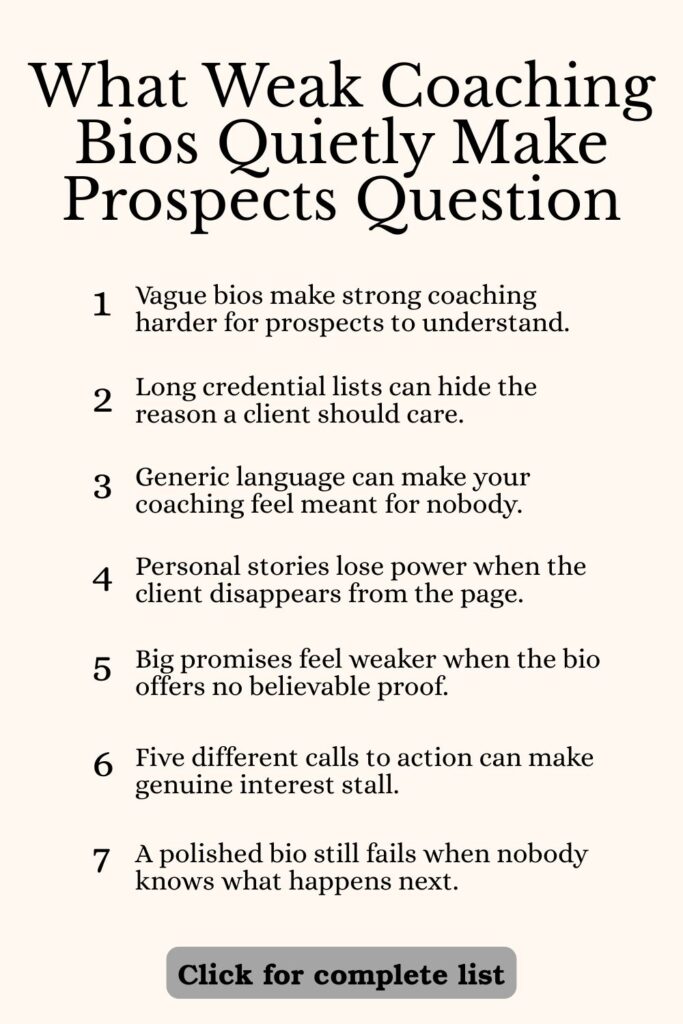
- Judge the bio by action, not compliments. Track whether the right prospects move from reading your bio to clicking, contacting you, or booking. A polished bio that produces no next step still needs work.
What Should a Life Coach Bio Include?
A life coach bio should tell potential clients who you help, what you help them work toward, why they should trust your expertise, how they can work with you, and what they should do next. It should read less like a résumé and more like a clear answer to the prospect’s question, “Is this coach right for me?”
A useful structure is: your coaching niche, the client or problem you specialize in, the outcome you help clients pursue, relevant experience or credentials, your coaching offer or pricing approach, and one clear call to action.
SEE ALSO: If you’re a coach looking to streamline your administrative tasks and save time, check out our Coaching Administration Software. It’s a simple, effective solution designed to help you focus less on paperwork and more on what matters—coaching your clients. From scheduling to client management, our software gives you the tools to run your business efficiently. Ready to reclaim your time and boost productivity? Click or tap here.
Personal details and your coaching story can strengthen the bio, but only when they help a potential client understand your approach, credibility, or connection to the problem you coach around.
What Is a Life Coaching Bio?
A life coaching bio is a short story a coach writes about their experiences and achievements as they relate to the business, career, or topic under discussion.
A well-crafted coaching bio is not simply a list of achievements. Instead, it is a unique and engaging overview of the coach’s journey to where they are today. Before writing a bio, get to know what the clients want.
What are they looking for in a coach?
What problems or challenges are they looking to solve?
Answering these questions is the first step in crafting an intriguing life coaching bio.
SEE ALSO: If you’re a coach looking to streamline your administrative tasks and save time, check out our Coaching Administration Software. It’s a simple, effective solution designed to help you focus less on paperwork and more on what matters—coaching your clients. From scheduling to client management, our software gives you the tools to run your business efficiently. Ready to reclaim your time and boost productivity? Click or tap here.
Why Is a Life Coaching Bio Important?
Buy a domain, set up a beautiful website, throw in some Facebook ads, and boom, clients start rolling in!
Erm, wrong!
A compelling life coaching bio takes the reader on an adventure they connect with and answers all their questions in the search for the right life coach with whom to work.
As the life coaching industry grows, acquiring clients will become more competitive and challenging. So, a simple, barely-there bio won’t cut it anymore. Many coaches overlook this. Some don’t have any idea.
Any business must first be appropriately introduced before clients and customers understand the business, then decide if they would like to interact with it. A coach is likely to get more clients if people can understand how the coach can solve their problems or challenges. This is why it is important to have a life coaching bio.
Coaches who want their piece of this multibillion-dollar action and be successful would have to set themselves apart from the pack. A verified way of doing this is learning how to write a life coaching bio that stands out from the crowd.
A compelling life coaching bio takes the reader on an adventure they connect with and answers all their questions in the search for the right life coach with whom to work.
SEE ALSO: If you’re a coach looking to streamline your administrative tasks and save time, check out our Coaching Administration Software. It’s a simple, effective solution designed to help you focus less on paperwork and more on what matters—coaching your clients. From scheduling to client management, our software gives you the tools to run your business efficiently. Ready to reclaim your time and boost productivity? Click or tap here.
But, not to worry.
I will guide you in more detail through a few examples of awesome life coaching bios here in our directory of well-written bios of coaches generating admirable results in their life coaching businesses.
Let’s get to it.
What Should a Life Coach Bio Say in the First Few Lines?
The first few lines of your coaching bio should help the right person recognize, almost immediately, that your work is relevant to them.
A simple hierarchy works well:
Who you help → what they are trying to change → what kind of coaching you provide → why you are credible
SEE ALSO: If you’re a coach looking to streamline your administrative tasks and save time, check out our Coaching Administration Software. It’s a simple, effective solution designed to help you focus less on paperwork and more on what matters—coaching your clients. From scheduling to client management, our software gives you the tools to run your business efficiently. Ready to reclaim your time and boost productivity? Click or tap here.
For example, compare this:
“I’m an experienced certified coach, speaker, author, NLP practitioner, and lifelong student of human potential.”
With this:
“I help newly promoted managers become confident leaders, especially when difficult conversations, delegation, and team accountability suddenly become part of the job.”
The second version gives a prospect something concrete to recognize. The credentials can come next, where they support the claim instead of competing with it.
You can test your opening with one question: Could your ideal client tell within the first two or three sentences that this bio was written for someone like them?
SEE ALSO: If you’re a coach looking to streamline your administrative tasks and save time, check out our Coaching Administration Software. It’s a simple, effective solution designed to help you focus less on paperwork and more on what matters—coaching your clients. From scheduling to client management, our software gives you the tools to run your business efficiently. Ready to reclaim your time and boost productivity? Click or tap here.
If not, move your niche, client problem, or desired result higher.
Your personal story still has a place. Just make sure the reader knows why they should keep reading before asking them to care about your journey.
What Do Great Life Coaching Bios Have in Common?

To a new coach or one who wants to revamp an existing bio, I always advise to first gather accurate and adequate information before attempting to write a life coaching bio.
An awesome bio must answer the following simple questions:
● Who am I?
● What is my coaching niche and focus?
SEE ALSO: If you’re a coach looking to streamline your administrative tasks and save time, check out our Coaching Administration Software. It’s a simple, effective solution designed to help you focus less on paperwork and more on what matters—coaching your clients. From scheduling to client management, our software gives you the tools to run your business efficiently. Ready to reclaim your time and boost productivity? Click or tap here.
● What solutions can I provide for the client through my coaching?
● What is the cost of my coaching?
● What is my call to action?
Who Am I as a Coach?
A great life coaching bio must clearly state who I am as a life coach. Then, a clear photo and a brief introduction would suffice.

I would also not hesitate to show off a few significant accomplishments and professional experiences, within reason, as long as they directly point to my capacity as a coach – coaching hours, certifications, awards, testimonials, recommendations, e.t.c. I’m trying to win over potential clients, after all.

In one sentence, Kirstin O’Donovan, gives an overview of who she is regarding coaching. She then explains how she has developed as a coach and adds her achievements along the journey to validate her presence in the coaching industry.
SEE ALSO: If you’re a coach looking to streamline your administrative tasks and save time, check out our Coaching Administration Software. It’s a simple, effective solution designed to help you focus less on paperwork and more on what matters—coaching your clients. From scheduling to client management, our software gives you the tools to run your business efficiently. Ready to reclaim your time and boost productivity? Click or tap here.
For a new coach who may not have these accolades to brag about, I would tell a brief personal story about my experiences and how they’ve shaped who I am today.
Telling stories help people connect and relate with each other. I would also include struggles I’ve overcome – the same struggles from which I’m now wanting to help others.
I would then explain how I helped others in similar situations and how those lessons have afforded me the skills and expertise I now possess. Potential clients can then begin to picture how I once was in the same shoes they currently are and how they also can step out of them.
How Do You Turn Coaching Credentials Into Proof Clients Actually Care About?
The strongest credentials in a coaching bio are the ones that make a potential client more confident that you understand their situation and are qualified to help.
That means you do not need to list every course, certificate, membership, award, job title, and workshop you have ever completed.
Choose proof based on the client you want to attract.
SEE ALSO: If you’re a coach looking to streamline your administrative tasks and save time, check out our Coaching Administration Software. It’s a simple, effective solution designed to help you focus less on paperwork and more on what matters—coaching your clients. From scheduling to client management, our software gives you the tools to run your business efficiently. Ready to reclaim your time and boost productivity? Click or tap here.
A leadership coach who spent 15 years managing teams may have a strong reason to mention that experience. A career coach who previously worked in recruitment can connect that background directly to job search, interview, and career-transition coaching. A coach working in a specialist field may lead with a relevant coaching credential or professional qualification.
Credentials also matter in a growing profession. According to the 2025 ICF Global Coaching Study, 73% of coaches agree that clients and organizations expect coaches to have a coaching certification or credential.
Online credibility research points in the same direction. Stanford University’s Web Credibility Project, whose guidelines were based on three years of research involving more than 4,500 people, recommends making relevant expertise and credentials easy for website visitors to see.
The practical rule is simple: do not ask, “What can I brag about?” Ask, “What evidence would help this client feel more confident choosing me?”
Then include the strongest two or three pieces of evidence.
How Do You Write a Strong Coaching Bio When You’re a New Coach?
A new coach can write a credible bio without pretending to have a long coaching track record by using relevant experience, training, a specific niche, and a clear coaching approach.
SEE ALSO: If you’re a coach looking to streamline your administrative tasks and save time, check out our Coaching Administration Software. It’s a simple, effective solution designed to help you focus less on paperwork and more on what matters—coaching your clients. From scheduling to client management, our software gives you the tools to run your business efficiently. Ready to reclaim your time and boost productivity? Click or tap here.
Suppose you have recently trained as a career coach after working in HR for 12 years. You may not have coached hundreds of paying clients yet, but you understand hiring decisions, career transitions, workplace expectations, and the conversations employees have when they want something to change.
That is relevant evidence.
Your bio could connect those dots directly: your background gave you exposure to a problem, your coaching training gave you a structured way to help people work through it, and your practice now focuses on a defined type of client.
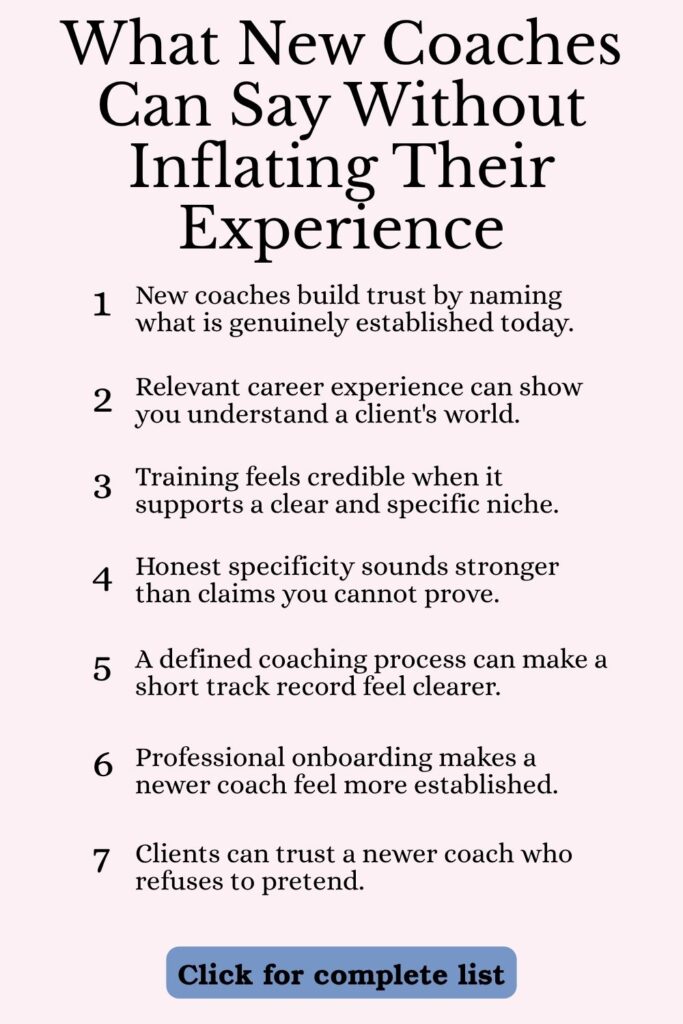
A coach without closely related career experience can use a similar approach. Lead with what is genuinely established: your training, the niche you have chosen, the situations you coach around, and the process clients can expect.
Avoid replacing missing experience with inflated promises. “I help women build six-figure businesses” is a weak claim if you cannot support it. “I coach first-time solopreneurs through offer decisions, priorities, and weekly action planning” is specific enough for a prospect to understand what you actually do.
Professionalism then needs to continue after the bio. A clear booking process, thoughtful intake questions, an agreement, and an organized first-client experience can reinforce the impression your bio creates, even while your coaching practice is still young.
SEE ALSO: If you’re a coach looking to streamline your administrative tasks and save time, check out our Coaching Administration Software. It’s a simple, effective solution designed to help you focus less on paperwork and more on what matters—coaching your clients. From scheduling to client management, our software gives you the tools to run your business efficiently. Ready to reclaim your time and boost productivity? Click or tap here.
What Is My Coaching Niche and Focus?
Clearly defining my niche or the focus of my coaching practice enables my ideal client to identify with me. It’s tempting to want to attract as many people as possible by creating a generic bio. However, I would narrow down my expertise to deliver the best service that would bring about excellent results.
Carving a niche would set me up to be an expert in that niche and build my credibility and authority in that field. By doing this, I can master that area of coaching, and my clients can experience lasting transformations.

Kirsten Gilbert has several niches, which is not uncommon among coaches with many years of experience.
As a new coach, I would begin with 1-2 related niches. Then, as time passes and I acquire more experience, training, and possibly certifications, I will expand my coaching offerings to cater to new markets.
What Results Can I Help My Coaching Clients Work Toward?
This is a no-brainer. People should know or at least have an idea of what results they expect to receive when they work with me.
Becky Michel not only mentions her niche and focus of coaching, but she tells her target client the results they can expect to see after working with her. I see some coaching bios neglect to do this, and it baffles me. My bio stands as my resume online, so leaving out valuable information that could limit my leads and potential income is non-negotiable.
SEE ALSO: If you’re a coach looking to streamline your administrative tasks and save time, check out our Coaching Administration Software. It’s a simple, effective solution designed to help you focus less on paperwork and more on what matters—coaching your clients. From scheduling to client management, our software gives you the tools to run your business efficiently. Ready to reclaim your time and boost productivity? Click or tap here.
When my customer knows what to expect even before hopping on a call with me, chances are I’ll close the call easier and faster.
Should I Include My Coaching Prices?
Although this wouldn’t be an issue for those needing coaching to improve particular aspects of their lives, it remains an integral part of a bio. Price is the number concern for many people, so it is crucial to learn how to set life coaching fees.
Costing coaching packages should never be about keeping it low enough to attract clients, except the target market is low income. I advise against crashing fees to attract clients because what that does is attract people who won’t take the sessions seriously. I would price my coaching packages based on the value I provide to my clients.
Whatever strategy I use to price my coaching package, what matters in my bio is a clear coaching fee schedule. It should be clear to my clients what I charge for all my services. Ariel Jones, another Life Coach here on Life Coach Hub does this right.
Here are the components of Ariel’s fee schedule:
-
Price per session
-
Price for her package
-
Frequency of sessions
-
Other add-ons included in the price
-
Mode of payment
With a transparent fee schedule like Ariel’s, I’m sure to speak more with people who already know what they are getting from me. The client gets right to the matter rather than spending time on a call to understand the cost.
SEE ALSO: If you’re a coach looking to streamline your administrative tasks and save time, check out our Coaching Administration Software. It’s a simple, effective solution designed to help you focus less on paperwork and more on what matters—coaching your clients. From scheduling to client management, our software gives you the tools to run your business efficiently. Ready to reclaim your time and boost productivity? Click or tap here.
Some coaches may argue that not including all the fees in their bios would allow them to present the total transformation results the clients will receive over a discovery phone call. This approach tends to be effective for high-ticket coaching.
High ticket coaches set their prices solely on the exceptional value they intend to deliver to their clients. Therefore, they set up coaching packages instead of listing their offers and hourly fees.
Although many have raised concerns about the high cost of coaching, the fact is coaching is a business based on the transformational results clients achieve. The resources and tools required to reach full-time income cost most coaches a lot of money and time.
Nonetheless, coaches can create profitable packages with a range of price points and several delivery methods – one-on-one, in small and large groups online, and in person – to give their clients more options and flexibility.
Online group coaching attracts the lowest fees and delivers excellent results with a good coach. One-on-one coaching is often the highest priced, but with a fee range, there’ll be something for everyone.
Remember, clients are paying for the solutions the coach is offering. They aren’t paying for coaching per se. So, deliver measurable results and set your fees accordingly.
SEE ALSO: If you’re a coach looking to streamline your administrative tasks and save time, check out our Coaching Administration Software. It’s a simple, effective solution designed to help you focus less on paperwork and more on what matters—coaching your clients. From scheduling to client management, our software gives you the tools to run your business efficiently. Ready to reclaim your time and boost productivity? Click or tap here.
When Should You Show Exact Coaching Prices Versus “Starting At”?
Use an exact price when the coaching offer is standardized, use “starting at” when a defined offer has legitimate variations, and use a consultation when the scope genuinely needs to be determined before you can quote it.
For example, if every client receives six 60-minute sessions, the same between-session support, and the same payment terms, there is little ambiguity. A clear package price helps someone decide whether the offer belongs in their budget before contacting you.
“Starting at” can make sense when there are real variables. A leadership coach might offer a base private-coaching package but charge more when stakeholder interviews, assessments, or additional sessions are included.
A consultation makes more sense when the engagement cannot be responsibly priced before you understand the scope. Corporate coaching involving several leaders is very different from hiding the price of a standard six-session package simply because you hope to explain the value on a call.
The useful question is not, “Should coaches publish their prices?” It is, “How much information does a qualified prospect need to understand the buying decision?”
Once you choose the path, make the next step match it. In LCH Core, coaches can manage payments, coaching packages, and billing for defined offers. If your path starts with a consultation instead, a Public Booking Page can give interested prospects a direct way to schedule. The Public Booking Page setup guide explains how public session types, availability, and booking links work together.
SEE ALSO: If you’re a coach looking to streamline your administrative tasks and save time, check out our Coaching Administration Software. It’s a simple, effective solution designed to help you focus less on paperwork and more on what matters—coaching your clients. From scheduling to client management, our software gives you the tools to run your business efficiently. Ready to reclaim your time and boost productivity? Click or tap here.
What Should My Coaching Bio Ask People to Do Next?
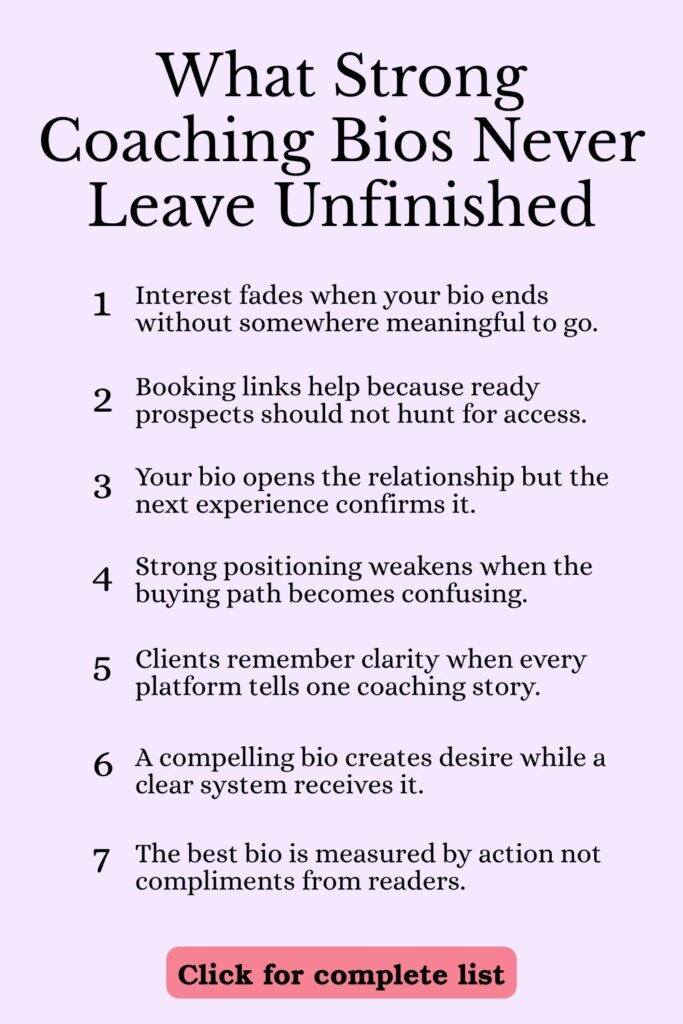
So, I’ve implemented all the tips mentioned above and written a great bio that keeps my ideal clients wanting to know more about me, but I leave them hanging without further direction. A good life coaching bio should always mention a call to action to prompt anyone who reads through the coaching bio to take further action.
Chances are, the person is interested in engaging more with me and my services. So, at the end of my bio, I’d direct them to consume more of my content, such as:
-
a course
-
an e-book
-
a newsletter
If I have no products to offer them, I will invite them to a free coaching session with me. Calls to action urge my ideal clients to interact more with me. By using a call to action, I’m sure to increase my leads and improve my business performance. So, be sure to tell them what to do next.
How Do You Adapt One Coaching Bio for Your Website, Directory, LinkedIn and Social Media?
You do not need four completely different coaching bios. You need one strong positioning message that can be expanded or compressed for different places.
Start with a master version containing the full set of information:
Who you coach, the problem or goal, your approach, relevant proof, your offer, and the next step.
SEE ALSO: If you’re a coach looking to streamline your administrative tasks and save time, check out our Coaching Administration Software. It’s a simple, effective solution designed to help you focus less on paperwork and more on what matters—coaching your clients. From scheduling to client management, our software gives you the tools to run your business efficiently. Ready to reclaim your time and boost productivity? Click or tap here.
Then create shorter versions without changing the core positioning.
Imagine a coach whose full positioning is:
“I help mid-career professionals decide what comes next when a successful career no longer feels like the right career. My coaching focuses on career direction, decision-making, and building a realistic transition plan.”
The website or directory version can expand that into experience, coaching approach, credentials, examples, and a call to action.
The LinkedIn version can keep the professional context and career problem but compress the personal story.
A very short social bio might become:
SEE ALSO: If you’re a coach looking to streamline your administrative tasks and save time, check out our Coaching Administration Software. It’s a simple, effective solution designed to help you focus less on paperwork and more on what matters—coaching your clients. From scheduling to client management, our software gives you the tools to run your business efficiently. Ready to reclaim your time and boost productivity? Click or tap here.
“Career coach for experienced professionals planning their next move. Career clarity, decisions, and transition strategy.”
Same coach. Same client. Same positioning.
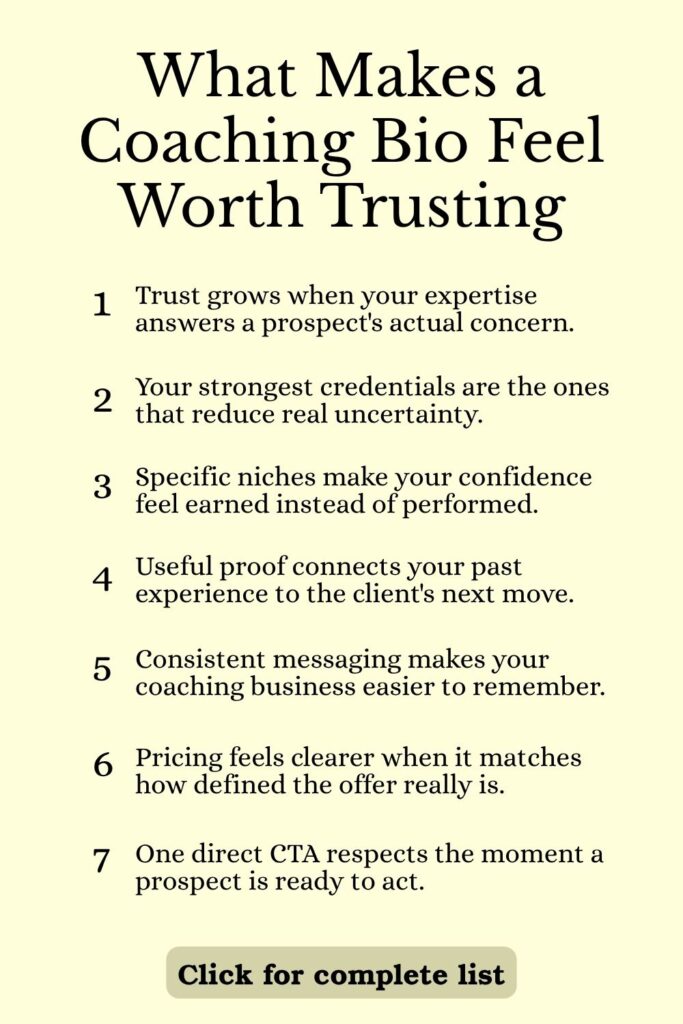
That consistency matters because a prospect may encounter you more than once. They might see your LinkedIn profile, search your name later, and then visit your website. They should not meet a completely different coaching business on every platform.
Build one message first. Shorten the format, not the strategy.
How Do You Write a Life Coaching Bio for Social Media?
At this point, I believe the average entrepreneur understands the significance of social media in growing a business. But, of course, this also goes for life coaching practices. Social media is a powerful marketing tool, and social media bios amplify this.
The social media platforms I use would depend on my client demographic. If I coach senior-level professionals towards higher career performance, I know TikTok wouldn’t have my potential clients.
SEE ALSO: If you’re a coach looking to streamline your administrative tasks and save time, check out our Coaching Administration Software. It’s a simple, effective solution designed to help you focus less on paperwork and more on what matters—coaching your clients. From scheduling to client management, our software gives you the tools to run your business efficiently. Ready to reclaim your time and boost productivity? Click or tap here.
I’ll know to direct my social media efforts primarily on LinkedIn, where I’d find career-minded people. In addition, the bio section on LinkedIn gives room for an in-depth bio.
With the 2000 character limit on LinkedIn bios, I would employ the tactics I have mentioned here. On the other hand, if I am a fitness coach for young women, I could focus on Instagram or Facebook.
I would be sure to find many of my target clients on those platforms. However, there is a limit on the character count in the bio section of these platforms.
-
Instagram bio: 150-characters
-
Twitter bio: 160-characters
-
Facebook description: 155-characters
A 150 – 160 bio doesn’t give much room for lengthy descriptions, so I’d have to get creative. Regardless of what I write, I could always do the following in my bio:
Which Achievements Should You Include?
That’s right, I’m saying it again. Show off achievements.
Listen. Nobody will show me off better than I can show myself.
SEE ALSO: If you’re a coach looking to streamline your administrative tasks and save time, check out our Coaching Administration Software. It’s a simple, effective solution designed to help you focus less on paperwork and more on what matters—coaching your clients. From scheduling to client management, our software gives you the tools to run your business efficiently. Ready to reclaim your time and boost productivity? Click or tap here.
But, I wouldn’t write endlessly about my achievements. Instead, I’d mention a few significant accomplishments. That would do. I’ve done the hard work. I’ve earned rewards as a result. Now’s the time to tell the world and solidify my position as a coac
-
High-Performance Coach
-
Helped 1000+ people to $10k monthly
-
Titan’s 2021 Life Coach of the Year Award
-
Founder @123coaches
How Short Should a Social Media Coaching Bio Be?
Yes, Instagram has a 150-character limit, but must I use up every character? Another way to write a bio is to use a statement, punchline, or quote. Short and powerful.
One I’ll never forget is, “There are some things money can’t buy; for everything else, there’s Mastercard:” The slogan is still one of the best I’ve ever come across. I know it’s a slogan but it’s a catchy and powerful marketing tool. Sometimes, brevity does the magic.
“Spreading smiles”
Short, but speaks a thousand words about what I do as a motivational coach, for instance.Follow this with a call to action and link to your website or products.
Which Keywords Belong in a Coaching Bio?
Social media allows for search using keywords. Putting powerful keywords in my bio that tell potential clients what they want to know will ensure I appear in search results and compel them to interact with my business. Using hashtags in my bio is another excellent tactic for appearing in social media search results.
SEE ALSO: If you’re a coach looking to streamline your administrative tasks and save time, check out our Coaching Administration Software. It’s a simple, effective solution designed to help you focus less on paperwork and more on what matters—coaching your clients. From scheduling to client management, our software gives you the tools to run your business efficiently. Ready to reclaim your time and boost productivity? Click or tap here.
What CTA Should You Use in a Social Bio?
Earlier, I talked about using a call to action in my bio but including a call to action in a 150-character bio is a different ball game. A few words like “schedule a call with me” or “get the e-book” make for a solid call to action.

Should You Create a Video Coaching Bio?
With enhancements in technology and future trends in the coaching industry pointing towards more virtual coaching, it may be an added advantage to have a video coaching bio.
Videos are:
-
more memorable
-
more engaging
-
better at showing off personality
-
better at converting “window shoppers” to buyers

81% of digital marketers claim that they have increased their sales using video, and 93% of marketers have increased their brand awareness with video.

The numbers speak for themselves. So, why aren’t more coaches using video bios? My guess is that word hasn’t gotten around yet.
With the pace of technological advancements and trends in video marketing, I believe more coaches will adopt this method in the near future. I’d get on it now, before the rush, and distinguish myself and my coaching brand with a video bio if I were you.
SEE ALSO: If you’re a coach looking to streamline your administrative tasks and save time, check out our Coaching Administration Software. It’s a simple, effective solution designed to help you focus less on paperwork and more on what matters—coaching your clients. From scheduling to client management, our software gives you the tools to run your business efficiently. Ready to reclaim your time and boost productivity? Click or tap here.

Sergio Decesare is one of the coaches on Life Coach Hub who have tapped into the power of video coaching. Although he has a well-written bio, he enhanced his profile by adding a video to cement himself in the minds of his ideal clients.
What Should You Avoid in a Life Coaching Bio?
Just as I’ve guided you through practical life coaching bio examples that could increase revenue, it is also beneficial to be aware of how not to write a coaching bio. As I mentioned earlier, a compelling coaching bio tells my potential client who I am and what my focus is.
It also states how I can help them and other information like the cost and certifications I may have acquired. An inadequate and ineffective coaching bio could damage a coaching business. So, efforts should be made to avoid writing such bios.
-
Don’t brag unnecessarily.
-
Don’t ramble on about how amazing your life is.
-
Don’t write stories about your family or personal life.
-
Don’t write a dry bio. Instead, put some personality and life in it.
-
Don’t use wordy, complicated sentences. It loses people.
-
Don’t talk about things ideal clients don’t care about.
How Do You Know Whether Your Coaching Bio Is Actually Getting Clients?
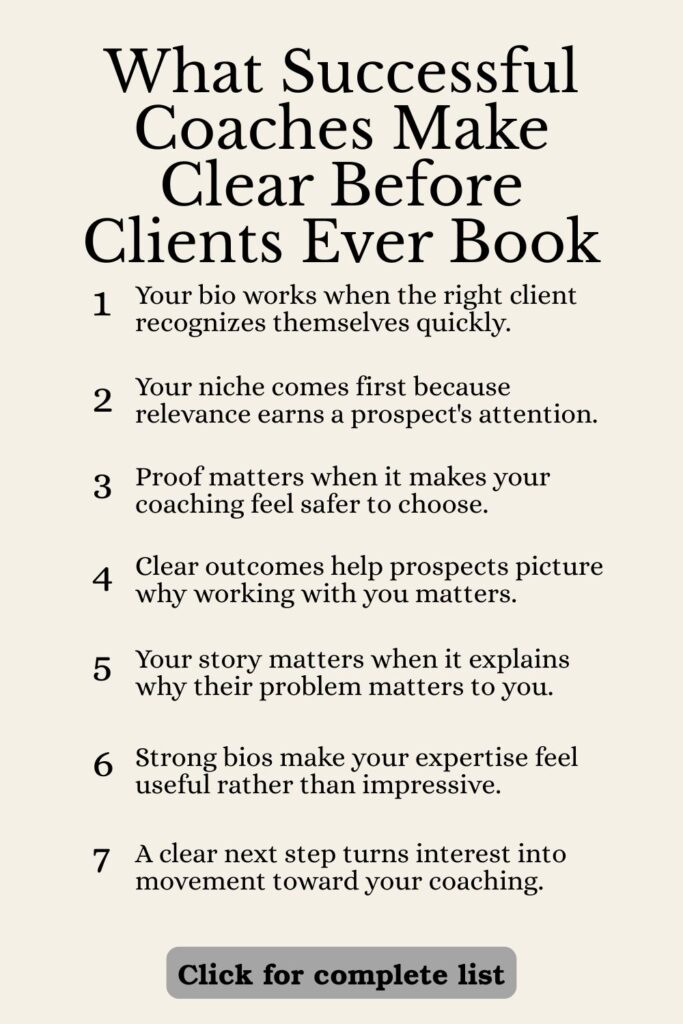
Your coaching bio is doing its job when the right people move from reading it to taking the next step.
You can diagnose it with a simple path:
Bio or profile view → CTA click → inquiry or booking → qualified conversation → client
SEE ALSO: If you’re a coach looking to streamline your administrative tasks and save time, check out our Coaching Administration Software. It’s a simple, effective solution designed to help you focus less on paperwork and more on what matters—coaching your clients. From scheduling to client management, our software gives you the tools to run your business efficiently. Ready to reclaim your time and boost productivity? Click or tap here.
You do not need sophisticated analytics to learn from that path.
If people view your profile but rarely click or contact you, inspect the bio itself. The niche may be vague. The outcome may be unclear. The proof may be irrelevant. The CTA may give the reader no compelling next step.
If people click through but rarely complete an inquiry or booking, the bio may not be the main problem. Look at the page or process after the click.
If qualified prospects regularly book conversations but rarely become clients, investigate the offer, fit, pricing, and sales conversation rather than constantly rewriting the bio.
Change one variable at a time. For example, sharpen the niche statement for a month before changing the photo, CTA, price language, and opening paragraph all at once. Otherwise, you will not know what produced the difference.
This is also why a bio works better as part of a client journey than as an isolated marketing asset. The guide to coaching funnels for coaches goes deeper into what needs to happen after someone first discovers your coaching business.
SEE ALSO: If you’re a coach looking to streamline your administrative tasks and save time, check out our Coaching Administration Software. It’s a simple, effective solution designed to help you focus less on paperwork and more on what matters—coaching your clients. From scheduling to client management, our software gives you the tools to run your business efficiently. Ready to reclaim your time and boost productivity? Click or tap here.
What Should You Check Before Publishing Your Coaching Bio?
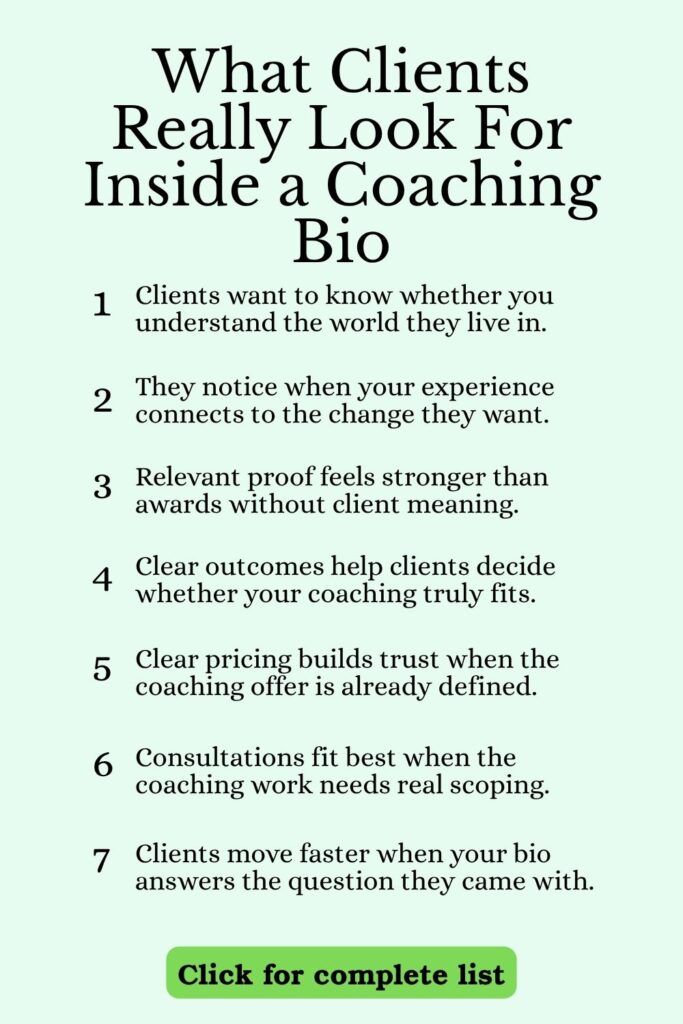
We’ve established that a great bio carries the reader along. It creates a lasting first impression and makes the reader want to continue interacting with you and your business. Work your way through this checklist to ensure you’ve included all essential information:
-
Who am I?
-
Did I use a clear professional photo?
-
Have I included a few achievements?
-
What is my coaching niche and focus?
-
Did I write for my target audience?
-
Have I mentioned the solutions I provide for the client through my coaching?
-
What is the cost of my coaching?
-
Have I included a fee schedule?
-
Is there a call to action?
-
Did I infuse some humor and personality?
-
Have I linked to my website and social media channels?
-
Have I included my contact information?
Where LCH Core Fits
A coaching-business system fits after your bio has created enough relevance and trust for someone to want a next step.
The bio does the positioning work. It explains who you help, what you coach around, why you are credible, and what the prospect should do next.
The system behind it should make that next step easy.
If your CTA is to schedule a conversation, a Public Booking Page can let prospects choose an available session directly. If someone becomes a client, a Welcome Package can then organize the welcome letter, coaching agreement with electronic signature, and forms used to begin the relationship. The Welcome Package onboarding guide shows how those materials can be handled together.
Client management can then keep client profiles, notes, and intake information organized after the prospect becomes a client.
SEE ALSO: If you’re a coach looking to streamline your administrative tasks and save time, check out our Coaching Administration Software. It’s a simple, effective solution designed to help you focus less on paperwork and more on what matters—coaching your clients. From scheduling to client management, our software gives you the tools to run your business efficiently. Ready to reclaim your time and boost productivity? Click or tap here.
That distinction matters. Software cannot make an unclear bio compelling. A strong bio cannot replace the operational steps required once someone says yes.
Used together, the bio creates a clear reason to act and LCH Core gives the coach a structured way to handle what happens next.
Frequently Asked Questions About Life Coaching Bios
What should a life coach bio include?
A life coach bio should include your niche, who you help, the results or problems you coach around, relevant experience or credentials, how people can work with you, and one clear next step.
Personal details belong only when they help a potential client understand your perspective, credibility, or coaching approach.
How long should a life coaching bio be?
A life coaching bio should be long enough to answer a potential client’s main questions without making them hunt for the useful information.
A website or directory bio can use several short paragraphs. A social profile needs a compressed version that preserves your client, niche, outcome, and CTA.
SEE ALSO: If you’re a coach looking to streamline your administrative tasks and save time, check out our Coaching Administration Software. It’s a simple, effective solution designed to help you focus less on paperwork and more on what matters—coaching your clients. From scheduling to client management, our software gives you the tools to run your business efficiently. Ready to reclaim your time and boost productivity? Click or tap here.
How do I write a coaching bio if I’m a new coach?
A new coach should build credibility from relevant professional experience, coaching training, a well-defined niche, and an honest description of the work they do.
Do not invent transformation claims to compensate for a short track record. Specificity is more credible than exaggeration.
Should a life coach bio be written in first person or third person?
First person is usually the stronger choice for your own website, directory profile, and social accounts because you are speaking directly to potential clients.
Third person is useful for speaker introductions, conference bios, media pages, and situations where someone else will introduce you.

Should I include coaching prices in my bio?
Include coaching prices when the offer is sufficiently standardized for the number to be meaningful.
For variable or customized work, a “starting at” figure or consultation may make more sense. The goal is to give prospects enough information to understand the next buying decision.
SEE ALSO: If you’re a coach looking to streamline your administrative tasks and save time, check out our Coaching Administration Software. It’s a simple, effective solution designed to help you focus less on paperwork and more on what matters—coaching your clients. From scheduling to client management, our software gives you the tools to run your business efficiently. Ready to reclaim your time and boost productivity? Click or tap here.
Should I include every coaching certification in my bio?
Include the coaching certifications that are most relevant to the clients and work you want to attract.
A long credential list can bury the information a prospect actually needs. Prioritize qualifications, training, professional experience, and achievements that strengthen your credibility for that particular niche.
How do I write a coaching bio for LinkedIn or Instagram?
Write a LinkedIn or Instagram coaching bio by compressing your full positioning into the client, problem or outcome, coaching role, and next step.
Do not create a completely different identity for every network. Keep your core positioning consistent and adjust the amount of detail.
What call to action should I put in a coaching bio?
A coaching bio should end with one specific action that matches the next step in your client journey.
That might be booking a consultation, viewing your coaching packages, downloading a relevant lead magnet, or contacting you. Avoid presenting five unrelated options and making the reader decide where to begin.
SEE ALSO: If you’re a coach looking to streamline your administrative tasks and save time, check out our Coaching Administration Software. It’s a simple, effective solution designed to help you focus less on paperwork and more on what matters—coaching your clients. From scheduling to client management, our software gives you the tools to run your business efficiently. Ready to reclaim your time and boost productivity? Click or tap here.
What Should You Do After Publishing Your Coaching Bio?
- Create a free life coach directory listing
- Create a compelling bio (follow the steps above).
- Create amazing value for your clients with forms, worksheets and coaching tools that will keep them coming back for more.
Sources
International Coaching Federation. “ICF Global Coaching Study: Insights on Professional Coaching.” International Coaching Federation, 2025. Accessed 9 Sept. 2026. ICF Global Coaching Study.
Fogg, B. J. “Stanford Guidelines for Web Credibility.” Stanford Persuasive Technology Lab, Stanford University, May 2002. Accessed 9 Sept. 2026. Stanford Guidelines for Web Credibility.
Read this next

Life Coaching Hashtags: 337 Best Hashtags for Life Coaches
Check out these topical hashtags for coaching that can help you grow your audience and client base
Read More
How to Master Funnels as a Coach (and Why You Need To)
If you’re like most coaches, you became a coach because you wanted to help people transform their lives, not because you wanted to learn marketing jargon like “funnels.” But here’s […]
Read More
10 Common Excuses Keeping You From Getting Paid Clients: Part 1
What is getting in the way? Ok… so we’ve established that you’re brilliant, talented, and have life experience that makes you a unique asset to others. We know you can […]
Read More