


Talk to a coach about Organizational coaching

Crystal Faulk
ACC
I help overwhelmed women in transition gain clarity, confidence, and...

Terrie Hein
Certified Life Coach, Certified Insight Coach Practitioner
Coaching to declutter your life, organize your goals, and cook...

Dr Charlene Ashley
Doctorate - Behaviours
I coach individuals to design fulfilling lives through structure, clarity,...

Paloma Chiara

Lana's Gymnastics Club
"Where the best in gymnastics meets fun. Where every child is a star"
lgclubny.com

Anna Sosnina
ICF (ACC)
ICF ACC certified coach, founder of EssorVie Coaching, passionate about...

Tyler Fink
B.A. in Religion, Anthropology, and Philosophy. Master of Divinity (M.Div.) in Missiology
Pastor, husband, and father helping Christian men pursue faithful growth...

Travis Brown
Professional Life coach
With experience in guiding clients to achieve goals, build confidence,...
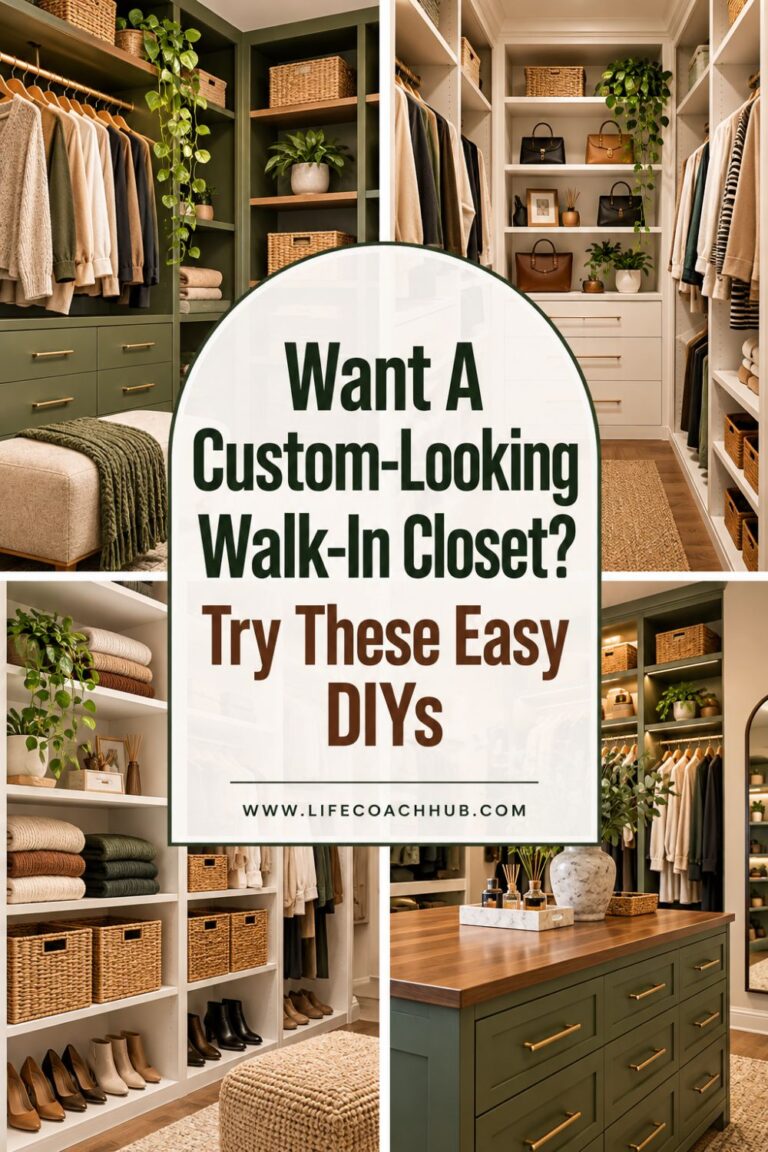


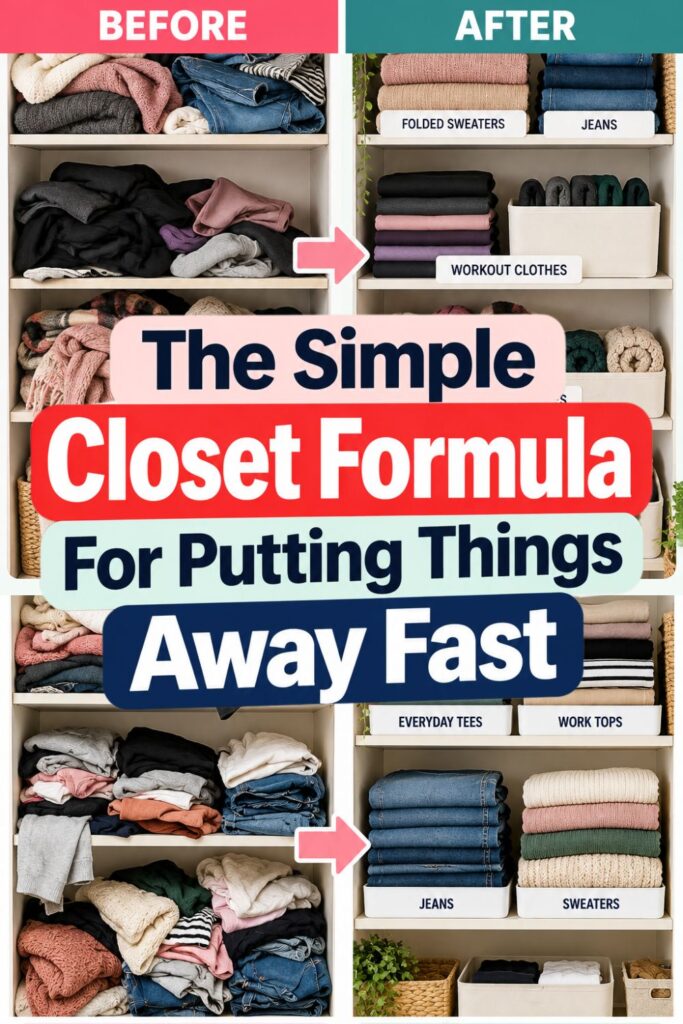
Closet Labeling For “Return In 10 Seconds”
Are you all about style, decor and organization? Download a copy of our Clutter Reset Guide.
*****
Why Your Closet Needs A 10-Second Return Rule
A closet usually gets messy again for one simple reason: putting things away takes more effort than leaving them out. If you have to decide where a sweater goes, move a leaning pile, or remember which shelf was supposed to hold what, your brain will choose the easier option.
That easier option is usually the chair, the floor, the bed, or the top of the laundry basket.
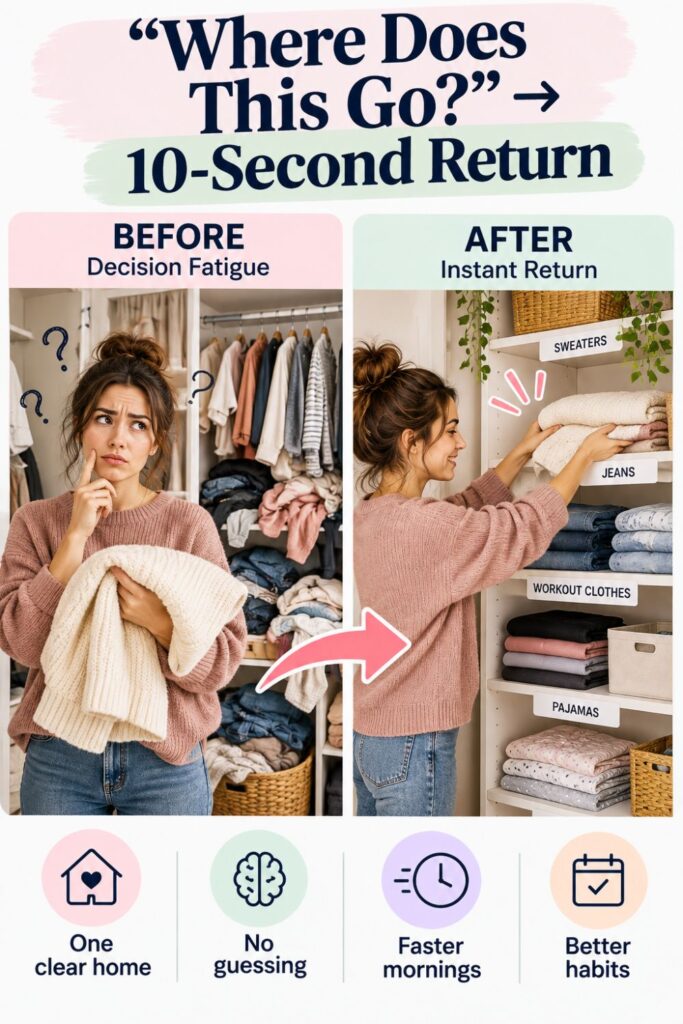
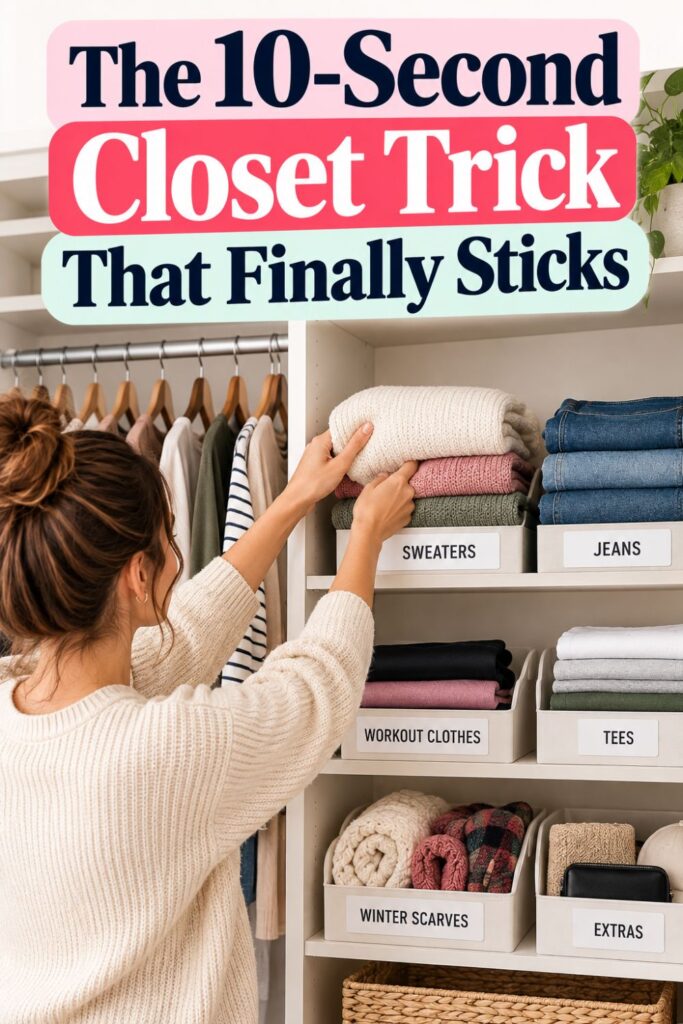
Closet labeling fixes that by removing the decision. Instead of opening the closet and thinking, “Where does this go?” you see the answer right in front of you. A good label turns a shelf into a clear return zone.
The goal is not to make your closet look like a storage aisle. The goal is to make returning items feel automatic.
A 10-second return rule means every common item should be easy to put away in about 10 seconds or less. That does not mean your closet has to be perfect. It means the most-used items have obvious homes that are simple to reach, simple to understand, and simple to maintain.
This works especially well in small closets because small spaces get messy fast. One sweater in the wrong spot can knock over a stack. One vague shelf can turn into a pile of “I’ll deal with this later.”
If you want to get more from your life, and are looking for concrete action steps to get you there, check out our Request a Coach page. It’s a “cut the fence-sitting and take action” way to tackle your issues and actually find success. To get off the fence and start to take action, click or tap here.
A labeled closet gives you a shortcut.
Instead of relying on memory, motivation, or a big weekend reset, you create a system that tells you what to do in the moment. That is what makes it useful for busy days, laundry days, rushed mornings, and ADHD-friendly organizing.
The basic idea is simple:
- Give each shelf one clear job.
- Use containers where piles do not stay neat.
- Label the shelf, bin, or zone.
- Test whether items can be returned quickly.
- Adjust the labels when they stop making sense.
You are not organizing for the version of you who has a whole afternoon and a burst of energy. You are organizing for the version of you who has 10 seconds, one hand full of laundry, and no patience for guessing.
That is the version of you this system needs to serve.
Need some in depth help with organization and productivity ? Drop on by our directories choc full of productivity coaches, minimalist coaches, and work/life balance coaches to get your life organized! Or click here to have us match you to the best.
1. Do A Fast Shelf Pile Audit Before You Make Labels
Before you make labels, you need to understand what your closet is already trying to do. Most messy shelves have a pattern. The piles may look random, but they usually form around real habits.
Maybe leggings always end up with pajamas. Maybe sweaters slide into jeans. Maybe bags, scarves, and “I don’t know where this goes” items keep landing on the same shelf.
If you want to get more from your life, and are looking for concrete action steps to get you there, check out our Request a Coach page. It’s a “cut the fence-sitting and take action” way to tackle your issues and actually find success. To get off the fence and start to take action, click or tap here.
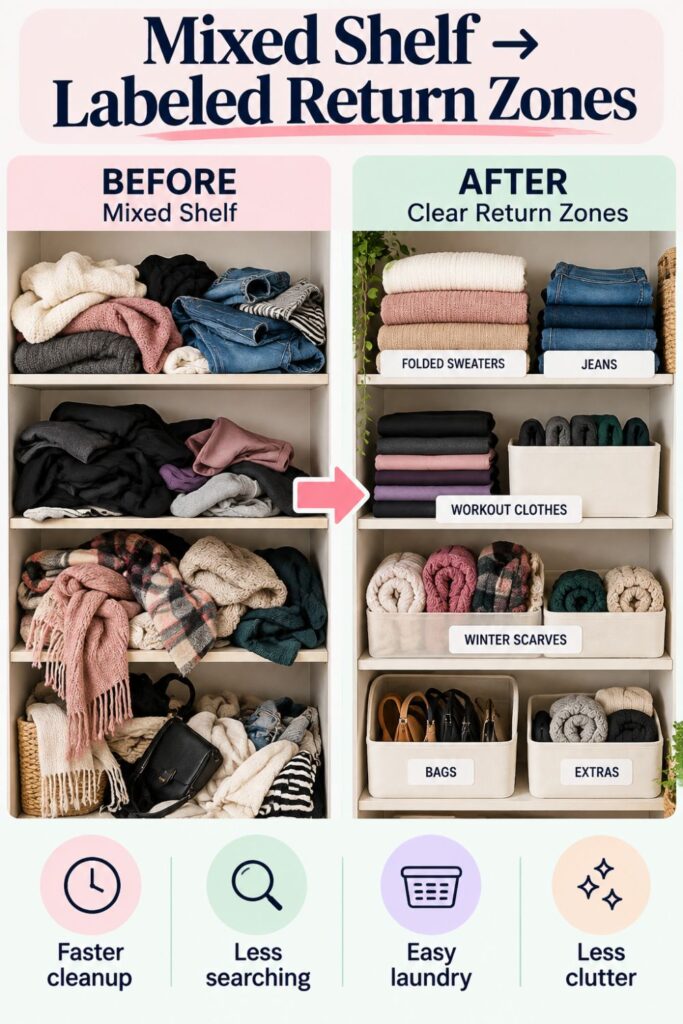
Start by auditing one shelf at a time. Do not empty the whole closet unless you truly have the time and energy to finish. A one-shelf audit is easier to complete, and it gives you useful information without turning your bedroom into a disaster zone.
Begin with the shelf that gets messy fastest. That is usually the shelf with the biggest return problem.
Use a simple process:
- Clear one shelf: Take everything off the shelf and place it nearby so you can see what was actually living there.
- Group repeat items: Sort the contents into natural piles, such as jeans, sweaters, workout clothes, pajamas, bags, scarves, or seasonal pieces.
- Notice mixed categories: Pay attention to items that were shoved together because they did not have a clear home.
- Identify overflow: Look for categories that have too many items for the space they are using.
- Spot homeless items: Pull aside anything you keep moving around because you never know where to put it.
This step matters because labels only work when they match real life. If you label a shelf “Sweaters” but you always toss leggings there too, the label will not hold. Either the leggings need their own zone, or the shelf needs a broader label that reflects how you actually use it.
Write rough label ideas on paper before you make anything permanent. Do not worry about making them pretty yet. You are just collecting information.
Try label drafts like:
- Everyday Tops
- Work Pants
- Gym Clothes
- Folded Sweaters
- Outfit Extras
- Seasonal Scarves
- Worn Once
Once you see the closet’s natural categories, the label plan becomes much easier. You are no longer guessing what should go where. You are naming the piles that already exist and giving them cleaner boundaries.
That is how labeling starts to solve the real problem.
If you want to get more from your life, and are looking for concrete action steps to get you there, check out our Request a Coach page. It’s a “cut the fence-sitting and take action” way to tackle your issues and actually find success. To get off the fence and start to take action, click or tap here.
2. Choose The Shelves That Actually Need Labels
Not every shelf needs a label. In fact, labeling everything can make a small closet feel busier than it needs to be. The best labels are the ones that solve a repeated problem.
Start with the shelves that create the most friction. These are usually the shelves you touch every day, the shelves that collect mixed piles, or the shelves where you often pause and think, “Where was this supposed to go?”
A useful label should answer a question. If there is no question, you may not need one.
For example, a top shelf that only holds one large storage bin may not need a visible label on the shelf. The bin itself might need a label, but the shelf does not. A shelf full of mixed folded clothes, however, probably needs several clear zones.
Use labels where they will reduce decisions.
Good places to start include:
- Shelves with folded clothing stacks
- Bins that hold small accessories
- Closet shelves shared by multiple people
- High shelves used for seasonal storage
- Spaces where clean laundry often gets dumped
- Areas where categories blend together
- “Temporary” piles that never seem to leave
For a first pass, choose three to five labels. That is enough to make the closet easier without creating visual clutter. A small system that works is better than a full labeling project that feels too detailed to maintain.
Think about your highest-use categories first. If you wear jeans three times a week, the jeans zone deserves a clear home. If you only touch formalwear twice a year, that label can wait.
If you want to get more from your life, and are looking for concrete action steps to get you there, check out our Request a Coach page. It’s a “cut the fence-sitting and take action” way to tackle your issues and actually find success. To get off the fence and start to take action, click or tap here.
This is especially important in a small closet. Every label should earn its place. If it does not help you return items faster, find things faster, or keep piles from mixing, it may not be necessary.
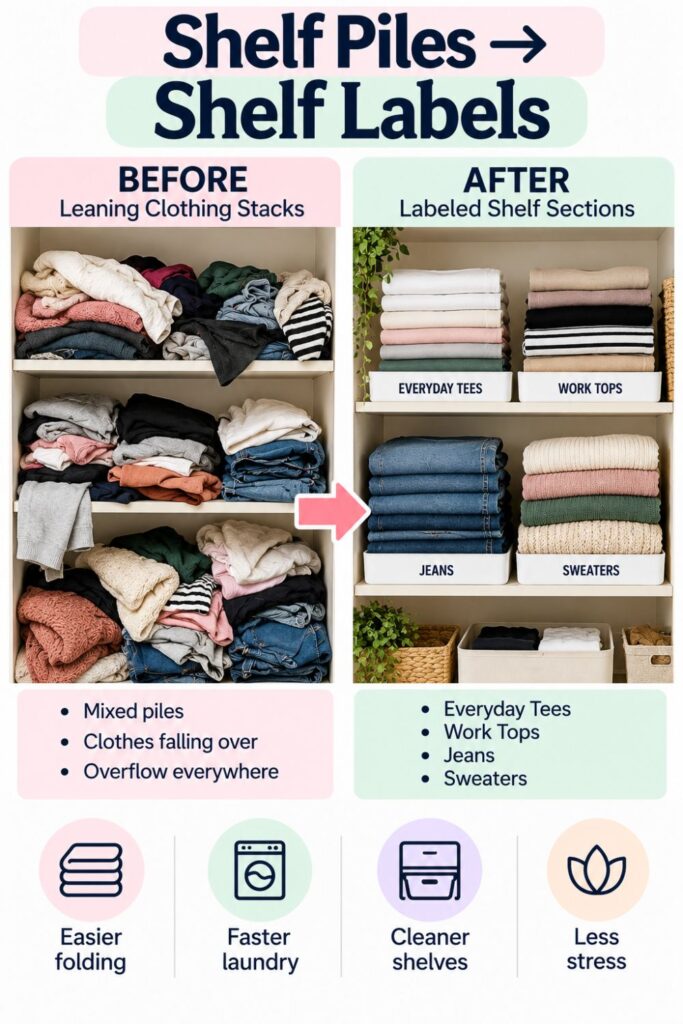
You can also label by shelf section instead of labeling the entire shelf. For example, one shelf might have three zones:
- Work Tops
- Casual Tees
- Gym Sets
This works well when you do not have enough shelves for every category but still need clear boundaries.
Before making the label final, ask one question: “Would this help me put something away faster when I am tired?”
If the answer is yes, label it. If the answer is no, simplify it, skip it, or wait until the closet shows you where the real problem is.
3. Turn Each Shelf Into A Clear Return Zone
A label works best when the shelf has one clear job. If the shelf is trying to hold too many unrelated things, the label becomes decoration instead of direction.
Think of each shelf as a return zone. A return zone is a specific place where a specific type of item goes back every time. The more obvious the zone is, the less effort it takes to use.
Start with broad, useful categories. You do not need a separate label for every tiny subcategory unless that level of detail genuinely helps you. Most closets work better with simple zones that are easy to remember.
If you want to get more from your life, and are looking for concrete action steps to get you there, check out our Request a Coach page. It’s a “cut the fence-sitting and take action” way to tackle your issues and actually find success. To get off the fence and start to take action, click or tap here.
For example:
- Everyday Tees
- Jeans
- Work Tops
- Workout Clothes
- Sweaters
- Pajamas
- Bags
- Scarves
- Worn Once
Each label should make the next action obvious. If you are holding a sweater, you should be able to scan the closet and know where it belongs immediately.
Placement matters too. Put the most-used items in the easiest spots to reach. If you wear workout clothes daily, do not store them on the highest shelf behind a basket. If you use work clothes every morning, keep them at eye level or close to your main dressing area.
A clear return zone usually needs three things:
- A simple category: The label should name what belongs there.
- A physical boundary: Use a shelf section, bin, divider, or basket to separate it.
- An easy motion: You should be able to return the item without moving several other things.
Test the zone before you commit. Pick up an item from that category, stand where you normally stand, and put it away. If the motion feels awkward, the zone is not ready.
Ask yourself:
- Do I have to move another pile first?
- Is the label blocked by clothing?
- Is the shelf too high or too deep?
- Is the category too vague?
- Would I actually use this spot on a rushed morning?
If the answer reveals friction, adjust the zone now. Move the category lower, make the label clearer, or add a container.
The best return zones feel almost too obvious. That is the point. Your closet should not make you think hard every time you put something away. It should guide your hand to the right spot.
If you want to get more from your life, and are looking for concrete action steps to get you there, check out our Request a Coach page. It’s a “cut the fence-sitting and take action” way to tackle your issues and actually find success. To get off the fence and start to take action, click or tap here.
4. Containerize The Items That Refuse To Stay Neat
Some closet items do not behave well on open shelves. Scarves slide around. Belts tangle. Small bags tip over. Seasonal extras drift into other categories. These are the items that need containers.
A label can tell something where to go, but a container helps it stay there.
Use containers for anything that turns into a loose pile. In a small closet, even a small messy category can make the whole space feel crowded. A bin gives that category a boundary and makes cleanup faster.
Good closet items to containerize include:
- Scarves
- Belts
- Hats
- Clutches
- Small bags
- Socks
- Tights
- Seasonal accessories
- Workout extras
- Swimwear
- Off-season clothing
- Worn-once items
Choose containers that match the shelf depth. A bin that is too deep can become a hidden clutter cave. You want containers that pull forward easily and let you see, reach, or remove what is inside without unloading the entire shelf.
Open bins usually work better for everyday items. Lidded bins can work for seasonal storage, but they add an extra step. If the goal is a 10-second return, fewer steps usually win.
Label the container clearly. If the bin moves around, label the bin front. If the container always sits in the same place, you can also label the shelf edge so the bin has a home too.
Avoid vague labels whenever possible.
If you want to get more from your life, and are looking for concrete action steps to get you there, check out our Request a Coach page. It’s a “cut the fence-sitting and take action” way to tackle your issues and actually find success. To get off the fence and start to take action, click or tap here.
Labels like these are usually too unclear:
- Stuff
- Misc.
- Extras
- Random
- Closet Things
More useful labels sound like this:
- Winter Scarves
- Small Bags
- Gym Extras
- Dress Belts
- Travel Items
- Worn Once
A good container label helps you make a fast decision. If you hesitate every time you read it, the label needs to be more specific.
Be careful not to over-containerize. If an item stacks neatly and stays in place, it may not need a bin. Containers are most useful for categories that spread, fall, mix, or disappear.
The goal is not to hide clutter. The goal is to create simple drop zones that still make sense later.
When containers and labels work together, returning items becomes much easier. You are not folding every scarf perfectly or arranging every accessory. You are giving each category a clear place to land.
5. Write Labels That Tell You Exactly What Goes There
A closet label should be clear before it is cute. Pretty labels are nice, but useful labels are what keep the system working.
The best label names tell you exactly what belongs in that space. They are short, specific, and easy to understand when you are tired, rushed, or holding a pile of laundry.
If you want to get more from your life, and are looking for concrete action steps to get you there, check out our Request a Coach page. It’s a “cut the fence-sitting and take action” way to tackle your issues and actually find success. To get off the fence and start to take action, click or tap here.
Start with the words you naturally use. If you call them “gym clothes,” do not label the bin “activewear” just because it sounds nicer. If you say “work tops,” use that instead of “professional blouses” unless that wording truly makes more sense to you.
Your labels should match your brain.
Useful label examples include:
- Everyday Tees
- Work Tops
- Jeans
- Leggings
- Gym Clothes
- Pajamas
- Folded Sweaters
- Winter Scarves
- Small Bags
- Worn Once
Try to keep labels to one to three words. Long labels are harder to scan, especially in a small closet where labels may be close together. The faster your eyes can read the label, the faster your hands can return the item.
Avoid labels that sound organized but do not give clear direction.
For example:
- “Essentials” might be too vague.
- “Extras” can become a clutter trap.
- “Nice Things” does not explain what belongs there.
- “Seasonal” may need more detail, like “Winter Hats” or “Summer Swim.”
You can label by clothing type, outfit use, or routine. The right choice depends on how you get dressed.
If you think by item type, use labels like:
If you want to get more from your life, and are looking for concrete action steps to get you there, check out our Request a Coach page. It’s a “cut the fence-sitting and take action” way to tackle your issues and actually find success. To get off the fence and start to take action, click or tap here.
- Jeans
- Sweaters
- Tees
- Pants
If you think by lifestyle zone, use labels like:
- Work Clothes
- Weekend Clothes
- Gym Clothes
- Errand Outfits
If you struggle to put away laundry, label by the way laundry comes back to the closet. That might mean categories like “Folded Tops,” “Soft Pants,” or “Basics.”
Consistency also helps. Choose one label style and repeat it. You might use printed labels, handwritten tags, label tape, clip-on tags, or small cards in holders.
The format matters less than the clarity. A simple handwritten label that you actually follow is better than a beautiful label that no one understands.
Before you make the final version, read each label out loud. Then ask, “Would I know exactly what goes here?”
If yes, the label is doing its job.
6. Attach Labels With Command Strips Or Renter-Friendly Holders
Once you know what the labels should say, decide how to attach them. This part matters because closet systems often need small adjustments. A label that feels right today may need to move after two weeks of real use.
That is why renter-friendly options are helpful. They let you test the system without damaging shelves, bins, walls, or closet finishes.
If you want to get more from your life, and are looking for concrete action steps to get you there, check out our Request a Coach page. It’s a “cut the fence-sitting and take action” way to tackle your issues and actually find success. To get off the fence and start to take action, click or tap here.
Command Strips can work well for lightweight label holders, small signs, or removable shelf markers. They are especially useful if you do not want to drill, nail, or permanently stick labels to a surface.
Before attaching anything, choose the most visible surface. A label should be easy to see while you are putting items away. If you have to bend, lift clothing, or move a bin to read it, the label is in the wrong spot.
Good label locations include:
- Shelf lips
- Bin fronts
- Basket handles
- Clip-on tags
- Label holders
- Drawer fronts
- Closet wall edges
- Inside door storage zones
For open shelves, the front edge of the shelf is often the easiest place to scan. For bins, the label should go on the side that faces you when the bin is stored. For deep shelves, a front-facing label helps prevent items from getting pushed into mystery zones.
Test one label before doing the entire closet. Attach it, use the closet for a day, and see whether it stays put and remains visible. This small test can save you from relabeling the whole closet later.
Use a simple attachment plan:
- Temporary test: Start with sticky notes or painter’s tape while you decide on categories.
- Semi-permanent label: Move to label holders, removable tags, or Command Strips once the system feels right.
- Final polish: Print or rewrite labels only after you know the wording works.
If you share the closet with someone else, place labels where both people can see them. A label that only makes sense from your angle may not help the whole household.
The attachment method should support the habit, not complicate it. Keep it visible, removable, and easy to update.
If you want to get more from your life, and are looking for concrete action steps to get you there, check out our Request a Coach page. It’s a “cut the fence-sitting and take action” way to tackle your issues and actually find success. To get off the fence and start to take action, click or tap here.
That way, your labels can change as your closet changes.
7. Build A 10-Second Return Checklist
A labeled closet works best when the return process is simple enough to repeat without thinking. That is where the 10-second checklist comes in.
The checklist is not meant to be another chore. It is a quick test for whether your closet setup is doing its job. If returning an item takes too long, the system needs to be easier.
The basic checklist is:
- Find the label.
- Open or access the zone.
- Return the item.
- Move on.
That is it.
If you need to move three stacks, pull down a bin, open a lid, refold a pile, and guess where the item belongs, it is not a 10-second return. It may look organized, but it is too hard to maintain in real life.
Test your most common items first. Use the items that usually end up on the chair, bed, floor, or laundry basket.
Try the test with:
If you want to get more from your life, and are looking for concrete action steps to get you there, check out our Request a Coach page. It’s a “cut the fence-sitting and take action” way to tackle your issues and actually find success. To get off the fence and start to take action, click or tap here.
- A clean T-shirt
- A pair of jeans
- A sweater
- Gym clothes
- Pajamas
- A scarf
- A bag
- A worn-once item
Hold the item where you normally stand when putting laundry away. Then return it to the closet. Notice what slows you down.
Common friction points include:
- The label is hard to see.
- The category is too vague.
- The shelf is too full.
- The bin is too deep.
- The item belongs too high up.
- You have to move another pile first.
- The category needs to be split.
- The container needs to be open, not lidded.
Fix one friction point at a time. You do not need to redesign the whole closet. Sometimes moving a label, adding one divider, or renaming one bin makes the system much easier.
This checklist is especially helpful after laundry. Clean laundry is often when closets fall apart because multiple categories return at once. If each category has a visible label and a clear home, laundry becomes less of a decision-heavy task.
The 10-second return rule is really a maintenance filter. Anything that passes is likely to stay organized. Anything that fails needs a simpler home.
8. Make The System ADHD-Friendly Without Making It Busy
An ADHD-friendly closet system should reduce memory work. You should not have to remember where everything goes. The closet should show you.
That is why labels can be so helpful. They create visible cues at the exact moment you need them. Instead of relying on motivation or a mental map, you can scan the shelf and follow the label.
The key is to keep the system clear, not crowded. Too many labels can become visual noise. If everything is labeled in tiny text, your brain may stop seeing any of it.
If you want to get more from your life, and are looking for concrete action steps to get you there, check out our Request a Coach page. It’s a “cut the fence-sitting and take action” way to tackle your issues and actually find success. To get off the fence and start to take action, click or tap here.
Start with the categories that matter most. Label the places where items often get dropped, mixed, or lost. Leave the obvious areas alone until you know they need help.
ADHD-friendly closet labels should be:
- Easy to see
- Easy to read
- Easy to understand
- Placed where the action happens
- Paired with a simple container or shelf zone
- Flexible enough to change
Use plain wording. Choose labels that your tired brain understands immediately. “Gym Clothes” is usually better than “Movement Wardrobe.” “Worn Once” is usually better than “Transitional Clothing.”
It also helps to create a small “not sure yet” zone. This is not a junk bin. It is a temporary holding spot for items that do not have an obvious home.
Label it clearly with something like:
- Decide Later
- Needs A Home
- Closet Reset
- Sort Weekly
Keep this container small. If it is too large, it will become a dumping ground. The purpose is to protect the rest of the closet when one item does not fit the system yet.
Set a simple reset rhythm for that basket. Once a week, empty it and ask:
- Does this item belong in an existing zone?
- Does a label need to change?
- Do I need a new container?
- Should this item leave the closet?
A good ADHD-friendly system is not rigid. It gives you structure without demanding perfection. If a label stops working, you change it. If a category grows, you split it. If a bin becomes annoying, you move it.
If you want to get more from your life, and are looking for concrete action steps to get you there, check out our Request a Coach page. It’s a “cut the fence-sitting and take action” way to tackle your issues and actually find success. To get off the fence and start to take action, click or tap here.
The system should support your real behavior, not shame you for having it.
9. Use Labels To Build The Habit Of Putting Things Away
Labels are not just for finding things. They can also help build the habit of putting things away.
A habit is easier to repeat when the next step is obvious. Closet labels make the next step visible. You do not have to decide where the item goes because the closet already tells you.
The easiest way to build the habit is to connect it to something you already do. This is called pairing. Instead of creating a brand-new routine, attach the closet reset to an existing moment.
For example:
- Put away clothes right after folding laundry.
- Return worn-once items when changing into pajamas.
- Reset the closet shelf after choosing tomorrow’s outfit.
- Sort the “Needs A Home” basket before starting a new load of laundry.
- Check labels once a week before trash day or cleaning day.
Keep the habit small. Do not make the goal “keep the entire closet perfect.” Make the goal “return one item to its labeled home.” Small actions are easier to repeat, and repeated small actions are what keep the system alive.
Also make sure the labeled home is easier than the bad habit. If tossing clothes on a chair is still faster than using the closet, the chair will win.
To fix that, look at the return path. The right home might need to be lower, closer, more open, or less crowded. You may need a labeled “Worn Once” basket for clothes that are not clean enough to fold away but not dirty enough to wash.
If you want to get more from your life, and are looking for concrete action steps to get you there, check out our Request a Coach page. It’s a “cut the fence-sitting and take action” way to tackle your issues and actually find success. To get off the fence and start to take action, click or tap here.
That one zone can prevent a lot of chair piles.
A useful worn-once zone might hold:
- Jeans worn for a few hours
- A cardigan you will wear again
- Pajamas that are still clean
- A work blazer
- A lounge outfit
The key is to give in-between items a real home. Otherwise, they will create their own home somewhere else.
After two weeks, review the labels. If a label is being ignored, do not assume you failed. Assume the label needs better placement, better wording, or a simpler container.
Habits stick better when the environment helps. Your labels are part of that environment.
How To Fix Labels That Stop Working
Even a good label system may need adjusting. That does not mean the system failed. It means your closet is giving you feedback.
A label stops working when it no longer matches the way you use the space. Maybe a category got too full. Maybe the label is too vague. Maybe the container is annoying to pull out. Maybe the shelf is in the wrong spot for how often you use those items.
Start by looking for repeated overflow. If the same bin is always stuffed, the category may be too broad. “Workout Clothes” might need to become “Workout Tops” and “Workout Bottoms.” “Accessories” might need to become “Scarves” and “Belts.”
If you want to get more from your life, and are looking for concrete action steps to get you there, check out our Request a Coach page. It’s a “cut the fence-sitting and take action” way to tackle your issues and actually find success. To get off the fence and start to take action, click or tap here.
Overflow is a sign that the label needs more support.
Next, look for hesitation. If you hold an item and pause before putting it away, the label may not be clear enough. A label should reduce thinking. If it creates a new decision, rename it.
For example:
- Change “Casual” to “Weekend Tops.”
- Change “Extras” to “Winter Scarves.”
- Change “Basics” to “Everyday Tees.”
- Change “Seasonal” to “Summer Swim.”
- Change “Nice Clothes” to “Work Tops.”
Also remove labels that are no longer useful. Some labels help during setup but become unnecessary later. If a zone is automatic and the label adds visual clutter, you can take it down.
Do a quick label reset when the closet starts feeling off.
Use this five-minute process:
- Scan each label.
- Pull out anything that clearly does not belong.
- Rename labels that feel vague.
- Split overflowing categories.
- Remove labels you no longer need.
- Add one label where clutter keeps landing.
Do not turn this into a full closet makeover. The point is to keep the system flexible and useful.
You can also keep a few blank labels or tags nearby. That makes it easier to update the system when you notice a problem. If you have to search for supplies every time a label needs changing, you probably will not change it.
If you want to get more from your life, and are looking for concrete action steps to get you there, check out our Request a Coach page. It’s a “cut the fence-sitting and take action” way to tackle your issues and actually find success. To get off the fence and start to take action, click or tap here.
A closet labeling system should evolve with your real life. If your wardrobe, season, work schedule, or daily routine changes, your labels can change too.
That flexibility is what keeps the system practical.
How An Organizing Coach Could Help
If your closet keeps falling apart no matter how many times you reset it, an organizing coach can help you see the problem differently. Sometimes the issue is not the amount of stuff. Sometimes it is the way the system asks you to think.
A coach can help identify your real return habits. They can look at where clothes land, which shelves you avoid, what categories keep mixing, and which parts of the closet feel too hard to use. That outside perspective can be helpful because you may be so used to the mess that you no longer see the pattern.
Instead of starting with what the closet “should” look like, a practical coach would start with how you actually use it.
They might ask:
- What do you reach for most often?
- Where do clean clothes usually pile up?
- Which categories are hardest to put away?
- What do you avoid folding?
- Which shelves are easiest to reach?
- What gets worn once and then left out?
- What items do you forget you own?
Those answers can shape better labels. For example, you may think you need labels by clothing type, but your habits might show that you need labels by routine. “Work,” “Gym,” “Errands,” and “Weekend” may work better than “Tops,” “Bottoms,” and “Layers.”
A coach can also help simplify the number of categories. Many closets fail because the system is too detailed. If every item has a tiny category, putting things away becomes a sorting project. A coach can help combine categories so the system feels easier to maintain.
If you want to get more from your life, and are looking for concrete action steps to get you there, check out our Request a Coach page. It’s a “cut the fence-sitting and take action” way to tackle your issues and actually find success. To get off the fence and start to take action, click or tap here.
They can also help set a maintenance rhythm. That might be a weekly five-minute shelf reset, a monthly label review, or a seasonal container swap.
The best coaching support is not about creating a perfect closet for a photo. It is about creating a closet you can actually use on a tired Tuesday.
If you struggle with decision fatigue, ADHD-friendly systems, small-space storage, or habit building, a coach can help turn the closet into a set of clear choices instead of one big overwhelming project.
Make Putting Things Away The Easy Choice
Closet labeling is not about making your shelves look more official. It is about making the right action easier.
When every item has a clear return zone, putting things away takes less thought. You do not have to remember your plan, recreate the system, or decide where something belongs every time you open the closet. The label answers that for you.
That is why the 10-second return rule is so useful. It keeps the focus on real life. If an item can be returned quickly, the system is working. If it cannot, the setup needs to be simpler.
A good labeling system should help you:
- Find items faster
- Put laundry away with less friction
- Stop shelf piles from blending together
- Keep small closets from feeling chaotic
- Create homes for loose items
- Build a repeatable cleanup habit
- Reduce the number of daily decisions
Start with one problem shelf. Do not wait until you have time to reorganize the entire closet. Choose the shelf that annoys you most, empty it, sort the real piles, create two or three return zones, and label them clearly.
If you want to get more from your life, and are looking for concrete action steps to get you there, check out our Request a Coach page. It’s a “cut the fence-sitting and take action” way to tackle your issues and actually find success. To get off the fence and start to take action, click or tap here.
Then test the shelf during real life. Use it after laundry. Use it when changing clothes. Use it when you are busy, tired, or in a hurry.
If the labels help, repeat the process on the next shelf. If they do not, adjust the wording, container, or placement until the shelf becomes easier to use.
That is the beauty of a one-time labeling setup. You do the thinking once so you do not have to keep doing it every day.
Your closet does not need a complicated system. It needs clear homes, visible cues, and return zones that make sense at the exact moment you need them.
When putting things away becomes faster than leaving them out, the closet finally has a system that can stick.
*****
Are you all about style, decor and organization? Download a copy of our Clutter Reset Guide.
Need some in depth help with organization and productivity ? Drop on by our directories choc full of productivity coaches, minimalist coaches, and work/life balance coaches to get your life organized! Or click here to have us match you to the best.
If you want to get more from your life, and are looking for concrete action steps to get you there, check out our Request a Coach page. It’s a “cut the fence-sitting and take action” way to tackle your issues and actually find success. To get off the fence and start to take action, click or tap here.
If you want to get more from your life, and are looking for concrete action steps to get you there, check out our Request a Coach page. It’s a “cut the fence-sitting and take action” way to tackle your issues and actually find success. To get off the fence and start to take action, click or tap here.
Read this next

Easy DIY Front Porch Christmas Decorations That Look Straight Out of a Magazine
Create a gorgeous DIY Christmas porch without spending a fortune—these cozy decorating tricks make your entry feel festive fast.
Read More
Easter Flower Arrangements That Feel Luxe Without The Florist Price Tag
Create luxe-looking Easter flower arrangements with grocery store blooms, simple vases, and easy tricks that make your table feel fresh fast.
Read More
This Year’s Outdoor Christmas Decor Ideas Are Better Than Last Year—Here’s What’s Trending
Are you all about style, decor and organization? Download a copy of our Decluttering Workbook. **** Outdoor Christmas décor is getting a major upgrade this year, and the trends are […]
Read More