


Talk to a coach about Organizational coaching

Crystal Faulk
ACC
I help overwhelmed women in transition gain clarity, confidence, and...

Terrie Hein
Certified Life Coach, Certified Insight Coach Practitioner
Coaching to declutter your life, organize your goals, and cook...

Dr Charlene Ashley
Doctorate - Behaviours
I coach individuals to design fulfilling lives through structure, clarity,...

Paloma Chiara

Lana's Gymnastics Club
"Where the best in gymnastics meets fun. Where every child is a star"
lgclubny.com

Anna Sosnina
ICF (ACC)
ICF ACC certified coach, founder of EssorVie Coaching, passionate about...

Tyler Fink
B.A. in Religion, Anthropology, and Philosophy. Master of Divinity (M.Div.) in Missiology
Pastor, husband, and father helping Christian men pursue faithful growth...

Travis Brown
Professional Life coach
With experience in guiding clients to achieve goals, build confidence,...
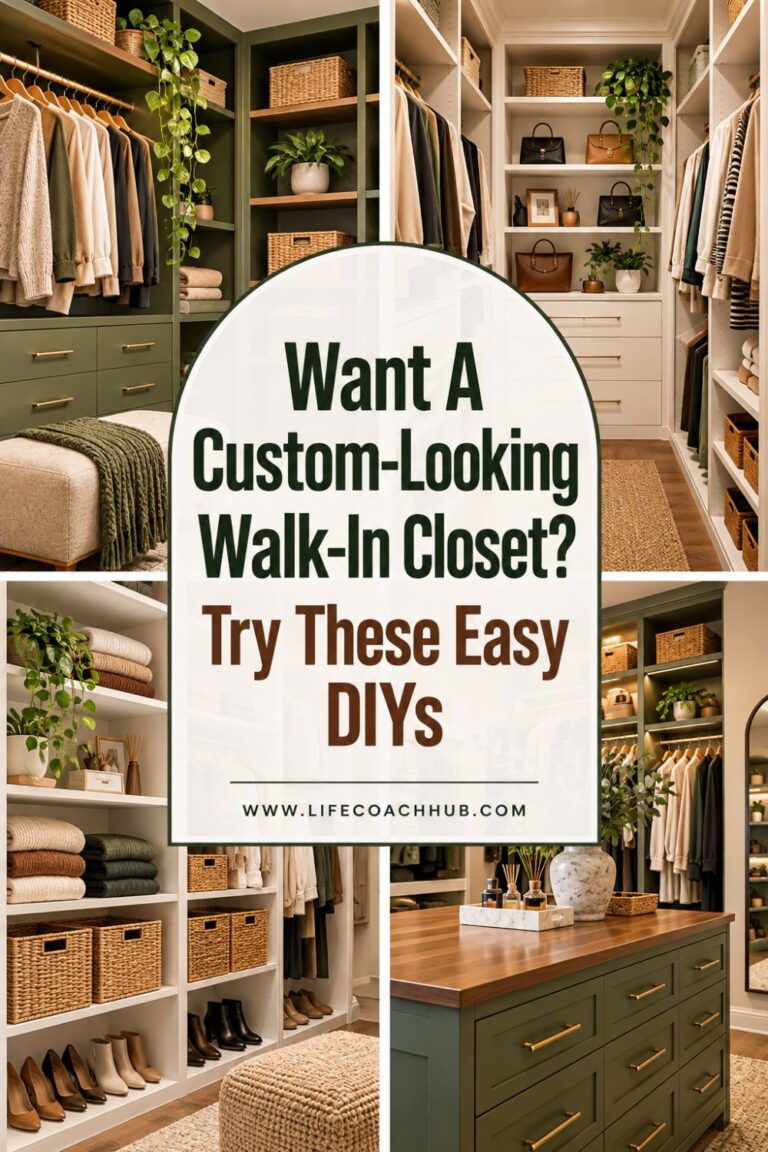


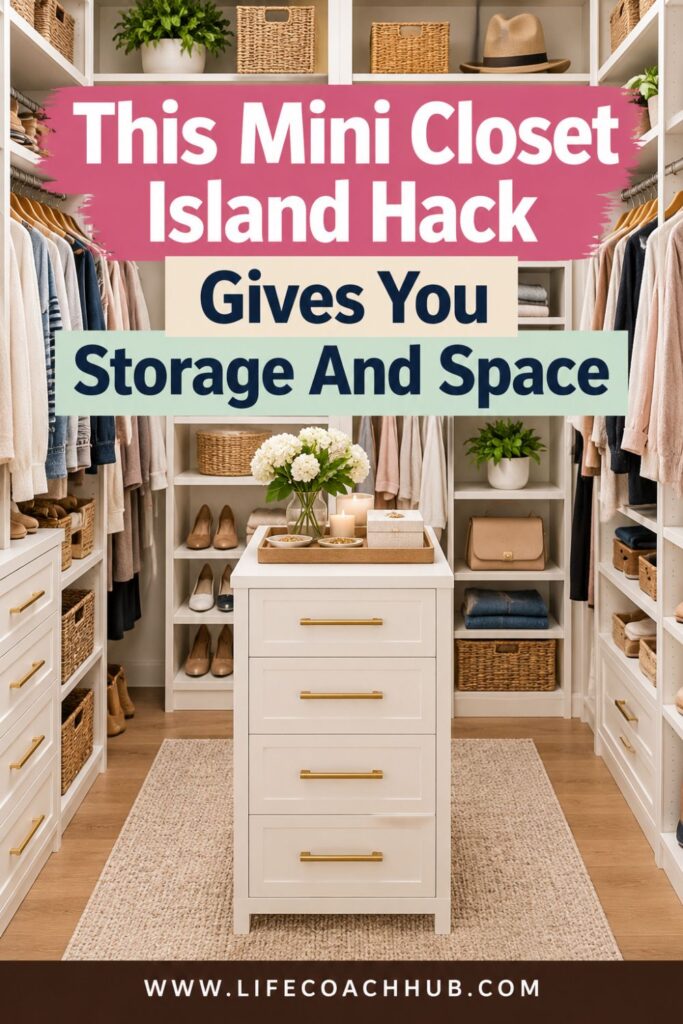
Closet Island Alternative Using a Slim Center Storage Unit
Are you all about style, decor and organization? Download a copy of our Clutter Reset Guide.
*****
Why You May Not Need a Full Closet Island
A closet island can make a walk-in closet feel polished and incredibly functional. It gives you drawers, a place to fold clothes, storage for accessories, and a convenient surface for setting down whatever you are wearing or putting away.
The problem is that traditional closet islands take up a surprising amount of floor space. Once you add enough room to walk around the island and open its drawers comfortably, many smaller walk-in closets simply cannot accommodate one.
A slim center storage unit can offer many of the same benefits without requiring a huge closet or a custom cabinetry budget. The trick is to stop thinking about recreating the exact appearance of an island and start thinking about recreating its functions.
Before shopping for anything, decide what you actually want a center unit to accomplish.
- List the functions you are missing: Think about whether you need drawers for small clothing, shelves for folded pieces, handbag storage, accessory organization, or simply a convenient surface for folding.
- Prioritize your biggest problems: If folded clothes constantly overflow from shelves, that problem matters more than creating a display area for jewelry.
- Separate needs from nice-to-haves: A beautiful countertop may look appealing, but practical drawer storage might improve your closet far more.
- Plan around the room you have: Your available walking space should determine the size of the unit, not the dimensions of a piece of furniture you happen to like.
This approach is especially useful in smaller walk-ins because every inch of floor space needs to earn its place. A narrow chest, compact shelving unit, or modular drawer system can provide valuable storage while still allowing the closet to feel open.
The result is not a scaled-down imitation of a luxury closet island. It is a more practical version designed around how you actually use your closet.
If you want to get more from your life, and are looking for concrete action steps to get you there, check out our Request a Coach page. It’s a “cut the fence-sitting and take action” way to tackle your issues and actually find success. To get off the fence and start to take action, click or tap here.
Need some in depth help with organization and productivity ? Drop on by our directories choc full of productivity coaches, minimalist coaches, and work/life balance coaches to get your life organized! Or click here to have us match you to the best.
1. Measure the Center Zone Before You Shop
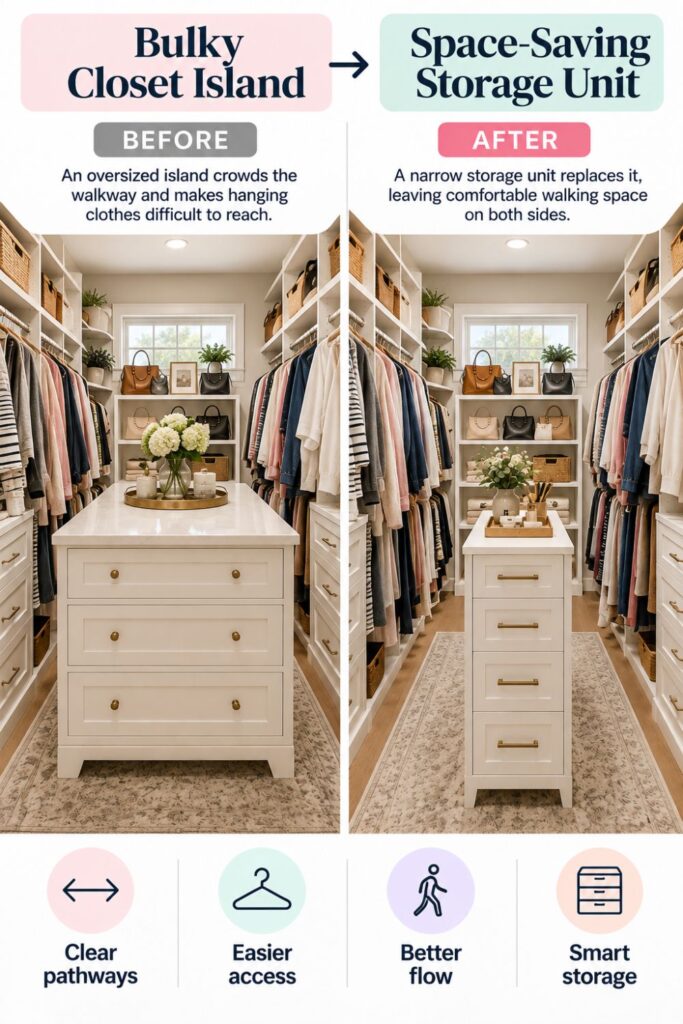
The biggest mistake you can make is buying a storage unit first and measuring the closet afterward. A piece can look wonderfully slim in a product photo but still make your walk-in closet frustrating to use once it is sitting between two walls of clothing.
Start by measuring the actual open floor space between your existing closet systems. Do not rely only on the overall dimensions of the room because shelves, hanging rods, dressers, and clothing all extend into that space.
Hanging clothes are particularly easy to underestimate. Shirts, jackets, and dresses may project considerably farther into the walkway than the rod itself.
- Measure between the real outer edges: Measure from the front of hanging clothes, shelving, drawers, or cabinets rather than from the wall behind them.
- Check your narrowest point: A closet may be wider in one area and tighter in another, so identify the smallest usable width along the proposed center zone.
- Test the footprint with tape: Mark the dimensions of a possible storage unit on the floor using painter’s tape. Walk around the outline several times and pretend you are getting dressed.
- Open everything nearby: Fully extend drawers, cabinet doors, hampers, shoe storage, and closet doors to make sure the new unit will not block them.
Spend a few minutes performing your normal routine inside the taped area. Reach for hanging clothes, bend down toward shoes, and imagine opening drawers in the proposed center unit.
You may discover that moving the unit a few inches changes everything. You might also realize that the storage piece needs to be narrower, shorter, or positioned slightly off-center.
This simple test can save you from buying a unit that technically fits but makes the closet feel cramped. The goal is not merely to squeeze furniture into the available space. It is to add storage while keeping the closet comfortable to move through every day.
2. Choose a Slim Unit That Gives You Island Function
Once you know how much space you can safely use, focus on finding a storage unit that performs the jobs you actually need. Width matters, but the internal layout matters just as much.
If you want to get more from your life, and are looking for concrete action steps to get you there, check out our Request a Coach page. It’s a “cut the fence-sitting and take action” way to tackle your issues and actually find success. To get off the fence and start to take action, click or tap here.
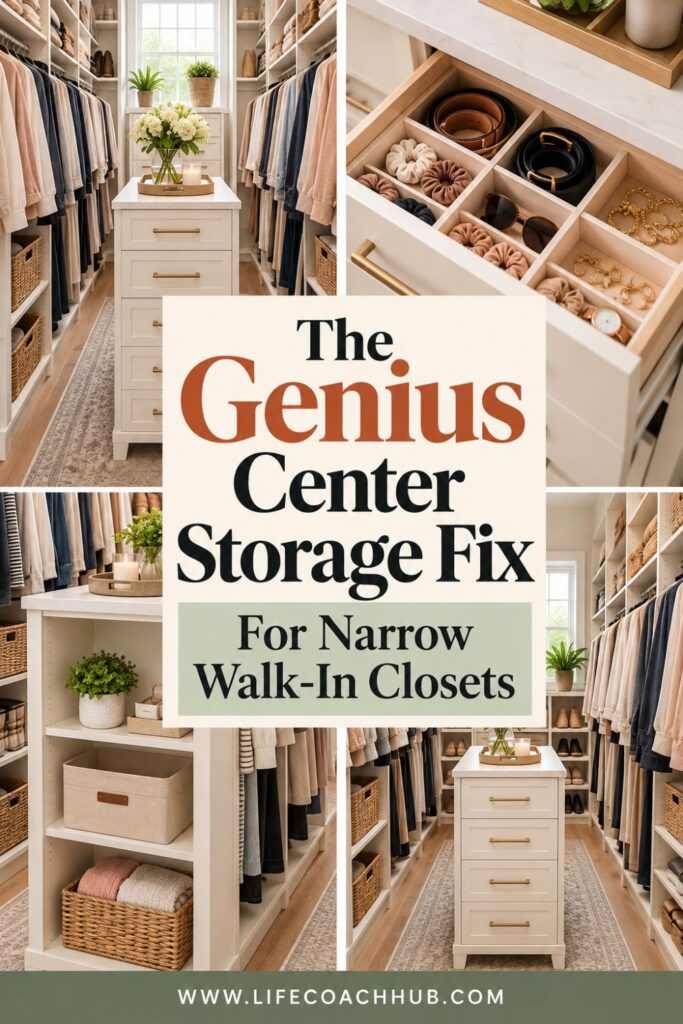
A narrow dresser is often one of the easiest alternatives because it provides concealed storage and a usable top surface. Modular drawer systems, slim cabinets, open cubby units, and small shelving pieces can also work well depending on what you want to store.
Think vertically whenever possible. A taller, narrower unit can often hold more than a short, wide cabinet while preserving valuable walking space.
- Choose drawers for smaller categories: Drawers work especially well for underwear, workout clothes, pajamas, scarves, belts, jewelry, and other items that easily become messy on open shelves.
- Choose shelves for visible storage: Open cubbies are useful for handbags, folded jeans, sweaters, baskets, and items you want to grab quickly.
- Combine storage types when possible: A unit with drawers below and open storage above or beside them can handle multiple categories without taking up additional floor space.
- Pay attention to the top surface: Make sure the top is large enough to fold a shirt, place a handbag, or set out accessories without being so deep that the unit overwhelms the room.
Height matters too. A comfortable top can become a useful staging area while you are getting dressed or putting laundry away.
Avoid choosing a piece simply because it looks similar to a traditional island. A decorative cabinet with poor internal storage may provide less value than a simple drawer unit that fits your routine perfectly.
Your ideal mini island is the smallest piece that solves the greatest number of storage problems. When every drawer, shelf, and inch of countertop has a clear purpose, a slim unit can be far more useful than a larger piece that wastes space.
3. Decide What Your Mini Island Needs to Do
Adding a new piece of storage does not automatically make a closet more organized. Without a plan, the new drawers and shelves can quickly become additional places to hide miscellaneous items.
Before filling the unit, decide exactly what jobs it will perform. Choose the categories that are currently creating the most friction in your closet.
For example, perhaps your sweaters are stacked too high, jewelry is scattered across several surfaces, and you have nowhere convenient to place tomorrow’s outfit. Those three problems can become the foundation of your center storage system.
If you want to get more from your life, and are looking for concrete action steps to get you there, check out our Request a Coach page. It’s a “cut the fence-sitting and take action” way to tackle your issues and actually find success. To get off the fence and start to take action, click or tap here.
- Choose your three main functions: Limit the unit to a few important jobs such as folded clothing, accessories, handbags, outfit preparation, or laundry supplies.
- Assign every drawer or shelf: Decide what belongs in each section before you start loading it. This prevents unrelated categories from drifting together.
- Put daily items within easiest reach: Use the top drawers and most accessible shelves for things you reach for frequently.
- Create one flexible holding zone: Reserve a small basket, tray, drawer, or cubby for items that need temporary attention.
That flexible zone can be surprisingly important. Without it, the top surface often becomes a collection point for clothing that needs to be returned, accessories you removed at the end of the day, or items you have not decided where to store.
Keep the categories broad enough that the system remains easy to maintain. A drawer labeled mentally as “everyday accessories” is often more practical than trying to create a separate compartment for every bracelet, belt, and pair of sunglasses.
The best closet systems reduce decisions. You should be able to put something away without stopping to wonder where it belongs.
Once the center unit has a clear job, it begins functioning like a true closet island. It becomes part of the room’s organization system rather than simply another piece of furniture placed in the middle.
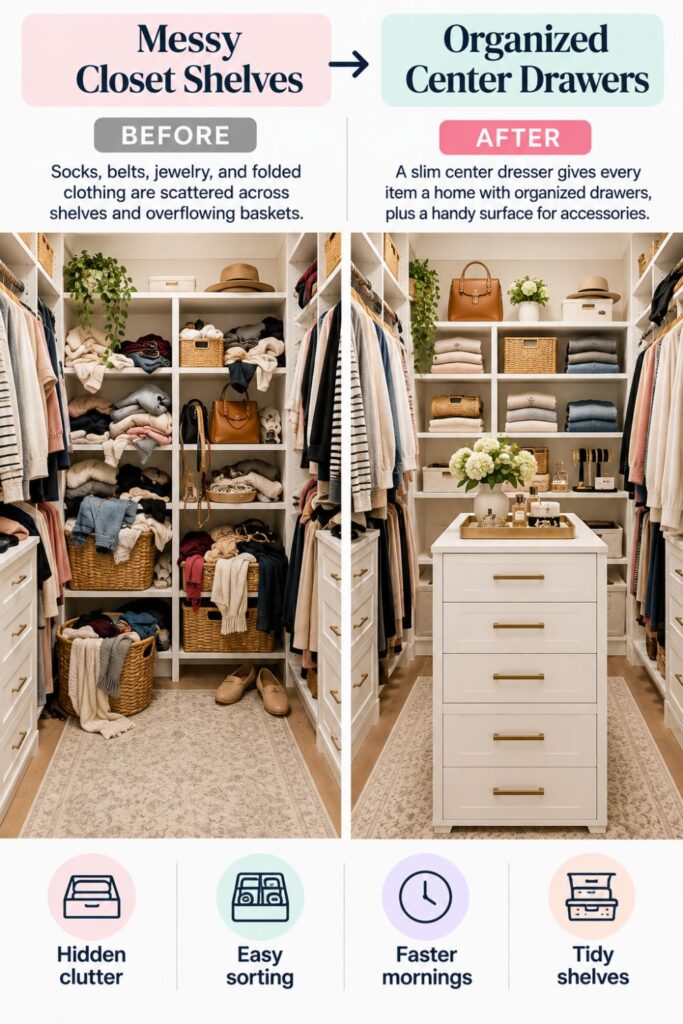
4. Create the Look Without Paying for Custom Cabinetry
A traditional built-in closet island can be expensive because you are paying for cabinetry, installation, hardware, finishing, and sometimes a custom countertop. A freestanding center unit lets you create a similar sense of structure using much simpler materials.
Start with ready-made furniture instead of assuming you need to build something from scratch. Narrow dressers, modular drawer units, cube storage, small utility cabinets, and unfinished wood pieces can all become useful closet storage.
The goal is to find a strong basic shape and then make a few thoughtful changes.
- Start with an affordable base: Look for a piece with the right dimensions and storage configuration before worrying about color or hardware.
- Replace simple hardware: Swapping knobs or drawer pulls can help an inexpensive unit coordinate with the closet around it.
- Upgrade the top if needed: A cut-to-size wood panel or other simple surface can create a more substantial folding and staging area.
- Repeat one existing finish: Match the closet’s wood tone, hardware finish, basket material, or cabinet color to make the unit feel intentional.
You do not need every finish to match perfectly. Repeating one or two elements is usually enough to visually connect the center piece to the rest of the room.
If you want to get more from your life, and are looking for concrete action steps to get you there, check out our Request a Coach page. It’s a “cut the fence-sitting and take action” way to tackle your issues and actually find success. To get off the fence and start to take action, click or tap here.
Keep the DIY work within your comfort level. Painting a unit, changing hardware, adding drawer organizers, or attaching a finished top are much easier projects than building custom cabinetry from the ground up.
This is where the slim-unit approach can make a major difference to the budget. You are spending money on storage capacity rather than complicated construction.
A simple piece can look surprisingly polished when the proportions are right and the surrounding closet is organized. Instead of trying to make the unit appear expensive, focus on making it look deliberate.
When the furniture fits the space, coordinates with nearby finishes, and clearly supports the closet’s organization, it will feel like part of the design rather than an afterthought.
5. Position the Unit So the Closet Still Feels Spacious
The natural instinct is to place a closet island directly in the center of the room. With a smaller walk-in closet, that is not always the best location.
Your center storage unit should support movement rather than creating a perfectly symmetrical layout. Sometimes shifting the piece several inches toward one side can dramatically improve the way the closet functions.
Test different positions before settling on the final location. Even if the unit technically fits in the middle, a slightly offset placement may give you better access to hanging clothes or drawers.
- Protect your busiest walkway: Keep the route from the closet entrance to the areas you use most often as open as possible.
- Check drawer access: Open every drawer completely and make sure you can stand in front of it comfortably.
- Watch hanging clothing: Leave enough room so coats, dresses, and shirts are not constantly brushing against the unit.
- Test several positions: Move the piece forward, backward, and slightly off-center before deciding where it works best.
Walk through an ordinary dressing routine while testing the placement. Imagine grabbing underwear, choosing clothes, reaching for shoes, opening accessory drawers, and returning items at the end of the day.
If you want to get more from your life, and are looking for concrete action steps to get you there, check out our Request a Coach page. It’s a “cut the fence-sitting and take action” way to tackle your issues and actually find success. To get off the fence and start to take action, click or tap here.
A layout that looks balanced from the doorway may feel awkward once you begin using it. Practical movement should win over perfect symmetry.
Once you have chosen the final position, make sure the unit is stable. Follow the manufacturer’s recommendations for leveling and anti-tip measures, especially if the piece is tall, narrow, or filled with heavy drawers.
You may also want to protect the flooring beneath the unit depending on the material and weight.
A successful mini island should make the closet feel more useful without making it feel significantly smaller. If you constantly have to turn sideways, move clothing out of the way, or close one drawer before reaching another area, the unit is probably too large or poorly positioned.
6. Organize the Slim Unit Like a Full Closet Island
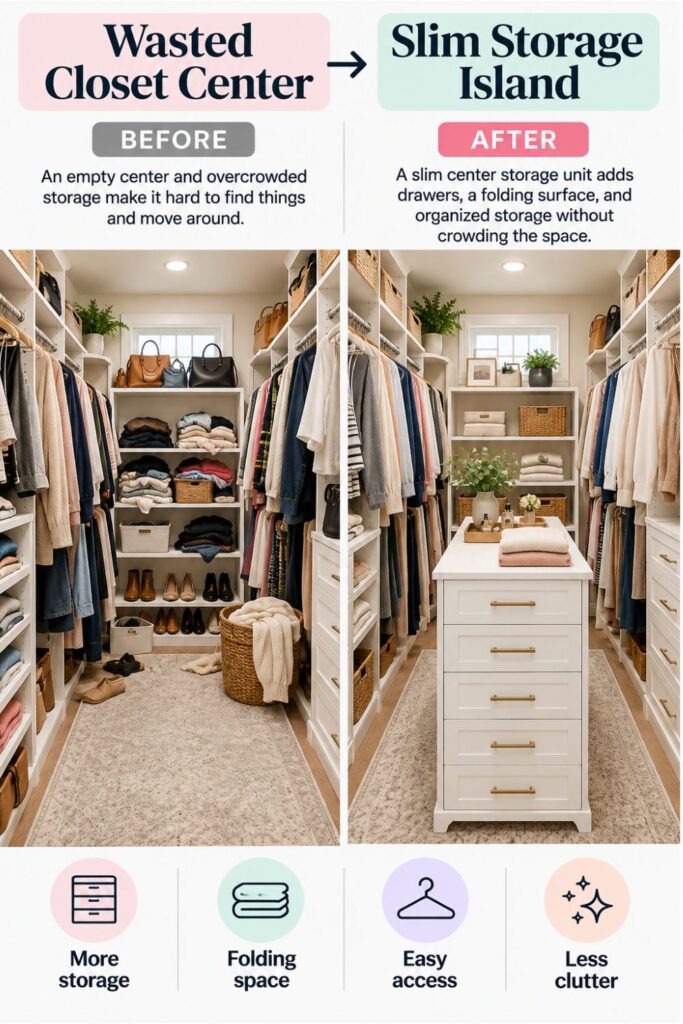
Once the storage unit is positioned, resist the urge to fill every available compartment immediately. A little planning will help you get much more function from a relatively small footprint.
Start with categories that benefit most from being centralized. These are often small accessories, folded clothing, and everyday items that tend to become scattered across shelves.
Shallow drawers are particularly useful because they prevent small pieces from disappearing underneath larger items.
- Use shallow drawers for accessories: Store jewelry, sunglasses, belts, scarves, watches, or smaller clothing in divided sections.
- Use deeper drawers for folded items: Jeans, leggings, sleepwear, workout clothes, and sweaters can be grouped by category.
- Use cubbies for structured items: Handbags, baskets, and neatly folded pieces often work better in open storage than in deep drawers.
- Keep the top mostly clear: Limit permanent countertop items so you still have room to fold clothes or assemble an outfit.
Drawer organizers can help, but you do not need to divide everything into tiny compartments. Too many sections can make the system fussy and difficult to maintain.
If you want to get more from your life, and are looking for concrete action steps to get you there, check out our Request a Coach page. It’s a “cut the fence-sitting and take action” way to tackle your issues and actually find success. To get off the fence and start to take action, click or tap here.
Think about visibility as well. If you forget about items once they are hidden, reserve drawers for predictable categories and keep less familiar pieces in open cubbies or clear organizers.
The countertop deserves its own rules. It is tempting to turn a new surface into a display area filled with perfume, jewelry trays, decor, and baskets.
A few useful items are fine, but leaving most of the surface empty gives the unit another practical function. You can fold laundry, set down a handbag, prepare clothes for the next morning, or temporarily place items while reorganizing a drawer.
That flexibility is one of the biggest advantages of a closet island. By protecting the surface instead of filling it, even a very slim unit can provide the same everyday convenience.
7. Make a Narrow or Awkward Walk-In Work Even Better
Some walk-in closets are too narrow, uneven, or oddly shaped for anything resembling a traditional center island. That does not automatically mean you need to abandon the idea.
Instead, treat the layout as a puzzle. The best solution may involve shifting, rotating, or scaling down the center storage rather than trying to force a perfectly centered cabinet into the room.
An off-center arrangement can be especially useful when one wall has deeper hanging storage than the other. Moving the unit closer to the shallower side may create a much more comfortable walkway.
- Try an off-center layout: Shift the unit toward the side with less projecting storage to create more clearance where clothes hang farther into the room.
- Rotate the unit: A narrow cabinet may work better lengthwise than crosswise, or vice versa.
- Use one-sided storage: If drawer clearance is tight, choose a piece with drawers or doors only on the side that has the most open space.
- Consider a movable option: A slim cart or suitable furniture piece with locking casters can provide temporary storage without permanently occupying the center.
You can also reduce the number of functions the unit performs. A very narrow walk-in might not support a large drawer system, but it may have room for a compact shelf with a folding surface and a few baskets.
If you want to get more from your life, and are looking for concrete action steps to get you there, check out our Request a Coach page. It’s a “cut the fence-sitting and take action” way to tackle your issues and actually find success. To get off the fence and start to take action, click or tap here.
Do not measure success by how much furniture you manage to fit into the room. The closet still needs breathing room.
Sometimes removing two or three inches from the width of a proposed unit gives you a noticeably more comfortable space. That small loss of storage can be worth it if the closet becomes easier to navigate every morning.
The point of the project is to gain the benefits of an island without inheriting its biggest disadvantage. If your slim center unit makes the closet frustrating to walk through, it is no longer solving the right problem.
8. How an Organization Coach Could Help You Design the Right Setup
Furniture is only part of closet organization. If your current closet repeatedly becomes messy even after reorganizing it, the deeper issue may be the system rather than the amount of storage.
An organization coach can help you look at how the space is actually being used. Instead of starting with bins, drawers, or furniture, the process starts with identifying where your routine breaks down.
Perhaps clean laundry sits in baskets because folded clothing has no easy home. Maybe accessories pile up on shelves because putting them away requires opening several containers.
- Identify the real friction point: Look for the moments when items stop moving smoothly through your routine.
- Match storage to your behavior: Put frequently used items where you naturally reach for them instead of where they look most attractive.
- Reduce unnecessary categories: Combine overly specific groups when a simpler system would make putting things away faster.
- Create a reset routine: Decide how temporary clothes, accessories, returns, and laundry will be handled before they turn into clutter.
A coach can also help you decide whether you genuinely need more storage. Sometimes a closet feels too small because the space is being asked to hold categories that are rarely used or because the current layout wastes valuable areas.
That matters before adding a center unit. A new cabinet should solve an identified problem, not simply provide additional places for belongings to accumulate.
If you want to get more from your life, and are looking for concrete action steps to get you there, check out our Request a Coach page. It’s a “cut the fence-sitting and take action” way to tackle your issues and actually find success. To get off the fence and start to take action, click or tap here.
You can use the same coaching approach on your own by paying attention to what happens during an ordinary week. Notice where clothes land when you are rushed, which drawers are difficult to maintain, and which shelves you avoid using.
Those observations tell you far more than a perfectly styled closet photograph.
When the center unit is designed around your real habits, keeping the closet organized becomes easier. The goal is not to create a system that looks perfect immediately after a makeover. It is to create one that still works on a busy Tuesday morning.
Get the Island Function Without the Island Footprint
A closet island does not have to be a large built-in cabinet surrounded by an oversized walk-in. If what you really want is extra storage, a folding surface, and a more organized center zone, a slim freestanding unit can provide much of the same function.
The key is choosing the piece only after you understand the room. Measure the actual walking area, account for hanging clothes, test the footprint, and make sure nearby drawers and doors can still operate comfortably.
Then build the storage around your habits.
- Measure before buying: Let the available clearance determine the maximum dimensions of the unit.
- Choose functions before features: Decide which storage problems the unit needs to solve before comparing furniture.
- Protect your walking space: A slightly smaller unit is usually better than one that makes the closet difficult to navigate.
- Keep the system adaptable: Freestanding furniture allows you to change the layout later without committing to expensive cabinetry.
You also do not need to recreate every feature of a traditional island. A narrow drawer chest might solve everything. Another closet may work better with a small cubby unit topped with a simple wood surface.
The right answer depends on how you dress, what you store, and where your existing closet currently falls short.
If you want to get more from your life, and are looking for concrete action steps to get you there, check out our Request a Coach page. It’s a “cut the fence-sitting and take action” way to tackle your issues and actually find success. To get off the fence and start to take action, click or tap here.
That is what makes this approach so useful for smaller walk-ins. Instead of designing the closet around an idealized piece of furniture, you design the furniture around the room you actually have.
You can still gain a convenient place for folded clothes, accessories, handbags, and outfit preparation without sacrificing most of the center floor.
A slim center storage unit may not look exactly like a custom island, but when it fits properly and supports your daily routine, it can deliver the part that matters most: a closet that works better every time you use it.
*****
Are you all about style, decor and organization? Download a copy of our Clutter Reset Guide.
Need some in depth help with organization and productivity ? Drop on by our directories choc full of productivity coaches, minimalist coaches, and work/life balance coaches to get your life organized! Or click here to have us match you to the best.
If you want to get more from your life, and are looking for concrete action steps to get you there, check out our Request a Coach page. It’s a “cut the fence-sitting and take action” way to tackle your issues and actually find success. To get off the fence and start to take action, click or tap here.
Read this next
Why Your Vision Board Aesthetic Matters More Than You Think
A vision board that looks good but fades fast needs this simple aesthetic fix. See why calm design keeps your goals impossible to ignore.
Read More
A Practical Way to Use Vision Boards for Manifestation
Use your vision board in a smarter, more practical way so manifestation feels clearer, calmer, and easier to follow every day.
Read More
How to Decorate for Christmas Based on Your Aesthetic: The Luxury Lover, Modern Minimalist, Vintage Soul & Boho Dreamer
Are you all about style, decor and organization? Download a copy of our Decluttering Workbook. **** Your Christmas decor says more about you than any trend ever could. It’s not […]
Read More