


Talk to a coach about Organizational coaching

Crystal Faulk
ACC
I help overwhelmed women in transition gain clarity, confidence, and...

Terrie Hein
Certified Life Coach, Certified Insight Coach Practitioner
Coaching to declutter your life, organize your goals, and cook...

Dr Charlene Ashley
Doctorate - Behaviours
I coach individuals to design fulfilling lives through structure, clarity,...

Paloma Chiara

Lana's Gymnastics Club
"Where the best in gymnastics meets fun. Where every child is a star"
lgclubny.com

Anna Sosnina
ICF (ACC)
ICF ACC certified coach, founder of EssorVie Coaching, passionate about...

Tyler Fink
B.A. in Religion, Anthropology, and Philosophy. Master of Divinity (M.Div.) in Missiology
Pastor, husband, and father helping Christian men pursue faithful growth...

Travis Brown
Professional Life coach
With experience in guiding clients to achieve goals, build confidence,...




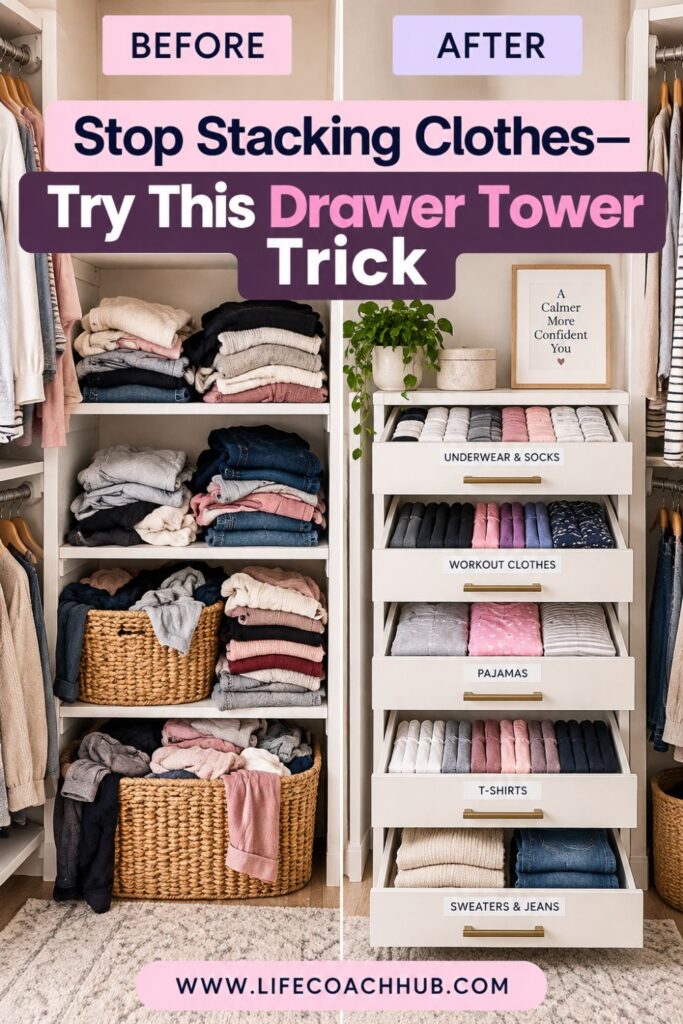
Drawer Tower Insert for Folded Clothes and Accessories
Are you all about style, decor and organization? Download a copy of our Clutter Reset Guide.
*****
Walk-in closets often give you plenty of hanging space but surprisingly little practical storage for everything that should not hang. Underwear, socks, workout clothes, pajamas, scarves, belts, and folded basics can easily end up piled on shelves or scattered between baskets and bedroom drawers.
A drawer tower solves that problem by turning one vertical section of the closet into compact, enclosed storage. Instead of renovating the entire closet or installing custom cabinetry, you can add a ready-made or modular drawer unit that feels much more intentional than a collection of bins.
The trick is choosing the right spot and giving the tower a specific job before you install it. Simply adding drawers will not automatically make the closet easier to use. The drawers need to fit the available space, open comfortably, and hold categories that make sense for your daily routine.
Start by looking at what currently causes the most frustration.
- Find the unstable piles: Notice folded clothing that constantly tips over or gets buried underneath other items.
- Look for overflowing baskets: Check whether socks, underwear, accessories, or workout clothes are packed into containers that are difficult to sort through.
- Notice what lives outside the closet: If you still need a bedroom dresser because the closet lacks drawers, a tower may allow you to move more clothing into one dressing area.
- Identify unused vertical space: Look for a narrow section that has plenty of height but is not being used efficiently.
The best drawer tower does more than add storage. It creates clearly defined homes for the small and folded items that tend to make closets feel messy.
Once every category has a logical place, getting dressed becomes easier and putting clean laundry away requires less thought. That is what makes this type of closet upgrade worth the extra planning.
If you want to get more from your life, and are looking for concrete action steps to get you there, check out our Request a Coach page. It’s a “cut the fence-sitting and take action” way to tackle your issues and actually find success. To get off the fence and start to take action, click or tap here.
Need some in depth help with organization and productivity ? Drop on by our directories choc full of productivity coaches, minimalist coaches, and work/life balance coaches to get your life organized! Or click here to have us match you to the best.
1. Measure the Closet Before You Shop for a Tower
The most important part of this project happens before you buy anything. A drawer tower can look perfect online and still be frustrating to use if it is slightly too deep, too wide, or positioned where the drawers cannot fully open.
Start by measuring the exact section where you think the tower will go. Do not rely on one measurement taken at eye level because closet walls, floors, shelving, and baseboards are not always perfectly straight.
- Measure the width in three places: Check near the floor, around the middle, and near the top of the proposed tower.
- Measure the usable height: Start at the finished floor and measure to the lowest shelf, rod, ceiling slope, or other obstruction.
- Check the depth carefully: Measure to the shallowest point, especially if there are baseboards, trim, outlets, vents, or closet-system supports.
- Measure the space in front: Make sure you have enough room to stand comfortably while a drawer is fully extended.
Turn those numbers into a maximum footprint before you shop. For example, you may discover that your opening is 25 inches wide, but a 24-inch tower would leave almost no margin for uneven walls or installation adjustments. Choosing something slightly narrower could make the project much easier.
Also consider nearby hanging clothes. Long sleeves, dresses, or jackets can interfere with drawers even when the tower itself technically fits.
Try marking the proposed footprint on the floor with painter’s tape. Then stand in front of it and imagine opening each drawer.
If possible, hold a tape measure out to approximate how far the drawer will extend. This simple test can reveal whether the tower would block a walkway, hit an island, collide with another closet wall, or make the space feel cramped.
Good measurements give you something more valuable than a perfect fit. They give you confidence about what not to buy, which can save you from forcing the wrong storage piece into the closet.
If you want to get more from your life, and are looking for concrete action steps to get you there, check out our Request a Coach page. It’s a “cut the fence-sitting and take action” way to tackle your issues and actually find success. To get off the fence and start to take action, click or tap here.
2. Choose the Right Drawer Tower Configuration
Once you know your maximum dimensions, focus on how the tower will actually function. The tallest or largest unit is not automatically the best choice.
Think about what you want the drawers to hold. Underwear and accessories usually work well in shallow drawers, while pajamas, sweaters, jeans, and workout clothes may require deeper ones.
A tower with several identical drawers can still work, but varied drawer sizes can make organization easier if your wardrobe includes both tiny accessories and bulkier folded clothing.
Use your intended categories to guide the decision.
- Choose shallow drawers for small items: Underwear, socks, belts, scarves, jewelry pouches, and hosiery need less vertical space.
- Choose medium drawers for everyday clothing: T-shirts, leggings, workout tops, shorts, and pajamas usually fit comfortably here.
- Reserve deeper drawers for bulky items: Sweaters, jeans, sweatshirts, or thicker lounge clothes need more room.
- Think about reach: The highest drawers should still be comfortable to open and see inside.
Construction matters too. Check whether the unit is freestanding, modular, or designed to attach to an existing closet system.
If the tower must be secured to the wall, look at where the studs, trim, and existing closet hardware are located. Always follow the manufacturer’s installation and anti-tip instructions rather than improvising attachment points.
Appearance can also help the addition feel intentional. A white drawer tower inside a white closet system will usually blend in more easily than a completely different finish. Matching is not essential, but coordinating the tower with existing shelves, hardware, or cabinetry can make a simple upgrade feel more polished.
Finally, resist the temptation to buy extra capacity just because it fits. An oversized tower may consume hanging space that you still need.
If you want to get more from your life, and are looking for concrete action steps to get you there, check out our Request a Coach page. It’s a “cut the fence-sitting and take action” way to tackle your issues and actually find success. To get off the fence and start to take action, click or tap here.
The goal is not to fill every available inch. The goal is to add the type of storage your closet is currently missing while keeping the rest of the closet functional.
3. Clear and Prep the Installation Zone
Installing a drawer tower is much easier when the surrounding area is completely empty. Trying to work around hanging clothes, baskets, shoes, and miscellaneous closet items can turn a manageable project into a frustrating one.
Remove everything from the section where the tower will sit. If nearby clothing hangs close to the installation zone, move that temporarily as well.
This gives you room to inspect the space instead of simply covering the existing problems with a new storage unit.
Use the empty area to check for anything that could interfere with installation.
- Inspect the baseboards: A tower may sit farther away from the wall than expected if the baseboard is thick.
- Check outlets and vents: Make sure you will not block anything that needs to remain accessible.
- Look at existing shelving supports: Brackets, cleats, and rails can reduce the usable width or depth.
- Check the floor: Uneven flooring can affect how the tower sits and how smoothly the drawers operate.
- Clean the space: Vacuum corners and wipe walls and trim while they are easy to reach.
If part of the existing closet system needs to be removed, do only what is necessary. A low shelf or short rod may be worth relocating if it creates the right opening, but there is no reason to dismantle useful storage that can remain.
Next, mark the tower’s approximate footprint with painter’s tape. This lets you see how much floor space the unit will claim before anything becomes permanent.
Stand where you would normally stand while getting dressed. Imagine the drawers opening toward you.
If you want to get more from your life, and are looking for concrete action steps to get you there, check out our Request a Coach page. It’s a “cut the fence-sitting and take action” way to tackle your issues and actually find success. To get off the fence and start to take action, click or tap here.
Check whether the tower crowds an adjacent hanging section or makes it harder to reach another part of the closet. This is also a good time to notice whether long garments will brush against the drawer fronts.
A little preparation can prevent a lot of rework. Once the space is empty, clean, measured, and tested, the actual installation becomes much more straightforward.
4. Assemble and Position the Drawer Tower
The easiest way to assemble a drawer tower depends on the size of the closet. If there is enough open floor space nearby, building the main frame outside the installation zone is often more comfortable.
Follow the manufacturer’s instructions carefully, especially when assembling drawer slides or structural components. A tower that is slightly out of square can cause drawers to rub, drift open, or refuse to close properly.
If the unit is large, consider leaving the drawers out while moving the frame into the closet. The lighter frame will be easier to maneuver and less likely to damage walls or trim.
Once the tower is in position, check the basics before loading anything.
- Center or align the unit: Position it according to your planned footprint.
- Check the level: Test from side to side and front to back.
- Adjust for baseboards: Use approved feet, spacers, or installation hardware if the unit requires clearance behind it.
- Secure the tower properly: Follow all manufacturer recommendations for anti-tip or wall attachment.
- Install and test the drawers: Open each one fully several times.
Do not skip the drawer test. A unit can appear to fit beautifully while one drawer catches on a nearby wall, closet door, basket, or hanging garment.
Stand directly in front of the tower while the lowest and highest drawers are open. Make sure each position is comfortable to use.
If you want to get more from your life, and are looking for concrete action steps to get you there, check out our Request a Coach page. It’s a “cut the fence-sitting and take action” way to tackle your issues and actually find success. To get off the fence and start to take action, click or tap here.
If the tower sits beside hanging clothes, put a few representative garments back on the rod temporarily. Check whether sleeves, hems, or jackets fall across the drawer fronts.
This is also the right time to adjust the unit’s position by an inch or two if necessary. Small changes are much easier before the drawers are full.
When everything works properly, tighten the remaining hardware and finish any required wall attachment.
The goal is for the tower to feel like a stable part of the closet, not a temporary piece of furniture squeezed into an empty corner. Careful positioning and leveling will make the drawers easier to use every single day.
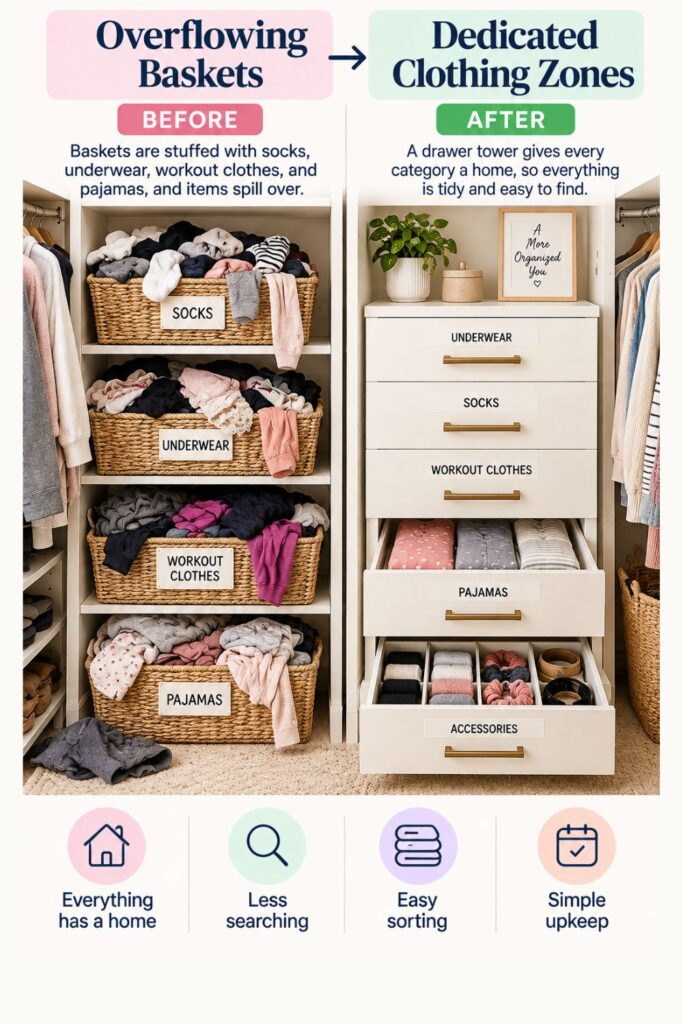
5. Turn the Drawers Into Clothing Zones
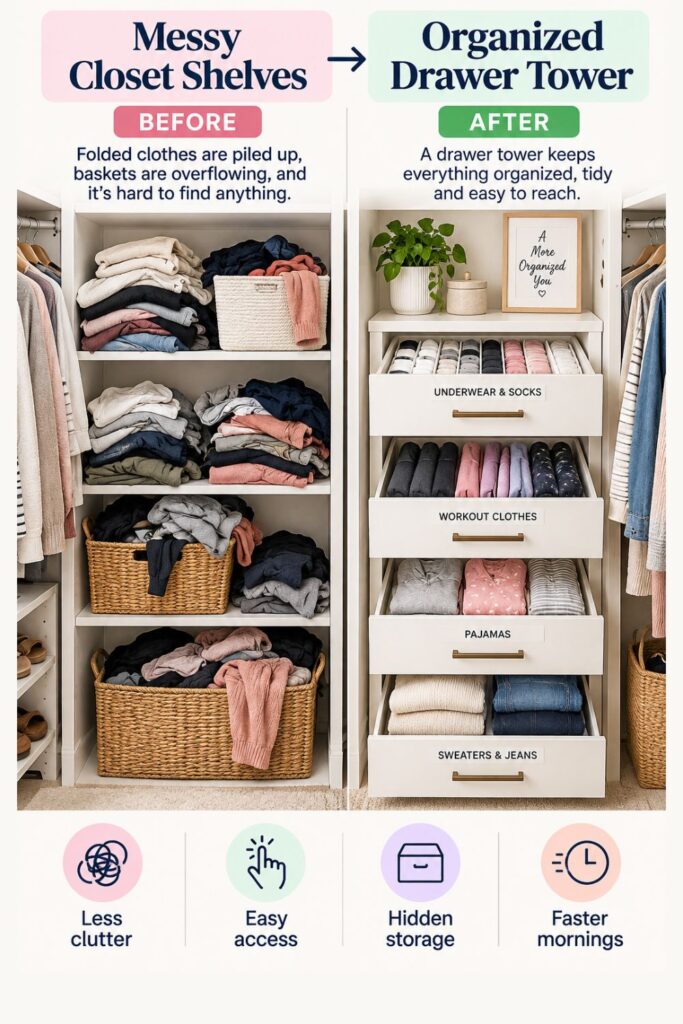
An empty drawer tower feels wonderfully spacious, which makes it tempting to start filling drawers immediately. Resist that urge.
Before putting anything inside, decide what each drawer is responsible for. Defined zones prevent the tower from becoming a collection of miscellaneous storage spaces.
Start with the categories you use most often. Everyday underwear, socks, T-shirts, pajamas, workout clothes, or other frequently worn items deserve the easiest positions to reach.
The most accessible drawers are usually somewhere between hip and chest height. Put your highest-use categories there.
If you want to get more from your life, and are looking for concrete action steps to get you there, check out our Request a Coach page. It’s a “cut the fence-sitting and take action” way to tackle your issues and actually find success. To get off the fence and start to take action, click or tap here.
Use the less convenient drawers more strategically.
- Upper drawers: Good for lightweight items you use less frequently.
- Middle drawers: Best for everyday clothing and basics.
- Lower drawers: Useful for heavier items such as jeans, lounge clothes, or workout gear.
- Very low drawers: Consider seasonal clothing or categories you do not need every day.
Avoid broad categories such as “miscellaneous clothes.” A category that is too vague will eventually attract unrelated items.
Instead, use clear assignments such as socks, underwear, workout tops, leggings, pajamas, scarves, or casual T-shirts.
You also do not need to fill every drawer immediately. Leaving part of the tower open gives you room to see how the system works in real life.
As you move clothing into the tower, remove those categories from their old storage locations. If socks now live in a dedicated drawer, do not keep an overflow basket of socks on a shelf unless there is a specific reason.
This is where the drawer tower begins changing the rest of the closet. Shelf piles become smaller, baskets disappear, and hanging space may open up.
The goal is not simply to relocate clutter into drawers. Each drawer should make a category easier to find, easier to put away, and easier to keep under control.
When those three things happen, the new storage starts earning its space.
If you want to get more from your life, and are looking for concrete action steps to get you there, check out our Request a Coach page. It’s a “cut the fence-sitting and take action” way to tackle your issues and actually find success. To get off the fence and start to take action, click or tap here.
6. Fold Clothes So You Can See the Whole Drawer
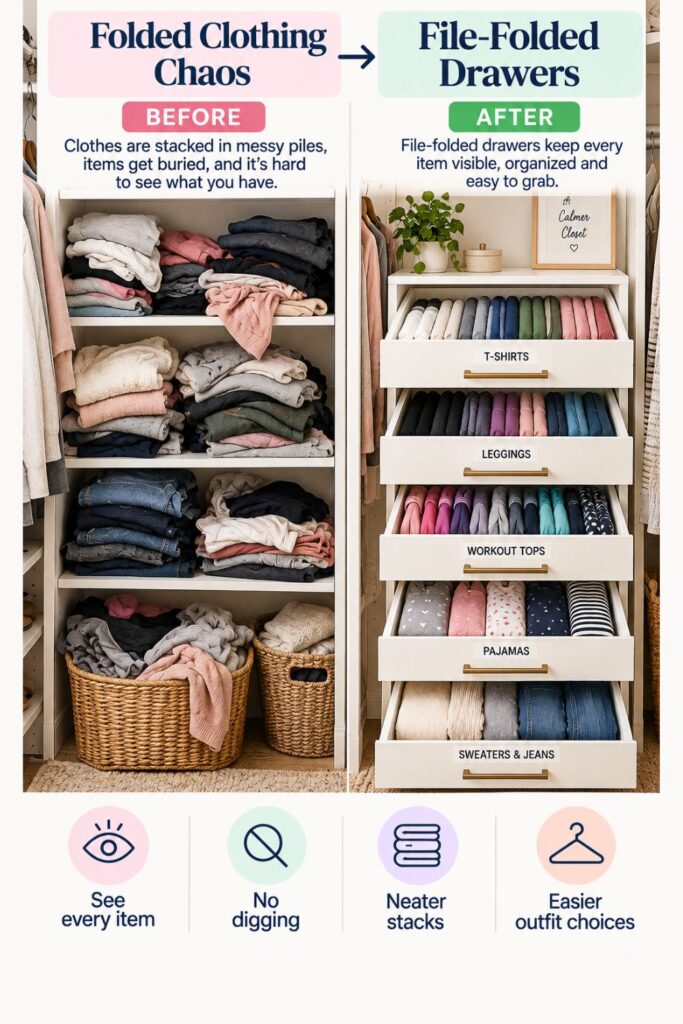
Drawer storage works best when you can see most of what you own without digging through layers. If you simply move tall folded piles from a shelf into a drawer, you may recreate the same problem in a different place.
Start by choosing a folding method you can repeat easily. The fold does not need to look perfect.
Consistency matters more than precision. Similar items should end up approximately the same width and height so they fit together naturally.
For many clothing categories, vertical or file-style folding works particularly well.
- T-shirts: Fold them into compact rectangles that can stand in rows.
- Leggings: Fold or roll them into similarly sized pieces.
- Pajamas: Keep matching sets together whenever possible.
- Workout clothes: Create separate rows for tops and bottoms.
- Shorts: Fold them so waistbands remain visible.
The advantage of vertical storage is visibility. Instead of removing three shirts to reach the one underneath, you can see several options at once.
Do not force every category into this method, though. Thick sweaters, heavy jeans, or bulky sweatshirts may be easier to store flat in a deep drawer or somewhere else in the closet.
The storage should adapt to your clothing, not the other way around.
As you fill each drawer, leave enough room to move items slightly. A drawer packed so tightly that everything springs upward when one shirt is removed will be difficult to maintain.
If you want to get more from your life, and are looking for concrete action steps to get you there, check out our Request a Coach page. It’s a “cut the fence-sitting and take action” way to tackle your issues and actually find success. To get off the fence and start to take action, click or tap here.
Pay attention to how full the drawer becomes after laundry day. If clean clothes repeatedly will not fit, the problem may not be your folding technique.
The category may need a larger drawer, fewer items, or a different storage location.
The best folding system is the one that lets you quickly answer two questions: What do I own, and where does this item go when I am finished with it?
If your drawer layout makes both answers obvious, the system is working.
7. Give Underwear and Small Accessories Their Own Micro-Zones
Large drawers can be surprisingly inefficient for small items. Socks, underwear, scarves, belts, and other accessories tend to slide together and create a mixed layer of clutter.
This is where smaller internal zones become useful.
Drawer dividers, shallow boxes, or modular organizers can create separate compartments without permanently changing the tower. Choose simple organizers that fit the drawer rather than trying to fill every inch with tiny containers.
Start with categories that naturally belong together.
If you want to get more from your life, and are looking for concrete action steps to get you there, check out our Request a Coach page. It’s a “cut the fence-sitting and take action” way to tackle your issues and actually find success. To get off the fence and start to take action, click or tap here.
- Separate underwear by type: Everyday underwear, specialty pieces, and bras may each need their own section.
- Divide socks by use: Everyday socks, workout socks, tights, and specialty pairs can be kept apart.
- Group belts together: Fold or roll them into one defined area.
- Create a scarf section: Keep smaller scarves visible instead of stacking them underneath clothing.
- Reserve a small accessory compartment: Use it for items that would otherwise disappear inside a large drawer.
Put frequently used items toward the front. Less-used accessories can sit toward the back because you will not need to move them every morning.
Be careful not to create too many compartments. An extremely detailed system can look beautiful on the first day and become exhausting after the first laundry cycle.
You want enough structure to keep categories from mixing, but not so much structure that putting items away feels like solving a puzzle.
Give the layout a week or two before buying more organizers. You may discover that one compartment is too small or that two categories naturally belong together.
That adjustment period is useful.
A successful micro-zone should make the drawer easier to scan and easier to reset. When you open the drawer, you should immediately understand where everything belongs.
That simple visual clarity is what prevents small items from gradually spreading across the entire drawer again.
8. Make the Tower Look Built Into the Closet
A ready-made drawer tower does not have to look like a piece of bedroom furniture accidentally placed inside a walk-in closet. A few small decisions can help it feel much more integrated.
If you want to get more from your life, and are looking for concrete action steps to get you there, check out our Request a Coach page. It’s a “cut the fence-sitting and take action” way to tackle your issues and actually find success. To get off the fence and start to take action, click or tap here.
Start with alignment. If possible, position the tower so its top or sides relate visually to the shelving around it.
You do not need perfect symmetry. The goal is simply to make the unit look deliberately placed.
Keep the area around the tower relatively clean.
- Avoid crowding the sides: Give hanging clothes enough room so they do not constantly brush the drawer fronts.
- Keep the top intentional: If the tower has a usable top surface, assign it one purpose rather than allowing random items to collect there.
- Coordinate finishes: Similar wood tones, white finishes, or matching hardware can help different closet pieces feel connected.
- Remove temporary storage: Do not leave leftover bins or baskets stacked beside the new tower simply because they were there before.
- Keep visible categories tidy: The tower will look more built in when the surrounding rods and shelves also feel organized.
If the drawer hardware can easily be changed, coordinating the pulls with nearby closet hardware may also help. This is optional and should only be done if it is compatible with the unit.
You can also use the tower to create a visual dividing point between closet zones. For example, hanging work clothes might sit on one side while casual items sit on the other.
That makes the tower useful structurally as well as aesthetically.
Do not feel pressure to add decorative accessories simply to make the closet look finished. This is primarily a storage project.
A few thoughtful alignments and a clean surrounding area will usually make a bigger difference than extra decor.
If you want to get more from your life, and are looking for concrete action steps to get you there, check out our Request a Coach page. It’s a “cut the fence-sitting and take action” way to tackle your issues and actually find success. To get off the fence and start to take action, click or tap here.
Once the tower is installed and filled, step back and look at the entire closet rather than only the drawers.
The unit should appear to belong to a larger system. When the surrounding categories, finishes, and proportions work together, even a relatively simple modular tower can give the closet a much more custom feel.
9. Rework the Rest of the Closet Around the New Tower
Adding drawers changes more than the section where the tower sits. It gives you an opportunity to rethink the surrounding closet storage.
Do not automatically return everything else to its old position.
Start by looking at the categories that moved into the drawers. Their previous shelves, baskets, or hanging sections may now be empty or partially empty.
Use that newly available space intentionally.
- Remove unnecessary bins: If underwear or accessories now have proper drawers, you may no longer need the baskets that held them.
- Reduce shelf piles: Move foldable basics into drawers so open shelving can hold items that are easier to store there.
- Free crowded rods: Consider folding casual clothing that does not truly need to hang.
- Create a shoe zone: Newly open floor or shelf space may work better for footwear.
- Give seasonal items a clearer home: Higher shelves can now hold less frequently used clothing instead of everyday basics.
Think about your normal dressing routine while making these decisions.
If you usually put on underwear, a top, jeans, and accessories in that order, keeping those categories reasonably close can make the closet easier to use.
If you want to get more from your life, and are looking for concrete action steps to get you there, check out our Request a Coach page. It’s a “cut the fence-sitting and take action” way to tackle your issues and actually find success. To get off the fence and start to take action, click or tap here.
You do not need to create a perfectly optimized route through the closet. The point is simply to reduce unnecessary searching and backtracking.
This is also the moment to remove duplicate storage products. Empty containers often get refilled simply because they exist.
If the drawer tower eliminates the need for three old baskets, take those baskets out of the closet rather than finding random things to put inside them.
Walk through the finished layout once everything has been redistributed.
Open the drawers. Reach for hanging clothes. Grab shoes and accessories.
Notice whether one area feels crowded or awkward.
A successful drawer tower should make the entire closet easier to use, not just create one beautifully organized column of storage.
The biggest improvement often comes from what the tower allows you to remove, simplify, and redistribute elsewhere.
If you want to get more from your life, and are looking for concrete action steps to get you there, check out our Request a Coach page. It’s a “cut the fence-sitting and take action” way to tackle your issues and actually find success. To get off the fence and start to take action, click or tap here.
10. Build a Five-Minute Drawer Reset Into the System
Even a carefully organized drawer tower can become messy over time. The difference between a system that lasts and one that falls apart is usually maintenance.
Fortunately, drawer maintenance does not need to become another major cleaning project.
Create a simple rule: each category returns to its assigned drawer after laundry. Avoid using whichever drawer happens to have space because that quickly weakens the structure you created.
Then use very small resets rather than waiting for the whole tower to become disorganized.
- Straighten one drawer at a time: If the sock drawer looks messy, fix the sock drawer.
- Refold only what needs attention: There is no reason to redo clothing that is already organized.
- Return migrating items: Move anything that landed in the wrong drawer back to its proper zone.
- Check dividers: Adjust organizers that have shifted or stopped serving their original purpose.
- Notice overflow: Repeatedly packed drawers are useful information.
Laundry day is one of the best times to evaluate the system because every category is close to its maximum volume.
If you cannot comfortably put clean clothing away, do not simply push harder.
Ask why the drawer is overflowing.
Perhaps too many categories share the same space. Maybe the category has grown. You might also be keeping pieces that you rarely wear.
If you want to get more from your life, and are looking for concrete action steps to get you there, check out our Request a Coach page. It’s a “cut the fence-sitting and take action” way to tackle your issues and actually find success. To get off the fence and start to take action, click or tap here.
Small adjustments made early are easier than a complete closet overhaul later.
Try spending five minutes once a week straightening any drawer that needs it. You may not even need the full five minutes.
The goal is to keep the tower functioning with minimal effort.
Leaving some breathing room helps enormously. A drawer filled to 100 percent capacity has no tolerance for laundry, new purchases, or imperfect folding.
A drawer that remains slightly open in its capacity is much easier to maintain.
The best closet system is not one that never gets messy. It is one that can be returned to order quickly when normal life makes it imperfect.
11. Know When the Drawer Tower Needs to Change
Your first drawer arrangement is a starting point, not a permanent rule. What looks logical during installation may not match the way you actually use the closet.
Give yourself permission to change the layout after living with it for a few weeks.
If you want to get more from your life, and are looking for concrete action steps to get you there, check out our Request a Coach page. It’s a “cut the fence-sitting and take action” way to tackle your issues and actually find success. To get off the fence and start to take action, click or tap here.
Pay attention to which drawers you open constantly. Those categories deserve the most accessible positions.
Also notice which drawers you rarely open. A prime middle drawer should not be occupied by something you use twice a year while daily basics are stored near the floor.
Use your habits as feedback.
- Move high-use categories upward: Everyday items should be easy to reach.
- Move seasonal items away from prime space: Swimwear, heavy winter accessories, or special-event pieces may not need central drawers year-round.
- Combine tiny categories: Two small related groups can often share a divided drawer.
- Split overflowing categories: A category that repeatedly becomes messy may need more space.
- Relocate bulky clothing: Thick items may work better on shelves than inside tightly packed drawers.
Seasonal changes are another good time to review the tower.
You may want workout clothes or summer basics more accessible during one part of the year and heavier lounge clothing during another.
The system can change without requiring another installation project.
Watch for categories that repeatedly migrate. If belts are constantly placed in a different drawer than the one you assigned, the original location may be inconvenient.
Instead of blaming yourself for not following the system, consider whether the system should change.
If you want to get more from your life, and are looking for concrete action steps to get you there, check out our Request a Coach page. It’s a “cut the fence-sitting and take action” way to tackle your issues and actually find success. To get off the fence and start to take action, click or tap here.
Organization is easier to maintain when the storage reflects actual behavior.
The tower should support your wardrobe rather than forcing your wardrobe into a fixed diagram.
A short review every few months can keep the setup working without requiring a full closet reset.
If the drawers still feel easy to use, easy to refill, and easy to understand, there is no reason to change anything. If one area continually frustrates you, adjust it before the problem spreads.
12. How an Organization Coach Can Help You Design a Closet You’ll Maintain

Sometimes the hardest part of organizing a closet is not installing shelves or assembling drawers. It is deciding what deserves space and creating a system that fits your real routines.
An organization coach can help you look beyond the storage products themselves.
For example, you may believe you need another set of drawers when the real issue is that several unrelated categories are sharing the same spaces. You may also have plenty of storage but keep everyday items in inconvenient locations.
A coach can help identify those patterns.
If you want to get more from your life, and are looking for concrete action steps to get you there, check out our Request a Coach page. It’s a “cut the fence-sitting and take action” way to tackle your issues and actually find success. To get off the fence and start to take action, click or tap here.
- Clarify what is causing friction: Is the problem insufficient space, difficult access, too many belongings, or unclear categories?
- Map storage to routines: Organize according to how you get dressed, do laundry, prepare for work, exercise, or change throughout the day.
- Create decision rules: Decide what should hang, what should fold, what belongs in drawers, and what belongs somewhere else.
- Simplify categories: Reduce complicated systems that require too many decisions.
- Build maintenance habits: Create realistic resets that fit your schedule instead of depending on occasional major cleanouts.
This type of support can be especially useful if you have reorganized the same closet several times and it keeps returning to the same problems.
Repeated clutter often provides clues about where the system does not match your habits.
You do not necessarily need a larger closet. You may need clearer boundaries between categories or storage that puts frequently used items closer to where you naturally reach for them.
A coach can also provide accountability during the decision-making stage. That can help if you tend to postpone decisions about what to keep, where things belong, or whether an old storage method still serves you.
The goal is not to create a showroom-perfect closet.
It is to create a system you understand well enough to maintain without constantly reorganizing it.
A drawer tower can provide the physical structure, but your routines determine whether that structure continues working long after the installation is finished.
A Built-In Home for the Things That Usually Get Lost
A drawer tower can solve one of the most common weaknesses in a walk-in closet: plenty of hanging and shelf space, but nowhere convenient for smaller or folded clothing.
If you want to get more from your life, and are looking for concrete action steps to get you there, check out our Request a Coach page. It’s a “cut the fence-sitting and take action” way to tackle your issues and actually find success. To get off the fence and start to take action, click or tap here.
By using a narrow vertical section, you can create several useful storage zones without rebuilding the entire closet.
The most successful version of this project starts with careful planning.
Measure the opening before you shop. Think about drawer clearance, nearby clothes, baseboards, walking space, and the categories you actually need to store.
Then choose a tower that fits those needs rather than simply buying the largest unit that fits the measurements.
Once installed, give every drawer a clear purpose.
Keep frequently used clothing in the easiest positions and use dividers where small accessories need additional structure. Fold items in ways that let you see what is inside rather than recreating hidden piles.
Then look beyond the tower itself.
The new drawers may allow you to remove baskets, reduce shelf piles, free hanging space, or create a better shoe and accessory zone elsewhere in the closet.
If you want to get more from your life, and are looking for concrete action steps to get you there, check out our Request a Coach page. It’s a “cut the fence-sitting and take action” way to tackle your issues and actually find success. To get off the fence and start to take action, click or tap here.
That ripple effect is part of what makes the project valuable.
Finally, expect the drawer assignments to change.
Your first arrangement is simply your best estimate. After a few weeks, your habits will show you which categories deserve better locations and which drawers need more or less space.
A closet does not have to remain perfectly organized every day to work well.
It needs clear homes, enough breathing room, and a reset process simple enough that you can restore order quickly.
When those pieces are in place, a basic drawer tower can feel surprisingly close to a custom closet upgrade. More importantly, folded clothes, underwear, socks, and accessories finally have places that make sense, which can make the entire closet easier to use every morning.
*****
Are you all about style, decor and organization? Download a copy of our Clutter Reset Guide.
If you want to get more from your life, and are looking for concrete action steps to get you there, check out our Request a Coach page. It’s a “cut the fence-sitting and take action” way to tackle your issues and actually find success. To get off the fence and start to take action, click or tap here.
Need some in depth help with organization and productivity ? Drop on by our directories choc full of productivity coaches, minimalist coaches, and work/life balance coaches to get your life organized! Or click here to have us match you to the best.
If you want to get more from your life, and are looking for concrete action steps to get you there, check out our Request a Coach page. It’s a “cut the fence-sitting and take action” way to tackle your issues and actually find success. To get off the fence and start to take action, click or tap here.
Read this next

Organizational Skills Coaching
Don’t let your life spin out of control. Learn to lose the clutter and concentrate on what’s important.
Read More
The Galentine’s Decor Trick That Makes Any Space Feel Pulled Together
Create a Galentine’s setup that feels warm, effortless, and pulled together with one simple decor trick that changes everything.
Read More
Why You Procrastinate and How To Stop It
Tips for how to really understand why you drag your feet and how to get you back in motion.
Read More