


Talk to a coach about Organizational coaching

Crystal Faulk
ACC
I help overwhelmed women in transition gain clarity, confidence, and...

Terrie Hein
Certified Life Coach, Certified Insight Coach Practitioner
Coaching to declutter your life, organize your goals, and cook...

Dr Charlene Ashley
Doctorate - Behaviours
I coach individuals to design fulfilling lives through structure, clarity,...

Paloma Chiara

Lana's Gymnastics Club
"Where the best in gymnastics meets fun. Where every child is a star"
lgclubny.com

Anna Sosnina
ICF (ACC)
ICF ACC certified coach, founder of EssorVie Coaching, passionate about...

Tyler Fink
B.A. in Religion, Anthropology, and Philosophy. Master of Divinity (M.Div.) in Missiology
Pastor, husband, and father helping Christian men pursue faithful growth...

Travis Brown
Professional Life coach
With experience in guiding clients to achieve goals, build confidence,...
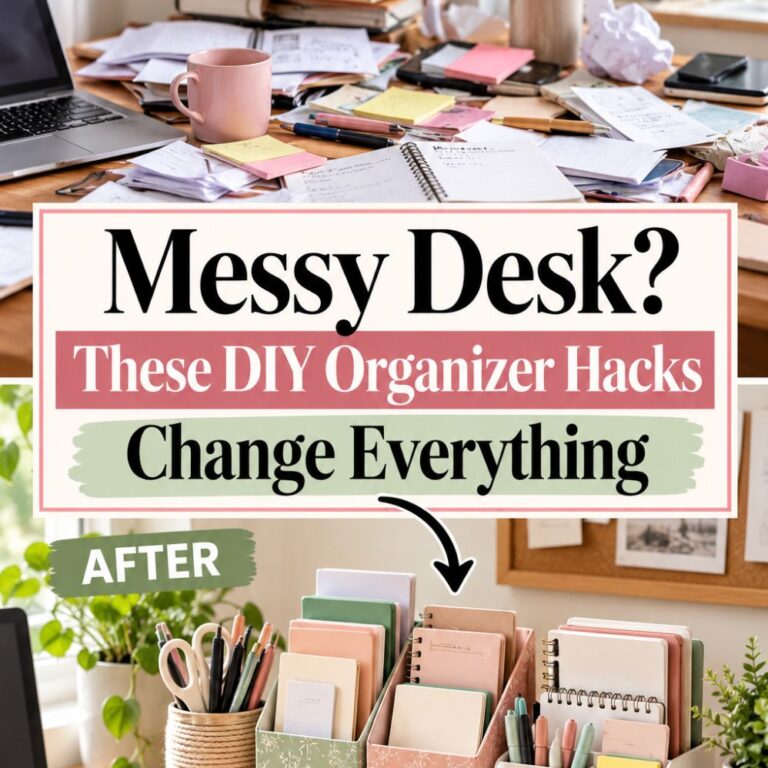





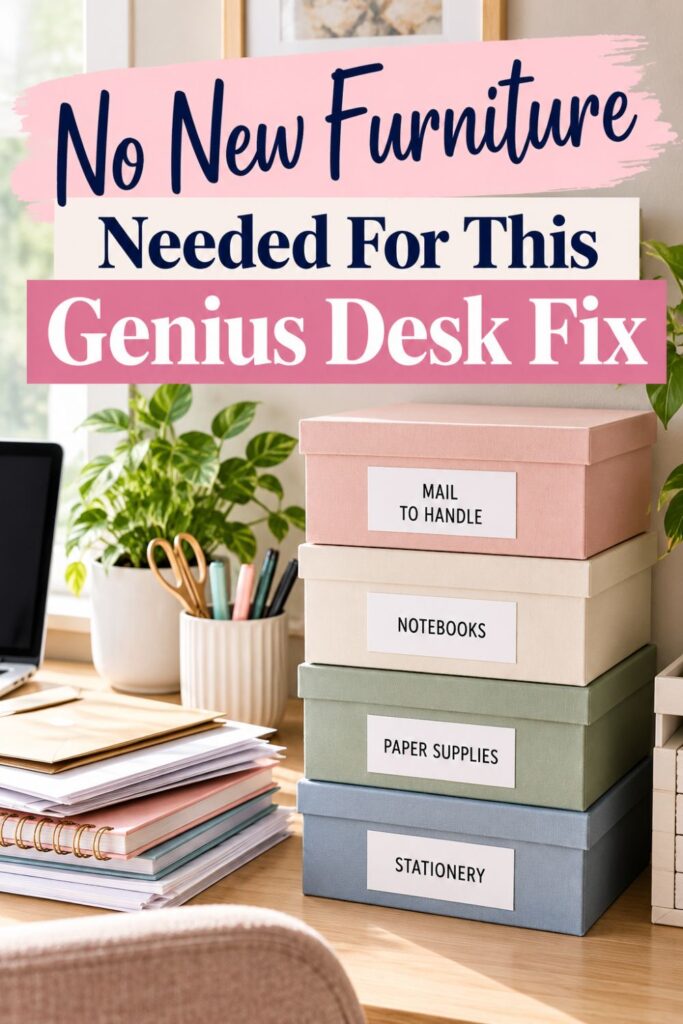
Shoe Box Drawer System for Paperwork and Flat Desk Supplies
Start With the Flat Stuff That Keeps Taking Over Your Desk
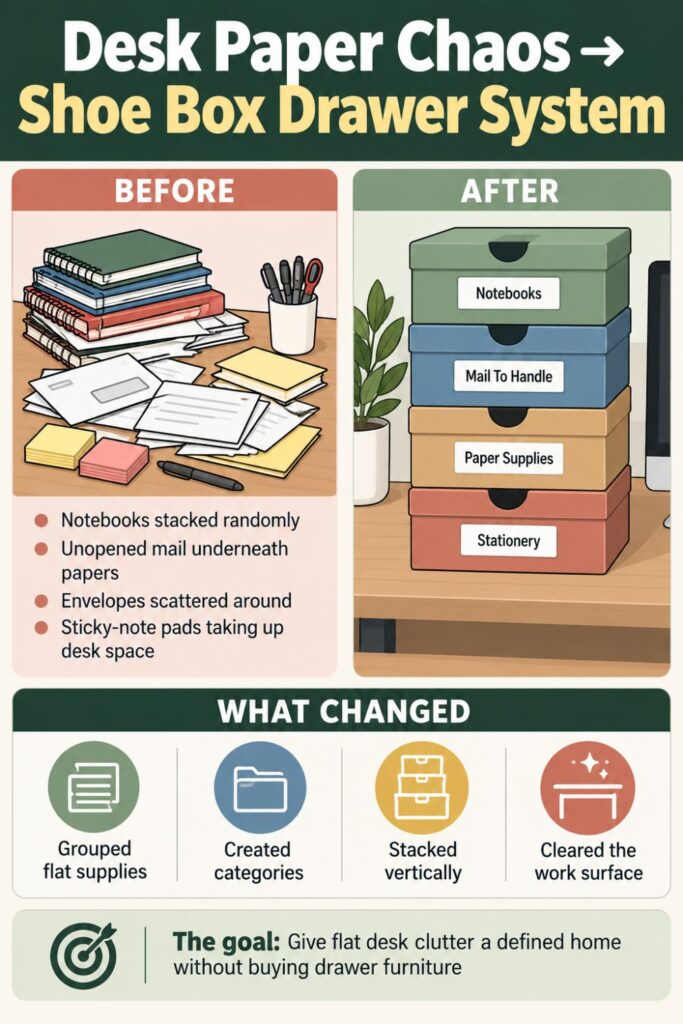
Paper clutter has a sneaky way of taking over a desk without looking like much at first. One notebook becomes two, a few pieces of mail get tucked underneath them, and suddenly you have a stack that gets moved from one side of the desk to the other every time you need to work.
Flat office supplies are especially awkward because many traditional desk organizers are made for pens, scissors, cables, and other small objects. Notebooks, envelopes, labels, printer paper, sticky-note pads, folders, and unopened mail need a different kind of storage.
A simple shoe box can solve more of this problem than you might expect.
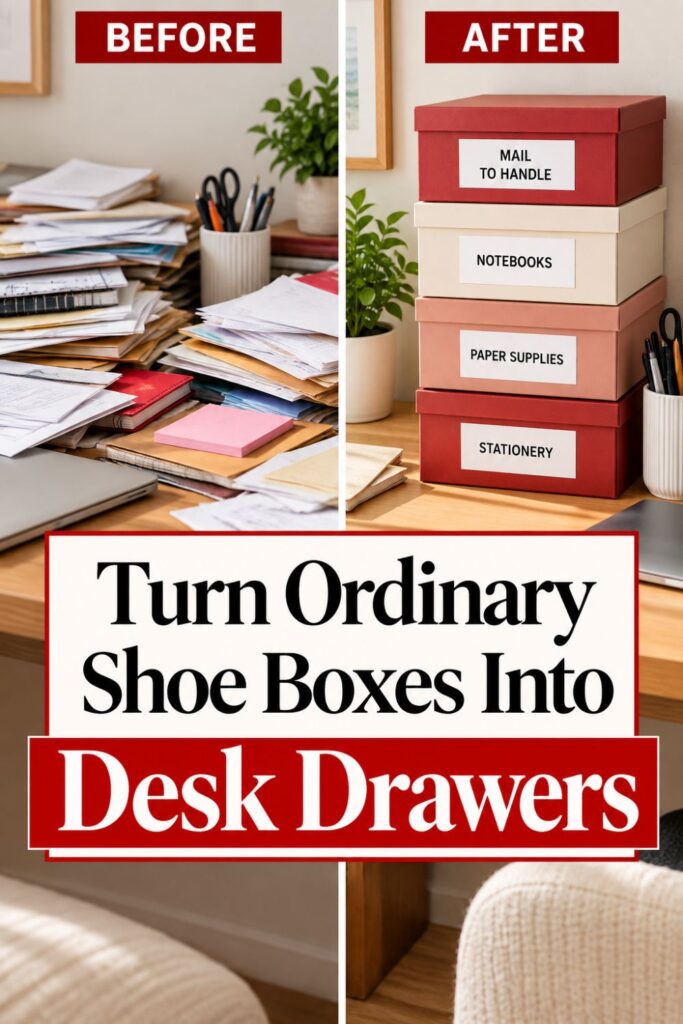
Instead of treating each item as something that needs its own special organizer, you can use shoe boxes to create broad categories. Each box becomes a removable storage zone for one type of desk clutter.
Start by looking around your workspace for the things that repeatedly end up in piles.
- Spot the flat clutter: Look for notebooks, folders, mail, stationery, labels, envelopes, paper pads, and other slim supplies that are constantly being stacked or shuffled around.
- Group similar items mentally: Notice which things naturally belong together, such as notebooks, mailing supplies, or paper that still needs attention.
- Set a boundary for the system: Decide that these boxes are for flat desk supplies rather than becoming catch-all containers for anything you do not know where to put.
- Keep the setup small: You do not need ten boxes to get started. Two or three useful categories can make a noticeable difference.
The advantage of this system is that it does not require permanent changes to your desk. There is no drilling, cutting, assembling, or complicated DIY involved.
You are simply giving loose items a defined home.
That makes this especially helpful if you work from a small desk, share a workspace, rent your home, or simply do not want to buy another piece of office furniture just to get paper under control.
If you want to get more from your life, and are looking for concrete action steps to get you there, check out our Request a Coach page. It’s a “cut the fence-sitting and take action” way to tackle your issues and actually find success. To get off the fence and start to take action, click or tap here.
1. Decide What Actually Belongs in the Shoe Box System
Before you start stacking boxes, decide which supplies actually benefit from this type of storage. The goal is not to move every object on your desk into a shoe box.
Instead, focus on the flat items that tend to spread, stack, or disappear underneath one another.
Gather possible candidates from your desk, nearby shelves, drawers, and any piles that have formed around your workspace. You may find more paper-related clutter than you realized once everything is in one place.
Good candidates can include:
- Notebooks and writing pads
- Sticky-note pads
- Printer paper
- Envelopes
- Mailing labels
- Stationery
- Folders
- Unopened mail
- Documents waiting for action
- Spare planner inserts
- Thin manuals or reference sheets
Pull together your likely candidates: Place all of these items in one temporary pile so you can see what you actually need to store. This makes it easier to spot duplicates and decide which categories are large enough to deserve their own box.
Remove items that need faster access: Pens, scissors, charging cables, staplers, and other frequently grabbed tools usually work better in a cup, tray, drawer, or small container. Putting them underneath stacks of paper will make the system frustrating.
Separate supplies from active paperwork: Blank notebooks and unused envelopes are storage items. A bill that needs paying or a form that needs returning is an unfinished task. Keeping those categories separate makes it less likely that important paperwork will disappear.
Check the physical fit: Place your largest notebook, folder, or pad inside the boxes you plan to use. Shoe boxes vary considerably in size, and some may be too narrow for larger office supplies.
If you want to get more from your life, and are looking for concrete action steps to get you there, check out our Request a Coach page. It’s a “cut the fence-sitting and take action” way to tackle your issues and actually find success. To get off the fence and start to take action, click or tap here.
This step prevents the system from becoming another clutter trap.
When every box has a clear purpose, you are far more likely to put things back where they belong. When everything gets tossed into one miscellaneous container, you simply trade visible clutter for hidden clutter.
2. Choose Shoe Boxes That Will Make a Stable Stack
Not every shoe box needs to match perfectly, but the system becomes much easier to use when the boxes are similar in size. A stack of wildly different boxes tends to wobble, slide, and become annoying to access.
Before organizing the contents, spend a few minutes choosing the best boxes from what you already have.
Match the box footprints: Look for boxes with roughly the same width and length. Identical boxes are ideal, but they are not required. The important thing is that one box can sit securely on top of another without tipping.
Check the strength: Press gently on the lid and side walls. Thin packaging that collapses under light pressure may not hold up well once you add several notebooks or a stack of printer paper.
Choose boxes that open easily: You want to be able to access the contents without fighting with complicated tabs, tight sleeves, or fragile packaging. A simple lift-off lid is often easiest.
Keep the stack reasonably short: Three or four boxes may be far more practical than six or seven. The taller the tower becomes, the more work it takes to reach whatever is at the bottom.
If you want to get more from your life, and are looking for concrete action steps to get you there, check out our Request a Coach page. It’s a “cut the fence-sitting and take action” way to tackle your issues and actually find success. To get off the fence and start to take action, click or tap here.
You can also decide whether you want the boxes to remain exactly as they are or whether you prefer a more visually consistent look. Matching shoe boxes can make the whole system feel intentional even if they are simply recycled packaging.
If the boxes do not match, that is not a problem. Function matters more than appearance.
A good stack should feel easy to live with.
Try placing your empty boxes where you plan to keep them before filling anything. Check whether they fit beside your desk, on a nearby shelf, underneath a console, or in an open desk cubby.
The best location is close enough that putting supplies away does not feel like an extra chore. If the boxes are tucked somewhere inconvenient, loose paper will probably begin collecting on the desk again.
3. Give Every Box One Clear Job
Once you have chosen your boxes, the most important step is deciding what each one is responsible for holding.
Think of each box as a category drawer.
When you need a notebook, you should know exactly which box to open. When mail arrives, there should be one obvious place for it. The less thinking required, the easier the system becomes to maintain.
If you want to get more from your life, and are looking for concrete action steps to get you there, check out our Request a Coach page. It’s a “cut the fence-sitting and take action” way to tackle your issues and actually find success. To get off the fence and start to take action, click or tap here.
Group items by how you use them: Categories such as Notebooks, Mail To Handle, Paper Supplies, Stationery, or Sticky Notes And Labels are usually more useful than sorting everything by size or color.
Your categories might look something like this:
- Box 1: Notebooks And Writing Pads
- Box 2: Mail And Papers To Handle
- Box 3: Envelopes, Labels, And Mailing Supplies
- Box 4: Sticky Notes And Small Paper Supplies
Keep categories broad: Avoid making the system too specific. If you create one box for lined notebooks, another for blank notebooks, and another for spiral notebooks, you may end up with too many containers and too many decisions.
Combine small categories logically: Envelopes and mailing labels can share a box because they are often used together. Sticky notes and page flags may make sense in the same container for the same reason.
Leave some room: A box packed tightly to the lid is difficult to use. You should be able to lift out a notebook or paper pad without removing half the contents first.
This is also a good moment to reduce duplicates.
If you discover twelve almost identical notebooks, twenty sticky-note pads, and a pile of stationery you have not touched in years, you do not necessarily need larger boxes. You may simply have more supplies than your current workspace needs.
Containerizing works best when the container creates a natural limit.
If you want to get more from your life, and are looking for concrete action steps to get you there, check out our Request a Coach page. It’s a “cut the fence-sitting and take action” way to tackle your issues and actually find success. To get off the fence and start to take action, click or tap here.
The box tells you how much space that category gets. If the contents no longer fit comfortably, it is time to review the category rather than automatically expanding the system.
4. Turn the Boxes Into a Drawer-Style Desk System
A stack of boxes only becomes useful when accessing the contents feels simple.
The easiest way to think about the system is to treat each shoe box as a removable drawer. Instead of rummaging around inside a cabinet or pulling apart several piles, you take out the category you need and return it when you are finished.
Face every box the same direction: Position the easiest-to-grab edge toward you. This creates a consistent motion every time you use the stack.
Keep flat items flat: Lay notebooks, folders, stationery, and paper horizontally. This prevents them from bending, leaning, or collapsing into one another.
Put frequently used items near the top of each box: If you have one notebook you use every day and four backups, place the daily notebook where you can reach it first.
Pull out the whole category when needed: If you are addressing mail, take the mail box to your desk. Finish what you need to do, place the remaining items back inside, and return the box to the stack.
That simple habit can reduce the tendency to spread supplies across the entire work surface.
If you want to get more from your life, and are looking for concrete action steps to get you there, check out our Request a Coach page. It’s a “cut the fence-sitting and take action” way to tackle your issues and actually find success. To get off the fence and start to take action, click or tap here.
You may also want to keep the lid underneath the box while you are actively using it. That way, you do not have a loose lid floating around the desk.
The goal is not to imitate an expensive drawer unit perfectly. Shoe boxes will still need to be lifted or moved.
The goal is to create the same basic organizational logic as drawers without buying furniture or completing a DIY project.
Everything has a defined horizontal space.
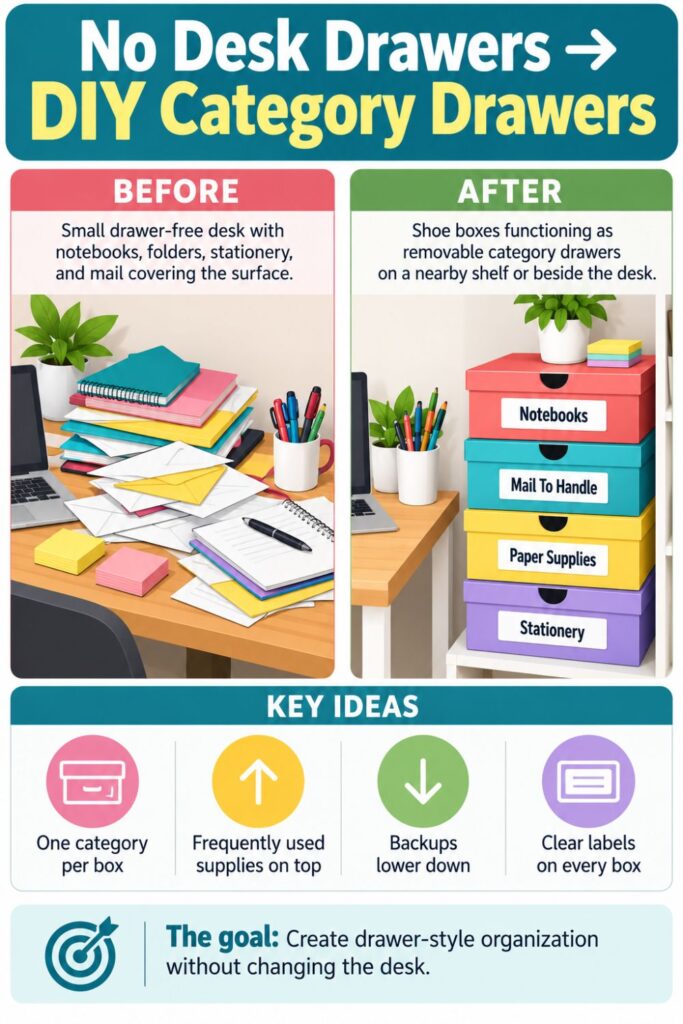
When work is finished, the desk can return to a clear surface much faster because you are not making individual decisions about dozens of small items. You are simply returning one category box to its place.
That is what makes the system practical for busy workspaces. It reduces both visible clutter and the number of decisions required to clean it up.
5. Stack the Boxes in the Right Order
Where each box sits matters almost as much as what goes inside it.
If the category you use five times a day is underneath three boxes you barely touch, the system will quickly become irritating. Eventually, you may stop returning things at all.
If you want to get more from your life, and are looking for concrete action steps to get you there, check out our Request a Coach page. It’s a “cut the fence-sitting and take action” way to tackle your issues and actually find success. To get off the fence and start to take action, click or tap here.
Start by thinking about two things: weight and frequency.
Put heavier categories lower down: Printer paper, thick notebooks, and larger writing pads make a more stable foundation. They are also less likely to crush lighter boxes when placed at the bottom.
Keep frequent-use boxes higher: Sticky notes, current notebooks, and active paperwork should be easier to access than supplies you only use once or twice a month.
Give temporary paperwork special attention: A box containing bills, forms, mail, or documents waiting for action should not disappear at the bottom of the stack. Keeping it visible makes unfinished tasks harder to forget.
A simple arrangement could look like this:
- Top: Mail And Papers To Handle
- Middle: Daily Notebooks And Writing Pads
- Middle: Sticky Notes And Stationery
- Bottom: Backup Paper And Less-Frequent Supplies
Your ideal order may be completely different.
The important part is observing what happens once you start using the system.
Test the arrangement for several days: Pay attention to how often you move boxes. If you repeatedly lift two containers just to reach the same lower box, that category probably belongs higher.
If you want to get more from your life, and are looking for concrete action steps to get you there, check out our Request a Coach page. It’s a “cut the fence-sitting and take action” way to tackle your issues and actually find success. To get off the fence and start to take action, click or tap here.
Rearrange without guilt: The first layout does not need to be permanent. One benefit of using shoe boxes is that the entire system can be changed in seconds.
You are designing around your actual habits rather than forcing yourself to adapt to a rigid organizer.
That flexibility is especially helpful if your work changes throughout the year. Tax paperwork might need a more accessible location for a few weeks. A notebook category might become more important during a large project.
The stack should support whatever you are doing now.
6. Label the Stack So You Never Have to Hunt
Labels may seem unnecessary when you only have two or three boxes, but they become surprisingly helpful once several similar containers are stacked together.
Without labels, every retrieval becomes a tiny guessing game.
You open one lid, realize it contains envelopes, close it, move another box, and finally find the notebook you wanted. Those small moments of friction are exactly what make organization systems difficult to maintain.
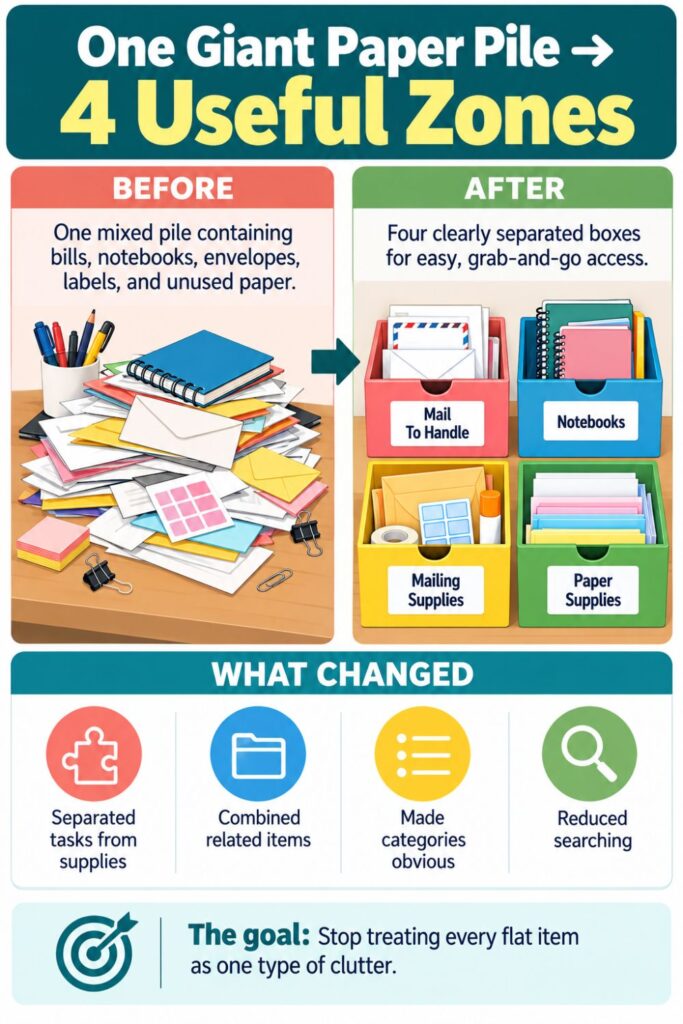
Name boxes by purpose: Use straightforward category names that tell you exactly what belongs inside.
If you want to get more from your life, and are looking for concrete action steps to get you there, check out our Request a Coach page. It’s a “cut the fence-sitting and take action” way to tackle your issues and actually find success. To get off the fence and start to take action, click or tap here.
Examples include:
- Notebooks
- Mail To Handle
- Paper Supplies
- Stationery
- Labels And Envelopes
- Sticky Notes
- Printer Paper
Avoid vague labels such as Stuff, Miscellaneous, Desk Things, or Office.
Label the visible side: Place the name on whichever edge faces outward when the boxes are stacked. You should be able to identify every category without touching the containers.
Use action labels for paperwork: Active documents often benefit from labels such as To Reply, To File, To Review, or To Pay. These names remind you why the paper is still on your desk.
Change labels when needed: If you regularly hesitate about where something belongs, the category may not be clear enough. Adjust the label rather than assuming you need to become more disciplined.
You do not need a label maker.
A sticky note, index card, small piece of paper, or removable label can work perfectly well. Keeping the labeling temporary can actually be useful while you test the system.
After a few weeks, you may discover that two categories should be combined or one box needs a different job.
If you want to get more from your life, and are looking for concrete action steps to get you there, check out our Request a Coach page. It’s a “cut the fence-sitting and take action” way to tackle your issues and actually find success. To get off the fence and start to take action, click or tap here.
The best organizational labels describe your real behavior.
If you naturally think, “I need the stuff for mailing this,” then Mailing Supplies may work better than Stationery Accessories.
Make the language obvious to you. That is more important than creating perfectly polished categories.
7. Keep the Boxes From Becoming Hidden Clutter
Containers can make a desk look tidy even when they are full of things you no longer need.
That is why the shoe box itself should act as a boundary.
When a box begins overflowing or becomes difficult to close, resist the urge to automatically add another one. Treat the lack of space as a signal that the category deserves a quick review.
Use the box as a physical limit: Decide that notebooks, stationery, or sticky notes get one specific amount of space. New supplies need to fit within that boundary.
Remove obvious excess first: Look for dried-out adhesive notes, outdated documents, duplicate pads, damaged folders, empty packaging, or supplies you consistently skip over.
If you want to get more from your life, and are looking for concrete action steps to get you there, check out our Request a Coach page. It’s a “cut the fence-sitting and take action” way to tackle your issues and actually find success. To get off the fence and start to take action, click or tap here.
Finish nearly used notebooks: If several notebooks have only a few blank pages remaining, consider using those pages before opening another one.
Move archives elsewhere: Papers you need to keep permanently should eventually leave your working desk area. File, scan, or relocate them once they are no longer active.
A quick reset can keep the system functioning.
Once or twice a week, spend a few minutes returning loose items to the correct boxes. This is easier than waiting until the desk has become completely overwhelmed again.
You can use a very simple reset:
- Put notebooks back.
- Process obvious trash.
- Return stationery to its box.
- Move active paper into the action category.
- Clear completed documents from the desk area.
The goal is not to maintain a perfectly empty desk at every moment.
A working desk will naturally become messy while you are working.
The useful distinction is whether the clutter has somewhere to return to afterward.
If you want to get more from your life, and are looking for concrete action steps to get you there, check out our Request a Coach page. It’s a “cut the fence-sitting and take action” way to tackle your issues and actually find success. To get off the fence and start to take action, click or tap here.
When every flat item has a clear container, resetting the workspace becomes much faster. Instead of deciding where each object should live every time you clean up, you already know.
That turns tidying from a project into a routine.
Follow-Up: Create a Simple Paper Flow Instead of One Giant Paper Box
Paperwork behaves differently from office supplies because it usually represents something unfinished.
A stack of envelopes can sit quietly for weeks without causing a problem. A bill, form, permission slip, receipt, or document waiting for a reply often requires action.
That is why dumping all paper into one shoe box can become risky.
Instead, use the box system to create a basic paper flow.
Create one incoming-paper location: New mail and documents should land in one predictable place instead of being scattered around the desk.
Separate action from storage: Paper that requires a decision should have a different category from blank supplies and documents you are keeping for reference.
If you want to get more from your life, and are looking for concrete action steps to get you there, check out our Request a Coach page. It’s a “cut the fence-sitting and take action” way to tackle your issues and actually find success. To get off the fence and start to take action, click or tap here.
You could use categories such as:
- Incoming
- To Do
- To File
- Waiting For Response
You do not necessarily need a separate box for every category. A few folders inside one action box can create the same distinction.
Review the action box regularly: Once a paper has been paid, replied to, filed, scanned, or completed, move it out. Active paperwork should be temporary.
Keep permanent filing elsewhere: A desk-side shoe box is not the ideal home for years of tax forms, insurance paperwork, or household records. The more archives you add, the harder it becomes to find the documents that actually need attention.
This small change turns the shoe box from passive storage into part of your workflow.
Instead of asking, “Where should I put this paper?” every time something lands on your desk, you already have an answer.
New paper goes into the incoming area.
Paper requiring action moves through the system.
If you want to get more from your life, and are looking for concrete action steps to get you there, check out our Request a Coach page. It’s a “cut the fence-sitting and take action” way to tackle your issues and actually find success. To get off the fence and start to take action, click or tap here.
Completed paper leaves.
That flow prevents the familiar situation where a beautifully organized container slowly turns into a box full of mysterious documents nobody wants to open.
Follow-Up: How an Organization Coach Could Help When the Boxes Keep Filling Up
Sometimes the organizer is not the real problem.
You can buy new bins, create beautiful labels, sort everything perfectly, and still find yourself facing the same piles a month later.
If that keeps happening, it may be useful to look at the habits behind the clutter.
An organization coach or productivity-focused coach can help identify where the system is breaking down.
Look for the actual bottleneck: Maybe paperwork arrives faster than you process it. Perhaps you buy notebooks faster than you use them. Maybe the storage location is inconvenient, so items never make it back into the box.
Create clearer rules: A coach can help you define decisions such as how often mail gets processed, how many notebooks you keep accessible, or how long unfinished paper stays beside the desk.
If you want to get more from your life, and are looking for concrete action steps to get you there, check out our Request a Coach page. It’s a “cut the fence-sitting and take action” way to tackle your issues and actually find success. To get off the fence and start to take action, click or tap here.
Match the system to your work style: Someone who handwrites notes throughout the day may genuinely need several notebooks nearby. Someone who works almost entirely digitally may only need one small paper box.
Build a realistic reset habit: Instead of trying to maintain a picture-perfect workspace, you might create a five-minute end-of-day reset or a Friday paper review.
Useful questions include:
- What keeps piling up first?
- Which category is always overflowing?
- What do you avoid processing?
- Which supplies do you repeatedly buy because you cannot find them?
- Where does clutter appear when you are busiest?
The answers often reveal more than buying another organizer.
A good organization system should reduce effort, not create another standard you struggle to maintain.
The shoe box method gives you an inexpensive structure. Coaching, reflection, or simply observing your own habits can help you figure out whether that structure actually matches the way you work.
If the system keeps failing, change the system before blaming yourself for not maintaining it.
A Small System That Keeps Flat Clutter Contained
You do not need a built-in drawer unit or expensive office organizer to stop notebooks, mail, and paper supplies from spreading across your workspace.
If you want to get more from your life, and are looking for concrete action steps to get you there, check out our Request a Coach page. It’s a “cut the fence-sitting and take action” way to tackle your issues and actually find success. To get off the fence and start to take action, click or tap here.
Sometimes the easiest solution is simply giving those items a boundary.
A few sturdy shoe boxes can create that boundary with almost no setup.
Start with what you already have: Try the system using two or three boxes before buying anything. You may find that you need far less storage than you expected.
Assign each box a clear purpose: The simpler the categories are, the easier the system will be to remember.
Arrange the stack around frequency: Keep everyday supplies accessible and less-used backups lower down.
Label everything clearly: You should be able to identify the right box without opening several containers.
Let the boxes create limits: When one fills up, review the category before expanding it.
Adjust as your habits change: Move boxes, rename categories, combine sections, or remove containers that no longer serve a purpose.
If you want to get more from your life, and are looking for concrete action steps to get you there, check out our Request a Coach page. It’s a “cut the fence-sitting and take action” way to tackle your issues and actually find success. To get off the fence and start to take action, click or tap here.
The simplicity of the system is its biggest advantage.
Nothing is permanent.
You can rearrange everything in a few minutes if you change desks, start a new project, begin working from home, or realize one category is not working.
More importantly, the system gives flat desk clutter somewhere to go.
Instead of moving a stack of notebooks from one corner to another, you return them to the notebook box. Instead of dropping new mail underneath your keyboard, you place it in the action box.
Those tiny decisions add up.
When the storage method is obvious and easy to use, clearing your desk stops feeling like a full organizing project. It becomes a quick reset that you can actually repeat.
That is often what makes a simple organization system work better than a complicated one.
If you want to get more from your life, and are looking for concrete action steps to get you there, check out our Request a Coach page. It’s a “cut the fence-sitting and take action” way to tackle your issues and actually find success. To get off the fence and start to take action, click or tap here.
If you want to get more from your life, and are looking for concrete action steps to get you there, check out our Request a Coach page. It’s a “cut the fence-sitting and take action” way to tackle your issues and actually find success. To get off the fence and start to take action, click or tap here.
Read this next

The DIY Christmas Wreaths Formula for Busy Holiday Weekends
Are you all about style, decor and organization? Download a copy of our Decluttering Workbook. Why We Love a Quick Holiday Project There’s something magical about creating a Christmas wreath […]
Read More
Closet Wall Organization Ideas That Use Vertical Space Better
Blank closet walls can do so much more. See the clever vertical storage ideas that make bags, shoes, shelves, and corners finally work.
Read More
Rustic, Modern, Farmhouse or Minimalist? What’s Your Christmas Mantle Style
Are you all about style, decor and organization? Download a copy of our Decluttering Workbook. **** The mantle is the fastest way to make a room feel like Christmas without […]
Read More