








Telephone Coaching Strategies: The Five Minute Window to Make a Successful Connection

How fast do you suppose a client will decide if a certain conversation will truly be of use to them? Psychologists have long studied how quickly people form impressions of others. In a 1992 meta-analysis, researchers Nalini Ambady and Robert Rosenthal found that brief observations of expressive behavior could provide meaningful information about interpersonal outcomes.
These findings do not establish a fixed deadline for building trust. But if you’re coaching via the telephone, the first five minutes offer a valuable opportunity to establish a connection and set the conversation up for success.
Your clients need connection and expect it to push them forward with confidence. The most important tools in your tool chest for building that connection and making it stronger are tone of voice, active listening, and rapport building.
Key Takeaways
- The first five minutes establish the direction of your coaching conversation. Use this opening to connect with your client, understand their immediate concerns, and agree on what would make the session useful. Treat five minutes as a practical guide, not a rigid deadline for earning trust.
- Your voice becomes a primary tool for connection. Without facial expressions or body language, clients rely heavily on your tone, pace, pauses, and responsiveness to understand how you are engaging with them.
- Reflecting a client’s language can strengthen rapport. Repeat meaningful phrases when appropriate, paraphrase to check understanding, and ask clarifying questions instead of assuming you know what the client means.
- Silence and vocal changes deserve attention. A pause may signal reflection, uncertainty, or a technical interruption. Explore what is happening before assigning meaning.
- Strong rapport requires ongoing attention. Notice changes in engagement, repair misunderstandings early, and connect each coaching conversation to the client’s goals and next actions.
How Do You Build Rapport With a Coaching Client Over the Phone?
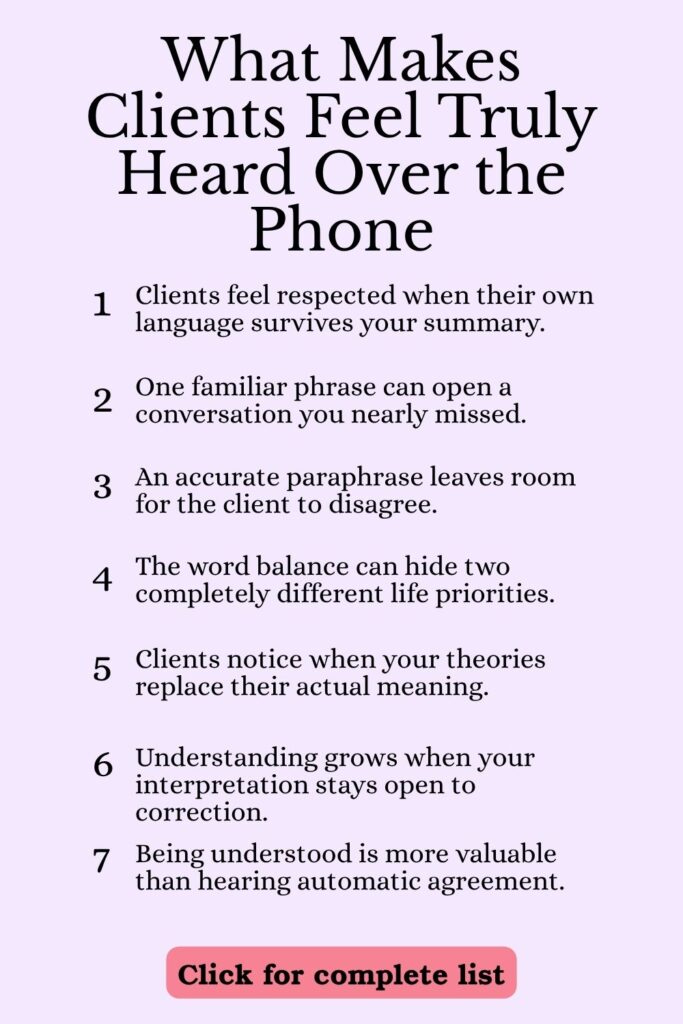
You build rapport with a coaching client over the phone by using a focused, attentive tone of voice, listening carefully to the client’s words and vocal changes, reflecting their meaning accurately, and establishing a shared purpose for the conversation. Because visual communication is absent, the quality of your listening and verbal responses becomes especially important.
Begin by giving the client your full attention, asking what they want from the session, and allowing enough space for them to explain their concerns. Use their language when it helps preserve meaning, paraphrase when clarification is needed, and check your interpretations rather than making assumptions about their emotions.
The first five minutes provide a useful structure for beginning this process. Rapport then develops throughout the coaching relationship as you continue listening accurately, respecting the client’s perspective, and helping them turn conversations into meaningful action.
SEE ALSO: If you’re a coach looking to streamline your administrative tasks and save time, check out our Coaching Administration Software. It’s a simple, effective solution designed to help you focus less on paperwork and more on what matters—coaching your clients. From scheduling to client management, our software gives you the tools to run your business efficiently. Ready to reclaim your time and boost productivity? Click or tap here.
What Should Happen in the First Five Minutes of a Telephone Coaching Call?
The first five minutes of a telephone coaching call should establish connection, identify the client’s immediate priority, and create agreement about what the conversation needs to accomplish.
You don’t need to follow a rigid script. However, a simple five-minute structure can prevent you from rushing into coaching questions before you understand what your client actually needs.
Minute 1: Establish your presence.
Begin by welcoming your client and checking that they are ready to talk. Make sure you’re in a place where you can listen without interruptions, and give them your complete attention.
A simple opening such as “How are you arriving at today’s session?” can reveal whether the client is focused, distracted, or carrying something unexpected into the conversation.
Minute 2: Invite the client’s agenda.
Ask what they would most like to work on.
You might say, “What’s the most useful thing we could focus on today?”
SEE ALSO: If you’re a coach looking to streamline your administrative tasks and save time, check out our Coaching Administration Software. It’s a simple, effective solution designed to help you focus less on paperwork and more on what matters—coaching your clients. From scheduling to client management, our software gives you the tools to run your business efficiently. Ready to reclaim your time and boost productivity? Click or tap here.
This encourages the client to identify what matters instead of simply responding to whatever you planned to discuss.
Minute 3: Listen for the underlying concern.
Pay attention to the words your client chooses, what they repeat, and where their voice changes.
A client might begin by saying they need help preparing for a promotion interview. As they continue speaking, you may discover that their real concern is whether they want the leadership responsibilities that come with the role.
Minute 4: Reflect and clarify.
Summarize what you’re hearing and give the client a chance to correct you.
For example, “It sounds as though you’re excited about the promotion, but you’re not sure whether the new responsibilities fit the life you want. Have I understood that correctly?”
This helps you avoid building an entire coaching conversation around the wrong problem.
SEE ALSO: If you’re a coach looking to streamline your administrative tasks and save time, check out our Coaching Administration Software. It’s a simple, effective solution designed to help you focus less on paperwork and more on what matters—coaching your clients. From scheduling to client management, our software gives you the tools to run your business efficiently. Ready to reclaim your time and boost productivity? Click or tap here.
Minute 5: Agree on the session focus.
Ask what the client would like to understand or decide by the end of the call.
An effective outcome might be identifying the most important criteria for accepting the promotion rather than making the decision immediately.
The timing is flexible. Some clients need more time to settle into the conversation, while established clients may identify their priorities almost immediately.
The value comes from moving through a clear sequence: connect, listen, clarify, and agree on a direction.
A little preparation can make this easier. For coaches using LCH Core, client profiles, notes, and intake forms can provide relevant context before a call, so the opening minutes are spent listening rather than collecting information the client has already shared.
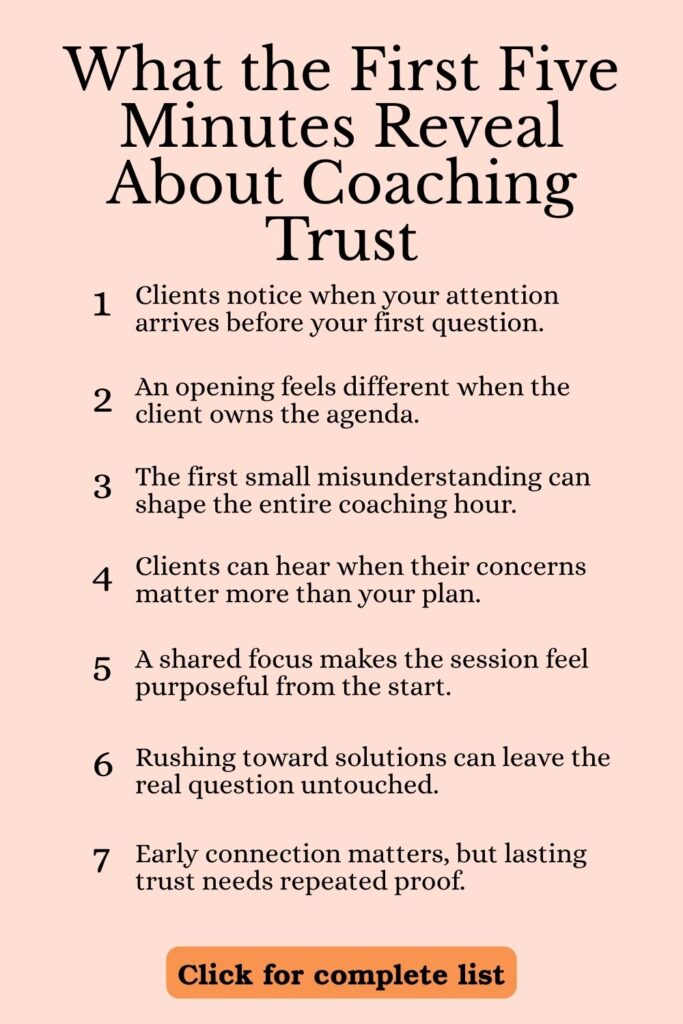
How Does Your Tone of Voice Build Trust Over the Phone?
The first part of understanding between you and your client is established not just through words, but through vocal qualities like cadence, pitch, tone, rhythm, and tempo.
SEE ALSO: If you’re a coach looking to streamline your administrative tasks and save time, check out our Coaching Administration Software. It’s a simple, effective solution designed to help you focus less on paperwork and more on what matters—coaching your clients. From scheduling to client management, our software gives you the tools to run your business efficiently. Ready to reclaim your time and boost productivity? Click or tap here.
These are influenced by a larger intention to connect carefully and thoughtfully with the client who is on the other end of the phone line.
Even though you are not able to see facial expressions, you can notice subtle differences in someone’s voice that may help you decide when to adjust your approach.
For example, speaking quickly when a client is carefully searching for the right words may make the conversation feel rushed. Slowing your responses and allowing a little more time between questions can give the client room to think.
Your tone should also fit the conversation.
When a client is discussing an exciting achievement, an engaged and energetic response may feel appropriate. When they are explaining a difficult decision, a more measured tone may help them concentrate on what they want to say.
This doesn’t mean copying every change in your client’s voice. Your role is to remain attentive and responsive without losing your natural way of speaking.
SEE ALSO: If you’re a coach looking to streamline your administrative tasks and save time, check out our Coaching Administration Software. It’s a simple, effective solution designed to help you focus less on paperwork and more on what matters—coaching your clients. From scheduling to client management, our software gives you the tools to run your business efficiently. Ready to reclaim your time and boost productivity? Click or tap here.
Before the conversation starts, get yourself ready to really connect with the client by staying fully focused throughout the call.
What Can a Client’s Pauses and Changing Tone Tell You?
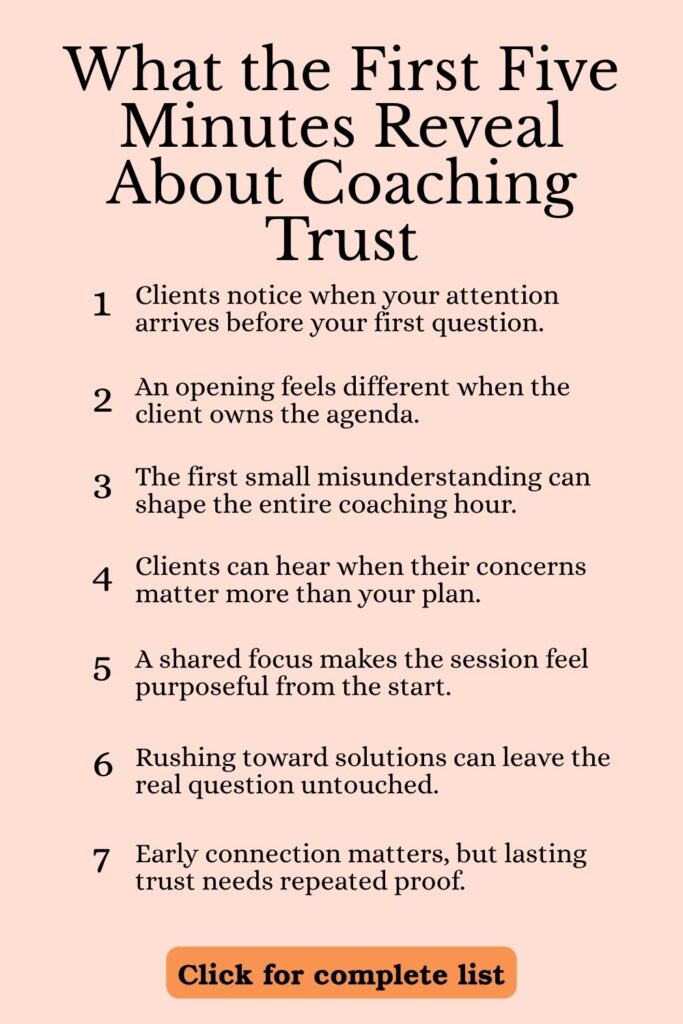
Changes in a client’s voice can help you identify moments worth exploring, but they should never be treated as definite proof of what the client is feeling.
Without visual cues, telephone coaches need to pay particular attention to how a person’s speech changes during a conversation.
The most useful clues are often differences from the client’s usual speaking pattern.
Consider three situations.
When a client suddenly starts speaking faster
A leadership coaching client has been speaking steadily about their responsibilities. When you ask about an upcoming meeting with their manager, their pace noticeably increases.
SEE ALSO: If you’re a coach looking to streamline your administrative tasks and save time, check out our Coaching Administration Software. It’s a simple, effective solution designed to help you focus less on paperwork and more on what matters—coaching your clients. From scheduling to client management, our software gives you the tools to run your business efficiently. Ready to reclaim your time and boost productivity? Click or tap here.
You might ask, “I noticed you picked up the pace when we started talking about that meeting. What’s coming up for you?”
The client may be excited, frustrated, concerned, or simply trying to explain several ideas at once. Their answer, rather than your assumption, tells you what the change means.
When a previously expressive client becomes quiet
A career coaching client has been enthusiastically discussing possible career changes. Their responses become much shorter when you ask which option they would actually pursue.
Rather than interpreting the silence as resistance, you could ask, “What are you considering as you think about making that choice?”
You may discover that the client has identified an important financial or family consideration.
When a client’s words and delivery seem inconsistent
A client says they are completely confident about having a difficult conversation with their business partner, but they repeatedly hesitate when describing what they intend to say.
SEE ALSO: If you’re a coach looking to streamline your administrative tasks and save time, check out our Coaching Administration Software. It’s a simple, effective solution designed to help you focus less on paperwork and more on what matters—coaching your clients. From scheduling to client management, our software gives you the tools to run your business efficiently. Ready to reclaim your time and boost productivity? Click or tap here.
Instead of telling them they sound uncertain, you could ask, “How confident do you feel about taking that step?”
This allows the client to explore their own experience.
A useful listening sequence is to notice the change, check its meaning, and then decide whether to explore it further.
Not every pause, hesitation, or shift in volume carries emotional significance. Sometimes a client is distracted by background noise, searching for a word, or experiencing a poor phone connection.
The aim is not to become an expert at guessing emotions. It’s to become more skillful at noticing when something may deserve a question.
How Do You Build Rapport Without Seeing Your Client?
While you’re listening to your client start the conversation, take this opportunity to build connection and attention by feeding back some of the same syntax, jargon, phrases, and words your client is using.
SEE ALSO: If you’re a coach looking to streamline your administrative tasks and save time, check out our Coaching Administration Software. It’s a simple, effective solution designed to help you focus less on paperwork and more on what matters—coaching your clients. From scheduling to client management, our software gives you the tools to run your business efficiently. Ready to reclaim your time and boost productivity? Click or tap here.
The language people choose can reveal how they understand their own situation.
For example, one client might describe a career decision as “taking a risk,” while another calls the same type of decision “finally moving forward.”
Those phrases carry different meanings for the people using them.
If you replace a client’s words with your own interpretation too quickly, you may unintentionally shift the conversation away from what matters to them.
A client who says, “I don’t feel respected at work” is not necessarily saying, “I need more confidence.”
That might eventually become part of the conversation, but assuming it too early could mean missing what the client actually wants to explore.
SEE ALSO: If you’re a coach looking to streamline your administrative tasks and save time, check out our Coaching Administration Software. It’s a simple, effective solution designed to help you focus less on paperwork and more on what matters—coaching your clients. From scheduling to client management, our software gives you the tools to run your business efficiently. Ready to reclaim your time and boost productivity? Click or tap here.
A safer approach is to begin with the client’s own language and use questions to understand what it means.
When you reflect an important phrase, you show that you are paying attention to how the client sees the situation.
You can then paraphrase or summarize to check whether you have understood correctly.
Strong rapport comes from accurately understanding the client’s perspective, not from agreeing with everything they say or repeating every sentence.
When Should You Mirror a Client’s Words or Paraphrase?
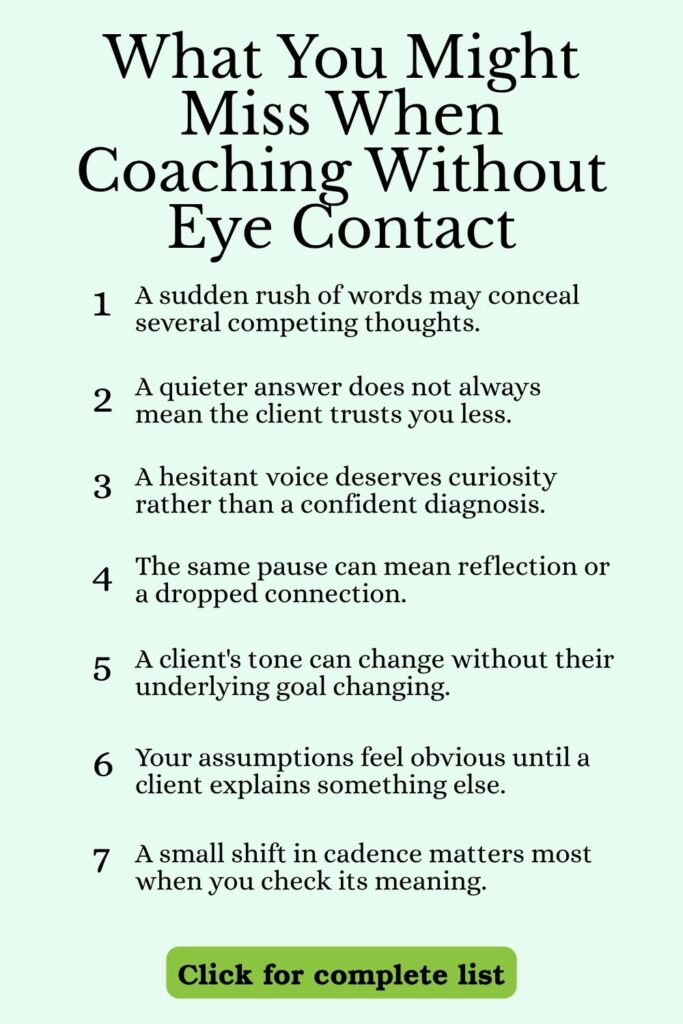
Mirroring is useful when a client’s exact words carry meaning, while paraphrasing helps you check your understanding or bring several ideas together.
Both techniques belong in effective telephone coaching. The skill is recognizing when each one will help the conversation move forward.
SEE ALSO: If you’re a coach looking to streamline your administrative tasks and save time, check out our Coaching Administration Software. It’s a simple, effective solution designed to help you focus less on paperwork and more on what matters—coaching your clients. From scheduling to client management, our software gives you the tools to run your business efficiently. Ready to reclaim your time and boost productivity? Click or tap here.
The International Coaching Federation’s 2025 Core Competencies recognize reflecting and summarizing client communication as part of active listening. The competencies also emphasize paying attention to words, vocal cues, and changes in a client’s communication.
Use exact-word reflection when a phrase deserves exploration.
Imagine a leadership coaching client tells you, “I feel like I’m carrying everyone else’s expectations.”
You might respond, “Everyone else’s expectations?”
This gives the client an opportunity to explain what that phrase means without you deciding the meaning for them.
They might reveal that they have been accepting additional responsibilities because they fear disappointing their colleagues.
Use paraphrasing when you need to confirm the bigger picture.
After listening further, you might say, “You’re taking on responsibilities you haven’t agreed to because you feel responsible for how other people react. Is that right?”
SEE ALSO: If you’re a coach looking to streamline your administrative tasks and save time, check out our Coaching Administration Software. It’s a simple, effective solution designed to help you focus less on paperwork and more on what matters—coaching your clients. From scheduling to client management, our software gives you the tools to run your business efficiently. Ready to reclaim your time and boost productivity? Click or tap here.
The client can confirm, correct, or refine your understanding.
A good paraphrase is an invitation to clarify. It is not a statement that the coach has uncovered a hidden truth.
Use clarifying questions when language is ambiguous.
Clients frequently use words that sound clear but mean different things to different people.
If a client says, “I need more balance,” ask what balance would look like in their actual week.
They may want fewer working hours, more predictable boundaries, or simply permission to stop checking messages after dinner.
Each answer would lead to a different coaching conversation.
SEE ALSO: If you’re a coach looking to streamline your administrative tasks and save time, check out our Coaching Administration Software. It’s a simple, effective solution designed to help you focus less on paperwork and more on what matters—coaching your clients. From scheduling to client management, our software gives you the tools to run your business efficiently. Ready to reclaim your time and boost productivity? Click or tap here.
Avoid turning mirroring into a mechanical exercise. Repeating every phrase can sound unnatural and may interrupt the client’s thinking.
When you notice recurring phrases across sessions, keep a record of the language the client uses. LCH Core’s client notes and session history can help you revisit those expressions when they become relevant to the client’s ongoing goals.
How Do You Handle Silence Without Losing Connection?
Silence during telephone coaching should be treated as part of the conversation, not automatically as a sign that rapport has been lost.
A thoughtful question sometimes requires more than a quick answer. Your client may be working through an unfamiliar idea, comparing possible choices, or noticing a reaction they have not yet put into words.
Because you cannot see the client thinking, the temptation is to fill every pause with another question.
That can interrupt an important moment.
SEE ALSO: If you’re a coach looking to streamline your administrative tasks and save time, check out our Coaching Administration Software. It’s a simple, effective solution designed to help you focus less on paperwork and more on what matters—coaching your clients. From scheduling to client management, our software gives you the tools to run your business efficiently. Ready to reclaim your time and boost productivity? Click or tap here.
Imagine you’re coaching someone who has been offered a new job. You ask, “What would you be giving up if you accepted it?”
The client falls silent.
You might feel tempted to immediately ask whether they are worried about the salary, commute, or responsibilities.
But the client may be considering something you haven’t anticipated, such as losing a professional identity they have spent years building.
Instead of supplying possible answers, allow a little space.
If the silence continues, you can check in without directing the response.
SEE ALSO: If you’re a coach looking to streamline your administrative tasks and save time, check out our Coaching Administration Software. It’s a simple, effective solution designed to help you focus less on paperwork and more on what matters—coaching your clients. From scheduling to client management, our software gives you the tools to run your business efficiently. Ready to reclaim your time and boost productivity? Click or tap here.
For example, “Would you like a moment to think about that?” or “What’s coming up as you consider the question?”
There are also times when silence signals confusion rather than reflection.
A client might not understand your question, feel uncomfortable with an assumption you’ve made, or be experiencing an interruption in the phone connection.
You can distinguish these possibilities by checking rather than guessing.
A 2016 exploratory study by Jenny Lynden and Rachel Avery, published in Coaching: An International Journal of Theory, Research and Practice, examined telephone coaching conversations and identified ways that silence can become challenging in this format.
The researchers studied seven workplace coaches and analyzed conversational interactions. Their findings highlight why telephone coaches need to pay attention to how pauses function within the exchange.
SEE ALSO: If you’re a coach looking to streamline your administrative tasks and save time, check out our Coaching Administration Software. It’s a simple, effective solution designed to help you focus less on paperwork and more on what matters—coaching your clients. From scheduling to client management, our software gives you the tools to run your business efficiently. Ready to reclaim your time and boost productivity? Click or tap here.
A useful distinction is between silence that supports thinking and silence that needs clarification.
The first may deserve more time. The second may need a gentle question.
You don’t have to eliminate silence to maintain rapport. You need to become comfortable enough with it to recognize when your client is still working.
What Are the Benefits of a Strong Coaching Connection?
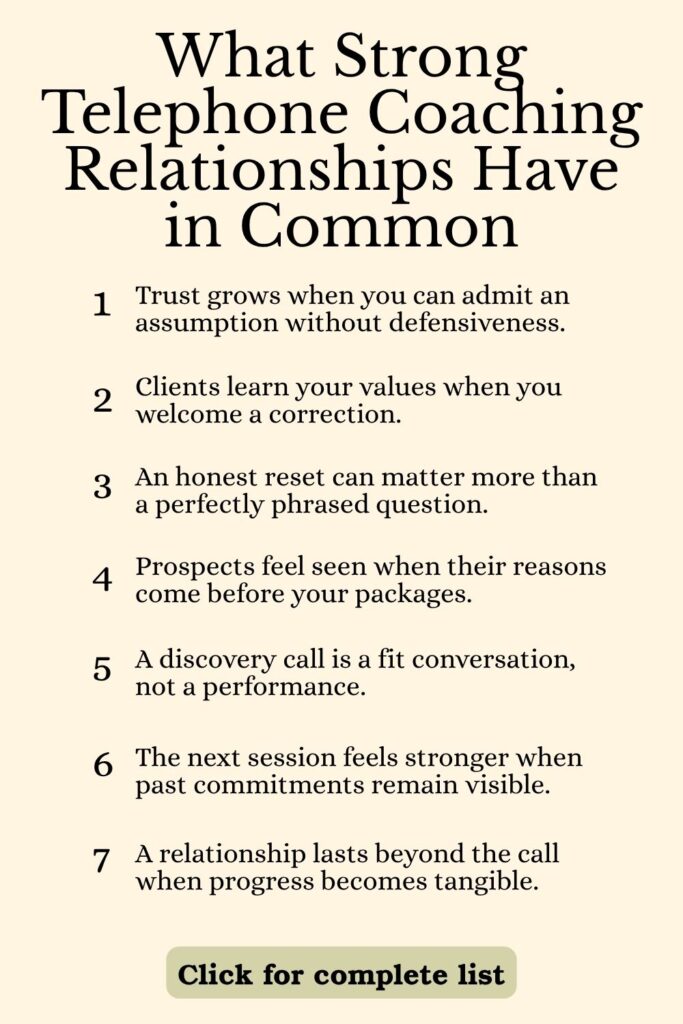
When you really connect with your clients, you’ll be able to move deeper into the issues that matter to them and spend less time correcting misunderstandings.
The more you understand tone of voice and become skilled at listening for what is not being said directly, the more thoughtful your coaching can become.
A strong connection also helps you recognize when a client is ready to explore a difficult subject and when they need more clarification before moving forward.
SEE ALSO: If you’re a coach looking to streamline your administrative tasks and save time, check out our Coaching Administration Software. It’s a simple, effective solution designed to help you focus less on paperwork and more on what matters—coaching your clients. From scheduling to client management, our software gives you the tools to run your business efficiently. Ready to reclaim your time and boost productivity? Click or tap here.
For example, a client who feels understood may be more willing to examine why they repeatedly agree to work commitments they later resent.
That creates an opportunity to explore the decisions behind the behavior rather than simply develop another time-management plan.
Over several sessions, the benefits extend beyond individual conversations.
You become more familiar with your client’s language, recurring concerns, goals, and responses to different questions.
This continuity can make subsequent sessions more focused because you are not repeatedly starting from the beginning.
It also creates opportunities to connect the coaching conversation with measurable action.
SEE ALSO: If you’re a coach looking to streamline your administrative tasks and save time, check out our Coaching Administration Software. It’s a simple, effective solution designed to help you focus less on paperwork and more on what matters—coaching your clients. From scheduling to client management, our software gives you the tools to run your business efficiently. Ready to reclaim your time and boost productivity? Click or tap here.
If a client decides to establish a boundary at work, your next session can explore what they actually did, what happened, and what they learned.
That ongoing relationship matters to coaches who want to deliver consistent value and retain clients through meaningful progress. The connection between client progress and longer coaching relationships is explored further in A Bird in the Hand: The Simple Math of Client Lifetime Value (for Coaches).
If you feel the connection with your client slipping at any point, you can work at rebuilding it.
Sometimes the problem is simply a misunderstanding that a few carefully chosen questions can resolve.
How Do You Repair Rapport When a Telephone Coaching Conversation Goes Wrong?
The most effective way to repair rapport is to acknowledge a possible misunderstanding, invite the client’s perspective, and check that you are both working from the same understanding.
You don’t have to abandon the session because a question lands badly or your client disagrees with your interpretation.
SEE ALSO: If you’re a coach looking to streamline your administrative tasks and save time, check out our Coaching Administration Software. It’s a simple, effective solution designed to help you focus less on paperwork and more on what matters—coaching your clients. From scheduling to client management, our software gives you the tools to run your business efficiently. Ready to reclaim your time and boost productivity? Click or tap here.
Consider a coach working with a client who has repeatedly postponed applying for a management position.
The coach asks, “What’s making you afraid to take the next step?”
The client responds sharply, “I’m not afraid. I’m being realistic.”
The coach has interpreted the client’s delay as fear, but the client may have practical reasons for hesitating.
Pushing the original interpretation could make the conversation less productive.
A better approach follows four steps.
SEE ALSO: If you’re a coach looking to streamline your administrative tasks and save time, check out our Coaching Administration Software. It’s a simple, effective solution designed to help you focus less on paperwork and more on what matters—coaching your clients. From scheduling to client management, our software gives you the tools to run your business efficiently. Ready to reclaim your time and boost productivity? Click or tap here.
1. Notice the change.
Pay attention when a client becomes unusually brief, starts correcting your assumptions, or responds with a noticeably different tone.
These changes may indicate that your understanding needs checking.
2. Acknowledge your part in the misunderstanding.
You might say, “I may have made an assumption there. You said you were being realistic, and I interpreted that as fear.”
This identifies what happened without making the client responsible for fixing it.
3. Invite clarification.
Ask, “What am I missing about your decision?”
The client might explain that they are concerned about the position’s travel requirements because they are caring for an elderly parent.
SEE ALSO: If you’re a coach looking to streamline your administrative tasks and save time, check out our Coaching Administration Software. It’s a simple, effective solution designed to help you focus less on paperwork and more on what matters—coaching your clients. From scheduling to client management, our software gives you the tools to run your business efficiently. Ready to reclaim your time and boost productivity? Click or tap here.
That changes the direction of the conversation.
The issue may not be confidence at all. It may be whether the opportunity fits the client’s current responsibilities.
4. Reconnect with the client’s goal.
Once the misunderstanding is clear, ask what the client would like to explore.
For example, “Would it be useful to look at what conditions would make a management role workable for you?”
Now you are addressing the client’s actual decision rather than trying to resolve a problem they never identified.
Repairing rapport does not require a lengthy apology or an elaborate explanation.
SEE ALSO: If you’re a coach looking to streamline your administrative tasks and save time, check out our Coaching Administration Software. It’s a simple, effective solution designed to help you focus less on paperwork and more on what matters—coaching your clients. From scheduling to client management, our software gives you the tools to run your business efficiently. Ready to reclaim your time and boost productivity? Click or tap here.
It requires enough openness to recognize that your interpretation may be inaccurate, and enough curiosity to discover what the client really means.
How Should the First Five Minutes Change During a Discovery Call?
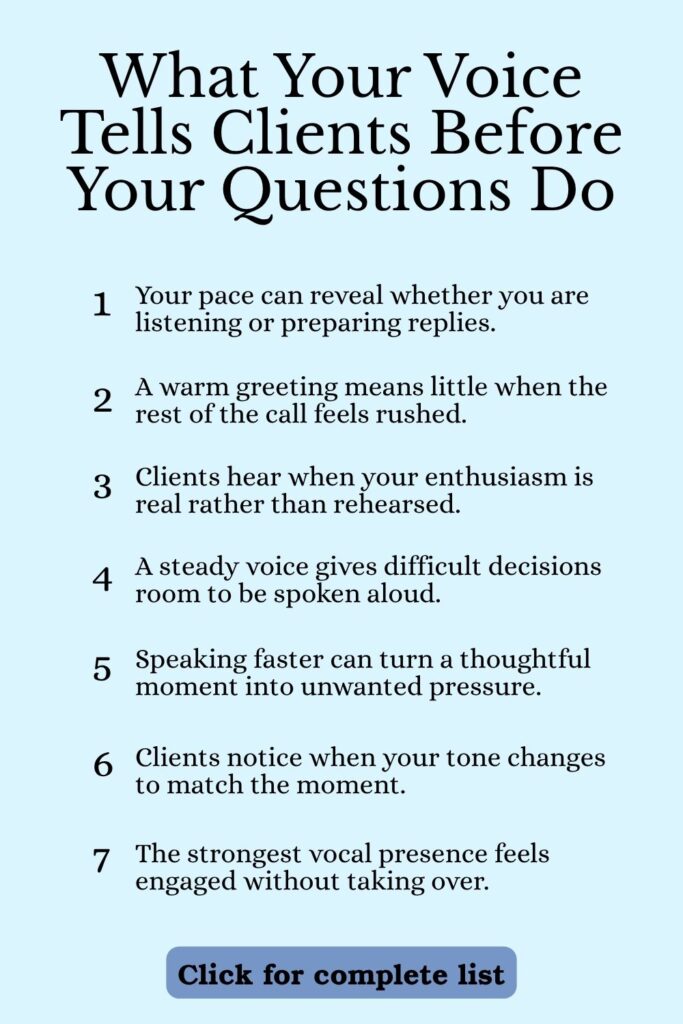
The first five minutes of a discovery call should establish trust, clarify why the prospective client is seeking coaching, and help both people determine whether working together might be a good fit.
Unlike a regular coaching session, a discovery call begins before an established coaching relationship exists.
The prospective client may not know how coaching works, what you will ask, or whether you understand the situation they are facing.
That uncertainty changes how you should approach the opening conversation.
Rather than beginning with an explanation of your packages, begin by finding out why the person booked.
SEE ALSO: If you’re a coach looking to streamline your administrative tasks and save time, check out our Coaching Administration Software. It’s a simple, effective solution designed to help you focus less on paperwork and more on what matters—coaching your clients. From scheduling to client management, our software gives you the tools to run your business efficiently. Ready to reclaim your time and boost productivity? Click or tap here.
A useful opening question is, “What made you decide to explore coaching now?”
Imagine a prospective client tells you they are considering a career change after ten years in the same industry.
They may have contacted several coaches and are trying to decide whose approach fits their needs.
Instead of immediately describing your career coaching program, explore what prompted the decision and what kind of support they are looking for.
You might ask, “What have you already tried to help you make this decision?”
Their answer may reveal that they have completed career assessments, spoken to recruiters, and identified several possible directions but still struggle to choose.
SEE ALSO: If you’re a coach looking to streamline your administrative tasks and save time, check out our Coaching Administration Software. It’s a simple, effective solution designed to help you focus less on paperwork and more on what matters—coaching your clients. From scheduling to client management, our software gives you the tools to run your business efficiently. Ready to reclaim your time and boost productivity? Click or tap here.
You now have a much clearer understanding of what they want from coaching.
You can also explain how you typically work, ask what they expect from the relationship, and discuss whether your approach suits their goals.
The same vocal techniques apply: listen carefully, reflect meaningful phrases, allow silence, and avoid making assumptions.
However, a discovery call needs one additional element: a clear and appropriate next step.
If you both believe the coaching relationship is a good fit, explain what working together would involve, including the structure of your sessions and any relevant coaching packages.
If the fit isn’t right, say so rather than trying to persuade the prospect.
SEE ALSO: If you’re a coach looking to streamline your administrative tasks and save time, check out our Coaching Administration Software. It’s a simple, effective solution designed to help you focus less on paperwork and more on what matters—coaching your clients. From scheduling to client management, our software gives you the tools to run your business efficiently. Ready to reclaim your time and boost productivity? Click or tap here.
For coaches growing their businesses, the quality of these early conversations matters because generating interest is only one part of attracting clients. People also need a straightforward way to move from finding you to deciding whether they want to work with you.
A free life coach directory listing on Life Coach Hub can help prospective clients discover your coaching services.
Once someone wants to explore working with you, a Public Booking Page gives them a way to schedule a free discovery conversation. The Public Booking Page setup guide explains how coaches can offer appointments and collect intake information before the call.
The discovery call then becomes part of a larger relationship-building process. For more on connecting visibility, consultations, and ongoing client relationships, see How to Master Funnels as a Coach (and Why You Need To).
Where LCH Core Fits

LCH Core supports telephone coaching by helping you prepare for client conversations, keep useful records, and connect what happens during sessions with the client’s ongoing progress.
The actual connection still depends on how you listen, ask questions, and respond to your client.
SEE ALSO: If you’re a coach looking to streamline your administrative tasks and save time, check out our Coaching Administration Software. It’s a simple, effective solution designed to help you focus less on paperwork and more on what matters—coaching your clients. From scheduling to client management, our software gives you the tools to run your business efficiently. Ready to reclaim your time and boost productivity? Click or tap here.
Software cannot create rapport for you, but it can help you avoid losing valuable information between appointments.
Before the first call, client profiles and intake forms help you understand what someone wants from coaching. A Public Booking Page can also simplify scheduling for prospective clients.
When beginning a new coaching relationship, a Welcome Package can provide a welcome letter, coaching agreement with electronic signature, and relevant forms. The Welcome Package setup guide explains how coaches can customize these materials for their clients.
During and after sessions, client notes allow you to preserve important phrases, decisions, concerns, and commitments. A simple record of what the client identified, rather than just what you advised, can make the next conversation more focused.
You can use the before, during, and after session workflow to keep these records connected to each coaching appointment.
Between sessions, assign journals, worksheets, goals, action items, or resources that support what the client agreed to work on.
SEE ALSO: If you’re a coach looking to streamline your administrative tasks and save time, check out our Coaching Administration Software. It’s a simple, effective solution designed to help you focus less on paperwork and more on what matters—coaching your clients. From scheduling to client management, our software gives you the tools to run your business efficiently. Ready to reclaim your time and boost productivity? Click or tap here.
For example, after a telephone session about workplace boundaries, you might assign a journal reflection to help the client notice when they say yes to responsibilities they don’t want to accept.
Across the coaching relationship, the Progress Stream and Engagement Report help you review client activity and notice changes in engagement.
The Progress Stream guide explains how coaching sessions, notes, and coaching tools can be reviewed together.
This makes it easier to return to the client’s actual goals and experiences rather than treating every telephone conversation as an isolated appointment.
The aim is simple: keep the human connection at the center of coaching while using LCH Core to organize the work that supports it.
Frequently Asked Questions About Telephone Coaching
How do you build rapport with a coaching client over the phone?
Build rapport by listening attentively, using a responsive tone of voice, reflecting the client’s language, and checking that you understand their concerns. Begin by establishing a shared purpose for the conversation and continue checking your understanding throughout the session.
SEE ALSO: If you’re a coach looking to streamline your administrative tasks and save time, check out our Coaching Administration Software. It’s a simple, effective solution designed to help you focus less on paperwork and more on what matters—coaching your clients. From scheduling to client management, our software gives you the tools to run your business efficiently. Ready to reclaim your time and boost productivity? Click or tap here.
What should a life coach say at the beginning of a telephone session?
Begin with a brief welcome followed by an open question about what the client wants to focus on. “What’s the most useful thing we could work on today?” gives the client ownership of the conversation without requiring a lengthy introduction.
How long does it take to establish trust during a coaching call?
Trust develops through consistent interactions rather than within a fixed number of minutes. The first five minutes are useful for establishing attention, understanding expectations, and creating a productive beginning, but meaningful trust is reinforced throughout the coaching relationship.
How can you read a client’s emotions without seeing their facial expressions?
Listen for changes in tone, pace, volume, word choice, and hesitation, then ask questions to clarify what those changes mean. Vocal signals may suggest something deserves exploration, but they do not reliably reveal a client’s emotions on their own.
Should coaches repeat a client’s words or paraphrase what they hear?
Coaches should use both techniques when they serve a clear purpose. Repeat meaningful phrases to preserve the client’s language, and paraphrase to check your understanding or summarize several connected ideas. Always leave room for the client to correct your interpretation.
What should a coach do when a client goes silent on the phone?
Allow a reasonable pause before deciding whether to intervene. If the silence continues, ask whether the client needs time to think or would like clarification. Avoid immediately filling the space with another question unless there is a clear reason to do so.
How do you rebuild rapport after a misunderstanding during coaching?
Acknowledge the possible misunderstanding, invite the client to clarify their perspective, and confirm what they want to explore next. Avoid defending an inaccurate interpretation. A simple correction often allows the conversation to return to the client’s actual concern.
SEE ALSO: If you’re a coach looking to streamline your administrative tasks and save time, check out our Coaching Administration Software. It’s a simple, effective solution designed to help you focus less on paperwork and more on what matters—coaching your clients. From scheduling to client management, our software gives you the tools to run your business efficiently. Ready to reclaim your time and boost productivity? Click or tap here.
Is telephone coaching as effective as face-to-face coaching?
Telephone coaching can support meaningful coaching relationships when the coach uses effective listening, questioning, and rapport-building techniques. Its effectiveness depends on factors such as the coaching approach, client needs, communication quality, and the suitability of the format. Telephone coaching requires particular attention to vocal communication because visual cues are unavailable.
Sources
Ambady, Nalini, and Robert Rosenthal. “Thin Slices of Expressive Behavior as Predictors of Interpersonal Consequences: A Meta-Analysis.” Psychological Bulletin, vol. 111, no. 2, 1992, pp. 256–74. https://doi.org/10.1037/0033-2909.111.2.256.
International Coaching Federation. 2025 ICF Core Competencies. International Coaching Federation, 2025. https://coachingfederation.org/credentialing/coaching-competencies/icf-core-competencies/.
Lynden, Jenny, and Rachel Avery. “Workplace Telephone Coaching Conversations: A Unique Institutional Practice as Revealed Through Interpretive and Empiricist Multi-Method Approaches.” Coaching: An International Journal of Theory, Research and Practice, vol. 9, no. 1, 2016, pp. 5–23. https://doi.org/10.1080/17521882.2015.1105835.
Read this next

Why Your Most Difficult Coaching Client May Not Be “Resistant” at All
How to coach difficult clients and achieve positive results!
Read More
Homework Really Helps in Coaching
Homework really helps your clients grow and develop, making it a must in your life coaching business.
Read More
9 Steps to Help You Coach Your Employees More Effectively
Learn how you can be a better leader with these simple steps
Read More