








Why Your Most Difficult Coaching Client May Not Be “Resistant” at All

One of my clients can be very difficult in the sense that he is always expects me to give him the answers I don’t have the answer to. My job as a coach is to get him to reach the answers for himself. Coaching is about conversing with someone so they can reach new levels of development, new highs and effectiveness.
Key Takeaways
- Your job is not to manufacture the client’s answer. Strong coaching keeps the client thinking, choosing, and taking responsibility instead of turning the coach into the decision-maker.
- Repeated requests for advice may signal a coaching agreement problem. Clarify what the client expects from you, what coaching can provide, and who owns the final decisions.
- “I don’t know” is information, not failure. It can mean the client needs more time, fears the consequences of choosing, wants you to decide, or needs the question made smaller.
- A difficult conversation can become a power struggle when you start pushing. Notice when you are arguing for change harder than the client is and return to curiosity.
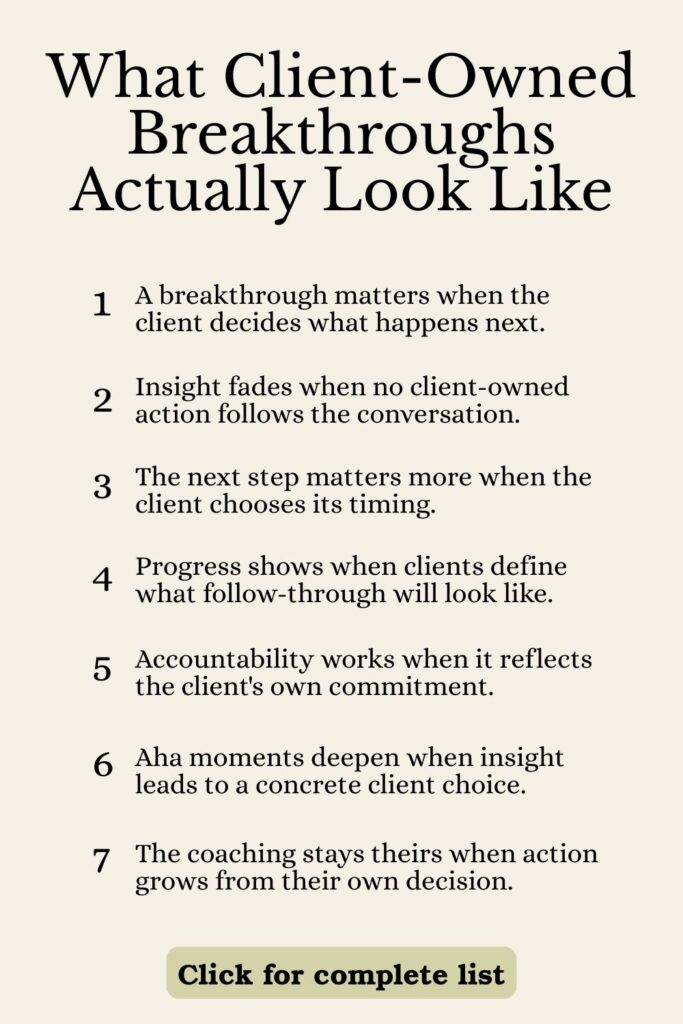
- Insight matters only when the client owns what happens next. Let the client define the action, evidence of progress, and accountability that follows the breakthrough.
How Do You Coach a Difficult Client Who Wants You to Give Them the Answers?
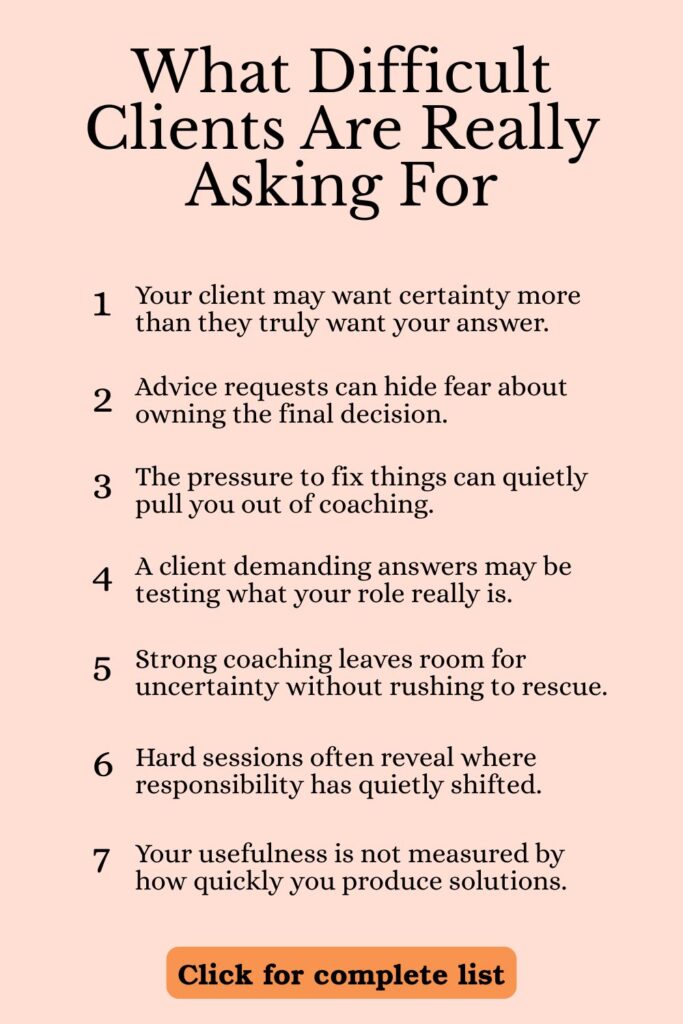
You coach a client who wants answers by staying clear about your role, exploring what sits underneath their demand for direction, and returning responsibility for the final choice to them. You can offer observations and challenge their thinking, but the coaching process should not depend on you deciding what they should do.
The International Coaching Federation’s 2025 Core Competencies make this distinction clear. Coaches are expected to define what coaching is and is not, agree on responsibilities within the relationship, partner with clients around desired outcomes, and revisit the agreement when the coaching approach is no longer meeting the client’s needs. ICF’s current competency framework also centers the client’s own insight and autonomy rather than a coach primarily telling the client what to do.
A difficult session therefore does not require you to win an argument or suddenly produce a brilliant solution. It requires you to stay present, clarify what the client needs from the conversation, challenge without taking over, and help the client choose what happens next.
How Do You Handle a Client Who Refuses to Dig Deeper?
How do you do that though when the client is difficult and is refusing to dig deep for his own answers and is full of doubt?
To effectively handle clients like these, it is important to stay unbribable, to stay true to ourselves and to trust in our power as a coach. Take a stand as a coach to be connected to your heart. When the conversation gets tough, remind yourself: “I am connected to my heart.” It is important to remain confident in our coaching methods, even during the rough bits.
SEE ALSO: If you’re a coach looking to streamline your administrative tasks and save time, check out our Coaching Administration Software. It’s a simple, effective solution designed to help you focus less on paperwork and more on what matters—coaching your clients. From scheduling to client management, our software gives you the tools to run your business efficiently. Ready to reclaim your time and boost productivity? Click or tap here.
Why Does a Client Keep Asking You for the Answer?
A client may keep asking for the answer because making the decision themselves feels riskier than handing responsibility to you.
You can hear this in questions such as, “What would you do?” “Which one should I choose?” or “I’m paying you, so why can’t you just tell me what works?”
Sometimes the client genuinely believes coaching means buying expert advice. Sometimes they know what they want but fear being responsible for the consequences. Sometimes they want reassurance that there is one correct path before they move.
Your own reaction matters too. When a client keeps pressing for answers, you may feel an urge to prove that you are useful by fixing the problem for them.
Motivational Interviewing calls a similar helping impulse the righting reflex. SAMHSA describes it as the natural desire to jump in, direct the client toward a particular change, and fix what appears wrong. Its guidance warns that acting on this reflex can create more sustain talk and discord rather than greater motivation. SAMHSA’s Motivational Interviewing guidance also warns against arguing with a client because the conversation can quickly become a power struggle.
So when a client asks, “Just tell me what to do,” do not automatically answer the surface question.
SEE ALSO: If you’re a coach looking to streamline your administrative tasks and save time, check out our Coaching Administration Software. It’s a simple, effective solution designed to help you focus less on paperwork and more on what matters—coaching your clients. From scheduling to client management, our software gives you the tools to run your business efficiently. Ready to reclaim your time and boost productivity? Click or tap here.
You might ask:
- “What makes it important that I choose this for you?”
- “What feels risky about choosing for yourself?”
- “What do you already know that you wish I would confirm?”
- “If I could not give you an answer, what would you need to work through before you could decide?”
The goal is not to refuse help. The goal is to discover what kind of help the client actually needs.
How Do You Re-Contract When a Client Wants Advice Instead of Coaching?
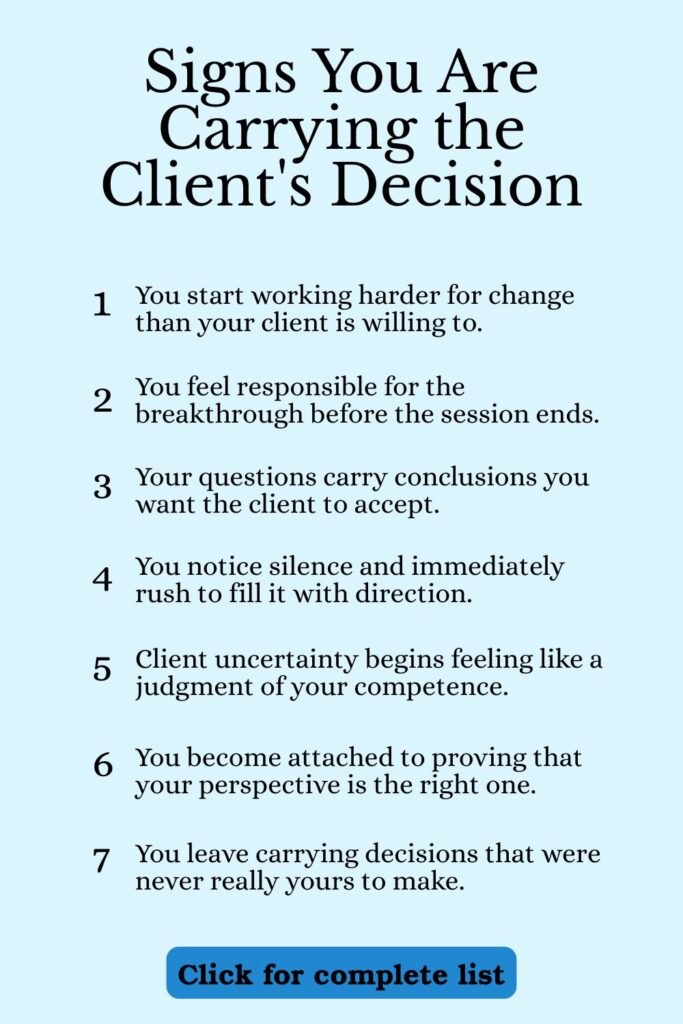
You re-contract by making the difference between coaching and advice explicit, then agreeing with the client on what the relationship should look like from this point forward.
A client may believe, “I am paying you to tell me what works.”
You may believe, “I am here to help you discover what works for you.”
If neither of you says that aloud, both people can leave the same session feeling disappointed.
SEE ALSO: If you’re a coach looking to streamline your administrative tasks and save time, check out our Coaching Administration Software. It’s a simple, effective solution designed to help you focus less on paperwork and more on what matters—coaching your clients. From scheduling to client management, our software gives you the tools to run your business efficiently. Ready to reclaim your time and boost productivity? Click or tap here.
The 2025 ICF Core Competencies specifically call on coaches to define what coaching is and is not, clarify what each person is responsible for, assess coach-client compatibility, and revisit the coaching agreement when necessary. That makes re-contracting part of the work, not evidence that the coaching has failed. ICF’s Establishes and Maintains Agreements competency gives a clear professional framework for this conversation.
You might say, “I hear that you want more direct answers from me. My role in coaching is to help you examine what you want, what is getting in the way, and what you choose to do. I can share observations and challenge your thinking, but I do not want to make your decisions for you. Is that still the kind of relationship you want?”
Then get specific.
What does the client want more of? Challenge? Structure? Accountability? Brainstorming? Reflection? A clearer process?
What do they expect you not to do?
What does responsibility for action look like between sessions?
SEE ALSO: If you’re a coach looking to streamline your administrative tasks and save time, check out our Coaching Administration Software. It’s a simple, effective solution designed to help you focus less on paperwork and more on what matters—coaching your clients. From scheduling to client management, our software gives you the tools to run your business efficiently. Ready to reclaim your time and boost productivity? Click or tap here.
If you use LCH Core, this kind of expectation-setting can also be carried into client onboarding through a Welcome Package with a welcome letter, coaching agreement with electronic signature, and forms. Keeping the agreement and intake information with the client’s profile and notes makes it easier to return to the original expectations when the relationship starts drifting. The LCH Core support center is the appropriate place to check setup guidance for these tools.
The agreement does not replace a live conversation. It gives that conversation something concrete to return to.
What If Neither the Coach Nor the Client Has the Answer?
You don’t have the answer, I don’t have the answer. Life is not about finding the answer, it’s about the journey and the process of expansion. Connecting our desires, and going in the direction of our desires.
I live for that moment when a man says: ” ‘aha’ yeah that is it… I will go this way.”
As we all know, most men find it difficult to admit that they also don’t know. Mental, emotional and physical possessions can get on top of you to the point that “I don’t know” is no longer something to smile at, it’s something to fear and to dread.
What Should You Do When a Client Says “I Don’t Know”?
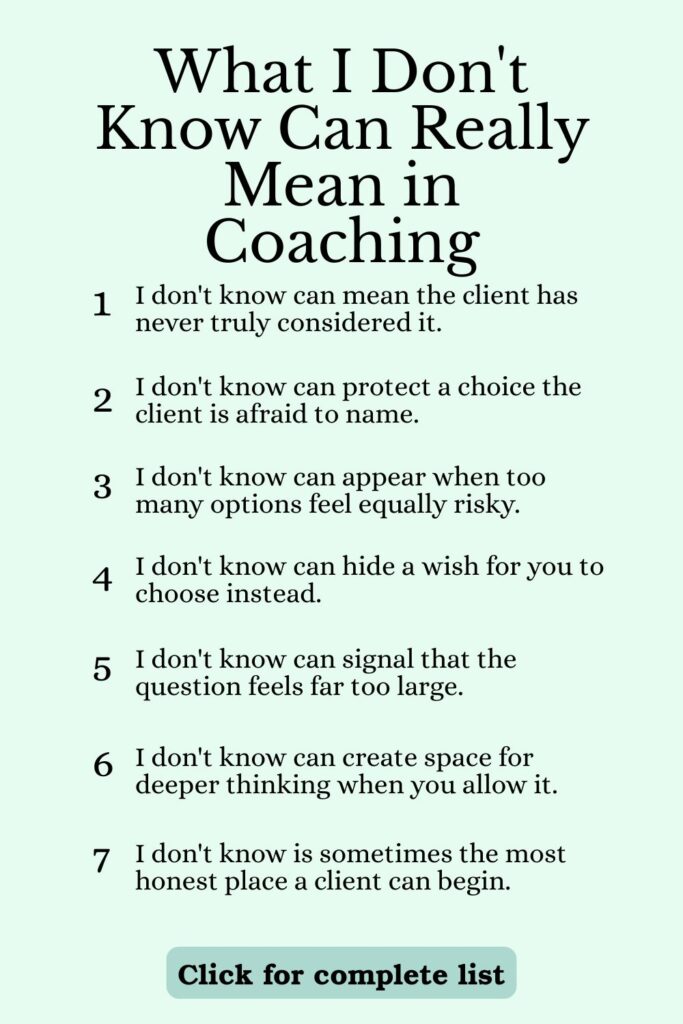
Treat “I don’t know” as a clue about what needs to happen next, not as an answer you must immediately break through.
SEE ALSO: If you’re a coach looking to streamline your administrative tasks and save time, check out our Coaching Administration Software. It’s a simple, effective solution designed to help you focus less on paperwork and more on what matters—coaching your clients. From scheduling to client management, our software gives you the tools to run your business efficiently. Ready to reclaim your time and boost productivity? Click or tap here.
The same three words can mean very different things.
“I genuinely haven’t thought about it.”
Give the client room to think. Silence may be more useful than another question fired immediately after the first one.
“I know, but I don’t want to say it.”
The issue may be the consequence of admitting the answer. Ask what would become real if they said it out loud.
“I see too many options.”
The client may need help comparing choices rather than digging for one hidden truth.
“I want you to decide.”
Responsibility itself may be uncomfortable. Explore what choosing would make them responsible for.
“The question is too big.”
Shrink it.
SEE ALSO: If you’re a coach looking to streamline your administrative tasks and save time, check out our Coaching Administration Software. It’s a simple, effective solution designed to help you focus less on paperwork and more on what matters—coaching your clients. From scheduling to client management, our software gives you the tools to run your business efficiently. Ready to reclaim your time and boost productivity? Click or tap here.
Instead of “What do you want from your life?” ask, “What do you want to be different by Friday?” Instead of “What career should you pursue?” ask, “Which part of your current work do you want more of?”
You do not need to punish “I don’t know” with ten smarter questions. Find out what kind of “I don’t know” is in the room.
What Happens When a Client Admits They Do Not Know?
There is nothing wrong with admitting to yourself when you feel lost and do not know what to do. Admit that you don’t know. Even though you don’t know or you have not achieved or produced the result, your heart speaks the truth and will help you. Yes, it is your heart, that has all the answers, and it can guide you in the direction of your desires by giving you concrete steps to take in order to move forward.
Is the Client Resistant, or Is the Conversation in Discord?
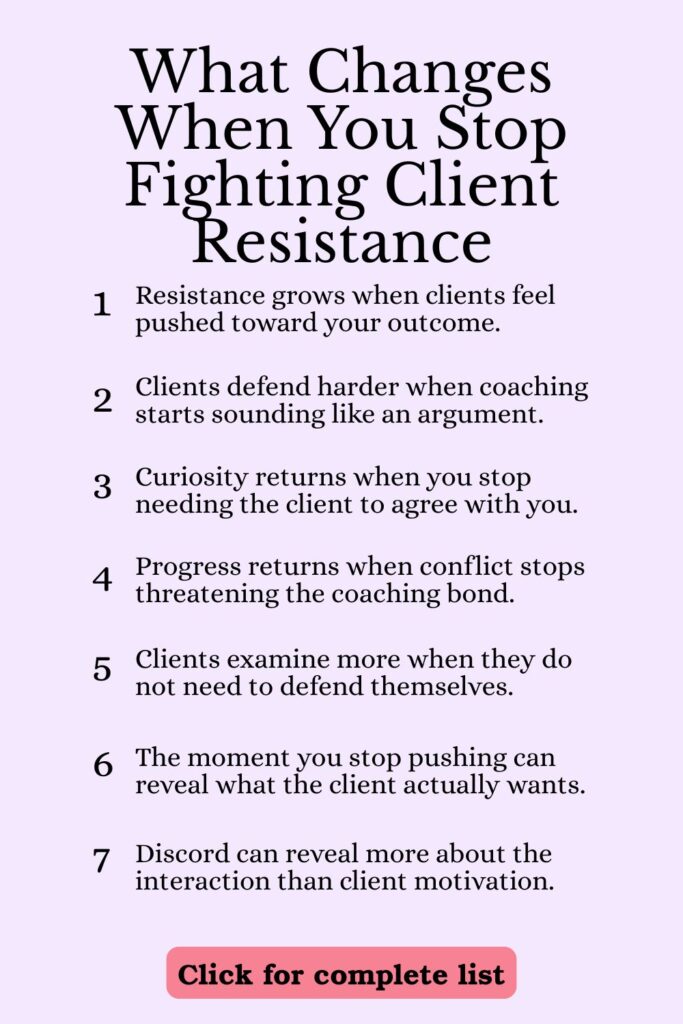
What looks like a resistant client may sometimes be a sign that the coaching conversation itself has turned into a tug-of-war.
Watch what happens when you become more invested in the client’s change than the client is.
You make a strong point. They explain why it will not work.
SEE ALSO: If you’re a coach looking to streamline your administrative tasks and save time, check out our Coaching Administration Software. It’s a simple, effective solution designed to help you focus less on paperwork and more on what matters—coaching your clients. From scheduling to client management, our software gives you the tools to run your business efficiently. Ready to reclaim your time and boost productivity? Click or tap here.
You challenge harder. They defend harder.
You produce another reason they should act. They produce another reason they cannot.
Soon the client is defending the exact position you hoped they would question.
Motivational Interviewing describes discord as tension in the helping relationship and warns that a directive style can intensify it. SAMHSA specifically cautions helpers against arguing to prove a point because the client is then likely to take the opposite side.
That gives you a useful diagnostic question: Am I still exploring with this client, or have I started arguing for the outcome?
Observable signs that the conversation is drifting into a power struggle include:
SEE ALSO: If you’re a coach looking to streamline your administrative tasks and save time, check out our Coaching Administration Software. It’s a simple, effective solution designed to help you focus less on paperwork and more on what matters—coaching your clients. From scheduling to client management, our software gives you the tools to run your business efficiently. Ready to reclaim your time and boost productivity? Click or tap here.
- You are talking more than the client.
- Your questions are starting to sound like arguments with question marks.
- The client keeps defending why change is impossible.
- You feel determined to make the client see what you see.
- The client begins defending their intelligence, judgment, or competence.
- You become attached to producing an “aha” before the session ends.
When you notice that pattern, stop pushing.
Return to the client’s goal.
“What do you want from this conversation now?”
“What part of what I am saying does not fit for you?”
“What do you see differently?”
“What would feel useful to explore instead?”
SEE ALSO: If you’re a coach looking to streamline your administrative tasks and save time, check out our Coaching Administration Software. It’s a simple, effective solution designed to help you focus less on paperwork and more on what matters—coaching your clients. From scheduling to client management, our software gives you the tools to run your business efficiently. Ready to reclaim your time and boost productivity? Click or tap here.
Your job is not to defeat the client’s resistance. Your job is to create conditions where the client can examine their own thinking without needing to defend it from you.
How Do You Stay Connected to Your Heart Under Pressure?
For everyone who is not connected with their heart, too bad. You need to cherish this part of your being as much as you should cherish the physical body. Meditate again and again until the intelligence of your heart awakes. Once it is awake, it will give you the answers.
Don’t you go be disappointed if the answer was something super simple. You may feel like a dumb ass or dumbstruck, but that’s ok.
Life is actually simple. Not easy. That’s why they say “Life is difficult” because following the simple isn’t always easy.
What Does Staying Connected to Your Heart Look Like in Practice?
Staying connected to your heart means remaining grounded in your values and in service of the client even when the conversation becomes uncomfortable.
You can make this practical.
SEE ALSO: If you’re a coach looking to streamline your administrative tasks and save time, check out our Coaching Administration Software. It’s a simple, effective solution designed to help you focus less on paperwork and more on what matters—coaching your clients. From scheduling to client management, our software gives you the tools to run your business efficiently. Ready to reclaim your time and boost productivity? Click or tap here.
Notice the instant you want to defend yourself.
Notice when you want the client to admit that you are right.
Notice when silence makes you nervous enough to start filling it.
Notice when you are preparing your next question instead of hearing the answer to the current one.
Then come back to the client.
Slow your pace.
SEE ALSO: If you’re a coach looking to streamline your administrative tasks and save time, check out our Coaching Administration Software. It’s a simple, effective solution designed to help you focus less on paperwork and more on what matters—coaching your clients. From scheduling to client management, our software gives you the tools to run your business efficiently. Ready to reclaim your time and boost productivity? Click or tap here.
Listen to their exact words.
Let an observation remain an observation instead of turning it into a verdict.
Ask a question because you are curious about the answer, not because you already know what you want them to say.
You can still be direct. You can still challenge. You can still say, “I notice that every option you describe ends with a reason you cannot take it.”
The difference is attachment.
A grounded coach can offer that observation and allow the client to reject it, correct it, sit with it, or discover something new from it. You do not need to force the insight to prove that the coaching is working.
SEE ALSO: If you’re a coach looking to streamline your administrative tasks and save time, check out our Coaching Administration Software. It’s a simple, effective solution designed to help you focus less on paperwork and more on what matters—coaching your clients. From scheduling to client management, our software gives you the tools to run your business efficiently. Ready to reclaim your time and boost productivity? Click or tap here.
That is what staying true to your stand can look like in the middle of a hard session.
What Role Does Self-Love Play in This Coaching Approach?
As a coach, it is important to me for the client to have or know the following things:
- Desires
- Commitment
- Heart connection
- Possessions on intellectual level
- Confidence, and if it is situational, core confidence.
Considering all this, it all comes down to self-love. We talked about the ground level from which everything has to build up and up. Well… the truth is… yes, self-love really is the answer to it all.
How Do You Stay True to Your Coaching Role When Challenged?
Tuning into you desire is where the starting point is. Once you know your desire, the rest of it is easy, you go in the direction of that answer.
Now, I took the stand to stay connected with my heart through out the coaching session and I could see how this brought my client to have the ‘aha’ moment several times, which cause him to attack me because the answers were simple.
When you take the stand – “I am connected with my heart” – you overcome the attacks because you stay true to your stand. That’s all you got. At the end of the day, being my word is all I have, is all you have. No attack is stronger than your stand to stay connected with your heart.
SEE ALSO: If you’re a coach looking to streamline your administrative tasks and save time, check out our Coaching Administration Software. It’s a simple, effective solution designed to help you focus less on paperwork and more on what matters—coaching your clients. From scheduling to client management, our software gives you the tools to run your business efficiently. Ready to reclaim your time and boost productivity? Click or tap here.
This connection may sometimes be broken, it may be laying there dormant, in which case, you wake it up through meditation and through daily practice, through the willingness to wake it up. Sending the signals back down from the mind into the heart intelligence centre.
This difficult client was stubborn, fiery and defensive because the sad truth that there is no answer is sad. In this sadness, it is our duty to find conviction and start the good fight. The joy and the happy and the following of the path of desire, hence expansion.
What Happens When a Client Starts Following Their Desires?
Yes, dear reader… follow your desire.
During the session, he asked me so what will the next session be about, to which I said, I don’t know, this is your time, my job is to empower you. Then he asked what if I don’t get the results I want, that I am paying for. I said, then I will recommend you to a competitor coach of mine that has a different style and may be it will suit you better until he drills into your head that you have all the answers, it’s about taking action and staying true to your desire.
- Hope is not enough. It is for the disbeliever, for the one who is still thinking something is about to happen when in reality, nothing is going to happen until you decide what is going to happen. You should think more in terms of “I got the purpose of life, the purpose of being here on Earth, so I have to move towards reaching my desires.”
- Faith. I have faith more than you know, my pocket is full of it. I have faith in people, I know we are made up of love and I know we are all able to reach that place.
When Is It Time to Pause, Refer, or End the Coaching Relationship?
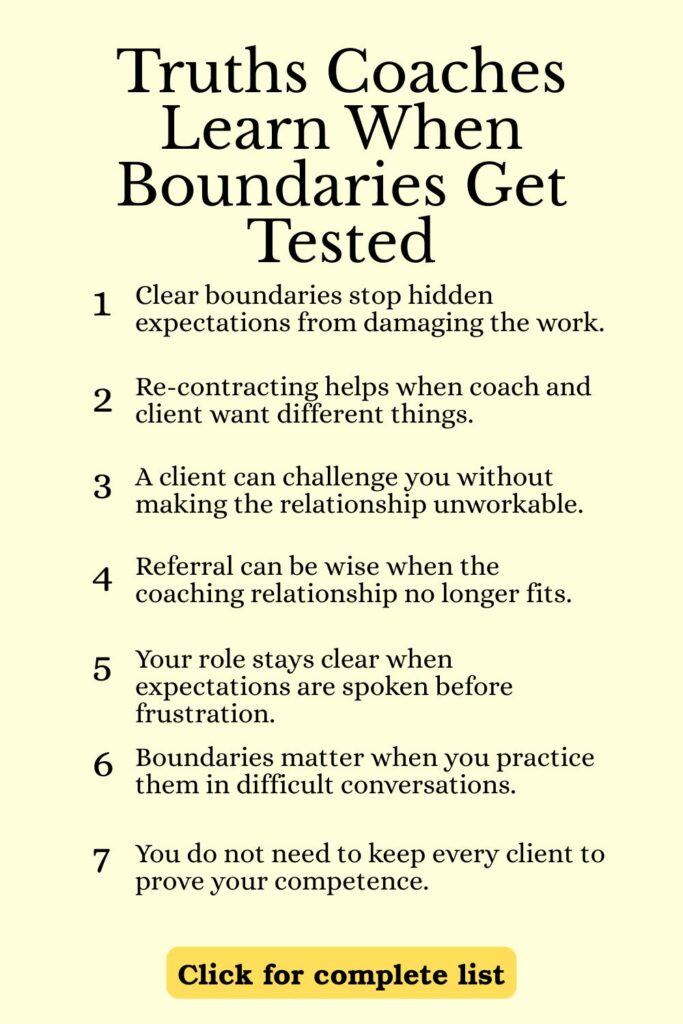
It is time to reconsider the coaching relationship when the client consistently needs something you cannot appropriately provide, the agreement no longer fits, or the work is repeatedly failing to serve the client’s goals.
One uncomfortable session is not automatically a bad fit.
SEE ALSO: If you’re a coach looking to streamline your administrative tasks and save time, check out our Coaching Administration Software. It’s a simple, effective solution designed to help you focus less on paperwork and more on what matters—coaching your clients. From scheduling to client management, our software gives you the tools to run your business efficiently. Ready to reclaim your time and boost productivity? Click or tap here.
Neither is disagreement.
Neither is a client challenging you.
The question is whether there is still a workable coaching relationship underneath the tension.
You may need to pause or re-contract when the client repeatedly asks for consulting-style advice even after the difference has been clarified. You may need to refer when the client’s needs move outside your competence or outside the scope of coaching. You may need to end the engagement when the same conflict keeps replacing the actual coaching work.
The ICF competency model explicitly includes determining coach-client compatibility, revisiting the coaching agreement when needed, and closing a coaching relationship in a way that respects the client and the coaching experience.
A useful question is not, “Can I handle this difficult person?”
SEE ALSO: If you’re a coach looking to streamline your administrative tasks and save time, check out our Coaching Administration Software. It’s a simple, effective solution designed to help you focus less on paperwork and more on what matters—coaching your clients. From scheduling to client management, our software gives you the tools to run your business efficiently. Ready to reclaim your time and boost productivity? Click or tap here.
Ask, “Is this relationship still helping this client do the work they came here to do?”
If the answer keeps becoming no, referral can be an act of professional judgment rather than defeat.
You may know an excellent coach with a more directive style. The client may actually need consulting. They may need a different professional altogether.
You do not have to keep a client simply to prove you can.
How Do You Turn an Aha Moment Into Client-Owned Action?
An aha moment becomes useful when the client decides what they will do with it.
Insight alone can feel powerful inside a session and disappear by Tuesday.
SEE ALSO: If you’re a coach looking to streamline your administrative tasks and save time, check out our Coaching Administration Software. It’s a simple, effective solution designed to help you focus less on paperwork and more on what matters—coaching your clients. From scheduling to client management, our software gives you the tools to run your business efficiently. Ready to reclaim your time and boost productivity? Click or tap here.
Suppose a client suddenly says, “I already know I want to leave this job. I have just been waiting for someone to tell me it is okay.”
Do not rush from that insight to, “Great, then resign.”
The client has discovered something. Now let them own what happens next.
Ask:
- “What do you want to do with what you just realized?”
- “What is the smallest action that would move this forward?”
- “When will you do it?”
- “What will tell you that you followed through?”
- “What could stop you?”
- “What support do you want from me?”
They might decide to update their resume. Speak with a recruiter. Research three roles. Talk with their partner. Define the conditions that would need to be true before they resign.
Their step. Their timing. Their responsibility.
SEE ALSO: If you’re a coach looking to streamline your administrative tasks and save time, check out our Coaching Administration Software. It’s a simple, effective solution designed to help you focus less on paperwork and more on what matters—coaching your clients. From scheduling to client management, our software gives you the tools to run your business efficiently. Ready to reclaim your time and boost productivity? Click or tap here.
This matches ICF’s Facilitates Client Growth competency, which emphasizes partnering with clients to turn awareness into goals, actions, and accountability while preserving client autonomy.
If you use LCH Core, this is where coaching tools can support the commitment after the call. A client-generated next step can become an action item or goal, a journal can hold further reflection, and a worksheet or resource can be assigned when structure would help. You can then review client activity through the Progress Stream rather than hoping both of you remember what was decided. LCH Core’s project documentation describes the Progress Stream as bringing client activity and coaching tools together so progress can be reviewed across the relationship. For broader thinking on making progress visible to clients, see The Simple Math of Client Lifetime Value for Coaches.
The tool does not decide the action. The client does.
That is the point.
What Are the Three Steps to Reach Your Desire?
All in all, I teach my clients three steps to help them:
- Heart Meditation
- Journal and to connect with your inner child
- Go through the Six steps process to the Self and feeling alive
In doing so, I foresee my clients’ heart cracking open, speaking up, standing up, showing up. I don’t just hope it’s going to do something for them. No…. I hold space and faith that their heart connection will awaken. And if it doesn’t, it’s going to be sad. It’s not his time yet. If nothing happens yet again then we will look at what stories are running through each of their lives.
SEE ALSO: If you’re a coach looking to streamline your administrative tasks and save time, check out our Coaching Administration Software. It’s a simple, effective solution designed to help you focus less on paperwork and more on what matters—coaching your clients. From scheduling to client management, our software gives you the tools to run your business efficiently. Ready to reclaim your time and boost productivity? Click or tap here.
Where LCH Core Fits
LCH Core fits around the coaching conversation by helping you preserve agreements, client context, reflection, commitments, and evidence of progress without taking ownership away from the client.
For difficult-client work, the most relevant uses are simple.
Set expectations before the work begins.
A Welcome Package can contain your welcome letter, coaching agreement with electronic signature, and forms. That gives you a written reference point when a client later expects a different kind of relationship.
Keep the client’s context together.
Client management can hold client profiles, notes, and intake forms so you can revisit what the client originally wanted, what patterns have appeared, and what has changed.
Give reflection somewhere to go.
Journals and worksheets can extend a question beyond the live session when the client needs more time than the conversation allows.
Turn client decisions into visible commitments.
Goals and action items give the client’s chosen next step a concrete form instead of leaving it as a good intention.
SEE ALSO: If you’re a coach looking to streamline your administrative tasks and save time, check out our Coaching Administration Software. It’s a simple, effective solution designed to help you focus less on paperwork and more on what matters—coaching your clients. From scheduling to client management, our software gives you the tools to run your business efficiently. Ready to reclaim your time and boost productivity? Click or tap here.
Look at progress across time.
The Progress Stream can help you review activity and follow-through across the relationship. That makes it easier to ask a grounded question such as, “You have named this goal in three sessions, but the actions around it have not moved. What do you think is happening?”
None of these tools replaces presence, judgment, or a difficult conversation. They simply give the work structure around the conversation. For a broader explanation of how coaching tools, client management, onboarding, and progress tracking fit together, see Best Coaching Software for Life Coaches: What to Look For Before You Choose or the LCH Core support center.
The coaching still belongs to you and the client. LCH Core gives you a place to keep the process connected.
FAQ
How do you coach a difficult client who wants you to give them the answers?
You keep the client responsible for the decision while helping them understand what is making the decision difficult. Clarify your role, explore what they want you to decide for them, and help them examine their own options, values, fears, and desired outcome.
What do you do when a coaching client keeps saying “I don’t know”?
You identify what the “I don’t know” means before asking another question. The client may need thinking time, fear admitting the answer, feel stuck between options, want you to take responsibility, or need a much smaller question.
How do you deal with a resistant coaching client?
You stop trying to overpower the resistance and examine what is happening in the interaction. Return to the client’s goal, ask what does not fit for them, and notice whether your own pushing is making the client defend their current position more strongly.
SEE ALSO: If you’re a coach looking to streamline your administrative tasks and save time, check out our Coaching Administration Software. It’s a simple, effective solution designed to help you focus less on paperwork and more on what matters—coaching your clients. From scheduling to client management, our software gives you the tools to run your business efficiently. Ready to reclaim your time and boost productivity? Click or tap here.
Should a life coach ever give a client advice?
A coach can share an observation or relevant information when it fits the agreed relationship, but coaching should not become a process where the coach routinely makes the client’s decisions. If the client wants expert prescriptions, clarify whether they are actually asking for consulting or another form of support.
What do you do when a coaching client becomes defensive or argumentative?
You lower the pressure and become curious about the disagreement instead of trying to win it. Ask what the client sees differently, what felt inaccurate or threatening in the conversation, and what they need to explore next.
How do you set boundaries with a difficult coaching client?
You set boundaries by stating clearly what you offer, what you do not offer, what behavior is workable within the relationship, and what each person is responsible for. Put the agreement into practice rather than relying on an unspoken expectation.
When should a coach refer a client to someone else?
A coach should consider referral when the client’s needs fall outside the coach’s competence or scope, when another professional is better suited to the problem, or when the coaching relationship repeatedly fails to serve the client’s stated goals.
What should you do when coaching is not working for a client?
You revisit the goal, the coaching agreement, the client’s expectations, and the evidence of progress before simply doing more of the same. Decide together whether the approach needs to change, the engagement should pause, or another professional would be a better fit.
What Do You Desire, My Friend?

Desire. That is it, if nothing happens then they have a huge resistance to bring to light, to admit their desires. Desires can be messy, they can be dark and filthy. Yet, it is the only force that can drive us forward. Everything else comes in handy to support us in living out our desires, If nothing happens, then their desire magnet needs to be shaken up.
SEE ALSO: If you’re a coach looking to streamline your administrative tasks and save time, check out our Coaching Administration Software. It’s a simple, effective solution designed to help you focus less on paperwork and more on what matters—coaching your clients. From scheduling to client management, our software gives you the tools to run your business efficiently. Ready to reclaim your time and boost productivity? Click or tap here.
Sources
International Coaching Federation. “2025 ICF Core Competencies.” International Coaching Federation, 2025, https://coachingfederation.org/wp-content/uploads/2025/09/icf-cs-core-competencies-2025.pdf.
International Coaching Federation. “2025 ICF Core Competencies.” International Coaching Federation, https://coachingfederation.org/credentialing/coaching-competencies/icf-core-competencies/. Accessed 9 Sept. 2026.
Substance Abuse and Mental Health Services Administration. “Chapter 3: Motivational Interviewing as a Counseling Style.” Enhancing Motivation for Change in Substance Use Disorder Treatment: Updated 2019, Treatment Improvement Protocol Series, no. 35, Substance Abuse and Mental Health Services Administration, 2019. NCBI Bookshelf, National Library of Medicine, https://www.ncbi.nlm.nih.gov/books/NBK571068/.
Substance Abuse and Mental Health Services Administration. “Counselor Note: The Righting Reflex.” Enhancing Motivation for Change in Substance Use Disorder Treatment: Updated 2019, Treatment Improvement Protocol Series, no. 35, Substance Abuse and Mental Health Services Administration, 2019. NCBI Bookshelf, National Library of Medicine, https://www.ncbi.nlm.nih.gov/books/NBK571075/box/ch7.b7/.
Read this next
Why Journaling Is One of the Most Underrated Client Retention Tools in Coaching
Journaling is a must for all your coaching and courses to help your clients reach their best. Find out why.
Read More
Coach like a Pro: Coaching Conversation Script, Samples and Template
Use a sound coaching conversation script for your client to visualize their path and realize their goals!
Read More
Make Your Students More Receptive
It doesn’t matter if you are teaching adults in a boardroom or tiny tots in a preschool; you need a strategy.
Read More