






Most Coaches Skip This After a Session, and It Could Be Costing Them Their Best Insights

One Habit That Can Transform Your Coaching Practice
We can spend so much time working on our business, looking at new ways of generating clients and researching new coaching techniques that can help our clients develop. These are all valid and yet there is one simple step that we often miss: reflecting on our practice.
When reflecting, we can consider our approach to our coaching business, as well as the time we actually spend with clients, how we interact, and the approaches we take to help them progress.
Key Takeaways
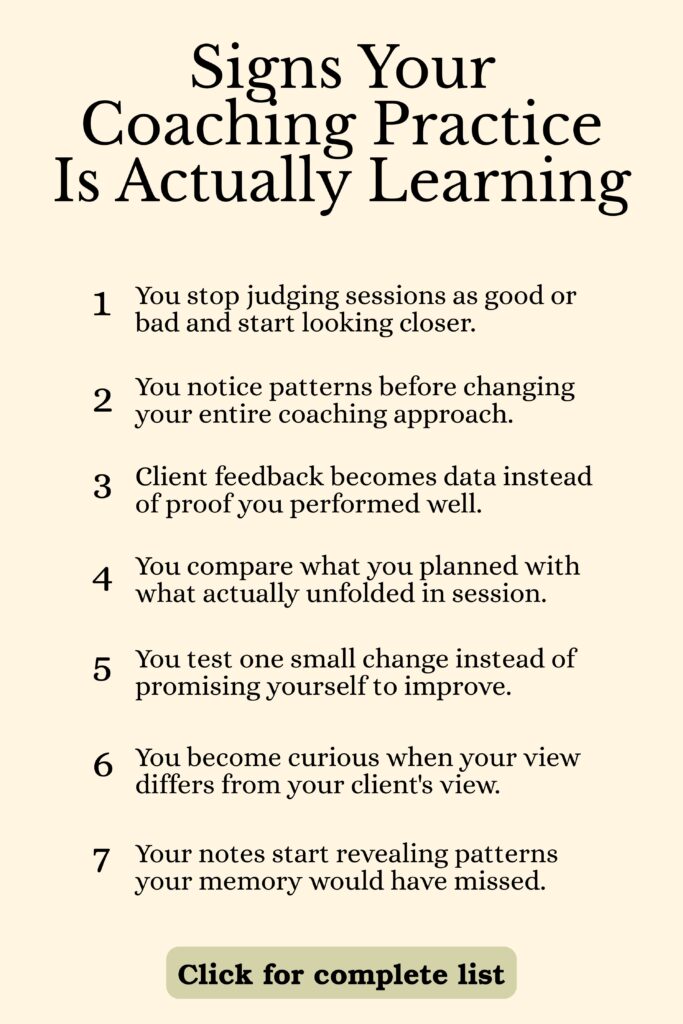
- Reflection becomes useful when it changes behavior. A strong review compares what you intended, what actually happened, why you changed course, how the client responded, and what you will test next.
- One session is evidence, not a pattern. Look across several sessions before changing your method so one awkward conversation does not send you in the wrong direction.
- Client feedback is data, not a grade. A 1-to-10 rating matters less than the explanation behind it, particularly what could have made the session more useful.
- Your view and the client’s view may differ. That mismatch can expose assumptions about what a good session looks like and give you something concrete to examine.
- Reflection works best as a loop. Notice, compare, ask, test, and review again. The goal is not perfect sessions. It is a coaching practice that learns from its own work.
How Do You Reflect on Your Coaching Practice?
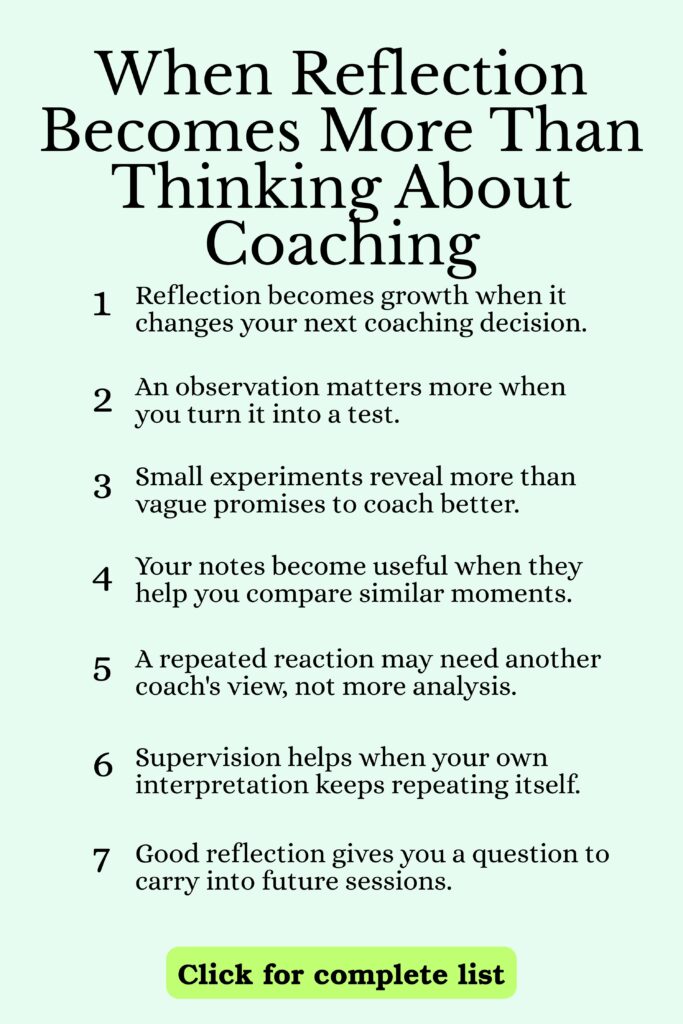
You reflect on your coaching practice by systematically comparing what you intended to do with what actually happened, examining the choices you made, considering the client’s response, and deciding what you will do differently next time.
Useful reflection is more specific than asking, “Was that a good session?” Look at observable moments instead. Where did you change direction? Which question opened something useful? Where did the conversation stall? What did the client do after you challenged them, stayed silent, reframed something, or moved toward action?
Then close the loop. Choose one thing to repeat, change, investigate, or test. Reflection becomes professional development when today’s observation affects tomorrow’s practice.
What Should You Ask Yourself After a Coaching Session?
I have developed a simple reflection tool that can help you to make the most of the learning that is readily available to you:
SEE ALSO: If you’re a coach looking to streamline your administrative tasks and save time, check out our Coaching Administration Software. It’s a simple, effective solution designed to help you focus less on paperwork and more on what matters—coaching your clients. From scheduling to client management, our software gives you the tools to run your business efficiently. Ready to reclaim your time and boost productivity? Click or tap here.
- This week I planned to:
- What actually happened?
- What did I do differently at the time, from what I had planned?
- How did I feel about it while it was happening?
- What went well?
- What could have been improved?
- Colleagues’ viewpoint: (if any)
- Other viewpoints: (if any)
- Theory related to it: (if any)
- How do I feel about it now?
- Action plan: (SMARTER: Specific, Measurable, Achievable, Resourced, Timebound, Ethical, Reviewed)
The power of these questions is in the comparison. “What actually happened?” becomes much more useful when you put it beside “What did I plan?” and “What did I do differently?”
That gap is often where the learning is.
How Do You Reflect During a Coaching Session, Not Just After It?
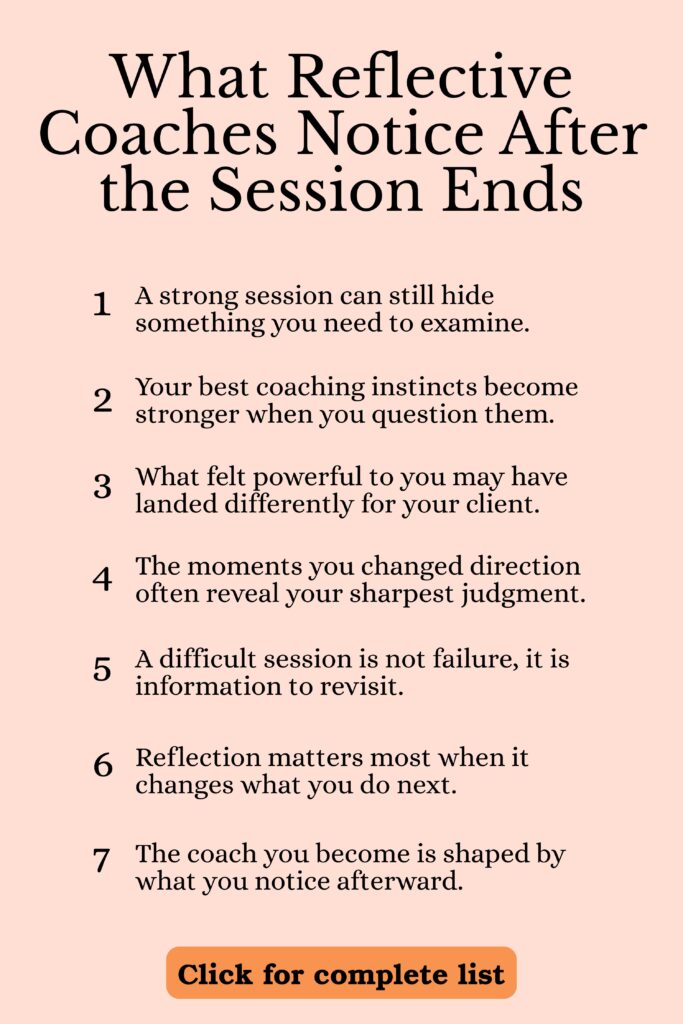
You can reflect while coaching by noticing what is happening in real time, making a deliberate adjustment, and later examining whether that adjustment helped.
Donald Schön described this distinction as reflection-in-action and reflection-on-action. Reflection-in-action happens while you are working. Reflection-on-action happens afterward, when you revisit what happened, why you responded as you did, and what alternatives were available.
Imagine you planned to spend part of a session exploring a client’s beliefs about asking for a promotion. Ten minutes in, you notice that every question produces increasingly abstract answers.
You change direction.
SEE ALSO: If you’re a coach looking to streamline your administrative tasks and save time, check out our Coaching Administration Software. It’s a simple, effective solution designed to help you focus less on paperwork and more on what matters—coaching your clients. From scheduling to client management, our software gives you the tools to run your business efficiently. Ready to reclaim your time and boost productivity? Click or tap here.
Instead of asking another conceptual question, you say, “Take me back to the last meeting where you wanted to speak up but didn’t. What happened?”
That is reflection-in-action. You noticed a signal and adapted.
After the session, reflection-on-action goes further:
- What told me the original approach was not working?
- Why did I choose a concrete example instead?
- What happened immediately after I changed approach?
- Did the client become clearer, more engaged, or more able to identify an action?
- Would I make the same change in a similar situation?
That review helps you separate an instinctive reaction from a useful coaching judgment.
Are You Learning From a Pattern or Overreacting to One Session?
A single difficult session should prompt reflection, but several similar sessions are what begin to reveal a pattern.
If one client struggles with a goal-setting exercise, the exercise may be completely appropriate and simply wrong for that client at that moment. If four clients repeatedly lose momentum at the same point in your process, you have something more useful to investigate.
SEE ALSO: If you’re a coach looking to streamline your administrative tasks and save time, check out our Coaching Administration Software. It’s a simple, effective solution designed to help you focus less on paperwork and more on what matters—coaching your clients. From scheduling to client management, our software gives you the tools to run your business efficiently. Ready to reclaim your time and boost productivity? Click or tap here.
A simple pattern review can capture four things after notable sessions:
- What I planned: The method, question, exercise, or outcome you intended.
- What changed: The point where you altered course or something unexpected occurred.
- Client response: What the client actually said, did, completed, avoided, or questioned.
- What I learned: The hypothesis you want to examine in future sessions.
Suppose you notice that several clients become vague when you move from exploration into action planning. Your first conclusion might be, “I need a better action-planning tool.”
But the pattern may reveal something different. Perhaps you are moving into action before the client has made a clear decision. That gives you a much more precise behavior to test.
Written records make this easier because you are not reconstructing five sessions from memory. If you use LCH Core, client management (CRM), client notes, and the Progress Stream can help you review what happened across a coaching relationship. The Life Coach Hub support center also includes guidance on client notes, coaching tools, and using the Progress Stream.
The tool is not doing the reflection for you. It is giving you a record to reflect on.
How Do You Use Client Feedback Without Chasing a 10/10?
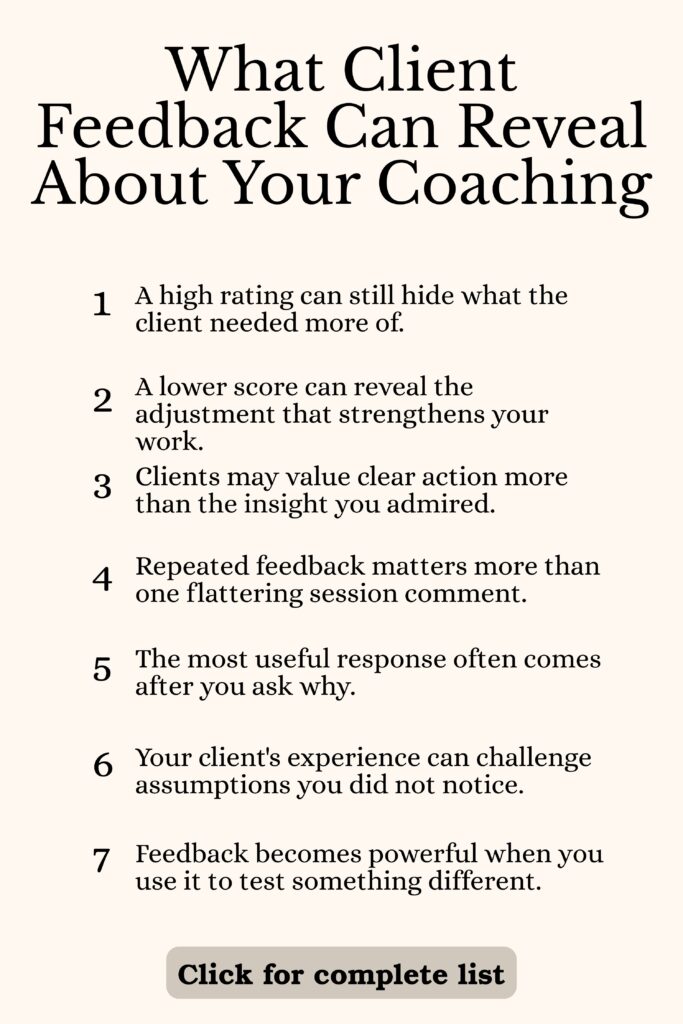
Client feedback is most useful when you treat the rating as the beginning of the conversation, not as your coaching score.
SEE ALSO: If you’re a coach looking to streamline your administrative tasks and save time, check out our Coaching Administration Software. It’s a simple, effective solution designed to help you focus less on paperwork and more on what matters—coaching your clients. From scheduling to client management, our software gives you the tools to run your business efficiently. Ready to reclaim your time and boost productivity? Click or tap here.
A client who gives a session an 8 has not necessarily told you much. The useful information comes next: Why an 8? What would have made it more useful? What did they need that they did not get?
There is adjacent evidence for this idea from psychotherapy research. A 2023 systematic review and meta-analysis by Rognstad and colleagues found that measurement feedback systems had a small positive effect on treatment outcomes, with larger effects among clients identified as not progressing as expected. This is psychotherapy research, not coaching research, so it should not be treated as evidence that a coaching rating system automatically improves outcomes. It does support a narrower point: structured feedback can surface information that practitioners may otherwise miss.
Combine this with regularly asking clients at the end of each discussion and you will develop consistently:
- On a scale of 1-10, how effective was this session for you?
- What could have made it a 10?
- What could I do differently next time to support you more effectively?
Do not make 10 the objective.
A thoughtful 7 followed by “I needed you to challenge me sooner” may teach you far more than an automatic 10 from a client who does not want to criticize you.
Look for repeated themes instead. If several clients ask for more time to think, clearer action steps, more challenge, or less structure, you now have something specific to examine in your practice.
SEE ALSO: If you’re a coach looking to streamline your administrative tasks and save time, check out our Coaching Administration Software. It’s a simple, effective solution designed to help you focus less on paperwork and more on what matters—coaching your clients. From scheduling to client management, our software gives you the tools to run your business efficiently. Ready to reclaim your time and boost productivity? Click or tap here.
What Do You Do When Your View of the Session and the Client’s View Do Not Match?
A mismatch between your assessment and the client’s assessment is valuable reflection data because it exposes what each of you is using to define a useful session.
Imagine leaving a session convinced that it went exceptionally well. The client had an emotional realization, connected several experiences, and said something they had never articulated before.
They rate the session 6 out of 10.
When you ask what would have made it more useful, they say, “I understood a lot, but I left without knowing what to do.”
That difference matters. You may have been judging the session by depth of insight, while the client was judging it by clarity of next action.
The reverse can happen too.
SEE ALSO: If you’re a coach looking to streamline your administrative tasks and save time, check out our Coaching Administration Software. It’s a simple, effective solution designed to help you focus less on paperwork and more on what matters—coaching your clients. From scheduling to client management, our software gives you the tools to run your business efficiently. Ready to reclaim your time and boost productivity? Click or tap here.
You abandon your planned exercise halfway through because the conversation goes somewhere unexpected. You leave thinking the session lacked structure. The client says it was the most useful session you have had together because they finally discussed the issue underneath the issue.
Neither response automatically proves that your interpretation is wrong.
The useful questions are:
- What was I using as evidence that the session worked?
- What was the client using as evidence?
- What outcome were we actually working toward?
- Does this discrepancy appear elsewhere in my coaching?
- What, if anything, should I change?
That is much richer than deciding that either you or the client must have judged the session incorrectly.
How Do You Turn Reflection Into a Coaching Experiment?
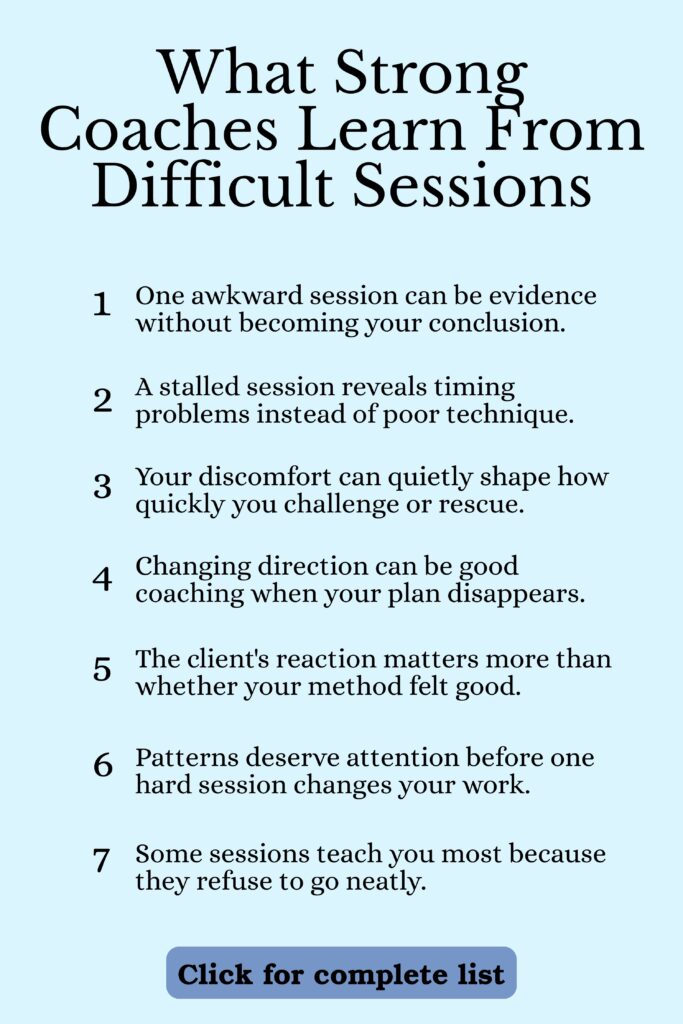
Reflection improves your practice when you turn one observation into a small, testable change rather than a vague promise to “do better.”
This is where the SMARTER action plan becomes particularly useful.
SEE ALSO: If you’re a coach looking to streamline your administrative tasks and save time, check out our Coaching Administration Software. It’s a simple, effective solution designed to help you focus less on paperwork and more on what matters—coaching your clients. From scheduling to client management, our software gives you the tools to run your business efficiently. Ready to reclaim your time and boost productivity? Click or tap here.
Suppose your reflection produces this observation:
I tend to interrupt a client’s silence because I assume they are stuck.
“I need to listen better” is not a strong action plan. You cannot easily tell whether you did it.
Instead, create a small experiment:
Specific: When a client goes quiet after an important question, I will allow five full seconds before speaking.
Measurable: I will notice whether I held the pause and record what happened immediately afterward.
SEE ALSO: If you’re a coach looking to streamline your administrative tasks and save time, check out our Coaching Administration Software. It’s a simple, effective solution designed to help you focus less on paperwork and more on what matters—coaching your clients. From scheduling to client management, our software gives you the tools to run your business efficiently. Ready to reclaim your time and boost productivity? Click or tap here.
Achievable: I will test this in my next three appropriate sessions rather than trying to change every conversational habit at once.
Resourced: I will place a small reminder beside my screen before the session.
Timebound: I will review the experiment after those three sessions.
Ethical: I will use silence only when it serves the client’s process, not because I am trying to force a response.
Reviewed: I will decide whether to keep, modify, or discard the practice based on what I observe.
Now reflection has produced something useful.
SEE ALSO: If you’re a coach looking to streamline your administrative tasks and save time, check out our Coaching Administration Software. It’s a simple, effective solution designed to help you focus less on paperwork and more on what matters—coaching your clients. From scheduling to client management, our software gives you the tools to run your business efficiently. Ready to reclaim your time and boost productivity? Click or tap here.
You are not trying to prove that five seconds of silence is a better technique. You are testing a hypothesis about your own coaching behavior.
That distinction matters. Good reflective experiments make your practice more deliberate without turning clients into a formula.
When Should Reflection Become a Conversation With Another Coach or Supervisor?
Bring reflection to another coach, mentor, peer, or supervisor when you keep reaching the same conclusion alone, when your own reaction may be influencing your interpretation, or when the situation raises a professional or ethical question.
Your existing reflection tool already makes room for a colleague’s viewpoint and other viewpoints. Those fields become particularly useful when the goal is not reassurance, but challenge.
For example, imagine that you repeatedly become more directive when clients are considering major career changes.
Your private reflection says:
SEE ALSO: If you’re a coach looking to streamline your administrative tasks and save time, check out our Coaching Administration Software. It’s a simple, effective solution designed to help you focus less on paperwork and more on what matters—coaching your clients. From scheduling to client management, our software gives you the tools to run your business efficiently. Ready to reclaim your time and boost productivity? Click or tap here.
“I need to stop giving so much advice.”
A stronger peer conversation might examine a different question:
“What happens in me when a client seems unable to make a decision?”
That could reveal that you become uncomfortable with uncertainty and start solving before the client has finished thinking.
The distinction is important. You are no longer only reviewing technique. You are examining what may be shaping the technique.
An International Coaching Federation Research Portal study analyzed responses from 1,280 coaches and coach supervisors worldwide. The study used a definition of coaching supervision centered on reflective dialogue and collaborative learning for the development and benefit of the coach, client, and organization.
SEE ALSO: If you’re a coach looking to streamline your administrative tasks and save time, check out our Coaching Administration Software. It’s a simple, effective solution designed to help you focus less on paperwork and more on what matters—coaching your clients. From scheduling to client management, our software gives you the tools to run your business efficiently. Ready to reclaim your time and boost productivity? Click or tap here.
That gives you a useful test for deciding when another perspective would help: Am I still learning from this reflection on my own, or am I simply repeating my existing interpretation?
When you bring the issue to someone else, take a specific situation rather than a general concern.
“I’m bad at challenging clients” gives the other person very little to examine.
“In three recent sessions, I noticed that I softened my question immediately after a client became uncomfortable” gives you both something concrete to work with.
Where LCH Core Fits
LCH Core fits reflective practice by giving you organized evidence to review, while the judgment about what that evidence means remains yours.
A useful reflection may draw on several sources:
SEE ALSO: If you’re a coach looking to streamline your administrative tasks and save time, check out our Coaching Administration Software. It’s a simple, effective solution designed to help you focus less on paperwork and more on what matters—coaching your clients. From scheduling to client management, our software gives you the tools to run your business efficiently. Ready to reclaim your time and boost productivity? Click or tap here.
- What you remember about the conversation
- Your session notes
- The client’s stated goals
- Action items the client agreed to complete
- Journal or worksheet responses
- Changes visible across several sessions
- The client’s own feedback
- Patterns in participation or follow-through
Inside LCH Core, client management (CRM) can keep client profiles, notes, and intake information connected. Goals and action items can make commitments visible. Journals and worksheets can capture reflection between sessions. The Progress Stream and Engagement Report can help you review progress and engagement over time.
That gives you more to work with than a vague impression that a client “seems to be doing well.”
For example, you may feel that a client has become less engaged. Before deciding your coaching approach is the problem, you can look at what has actually changed. Are agreed action items no longer being completed? Has the client’s stated goal changed? Did their engagement drop after a particular milestone? Is there evidence that the coaching objective itself now needs revisiting?
The records give you questions. They do not give you the conclusion.
This connects closely with the wider business value of making client progress visible. A Bird in the Hand: The Simple Math of Client Lifetime Value (for Coaches) looks at how progress reviews, retention, appropriate next steps, and referrals fit into longer coaching relationships.

FAQ
What is reflective practice in coaching?
Reflective practice in coaching is the deliberate review of your coaching decisions, client responses, and outcomes so you can make better-informed choices in future sessions.
SEE ALSO: If you’re a coach looking to streamline your administrative tasks and save time, check out our Coaching Administration Software. It’s a simple, effective solution designed to help you focus less on paperwork and more on what matters—coaching your clients. From scheduling to client management, our software gives you the tools to run your business efficiently. Ready to reclaim your time and boost productivity? Click or tap here.
It goes beyond deciding whether a session felt successful. You compare what you intended with what occurred, examine significant decisions, consider other perspectives, and identify a specific next action.
How often should a coach reflect on coaching sessions?
A coach should reflect after sessions that contain a meaningful surprise, difficulty, change of direction, or useful breakthrough, then review patterns across sessions regularly.
You do not need a lengthy written review after every call. A short weekly review can help you spot patterns that individual session notes may not reveal.
What should I include in a coaching reflection?
A coaching reflection should include what you planned, what actually happened, significant choices you made, the client’s observable response, what worked, what could change, relevant feedback, and your next action.
The reflection becomes stronger when you distinguish observations from interpretations. “The client paused for 20 seconds” is an observation. “The client hated the question” is an interpretation unless the client tells you so.
How can I get honest feedback from coaching clients?
You can get more useful feedback by asking specific questions about the client’s experience rather than simply asking whether they enjoyed the session.
SEE ALSO: If you’re a coach looking to streamline your administrative tasks and save time, check out our Coaching Administration Software. It’s a simple, effective solution designed to help you focus less on paperwork and more on what matters—coaching your clients. From scheduling to client management, our software gives you the tools to run your business efficiently. Ready to reclaim your time and boost productivity? Click or tap here.
A rating followed by “What would have made this more useful?” gives the client something concrete to respond to. Asking what you could do differently also gives permission to comment on your coaching, not only on their own progress.
Should coaches use a 1-to-10 session rating?
A 1-to-10 session rating can be useful when you explore the reason behind the number.
Do not optimize your coaching around getting 10s. Look for explanations and repeated themes. The comment attached to a 7 can contain more useful information than the number itself.
What is the difference between reflective practice and coaching supervision?
Reflective practice is your process of examining your own work, while coaching supervision introduces another person into that examination.
Supervision can be particularly useful when you are dealing with recurring patterns, ethical questions, strong personal reactions, or situations where your own assumptions may be difficult to see alone.
How do I know whether a difficult coaching session reveals a real problem?
A difficult session becomes more meaningful when the same issue appears across several comparable situations.
SEE ALSO: If you’re a coach looking to streamline your administrative tasks and save time, check out our Coaching Administration Software. It’s a simple, effective solution designed to help you focus less on paperwork and more on what matters—coaching your clients. From scheduling to client management, our software gives you the tools to run your business efficiently. Ready to reclaim your time and boost productivity? Click or tap here.
Treat one session as a prompt to investigate. Keep a short record of what happened and review whether the same trigger, response, or outcome recurs before making major changes to your method.
Should coaches keep written reflections?
Written reflections are useful when they help you identify patterns, test changes, or preserve details you are likely to forget.
They do not need to become lengthy journal entries. A few lines covering what happened, what you noticed, and what you will test next can be enough to make the learning usable.
I’d love to know what you learn as a result!
Sources
McAnally, K., et al. “Global Coaching Supervision: A Study of the Perceptions and Practices Around the World.” International Coaching Federation Research Portal, 2020. International Coaching Federation Research Portal source
Rognstad, Kristian, Tore Wentzel-Larsen, Simon-Peter Neumer, and John Kjøbli. “A Systematic Review and Meta-Analysis of Measurement Feedback Systems in Treatment for Common Mental Health Disorders.” Administration and Policy in Mental Health and Mental Health Services Research, vol. 50, no. 2, 2023, pp. 269-282. PubMed record
SEE ALSO: If you’re a coach looking to streamline your administrative tasks and save time, check out our Coaching Administration Software. It’s a simple, effective solution designed to help you focus less on paperwork and more on what matters—coaching your clients. From scheduling to client management, our software gives you the tools to run your business efficiently. Ready to reclaim your time and boost productivity? Click or tap here.
The Open University. “Defining Reflective Practice.” OpenLearn, The Open University. Accessed 25 Sept. 2026. OpenLearn source
Read this next

How to Incorporate Journaling into Your Coaching
The following tips can help you to smoothly incorporate journaling into your coaching courses.
Read More
Homework Really Helps in Coaching
Homework really helps your clients grow and develop, making it a must in your life coaching business.
Read More
What Smart Coaches Do Between Sessions to Keep Clients Moving
How assigning homework can help you develop a better relationship with your client
Read More