


Talk to a coach about Organizational coaching

Crystal Faulk
ACC
I help overwhelmed women in transition gain clarity, confidence, and...

Terrie Hein
Certified Life Coach, Certified Insight Coach Practitioner
Coaching to declutter your life, organize your goals, and cook...

Dr Charlene Ashley
Doctorate - Behaviours
I coach individuals to design fulfilling lives through structure, clarity,...

Paloma Chiara

Lana's Gymnastics Club
"Where the best in gymnastics meets fun. Where every child is a star"
lgclubny.com

Anna Sosnina
ICF (ACC)
ICF ACC certified coach, founder of EssorVie Coaching, passionate about...

Tyler Fink
B.A. in Religion, Anthropology, and Philosophy. Master of Divinity (M.Div.) in Missiology
Pastor, husband, and father helping Christian men pursue faithful growth...

Travis Brown
Professional Life coach
With experience in guiding clients to achieve goals, build confidence,...




Pretty Pen Cup Pairing System for Sorted Desk Tools
Are you all about style, decor and organization? Download a copy of our Clutter Reset Guide.
*****
A Prettier Desk Can Also Be Easier to Use
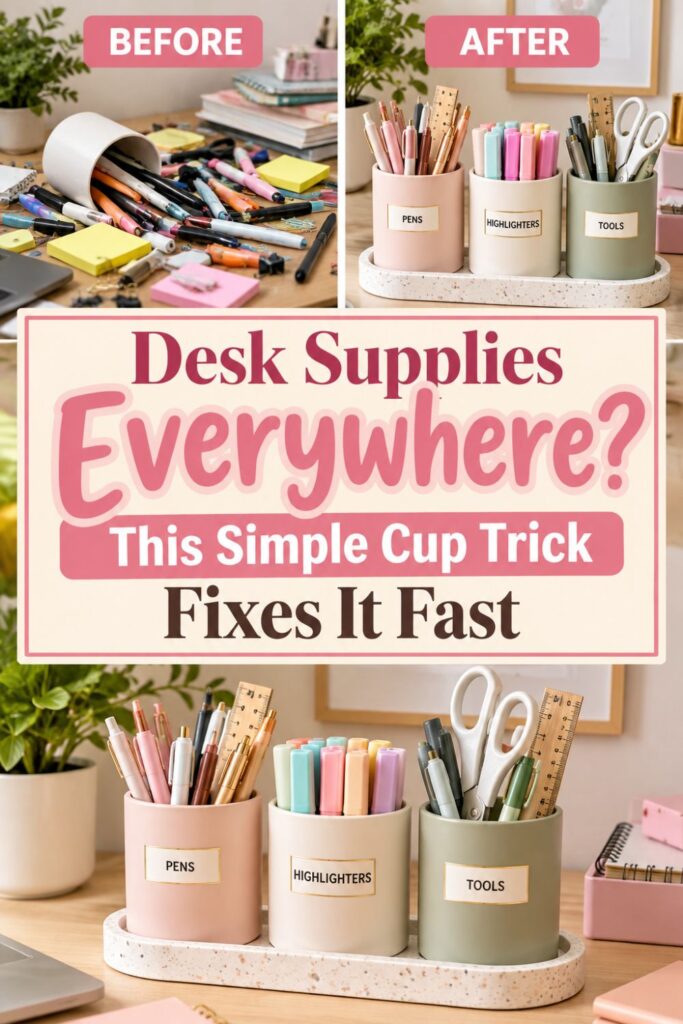
A pen cup seems like one of the simplest desk organizers you can own. Drop your pens, pencils, scissors, markers, and other small tools inside, and the clutter disappears from the desktop.
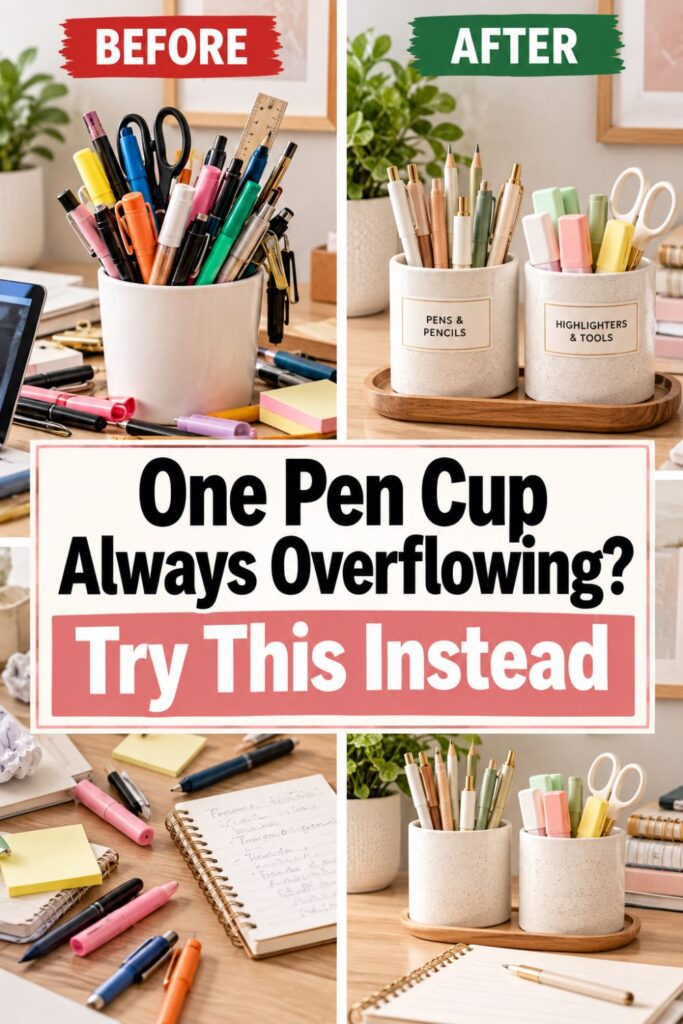
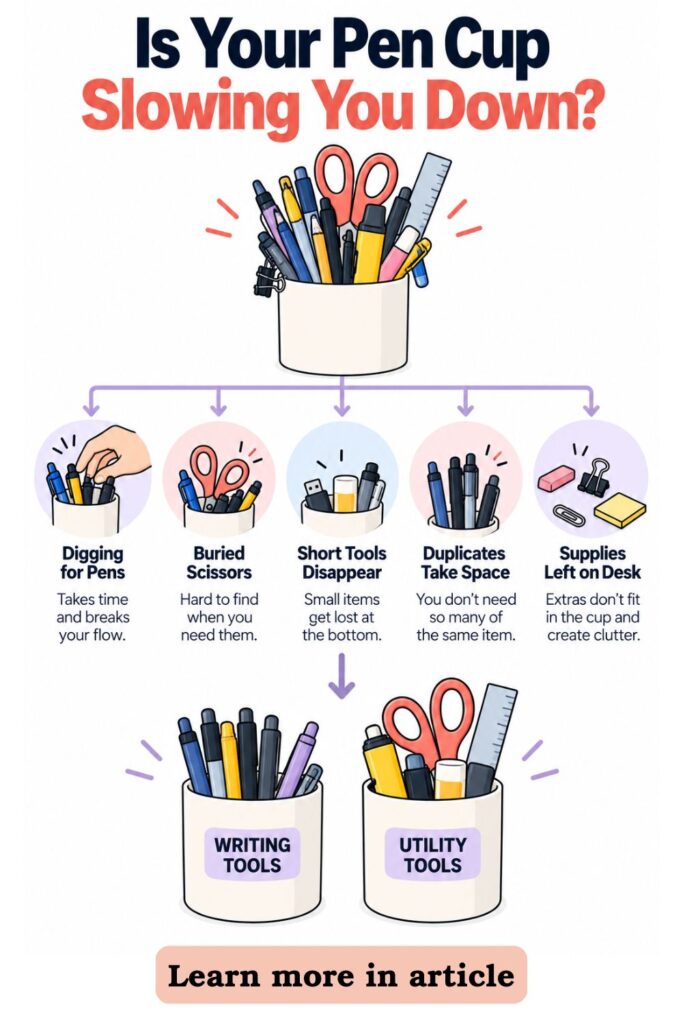
The problem is that one cup can quickly become a catch-all. You may technically know where your supplies are, but you still have to dig through highlighters to find a black pen, pull out three markers before finding your scissors, or empty half the container to reach something short at the bottom.
A paired pen cup system solves that problem without adding a complicated organizer to your workspace. Instead of putting every tool into one container, you use two or three coordinated cups to create simple categories that are easy to see and easy to maintain.
The cups can match exactly, but they do not have to. Two holders in the same color, material, finish, or general style can look intentional together while still serving different purposes.
The basic idea is simple:
- One cup holds your most-used writing tools.
- A second cup holds larger tools or another clear category.
- An optional third cup holds a specialty group you genuinely use often.
- Extra and rarely used supplies stay somewhere else.
This approach gives every item an obvious place without making you sort your supplies into dozens of tiny compartments.
If you want to get more from your life, and are looking for concrete action steps to get you there, check out our Request a Coach page. It’s a “cut the fence-sitting and take action” way to tackle your issues and actually find success. To get off the fence and start to take action, click or tap here.
It also uses your environment to make organization easier. When the right tools are visible, within reach, and separated into broad categories, returning them requires less thought. You do not need to remember an elaborate system because the containers themselves tell you where things belong.
The result can look surprisingly polished too. Instead of one overloaded cup filled with a jumble of colors and shapes, you get a small coordinated arrangement that feels like part of your desk design.
The key is resisting the temptation to simply buy several cute containers and hope organization follows. Start with how you work, then build the pairing system around the tools you actually reach for.
Need some in depth help with organization and productivity ? Drop on by our directories choc full of productivity coaches, minimalist coaches, and work/life balance coaches to get your life organized! Or click here to have us match you to the best.
1. Decide How Many Pen Cups Your Desk Actually Needs
Before buying matching holders or rearranging your desktop, figure out how many containers would actually make your work easier. More organizers do not automatically create better organization, especially on a small desk.
For most people, two cups are enough.
The first cup can hold everyday writing supplies such as pens, pencils, a favorite highlighter, or a stylus. The second can hold tools that are taller, bulkier, or used for a different purpose, such as scissors, rulers, craft tools, or markers.
Start by emptying your existing pen cup or gathering the loose desk tools currently sitting around your workspace. Place everything where you can see it.
If you want to get more from your life, and are looking for concrete action steps to get you there, check out our Request a Coach page. It’s a “cut the fence-sitting and take action” way to tackle your issues and actually find success. To get off the fence and start to take action, click or tap here.
Then ask yourself three questions:
- Which tools do I reach for almost every day?
- Which items are awkward to store with ordinary pens?
- Which supplies am I keeping on my desk even though I rarely use them?
Your answers will usually reveal two natural groups.
For example, a writer might create one cup for pens and pencils and another for highlighters, scissors, and a ruler. Someone who journals or creates content by hand might keep everyday writing tools in one cup and colored markers in another.
Add a third cup only when a category is large enough and frequently used enough to deserve permanent desk space. If you use brush pens every day, giving them their own holder may make sense. If you use them twice a month, they probably belong in a drawer.
Try to avoid building a container for every tiny category. Four pens do not necessarily need one cup while three pencils get another and two highlighters get a third.
The goal is broad, obvious separation.
You should be able to glance at the holders and immediately understand where something belongs. If your system requires remembering complicated rules, it is probably more detailed than your desk needs.
When in doubt, begin with two cups. You can always add another later if your actual work habits show you that another category would genuinely reduce friction.
If you want to get more from your life, and are looking for concrete action steps to get you there, check out our Request a Coach page. It’s a “cut the fence-sitting and take action” way to tackle your issues and actually find success. To get off the fence and start to take action, click or tap here.
2. Choose Cups That Look Like a Pair Without Needing to Be Identical
Once you know how many holders you need, you can think about how they will look together. This is where the system becomes more than basic supply storage.
Matching does not have to mean identical.
Two containers can feel like a pair because they share one obvious visual feature. They might both be ceramic, both be cream colored, both have a matte finish, or both use the same simple cylindrical shape.
This gives you flexibility to choose containers based on what they need to hold.
A taller cup may work better for scissors, rulers, paintbrushes, or long markers. A shorter holder can make pens and pencils easier to grab because you are not reaching deep inside every time you need one.
Look for consistency in one or two areas:
- Similar colors
- The same material
- Matching finishes
- Related shapes
- Similar proportions
- One repeated design detail
You can even repurpose containers you already own. Small planters, sturdy mugs, candle jars, pencil pots, and simple storage cups can work well as long as they are stable and deep enough to keep tools upright.
Pay attention to the opening too. A very narrow container may look tidy when empty but become frustrating when filled. Tools should have enough room to move slightly so you can grab one without pulling out several others.
If you want to get more from your life, and are looking for concrete action steps to get you there, check out our Request a Coach page. It’s a “cut the fence-sitting and take action” way to tackle your issues and actually find success. To get off the fence and start to take action, click or tap here.
At the same time, avoid oversized holders that encourage you to keep adding supplies. If a cup is large enough to swallow twenty pens, you may eventually fill it with twenty pens whether you need them or not.
Aim for a container that holds your working set comfortably with a little breathing room.
Before committing to a pair, place the holders beside each other and imagine them filled. They should look balanced rather than like two unrelated objects that happen to be sitting on the same desk.
The prettiest setup is not necessarily the one with the most decorative containers. A simple, coordinated pair often looks calmer because the repetition creates visual order while the different contents still serve a practical purpose.
3. Sort Desk Tools by How You Use Them, Not Just by What They Are
Traditional organizing advice often tells you to group like with like. Pens go with pens, markers with markers, scissors with scissors.
That can work, but a desktop system becomes even easier when you organize around how you actually use your supplies.
Start with your everyday tools.
These are the items you reach for during a normal workday without thinking much about it. They might include a black pen, pencil, highlighter, stylus, or a couple of colored pens you use for notes.
If you want to get more from your life, and are looking for concrete action steps to get you there, check out our Request a Coach page. It’s a “cut the fence-sitting and take action” way to tackle your issues and actually find success. To get off the fence and start to take action, click or tap here.
Put those together in the easiest-to-reach cup.
Then create a second group based on a different kind of task. This might include scissors, a ruler, utility tools, permanent markers, or anything larger that tends to get buried in an ordinary pen cup.
For some people, the categories may look like this:
- Everyday writing tools
- Cutting and measuring tools
For someone else, they might be:
- Workday pens and highlighters
- Journaling and creative markers
Another desk might use:
- Writing tools
- Packing and shipping tools
There is no universal correct pairing.
The important question is whether the categories make sense while you are actually working.
Avoid creating extremely specific categories unless you truly need them. Separating black pens from blue pens may look beautifully organized, but it can create unnecessary sorting every time you put something away.
If you want to get more from your life, and are looking for concrete action steps to get you there, check out our Request a Coach page. It’s a “cut the fence-sitting and take action” way to tackle your issues and actually find success. To get off the fence and start to take action, click or tap here.
Broad categories tend to work better because they reduce decisions.
Also look for supplies that do not need to stay on the desktop at all. Duplicate pens, dried-out markers, promotional pencils, spare scissors, and rarely used specialty tools can make your cups feel crowded without making your work easier.
Move backups into a drawer, bin, or supply area.
Your desktop cups should represent your active working set, not your entire collection of stationery.
A useful test is to imagine putting everything away quickly at the end of the day. If you can return each tool to the correct cup almost automatically, the categories are probably simple enough.
If you have to stop and decide where a tool belongs, simplify the system until the answer becomes obvious.
4. Pair the Cups According to Your Actual Workflow
Sorting the tools is only half of the system. Where you place the cups can determine whether you keep using them.
A beautifully arranged desk can still become frustrating if your most-used supplies are positioned in an inconvenient spot.
If you want to get more from your life, and are looking for concrete action steps to get you there, check out our Request a Coach page. It’s a “cut the fence-sitting and take action” way to tackle your issues and actually find success. To get off the fence and start to take action, click or tap here.
Start with your dominant hand.
If you are right-handed, try placing your everyday writing cup slightly to the right of your main working area. If you are left-handed, place it slightly to the left.
The cup should be close enough that reaching for a pen feels natural but far enough away that it does not crowd your keyboard, notebook, or mouse.
Place the second holder nearby so the two cups still read visually as a pair.
You might position them:
- Side by side
- Slightly staggered
- With the taller cup behind the shorter cup
- At the corner of a monitor or notebook area
- Together on a small tray
The exact arrangement matters less than keeping the system easy to reach.
Think about which tools you use while performing specific tasks. If you frequently highlight notes while writing, the highlighters should not live on the opposite side of the desk. If you use scissors mainly for packing orders, they might belong near the area where envelopes and labels are handled.
This is where environment design becomes useful.
If you want to get more from your life, and are looking for concrete action steps to get you there, check out our Request a Coach page. It’s a “cut the fence-sitting and take action” way to tackle your issues and actually find success. To get off the fence and start to take action, click or tap here.
Instead of expecting yourself to remember where things should go, place the organizers where your hands naturally reach for those tools.
Then test the setup for a few normal work sessions.
Notice what happens.
Do you keep moving one of the cups closer? Do you leave your favorite pen beside the keyboard instead of returning it? Do scissors repeatedly end up somewhere else?
Those behaviors are useful information.
Rather than telling yourself to be more organized, adjust the environment. Move the cup closer, switch the categories, or change which tools stay visible.
A good desk system should adapt to your natural workflow.
When the organization matches the way you already move through your workday, using it feels almost automatic instead of becoming another routine you have to remember.
If you want to get more from your life, and are looking for concrete action steps to get you there, check out our Request a Coach page. It’s a “cut the fence-sitting and take action” way to tackle your issues and actually find success. To get off the fence and start to take action, click or tap here.
5. Use Visibility to Make Putting Tools Away Automatic
One reason desktop cups work so well is that they keep supplies visible.
A drawer can hide clutter beautifully, but it also adds another action. You have to open it, locate the correct section, put the tool away, and close it again.
A visible cup removes several of those steps.
That small difference matters because organization is easier to maintain when the correct action requires very little effort.
The trick is keeping the cups organized enough that visibility remains useful.
If a holder is packed with thirty pens, pencils, markers, scissors, and random objects, you lose the advantage. You still know the tools are there, but you cannot immediately see what you need.
Keep the contents loose enough to scan at a glance.
A practical everyday writing cup might contain:
If you want to get more from your life, and are looking for concrete action steps to get you there, check out our Request a Coach page. It’s a “cut the fence-sitting and take action” way to tackle your issues and actually find success. To get off the fence and start to take action, click or tap here.
- Two or three favorite pens
- One pencil
- One highlighter
- A stylus
- One specialty pen you regularly use
You do not need your entire stationery collection within arm’s reach.
The second cup can contain a similarly edited set of tools for another category.
Visibility also helps with putting things away. If one cup obviously contains writing tools and another contains larger desk tools, you barely have to think about where an item belongs.
That is much easier than maintaining several tiny compartments with narrow rules.
Keep backups somewhere less visible. Extra pens, unopened markers, spare scissors, and replacement supplies can live in a drawer, cabinet, or small storage box.
When something runs out, replace it from the backup area.
This keeps your active workspace from slowly becoming a supply cabinet.
It also makes it easier to notice when something does not belong. A random receipt or charging cable stuffed into an otherwise tidy pen cup looks obviously out of place, which encourages you to deal with it rather than letting it disappear into the container.
If you want to get more from your life, and are looking for concrete action steps to get you there, check out our Request a Coach page. It’s a “cut the fence-sitting and take action” way to tackle your issues and actually find success. To get off the fence and start to take action, click or tap here.
The goal is not perfect visual minimalism.
The goal is creating a visible system where grabbing and returning supplies takes so little thought that staying organized becomes easier than leaving things scattered across the desk.
6. Create a Simple Pretty but Practical Desk Formula
Once the functional part of the system is working, you can make the paired cups feel intentional within the rest of your workspace.
The easiest way to do this is through repetition.
If your pen cups are cream ceramic, you might repeat that tone in a small tray, planter, notebook, or lamp. If they are clear acrylic, you might keep the rest of the desktop simple so the transparent containers blend into the background.
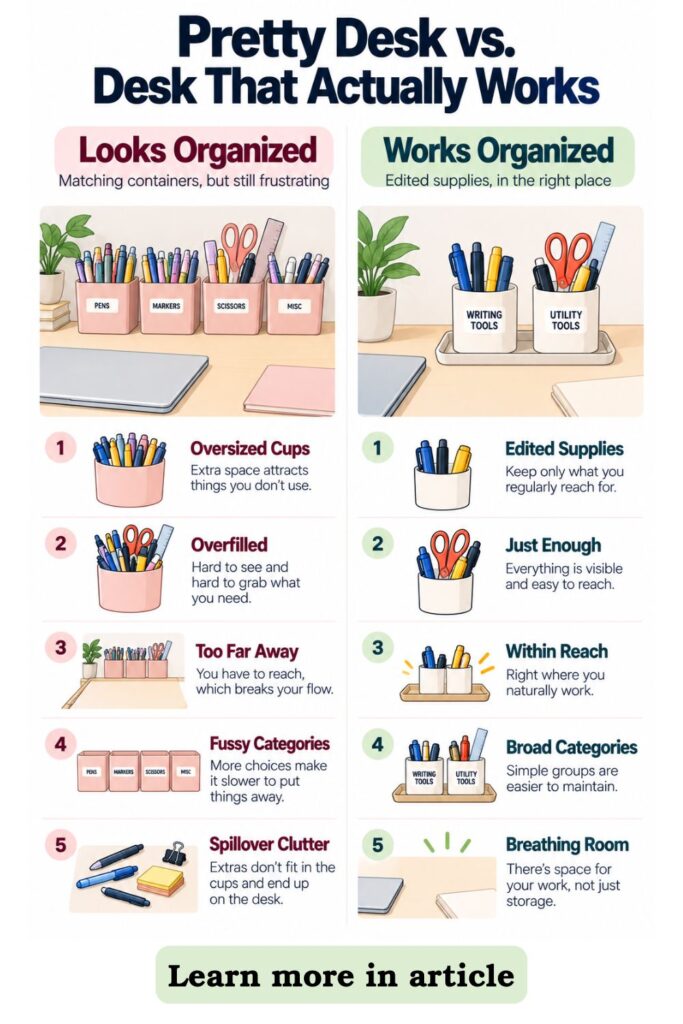
You do not need every accessory to match.
In fact, too much matching can make a workspace feel more staged than useful.
Instead, choose one repeated visual idea and let the practical items create the variation.
If you want to get more from your life, and are looking for concrete action steps to get you there, check out our Request a Coach page. It’s a “cut the fence-sitting and take action” way to tackle your issues and actually find success. To get off the fence and start to take action, click or tap here.
Consider a simple formula:
- One coordinated pair of desk cups
- One nearby item that repeats their color or material
- One larger functional object, such as a lamp or monitor
- Plenty of open desktop space around everything
That empty space is important.
When the cups are surrounded by stacks of sticky notes, decorative objects, chargers, notebooks, and miscellaneous supplies, even attractive organizers can begin to look cluttered.
Give the pair a little breathing room.
You can also use the contents themselves as part of the visual design.
If your supplies are colorful, simple neutral cups can calm the overall look. If most of your tools are black, silver, or neutral, a pair of softly colored holders can add personality without making the desk feel busy.
Keep practicality first.
Scissors should still be easy to remove. Pens should not sit so deep that you have to reach inside the cup. Frequently used tools should not be hidden merely because a perfectly symmetrical arrangement looks better in a photo.
If you want to get more from your life, and are looking for concrete action steps to get you there, check out our Request a Coach page. It’s a “cut the fence-sitting and take action” way to tackle your issues and actually find success. To get off the fence and start to take action, click or tap here.
A useful workspace usually looks good because the system is clear.
When the tools are separated, containers are coordinated, and surfaces are not overloaded, the desk naturally appears more intentional.
You get the visual payoff without turning everyday organization into a decorating project that requires constant arranging.
7. Expand the System Without Creating a Row of Containers
Once a simple cup pairing starts working, you may be tempted to expand it.
Suddenly there could be a cup for markers, another for pencils, another for scissors, another for brushes, another for rulers, and another for miscellaneous tools.
That is how a low-effort system can quietly turn into organizer clutter.
Before adding another holder, identify the problem you are trying to solve.
A new cup is useful when a group of tools is repeatedly creating friction. Perhaps your markers keep crowding the writing cup, or your scissors constantly disappear behind taller supplies.
If you want to get more from your life, and are looking for concrete action steps to get you there, check out our Request a Coach page. It’s a “cut the fence-sitting and take action” way to tackle your issues and actually find success. To get off the fence and start to take action, click or tap here.
That is a reason to create another category.
Having an empty patch of desktop is not.
Use a desktop versus backup rule to keep the system controlled.
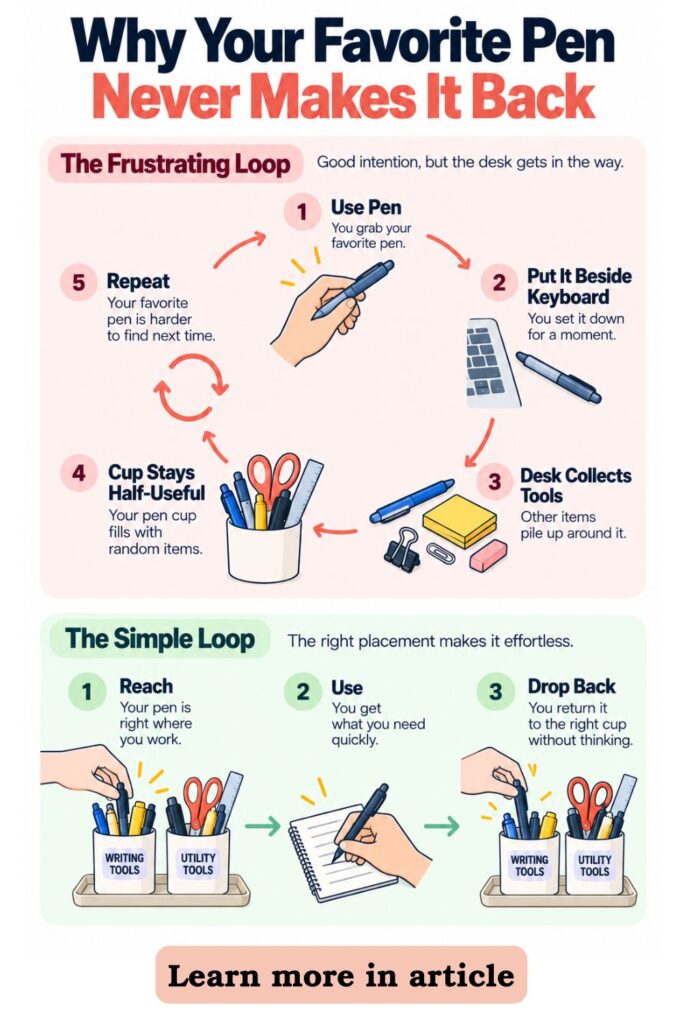
Your desktop should hold the supplies involved in your current routines. Everything else can live somewhere nearby but less visible.
For example:
Keep on the desktop:
- Favorite pens
- Frequently used highlighters
- Everyday scissors
- A ruler you use regularly
- Current creative tools
Store elsewhere:
- Duplicate pens
- Seasonal markers
- Specialty supplies
- Refills
- Rarely used craft tools
You can rotate tools when your work changes.
If you want to get more from your life, and are looking for concrete action steps to get you there, check out our Request a Coach page. It’s a “cut the fence-sitting and take action” way to tackle your issues and actually find success. To get off the fence and start to take action, click or tap here.
If you are working on a month-long creative project, a third marker cup might temporarily earn a spot on your desk. When the project ends, those markers can return to storage.
The same pairing idea can also work in other areas.
A homework desk might use one cup for writing supplies and another for scissors and glue. A small home-office packing station could pair pens and markers with scissors and box cutters. A vanity workspace might use coordinated holders for brushes and small grooming tools.
The principle stays the same.
Use a small number of visible containers, give each one a broad purpose, and make the group look visually related.
Expansion should make the system clearer, not simply larger.
If you find yourself creating more and more containers to hold more and more supplies, pause and edit the contents instead.
Sometimes the best organization upgrade is not adding storage. It is deciding what no longer needs to occupy your most valuable desktop space.
If you want to get more from your life, and are looking for concrete action steps to get you there, check out our Request a Coach page. It’s a “cut the fence-sitting and take action” way to tackle your issues and actually find success. To get off the fence and start to take action, click or tap here.
8. How an Organization or Productivity Coach Could Help the System Stick
Sometimes a desk becomes cluttered again even after you have created a perfectly reasonable organizing system.
That does not always mean you need better containers.
The problem may be the workflow surrounding the desk.
An organization coach, productivity coach, or professional organizer can help identify what happens before the clutter appears. Instead of only asking where the scissors should go, they may look at why supplies are repeatedly left scattered in the first place.
For example, you might discover that your most-used pen cup is simply too far from where you write. You may be switching between several different tasks at the same desk, each requiring different supplies. You might also be keeping far more tools visible than your daily work actually requires.
A coach could help you examine questions such as:
- Which tools do you repeatedly leave out?
- Where do those tools naturally end up?
- Which supplies are rarely used but still occupy desktop space?
- What happens at the beginning and end of your workday?
- Which organizing steps do you consistently avoid?
The goal is not to create stricter rules.
It is to design a workspace that requires fewer unnecessary decisions.
If you want to get more from your life, and are looking for concrete action steps to get you there, check out our Request a Coach page. It’s a “cut the fence-sitting and take action” way to tackle your issues and actually find success. To get off the fence and start to take action, click or tap here.
A coach might also help you connect a short reset to an existing routine. Instead of telling yourself to organize your desk whenever you remember, you could create one specific trigger.
You might reset the cups when you:
- Close your laptop
- Finish your last work task
- Write tomorrow’s priorities
- Plug in your devices for the night
- Leave your home office
Because the pen cup system already has broad, obvious categories, the reset can take less than a minute.
This approach can be especially useful if you repeatedly reorganize your desk but struggle to maintain the results.
Rather than searching for another storage product, you begin looking at patterns, placement, and habits.
The paired cups are only one small part of that environment. When the surrounding workflow supports them, they become much easier to keep organized without relying on constant motivation.
A Small Desk System That Keeps Looking Pulled Together
The strength of a paired pen cup system is its simplicity.
You are not trying to build the perfect stationery storage system or assign every object on your desk to a tiny labeled compartment. You are simply giving the tools you use most a few clear places to land.
If you want to get more from your life, and are looking for concrete action steps to get you there, check out our Request a Coach page. It’s a “cut the fence-sitting and take action” way to tackle your issues and actually find success. To get off the fence and start to take action, click or tap here.
For many desks, the basic setup is enough:
- One cup for everyday writing tools
- One cup for another frequently used category
- An optional third holder only when your work genuinely needs it
- Backup and occasional-use supplies stored somewhere else
That small amount of structure can make a noticeable difference.
Pens stop disappearing under notebooks. Scissors stop becoming buried beneath markers. The desktop looks less scattered because several unrelated tools are no longer competing inside one overloaded container.
The visual pairing helps too.
When the holders share a color, finish, material, or shape, they look like one small organizing system rather than several random containers.
You can adjust the setup whenever your routine changes.
Maybe your highlighters become more important during a planning project. Perhaps you stop using markers every day and move them into a drawer. You may discover that the second cup works better on the opposite side of your monitor.
None of those changes mean the system failed.
If you want to get more from your life, and are looking for concrete action steps to get you there, check out our Request a Coach page. It’s a “cut the fence-sitting and take action” way to tackle your issues and actually find success. To get off the fence and start to take action, click or tap here.
A useful organizing system should respond to the way you actually work.
Periodically look at what has accumulated in the cups. Remove dried-out pens, duplicates, random objects, and supplies you no longer reach for. If a holder begins overflowing, edit the contents before buying another container.
That one habit protects the low-effort nature of the system.
A desk does not have to be perfectly minimal to feel organized. It just needs enough structure that finding, using, and returning your everyday tools feels easy.
With a thoughtfully chosen pair of holders, broad categories, and smart placement, even something as ordinary as a pen cup can help create a workspace that feels calmer, more functional, and pulled together.
Are you all about style, decor and organization? Download a copy of our Clutter Reset Guide.
Need some in depth help with organization and productivity ? Drop on by our directories choc full of productivity coaches, minimalist coaches, and work/life balance coaches to get your life organized! Or click here to have us match you to the best.
If you want to get more from your life, and are looking for concrete action steps to get you there, check out our Request a Coach page. It’s a “cut the fence-sitting and take action” way to tackle your issues and actually find success. To get off the fence and start to take action, click or tap here.
Read this next

6 Small Closet Fixes That Make It Feel Twice the Size
These 6 small closet fixes make tight storage feel bigger, clearer, and way easier to use. See the simple upgrades worth trying first.
Read More
6 Small Closet Layout Fixes That Actually Work
Small closet feeling impossible? These layout fixes help you find hidden space, improve flow, and make every inch work harder.
Read More
The Secret Formula for Choosing the Perfect Christmas Tree Color Palette
Are you all about style, decor and organization? Download a copy of our Decluttering Workbook.**** Choosing a Christmas tree color palette might feel intimidating, but a simple design formula makes […]
Read More