


Talk to a coach about Organizational coaching

Crystal Faulk
ACC
I help overwhelmed women in transition gain clarity, confidence, and...

Terrie Hein
Certified Life Coach, Certified Insight Coach Practitioner
Coaching to declutter your life, organize your goals, and cook...

Dr Charlene Ashley
Doctorate - Behaviours
I coach individuals to design fulfilling lives through structure, clarity,...

Paloma Chiara

Lana's Gymnastics Club
"Where the best in gymnastics meets fun. Where every child is a star"
lgclubny.com

Anna Sosnina
ICF (ACC)
ICF ACC certified coach, founder of EssorVie Coaching, passionate about...

Tyler Fink
B.A. in Religion, Anthropology, and Philosophy. Master of Divinity (M.Div.) in Missiology
Pastor, husband, and father helping Christian men pursue faithful growth...

Travis Brown
Professional Life coach
With experience in guiding clients to achieve goals, build confidence,...


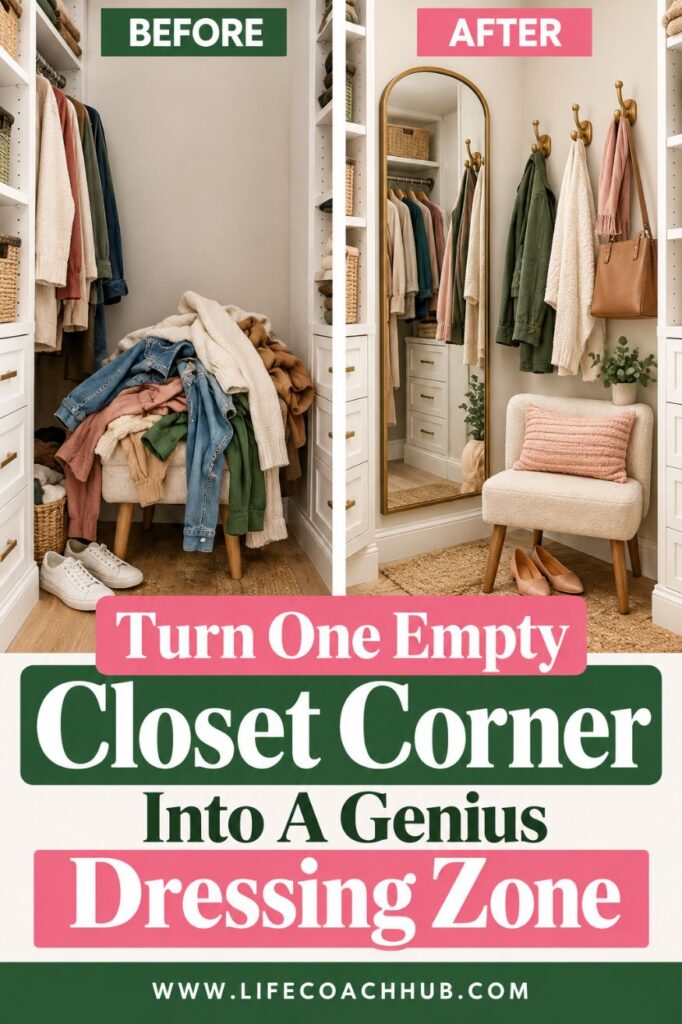
Mirror-and-Hook Dressing Corner for Walk-In Closets
Are you all about style, decor and organization? Download a copy of our Clutter Reset Guide.
*****
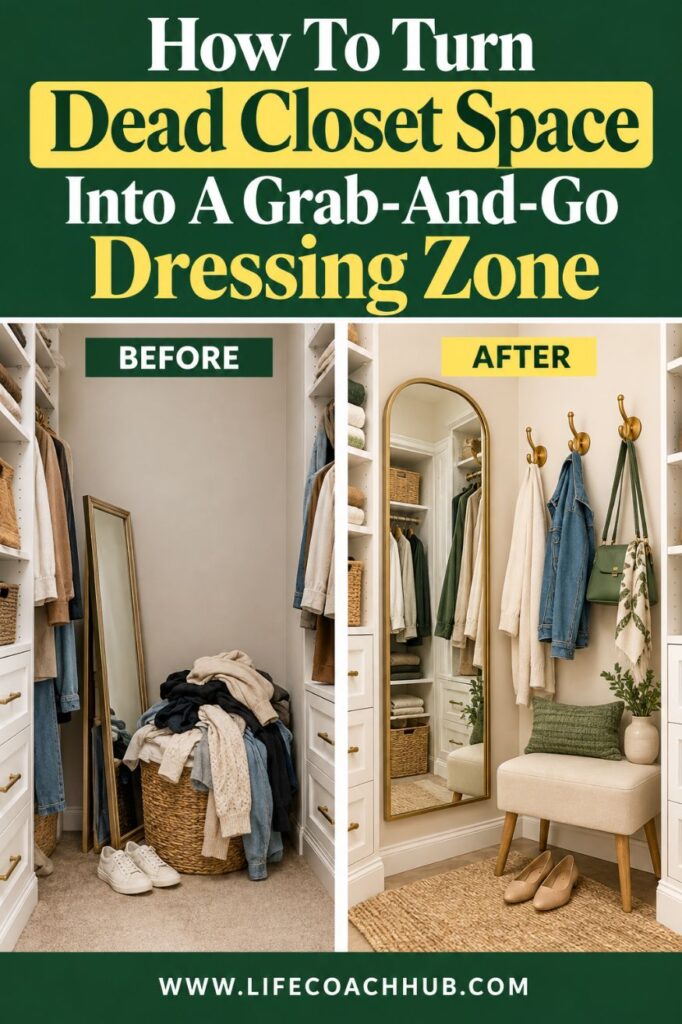
Why One Empty Closet Corner Can Make Getting Dressed Easier
A walk-in closet can hold plenty of clothes and still make getting dressed feel harder than it should. You may have shelves, rods, drawers, and shoe storage, but no clear place to actually stand, compare pieces, and decide what works together.
That is where a small dressing corner can make a noticeable difference. Instead of treating every inch of your closet as storage, you dedicate one small section to the act of getting dressed.
The basic setup is simple:
- A mirror positioned where you can see your outfit clearly
- A few hooks for clothing you are considering
- Optional space for accessories or shoes
- Enough standing room to step back and look at the outfit
The important part is that this area stays different from regular closet storage. Your hooks are not meant to become permanent homes for handbags, robes, or yesterday’s clothes.
Treat the corner as a dressing station: Use it for clothing that is actively part of your outfit decision. That might include the jacket you are considering, tomorrow’s blouse, or two dresses you want to compare.
Keep the setup intentionally small: Start with the mirror and two or three hooks before adding anything else. A dressing area works best when it gives you breathing room rather than becoming another densely packed storage system.
If you want to get more from your life, and are looking for concrete action steps to get you there, check out our Request a Coach page. It’s a “cut the fence-sitting and take action” way to tackle your issues and actually find success. To get off the fence and start to take action, click or tap here.
Think about your normal dressing sequence: Notice what you usually do first. You may choose pants, add a top, look for a layer, select shoes, and finish with a bag. Your dressing corner should support that sequence instead of forcing you to change it.
Even a narrow section of wall can work. You do not need a huge luxury walk-in closet or a built-in dressing table.
The goal is simply to bring the pieces you are considering into one visible area. When everything you need to make the decision is in front of you, getting dressed can feel less scattered and much more deliberate.
Need some in depth help with organization and productivity ? Drop on by our directories choc full of productivity coaches, minimalist coaches, and work/life balance coaches to get your life organized! Or click here to have us match you to the best.
1. Choose the Right Corner Before You Hang Anything
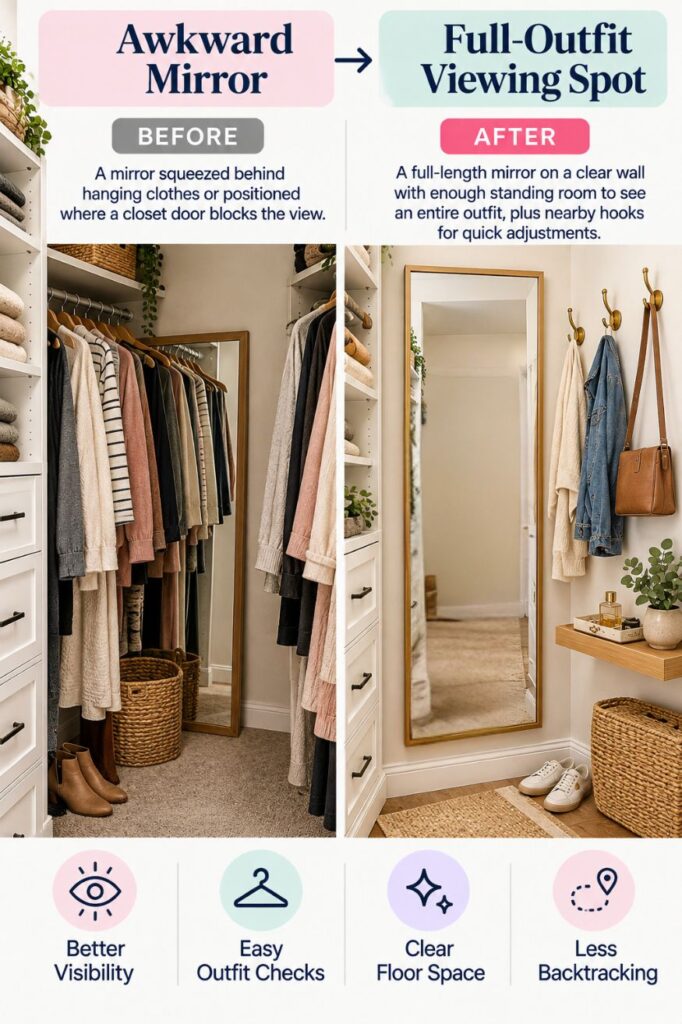
Before buying hooks or mounting a mirror, spend a few minutes deciding where the dressing corner should actually go. The prettiest empty wall is not always the most practical location.
Start by standing in different parts of the closet and imagining yourself getting dressed there. You should be able to face the mirror, step backward if necessary, and move your arms comfortably without hitting shelving or hanging clothes.
Check the standing space: Make sure there is enough floor area for you to view your outfit comfortably. A mirror can technically fit on a narrow wall while still being almost useless if you cannot stand far enough away from it.
Test nearby doors and drawers: Open everything around the proposed spot. Closet doors, cabinet doors, drawers, hampers, and pull-out accessories should still work normally while you are using the dressing corner.
If you want to get more from your life, and are looking for concrete action steps to get you there, check out our Request a Coach page. It’s a “cut the fence-sitting and take action” way to tackle your issues and actually find success. To get off the fence and start to take action, click or tap here.
Pay particular attention to circulation. A hook that seems harmless when empty can stick several inches farther into the room once a jacket or handbag is hanging from it.
Look at the lighting too. Natural light is helpful if your closet has it, but good overhead or wall lighting can work just as well.
Consider:
- Whether your face and clothing are evenly lit
- Whether your body blocks the main light source
- Whether shadows make colors difficult to judge
- Whether adding a small light fixture would improve the space
Protect your main walking path: Avoid creating a dressing station in the narrowest passage through the closet. You should not have to squeeze past hanging clothes every time you enter.
Notice what is already nearby: A shelf, shoe rack, drawer unit, or small bench may already provide part of the setup you need. Using existing features can keep the project simpler.
If you are choosing between two corners, prioritize the one that makes dressing easier rather than the one that looks more symmetrical.
A functional location will save you more time every morning than a perfectly centered mirror ever will.
2. Position the Mirror for a Useful Full-Outfit View
The mirror is the anchor of the dressing corner, so its position matters more than almost anything else. A mirror that looks beautifully centered on the wall is not helpful if you have to crouch, lean, or stand at an awkward angle to see your outfit.
If you want to get more from your life, and are looking for concrete action steps to get you there, check out our Request a Coach page. It’s a “cut the fence-sitting and take action” way to tackle your issues and actually find success. To get off the fence and start to take action, click or tap here.
Before mounting anything permanently, test the mirror.
Temporarily position the mirror first: Lean it safely against the wall or have someone hold it while you stand in the spot where you expect to get dressed. Step forward and backward and check what you can actually see.
Ideally, you should be able to see most or all of your outfit without having to move dramatically. If the mirror is shorter, position it so the most useful portion of your body stays visible from your normal standing distance.
Choose the height based on the reflection: Do not rely only on measurements from the floor. People are different heights, and mirror shapes vary. Let the actual reflection determine where the mirror belongs.
Think about the clothing you regularly wear. If shoes are an important part of your outfits, seeing your feet may matter. If your main concern is coordinating tops, jackets, and accessories, a slightly smaller mirror might still work perfectly.
Leave some usable wall space beside the mirror as well.
A helpful arrangement might include:
- Mirror in the center or slightly to one side
- Two garment hooks on one side
- One lower accessory hook
- A small open area underneath
Keep hooks out of the reflection when possible: Clothing hanging directly in front of the mirror can block your view and make the corner feel crowded.
If you want to get more from your life, and are looking for concrete action steps to get you there, check out our Request a Coach page. It’s a “cut the fence-sitting and take action” way to tackle your issues and actually find success. To get off the fence and start to take action, click or tap here.
Secure the mirror correctly: Use hardware suited to the mirror’s weight and your wall type. Lightweight adhesive solutions may work for very small mirrors, but larger full-length mirrors need appropriate support.
If you rent, consider a safely supported leaning mirror or a mounting option approved for your wall and lease.
A properly positioned mirror turns the corner from an attractive idea into something you can actually use every day.
3. Build the Grab-and-Go Hook Zone Beside the Mirror
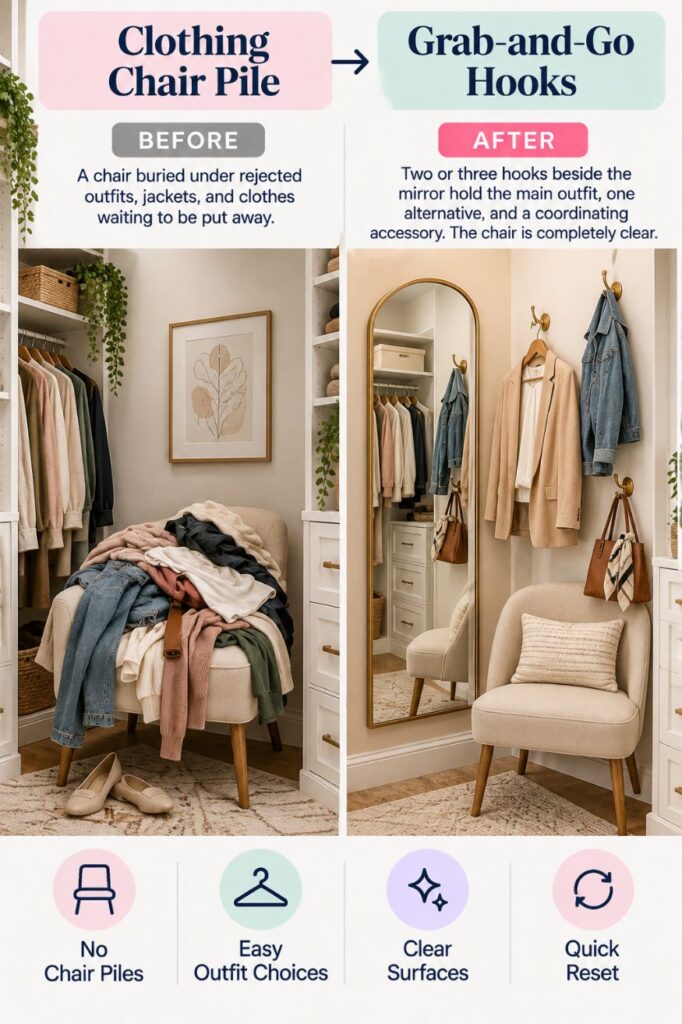
Hooks are what make this setup more useful than simply placing a mirror in the closet. They create temporary landing spots for clothes you are considering, preparing, or comparing.
The key word is temporary.
If every hook becomes permanent storage, your dressing corner will slowly disappear behind coats, bags, and clothes waiting to be put away.
Give each hook a specific purpose: Decide what each hook is allowed to hold before you install it. One might hold the main outfit, another could hold an alternative layer, and a lower hook could hold a handbag or belt.
This simple rule makes the setup easier to maintain because you immediately know what belongs there.
If you want to get more from your life, and are looking for concrete action steps to get you there, check out our Request a Coach page. It’s a “cut the fence-sitting and take action” way to tackle your issues and actually find success. To get off the fence and start to take action, click or tap here.
For example:
- Hook 1: Tomorrow’s outfit
- Hook 2: Alternate jacket or layer
- Hook 3: Bag, belt, or scarf
Place the main hooks around comfortable reach height: You should be able to hang and remove clothing without stretching or crouching. Garments should also have enough room to fall naturally.
If you plan to hang dresses or longer jackets, check where the bottom of the garment will land. You do not want clothes dragging across the floor or resting on a shoe rack.
Leave space between hooks: Two hooks placed too close together quickly become one tangled pile. Give garments enough room to remain visually separate so you can compare them.
Do not automatically fill the entire wall with hooks.
Start with fewer hooks than you think you need. You can always add another later if the routine shows you that it would be useful.
Choose hooks that match what they will carry: Lightweight accessories may only need small hooks, while jackets, bags, or multiple hangers require sturdier hardware.
The most useful setup is usually simple and obvious. When you walk into the closet, you should be able to look at the hook area and immediately understand what is being worn, considered, or prepared.
If you want to get more from your life, and are looking for concrete action steps to get you there, check out our Request a Coach page. It’s a “cut the fence-sitting and take action” way to tackle your issues and actually find success. To get off the fence and start to take action, click or tap here.
That clarity is what turns a blank corner into a practical dressing station.
4. Add a Tiny Landing Zone Without Creating Another Clutter Spot
Not every part of an outfit can hang from a hook. Shoes, watches, earrings, sunglasses, hair accessories, and other small pieces often need somewhere to sit temporarily.
A small landing zone can make the dressing corner more useful, but it can also become the fastest route back to clutter if it is too large or poorly defined.
Decide whether you actually need a surface: Do not add a shelf or table simply because the corner looks unfinished. First ask what you regularly need to put down while getting dressed.
If the answer is nothing, skip it.
If you regularly gather small accessories or compare shoes, a shallow surface may help.
Possible options include:
- A narrow floating shelf
- A small tray on an existing drawer unit
- A tiny wall-mounted ledge
- The top of a nearby shoe cabinet
- A compact stool with a flat surface
Give the landing area one clear job: A tray for today’s accessories works better than a general surface where receipts, laundry, shopping bags, and random objects accumulate.
If you want to get more from your life, and are looking for concrete action steps to get you there, check out our Request a Coach page. It’s a “cut the fence-sitting and take action” way to tackle your issues and actually find success. To get off the fence and start to take action, click or tap here.
You can create a simple rule such as, “This tray only holds items being worn today.”
Keep the footprint small: Larger surfaces attract more objects. Choose the smallest option that solves the problem while preserving room to stand and move.
If the closet is narrow, wall-mounted storage is often better than adding another piece of furniture.
Set a capacity limit: A small tray naturally tells you when the space is full. Once items begin stacking or spilling onto nearby surfaces, something needs to return to its proper home.
You may also discover that one small bowl inside the tray is enough for jewelry while the rest of the surface stays open.
The dressing corner should help you make decisions, not create more places to postpone them.
When the landing zone has a specific purpose and limited capacity, it supports the routine without becoming a new dumping ground.
5. Arrange the Corner in the Order You Get Dressed
Once the mirror, hooks, and optional landing zone are in place, think about the order in which you actually use them. This is what turns a collection of useful objects into a working system.
If you want to get more from your life, and are looking for concrete action steps to get you there, check out our Request a Coach page. It’s a “cut the fence-sitting and take action” way to tackle your issues and actually find success. To get off the fence and start to take action, click or tap here.
Most people already have a natural sequence when getting dressed, even if they have never consciously noticed it.
You might choose your main clothes first, then compare a jacket, pick shoes, and finish with jewelry or a handbag. Your setup should follow that same flow.
Put the main outfit in the easiest position: The most accessible hook should hold the clothing you are most likely to wear. You should not have to move other pieces aside to reach it.
Place alternatives nearby: A second hook can hold the jacket, cardigan, shirt, or dress you are comparing with your first choice.
This makes outfit decisions more visual. Instead of pulling one item out, returning it, and finding another, you can see both options at the same time.
A simple flow might look like this:
- Main outfit on the first hook
- Alternate layer on the second hook
- Shoes positioned below
- Accessories on the small landing surface
- Mirror immediately beside the setup
Keep finishing pieces closer to the end of the routine: If you usually add a handbag or belt last, place those items slightly lower or closer to the closet exit.
Create a return route for rejected clothing: This step is easy to overlook. Decide what happens when you try something and decide not to wear it.
If you want to get more from your life, and are looking for concrete action steps to get you there, check out our Request a Coach page. It’s a “cut the fence-sitting and take action” way to tackle your issues and actually find success. To get off the fence and start to take action, click or tap here.
Ideally, rejected pieces go directly back to their normal storage spot instead of staying on the hooks.
You can even adopt a simple rule: only one alternative can remain on the dressing hooks after you leave the closet.
A system that follows your natural movements requires less thought to maintain. That is important because organization works best when it reduces decisions rather than creating more of them.
The layout should feel intuitive enough that you begin using it without consciously thinking about the process.
6. Use the Dressing Corner to Plan Tomorrow’s Outfit
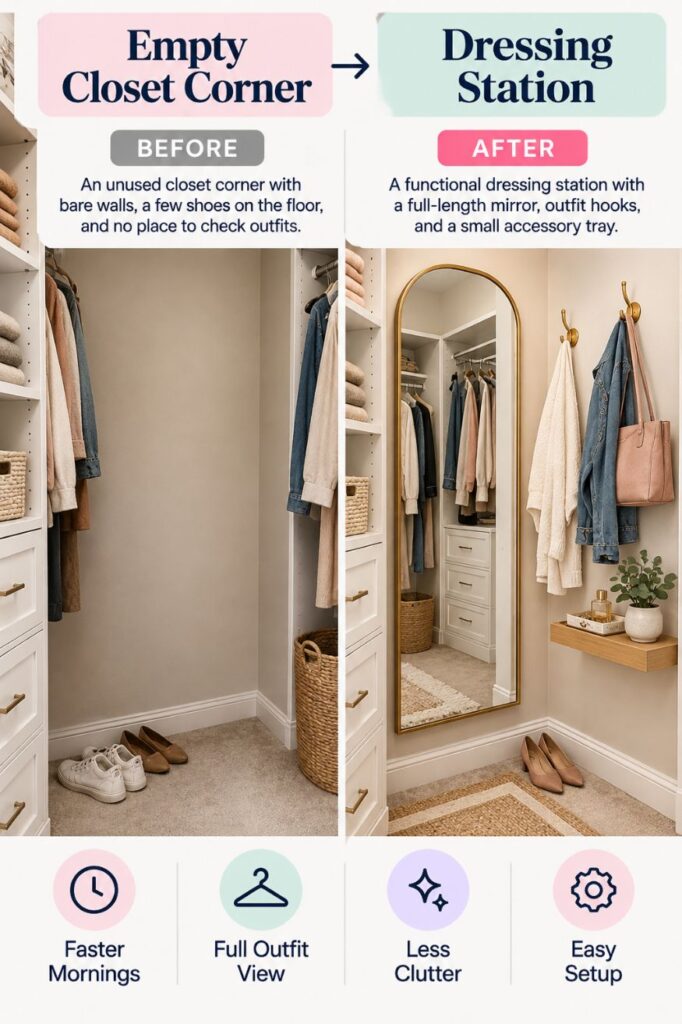
The dressing corner becomes even more useful when it helps you prepare before a busy morning begins. Instead of choosing everything while watching the clock, you can stage the main parts of your outfit the night before.
You do not need to plan an entire week.
In fact, keeping the setup focused on one upcoming outfit usually works better because it prevents the hooks from becoming another crowded clothing rack.
Stage one main outfit: Hang the clothing you expect to wear on the primary hook. If several pieces belong together, place them on one or two hangers so they remain visually connected.
If you want to get more from your life, and are looking for concrete action steps to get you there, check out our Request a Coach page. It’s a “cut the fence-sitting and take action” way to tackle your issues and actually find success. To get off the fence and start to take action, click or tap here.
Use the second hook for one alternative: Weather, meetings, or changing plans may make you want another layer or top. Keeping a single backup option nearby gives you flexibility without creating too many choices.
Then stand in front of the mirror and look at the pieces together.
You might notice:
- Two colors do not work as well as expected
- A jacket changes the proportions of the outfit
- Different shoes would balance the look better
- The outfit needs a belt or another finishing piece
Add the easy-to-forget items: Once you have chosen the outfit, gather the accessories that usually cause last-minute searching. That could include a belt, scarf, bag, jewelry, or another small item.
Put those pieces in your landing zone or on the appropriate hook.
Reset the corner after dressing: Once you are dressed, return anything you did not use to its regular place. Leaving rejected pieces behind makes tomorrow’s planning harder.
The reset should only take a minute or two.
Over time, this small routine can also help you notice which clothes you actually reach for. Items that repeatedly make it to the dressing corner but never get worn may deserve another look during your next closet edit.
If you want to get more from your life, and are looking for concrete action steps to get you there, check out our Request a Coach page. It’s a “cut the fence-sitting and take action” way to tackle your issues and actually find success. To get off the fence and start to take action, click or tap here.
The point is not to make outfit planning elaborate. It is to move a few decisions out of the busiest part of your morning.
7. Adjust the Setup for a Small or Shared Walk-In Closet
A dressing corner does not require a huge walk-in closet. The idea can work in a narrow closet, an awkward corner, or a space shared between two people.
The trick is adjusting the layout instead of trying to copy a larger setup exactly.
Use vertical space when the wall is narrow: If you do not have enough width for several hooks side by side, place them at different heights.
For example, a clothing hook can sit higher while a bag or accessory hook sits below it. Just make sure the hanging items do not overlap.
Choose a slimmer mirror: A narrow full-length mirror can still provide a useful outfit view without taking over the entire wall.
In a particularly tight closet, you might position the mirror on the back of a suitable door if doing so does not interfere with storage or movement.
Shared closets need an extra layer of structure.
If you want to get more from your life, and are looking for concrete action steps to get you there, check out our Request a Coach page. It’s a “cut the fence-sitting and take action” way to tackle your issues and actually find success. To get off the fence and start to take action, click or tap here.
Give each person a defined hook area: Even two hooks per person can be enough. The important part is making ownership obvious so one person’s temporary outfit does not take over the entire station.
A shared setup might include:
- Two upper hooks for Person A
- Two upper hooks for Person B
- One shared mirror
- One small neutral accessory surface
- Separate storage elsewhere for permanent belongings
Keep shared surfaces especially controlled: A tray or shelf that belongs to everyone can quickly become nobody’s responsibility.
Limit it to things that are actively part of the current dressing routine. Permanent jewelry storage, wallets, keys, laundry, and personal overflow should have separate homes.
If the closet is extremely small, consider whether the mirror needs to be inside the closet at all. The hooks may remain inside while a nearby bedroom mirror completes the routine.
The exact arrangement matters less than preserving the purpose of the space.
Even in a small or shared closet, the dressing corner should remain open enough that you can see your choices, reach your clothes, and move comfortably.
8. When an Organization Coach Could Help Refine the Dressing Routine
Sometimes the physical setup is not the real problem. You may install the mirror, add hooks, create a landing zone, and still find yourself dropping clothes on the floor or standing in front of the closet unable to decide what to wear.
If you want to get more from your life, and are looking for concrete action steps to get you there, check out our Request a Coach page. It’s a “cut the fence-sitting and take action” way to tackle your issues and actually find success. To get off the fence and start to take action, click or tap here.
That is where an organization coach can sometimes help.
The goal is not necessarily to redesign the closet again. Instead, a coach can help identify what part of the routine is breaking down.
Look for the actual friction point: You may assume you need more hooks when the real problem is that too many clothing options are competing for attention.
Another person may have plenty of space but no habit of returning rejected outfits to the rod.
A coach might help you examine questions such as:
- When does the dressing area become messy?
- Which decisions take the longest?
- What repeatedly gets left out?
- Which parts of the setup are rarely used?
- What would make resetting the space easier?
Build the routine around existing habits: Organization tends to work better when it supports what you already do.
If you naturally choose tomorrow’s clothes before bed, the hooks can become part of that evening routine. If you only plan clothes in the morning, the corner can be designed around quick comparisons instead.
Create one simple reset trigger: A coach may help you attach the reset to something you already do, such as putting away rejected clothes immediately after getting dressed.
If you want to get more from your life, and are looking for concrete action steps to get you there, check out our Request a Coach page. It’s a “cut the fence-sitting and take action” way to tackle your issues and actually find success. To get off the fence and start to take action, click or tap here.
The rule should be easy enough to repeat consistently.
Review the system after real use: After a few weeks, look at what is actually happening rather than what you expected to happen.
Maybe three hooks are too many. Maybe the accessory shelf is unnecessary. Perhaps the second hook is the most useful part of the entire setup.
Good organization is not about keeping every original idea. It is about noticing what reduces friction and simplifying the system around that.
Turn One Underused Corner Into a Daily Dressing Shortcut
A useful walk-in closet does more than store clothing. It should also make the process of choosing, combining, and wearing those clothes easier.
That is why a small dressing corner can have such an outsized effect.
You are not rebuilding the closet or installing an expensive custom system. You are simply giving one small area a very specific purpose.
At its simplest, the setup needs:
If you want to get more from your life, and are looking for concrete action steps to get you there, check out our Request a Coach page. It’s a “cut the fence-sitting and take action” way to tackle your issues and actually find success. To get off the fence and start to take action, click or tap here.
- One well-positioned mirror
- Two or three purposeful hooks
- Enough room to stand comfortably
- An optional small accessory landing zone
- A simple habit for clearing the space
Keep the final system simple: If the dressing corner starts filling with extra racks, baskets, shelves, and permanent storage, pause before adding more.
The power of the setup comes from having visible open space where today’s decisions can happen.
Judge the corner by what it makes easier: A successful dressing station should reduce the amount of walking back and forth, searching, piling, and second-guessing involved in choosing an outfit.
You should be able to pull a few pieces, hang them together, look in the mirror, make your decision, and return anything you are not wearing.
Protect the original purpose: The biggest long-term challenge will probably be keeping the hooks from turning into overflow storage.
When that happens, reset them.
You do not have to maintain a picture-perfect closet every day. You simply want the dressing area clear enough to do its job.
One overlooked wall or awkward corner can become one of the most useful parts of your walk-in closet when it is designed around how you actually get dressed.
If you want to get more from your life, and are looking for concrete action steps to get you there, check out our Request a Coach page. It’s a “cut the fence-sitting and take action” way to tackle your issues and actually find success. To get off the fence and start to take action, click or tap here.
Instead of adding more storage, you are adding a better process. And sometimes that is exactly what makes an organized closet finally feel easier to use.
*****
Are you all about style, decor and organization? Download a copy of our Clutter Reset Guide.
Need some in depth help with organization and productivity ? Drop on by our directories choc full of productivity coaches, minimalist coaches, and work/life balance coaches to get your life organized! Or click here to have us match you to the best.
If you want to get more from your life, and are looking for concrete action steps to get you there, check out our Request a Coach page. It’s a “cut the fence-sitting and take action” way to tackle your issues and actually find success. To get off the fence and start to take action, click or tap here.
Read this next

Clearing Out Your Life’s Clutter
Are you overwhelmed and stressed out because of all the clutter in your life?
Read More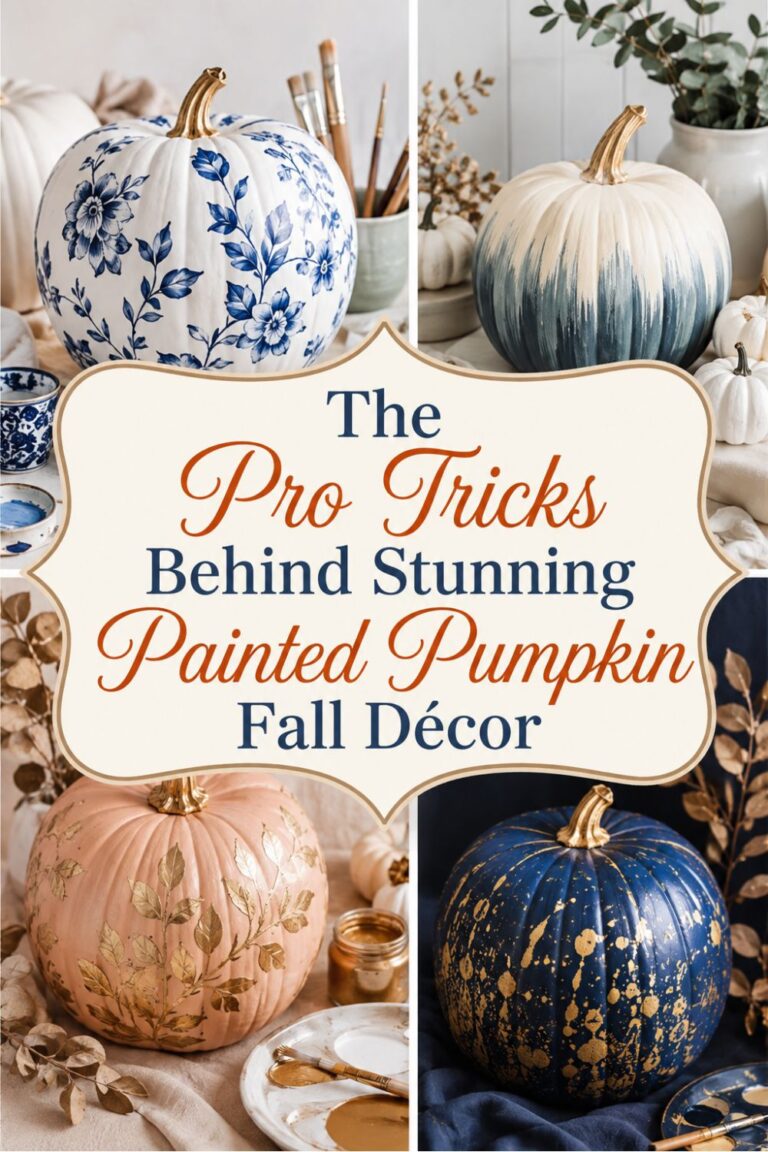
The Secret Techniques Professional Artists Use on Painted Pumpkins
Are you all about style, decor and organization? Download a copy of our Decluttering Workbook. **** Carving pumpkins might be the tradition, but painted pumpkins have taken over as the […]
Read More
7 Super Easy DIY Rustic Outdoor Christmas Porch Decor Ideas
Are you all about style, decor and organization? Download a copy of our Decluttering Workbook.**** Rustic Christmas porch decor has a charm that feels welcoming, warm, and handmade in all […]
Read More