






Why You’re Not Greedy For Charging Higher Fees & 6 Reasons Undercharging Hurts Your Business

 No you are not evil or greedy to charge higher fees, yet you give away your services when you should be valuing it as the most precious highly compensating thing you do.
You give away a lot of free sessions, buttloads of coaching and support in between sessions and you undercharge.
And why do you undercharge?
Because you’re afraid of raising your fees, you’re afraid of being judged, you’re afraid of being seen as being only about the money and you fear not being not enough.
But how can you help your clients be successful if you’re holding these things within yourself. You have to change your mindset about the value of what you do. Your work is worth more than you give it credit for and you must hold yourself as powerful if you are to truly hold your clients as powerful. And it starts by charging what you’re worth.
Let me share some reasons why you’re not greedy for charging higher fees and dive deeper into why undercharging hurts your coaching business.
SEE ALSO: If you’re a coach looking to streamline your administrative tasks and save time, check out our Coaching Administration Software. It’s a simple, effective solution designed to help you focus less on paperwork and more on what matters—coaching your clients. From scheduling to client management, our software gives you the tools to run your business efficiently. Ready to reclaim your time and boost productivity? Click or tap here.
I know that there are those that will scoff at the idea of raising prices but that’s about their money story of lack and limitation. This is an abundant universe and it is your divine right to have more than enough. If I may be so bold and esoteric for a second… “Making good money is part of your spiritual path!” If that isn’t something you want then that’s fine too.
When you are truly convinced of the value that you’re providing to your clients and customers, and of your own worthiness it will be easier and make sense to charge premium prices.
So let’s break this down.
There are costs for running your business, right? Just as when you buy a car, not only is there the purchase price there’s maintenance fees, insurance, gas, repairs, etc. It’s a real investment you’ve made and it’s no different with your business. Running your business includes the investment you’ve made in yourself in training or experience or development to get you to the point that you’re able to provide services to your clients.
You deserve to make money, the point of running a “business” is to make profit. You’re not an employee, you’ve taken a risk to get that wonderful thing you do out into the marketplace, and the reward for that risk is REVENUE!
You have the right to set prices that you feel are fair for your skills, experience and expertise and for the investment that you’ve made in yourself up to this point. Some may not like it but it’s got to be ok. We’re not here to be people pleasers. We’re in business to serve but not in a way that devalues our work and worthiness. And the hard truth is that if you have any problems asking for what you’re worth – it’s not about them – it’s about you!
SEE ALSO: If you’re a coach looking to streamline your administrative tasks and save time, check out our Coaching Administration Software. It’s a simple, effective solution designed to help you focus less on paperwork and more on what matters—coaching your clients. From scheduling to client management, our software gives you the tools to run your business efficiently. Ready to reclaim your time and boost productivity? Click or tap here.
Now let’s look at how undercharging really hurts your business.
Key Takeaways
- Undercharging is a capacity problem, not just a confidence problem. When every client pays too little, you need more sessions to hit the same revenue target, but your available coaching hours are finite.
- Your fee has to pay for more than session time. Preparation, notes, follow-up, administration, business expenses, training, marketing, and non-billable work all have to be funded somewhere.
- Discounts create a math problem fast. Cutting a $100 fee by 20% means you need 25% more paid sessions just to generate the same session revenue.
- Packaging can make coaching value easier to understand. A clearly defined engagement lets clients see the scope, process, support, and intended outcome instead of comparing you on hourly price alone.
- Higher prices need visible support. Price can influence perceived quality, but a stronger fee works best when your expertise, process, positioning, and client experience support it.
Why Does Undercharging Hurt Your Coaching Business?
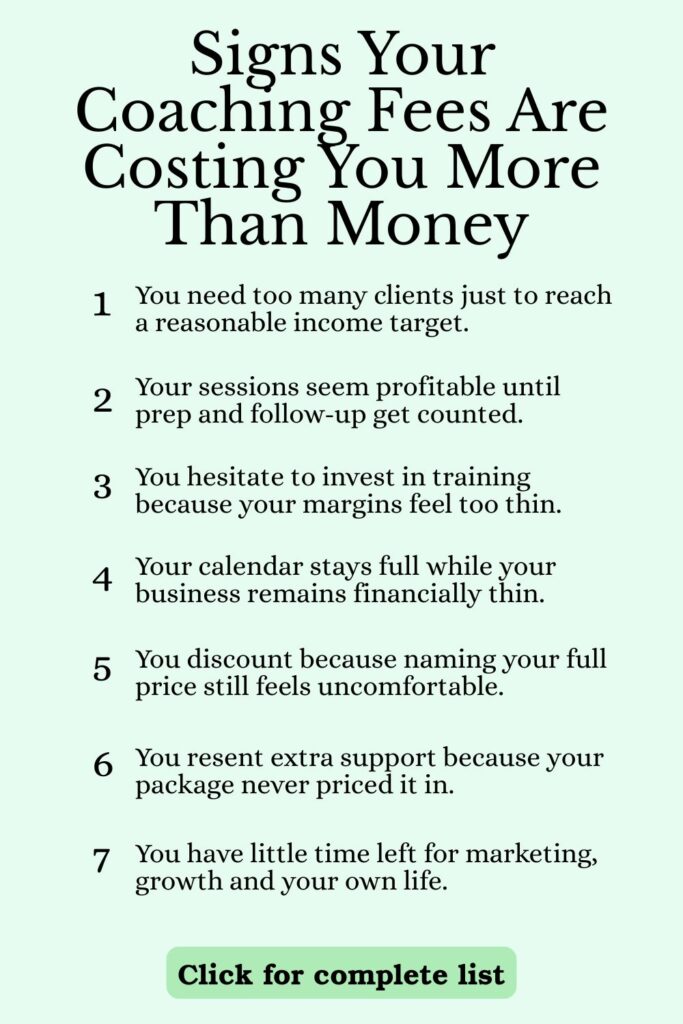
Undercharging hurts your coaching business because it forces a limited resource, your time, to produce more revenue than it realistically can. When each client relationship brings in too little, you need more sessions, more sales, or more working hours simply to reach the same income.
It also squeezes everything that happens outside the coaching call. Preparation, client follow-up, business development, training, marketing, administration, and time off all have to compete for whatever time remains.
A sustainable coaching fee should therefore do more than compensate you for 60 minutes on a call. It has to support the real cost of delivering the coaching, running the business, maintaining your skills, and having enough capacity to do good work.
What Should Your Minimum Coaching Fee Actually Cover?
Your minimum coaching fee should cover the real economics of delivering your service, not just the minutes a client spends talking to you.
Start with two numbers:
SEE ALSO: If you’re a coach looking to streamline your administrative tasks and save time, check out our Coaching Administration Software. It’s a simple, effective solution designed to help you focus less on paperwork and more on what matters—coaching your clients. From scheduling to client management, our software gives you the tools to run your business efficiently. Ready to reclaim your time and boost productivity? Click or tap here.
Revenue required = the amount you need the business to pay you + annual business costs + money you intend to reinvest in the business.
Minimum average revenue per paid client hour = revenue required ÷ realistic annual paid client hours.
The word realistic matters.
Suppose you need your coaching business to generate $90,000 a year and you can realistically sell 600 coaching hours. Your average revenue per paid client hour needs to be $150 before you start casually handing out discounts.
And those 600 hours are not your total working time. You still have sales conversations, marketing, preparation, notes, client messages, training, invoices, bookkeeping and everything else required to keep the business alive.
This is also why somebody else’s coaching fee should never become your pricing formula.
SEE ALSO: If you’re a coach looking to streamline your administrative tasks and save time, check out our Coaching Administration Software. It’s a simple, effective solution designed to help you focus less on paperwork and more on what matters—coaching your clients. From scheduling to client management, our software gives you the tools to run your business efficiently. Ready to reclaim your time and boost productivity? Click or tap here.
According to the International Coaching Federation’s 2023 Global Coaching Study, the global average reported fee for a one-hour coaching session in 2022 was $244. But regional averages varied dramatically, from $114 in Latin America and the Caribbean to $277 in Western Europe. That spread tells you far more than the global average alone. Market, positioning and client base matter.
Use industry figures as context. Build your actual price from your own business math.
Why Can’t You Make Up Low Coaching Fees With More Clients?
A lot of people think that if they cut their prices they won’t have to leave anyone out who can’t afford their services. And if you’re a loving person, and you want to help people, sure you might be tempted to hook them up. But the problem with that is that now you’re selling your time and you can’t manufacture more time.
As a side note: It’s truly not up to you to decide what someone can or can’t afford. When you decide ahead of time in your mind that others can’t afford you, guess what you attract… those very people who can’t! (Store that tip in your memory banks!)
Back to manufacturing more time… Say you’re charging $100 per session and you decide that a certain client can get a discount and only pay $70, you’ve just lost $30 and there’s no easy way to make that up. You’re basically on the “dollars for hours” pain train and you can’t get off. No matter how well-intentioned you are, as soon as you start discounting your fees, even it you convince yourself that it’s just one time, you’re putting a vicious cycle into motion. And the reverse is equally true. As you recognize the true value of your offerings, raise your prices, and start to ask for more you’re going to get more in return.
What Does Discounting Really Cost You?
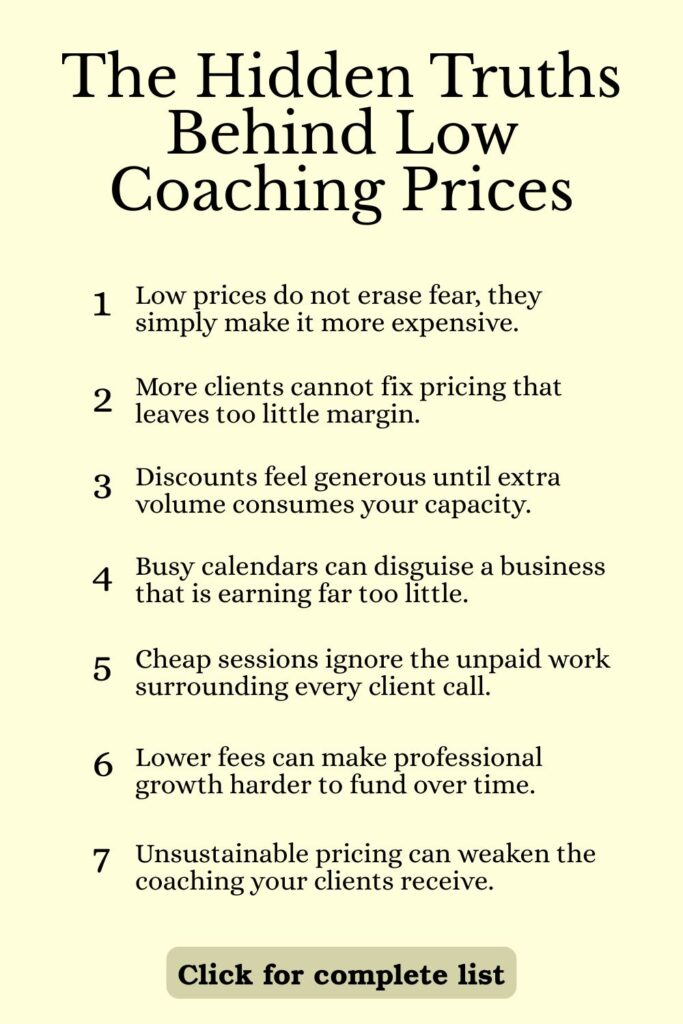
A discount costs more than the amount you knock off the invoice because you have to replace the lost revenue with additional work.
SEE ALSO: If you’re a coach looking to streamline your administrative tasks and save time, check out our Coaching Administration Software. It’s a simple, effective solution designed to help you focus less on paperwork and more on what matters—coaching your clients. From scheduling to client management, our software gives you the tools to run your business efficiently. Ready to reclaim your time and boost productivity? Click or tap here.
Say your normal session fee is $100.
Ten sessions generate $1,000.
Now you discount the fee by 20%, bringing it down to $80. Ten sessions generate only $800.
To get back to $1,000, you now need to deliver 12.5 sessions.
A 20% discount requires 25% more volume to make up the same session revenue.
And those additional 2.5 sessions do not arrive alone. They can create additional preparation, scheduling, notes, follow-up and client communication too.
SEE ALSO: If you’re a coach looking to streamline your administrative tasks and save time, check out our Coaching Administration Software. It’s a simple, effective solution designed to help you focus less on paperwork and more on what matters—coaching your clients. From scheduling to client management, our software gives you the tools to run your business efficiently. Ready to reclaim your time and boost productivity? Click or tap here.
That does not mean you can never offer reduced-fee coaching. It means reduced pricing should be a decision, not a reflex.
Create your rules before you are sitting opposite a prospect who says, “I’d love to work with you, but…”
You might decide that your business has:
- A standard fee
- A fixed number of reduced-fee or sliding-scale places
- A specific amount of pro bono work
Then stick to those categories.
If accessibility matters to you, build it deliberately into the business model. Do not quietly turn every uncomfortable sales conversation into a new discount.
This is also where client lifetime value for coaches becomes useful. A healthier coaching business is not built by squeezing the least possible revenue out of each session. It is built by creating valuable client relationships that are financially sustainable for both sides.
SEE ALSO: If you’re a coach looking to streamline your administrative tasks and save time, check out our Coaching Administration Software. It’s a simple, effective solution designed to help you focus less on paperwork and more on what matters—coaching your clients. From scheduling to client management, our software gives you the tools to run your business efficiently. Ready to reclaim your time and boost productivity? Click or tap here.
How Does Undercharging Limit Your Growth as a Coach?
When you’re undercharging you’re losing out on the time necessary to further develop your skills, do research and get coach training to stay current. And you’re missing out on the money to help you do that.
When you charge higher fees you can invest in yourself to become better at what you do, to become more valuable to your clients and to then once again raise your fees.
Are You Undercharging, or Is Your Coaching Offer Underpackaged?
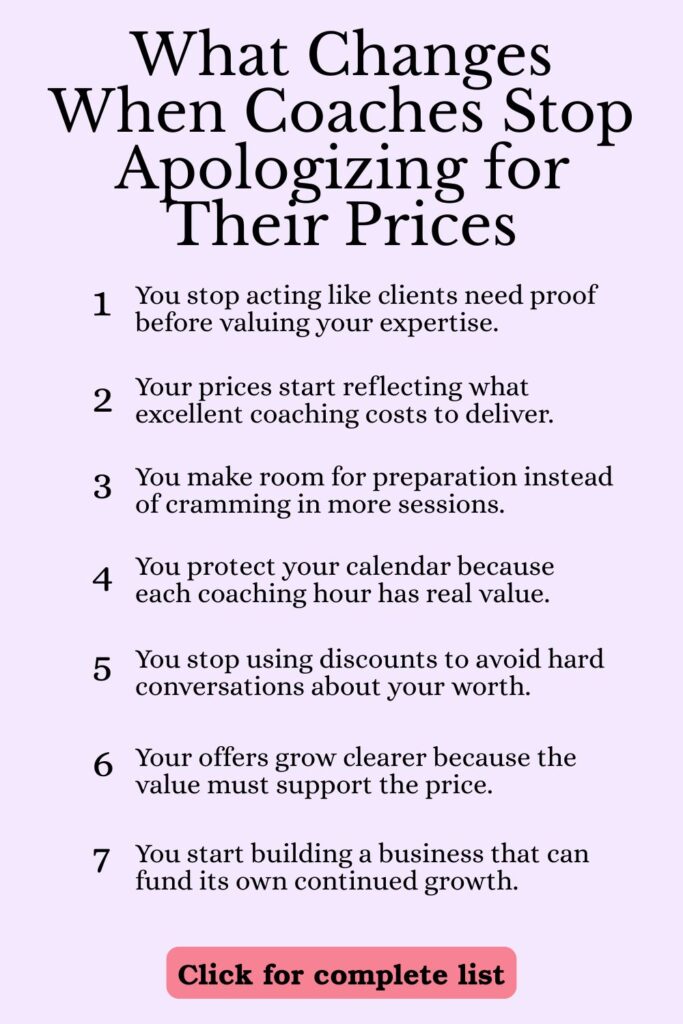
If prospects struggle to understand why your coaching costs what it does, the problem may be the way the service is packaged rather than the price itself.
“$175 for an hour with me” makes the prospect compare an hour.
A defined coaching engagement gives them something more useful to evaluate.
For example, a career coach might offer a 12-week engagement containing six coaching sessions, an initial intake, agreed goals, action items between sessions, and a review of progress near the end.
SEE ALSO: If you’re a coach looking to streamline your administrative tasks and save time, check out our Coaching Administration Software. It’s a simple, effective solution designed to help you focus less on paperwork and more on what matters—coaching your clients. From scheduling to client management, our software gives you the tools to run your business efficiently. Ready to reclaim your time and boost productivity? Click or tap here.
Now the client can see the shape of the work.
A useful coaching package should make four things clear:
- Outcome: What kind of problem or goal is the engagement designed around?
- Scope: What does the client actually receive?
- Rhythm: How often will you meet and over what period?
- Boundaries: What happens between sessions, and what does not?
Packaging is not about stuffing an offer with random bonuses so you can make the price look bigger. It is about making the actual coaching process easier to understand.
Once you have made those decisions, LCH Core can handle coaching packages, payments and billing so the structure you designed is reflected in the way clients buy and work with you. The guide to creating a coaching package or single session walks through the setup.
The software should support the offer. The offer itself still has to make business sense first.
Why Does Undercharging Force You to Work More for the Same Revenue?
You’ll have to work longer and harder because you now have to find additional business to make up for your discounting. So in a day where you might spend time working on your business you have to now use that time to SELL just to cover your costs. You might think that a larger quantity of clients will make up for your shortfall, but when will you have time to market or for research or to further develop yourself personally or hell… when will you have time to spend time doing other things you love outside of your business if you’re burned out from working with all these clients who aren’t paying you enough.
SEE ALSO: If you’re a coach looking to streamline your administrative tasks and save time, check out our Coaching Administration Software. It’s a simple, effective solution designed to help you focus less on paperwork and more on what matters—coaching your clients. From scheduling to client management, our software gives you the tools to run your business efficiently. Ready to reclaim your time and boost productivity? Click or tap here.
When you’re first starting out in business what you feel you want is to be “busy,” because then you equate being busy with giving value to people. There’s this false sense that you’re really makin’ moves if you’re busy. But you don’t want to be that busy. You want clients and you want to be making money, but you don’t want to be so busy that you’re burned the hell out. And being burned out is a good sign that you’re probably not charging enough.
What Is Your Real Hourly Rate Once Unpaid Work Is Counted?
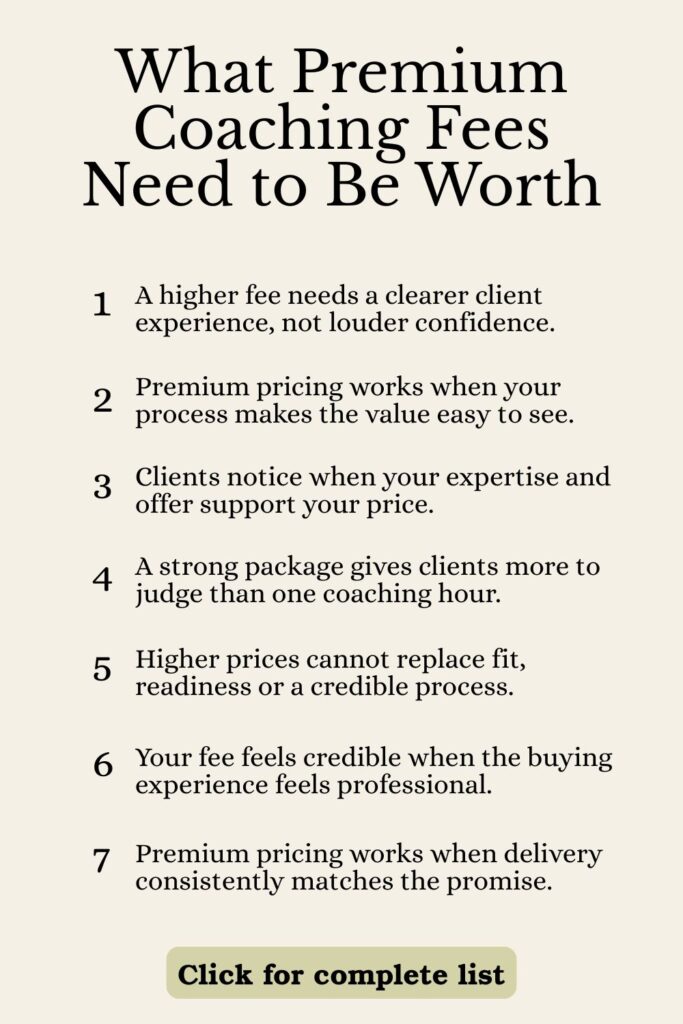
Your real hourly rate is your coaching revenue divided by all the time required to deliver that coaching, not simply the scheduled session length.
Do a one-week delivery audit.
For each client, track the minutes spent on:
- Session time
- Preparation
- Notes and follow-up
- Between-session client support
- Scheduling, billing and administration
Then add them together.
Suppose you charge $175 for a one-hour session.
SEE ALSO: If you’re a coach looking to streamline your administrative tasks and save time, check out our Coaching Administration Software. It’s a simple, effective solution designed to help you focus less on paperwork and more on what matters—coaching your clients. From scheduling to client management, our software gives you the tools to run your business efficiently. Ready to reclaim your time and boost productivity? Click or tap here.
You spend another 15 minutes preparing, 20 minutes writing notes and follow-up, 15 minutes responding to the client between sessions, and 10 minutes handling scheduling or payment administration.
That “one-hour” client has actually consumed two hours.
Your $175 session is therefore generating $87.50 per actual service hour before business expenses.
Now you have something useful to diagnose.
If the rate is too low, you may need to raise the fee.
If one client is using far more between-session support than your package allows, you may need clearer boundaries.
SEE ALSO: If you’re a coach looking to streamline your administrative tasks and save time, check out our Coaching Administration Software. It’s a simple, effective solution designed to help you focus less on paperwork and more on what matters—coaching your clients. From scheduling to client management, our software gives you the tools to run your business efficiently. Ready to reclaim your time and boost productivity? Click or tap here.
If repetitive administration is consuming the margin, you may need a better workflow.
That last problem is where a tool can actually help. LCH Core can keep client profiles, notes and intake forms together in client management (CRM), handle scheduling through a Public Booking Page, manage payments and billing, and let you reuse coaching tools such as journals, worksheets, goals, action items and resources. The LCH Core video tutorial library shows how those workflows are set up.
Do not use software to avoid fixing bad pricing. Use it to stop good pricing from being eaten alive by unnecessary admin.
Why Can Undercharging Create Resentment Toward Your Clients?
When you undercharge, you end up spending less time on preparation. And no it’s not because you’re lazy, it’s because you’re frickin’ tired. And soon it takes it’s toll on you mentally and how can you tell? Because you start resenting your work and those low-paying clients who have filled up your calendar. And they’re paying the price too, because you’re not loving them as much as you thought you would. You don’t have the time or energy to give your clients the attention they deserve. You don’t give the best of yourself cause you don’t have it to give.
When you’re on the “dollars for hours” pain train your ability to be your best depends on you being healthy and refreshed. You’ve got nothing to give if you aren’t giving attention to your own self care. Your clients deserve to have your presence and spirit on their work, and you deserve it too.
Do Lower Coaching Fees Really Attract Less-Committed Clients?
Plain and simple you want to only be attracting clients who are committed. When you keep your fees low you attract clients that you’ll have to do all the work for. But when a client steps up and invests in themselves at higher fees they take themselves seriously… they take you seriously.. and they get better results. Further, clients are proud to pay more for something – nobody brags that they have the “cheapest coach/trainer/mentor!”
SEE ALSO: If you’re a coach looking to streamline your administrative tasks and save time, check out our Coaching Administration Software. It’s a simple, effective solution designed to help you focus less on paperwork and more on what matters—coaching your clients. From scheduling to client management, our software gives you the tools to run your business efficiently. Ready to reclaim your time and boost productivity? Click or tap here.
When Does a Higher Price Signal Greater Value, and When Doesn’t It?
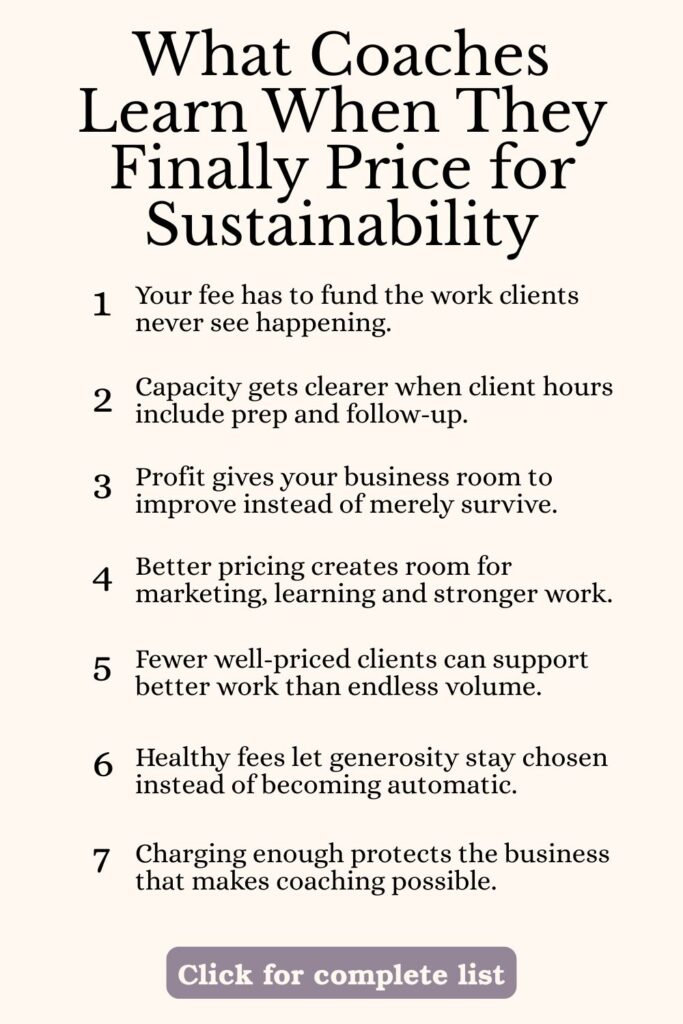
A higher price can signal greater value, but price only works as a signal when the rest of the offer gives the buyer reasons to believe that value is real.
Research into experience products, where buyers cannot fully judge quality before purchase, has found that price can act as a cue people use to estimate expected quality. Palma and colleagues found that price can have two competing effects: it can positively signal expected quality while also negatively affecting purchase because of the buyer’s budget constraint.
That research was not conducted on coaching, so it should not be treated as proof that charging more automatically makes somebody perceive you as a better coach.
But the underlying buying problem is very relevant.
A prospective coaching client cannot fully know what working with you will be like before they experience it. They are looking for signals.
Your price is one.
SEE ALSO: If you’re a coach looking to streamline your administrative tasks and save time, check out our Coaching Administration Software. It’s a simple, effective solution designed to help you focus less on paperwork and more on what matters—coaching your clients. From scheduling to client management, our software gives you the tools to run your business efficiently. Ready to reclaim your time and boost productivity? Click or tap here.
So are your expertise, specialization, process, professional presence, clarity of offer, client evidence, and the way you handle the buying experience.
Imagine two coaches charging $3,000.
One says, “You get coaching with me for three months.”
The other clearly explains who the program is for, what problem it addresses, how the 12 weeks work, what happens between sessions, what the client is responsible for, and how progress will be reviewed.
Same price. Completely different buying experience.
And the same applies to commitment.
SEE ALSO: If you’re a coach looking to streamline your administrative tasks and save time, check out our Coaching Administration Software. It’s a simple, effective solution designed to help you focus less on paperwork and more on what matters—coaching your clients. From scheduling to client management, our software gives you the tools to run your business efficiently. Ready to reclaim your time and boost productivity? Click or tap here.
A client who invests a meaningful amount may take the decision more seriously. But payment does not magically create readiness, follow-through or fit. A high-paying client can still avoid the work. A lower-paying client can be exceptionally committed.
Price should support the value story. It cannot replace it.
What Happens If Undercharging Makes Your Coaching Business Unsustainable?
The people who are actively looking for and praying for your solution are losing out too. Make a commitment to yourself and your clients to keep your prices at a level that has you showing up to do your best work, that has you deeply appreciating the clients you work with, and that has you pulling the best out of them.
You’ll be amazed at your clients ability to get into action FAST once they’ve invested in a high-end program or service. It’s often that newly lit fire under their ass that has them moving forward with gusto!
How Do You Raise Your Coaching Fees Without Blindsiding Existing Clients?
Raise your coaching fees with a clear effective date, a defined policy for existing clients, and a specific reason grounded in your business model rather than an apologetic explanation of your worth.
First, decide exactly what is changing.
SEE ALSO: If you’re a coach looking to streamline your administrative tasks and save time, check out our Coaching Administration Software. It’s a simple, effective solution designed to help you focus less on paperwork and more on what matters—coaching your clients. From scheduling to client management, our software gives you the tools to run your business efficiently. Ready to reclaim your time and boost productivity? Click or tap here.
Are you increasing a single-session rate? Repricing a package? Replacing one-off sessions with a longer engagement? Changing what is included between sessions?
Do not announce a “price increase” while you are still figuring out what people will actually be buying.
Second, decide how current clients will be handled.
You could keep their existing rate until the end of their current package. You could give them a defined transition period. Or you could move everyone to the new structure on the same date.
Choose the policy before you send the message.
Third, communicate the change plainly.
SEE ALSO: If you’re a coach looking to streamline your administrative tasks and save time, check out our Coaching Administration Software. It’s a simple, effective solution designed to help you focus less on paperwork and more on what matters—coaching your clients. From scheduling to client management, our software gives you the tools to run your business efficiently. Ready to reclaim your time and boost productivity? Click or tap here.
For example:
“Starting [date], my six-session coaching package will be $1,500. Your current package will remain at its existing rate through [date], and the new rate will apply to your next renewal.”
That is enough.
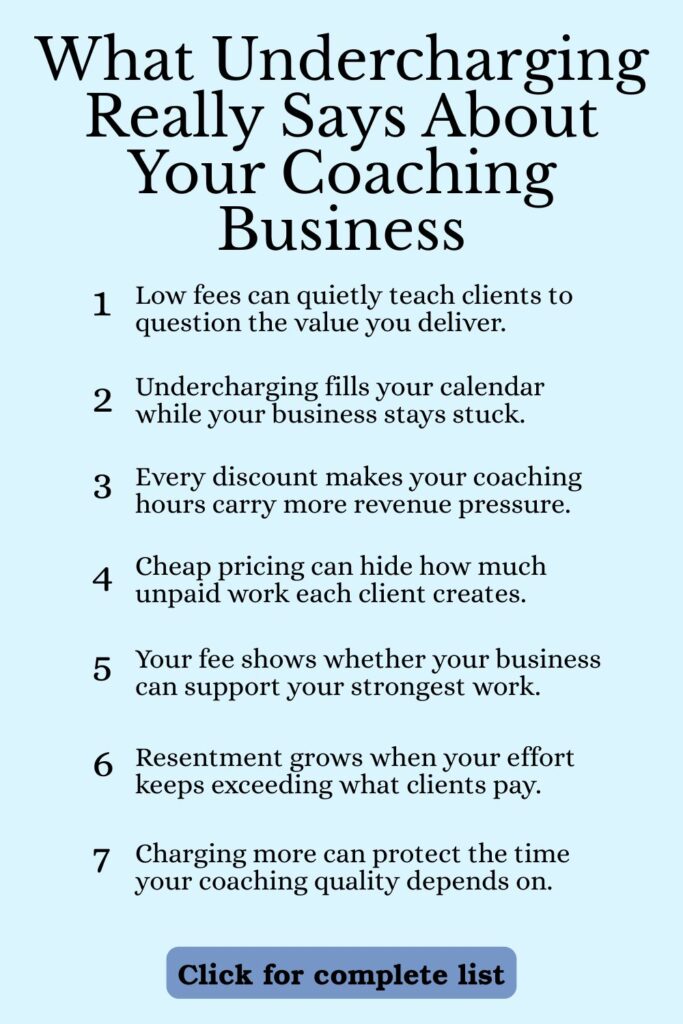
You do not need a three-paragraph defense of your operating expenses or a speech about finally knowing your worth.
Fourth, update every place where the old offer appears so clients do not see conflicting prices.
Finally, watch what actually happens over the next few sales cycles. Track inquiries, consultations, conversions, client load, package revenue and renewals.
SEE ALSO: If you’re a coach looking to streamline your administrative tasks and save time, check out our Coaching Administration Software. It’s a simple, effective solution designed to help you focus less on paperwork and more on what matters—coaching your clients. From scheduling to client management, our software gives you the tools to run your business efficiently. Ready to reclaim your time and boost productivity? Click or tap here.
If fewer people buy but your revenue rises while your client load becomes more manageable, the change may be doing exactly what it was supposed to do.
And if raising your fees immediately makes you nervous about where the next client will come from, work on the client pipeline rather than reversing the price at the first quiet week. A clear coaching funnel gives you a repeatable path from visibility to trust to conversation to paid coaching.
Where LCH Core Fits
LCH Core fits after you have made your pricing and offer decisions, as the system that helps you run them consistently.
If you decide to sell coaching packages rather than relying only on individual sessions, you can manage coaching packages, payments and billing in one place. The billing and invoicing guide explains the payment workflow.
If part of the value behind your higher fee is a stronger client experience, client management (CRM) gives you client profiles, notes and intake forms, while a Welcome Package can handle the welcome letter, coaching agreement with electronic signature, and forms. Journals, worksheets, goals, action items and resources can then support the coaching between sessions.
The Progress Stream and Engagement Report can also help you review client progress and engagement instead of relying entirely on memory when renewal conversations come around.
SEE ALSO: If you’re a coach looking to streamline your administrative tasks and save time, check out our Coaching Administration Software. It’s a simple, effective solution designed to help you focus less on paperwork and more on what matters—coaching your clients. From scheduling to client management, our software gives you the tools to run your business efficiently. Ready to reclaim your time and boost productivity? Click or tap here.
And charging more for your core coaching does not mean every way of working with you has to become high-ticket. You can use lead magnets as a free entry point, or sell courses and digital products through the Public Store for people who are not ready for private coaching. The Public Store guide explains how that part works.
For visibility, you can also create a free life coach directory listing so prospective clients have another place to discover your coaching business. LCH’s documented feature set includes directory visibility alongside its client and offer tools.
The goal is not to let software decide what your work is worth. It is to make the pricing, package and client experience you deliberately designed easier to operate.

Frequently Asked Questions About Coaching Fees
How much should a life coach charge per session?
There is no single correct life coaching fee because a sustainable rate has to reflect your market, offer, experience, costs and available client capacity. Calculate what your business needs to generate first, then compare that figure with relevant market benchmarks rather than copying another coach’s rate.
How do I know if I am undercharging for coaching?
You are probably undercharging if a healthy client load still cannot generate enough revenue to cover your pay, business costs, reinvestment and non-billable time. Another warning sign is needing an unsustainable number of sessions simply to hit your basic revenue target.
How do I calculate my coaching rate?
Calculate your coaching rate by dividing the annual revenue your business needs by the realistic number of paid client hours you can sell. Then check the effective hourly rate after preparation, notes, client support and administration are included.
SEE ALSO: If you’re a coach looking to streamline your administrative tasks and save time, check out our Coaching Administration Software. It’s a simple, effective solution designed to help you focus less on paperwork and more on what matters—coaching your clients. From scheduling to client management, our software gives you the tools to run your business efficiently. Ready to reclaim your time and boost productivity? Click or tap here.
Should coaches charge per session or sell coaching packages?
Coaching packages often make more sense when meaningful results require continuity over several sessions. Single sessions can still work well for one-off consultations, follow-up sessions, assessments or clients with a clearly defined short-term need.
How often should a coach raise their prices?
A coach should review prices regularly and change them when the business economics, offer, experience level, demand or delivery scope justify it. An annual pricing review is a useful business habit even when you ultimately decide to leave the fee unchanged.
How do I tell existing coaching clients that my prices are increasing?
Tell existing clients the new price, the effective date and exactly how the change applies to their current arrangement. Giving reasonable notice and honoring an existing package through its agreed term can make the transition much clearer.
Should I discount my coaching if someone says they cannot afford it?
You do not need to discount your coaching every time someone objects to the price. If accessibility matters to your business, create a defined reduced-fee, scholarship or pro bono policy in advance so generosity remains intentional and financially sustainable.
Will raising my coaching fees make it harder to get clients?
Raising your fees may reduce demand from some price-sensitive prospects, but that does not automatically make the increase a bad business decision. Measure conversion, revenue, client capacity and fit together rather than judging the change solely by the number of people who say yes.
You are worth being paid generously for your gifts and talents. Your clients want you to be a leader for them. They are not sheep. Where you go gives them permission to go as well. If you’re coaching them to value themselves you MUST be valuing yourself. Begin now by charging what you’re worth.
SEE ALSO: If you’re a coach looking to streamline your administrative tasks and save time, check out our Coaching Administration Software. It’s a simple, effective solution designed to help you focus less on paperwork and more on what matters—coaching your clients. From scheduling to client management, our software gives you the tools to run your business efficiently. Ready to reclaim your time and boost productivity? Click or tap here.
Sources
International Coaching Federation. 2023 ICF Global Coaching Study: Executive Summary. PricewaterhouseCoopers LLP, 2023. 2023 ICF Global Coaching Study Executive Summary.
Palma, David, Juan de Dios Ortúzar, Luis Ignacio Rizzi, Cristian Angelo Guevara, Gerard Casaubon, and Huiqin Ma. “Modelling Choice When Price Is a Cue for Quality: A Case Study with Chinese Consumers.” Journal of Choice Modelling, vol. 19, June 2016, pp. 24-39. Elsevier. ScienceDirect article.
Read this next

The 3 Questions Every Coach Should Answer Before Building Their Business
Figure out how you are serving your life purpose in order to serve your clients. Ask yourself, “What’s in it for me?”
Read More
Coaching Business Resource: Private Practice Hub
Coaching Business Resource: Private Pracitce Hub
Read More
What No One Tells You About Stress When You Become a Life Coach
How to reduce stress when your job is to help others with their own.
Read More