


Talk to a coach about Organizational coaching

Crystal Faulk
ACC
I help overwhelmed women in transition gain clarity, confidence, and...

Terrie Hein
Certified Life Coach, Certified Insight Coach Practitioner
Coaching to declutter your life, organize your goals, and cook...

Dr Charlene Ashley
Doctorate - Behaviours
I coach individuals to design fulfilling lives through structure, clarity,...

Paloma Chiara

Lana's Gymnastics Club
"Where the best in gymnastics meets fun. Where every child is a star"
lgclubny.com

Anna Sosnina
ICF (ACC)
ICF ACC certified coach, founder of EssorVie Coaching, passionate about...

Tyler Fink
B.A. in Religion, Anthropology, and Philosophy. Master of Divinity (M.Div.) in Missiology
Pastor, husband, and father helping Christian men pursue faithful growth...

Travis Brown
Professional Life coach
With experience in guiding clients to achieve goals, build confidence,...
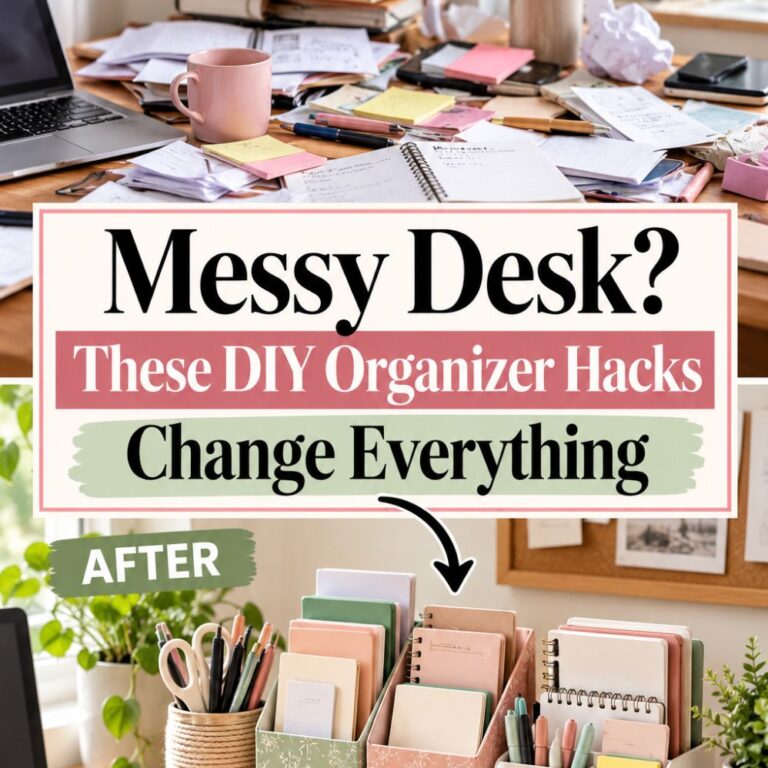
Closet Bin System For Accessories That Vanish
Are you all about style, decor and organization? Download a copy of our Clutter Reset Guide.
*****
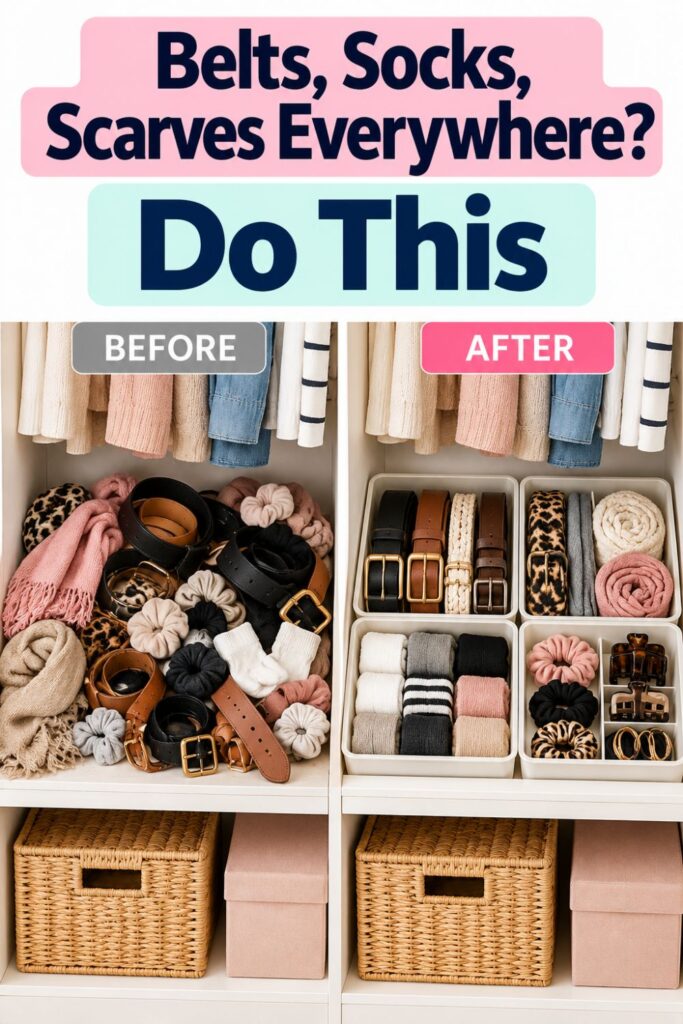
Small accessories have a sneaky way of disappearing right when you need them. Socks slip behind folded clothes, belts get shoved under sweaters, hair clips scatter into random drawers, and tiny jewelry pieces somehow end up everywhere except where you expected them to be. The problem is not always that you own too much. Sometimes the real issue is that the smallest items in your closet do not have clear homes.
A closet bin system fixes that by giving every accessory a visible, labeled, easy-to-use place to land. Instead of tossing socks into one crowded drawer or letting belts coil up wherever they fit, you create simple containers for each category. The goal is not a picture-perfect closet. The goal is being able to open one drawer, shelf, or bin and find what you need in seconds.
This works especially well in small spaces because accessories can become visual clutter fast. A few loose items can make an entire closet feel messy, even if the clothes are mostly organized. When small items are containerized, the space feels calmer because everything has a boundary.
The best part is that you do not need fancy organizers to make this work. Shoe boxes, small bins, drawer dividers, ice cube trays, and simple labels can completely change how your accessories function. You can use what you already have, test the layout, and upgrade later only if you need to.
This system is also helpful if you need an ADHD-friendly closet setup. When the categories are obvious and the containers are open, you do not have to remember where everything goes. The system reminds you. That makes getting ready faster and putting things away much easier.
Need some in depth help with organization and productivity ? Drop on by our directories choc full of productivity coaches, minimalist coaches, and work/life balance coaches to get your life organized! Or click here to have us match you to the best.
If you want to get more from your life, and are looking for concrete action steps to get you there, check out our Request a Coach page. It’s a “cut the fence-sitting and take action” way to tackle your issues and actually find success. To get off the fence and start to take action, click or tap here.
Why Small Accessories Disappear So Easily
Tiny closet items disappear because they usually do not have enough structure around them. A shirt can hang on a hanger, shoes can sit on a rack, and jeans can fold into a stack. But socks, belts, hair ties, jewelry, scarves, and small extras need smaller boundaries or they quickly blend into the background.
The first step is noticing which accessories are causing the most friction. These are usually the things you search for, rebuy, untangle, or forget you own. If you often say, “I know I have one somewhere,” that item probably needs a better home.
Look for patterns like:
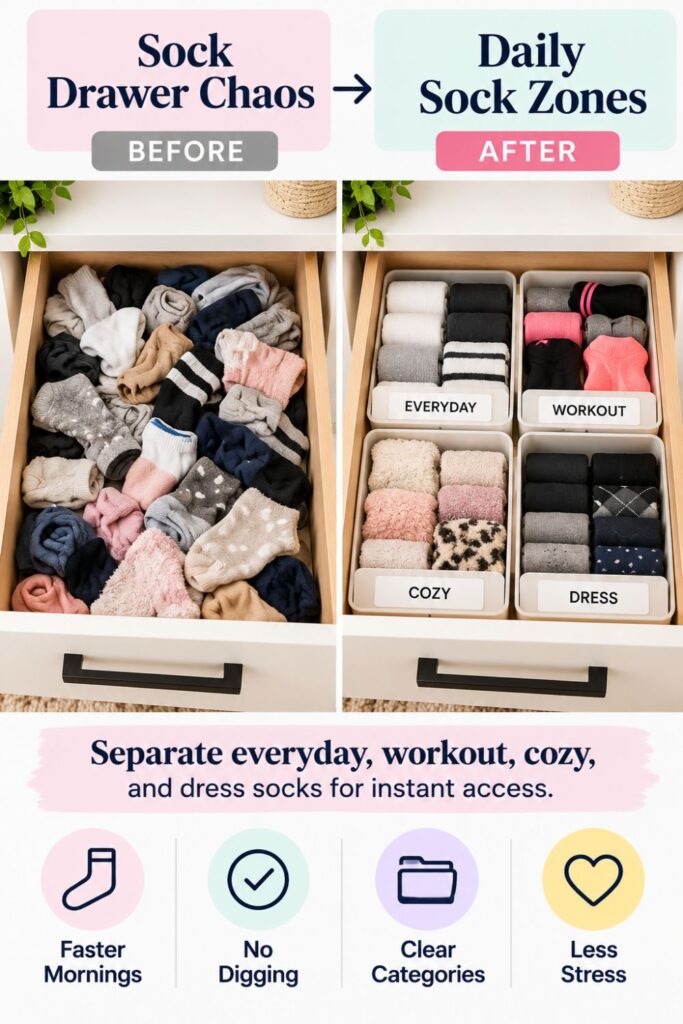
- Socks without a clear category: Everyday socks, workout socks, cozy socks, and dress socks may all be mixed together.
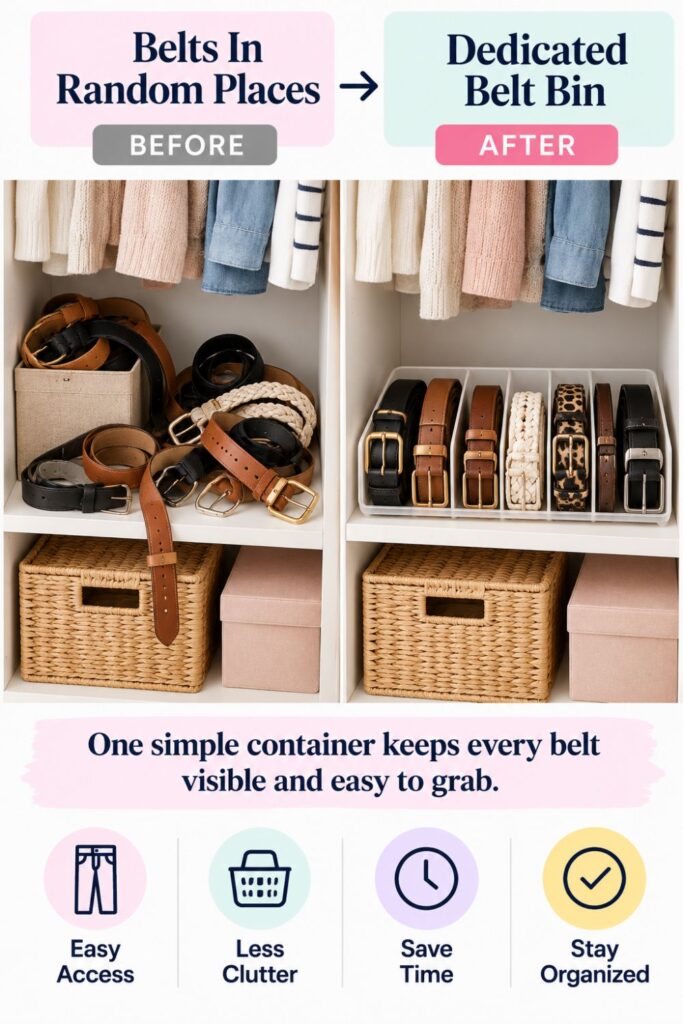
- Belts shoved into empty spaces: Belts often land wherever there is a gap, which makes them hard to see later.
- Tiny pieces floating loose: Earrings, pins, clips, and elastics can disappear inside larger drawers.
- Occasional accessories mixed with daily ones: Special-event items can crowd out the things you use every week.
A drawer can look “contained” and still be difficult to use. If everything is inside one drawer but you have to dig through it every morning, the drawer is not organized in a practical way. It is just hiding the clutter.
Visibility is the real goal. You want to open the closet, drawer, or shelf and immediately understand where each category lives. You should not have to lift five things to find one belt or dump out a container to locate matching socks.
When accessories disappear, the fix is usually not a bigger closet. It is a smarter container system. Once small items have smaller homes, the whole space starts working better because each piece has a place to return to.
Step 1: Empty One Accessory Zone At A Time
The fastest way to make this project overwhelming is to pull apart the entire closet at once. Instead, choose one accessory zone to reset first. That might be a sock drawer, a closet shelf, a hanging organizer, a basket, or the bottom corner where small things keep collecting.
Keep the project small enough to finish in one sitting. You are not trying to reorganize your whole closet today. You are building one working section that can become the model for the rest of the space.
If you want to get more from your life, and are looking for concrete action steps to get you there, check out our Request a Coach page. It’s a “cut the fence-sitting and take action” way to tackle your issues and actually find success. To get off the fence and start to take action, click or tap here.
Use this process:
- Choose one starting zone: Pick the area that causes the most daily frustration. A messy sock drawer or belt bin is usually a better place to start than a rarely used seasonal shelf.
- Pull everything out: Empty the zone completely so you can see what is actually in there. It is hard to create useful categories when items are still buried.
- Create a clear sorting surface: Use the bed, floor, or a table. Spread items out enough that you can see each accessory without digging.
- Remove obvious clutter first: Toss broken hair ties, damaged socks, stretched elastics, empty packaging, and anything you already know you will not use.
Do not start with buying containers. That is the most common mistake. If you buy bins before sorting, you may end up with organizers that look nice but do not match your actual categories.
Once everything is out, look at quantity. You might discover that you have three belts, not fifteen. Or you might realize your sock drawer is crowded because you have too many worn-out pairs mixed in with the good ones. The right container depends on the amount you are keeping.
This step is about making the invisible visible. When every small item is out in front of you, it becomes much easier to decide what deserves space and what has just been hiding there out of habit.
Step 2: Sort Accessories By How You Actually Use Them
Once the accessory zone is empty, sort everything by how you use it in real life. This is different from sorting by what the item technically is. A closet system works best when it matches your routine, not an imaginary perfect version of your routine.
Start with broad groups first, then break them down only if needed. For example, you might begin with socks, belts, jewelry, hair accessories, scarves, tights, and extras. After that, you can decide whether any group needs smaller categories.
Try sorting into practical categories like:
- Daily socks: The socks you reach for most often.
- Workout socks: Pairs you only use for exercise or walking shoes.
- Cozy socks: Thicker pairs for lounging or cold weather.
- Work belts: Belts you wear with office outfits or polished looks.
- Casual belts: Belts you wear with jeans, shorts, or everyday outfits.
- Tiny accessories: Hair clips, bobby pins, rings, earrings, pins, or elastics.
The key is to avoid categories that are too vague. A bin labeled “Accessories” is not specific enough if it holds ten different things. You will still have to dig. A bin labeled “Belts” or “Hair Clips” gives your brain a faster answer.
If you want to get more from your life, and are looking for concrete action steps to get you there, check out our Request a Coach page. It’s a “cut the fence-sitting and take action” way to tackle your issues and actually find success. To get off the fence and start to take action, click or tap here.
Separate daily items from occasional items. This matters because prime closet space should go to what you use most. If special-event jewelry or seasonal scarves are sitting in the easiest spot, they may be pushing daily items into harder-to-reach places.
Create a temporary “not sure yet” pile if you need one. This helps you keep moving without getting stuck on one random item. After the obvious categories are done, you can come back and decide whether those leftover pieces need a real home, a donation bag, or a small overflow container.
Sorting by use makes the system feel intuitive. When the categories match your getting-ready habits, you do not have to think so hard in the morning.
Step 3: Match Each Category To The Right Container
After sorting, choose containers based on the size and behavior of each category. Some accessories need open bins. Some need tiny compartments. Some need a larger box with a clear label. The right container is the one that makes the item easy to see, easy to grab, and easy to put back.
Shoe boxes are great for larger accessory groups because they create simple boundaries. They work well for socks, scarves, belts, tights, seasonal extras, and backup items. If the boxes are sturdy and shallow enough, they can turn a messy shelf or drawer into clean zones without costing anything.
Ice cube trays are surprisingly useful for tiny pieces. Their small compartments are ideal for earrings, rings, bobby pins, safety pins, tiny clips, collar stays, or little items that normally scatter. They keep small things from rolling together and make it easier to see exactly what you have.
Use this matching system:
- Choose shoe boxes for flexible groups: Use them for socks, belts, scarves, tights, and other accessories that can sit in a loose category.
- Choose ice cube trays for tiny pieces: Use them when items need individual sections instead of one shared pile.
- Choose shallow bins for daily items: These are best for accessories you grab often because you can see everything at a glance.
- Choose deeper bins for backups: Use deeper containers only for less-used items, since deep bins can make daily accessories disappear again.
Avoid overfilling each container. A bin that is packed to the top may look organized at first, but it becomes annoying to use. You should be able to remove one item without disturbing the whole category.
If you want to get more from your life, and are looking for concrete action steps to get you there, check out our Request a Coach page. It’s a “cut the fence-sitting and take action” way to tackle your issues and actually find success. To get off the fence and start to take action, click or tap here.
Also think about where the container will live. A bin in a drawer needs to fit the drawer height. A box on a shelf should be easy to pull forward. A tray for tiny items should sit somewhere stable so it does not slide around every time you open the drawer.
The container does not need to be pretty. It needs to do the job clearly.
Step 4: Build A Drawer Layout That Makes Sense Fast
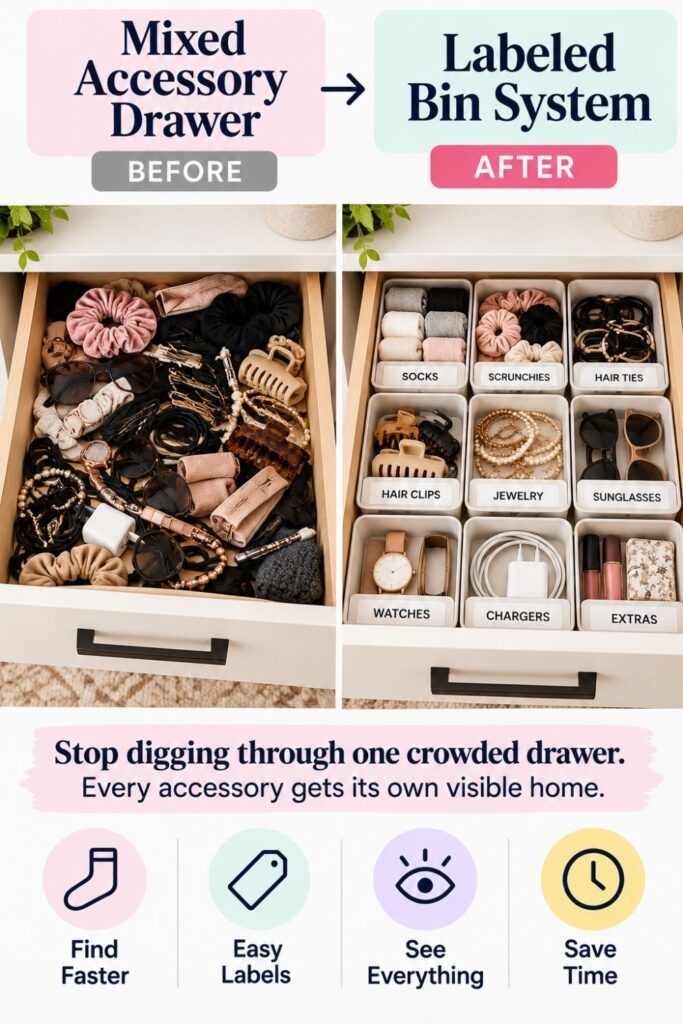
A good accessory drawer should work like a map. When you open it, your eyes should know where to go first. The layout should make sense even when you are tired, rushed, distracted, or trying to get dressed quickly.
Start by putting the most-used categories in the easiest positions. For most people, that means daily socks, everyday jewelry, favorite belts, hair accessories, or anything used before leaving the house. These items should be near the front of the drawer or at the most reachable spot on the shelf.
Use rows or lanes whenever possible. Instead of letting bins sit randomly, line them up in a simple pattern. This helps your brain read the space faster. It also makes it obvious when something is out of place.
Try this layout logic:
- Front row: Daily accessories you use most often.
- Middle row: Weekly accessories, like extra belts, tights, scarves, or backup socks.
- Back row: Occasional accessories, special-event pieces, or seasonal items.
- Tiny tray zone: Jewelry, clips, pins, and small items that need compartments.
Keep related categories close together. Socks and tights can live near each other. Belts and scarves can share a shelf zone. Hair clips and earrings can sit near a mirror or getting-ready area if that makes more sense for your routine.
After placing the containers, test the layout. Open the drawer and pretend it is a normal morning. Can you find your most-used socks without moving another bin? Can you grab a belt without untangling anything? Can you return a hair clip quickly?
If you want to get more from your life, and are looking for concrete action steps to get you there, check out our Request a Coach page. It’s a “cut the fence-sitting and take action” way to tackle your issues and actually find success. To get off the fence and start to take action, click or tap here.
If the answer is no, adjust the layout before calling it finished. This is the step where function matters more than looks. A beautiful drawer that requires too many steps will not stay organized for long.
The best layout is the one you can use without overthinking it.
Step 5: Label The System So It Stays Obvious
Labels are what turn a temporary organizing project into a system. Without labels, bins can slowly shift purpose. A sock box becomes a random catchall. A hair accessory tray starts holding receipts. A belt bin ends up with sunglasses, lint rollers, and mystery items.
A clear label tells you what belongs there before clutter has a chance to take over. It also makes the system easier to maintain when you are moving quickly. You do not have to remember where something goes because the container already tells you.
Use simple, direct labels like:
- Work Socks
- Cozy Socks
- Belts
- Hair Clips
- Everyday Jewelry
- Tights
- Scarves
- Seasonal Extras
- Repair
- Donate
Plain words are usually better than cute names. A label like “Little Lovelies” might look fun, but it does not help much when you are trying to put things away quickly. Choose labels that are instantly clear.
Label temporary bins too. This is especially important for categories like Maybe, Repair, Donate, or Seasonal. Without a label, these bins can become mystery boxes that never get dealt with.
Place labels where you can see them from the angle you normally use the space. If the container is in a drawer, the label should be visible from above. If it is on a closet shelf, place the label on the front. If it is inside a deeper bin, use a label near the top edge so it does not disappear behind the contents.
If you want to get more from your life, and are looking for concrete action steps to get you there, check out our Request a Coach page. It’s a “cut the fence-sitting and take action” way to tackle your issues and actually find success. To get off the fence and start to take action, click or tap here.
For an ADHD-friendly setup, labels reduce decision fatigue. They create visual cues that make the next step obvious. When every container has a clear name, the system becomes easier to follow even on busy days.
Step 6: Create A 10-Second Return Rule
An accessory system only works if putting things away is easy. If returning one belt or pair of socks takes too much effort, the item will probably land on a chair, dresser, floor, or random shelf. That is how the clutter cycle starts again.
The 10-second return rule is simple. Every accessory should be able to go back to its home in 10 seconds or less. If it takes longer than that, the system needs fewer steps.
This is why open containers work so well for daily items. A lid might look neat, but it adds friction. If you have to remove a lid, move another bin, fold the item perfectly, and slide everything back into place, you are less likely to keep doing it.
Build the rule into your setup:
- Keep daily bins open: Use lid-free containers for socks, belts, hair accessories, and other items you touch often.
- Avoid stacking daily containers: If you have to lift one bin to reach another, the lower bin is probably in the wrong place.
- Use loose folding for everyday socks: Neat is fine, but perfection should not be required for the system to work.
- Give every category a size limit: If a bin overflows, edit the category or create a backup bin.
Tie the reset to something you already do. Laundry day is a natural time to return socks. Outfit changes are a good time to put belts and scarves back. Getting ready for bed can be a quick moment to drop jewelry or hair accessories into the right tray.
The system should feel easy enough to use when you are not motivated. That is the real test. If it only works when you have extra time and energy, it is probably too complicated.
A good closet bin system makes the right action the easiest action.
If you want to get more from your life, and are looking for concrete action steps to get you there, check out our Request a Coach page. It’s a “cut the fence-sitting and take action” way to tackle your issues and actually find success. To get off the fence and start to take action, click or tap here.
Step 7: Use A Simple Accessory Checklist
A checklist helps you finish the system without missing the little categories that usually become clutter again. It also gives you a quick way to review the setup later. Instead of wondering why the drawer feels messy, you can check each category and see what needs adjusting.
Start with the daily-use items. These are the accessories that deserve the most convenient homes because they affect your routine the most. If daily items are hard to reach, the whole system will feel frustrating.
Use this accessory checklist:
- Daily socks have one clear home: They are not mixed with seasonal, worn-out, or special-use socks.
- Belts are contained: They are rolled, folded, or placed in one bin instead of scattered through the closet.
- Tiny accessories are divided: Earrings, clips, pins, and elastics have compartments or small containers.
- Occasional items are separate: Special-event pieces are not crowding the daily zone.
- Labels are visible: Each container can be identified without opening or digging.
- Overflow has a limit: Extra accessories have a backup space or have been edited down.
After the first setup, use the checklist again one week later. This is important because the first version of an organizing system is rarely perfect. Real life will show you what needs to move.
Pay attention to what stayed neat and what fell apart. If one category is messy again, the problem might be the container, the location, or the label. For example, hair clips may need smaller compartments. Belts may need a wider bin. Daily socks may need to move closer to the front.
A checklist keeps the project practical. It reminds you that the goal is not a flawless drawer. The goal is a system that keeps working after normal life happens.
How To Keep The Bin System From Becoming Another Junk Drawer
Even a good bin system can slowly turn into clutter if it does not have boundaries. The difference between an organized drawer and a junk drawer is not the container itself. It is whether each container has a clear purpose and a simple limit.
The easiest way to protect the system is to give every category a one-bin rule. If all your belts live in one box, then the box decides the limit. If the belt box starts overflowing, it is time to edit the category, move rarely used pieces somewhere else, or stop adding more until something leaves.
If you want to get more from your life, and are looking for concrete action steps to get you there, check out our Request a Coach page. It’s a “cut the fence-sitting and take action” way to tackle your issues and actually find success. To get off the fence and start to take action, click or tap here.
Use a small monthly reset to keep the system from drifting. This does not need to be a big closet cleanout. Five minutes is enough if the categories are already clear.
Try this monthly reset:
- Remove items from the wrong bins: Put socks, belts, clips, and jewelry back where they belong.
- Check for overflow: Notice which categories no longer fit comfortably.
- Clear out obvious extras: Remove worn socks, broken clips, stretched elastics, or accessories you no longer use.
- Rename vague labels: Replace labels like Miscellaneous or Extras with more specific categories.
- Empty the donation or repair bin: Do not let temporary bins become permanent storage.
The word “miscellaneous” is usually a warning sign. It often means the category is too unclear, too broad, or full of items you do not want to decide on. If you need a catchall, keep it very small and review it often.
The system will also work better if you leave a little empty space. A packed drawer is harder to maintain because there is no room for normal movement. A bin should be full enough to be useful but not so full that every item becomes a struggle.
Maintenance is not a sign the system failed. It is how the system stays alive.
How An Organizing Coach Could Help
If accessories keep vanishing even after you organize them, an organizing coach can help you figure out why the system is not sticking. Sometimes the problem is not the drawer or the bin. It is that the setup does not match the way you naturally get dressed, do laundry, shop, or put things away.
A coach can look at your routine and help identify the real friction point. Maybe your daily socks are stored too far from where you get dressed. Maybe your jewelry is in a drawer when you actually take it off in the bathroom. Maybe your belt bin is hidden behind clothes, so it never feels easy to use.
A coach may help with:
If you want to get more from your life, and are looking for concrete action steps to get you there, check out our Request a Coach page. It’s a “cut the fence-sitting and take action” way to tackle your issues and actually find success. To get off the fence and start to take action, click or tap here.
- Reducing categories: Too many tiny categories can become confusing, especially if you need an ADHD-friendly system.
- Choosing better container sizes: A coach can spot when a bin is too deep, too small, too hidden, or too hard to access.
- Creating a realistic reset habit: Instead of relying on a big cleanout, they can help you build a small weekly or monthly routine.
- Matching the system to your energy: The best system is one you can use on a busy morning, not just when you feel organized.
An organizing coach can also help you stop copying systems that look good online but do not fit your life. A drawer full of matching organizers may photograph beautifully, but it may not solve the real problem if the categories are wrong.
This is especially helpful in small spaces. When every inch matters, you need each container to earn its spot. A coach can help you decide what belongs in prime space, what can move to backup storage, and what should leave the closet completely.
The goal is not to become a more organized person overnight. The goal is to build a closet setup that supports the way you already live.
The Small-System Closet Reset
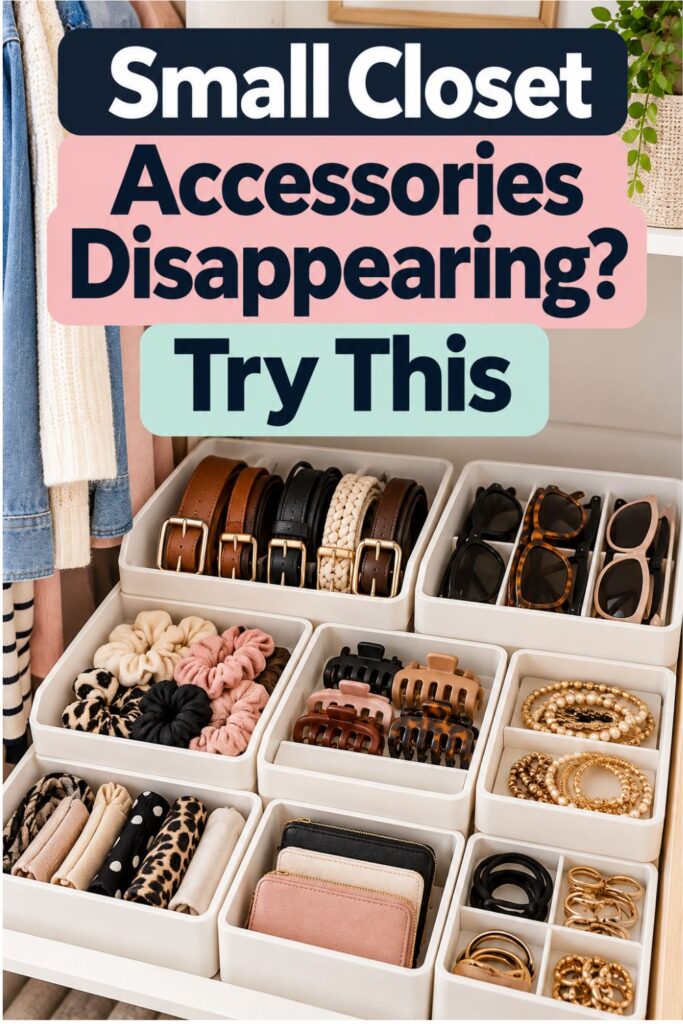
A closet accessory system does not need to be expensive, complicated, or perfectly styled. It needs to be clear. When socks, belts, hair clips, jewelry, tights, and tiny extras have visible homes, they stop disappearing into the background of your closet.
Start with one drawer or shelf. Empty it, sort the accessories by how you actually use them, and match each category to a container that makes sense. Shoe boxes can handle larger groups. Ice cube trays can divide tiny pieces. Shallow bins can keep daily items easy to grab.
Then add labels that are simple enough to understand at a glance. This is what makes the system easier to maintain. A labeled bin gives you a clear place to return each item, even when you are tired or in a hurry.
Remember that the best organizing system is not the one that looks the most polished. It is the one that makes your next action easier. If you can open a drawer and find the socks, belt, clip, or accessory you need in seconds, the system is doing its job.
Small accessories do not need to keep creating big frustration. With a few containers, clear categories, and visible labels, your closet can become much easier to use. You will spend less time digging, less time rebuying things you already own, and less time feeling like the small stuff is always slipping away.
If you want to get more from your life, and are looking for concrete action steps to get you there, check out our Request a Coach page. It’s a “cut the fence-sitting and take action” way to tackle your issues and actually find success. To get off the fence and start to take action, click or tap here.
The reset may look simple, but that is why it works. Small items need small homes. Once they have them, your closet becomes faster, calmer, and much easier to keep organized.
*****
Are you all about style, decor and organization? Download a copy of our Clutter Reset Guide.
Need some in depth help with organization and productivity ? Drop on by our directories choc full of productivity coaches, minimalist coaches, and work/life balance coaches to get your life organized! Or click here to have us match you to the best.
If you want to get more from your life, and are looking for concrete action steps to get you there, check out our Request a Coach page. It’s a “cut the fence-sitting and take action” way to tackle your issues and actually find success. To get off the fence and start to take action, click or tap here.
Read this next

Simplify Holiday Decorating
4 Things You Can Do This Year to Make Decorating for Christmas Next Year a Breeze
Read More
10 Cozy Burr Basket Ideas Under $30 To Warm You Up on Cold Days
There’s something special about giving a gift that feels like a hug. Burr baskets — simple bundles of cozy, comforting items — are the perfect way to show care when […]
Read More
DIY Closet Drawer Ideas for Clothes, Accessories, and Small Items
Tiny closet driving you crazy? These simple drawer, bin, and shelf fixes make clothes and accessories easier to find fast.
Read More