


Talk to a coach about Organizational coaching

Crystal Faulk
ACC
I help overwhelmed women in transition gain clarity, confidence, and...

Terrie Hein
Certified Life Coach, Certified Insight Coach Practitioner
Coaching to declutter your life, organize your goals, and cook...

Dr Charlene Ashley
Doctorate - Behaviours
I coach individuals to design fulfilling lives through structure, clarity,...

Paloma Chiara

Lana's Gymnastics Club
"Where the best in gymnastics meets fun. Where every child is a star"
lgclubny.com

Anna Sosnina
ICF (ACC)
ICF ACC certified coach, founder of EssorVie Coaching, passionate about...

Tyler Fink
B.A. in Religion, Anthropology, and Philosophy. Master of Divinity (M.Div.) in Missiology
Pastor, husband, and father helping Christian men pursue faithful growth...

Travis Brown
Professional Life coach
With experience in guiding clients to achieve goals, build confidence,...



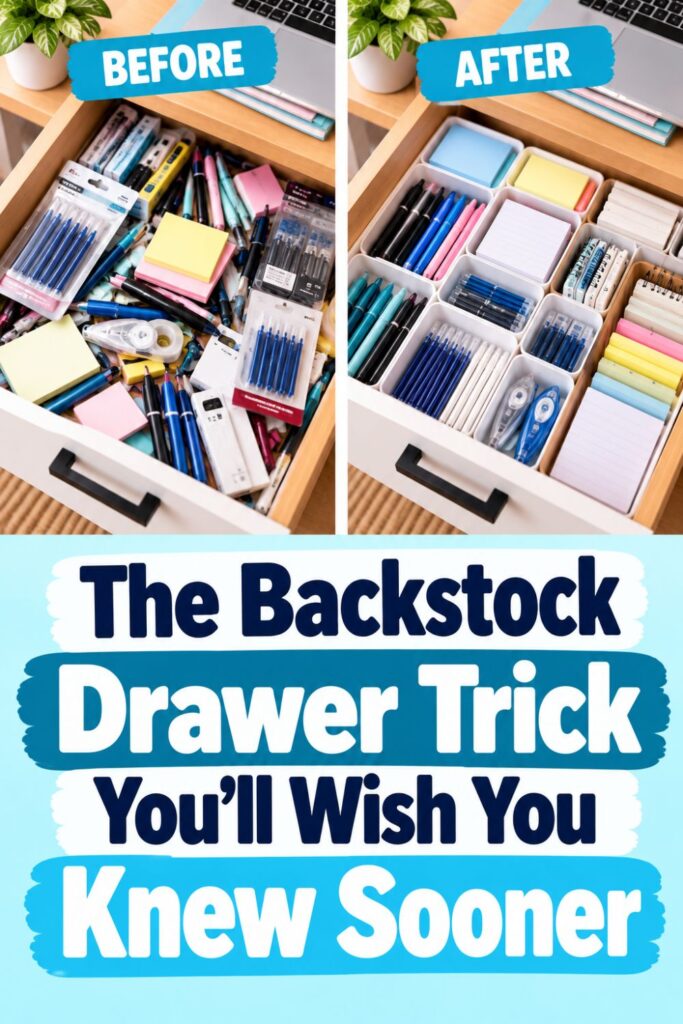
Backstock Drawer System for Extra Pens, Notes, and Refills
Are you all about style, decor and organization? Download a copy of our Clutter Reset Guide.
*****
When Your Desk Drawer Becomes a Storage Problem
You open your desk drawer looking for a pen, but instead you find three unopened packs of sticky notes, loose staples, dried-out markers, and enough spare pens to supply a small office. Somewhere underneath everything is the one thing you actually need.
Sound familiar? Desk drawers often become crowded because we treat everyday supplies and backup supplies as though they belong in the same place. Every extra notebook, refill cartridge, and multipack of pens gets added to the drawer until finding anything becomes a frustrating little task.
The problem isn’t necessarily that you own too many office supplies. It’s that your drawer is trying to do two different jobs at once: provide quick access to daily essentials and store inventory for future use.
A backstock drawer system solves this by separating what you’re currently using from what you’re saving for later. Think of it as a tiny supply closet built into your workspace.
Here’s what changes when you make that separation:
- Your everyday drawer stays accessible: You can reach the supplies you need without moving unopened packages or searching through duplicates.
- Your extra supplies have a designated home: Spare pens, sticky notes, staples, and refills stay grouped together instead of spreading across multiple drawers.
- You can see what you already own: A dedicated backup area makes it easier to check inventory before purchasing more supplies.
- Restocking becomes straightforward: When something runs out, you know exactly where to find its replacement.
You don’t need expensive drawer organizers or an entire filing cabinet to make this work. A spare drawer, a few dividers, and some simple rules are enough to create a functional system.
If you want to get more from your life, and are looking for concrete action steps to get you there, check out our Request a Coach page. It’s a “cut the fence-sitting and take action” way to tackle your issues and actually find success. To get off the fence and start to take action, click or tap here.
The secret is deciding which supplies deserve immediate access and which ones can wait until they’re needed. Once that distinction is clear, organizing everything else becomes much easier.
Let’s build a backstock system that keeps your desk functional without turning organization into another daily chore.
Need some in depth help with organization and productivity ? Drop on by our directories choc full of productivity coaches, minimalist coaches, and work/life balance coaches to get your life organized! Or click here to have us match you to the best.
How to Separate Everyday Desk Essentials From Backup Supplies
Before buying dividers or rearranging drawers, you need to know what’s actually taking up space. Most overflowing desk drawers contain a mixture of frequently used tools, unopened supplies, forgotten duplicates, and things that don’t belong there at all.
The first step is creating a clear distinction between daily-use supplies and backstock. Your everyday drawer should support what you’re doing right now, while your backup storage holds replacements until they’re needed.
Start with a complete inventory rather than trying to organize around the existing clutter.
- Empty your main desk drawer completely: Spread everything across a clear table or work surface where you can see individual items. Remove packaging, separate loose supplies, and avoid putting anything back until you’ve reviewed what you own.
- Identify the supplies you use regularly: Set aside your favorite pens, one working highlighter, the sticky notes you’re currently using, and other essentials you reach for throughout the week. These items belong in your primary workspace because immediate access matters.
- Create a separate backup category: Gather unopened pen packages, extra note pads, staple refills, replacement ink cartridges, and other supplies you’re keeping for future use. If you already have a working version of an item and won’t need another until it runs out, the extra usually belongs in backstock.
- Remove unusable or unnecessary supplies: Test questionable pens, check dried-out markers, and discard empty packaging. Recycle or dispose of damaged items appropriately rather than allowing them to occupy storage space indefinitely.
One useful trick is to ask yourself, “Would I reach for this during a normal workday, or only when something runs out?” That question makes decisions much easier when you’re sorting duplicates.
For example, if you use one black pen daily but own twelve identical replacements, keep your current pen accessible and move the remaining eleven into your backup category.
If you want to get more from your life, and are looking for concrete action steps to get you there, check out our Request a Coach page. It’s a “cut the fence-sitting and take action” way to tackle your issues and actually find success. To get off the fence and start to take action, click or tap here.
You can also create a small donation pile for usable supplies you no longer need. Schools, community organizations, or coworkers may appreciate extras that would otherwise remain untouched.
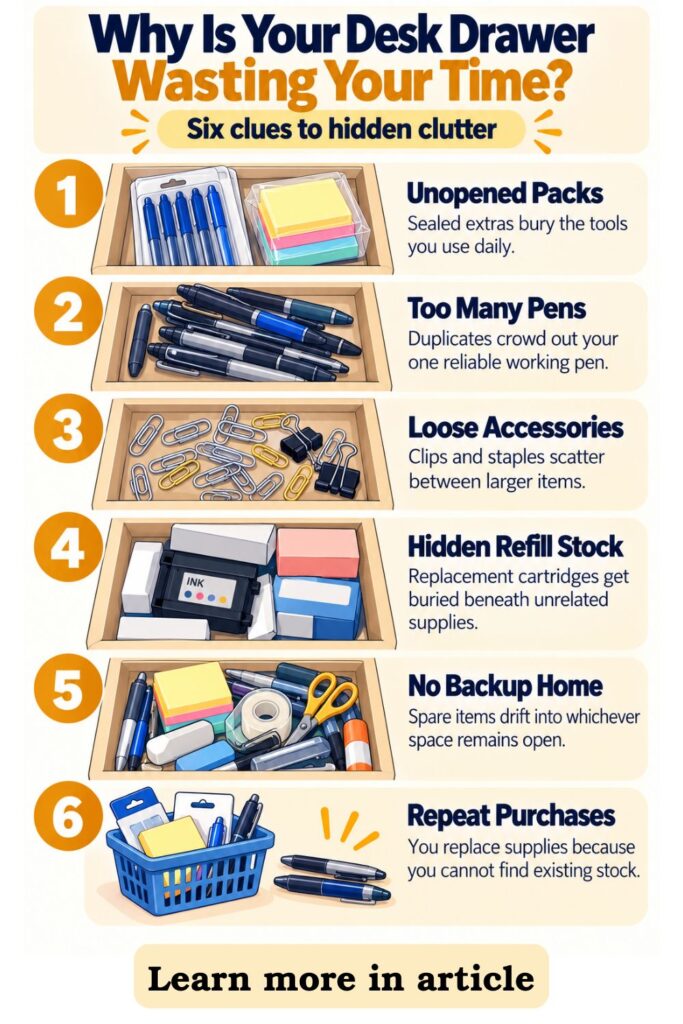
By the end of this step, you should have two clearly defined groups. Don’t worry about making them look beautiful yet. The important thing is that your everyday essentials are no longer competing with your backup inventory.
How to Choose the Right Drawer for Your Backstock System
Not every drawer is a good candidate for backup storage. The ideal location should be easy enough to access when you need a replacement, but separate from the drawer you open repeatedly throughout the workday.
A lower desk drawer, secondary cabinet drawer, or nearby filing cabinet compartment can work well. The goal isn’t to hide your supplies somewhere inconvenient. It’s to give them a dedicated location that doesn’t interfere with your everyday workflow.
Before committing to a space, consider its dimensions, accessibility, and capacity.
- Look beyond your primary desk drawer: Start with storage you already own, especially compartments that currently hold miscellaneous items. A lower drawer is often better for backstock because you don’t need to access it every few minutes.
- Measure the usable interior space: Check the drawer’s width, depth, and height before choosing organizers. Remember to account for drawer slides, internal rails, and clearance beneath the desktop so containers won’t prevent the drawer from closing.
- Compare the space with your actual inventory: Lay out your grouped backup supplies and estimate how much room each category requires. A drawer that holds pens comfortably might not accommodate bulky printer cartridges or several large notebook packs.
- Choose a location that supports easy restocking: Keep your supplies close enough that replacing an empty pen or finished note pad feels effortless. If the storage location is too inconvenient, you’ll be more tempted to keep unnecessary extras in your main drawer.
Accessibility matters more than having the perfect-looking storage setup. A plain drawer beside your desk is often more practical than an attractive organizer across the room.
If your backup supplies exceed the space available, don’t immediately look for additional storage. First, examine whether you’re holding more inventory than you’re likely to use.
You might discover that a large collection of promotional pens, outdated refills, or barely used stationery is occupying valuable space. Reducing unnecessary stock can make the system easier to manage.
If you want to get more from your life, and are looking for concrete action steps to get you there, check out our Request a Coach page. It’s a “cut the fence-sitting and take action” way to tackle your issues and actually find success. To get off the fence and start to take action, click or tap here.
Once you’ve chosen your storage location, designate it specifically for backup supplies. Avoid mixing in unrelated paperwork, charging cables, or miscellaneous household items.
Giving the drawer a single purpose is what prevents it from gradually becoming another catchall.
The Simple Drawer Layout That Keeps Every Backup Supply in Its Place
A backstock drawer works best when every category has a predictable location. Without designated compartments, neatly stacked supplies eventually slide together, and the drawer returns to the same mixed-up collection you started with.
The solution is to divide the drawer into a few functional zones based on the types of supplies you own. You don’t need a complicated organizer with dozens of tiny sections. Four clear categories are often enough.
<text strong>Start with this simple layout:</text>
- Writing supplies: Extra pens, pencils, markers, and highlighters.
- Paper supplies: Sticky notes, index cards, small notebooks, and page flags.
- Fastening supplies: Staples, paper clips, binder clips, and similar accessories.
- Replacement refills: Pen cartridges, pencil leads, printer ink, and other compatible replacements.
Once you’ve established these categories, arrange them according to size and frequency of use.
- Divide the drawer into dedicated zones: Assign one section to each supply category rather than allowing different products to share a large open space. Keep categories visually distinct so everything has an obvious place to return to.
- Use dividers that fit your existing inventory: Adjustable drawer separators, shallow trays, and small repurposed boxes can all create useful compartments. Choose containers that fit snugly enough to limit movement when the drawer opens and closes.
- Position larger packages along the back or sides: Place extra notebooks, full sticky note packs, and other bulky supplies where they won’t block access to smaller items. Keep the most frequently replenished supplies toward the front.
- Give loose accessories their own containers: Small staple strips, pencil leads, and paper clips can easily disappear beneath larger products. Use shallow compartments or secure containers to keep them together.
- Leave some space between categories: Avoid packing every compartment tightly, even if everything technically fits. You should be able to remove one product without knocking over several others.
Before finalizing your layout, open and close the drawer a few times. Watch for containers that slide, packages that shift, or supplies that catch on the drawer’s upper edge.
A little empty space is a feature, not wasted storage. It makes the drawer easier to use and gives you room to handle supplies without creating another pile.
If you want to get more from your life, and are looking for concrete action steps to get you there, check out our Request a Coach page. It’s a “cut the fence-sitting and take action” way to tackle your issues and actually find success. To get off the fence and start to take action, click or tap here.
The finished system should be simple enough that you can find any replacement without searching through multiple compartments.
How to Organize Extra Pens, Sticky Notes, Staples, and Refills
Once your drawer has defined zones, it’s time to organize the supplies inside them. This is where a little attention to detail makes the difference between a system that looks tidy today and one that remains useful months later.
The key is keeping similar supplies together while making it obvious which packages are already open. You want to avoid starting another pack of sticky notes or pens simply because you couldn’t find the one you’d opened previously.
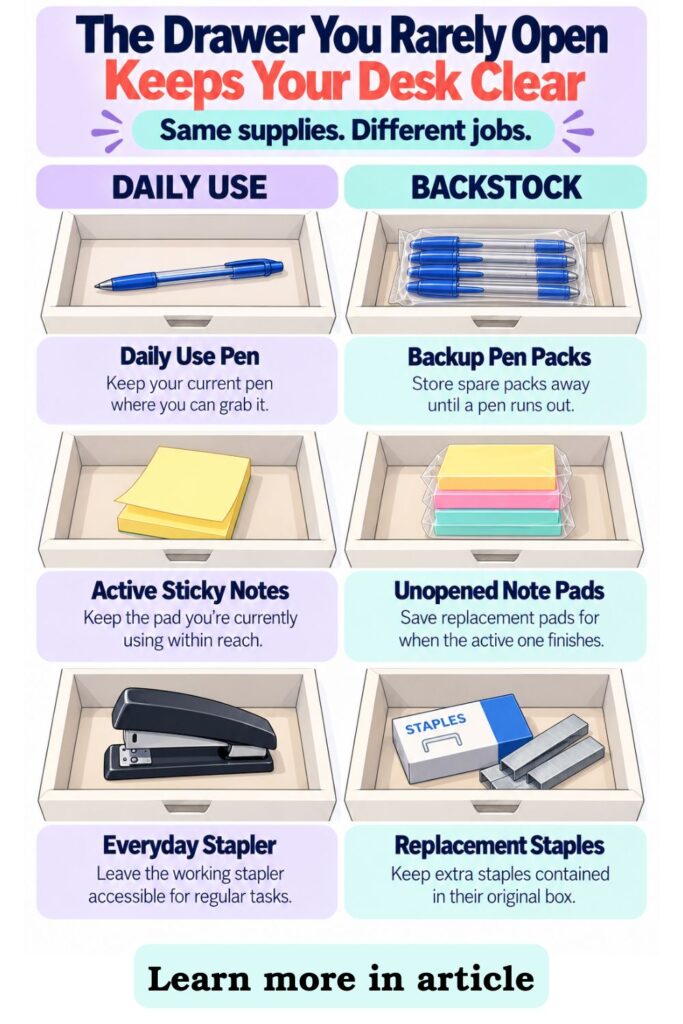
Handle each category according to its size, packaging, and how often you use it.
- Group spare pens by type and color: Separate ballpoint pens, gel pens, highlighters, and permanent markers when you have enough of each to justify individual sections. Store loose pens together in a shallow tray, and keep unopened packages compact rather than scattering individual pens throughout the drawer.
- Stack sticky notes by size and format: Keep standard square pads in one section, page flags in another, and larger writing pads together. Place partially used packs at the front so you finish them before opening new ones.
- Contain staples and small fastening supplies: Keep staples in their original boxes whenever possible, especially if the packaging identifies their size. Separate paper clips, binder clips, and other loose accessories into compartments so they don’t become tangled or mixed together.
- Separate refills from complete tools: Store replacement pen cartridges, mechanical pencil leads, and printer ink apart from everyday writing supplies. Preserve packaging or identifying labels when compatibility matters, particularly for printer cartridges and specialized pens.
- Keep opened supplies visible: Place partially used packages where you can immediately recognize them rather than burying them underneath unopened stock. This makes it easier to finish existing supplies before starting something new.
A simple label can help when compartments contain products that look similar. For example, marking different pen refills by model can prevent mistakes when several cartridges share the same general appearance.
You don’t need to label every pen or sticky note stack. Labels are most useful when they eliminate uncertainty rather than merely decorate the drawer.
Take a final look at each section and ask whether you’d know where to find a replacement without thinking about it.
That’s the real measure of a successful layout. Every category should have a clear location, and every supply should be easy to identify, remove, and put back.
If you want to get more from your life, and are looking for concrete action steps to get you there, check out our Request a Coach page. It’s a “cut the fence-sitting and take action” way to tackle your issues and actually find success. To get off the fence and start to take action, click or tap here.
How to Set Backstock Limits So Your Drawer Never Overflows Again
A perfectly organized drawer can still become overcrowded if you keep adding supplies without limits. Even with dividers and labeled compartments, every new multipack of pens or sticky notes takes up physical space.
That’s why a good backstock system needs more than organization. It also needs simple inventory rules that prevent backup supplies from accumulating faster than you use them.
The easiest way to create those rules is to assign each category a maximum quantity or storage area.
- Decide how many backups you realistically need: Consider how quickly you use each type of supply and how easily you can replace it. Someone who writes constantly may need several extra pens, while someone who rarely uses sticky notes might only need one spare pad.
- Let each compartment define its storage limit: Choose a reasonable amount of space for each category and treat that boundary as fixed. If a new purchase won’t fit, review what you already have rather than automatically adding another organizer.
- Check your inventory before buying duplicates: Make opening the backstock drawer part of your shopping routine. This small habit prevents unnecessary purchases when you’re tempted by bulk discounts, colorful stationery collections, or convenient online multipacks.
- Review supplies that rarely get used: Notice which items haven’t moved in several months and consider whether you need to keep so many. Extra specialty markers, outdated cartridges, and unfamiliar pen refills often deserve closer inspection.
You can also establish a simple “one open, one backup” rule for products you use slowly. For example, you might keep one active sticky note pad in your everyday drawer and one unopened replacement in backstock.
For supplies you consume quickly, such as pens used for extensive handwritten notes, a slightly larger reserve may make sense.
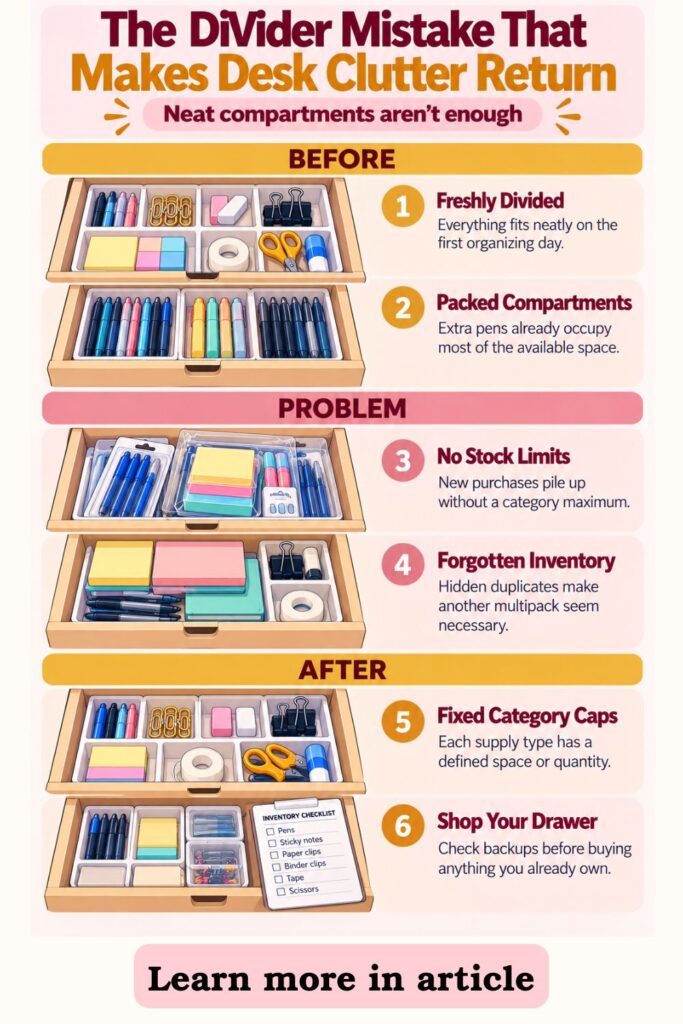
The important thing is to choose limits based on your actual habits rather than assuming more supplies will always be useful.
Avoid using your storage capacity as a reason to purchase unnecessary products. An empty compartment doesn’t mean you need to fill it.
A backstock drawer should contain enough to keep your work running smoothly, not every office supply you might possibly need someday.
If you want to get more from your life, and are looking for concrete action steps to get you there, check out our Request a Coach page. It’s a “cut the fence-sitting and take action” way to tackle your issues and actually find success. To get off the fence and start to take action, click or tap here.
When you give each category a reasonable limit, maintaining the system becomes much easier.
How to Create a Restocking Routine That Keeps Your Main Drawer Clear
Separating daily supplies from backup inventory solves the immediate clutter problem, but keeping them separate requires a small ongoing habit. Without a restocking routine, extra pens and sticky note pads can gradually migrate back into your everyday drawer.
Fortunately, you don’t need a complicated inventory spreadsheet or elaborate maintenance schedule. A few consistent rules can keep the system functioning with very little effort.
The most important principle is simple: Replace supplies when you need them, not whenever you see extras available.
- Restock your daily drawer only when something runs out: When a pen stops working or a sticky note pad is finished, retrieve one replacement from your backstock drawer. Avoid moving an entire package into the main drawer when you only need one item.
- Use older supplies before newer purchases: Place newly purchased supplies behind existing inventory whenever practical. This reduces the chance that older pens, adhesive notes, or other products remain unused long enough to deteriorate.
- Keep a simple replacement list: Add a product to your shopping list when your backup supply reaches its chosen minimum. Check the drawer before buying so you’re not relying on memory to determine what you own.
- Schedule a short monthly inventory check: Open the backstock drawer, return misplaced items, review low-stock categories, and remove unnecessary packaging. Most of the work should involve small adjustments rather than another complete reorganization.
- Reset your main drawer when extras appear: If you notice several backup pens or unopened note pads collecting beside your everyday tools, return them to backstock immediately. Addressing the problem early prevents small exceptions from becoming permanent clutter.
Linking the monthly check to an existing habit can make it easier to remember. You might review your supplies while planning the next month, completing administrative tasks, or ordering routine office materials.
You can also keep a small note inside the drawer showing which supplies need replacement. This works particularly well when multiple people share the same workspace.
The goal isn’t to keep a perfect record of every staple or pen. It’s to make sure your main drawer contains only what you currently need.
A successful restocking routine should feel almost automatic. Once something runs out, you retrieve a replacement, update your shopping list if necessary, and return to work.
If you want to get more from your life, and are looking for concrete action steps to get you there, check out our Request a Coach page. It’s a “cut the fence-sitting and take action” way to tackle your issues and actually find success. To get off the fence and start to take action, click or tap here.
How to Build a Backstock System When You Only Have One Desk Drawer
A separate backup drawer is convenient, but it isn’t essential. If you work from a small apartment, shared workspace, dorm room, or compact home office, you might only have one drawer available for everything.
The good news is that you can apply the same daily-use versus backstock principle within a single drawer. The trick is creating a physical boundary between the supplies you access frequently and the ones you’re storing for later.
Start by identifying which part of the drawer is easiest to reach.
- Reserve the front for everyday supplies: Place your current pens, active sticky note pad, stapler, and other frequently used essentials near the front. This creates a grab-and-go area that doesn’t require moving backup products out of the way.
- Create a small backup compartment at the rear: Use an adjustable divider or shallow tray to separate replacement supplies from your daily essentials. Keep the quantity limited so the backup section doesn’t gradually take over the drawer.
- Move bulky extras into another storage location: Store unopened multipacks, large notebook reserves, and rarely needed refills inside a labeled box on a nearby shelf or cabinet. Treat that container as your main backstock location rather than trying to force everything into the drawer.
- Keep only a modest emergency reserve nearby: One spare pen, one additional sticky note pad, and a small quantity of essential refills may be enough for your immediate workspace. Store additional quantities in the separate backup box.
- Apply the same purchasing and restocking rules: Check both locations before buying replacements, and transfer supplies into the daily-use area only when they’re needed. Keeping the rules consistent prevents the system from becoming confusing.
If your drawer is especially shallow, consider using low-profile dividers or small containers without lids. Tall organizers can make a compact drawer harder to use even when they fit inside.
Your backup container doesn’t need to match your desk furniture or look decorative. A sturdy box that keeps supplies grouped together is perfectly adequate.
The most important thing is preserving easy access to your everyday tools.
Even in a tiny workspace, distinguishing between active supplies and future replacements can make your desk feel significantly more functional.
How an Organizing Coach Can Help You Maintain a Clutter-Free Desk
Sometimes the challenge isn’t figuring out where to put your supplies. It’s understanding why the same clutter keeps returning, even after you’ve carefully organized everything.
If you want to get more from your life, and are looking for concrete action steps to get you there, check out our Request a Coach page. It’s a “cut the fence-sitting and take action” way to tackle your issues and actually find success. To get off the fence and start to take action, click or tap here.
You might repeatedly purchase supplies you already own, keep products you’re unlikely to use, or struggle to return items to their designated locations. These habits can undermine even the most thoughtfully arranged drawer.
A professional organizing coach can help you examine the routines behind those patterns and develop systems that fit the way you actually work.
Rather than focusing exclusively on containers and drawer layouts, coaching can address the decisions that determine whether the organization lasts.
- Identify the habits contributing to product overflow: A coach might help you recognize patterns such as impulse-buying stationery, keeping unnecessary duplicates, or placing new supplies wherever there’s available space. Understanding these habits makes it easier to choose realistic changes.
- Establish practical limits for your supplies: Instead of following someone else’s ideal inventory, you can determine how many backups make sense for your workload and purchasing habits. The goal is to create boundaries that support your work without making you feel restricted.
- Create a manageable maintenance routine: A coach can help you connect quick organization tasks to habits you already have, such as ending your workday or completing a weekly planning session. Small, repeatable actions are often easier to maintain than occasional major cleanouts.
- Address decisions that keep supplies accumulating: If you find it difficult to discard unusable items or stop saving products for hypothetical future needs, coaching may help you develop clearer decision-making criteria. This can reduce the uncertainty involved in sorting and maintaining your workspace.
- Adjust the system as your needs change: A new business project, additional responsibilities, or a different working arrangement might change which supplies you use most often. Reviewing your setup periodically can help you adapt without starting over.
You don’t need professional assistance to organize a drawer, and most people can implement this system independently. Coaching is simply an additional option when organization challenges extend beyond one storage space.
It can be particularly useful when similar patterns appear throughout your office, home, or daily routines.
Ultimately, the most sustainable organization system is one that supports your habits while giving you practical ways to improve them.
A Desk Drawer That Stays Organized Without Constant Decluttering
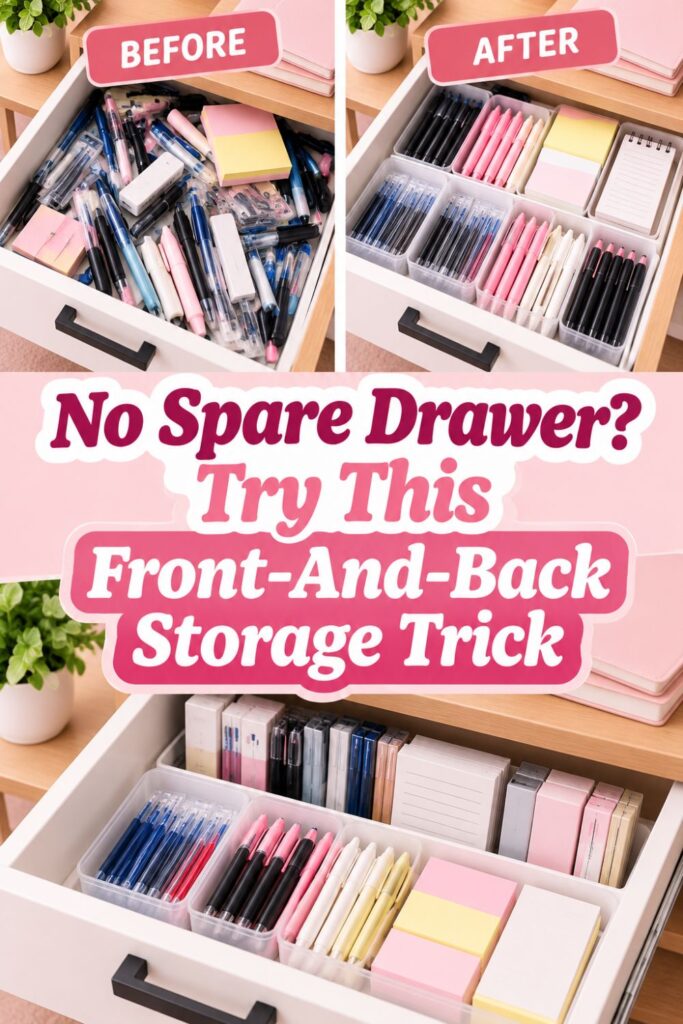
An organized desk drawer shouldn’t require constant attention. When every item has a purpose and a designated location, everyday maintenance becomes a matter of returning supplies to their proper places rather than repeatedly sorting through clutter.
That’s what makes a backstock system so useful. It removes the competition between the things you need now and the things you’re saving for later.
If you want to get more from your life, and are looking for concrete action steps to get you there, check out our Request a Coach page. It’s a “cut the fence-sitting and take action” way to tackle your issues and actually find success. To get off the fence and start to take action, click or tap here.
Instead of opening a drawer filled with duplicate pens, unopened notes, and scattered refills, you have two distinct storage areas with two different purposes.
Your daily-use drawer holds the tools you reach for regularly. Your backstock area contains the extras that will replace those tools when they’re finished.
To get started, focus on these essential actions:
- Separate active supplies from backups: Empty your drawer and decide which products you currently use and which ones belong in reserve.
- Create clearly defined storage zones: Group extra writing tools, paper supplies, fasteners, and refills into compartments that make everything easy to locate.
- Set reasonable limits for extra inventory: Keep quantities based on actual usage rather than how many products you can fit into the available space.
- Restock one item at a time: Replace finished supplies without transferring entire multipacks into your everyday drawer.
- Maintain the system with small check-ins: Review your backup inventory periodically and correct small problems before they become major clutter.
Remember that your setup doesn’t need to be expensive, visually perfect, or filled with matching organizers. A few repurposed containers and a clear plan can work just as well as a custom drawer system.
It’s also fine to adjust your arrangement after using it for a while. You might discover that you need more space for sticky notes, fewer spare pens, or a more accessible location for certain refills.
Let your everyday experience guide those changes rather than trying to create a flawless layout from the beginning.
Start by separating the supplies in your current drawer into two groups: what you’re using and what you’re saving. That simple decision creates the foundation for a workspace that’s easier to navigate, easier to restock, and much less likely to become cluttered again.
*****
If you want to get more from your life, and are looking for concrete action steps to get you there, check out our Request a Coach page. It’s a “cut the fence-sitting and take action” way to tackle your issues and actually find success. To get off the fence and start to take action, click or tap here.
Are you all about style, decor and organization? Download a copy of our Clutter Reset Guide.
Need some in depth help with organization and productivity ? Drop on by our directories choc full of productivity coaches, minimalist coaches, and work/life balance coaches to get your life organized! Or click here to have us match you to the best.
If you want to get more from your life, and are looking for concrete action steps to get you there, check out our Request a Coach page. It’s a “cut the fence-sitting and take action” way to tackle your issues and actually find success. To get off the fence and start to take action, click or tap here.
Read this next

The Galentine’s Formula: Decor, Tables, and Activities That Just Work
Are you all about style, decor and organization? Download a copy of our Decluttering Workbook. ***Galentine’s Day has become one of those rare gatherings that people genuinely enjoy planning for […]
Read More
Beware! The DIY Organization Mistakes That Could Cost You More Than Just Space
You want a home that feels calm, cool, and functional—but DIY organizing can quickly backfire if you’re not careful. Here are 7 mistakes that cost more than just space. Need […]
Read More
A Practical Way to Use Vision Boards for Manifestation
Use your vision board in a smarter, more practical way so manifestation feels clearer, calmer, and easier to follow every day.
Read More