


Talk to a coach about Organizational coaching

Crystal Faulk
ACC
I help overwhelmed women in transition gain clarity, confidence, and...

Terrie Hein
Certified Life Coach, Certified Insight Coach Practitioner
Coaching to declutter your life, organize your goals, and cook...

Dr Charlene Ashley
Doctorate - Behaviours
I coach individuals to design fulfilling lives through structure, clarity,...

Paloma Chiara

Lana's Gymnastics Club
"Where the best in gymnastics meets fun. Where every child is a star"
lgclubny.com

Anna Sosnina
ICF (ACC)
ICF ACC certified coach, founder of EssorVie Coaching, passionate about...

Tyler Fink
B.A. in Religion, Anthropology, and Philosophy. Master of Divinity (M.Div.) in Missiology
Pastor, husband, and father helping Christian men pursue faithful growth...

Travis Brown
Professional Life coach
With experience in guiding clients to achieve goals, build confidence,...




Catch-All Tray System for Pretty Desk Essentials
Are you all about style, decor and organization? Download a copy of our Clutter Reset Guide.
*****
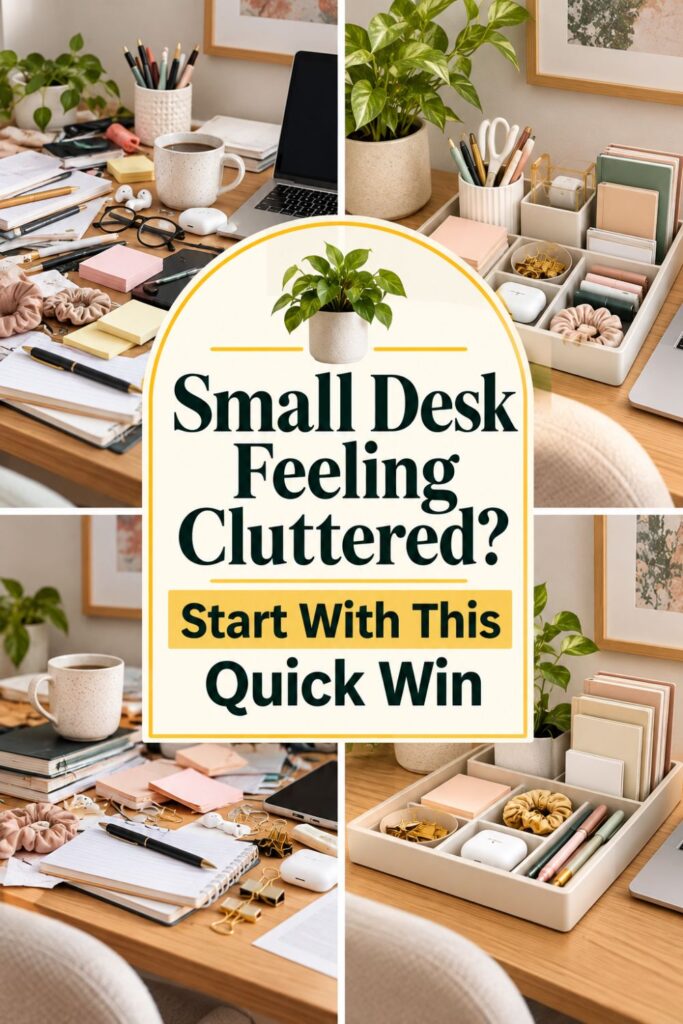
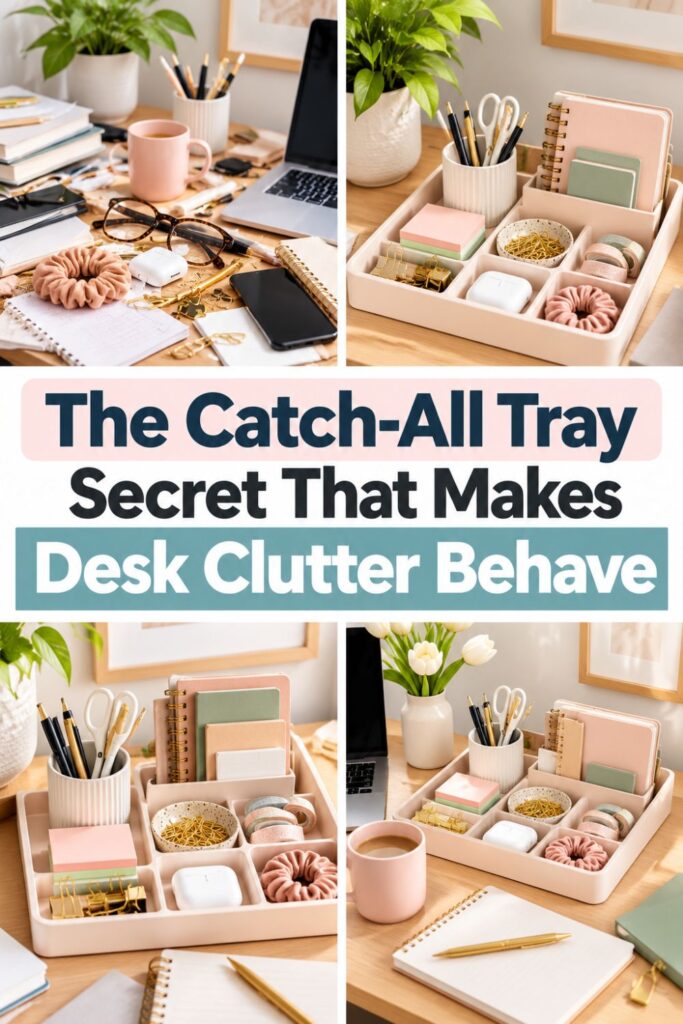
Why One Little Tray Can Make a Desk Look More Organized
Desk clutter rarely begins with anything dramatic. It is usually the collection of tiny things you genuinely use throughout the day: lip balm, earbuds, glasses, a favorite pen, hand cream, charging adapters, hair ties, or a small notebook.
Individually, none of these items looks particularly messy. Scattered across a desk, though, they create visual noise and make the entire workspace feel busier than it really is.
A catch-all tray solves that problem by giving those loose essentials a clear boundary. Instead of seeing six or seven unrelated objects spread across your work surface, your eye sees one intentional group.
That small distinction can make a surprisingly big difference.
The goal is not to create a perfectly empty desktop. A desk should support the way you actually work, which means some frequently used items deserve to stay within reach.
The trick is deciding exactly which items earn that convenient spot.
If you want to get more from your life, and are looking for concrete action steps to get you there, check out our Request a Coach page. It’s a “cut the fence-sitting and take action” way to tackle your issues and actually find success. To get off the fence and start to take action, click or tap here.
A useful tray system should help you:
- Keep everyday essentials visible and accessible
- Reduce the number of loose objects scattered across your desk
- Create a clear visual boundary around personal items
- Make resetting your workspace faster
- Add a little polish without turning organization into a decorating project
The tray itself is only part of the system. If you simply move every loose item onto it, the tray quickly becomes a smaller version of the clutter problem you started with.
Instead, think of the tray as limited desk real estate.
Only the things you repeatedly use should be allowed to stay there. Everything else needs another home.
This approach works especially well when you want a quick desk upgrade without rearranging drawers, buying an entire organizer system, or doing a major workspace makeover.
One small tray can make your desk look more intentional while also making daily routines easier.
The key is using it as a boundary, not just a container.
Need some in depth help with organization and productivity ? Drop on by our directories choc full of productivity coaches, minimalist coaches, and work/life balance coaches to get your life organized! Or click here to have us match you to the best.
If you want to get more from your life, and are looking for concrete action steps to get you there, check out our Request a Coach page. It’s a “cut the fence-sitting and take action” way to tackle your issues and actually find success. To get off the fence and start to take action, click or tap here.
1. Decide What Actually Deserves a Spot on Your Tray
The easiest way to overload a catch-all tray is to start by asking, “What would look nice here?”
Start with a more practical question instead: “What do I actually reach for while I am sitting at my desk?”
Your tray should be built around real habits, not an idealized version of your workspace.
Track what you reach for: Spend a normal workday noticing the small objects you repeatedly pick up. These may include your glasses, earbuds, lip balm, hand cream, a pen, a charging adapter, or another personal essential.
Do not add an item simply because it fits the aesthetic. If you rarely use it, it is occupying valuable tray space.
Separate daily essentials from occasional supplies: Items you use almost every day are strong candidates for the tray. Things you use once or twice a week usually belong in a drawer, cabinet, pouch, or another nearby storage area.
For example, your daily tray might contain:
- One favorite pen
- Earbuds
- Glasses
- Lip balm
- Hand cream
- A small charging adapter
That does not mean every pen, cable, beauty product, or accessory you own should join them.
If you want to get more from your life, and are looking for concrete action steps to get you there, check out our Request a Coach page. It’s a “cut the fence-sitting and take action” way to tackle your issues and actually find success. To get off the fence and start to take action, click or tap here.
Set a maximum number of items: Give yourself a physical limit before the tray starts filling up. The exact number depends on the size of your objects, but everything should fit comfortably without stacking or covering one another.
Visible breathing room matters.
If you have to move three things to reach the fourth, the tray is already too full.
This step also helps you identify duplicate items that may be quietly contributing to desk clutter. You probably do not need four pens within arm’s reach if you always choose the same one.
Choosing what belongs on the tray first makes every later decision easier. You will know how large the tray needs to be, where it should sit, and how much space you actually need to dedicate to these essentials.
Instead of finding a container and filling it, you are designing a small system around the way you already work.
2. Choose a Tray That Creates a Useful Boundary
Once you know what belongs on your tray, you can choose the tray itself.
This order matters. Buying a tray first often leads to filling whatever space is available, which can quietly turn a simple organization tool into another clutter magnet.
If you want to get more from your life, and are looking for concrete action steps to get you there, check out our Request a Coach page. It’s a “cut the fence-sitting and take action” way to tackle your issues and actually find success. To get off the fence and start to take action, click or tap here.
Size the tray to your essentials: Place the items you identified together on your desk before shopping or searching your home for a tray. Look at how much room they need when they are arranged comfortably rather than tightly packed.
Your tray should provide enough space for those objects plus a little visible breathing room.
Avoid choosing an oversized tray “just in case.” Extra space tends to attract extra objects.
Match the tray shape to your desk: The available footprint matters just as much as the overall size.
A long, narrow tray can work well beside a monitor. A compact rectangle can fit into a corner, while a small round tray may be enough if you only need space for two or three personal essentials.
Think about your desk before deciding which shape looks prettiest.
A good tray should fit naturally into the space without pushing into your keyboard, mouse, writing area, or active work zone.
Use the edges as your clutter limit: The most useful feature of the tray is not its material or color. It is the physical boundary around your things.
If you want to get more from your life, and are looking for concrete action steps to get you there, check out our Request a Coach page. It’s a “cut the fence-sitting and take action” way to tackle your issues and actually find success. To get off the fence and start to take action, click or tap here.
Everything assigned to this small zone should fit inside it.
Once something starts sitting beside the tray because there is no room left, that is a sign the system needs attention.
You do not need a specialized desk organizer, either. Depending on your style, you could use:
- A small ceramic tray
- A shallow wood tray
- A simple acrylic tray
- A rectangular vanity tray
- A small metal catch-all
- A decorative dish for a very minimal setup
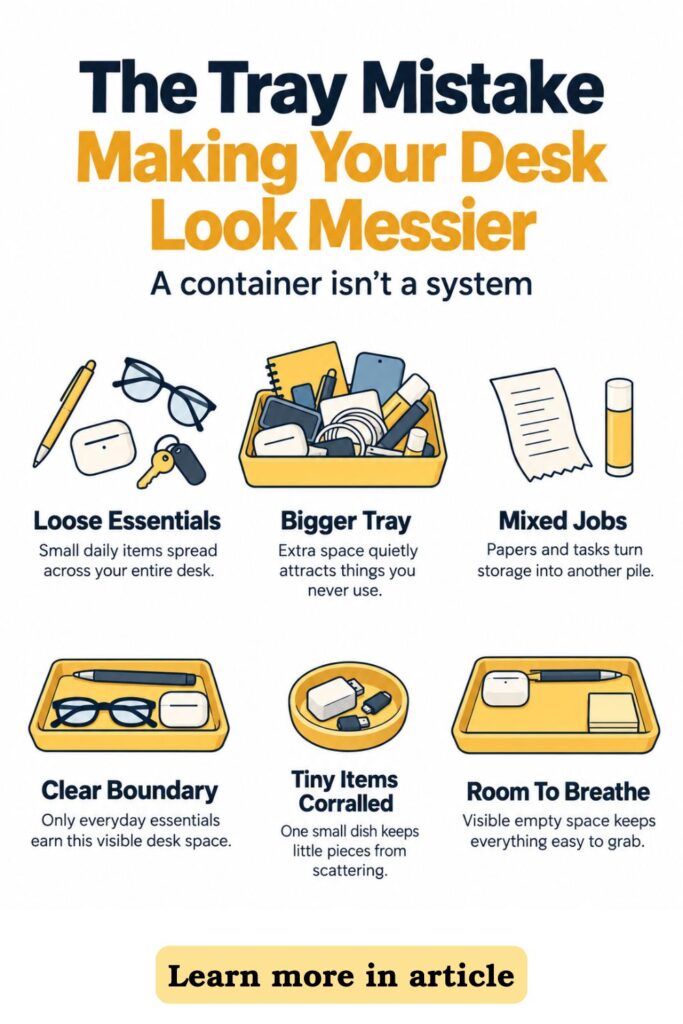
Choose something shallow enough that you can easily see and grab what you need.
The best tray quietly controls how much stays on your desk. Its job is not simply to hold things. It is to tell you when your everyday essentials have reached their limit.
3. Put the Tray Where Your Habits Already Happen
A beautifully arranged tray will not stay organized if it is placed somewhere inconvenient.
The easiest systems to maintain are usually the ones that work with your existing habits instead of asking you to create completely new ones.
Find your natural drop point: Pay attention to where you already place things when you sit down or finish using them.
If you want to get more from your life, and are looking for concrete action steps to get you there, check out our Request a Coach page. It’s a “cut the fence-sitting and take action” way to tackle your issues and actually find success. To get off the fence and start to take action, click or tap here.
Maybe your glasses always land to the left of your keyboard. Perhaps your earbuds end up near your laptop, or your lip balm repeatedly appears beside your notebook.
Those patterns are useful information.
Instead of fighting them, position your tray near the area where those objects naturally accumulate.
Keep the tray within easy reach: The tray should be accessible with one simple movement from your normal seated position.
If you have to stand up, stretch across the desk, move your monitor, or open something every time you put an item away, you have added unnecessary friction.
That small inconvenience may not seem important, but repeated dozens of times, it makes the system easier to ignore.
A useful placement might be:
- Beside your monitor
- Near the dominant-hand side of your keyboard
- In a back corner that is still within reach
- Beside a notebook or planner you use every day
The exact location matters less than how naturally it fits your routine.
If you want to get more from your life, and are looking for concrete action steps to get you there, check out our Request a Coach page. It’s a “cut the fence-sitting and take action” way to tackle your issues and actually find success. To get off the fence and start to take action, click or tap here.
Protect your active work zone: Convenience does not mean putting the tray directly in the middle of your workspace.
Keep it outside the space required for your keyboard, mouse, notebook, tablet, paperwork, or other tools you actively use.
Your tray should reduce interference, not create it.
This is where environment design becomes especially useful. Instead of relying on yourself to remember where every tiny item belongs, you place the storage exactly where the behavior already happens.
Putting away your essentials becomes the easiest option.
When the tray sits in the right location, you are much more likely to use it automatically. Glasses return to the tray. Earbuds have an obvious landing spot. The small objects that once wandered across your desk now have one predictable home.
That is what makes the system sustainable.
4. Arrange the Tray So It Looks Polished, Not Packed
Once you have the right items and the right location, arrangement becomes much easier.
If you want to get more from your life, and are looking for concrete action steps to get you there, check out our Request a Coach page. It’s a “cut the fence-sitting and take action” way to tackle your issues and actually find success. To get off the fence and start to take action, click or tap here.
The goal is not to style the tray like a store display. You simply want everything to be easy to see, easy to grab, and visually calm.
Anchor the largest item first: Start with the biggest object that permanently lives on the tray.
That might be a glasses case, small hand cream bottle, compact notebook, or another everyday essential.
Place that item first, then arrange the smaller objects around it.
Beginning with the largest piece gives the tray structure and prevents you from accidentally using all the space on small items before realizing the largest one does not fit.
Group very small objects together: Tiny items such as paper clips, adapters, rings, or hair ties can make a tray look cluttered quickly.
If you truly use them at your desk, corral them into one small dish or section rather than scattering them across the entire surface.
Keep this simple.
If you want to get more from your life, and are looking for concrete action steps to get you there, check out our Request a Coach page. It’s a “cut the fence-sitting and take action” way to tackle your issues and actually find success. To get off the fence and start to take action, click or tap here.
You do not need five containers inside one tray. One tiny dish or divider is usually enough.
Leave visible empty space: This may be the most important styling rule.
Do not try to fill every available inch.
A little open space helps individual items remain visible and makes the whole setup feel intentional rather than crowded.
It also gives you temporary room to put down something you are actively using without immediately overflowing the tray.
Try arranging the tray so:
- Items do not overlap
- You can see each object clearly
- Frequently used items are easiest to reach
- Nothing has to be moved to access something else
- A portion of the tray remains visibly empty
If your tray looks packed immediately after organizing it, remove something.
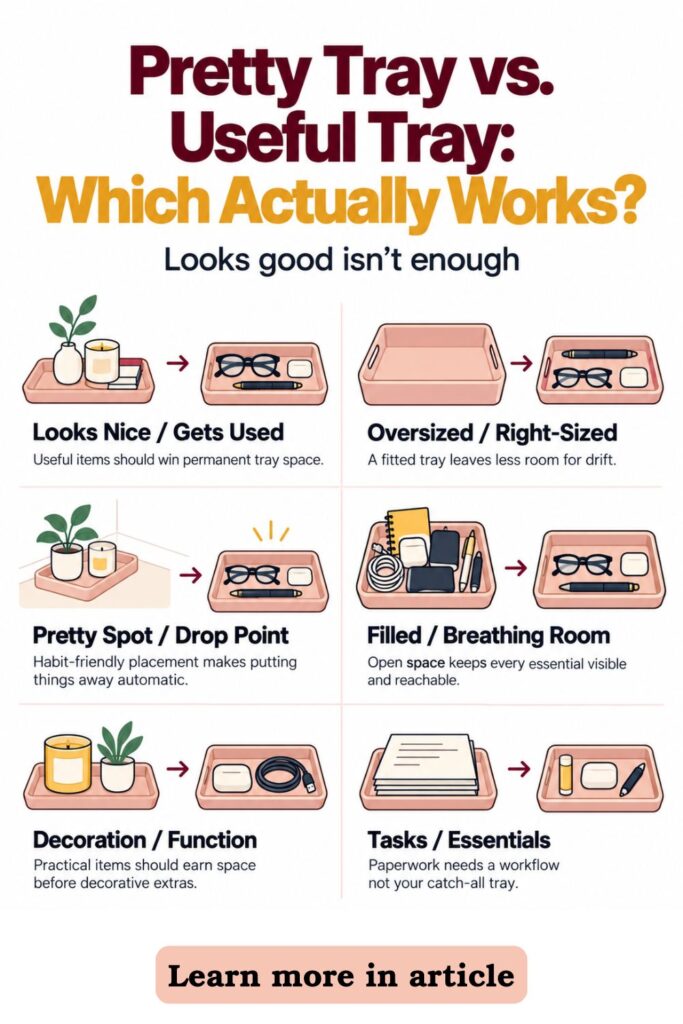
A useful catch-all should look calm even when several objects are inside it.
If you want to get more from your life, and are looking for concrete action steps to get you there, check out our Request a Coach page. It’s a “cut the fence-sitting and take action” way to tackle your issues and actually find success. To get off the fence and start to take action, click or tap here.
That sense of order does not come from perfect styling. It comes from restraint.
The tray looks polished because everything has a reason for being there and nothing is fighting for space.
5. Use the Pretty + Practical Rule
One of the reasons a catch-all tray works so well on a visible desk is that it can serve two purposes at once.
It organizes the small items you use while also making that group of objects look more intentional.
The important thing is keeping usefulness in charge.
Prioritize usefulness first: Every permanent item on the tray should earn its place through regular use.
If you reach for it frequently, it belongs in the conversation. If it exists only to make the tray look styled, consider whether it is taking space away from something more helpful.
Your desk is still a workspace.
If you want to get more from your life, and are looking for concrete action steps to get you there, check out our Request a Coach page. It’s a “cut the fence-sitting and take action” way to tackle your issues and actually find success. To get off the fence and start to take action, click or tap here.
A tray that looks beautiful but makes it harder to work has missed the point.
Choose practical items that work together visually: When you have multiple versions of the same useful object, consider keeping the one that looks most cohesive with the rest of your desk.
For example, you might use:
- A simple pen instead of keeping several mismatched ones visible
- A neutral glasses case rather than leaving loose glasses on the desk
- A small ceramic dish for tiny accessories
- A streamlined hand cream tube
- A tidy case for earbuds
You do not need to replace perfectly good belongings just for appearance.
The idea is simply to be selective about which everyday items remain visible.
Limit purely decorative additions: If you love a styled desk, you can still include something decorative.
Keep it small and make sure it does not interfere with the tray’s function.
A tiny decorative object may work if there is plenty of room. A candle, figurine, plant, or stack of accessories that forces you to move things whenever you need your earbuds probably does not.
If you want to get more from your life, and are looking for concrete action steps to get you there, check out our Request a Coach page. It’s a “cut the fence-sitting and take action” way to tackle your issues and actually find success. To get off the fence and start to take action, click or tap here.
A helpful test is simple: if you have to rearrange the tray before you can work, there is too much on it.
The prettiest tray is often the one with fewer things.
Useful items, a little visual consistency, and visible open space are usually enough to make the setup feel polished without turning it into another project to maintain.
6. Create a 30-Second Tray Reset
Even the best desk organization system will occasionally collect something that does not belong.
The difference between a system that stays useful and one that slowly turns into clutter is how easy it is to reset.
Your catch-all tray should require seconds, not a full cleaning session.
Return stray essentials to the tray: At the end of your work session, take a quick look around the desk.
If your earbuds, glasses, pen, or another designated tray item has wandered away, put it back.
If you want to get more from your life, and are looking for concrete action steps to get you there, check out our Request a Coach page. It’s a “cut the fence-sitting and take action” way to tackle your issues and actually find success. To get off the fence and start to take action, click or tap here.
This should feel like closing your laptop, not like doing a chore.
Remove anything that does not belong: Trays naturally attract temporary objects.
Receipts, wrappers, sticky notes, extra pens, random cables, coins, mail, and other small items may land there during the day.
Do not let temporary placement quietly become permanent storage.
Take a few seconds to move those objects to the places where they actually belong.
Your reset might look like this:
- Put daily essentials back on the tray
- Throw away obvious trash
- Move papers to their appropriate workflow
- Return extra supplies to drawers
- Put loose cables in their normal storage spot
- Stop once the tray contains only its designated items
Use fullness as your warning sign: You do not need to wait until the tray looks chaotic before resetting it.
Crowding is the early signal.
If you want to get more from your life, and are looking for concrete action steps to get you there, check out our Request a Coach page. It’s a “cut the fence-sitting and take action” way to tackle your issues and actually find success. To get off the fence and start to take action, click or tap here.
If you find yourself squeezing an object into the last available space, pause before adding it.
Ask whether the new item really belongs there or whether something else should leave.
That one habit protects the entire system.
The benefit of a small tray is that clutter becomes easy to notice. A large drawer can hide accumulation for months. A small surface shows you immediately when the boundary has been crossed.
Your reset should never require reorganizing the tray from scratch.
When everything has a defined place and the number of items stays limited, returning the tray to order can genuinely take less than a minute.
That makes consistency much easier.
7. What Should and Shouldn’t Go on a Catch-All Tray
One of the easiest ways to keep this system working is to establish a few basic rules about what belongs on the tray.
If you want to get more from your life, and are looking for concrete action steps to get you there, check out our Request a Coach page. It’s a “cut the fence-sitting and take action” way to tackle your issues and actually find success. To get off the fence and start to take action, click or tap here.
Not every small object deserves prime desk space.
The best candidates are items that are both frequently used and easily misplaced when they do not have a defined home.
Keep high-frequency personal essentials nearby: Personal items often create visual clutter because they do not fit naturally with traditional office supplies.
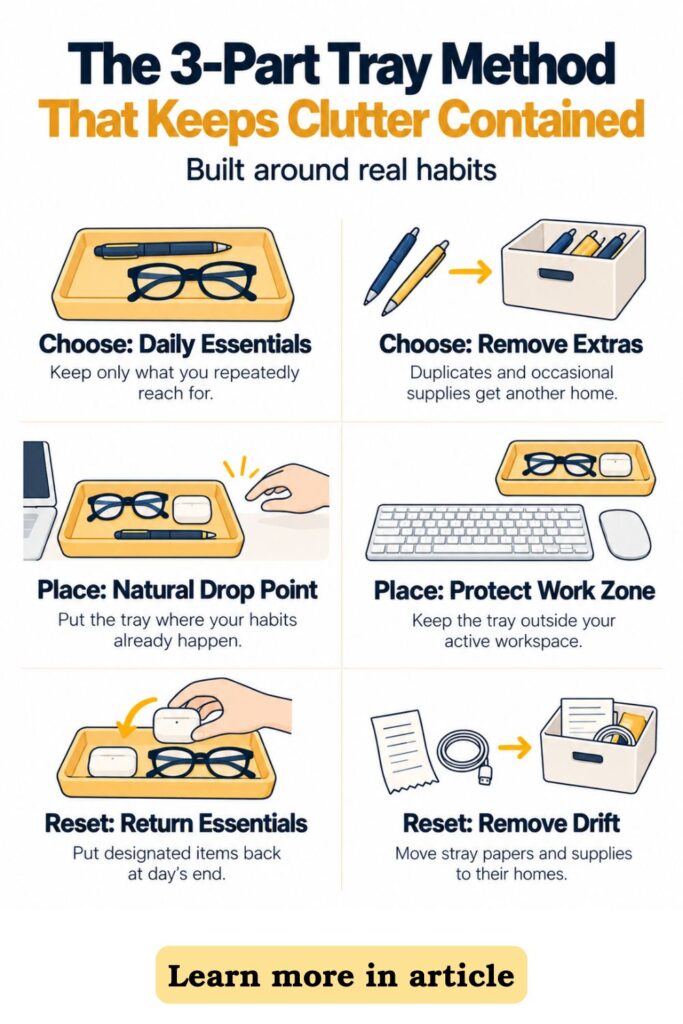
Glasses, lip balm, earbuds, hand cream, or a hair tie may be perfectly reasonable things to keep at your desk if you use them often.
The tray gives these items a clear place without pretending they need to live in a filing cabinet.
Be selective with work supplies: Office supplies can quickly overwhelm a catch-all system.
You may need a pen every day, but that does not mean you need your entire pen collection on the tray.
Keep only the tools you repeatedly use within reach. Store backups and less frequently used supplies elsewhere.
If you want to get more from your life, and are looking for concrete action steps to get you there, check out our Request a Coach page. It’s a “cut the fence-sitting and take action” way to tackle your issues and actually find success. To get off the fence and start to take action, click or tap here.
Good tray candidates may include:
- One favorite pen
- Earbuds
- Glasses
- A small hand cream
- Lip balm
- One charging adapter
- A compact personal accessory you use often
Items that usually need another home include:
- Duplicate pens
- Spare cables
- Staplers and larger office tools
- Receipts
- Bills
- Unfinished paperwork
- Packaging
- Random items you plan to deal with later
Keep active tasks off the tray: This is especially important with paper.
A catch-all tray should not become a reminder system for things you need to do.
Once bills, notes, receipts, or unfinished paperwork start mixing with personal essentials, the tray takes on a second job.
That usually makes the system harder to maintain.
Tasks need a task-management system. Papers need a paper workflow. Supplies need supply storage.
Your catch-all tray has a much simpler role.
If you want to get more from your life, and are looking for concrete action steps to get you there, check out our Request a Coach page. It’s a “cut the fence-sitting and take action” way to tackle your issues and actually find success. To get off the fence and start to take action, click or tap here.
It keeps the small things you genuinely use every day from scattering across your work surface.
The clearer that role remains, the better the tray will work.
8. When Your Catch-All Tray Keeps Turning Back Into Clutter
If your tray repeatedly becomes overcrowded, the problem may not be the tray itself.
Overflow can reveal useful information about what is missing elsewhere in your workspace.
Instead of continually cleaning the same mess, look for the behavior behind it.
Identify what keeps sneaking in: Notice which objects repeatedly appear on the tray even though you never intended to keep them there.
Are receipts constantly landing there? Do charging cables pile up beside your earbuds? Does every pen you own eventually make its way onto the tray?
Repeated clutter is often a clue.
If you want to get more from your life, and are looking for concrete action steps to get you there, check out our Request a Coach page. It’s a “cut the fence-sitting and take action” way to tackle your issues and actually find success. To get off the fence and start to take action, click or tap here.
The object may not have another convenient home.
Fix the missing storage problem: Once you identify the repeat offender, give it a dedicated place that is just as easy to use.
For example:
- Repeated receipts may need a small paper-processing spot.
- Charging cables may need a nearby pouch or cable clip.
- Extra pens may need a drawer organizer.
- Sticky notes may need one defined supply zone.
- Jewelry may need a small container somewhere else.
This is more effective than repeatedly telling yourself not to put those things on the tray.
You are changing the environment so the correct action becomes easier.
Shrink the system when necessary: Sometimes the tray itself is encouraging accumulation.
If you chose a large tray and consistently fill it, try reducing either the size of the tray or the number of permanent items allowed on it.
A tighter boundary forces clearer decisions.
If you want to get more from your life, and are looking for concrete action steps to get you there, check out our Request a Coach page. It’s a “cut the fence-sitting and take action” way to tackle your issues and actually find success. To get off the fence and start to take action, click or tap here.
You may discover that five items are genuinely useful while the other eight were simply convenient to leave visible.
A cluttered tray does not mean the idea failed.
It means your system is giving you feedback.
Pay attention to what keeps accumulating and why.
The solution may be a better home for one category, a more convenient storage spot, or simply fewer things living on your desk.
When you address the cause instead of repeatedly clearing the symptoms, maintaining the tray becomes much easier.
9. How an Organization Coach Could Help You Fix the Clutter Behind the Tray
A catch-all tray is a small system, but the habits behind it can reveal larger patterns in your workspace.
If your desk repeatedly returns to the same state no matter how often you organize it, outside guidance can help you understand why.
If you want to get more from your life, and are looking for concrete action steps to get you there, check out our Request a Coach page. It’s a “cut the fence-sitting and take action” way to tackle your issues and actually find success. To get off the fence and start to take action, click or tap here.
An organization coach can look beyond the visible clutter and help you build systems around your actual behavior.
Look for the repeated pattern: A coach may start by asking what consistently ends up on your desk and why.
Maybe you keep paperwork visible because you are afraid you will forget it. Perhaps charging accessories stay scattered because the drawer where they technically belong is inconvenient.
The goal is not simply to identify what looks messy.
It is to understand what function the clutter is currently serving.
Build around your real routine: A good system should reflect how you work rather than how a styled office photo looks.
If you constantly reach for earbuds, they probably need to remain accessible.
If you never open a drawer on the opposite side of the desk, that drawer may not be the right home for something you use six times a day.
If you want to get more from your life, and are looking for concrete action steps to get you there, check out our Request a Coach page. It’s a “cut the fence-sitting and take action” way to tackle your issues and actually find success. To get off the fence and start to take action, click or tap here.
A coach can help identify those friction points and redesign the environment around them.
Connect the tray to a larger desk system: Once the small-item clutter is under control, the same logic can be applied elsewhere.
For example:
- Papers can have a defined processing zone
- Cables can have one storage point
- Active projects can have designated space
- Supplies can be stored according to frequency of use
- Drawers can support rather than compete with your desktop routine
This can be especially useful if you have tried buying organizers without seeing lasting results.
The goal is not to own more organizing products.
It is to create fewer decisions during the day.
A tray works because it answers one question immediately: where do these little things go?
A coach can help you build similarly clear answers for the rest of your workspace, turning organization into something your environment supports automatically.
If you want to get more from your life, and are looking for concrete action steps to get you there, check out our Request a Coach page. It’s a “cut the fence-sitting and take action” way to tackle your issues and actually find success. To get off the fence and start to take action, click or tap here.
A Small Boundary That Makes the Whole Desk Feel Better
You do not need an empty desk to have an organized workspace.
You need clear boundaries around the things that stay visible.
A catch-all tray creates one of those boundaries with very little effort.
Instead of allowing small personal essentials to spread across the desk, you give them a defined landing zone. That simple change can make the whole workspace feel calmer even though you have not removed everything from sight.
The most successful version of this system is not a tray overflowing with carefully styled objects.
It is a small, useful zone containing only the things you regularly reach for.
Your setup can stay simple:
- Choose the everyday items that genuinely need to stay nearby
- Pick a tray sized to those items
- Place it where you naturally reach and drop things
- Keep the arrangement loose enough to leave visible space
- Remove anything that does not belong
- Reset the tray in seconds at the end of the day
That is enough.
If you want to get more from your life, and are looking for concrete action steps to get you there, check out our Request a Coach page. It’s a “cut the fence-sitting and take action” way to tackle your issues and actually find success. To get off the fence and start to take action, click or tap here.
You do not need a full desk makeover, complicated drawer inserts, or a long organizing routine.
The tray works because it gives visual clutter a limit.
It also makes putting things away easier. Instead of deciding where your glasses, earbuds, pen, or lip balm should go every time you use them, you already know the answer.
Over time, that reduces tiny decisions as well as tiny messes.
If the tray starts overflowing, treat that as useful information rather than a failure. Something may need a better home, a category may need its own storage system, or the number of visible essentials may simply need to shrink.
The goal is not perfection.
It is creating a workspace that supports your routines while still feeling polished and pleasant to use.
Sometimes one small boundary is enough to make an entire desk feel more under control.
If you want to get more from your life, and are looking for concrete action steps to get you there, check out our Request a Coach page. It’s a “cut the fence-sitting and take action” way to tackle your issues and actually find success. To get off the fence and start to take action, click or tap here.
Are you all about style, decor and organization? Download a copy of our Clutter Reset Guide.
Need some in depth help with organization and productivity ? Drop on by our directories choc full of productivity coaches, minimalist coaches, and work/life balance coaches to get your life organized! Or click here to have us match you to the best.
If you want to get more from your life, and are looking for concrete action steps to get you there, check out our Request a Coach page. It’s a “cut the fence-sitting and take action” way to tackle your issues and actually find success. To get off the fence and start to take action, click or tap here.
Read this next

7 Window Christmas Decor Ideas That Look Luxe With Almost No Effort
Are you all about style, decor and organization? Download a copy of our Decluttering Workbook. **** Bare windows can make a whole room feel unfinished, even if your tree looks […]
Read More
Before & After: Tiny Bathroom Transformations You Can Do in a Day
If your small bathroom feels more like a daily source of stress than a soothing space, you’re not alone. Tiny bathrooms have a way of collecting clutter, swallowing storage, and […]
Read More
Which Christmas Decor Style Fits You Best? Elegant, Minimalist, Cozy, or Rustic
Are you all about style, decor and organization? Download a copy of our Decluttering Workbook. Your Holiday Style Is About More Than Décor Every December, the same question quietly returns: […]
Read More