


Talk to a coach about Organizational coaching

Crystal Faulk
ACC
I help overwhelmed women in transition gain clarity, confidence, and...

Terrie Hein
Certified Life Coach, Certified Insight Coach Practitioner
Coaching to declutter your life, organize your goals, and cook...

Dr Charlene Ashley
Doctorate - Behaviours
I coach individuals to design fulfilling lives through structure, clarity,...

Paloma Chiara

Lana's Gymnastics Club
"Where the best in gymnastics meets fun. Where every child is a star"
lgclubny.com

Anna Sosnina
ICF (ACC)
ICF ACC certified coach, founder of EssorVie Coaching, passionate about...

Tyler Fink
B.A. in Religion, Anthropology, and Philosophy. Master of Divinity (M.Div.) in Missiology
Pastor, husband, and father helping Christian men pursue faithful growth...

Travis Brown
Professional Life coach
With experience in guiding clients to achieve goals, build confidence,...
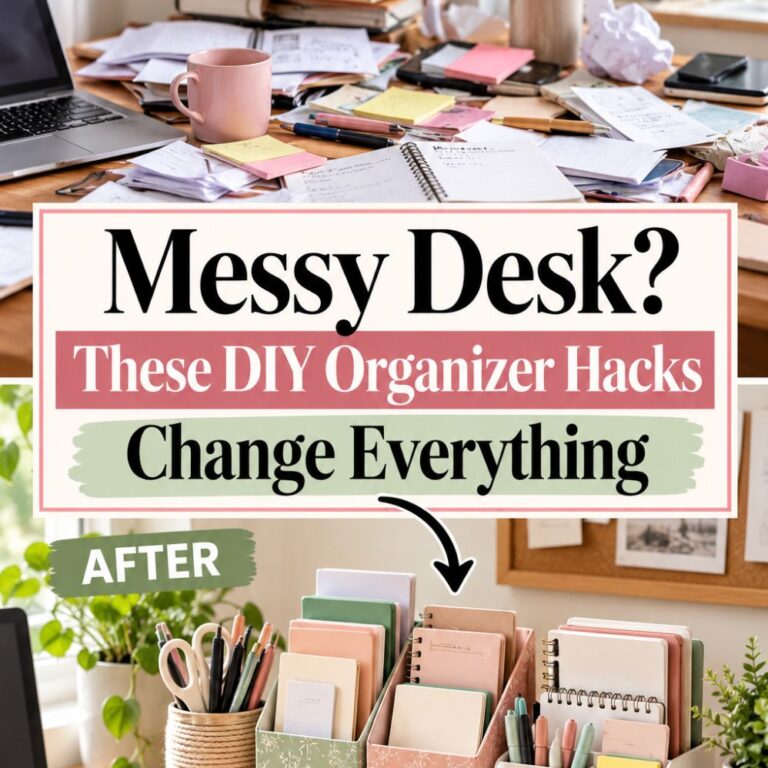




Repurposed Jar Station for Pens, Clips, and Small Desk Supplies
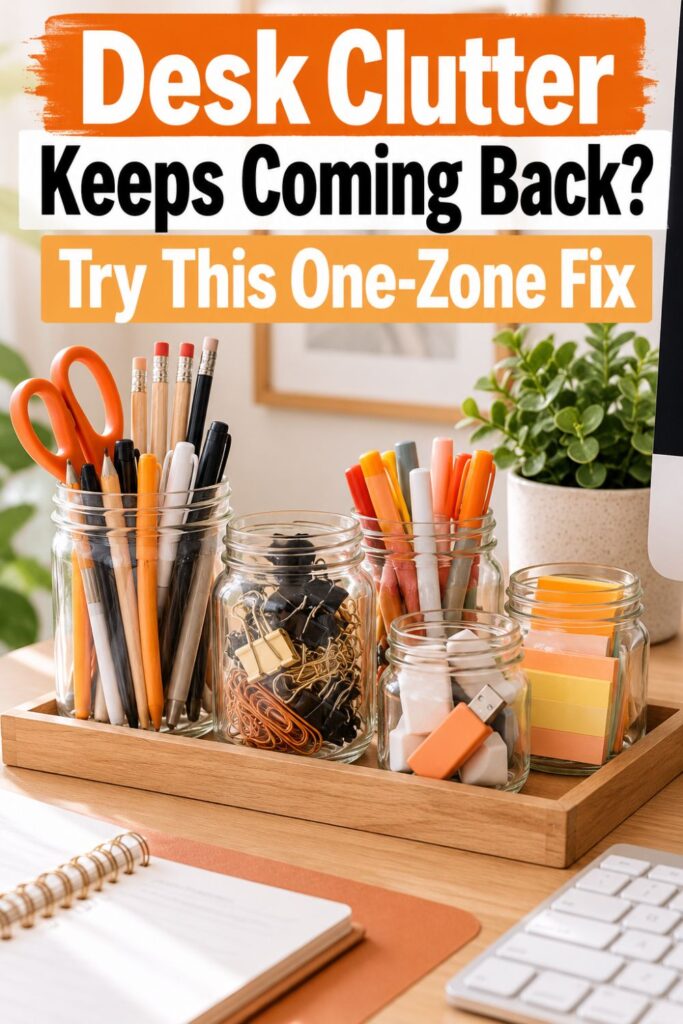
A desk can look reasonably organized and still feel cluttered because of all the tiny things that never seem to have a proper home. Pens collect beside the keyboard. Paper clips scatter near notebooks. USB drives disappear underneath planners, and binder clips somehow migrate into every corner.
The problem is not necessarily that you need more storage. Often, you just need a simple place to contain the handful of small supplies you use regularly.
A repurposed jar station is one of the easiest ways to solve that problem. Empty food jars, candle jars, small glass containers, or even sturdy plastic jars can become compact desktop organizers without drilling, measuring, assembling, or buying a complicated organizer.
The key is not to save every empty jar you come across. The goal is to create a small, intentional station where your most-used supplies have obvious homes.
Notice what keeps landing on your desk: Spend a day or two paying attention to the little objects that repeatedly end up beside your keyboard, notebook, or monitor. These are usually the best candidates for your jar station.
Separate everyday supplies from occasional supplies: Keep frequently used pens, clips, sticky flags, scissors, and small tech accessories nearby. Store large quantities and rarely used items somewhere else.
Group similar objects together: Instead of creating a separate container for every object, think in broader categories such as writing tools, fasteners, and small tech accessories.
A good jar station should make your desk feel more open, not give you another collection of things to manage.
If you want to get more from your life, and are looking for concrete action steps to get you there, check out our Request a Coach page. It’s a “cut the fence-sitting and take action” way to tackle your issues and actually find success. To get off the fence and start to take action, click or tap here.
Once you decide what actually needs a home, you can build a compact system that keeps the small stuff contained while leaving plenty of room to work.
1. Start With the Supplies That Actually Need a Home
Before collecting containers, figure out what your desk is actually struggling to hold.
It is easy to approach this project backwards. You find six cute jars, line them up, and then start searching for things to put inside them. Before long, the containers are filled with supplies you barely use, while the objects creating everyday clutter are still sitting on the desk.
Instead, let the clutter determine the containers.
Gather the loose supplies first: Collect the small objects currently scattered across your desk, hiding beside your computer, or floating around your drawers. Put them in one temporary pile so you can see exactly what you are dealing with.
Your pile might include:
- Pens and pencils
- Highlighters and markers
- Paper clips
- Binder clips
- Erasers
- Sticky-note flags
- Thumbtacks
- USB drives
- Charging adapters
- Small scissors
Now look for patterns.
Remove anything you rarely use: If you have 25 pens but regularly use only three, your jar station probably does not need to hold all 25. Keep frequently used supplies within reach and move backup stock somewhere else.
If you want to get more from your life, and are looking for concrete action steps to get you there, check out our Request a Coach page. It’s a “cut the fence-sitting and take action” way to tackle your issues and actually find success. To get off the fence and start to take action, click or tap here.
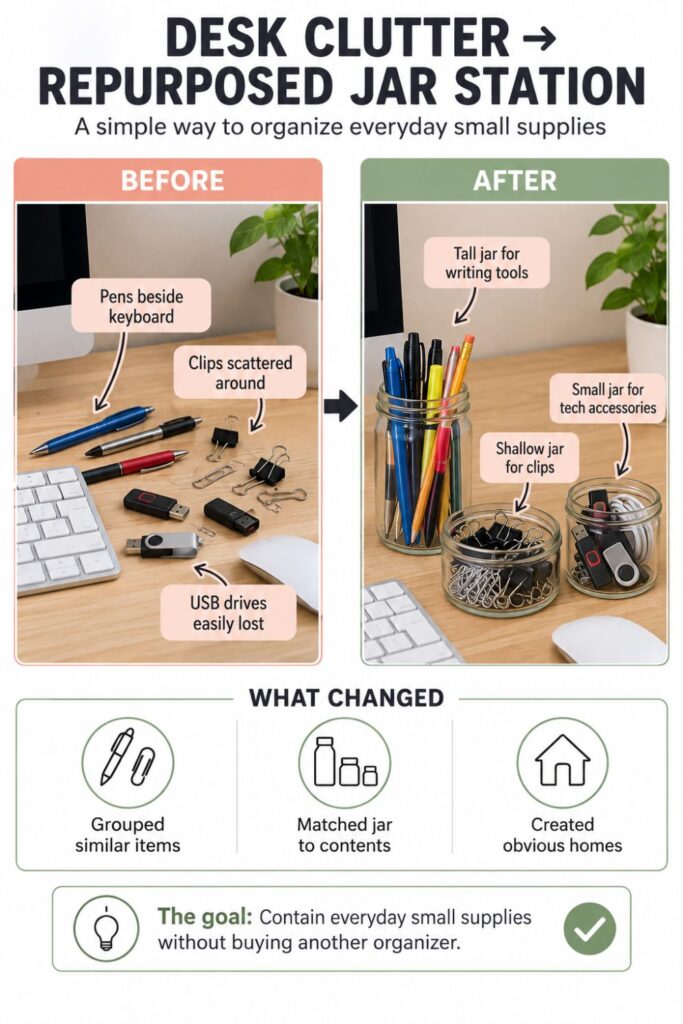
Create a few practical categories: Group things according to how you use them instead of trying to make every category extremely specific. Pens and pencils might share one jar. Paper clips and binder clips might share another.
Limit the number of categories: Three to five categories are often enough for a small desk. Too many containers can make the organization system feel just as visually busy as the original clutter.
This first step matters because the jar station should solve an existing problem. It should not create a reason to keep more supplies on the desktop.
When you finish sorting, you should be able to clearly answer one question: What small things do I actually need within arm’s reach while I work?
Those are the supplies your jars need to hold.
2. Choose Jars That Match What You’re Storing
Not every jar works equally well for every type of desk supply.
A tall pasta sauce jar might be perfect for pens but annoying for paper clips. A shallow candle jar may be great for binder clips but completely useless for scissors. Matching the container to the contents makes the station much easier to use.
Use tall jars for long supplies: Pens, pencils, markers, rulers, and scissors usually need enough height to stay upright without tipping over.
If you want to get more from your life, and are looking for concrete action steps to get you there, check out our Request a Coach page. It’s a “cut the fence-sitting and take action” way to tackle your issues and actually find success. To get off the fence and start to take action, click or tap here.
Look for containers that keep most of the item visible. If a pen disappears almost completely inside a jar, you may find yourself digging around every time you need it.
Use shallow containers for tiny pieces: Paper clips, thumbtacks, erasers, USB drives, and other small items are easier to retrieve from short jars or containers.
A good rule is simple: if you cannot comfortably reach the bottom with your fingers, the container is probably too deep for tiny supplies.
Check the opening size: Wide-mouth jars tend to work better for frequently used objects because you can quickly reach inside without knocking things over.
Pay attention to stability: Lightweight or narrow jars may tip when filled with scissors, heavy markers, or rulers. Choose a sturdier jar for taller objects.
You do not need a perfectly matching set, either.
If you want the station to look intentional, try choosing jars with one or two characteristics in common. They might all be clear glass, have similar shapes, or stay within a similar height range.
Before permanently assigning categories, place your empty jars on the desk and test them.
If you want to get more from your life, and are looking for concrete action steps to get you there, check out our Request a Coach page. It’s a “cut the fence-sitting and take action” way to tackle your issues and actually find success. To get off the fence and start to take action, click or tap here.
Ask yourself:
- Can I easily reach inside?
- Does the jar stay stable?
- Can I see what is stored there?
- Does it fit comfortably in the available space?
The best jar is not necessarily the prettiest one. It is the one that makes grabbing and returning supplies almost effortless.
3. Decide How Many Jars Your Desk Can Handle
Once you start sorting desk supplies, it can feel as though every category deserves its own container.
That is how a simple three-jar station can quietly become nine jars lined across the back of your desk.
Instead of deciding how many jars you need based only on your supplies, look at how much desktop space you can realistically give them.
Choose the footprint first: Pick one small area where the entire station must live. This could be a corner of the desk, a strip beside your monitor, or a narrow section along the back edge.
Then treat that area as a boundary.
Arrange the empty jars before filling them: Test several combinations while the containers are still empty. Three medium jars might fit better than five small ones, or you may discover that one tall jar and two short jars use the available space more efficiently.
If you want to get more from your life, and are looking for concrete action steps to get you there, check out our Request a Coach page. It’s a “cut the fence-sitting and take action” way to tackle your issues and actually find success. To get off the fence and start to take action, click or tap here.
Prioritize what you reach for most: If you have room for only three containers, give that space to the supplies you use constantly.
For example:
- Jar 1: Pens and pencils
- Jar 2: Markers and scissors
- Jar 3: Clips and tiny accessories
Less frequently used supplies can stay in a drawer or another storage area.
Leave open space around the station: A container system should make your desk easier to use, not squeeze into every available inch. Give yourself room for notebooks, coffee, your keyboard, and whatever else you actually need during the day.
If the jar station keeps growing, use a simple rule: adding one container means reconsidering another.
You may discover that two categories can be combined or that one jar is holding objects you rarely use.
A compact station forces you to prioritize.
That is part of why it works. Instead of trying to keep every office supply visible and accessible, you create a small collection of the things that truly deserve prime desktop space.
If you want to get more from your life, and are looking for concrete action steps to get you there, check out our Request a Coach page. It’s a “cut the fence-sitting and take action” way to tackle your issues and actually find success. To get off the fence and start to take action, click or tap here.
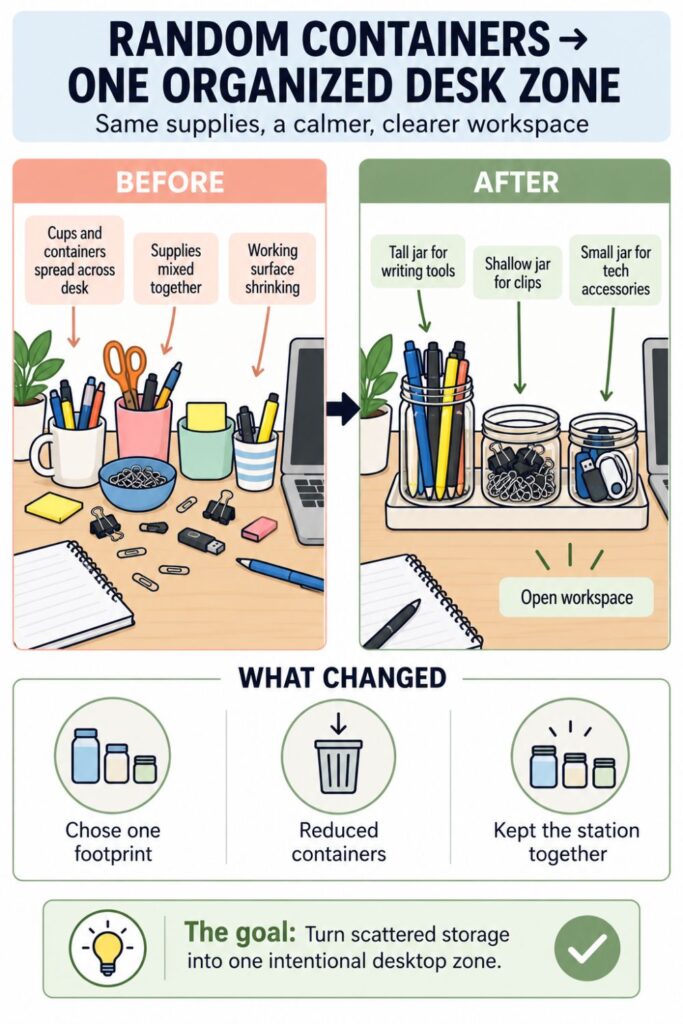
4. Build the Jar Station Around Reach, Not Appearance
A beautifully arranged jar station can still be frustrating if the things you use most are difficult to reach.
Organization works best when the easiest action is also the correct action. If putting a pen away requires stretching behind your monitor, you are much more likely to leave it beside the keyboard instead.
That is why placement matters.
Put everyday supplies closest to your dominant hand: If you are right-handed, your pen jar may work best near the right side of your main workspace. If you are left-handed, the opposite may feel more natural.
Move occasional supplies farther back: Paper clips, backup charging adapters, or specialty markers do not necessarily need the most convenient position.
You can think of your station in simple layers:
- Closest: things you use constantly
- Middle: things you use several times a week
- Back: things you want nearby but use less often
Keep short jars visible: Containers holding tiny objects are easier to use when you can look down and immediately see the contents.
Avoid tucking a shallow jar behind a tall container where you forget it exists.
If you want to get more from your life, and are looking for concrete action steps to get you there, check out our Request a Coach page. It’s a “cut the fence-sitting and take action” way to tackle your issues and actually find success. To get off the fence and start to take action, click or tap here.
Test the arrangement while working: Use the station for a normal workday before deciding that the layout is finished.
Notice what happens naturally.
Are you constantly reaching across your keyboard for scissors? Move them.
Do pens still pile up beside your notebook even though there is a jar nearby? The jar may be positioned in the wrong place.
Do you repeatedly knock over a container while grabbing your coffee? Shift the station farther back.
Small adjustments can make a big difference.
The goal is not to create a photographically perfect row of jars. The goal is to make returning a pen, clip, or USB drive so easy that leaving it loose on the desk feels like more work.
That is when the system begins maintaining itself.
If you want to get more from your life, and are looking for concrete action steps to get you there, check out our Request a Coach page. It’s a “cut the fence-sitting and take action” way to tackle your issues and actually find success. To get off the fence and start to take action, click or tap here.
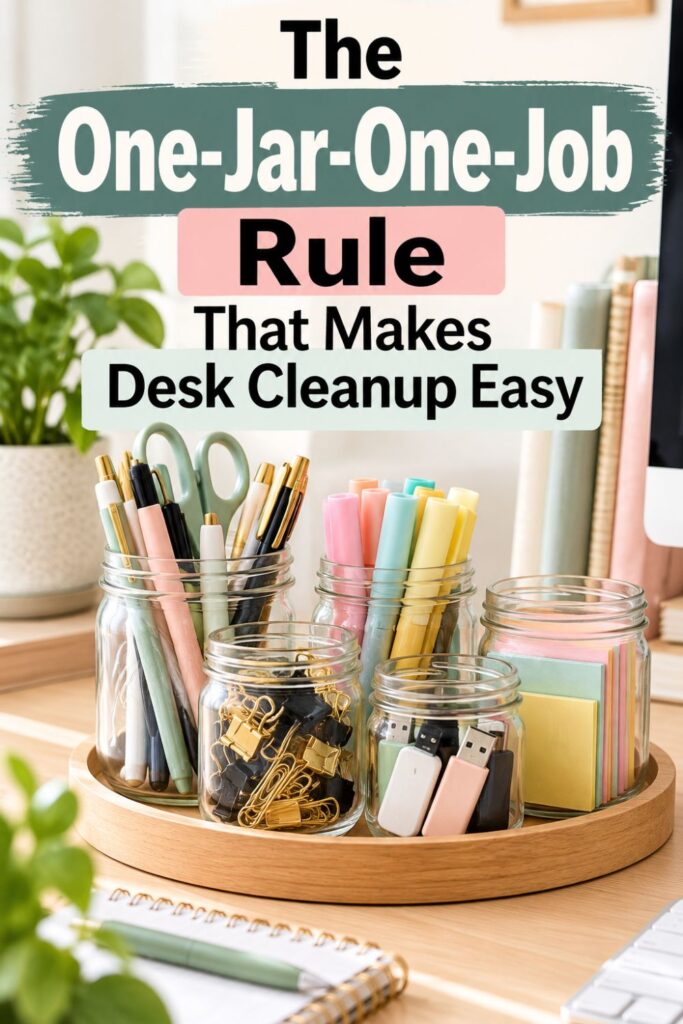
5. Give Every Jar One Clear Job
Containers do not automatically create organization.
A jar filled with pens, paper clips, USB drives, sticky-note tabs, coins, and random screws is really just a smaller junk drawer.
The biggest advantage of a jar station is visibility. You can immediately see where something belongs and grab it without searching. That benefit disappears when every container becomes miscellaneous storage.
Assign the category before filling the jar: Decide what each container is responsible for before adding anything.
For example:
- Writing tools
- Markers and scissors
- Clips and fasteners
- Small tech accessories
The categories do not have to be extremely narrow. They simply need to make sense when you are putting something away.
Combine objects you naturally use together: Paper clips and binder clips may work well in the same shallow jar. Pens and pencils may comfortably share another.
On the other hand, mixing a USB drive with thumbtacks simply because they are both small may make the container more frustrating to use.
If you want to get more from your life, and are looking for concrete action steps to get you there, check out our Request a Coach page. It’s a “cut the fence-sitting and take action” way to tackle your issues and actually find success. To get off the fence and start to take action, click or tap here.
Avoid creating a miscellaneous jar: The miscellaneous container usually becomes the place where anything without an obvious home gets dropped.
Once that happens, clutter slowly begins rebuilding itself.
If something does not fit any existing category, ask whether it actually needs to live on the desk.
Add labels only if they help: Clear glass often makes labels unnecessary because you can already see what is inside.
Labels can be useful when several containers hold visually similar supplies or when multiple people use the same workspace. A simple piece of removable tape or paper label is enough.
The real test is whether you can put something away without stopping to think.
When you finish using a binder clip, there should be one obvious place for it to go. When you grab a pen, you should know exactly where to return it.
Clear categories remove tiny decisions.
If you want to get more from your life, and are looking for concrete action steps to get you there, check out our Request a Coach page. It’s a “cut the fence-sitting and take action” way to tackle your issues and actually find success. To get off the fence and start to take action, click or tap here.
That may seem insignificant, but reducing those decisions is what keeps an organization system easy enough to maintain during a busy day.
6. Keep the Station From Turning Into Another Clutter Zone
The biggest danger with small organizers is that they eventually become storage for more and more stuff.
You notice the pen jar has room, so you add six promotional pens. Someone gives you a new pack of highlighters, so those get added too. A few months later, you have jars overflowing with supplies you rarely touch.
The easiest solution is to give every container a capacity limit.
Use the rim as a visual boundary: If items are packed tightly, sticking out awkwardly, or becoming difficult to remove, the jar is full.
Do not automatically add another container.
Instead, remove duplicates or move backups elsewhere.
Store excess supplies away from your desk: Your jar station should hold the working supply, not the entire inventory.
If you want to get more from your life, and are looking for concrete action steps to get you there, check out our Request a Coach page. It’s a “cut the fence-sitting and take action” way to tackle your issues and actually find success. To get off the fence and start to take action, click or tap here.
If you buy a ten-pack of pens, you might keep two or three on the desktop and store the rest in a drawer or supply cabinet.
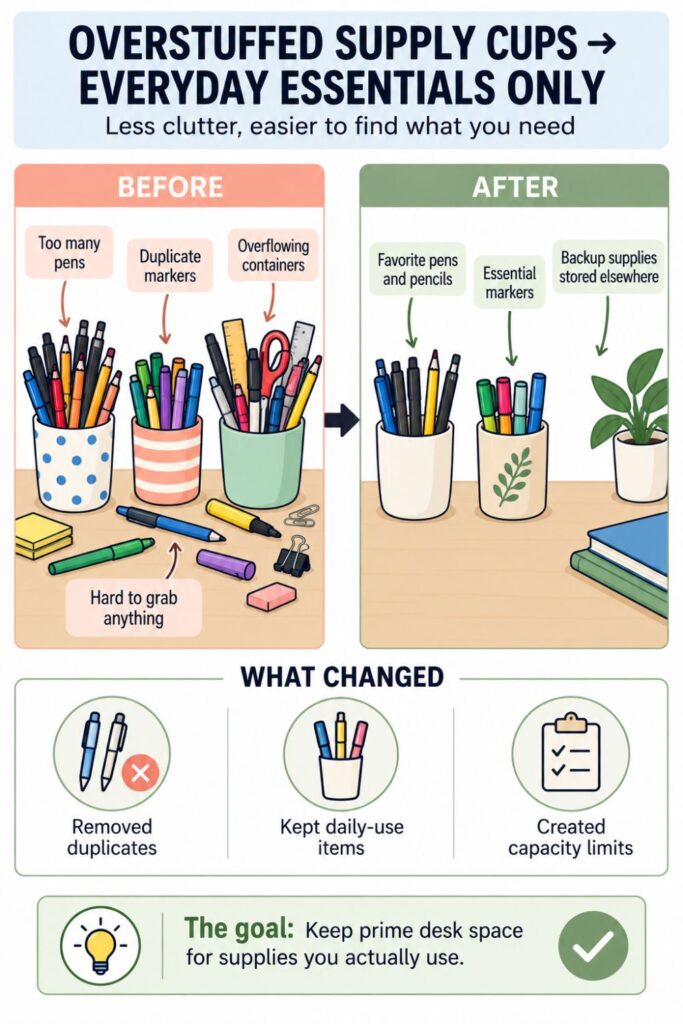
Reset loose items regularly: A jar system is especially useful because the reset can take less than a minute.
At the end of your work session, scan the desktop and return anything that belongs in the station.
Look for:
- Loose pens
- Scattered clips
- Highlighters
- Small tech accessories
- Scissors
- Sticky flags
Reassess categories when something constantly overflows: An overflowing jar can signal that you own too much, but it can also mean the category is too broad.
Maybe one container originally held pens, markers, and scissors, but you now use markers frequently enough to justify their own jar.
Organization systems are allowed to change.
The goal is not to create the perfect arrangement once and preserve it forever. The goal is to keep the desk easy to use.
If you want to get more from your life, and are looking for concrete action steps to get you there, check out our Request a Coach page. It’s a “cut the fence-sitting and take action” way to tackle your issues and actually find success. To get off the fence and start to take action, click or tap here.
If the station starts feeling crowded, inconvenient, or visually messy, edit it.
A quick five-minute reset may be all it takes to return the jars to their original purpose: keeping tiny desk supplies contained instead of letting them slowly take over the surface.
7. Make the Jar Station Work With the Rest of Your Desk
A jar station works best when it has one clear responsibility.
It should contain the small supplies you frequently reach for. It does not need to solve every storage problem in your workspace.
Trying to make one system handle everything usually leads to clutter again.
Protect your main working area: The space directly in front of you should remain available for the activities you actually do.
If you spend most of the day typing, keep the area around your keyboard comfortable. If you write frequently, protect enough clear surface for a notebook or planner.
The jars should live around your work zone, not inside it.
If you want to get more from your life, and are looking for concrete action steps to get you there, check out our Request a Coach page. It’s a “cut the fence-sitting and take action” way to tackle your issues and actually find success. To get off the fence and start to take action, click or tap here.
Let different storage types handle different jobs: Desktop jars are excellent for tiny, frequently used supplies.
Other storage might be better for:
- Printer paper
- Extra notebooks
- Charging cables
- Backup stationery
- Craft materials
- Documents
- Large electronics
Drawers, shelves, bins, and cabinets can handle those categories while the jars stay focused on grab-and-go items.
Check for duplicated storage: Sometimes clutter develops because one category has too many homes.
You may have pens in a desk drawer, a pen cup, a jar, your handbag, and a supply box.
Choose the easiest everyday location and let that become the primary home.
Use the station as a visual boundary: One useful benefit of grouping the jars together is that you can immediately see when small-object clutter begins spreading beyond the designated area.
If clips, pens, or accessories start appearing outside the station, return them before the mess expands.
If you want to get more from your life, and are looking for concrete action steps to get you there, check out our Request a Coach page. It’s a “cut the fence-sitting and take action” way to tackle your issues and actually find success. To get off the fence and start to take action, click or tap here.
Think of the jars as one small zone inside a larger desk system.
They handle the tiny objects. Your other storage handles everything else.
When each part of the desk has a clear role, organization becomes simpler because you are no longer asking one container, drawer, or surface to do too many jobs at once.
8. How an Organizing Coach Could Help When the Jars Aren’t the Real Problem
Sometimes the scattered pens and paper clips are only the most visible part of a bigger organization problem.
You can create a perfectly functional jar station and still find that your desk becomes cluttered every afternoon. That may mean the issue is not a lack of containers. It may be the way your workspace is arranged or the habits built around it.
This is where an organizing coach or professional organizer can be useful.
Identify why items keep landing on the desk: A coach can help you notice whether clutter is appearing because storage is too far away, categories are unclear, you own too many supplies, or your current system requires too many steps.
For example, repeatedly leaving charging cables on the desk may not mean you need another jar. You might simply need a better charging zone.
If you want to get more from your life, and are looking for concrete action steps to get you there, check out our Request a Coach page. It’s a “cut the fence-sitting and take action” way to tackle your issues and actually find success. To get off the fence and start to take action, click or tap here.
Build zones around your actual routine: Your workspace should support the way you work, not an ideal version of how you think you should work.
Someone who spends hours writing may need a completely different desk setup from someone who spends most of the day on video calls.
Reduce unnecessary duplicates: It is surprisingly easy to accumulate multiple versions of the same office supply.
An outside perspective can help you decide how many pens, notebooks, cables, or accessories you realistically need within reach.
Create a maintenance routine: Even good systems need a small reset.
A coach might help you develop something as simple as:
- One-minute desk reset each evening
- Weekly supply check
- Monthly duplicate purge
- Dedicated home for incoming papers
You certainly do not need professional help to organize a few jars.
The useful lesson is that persistent clutter is often information. If the same mess keeps returning despite repeated organizing attempts, look beyond the container.
If you want to get more from your life, and are looking for concrete action steps to get you there, check out our Request a Coach page. It’s a “cut the fence-sitting and take action” way to tackle your issues and actually find success. To get off the fence and start to take action, click or tap here.
The real improvement may come from changing the larger workflow surrounding the desk.
A Small System That Keeps Tiny Clutter Contained
You do not need an elaborate desk organizer to stop pens, clips, and tiny supplies from spreading across your workspace.
Sometimes a few empty jars are enough.
The most effective version of this system starts with the clutter you already have. Instead of collecting containers first, identify the small objects you genuinely reach for during a normal day and create simple homes for those items.
Start with your real habits: Notice which supplies repeatedly land on the desk. Those are the items that deserve easy-access storage.
Keep the station intentionally small: Three useful jars are often better than eight highly specific containers.
Match the container to the contents: Tall jars work well for writing tools. Short, wide containers make tiny clips and accessories easier to retrieve.
Position everything for convenience: Put frequently used supplies where your hand naturally reaches for them.
If you want to get more from your life, and are looking for concrete action steps to get you there, check out our Request a Coach page. It’s a “cut the fence-sitting and take action” way to tackle your issues and actually find success. To get off the fence and start to take action, click or tap here.
Keep backup stock somewhere else: Your desktop does not need to hold every pen, clip, or marker you own.
Edit the system when necessary: If a jar constantly overflows, sits unused, or feels inconvenient, change it.
That flexibility is what makes the idea practical.
You are not committing to a complicated storage system or installing something permanent. You are simply turning containers you already have into a compact sorting station that can change along with your routine.
The biggest benefit is not that the jars make the desk look prettier, although they certainly can.
The real benefit is that every tiny object has somewhere obvious to go.
When putting away a pen or paper clip takes almost no thought, clutter has fewer opportunities to rebuild.
That is the kind of low-effort organization system that is much easier to keep using long after the initial desk reset is finished.
If you want to get more from your life, and are looking for concrete action steps to get you there, check out our Request a Coach page. It’s a “cut the fence-sitting and take action” way to tackle your issues and actually find success. To get off the fence and start to take action, click or tap here.
If you want to get more from your life, and are looking for concrete action steps to get you there, check out our Request a Coach page. It’s a “cut the fence-sitting and take action” way to tackle your issues and actually find success. To get off the fence and start to take action, click or tap here.
Read this next

8 Iconic Holiday Movie-Inspired Wreaths to Transform Your Door This Christmas
Are you all about style, decor and organization? Download a copy of our Decluttering Workbook. **** There’s something about Christmas movies that makes us want to press pause on real […]
Read More
DIY Closet Drawer Ideas for Clothes, Accessories, and Small Items
Tiny closet driving you crazy? These simple drawer, bin, and shelf fixes make clothes and accessories easier to find fast.
Read More
4 Christmas Living Room Styles That Reveal Your Holiday Personality
Are you all about style, decor and organization? Download a copy of our Decluttering Workbook. **** Your living room already knows your holiday personality; it shows up in the textures […]
Read More