




Stuck Staring at a Blank Page? This Writing Trick Gets The Words Flowing In Minutes

Want to try this at home? No worries! Download a copy of our SMART Goals PDF Worksheet.
*****
Starting is where most writing stops before it even begins. You sit down with the intention to write, but the pressure to do it well makes everything feel heavier than it should be. The blank page doesn’t just feel empty—it feels demanding.
A warm-up changes that dynamic. Instead of asking you to produce something meaningful, it gives you something small and contained to do. It lowers the bar so much that starting no longer feels like a decision you have to wrestle with.
This is especially important if writing has started to feel inconsistent or forced. When every session feels like it has to “count,” it becomes harder to return to it. You begin to associate writing with pressure instead of movement.
A five-minute warm-up removes that weight. It creates a space where writing exists without expectations. You’re not trying to be clear, insightful, or productive. You’re simply getting words onto the page.
And that’s the real shift. Writing stops being something you perform and starts becoming something you practice. The goal is no longer to get it right. The goal is to begin.
Once that becomes familiar, everything else gets easier. Not because writing itself changes, but because the way you approach it does.
If you want to get more from your life, and are looking for concrete action steps to get you there, check out our Request a Coach page. It’s a “cut the fence-sitting and take action” way to tackle your issues and actually find success. To get off the fence and start to take action, click or tap here.
In our original roundup of next-step fixes, we included this writing article as a smart answer to blank-page paralysis, and now we’re taking a closer look at how this low-pressure warm-up helps make writing feel easier, less intimidating, and much more approachable.
Need some in depth help with goal settings, motivation or productivity ? Drop on by our directories choc full ofproductivity coaches,accountability coaches,and goal-setting coaches,and start reaching those goals! Or click here to have us match you to the best.
Start with a low-stakes prompt

- Choose a simple starting line: Pick a neutral or slightly open sentence like “Today I’m thinking about…” or “One thing on my mind is…” and begin writing without trying to shape it into anything meaningful.
- Let the sentence lead the direction: Follow whatever comes up next, even if it feels random or repetitive, because the goal is to get words moving rather than ideas perfected.
The hardest part of writing is often deciding what to say. When you remove that decision, you remove a major source of resistance. A low-stakes prompt gives your brain something to respond to instead of something to invent.
It doesn’t need to be clever or original. In fact, the more ordinary it is, the better. You’re not trying to impress yourself—you’re trying to get started. The simplicity is what makes it effective.
Once you begin, your brain naturally looks for something to continue with. That’s where momentum starts to build. Even if the first few sentences feel flat, they’re doing something important: they’re breaking the stillness.
Over time, you’ll notice that you don’t need to overthink your starting point. You begin to trust that something will come once you begin. That trust is what makes writing feel easier to return to.
Write without stopping or editing
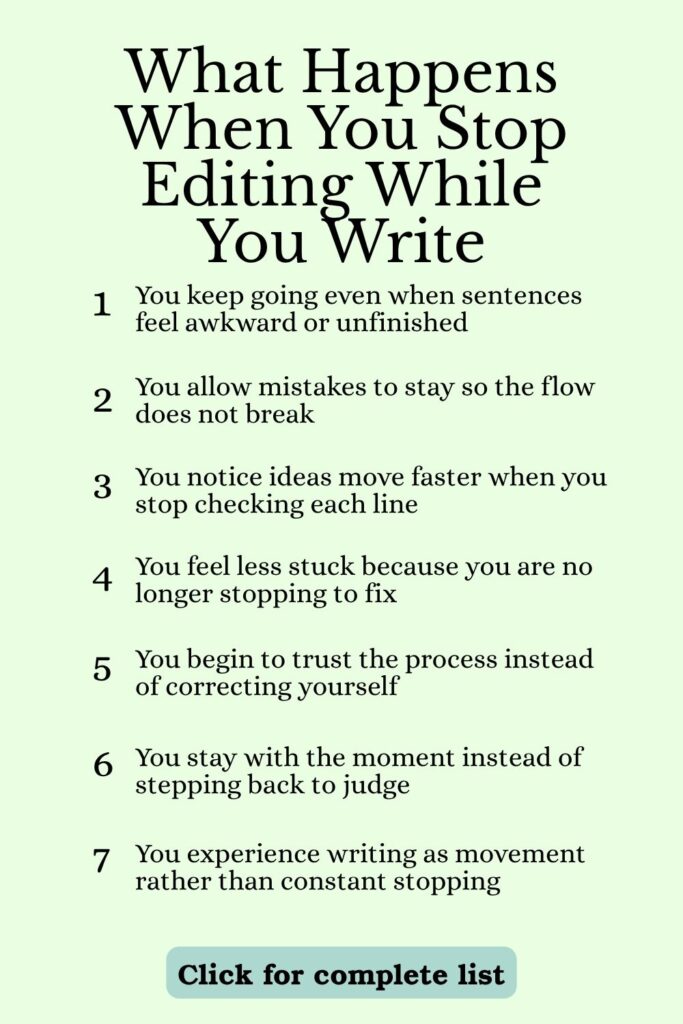
- Set a short timer: Give yourself exactly five minutes and commit to writing continuously, even if that means repeating words or writing “I don’t know what to say” until something shifts.
- Ignore quality completely: Resist the urge to fix grammar, structure, or clarity, because stopping to edit pulls you out of the flow you’re trying to build.
When you stop to edit, you interrupt the very thing you’re trying to create. Flow doesn’t happen when you’re evaluating every sentence. It happens when you allow yourself to move forward without checking.
A timer helps with this because it creates a boundary. You’re not writing indefinitely. You’re just writing for a few minutes. That makes it easier to stay with the process instead of drifting into judgment.
If you want to get more from your life, and are looking for concrete action steps to get you there, check out our Request a Coach page. It’s a “cut the fence-sitting and take action” way to tackle your issues and actually find success. To get off the fence and start to take action, click or tap here.
At first, it might feel uncomfortable to keep going without fixing things. You might notice mistakes or awkward phrasing. Let them stay. The point isn’t to produce clean writing—it’s to keep writing at all.
Something interesting happens when you do this consistently. The hesitation starts to fade. You spend less time pausing and more time continuing. Writing begins to feel less like starting and stopping, and more like staying in motion.
Focus on describing instead of creating
- Describe something simple: Write about what you see, feel, or remember in plain detail, like your workspace, your morning, or a recent conversation.
- Stay concrete and specific: Keep your attention on small details instead of big ideas so your brain doesn’t feel pressure to be insightful or original.
Trying to create something meaningful can make writing feel heavy. It asks you to be thoughtful, original, and clear all at once. That’s a lot to carry, especially at the beginning.
Description is lighter. It gives you something already there to work with. You’re not inventing—you’re noticing. That shift makes it easier to stay engaged without overthinking.
When you describe something simple, your attention narrows. You focus on small details: how something looks, how it feels, what stands out. That focus pulls you into the act of writing without requiring anything from you beyond observation.
This also helps quiet the part of your mind that wants everything to sound important. Description doesn’t need to be impressive. It just needs to be accurate enough to continue.
And often, that’s where more interesting ideas begin to surface. Not because you forced them, but because you stayed with something long enough for them to appear.
Use repetition to break resistance

- Repeat a phrase intentionally: Start with a line like “I keep thinking about…” and write it multiple times, letting each repetition shift slightly as new thoughts come up.
- Let repetition loosen your thinking: The act of repeating creates rhythm, which helps bypass overthinking and allows more honest ideas to surface.
Repetition can feel pointless at first, but that’s exactly why it works. It removes the expectation that every sentence needs to be new or valuable. You’re allowed to circle the same idea.
If you want to get more from your life, and are looking for concrete action steps to get you there, check out our Request a Coach page. It’s a “cut the fence-sitting and take action” way to tackle your issues and actually find success. To get off the fence and start to take action, click or tap here.
That repetition creates a kind of rhythm. Instead of trying to move forward in a straight line, you move in loops. And within those loops, small variations begin to appear.
You might start with something simple or surface-level, but as you repeat the phrase, your thinking shifts slightly each time. That’s where deeper or more honest thoughts tend to emerge.
It also reduces pressure. You’re not trying to get it right—you’re just continuing the pattern. That makes it easier to stay with the process without second-guessing yourself.
Over time, repetition becomes a tool you can rely on whenever you feel stuck. It gives you a way back into writing without needing clarity first.
End before you feel done
- Stop at the timer, not the idea: Even if you feel like you could keep going, stop when the five minutes ends so writing feels contained and manageable.
- Leave something unfinished: Ending mid-thought gives you an easier starting point next time, which reduces resistance the next day.
It might feel counterintuitive to stop when things are going well. But ending early is what keeps writing from feeling overwhelming. It leaves the experience positive and manageable.
When you stop before you’re done, you create a sense of continuation. You’re not closing the loop—you’re leaving it open. That makes it easier to come back, because you already know where to begin.
This also helps build consistency. If every session feels contained, you’re more likely to repeat it. You don’t need a large block of time or a perfect setup. You just need a few minutes.
Over time, this creates momentum. Writing becomes something you return to regularly, not something you wait to feel ready for. And that shift is what makes it sustainable.
If you want to get more from your life, and are looking for concrete action steps to get you there, check out our Request a Coach page. It’s a “cut the fence-sitting and take action” way to tackle your issues and actually find success. To get off the fence and start to take action, click or tap here.
How to Make This a Daily Habit

Attach the warm-up to something you already do
- Pair it with an existing routine: Add your writing warm-up after something consistent like coffee, opening your laptop, or sitting at your desk.
- Keep the sequence predictable: Doing it at the same moment each day removes decision-making and makes starting feel automatic.
Habits are easier to build when they don’t exist on their own. When you attach a new behavior to something already established, you remove the need to remember or decide.
This is what makes pairing effective. You’re not creating a new routine from scratch. You’re extending one that already exists. Writing becomes part of something familiar.
The key is consistency. The more predictable the timing, the less effort it takes to begin. You don’t have to ask yourself if you should write—you just follow the sequence you’ve already set.
Over time, this reduces resistance even further. Writing becomes less of an activity you initiate and more of something you move into naturally.
Keep the setup frictionless
- Prepare your space in advance: Leave your notebook open or your document ready so there’s no setup required when it’s time to start.
- Reduce choices as much as possible: Use the same format, same timer, and same structure so you don’t waste energy deciding how to begin.
Friction often shows up in small ways. Opening a document, choosing a format, deciding what to write—each of these adds a layer of effort that can delay starting.
When you remove those layers, writing becomes easier to access. You’re not preparing to write. You’re already in position to begin.
This is why consistency in setup matters. The fewer decisions you have to make, the more energy you have for the writing itself. You’re not spending time getting ready—you’re already there.
That simplicity is what keeps the habit sustainable. It doesn’t rely on motivation. It relies on reducing the barriers that usually get in the way.
If you want to get more from your life, and are looking for concrete action steps to get you there, check out our Request a Coach page. It’s a “cut the fence-sitting and take action” way to tackle your issues and actually find success. To get off the fence and start to take action, click or tap here.
How This Builds Writing Momentum

Shift your identity from “thinking” to “writing”
- Focus on showing up, not output: Each warm-up reinforces the habit of writing regularly, which matters more than producing something impressive.
- Let small sessions accumulate: Over time, these short sessions build confidence and make longer writing feel less intimidating.
It’s easy to spend a lot of time thinking about writing without actually doing it. Planning, outlining, and reflecting can feel productive, but they don’t replace the act itself.
A warm-up shifts that focus. It prioritizes action over preparation. You’re not waiting to feel ready—you’re showing up anyway.
This is where identity begins to change. You stop seeing yourself as someone who “should write more” and start becoming someone who writes, even in small ways.
That consistency builds trust. You begin to rely on yourself to follow through, even when it’s simple. And that trust carries into larger writing sessions.
Use the warm-up as a bridge into deeper work

- Continue if it feels easy: If you naturally want to keep writing after the five minutes, allow it without pressure or expectation.
- Or stop and still count it: Even if you stop, the warm-up has already done its job by helping you start and lowering resistance for next time.
The warm-up isn’t just a standalone habit. It can also act as a bridge into deeper work. Once you’ve started, continuing often feels easier than beginning.
But the important part is that continuation is optional. You don’t have to turn every warm-up into a longer session. The value is in the starting, not the outcome.
Some days, five minutes will be enough. Other days, it might lead to more. Both are useful. Both reinforce the same habit.
And that’s what makes this approach sustainable. It allows for variation without breaking consistency. You’re not relying on perfect conditions. You’re relying on a simple, repeatable beginning.
If you want to get more from your life, and are looking for concrete action steps to get you there, check out our Request a Coach page. It’s a “cut the fence-sitting and take action” way to tackle your issues and actually find success. To get off the fence and start to take action, click or tap here.
*****
Want to try this at home? No worries! Download a copy of our SMART Goals PDF Worksheet.
Need some in depth help with goal settings, motivation or productivity ? Drop on by our directories choc full of productivity coaches, accountability coaches, and goal-setting coaches, and start reaching those goals! Or click here to have us match you to the best.
If you want to get more from your life, and are looking for concrete action steps to get you there, check out our Request a Coach page. It’s a “cut the fence-sitting and take action” way to tackle your issues and actually find success. To get off the fence and start to take action, click or tap here.
Read this next

Seeing the World as a Kaleidoscope: Your Purpose and Your Path
Do you see the world as a kaleidoscope? Open your eyes to color when searching for your purpose.
Read More
Your Present Circumstances Don’t Determine Where You Can Go
Life coaching quote of the day: Your present circumstances don’t determine where you can go; they merely determine where you start. If you want to get more from your life, […]
Read More
Vision Board Ideas That Actually Help You Stay Focused on Your Goals
Try these vision board ideas that make goal setting feel clearer, calmer, and way easier to stick with every day.
Read More