




Always Switching Tabs? This Single-Tab Setup Makes Deep Focus Feel Possible Again
Want to try this at home? No worries! Download a copy of our SMART Goals PDF Worksheet.
****
A lot of people think focus problems start with motivation.
They assume they need more willpower, more energy, or a better mood before they can finally sit down and work. But often the real problem is simpler: the environment is asking the brain to do too much.
When your screen is full of tabs, messages, saved articles, open docs, and half-finished searches, your attention has nowhere clean to land. Even if you know what you should be doing, your brain is still sorting through too many possible next moves.
That extra friction adds up fast.
A single-tab setup works because it removes choice at the moment when choice is most dangerous. You are not trying to become a different person. You are making it easier to stay with one task for one short stretch of time.
This works especially well when you have enough energy to do something, but not enough to manage a chaotic work session.
What makes this method useful is how simple it is:
If you want to get more from your life, and are looking for concrete action steps to get you there, check out our Request a Coach page. It’s a “cut the fence-sitting and take action” way to tackle your issues and actually find success. To get off the fence and start to take action, click or tap here.
- One tab
- One task
- One short sprint
- One deliberate decision to stop or repeat
That structure makes focus feel less abstract.
Instead of telling yourself to “be more disciplined,” you create a visible container for attention. You can look at your screen and immediately tell whether you are still doing the sprint or not.
When the setup is clean, starting feels lighter.
When the task is clear, staying with it feels easier.
And when the sprint ends, finishing feels real instead of fuzzy.
That is the whole goal. Not to build a perfect productivity system. Just to make focused work easier to begin, easier to continue, and easier to repeat.
Need some in depth help with goal settings, motivation or productivity ? Drop on by our directories choc full of productivity coaches, accountability coaches, and goal-setting coaches, and start reaching those goals! Or click here to have us match you to the best.
If you want to get more from your life, and are looking for concrete action steps to get you there, check out our Request a Coach page. It’s a “cut the fence-sitting and take action” way to tackle your issues and actually find success. To get off the fence and start to take action, click or tap here.
Pick the one task that deserves the tab
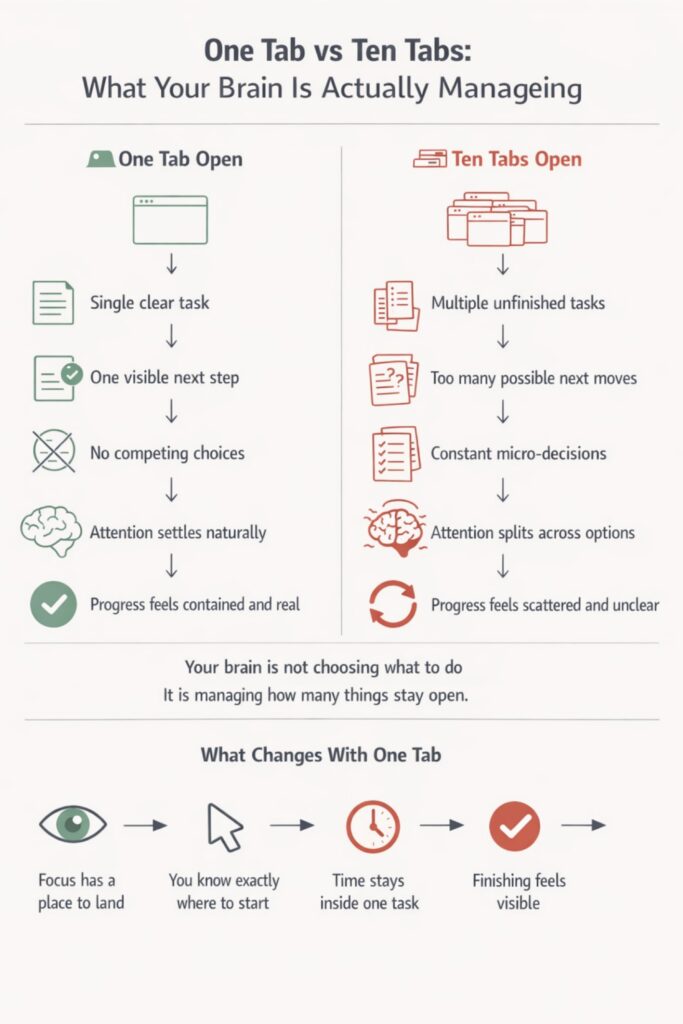
The first step is choosing a task that is specific enough to hold your attention.
This matters because vague tasks create instant friction. If the task is too broad, your brain keeps trying to define the work while doing the work. That usually leads to wandering, tab switching, or fake productivity.
A sprint task needs a visible finish line.
Instead of saying “work on my business” or “make progress on the project,” choose something you can actually picture yourself finishing or moving forward.
Better task examples look like this:
- Draft the intro
- Reply to three emails
- Edit the first section
- Outline the next three points
- Rename and organize the files for this project
These are easier to start because they describe action, not responsibility.
If the task still feels heavy, shrink it.
You are not making it less important. You are making it small enough to fit inside a real sprint. A short work block needs one manageable chunk, not a whole category of life.
If you want to get more from your life, and are looking for concrete action steps to get you there, check out our Request a Coach page. It’s a “cut the fence-sitting and take action” way to tackle your issues and actually find success. To get off the fence and start to take action, click or tap here.
A good sprint task usually has three qualities:
- It starts with a verb
- It has a visible stopping point
- It can be completed or clearly advanced in one sitting
It also helps to rule out everything else before you begin.
If other tasks are floating around in your head, write them down somewhere else. Put them on paper or in a note. Do not let them stay mentally open while you try to focus.
That small move reduces background pressure.
You are not deciding those other things do not matter. You are deciding they do not belong in this sprint.
That distinction is important.
The goal is not to prove that one task is the most important thing in your life. The goal is to give one task temporary priority so your attention has somewhere clear to go.
Once you do that, focus gets lighter almost immediately.
If you want to get more from your life, and are looking for concrete action steps to get you there, check out our Request a Coach page. It’s a “cut the fence-sitting and take action” way to tackle your issues and actually find success. To get off the fence and start to take action, click or tap here.
Build the single-tab environment before you start
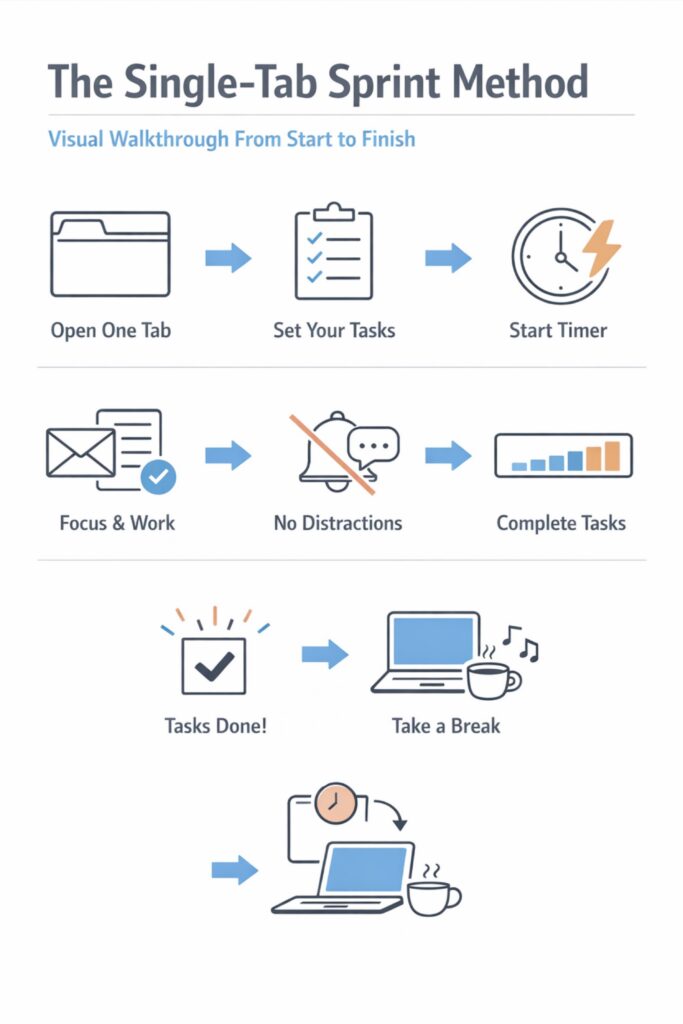
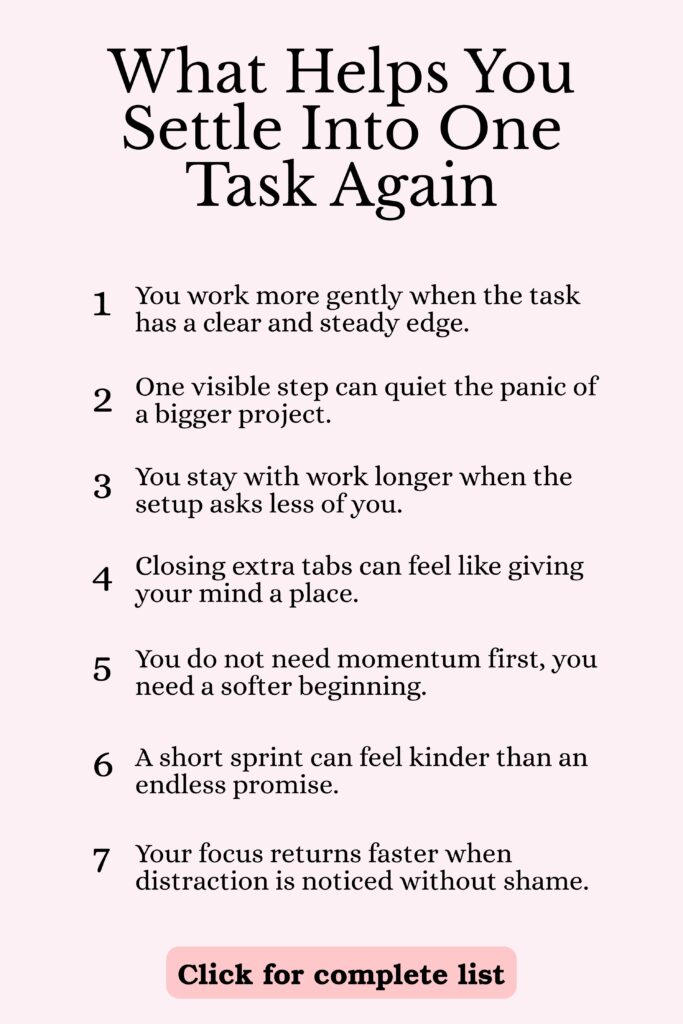
After you choose the task, build the environment around it before the sprint begins.
This step matters because focus often breaks before the work even starts. People open the task, leave everything else visible, and assume they will just resist temptation through sheer effort. That usually does not work for long.
A single-tab environment means removing obvious escape routes.
That might include:
- Closing extra browser tabs
- Hiding your inbox
- Muting chat or Slack
- Putting your phone out of reach
- Closing side windows you tend to click automatically
- Turning off notifications for the length of the sprint
The more options you leave visible, the more your brain treats them like unfinished invitations.
Even if you do not click them right away, they split your attention. Part of your mind stays slightly available for something else, which makes it harder to settle into the task in front of you.
You also want to prepare what you need in advance.
Before the timer starts:
If you want to get more from your life, and are looking for concrete action steps to get you there, check out our Request a Coach page. It’s a “cut the fence-sitting and take action” way to tackle your issues and actually find success. To get off the fence and start to take action, click or tap here.
- Open the exact doc or page you need
- Place the cursor where you will begin
- Pull out any notes you need
- Keep reference material minimal
- Put supporting info beside the work, not buried in another tab
This makes a big difference.
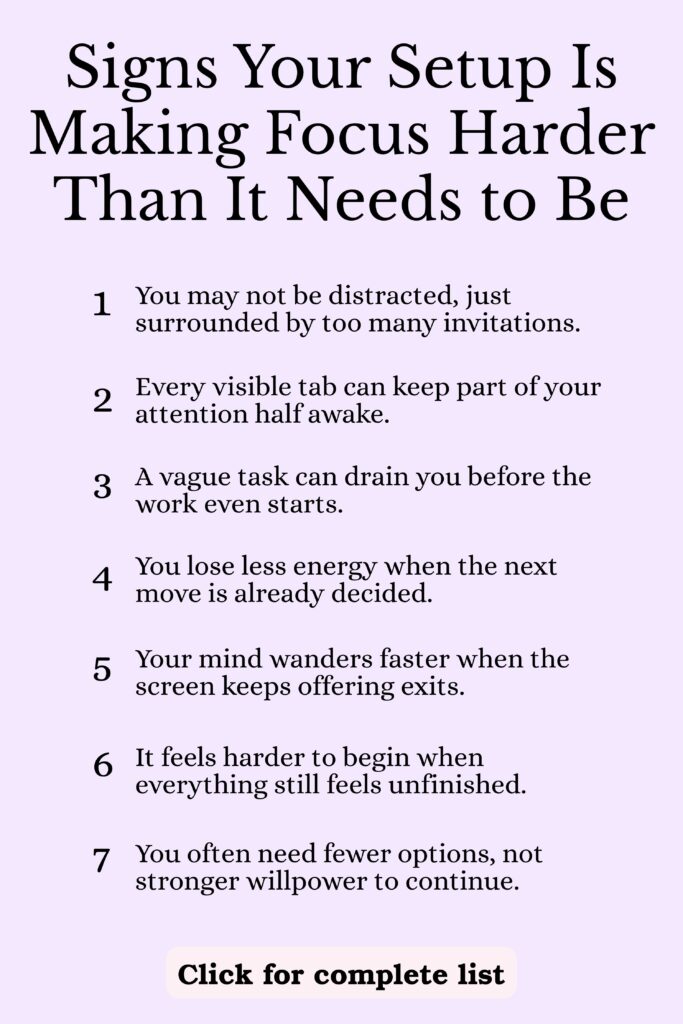
A messy setup creates mini-decisions every few minutes. A clean setup removes those decisions before they can interrupt you.
That is especially helpful at home, where distraction usually comes from many small things instead of one dramatic interruption. A message here, a tab there, a random thought, a nearby chore. It all pulls on your attention.
A clean screen creates a clearer lane.
Think of setup as part of the work, not a delay before the work. The better the setup, the less your future self has to manage once the sprint begins.
And the less you have to manage, the easier it is to stay with the task.
Start the sprint with a tiny entry move
Once the environment is ready, do not begin with the hardest part.
Begin with the smallest useful move.
If you want to get more from your life, and are looking for concrete action steps to get you there, check out our Request a Coach page. It’s a “cut the fence-sitting and take action” way to tackle your issues and actually find success. To get off the fence and start to take action, click or tap here.
This helps because the first few seconds of a sprint often decide whether the task feels approachable or overwhelming. If you start by pressuring yourself to “really focus now,” your brain may resist before you even begin.
A tiny entry move lowers that resistance.
Good entry moves might be:
- Write one sentence
- Add three bullet points
- Rename the document
- Highlight the paragraph to revise
- Open the section and type a rough heading
- Make a quick list of what this sprint will cover
These actions are small, but they are not meaningless. They create motion.
That matters because action reduces ambiguity. Before you begin, the task may feel like one big cloud. Once you take one visible step, the work becomes more concrete.
You are no longer staring at the whole project.
You are inside it.
A short timer helps too. It gives your brain a boundary it can trust. You are not agreeing to work forever. You are agreeing to stay with one task for one contained stretch.
If you want to get more from your life, and are looking for concrete action steps to get you there, check out our Request a Coach page. It’s a “cut the fence-sitting and take action” way to tackle your issues and actually find success. To get off the fence and start to take action, click or tap here.
That makes the sprint feel safer.
While the timer is running:
- Keep your eyes on the current task
- Do not renegotiate the plan every few minutes
- Do not check whether you “feel like it” yet
- Let the timer hold the boundary for you
It also helps to keep a capture spot nearby for unrelated thoughts.
During the sprint, your brain will remember other tasks, ideas, errands, and questions. That is normal. Write them down quickly and return to the tab.
Do not turn every remembered thought into a detour.
You do not need a dramatic wave of motivation to begin. You just need a first move small enough to take without resistance and useful enough to create momentum.
That is often enough to carry the sprint forward.
Handle distraction without breaking the setup
Distraction rarely shows up as a dramatic decision.
If you want to get more from your life, and are looking for concrete action steps to get you there, check out our Request a Coach page. It’s a “cut the fence-sitting and take action” way to tackle your issues and actually find success. To get off the fence and start to take action, click or tap here.
It usually arrives as a tiny suggestion that feels harmless in the moment. Check one message. Open one tab. Look up one thing. Search something “related.” Clean up something quickly before getting serious.
That is why distraction is so sneaky. It often feels reasonable.
The best response is to expect the urge instead of acting surprised by it. Focus does not mean your brain suddenly stops wanting novelty. It means you notice the pull and return to the task faster.
A useful question to ask is:
- Does this help the current sprint right now?
Not eventually. Not vaguely. Right now.
If the answer is no, do not follow it. Write it down and keep going.
It also helps to build friction around your usual distractions.
For example:
If you want to get more from your life, and are looking for concrete action steps to get you there, check out our Request a Coach page. It’s a “cut the fence-sitting and take action” way to tackle your issues and actually find success. To get off the fence and start to take action, click or tap here.
- Log out of sites you tend to check automatically
- Put your phone across the room
- Silence notifications
- Close your default escape tabs
- Remove bookmarks you click without thinking during work
This matters because distraction is often a reflex, not a thoughtful choice.
Your hand follows a familiar path before your brain fully catches up. Small friction points interrupt that pattern long enough for intention to step back in.
A reset phrase can help too.
Simple lines like these work well:
- Back to the tab
- Finish this step first
- Not for this sprint
- Write it down, then return
The goal is not to shame yourself for drifting. The goal is to recover quickly without turning one distraction into a full derailment.
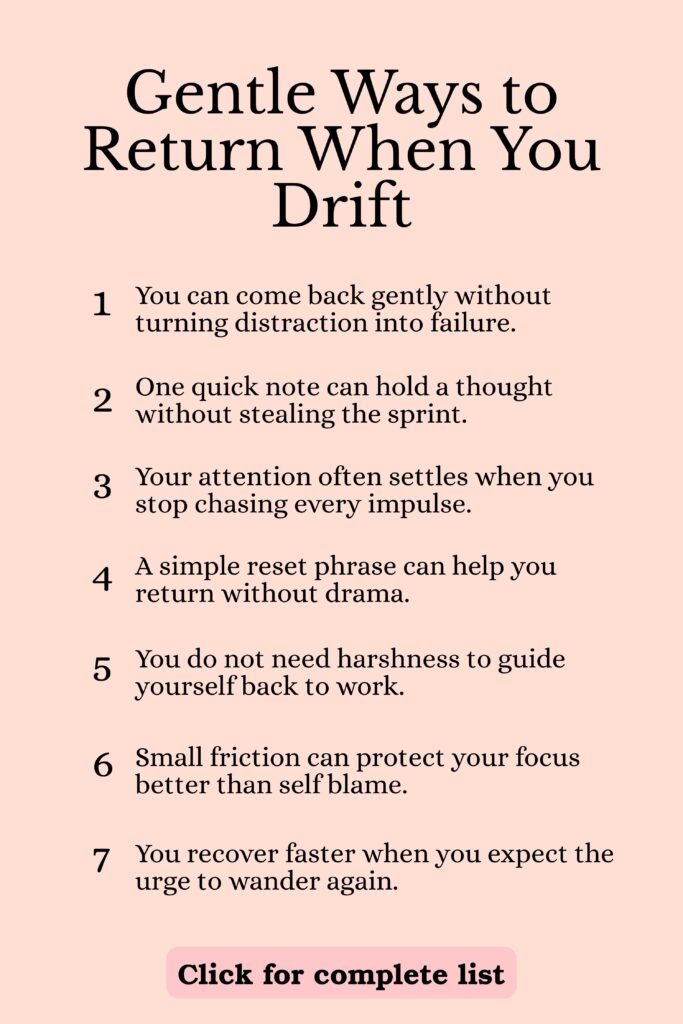
That is where people usually lose the most time.
Not in the first slip, but in everything that happens after it:
- One check becomes five minutes
- Five minutes becomes a mood shift
- The mood shift becomes avoidance
- The avoidance becomes self-criticism
- The self-criticism makes the task feel heavier
A fast recovery interrupts that cycle.
If you want to get more from your life, and are looking for concrete action steps to get you there, check out our Request a Coach page. It’s a “cut the fence-sitting and take action” way to tackle your issues and actually find success. To get off the fence and start to take action, click or tap here.
You do not need perfect concentration. You need a reliable way back.
That is what protects the sprint.
Decide whether to stop or repeat
When the sprint ends, pause before automatically continuing.
This is where the method becomes intentional instead of messy. The sprint should have an edge. If you ignore that edge, you lose one of the biggest benefits of the setup.
Start with a quick check-in.
Ask yourself:
- Did I finish the chunk I planned?
- Did I make clear progress?
- Is there an obvious next step?
- Do I still have enough attention for another round?
You are not grading yourself here. You are just noticing where the work landed.
Sometimes the best move is to stop.
If you want to get more from your life, and are looking for concrete action steps to get you there, check out our Request a Coach page. It’s a “cut the fence-sitting and take action” way to tackle your issues and actually find success. To get off the fence and start to take action, click or tap here.
Stopping makes sense when:
- You completed the planned piece
- You reached a natural pause point
- Your attention is thinning out
- Another sprint would be low quality rather than useful
Ending there is not failure. It is part of the method.
A lot of people drift into distraction because they keep going past the point where focus is clean. Then they start opening random tabs, not because they are lazy, but because their brain is already tired and looking for relief.
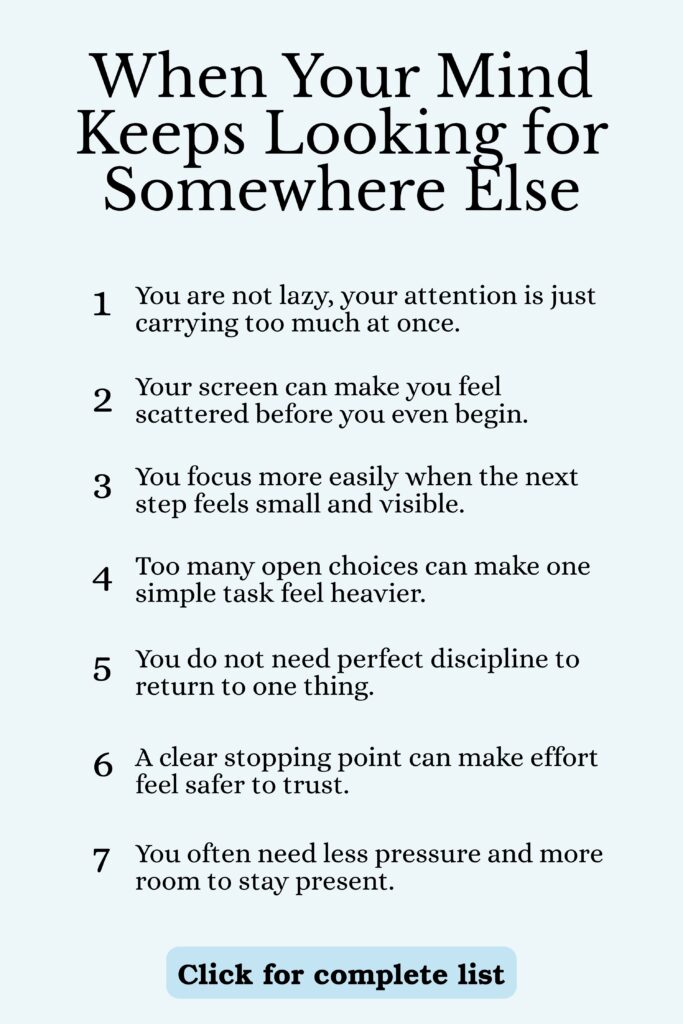
A clear stop prevents that.
Other times, repeating is the right choice.
Repeat when:
- The next step is obvious
- The tab setup is still clean
- You still have enough attention to do the next chunk well
- One more sprint would create meaningful progress
The key is to repeat on purpose, not out of guilt.
Before you walk away, leave a visible restart point for yourself.
If you want to get more from your life, and are looking for concrete action steps to get you there, check out our Request a Coach page. It’s a “cut the fence-sitting and take action” way to tackle your issues and actually find success. To get off the fence and start to take action, click or tap here.
That could be:
- A note at the top of the doc
- A highlighted sentence
- A bullet that says “next”
- An unfinished line you can return to easily
This makes tomorrow easier.
Instead of reopening the file and having to figure out where to begin, you can drop straight back into motion. That lowers resistance for the next sprint and makes focused work feel more repeatable.
Whether you stop or repeat, the goal is the same: end the sprint with clarity instead of drift.
Make the setup easier to reuse tomorrow
The real value of this method is not one good sprint.
It is the fact that you can use it again without much effort.
That is why it helps to make the setup familiar. You do not want to reinvent your focus system every time you sit down to work. You want a repeatable structure that feels easy to enter, even on average days.
A simple ritual helps with that.
If you want to get more from your life, and are looking for concrete action steps to get you there, check out our Request a Coach page. It’s a “cut the fence-sitting and take action” way to tackle your issues and actually find success. To get off the fence and start to take action, click or tap here.
Your ritual might include:
- Choosing one clear task
- Closing every extra tab
- Setting the same timer length
- Keeping a note space for distractions
- Starting with the same kind of tiny entry move
- Leaving a restart point before you stop
It does not need to be fancy. It just needs to be consistent.
Familiarity reduces friction. When the starting process is predictable, you spend less energy deciding how to focus and more energy actually doing the work.
It also helps to pay attention to which distractions keep showing up.
Notice patterns like:
- I always open email when the task gets dull
- I start researching before I begin writing
- I keep switching tabs when I do not know the next step
- I lose momentum when my materials are spread out
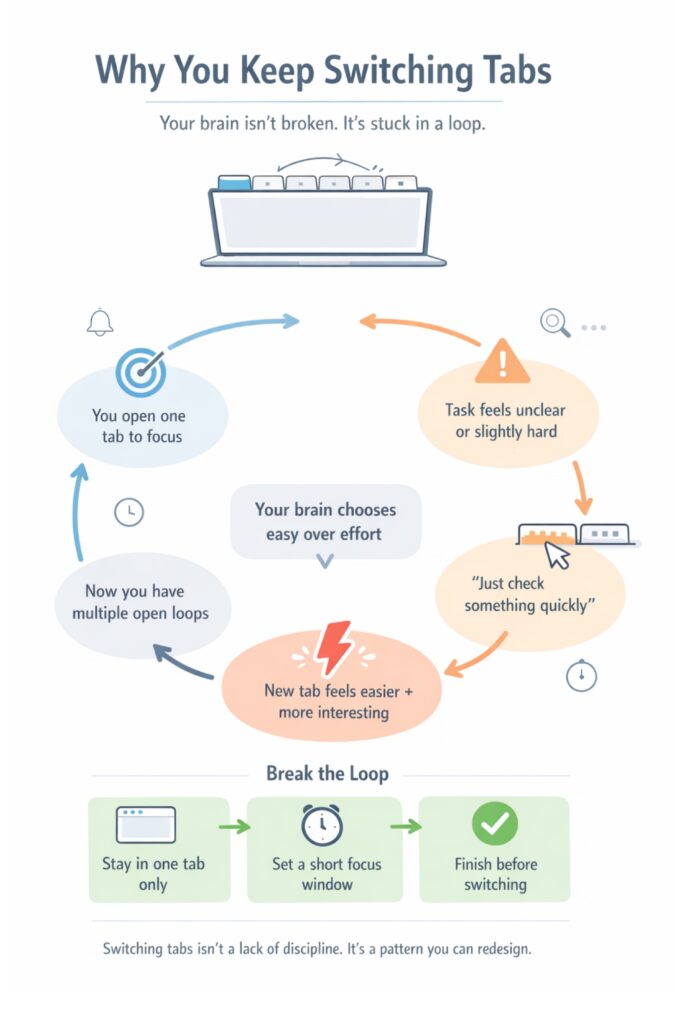
These are not just bad habits. They are clues.
They tell you where your setup still needs support.
Instead of blaming yourself, adjust the system:
If you want to get more from your life, and are looking for concrete action steps to get you there, check out our Request a Coach page. It’s a “cut the fence-sitting and take action” way to tackle your issues and actually find success. To get off the fence and start to take action, click or tap here.
- If messages pull you away, mute them sooner
- If research turns into browsing, prepare sources in advance
- If you freeze when the task gets vague, define the chunk more clearly
- If you reopen too much, simplify what stays on screen
You can also keep a short list of tasks that work well in a single-tab sprint.
For example:
- Drafting
- Editing
- Sorting
- Replying
- Outlining
- Organizing notes
- Planning the next step
That list helps on low-motivation days because it removes one more decision.
Consistency usually comes from reduced complexity, not increased pressure.
That is what makes this method useful. It gives you a structure you can trust and return to without needing to become a different kind of person first.
A simple way to make progress feel real
Want to try this at home? No worries! Download a copy of our SMART Goals PDF Worksheet.
Need some in depth help with goal settings, motivation or productivity ? Drop on by our directories choc full of productivity coaches, accountability coaches, and goal-setting coaches, and start reaching those goals! Or click here to have us match you to the best.
Single-tab work helps because it gives focus a visible shape.
If you want to get more from your life, and are looking for concrete action steps to get you there, check out our Request a Coach page. It’s a “cut the fence-sitting and take action” way to tackle your issues and actually find success. To get off the fence and start to take action, click or tap here.
Instead of trying to manage everything at once, you create one lane for one task and stay there for one short sprint. That sounds basic, but basic structure is often what turns vague intention into real action.
You do not need to overhaul your whole life.
You do not need perfect discipline.
You do not need the ideal mood.
You just need a simple container:
- One tab
- One task
- One timer
- One clear choice about what happens next
That is what makes the method feel doable.
It respects limited energy. It reduces choice. It lowers the startup cost of doing something useful. And because it is simple, it is easier to repeat than more complicated systems people abandon after a few days.
It also changes the emotional tone of work.
If you want to get more from your life, and are looking for concrete action steps to get you there, check out our Request a Coach page. It’s a “cut the fence-sitting and take action” way to tackle your issues and actually find success. To get off the fence and start to take action, click or tap here.
Instead of forcing yourself into some huge session, you are giving yourself one manageable round. Instead of drifting until you burn out, you are deciding whether to stop or repeat. Instead of feeling guilty for not doing everything, you are finishing one defined piece.
That makes progress feel more solid.
Over time, the biggest shift may be this: focus starts to feel less dramatic. You stop seeing it as a rare mood and start seeing it as a setup you know how to build.
That is encouraging, especially if you have been telling yourself you are bad at concentrating.
Very often, the issue is not that you cannot focus.
It is that your attention keeps landing in environments that ask too much of it at once.
A single-tab sprint fixes that by making the work easier to enter and easier to stay inside.
So the next time your day feels crowded, do not ask how to fix everything.
If you want to get more from your life, and are looking for concrete action steps to get you there, check out our Request a Coach page. It’s a “cut the fence-sitting and take action” way to tackle your issues and actually find success. To get off the fence and start to take action, click or tap here.
Ask:
- What deserves one tab right now?
- What is the next clear chunk?
- Am I doing one sprint or starting a spiral?
Then set the timer and begin.
That is enough to move things forward.
If you want to get more from your life, and are looking for concrete action steps to get you there, check out our Request a Coach page. It’s a “cut the fence-sitting and take action” way to tackle your issues and actually find success. To get off the fence and start to take action, click or tap here.
Read this next
What Does it Mean to Hold Someone Accountable (Accountability Coach Tips)
There’s more to holding another person accountable than just said person owning up to their actions.
Read More
You Become What You Believe
Life coaching quote of the day: You become what you believe. If you want to get more from your life, and are looking for concrete action steps to get you […]
Read More
8 Focus Setups for People Who Feel Busy but Get Nothing Finished
Busy all day but still getting nowhere? These focus setups help you find the real problem and finally start making progress that sticks.
Read More