


Talk to a coach about Motivational coaching

Robert Bradley Singleton
Certified Master Spiritual Life Coach, Neuropsychologist, and Existential Therapist
Train with the best to be the best you! Don't...

Diana Davis-Nanasi
ICF Certified Coach, helping clients overcome self-doubt, low confidence, stress managment
I understand life can become overwhelming; I am excited to...

Robert B Singleton, MCMA, MSc.
MSc. Metaphysical Sciences; B. Div., Divinity: Mindfulness and Positive Psychology fanatic
Positive Psychology and Mindfulness Specialties; NeuroScience and Trauma-informed

Dr. Kate Watson
B.A Psychology, M.Ed. Psychological Counseling, Dr.PH in Public Health, Certified Health Coach, Certified Life Coach, Certified Mind and Body Specialist, Certified Women's Empowerment Coach, Certified Neurodiversity Coach
Dr. Kate Watson helps people with boundaries, coping strategies, and...

Stephanie Peers
Somatic Coach | Midlife Transitions, Self-Trust & Personal Growth --> (Download my free Body-Led Clarity Guide in My Store!)
Body-led coaching for midlife women ready to trust themselves, set...

Claudia Silver
HDIP CBH - Cognitive Behavioural Hypnotherapist (UK Higher Diploma)
Certified Hypnotherapist for evidence-based help with stress, specific fears and...

Mak Estill
Anxiety, Panic & Life Coach dedicated to coaching you into a life of lesser and lighter anxiety!
Founder and owner of Actionable Anxiety, a private coaching practice...

Elise Boren
Certified Life Coach, Communication Specialist and Sound Healer
Through listening and discussion we will create a plan to...


Overthinking the First Step? The “Practice Round” Trick That Helps You Start Without So Much Pressure
Want to try this at home? No worries! Download a copy of our SMART Goals PDF Worksheet.
****
Make Today a Practice Round
Some goals feel heavy before you even begin.
You open the document, look at the task list, think about the email, or stare at the project you said you would start, and suddenly it feels like more than a task. It feels like a test of whether you are disciplined enough, talented enough, organized enough, or serious enough.
That is where perfectionism quietly takes over.
It tells you that your first attempt should already be good. It tells you that if you cannot do the task properly, you should wait until you have more time, more energy, more clarity, or more confidence. And because those perfect conditions rarely arrive, the task keeps getting pushed off.
The “practice not performance” reframe gives you a different way in.
Instead of treating today like the final version, you treat it like a practice round. You are not here to prove your worth. You are here to rehearse the next move.
If you want to get more from your life, and are looking for concrete action steps to get you there, check out our Request a Coach page. It’s a “cut the fence-sitting and take action” way to tackle your issues and actually find success. To get off the fence and start to take action, click or tap here.
Need some in depth help with goal settings, motivation or productivity ? Drop on by our directories choc full of productivity coaches, accountability coaches, and goal-setting coaches, and start reaching those goals! Or click here to have us match you to the best.
That shift matters because pressure often makes starting harder than the work itself. When the goal is to perform, every tiny step feels loaded. When the goal is to practice, the same step becomes lighter. You can try something, notice what happens, and improve from there.
This does not mean you stop caring about quality. It means you stop demanding quality before you have even created a first version.
A practice day might look like:
- Writing five rough sentences instead of a polished introduction
- Opening the file and organizing your notes
- Sending a simple update instead of rewriting it ten times
- Practicing one part of a bigger skill
- Spending five minutes on the task instead of waiting for a perfect hour
This is especially useful at work, where tasks can feel visible and judged. It is also helpful for any goal that has become tangled with pressure, procrastination, or self-criticism.
Today does not have to be your final performance.
Today can simply be the day you practice showing up.
1. Name the Pressure Before You Try to Push Through It
Before you try to force yourself into action, pause and name what is making the task feel so loaded.
If you want to get more from your life, and are looking for concrete action steps to get you there, check out our Request a Coach page. It’s a “cut the fence-sitting and take action” way to tackle your issues and actually find success. To get off the fence and start to take action, click or tap here.
A lot of perfectionism hides behind vague discomfort. You might say, “I just do not feel like doing this,” when the deeper truth is, “I am scared this will not be good enough.” That distinction matters because low motivation and fear of imperfection need different solutions.
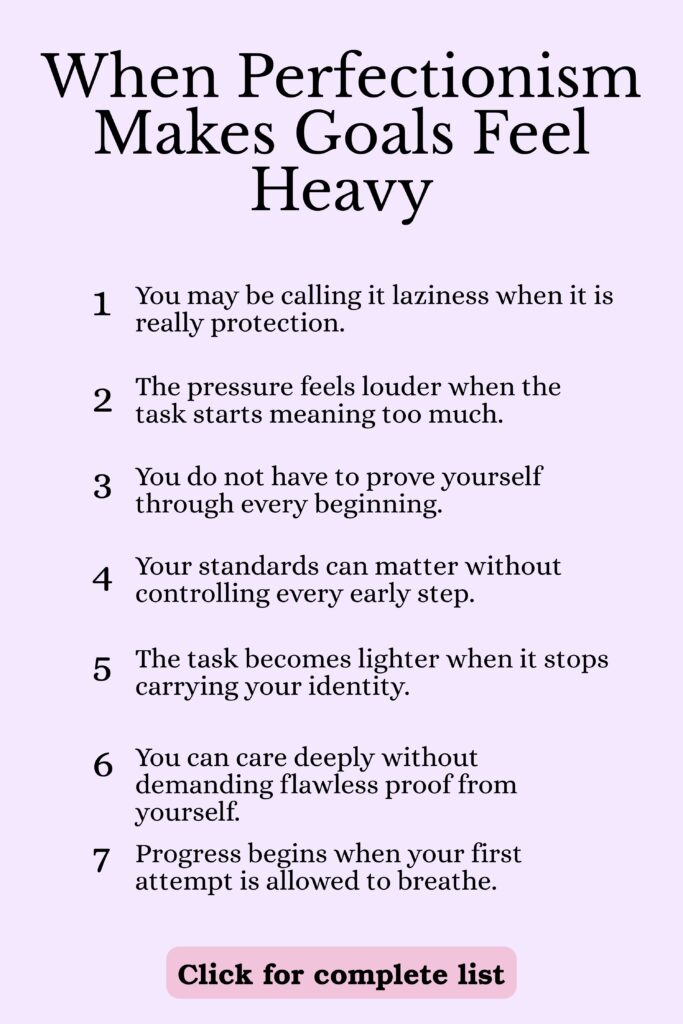
Start by writing down the pressure thought in plain language. Do not make it sound nicer than it is. Capture the exact sentence your brain is using.
It might sound like:
- “This has to be impressive.”
- “I should already know how to do this.”
- “If I start and it is bad, I will feel embarrassed.”
- “I cannot send anything until it is perfect.”
- “People will think I am not good at this.”
Once you see the thought written down, it becomes less powerful. It is no longer a foggy feeling sitting in your chest. It is a sentence you can examine.
Then separate the task from the meaning you attached to it.
Spot the actual task: Write what you truly need to do in the simplest possible terms. For example, “draft the email,” “outline the meeting points,” “review the first page,” or “make a rough plan.”
Name the extra meaning: Write what your brain has added on top. For example, “This has to prove I am competent” or “This needs to be the perfect version.”
Shrink the task back down: Remind yourself that the task is not your whole identity. It is one action, one draft, one message, one small move.
If you want to get more from your life, and are looking for concrete action steps to get you there, check out our Request a Coach page. It’s a “cut the fence-sitting and take action” way to tackle your issues and actually find success. To get off the fence and start to take action, click or tap here.
This is not about dismissing the pressure. It is about understanding it.
Sometimes the pressure is trying to protect you from criticism. Sometimes it is trying to prevent embarrassment. Sometimes it is trying to make sure you do not waste effort. Those are understandable fears, but they are not always useful guides.
When you name the pressure first, you stop treating it like a command.
You can say, “I see why this feels big, but the next step is still small.”
That one sentence can make starting feel possible again.
2. Change the Goal From “Do It Well” to “Practice the Move”
One of the fastest ways to reduce pressure is to change what counts as success.
If your goal is “do this well,” your brain may immediately start scanning for all the ways you could fail. It wonders whether the work will be good enough, whether someone will judge it, whether you have enough time, and whether the result will match the image in your head.
That is a lot of weight to put on the first step.
If you want to get more from your life, and are looking for concrete action steps to get you there, check out our Request a Coach page. It’s a “cut the fence-sitting and take action” way to tackle your issues and actually find success. To get off the fence and start to take action, click or tap here.
Instead, change the goal to “practice the move.”
This makes the task more concrete. You are not trying to produce the perfect result. You are practicing the skill inside the task.
For example:
- If the task is writing, you are practicing getting thoughts onto the page.
- If the task is sending a work update, you are practicing clear communication.
- If the task is organizing a project, you are practicing sorting the next few steps.
- If the task is making a decision, you are practicing choosing with limited information.
- If the task is following through, you are practicing returning to the goal.
This shift is small, but it changes the emotional temperature of the work.
Choose one practice move: Pick the smallest skill you can rehearse today. Do not choose the whole project. Choose one part of the project.
Define the practice version clearly: Write a sentence like, “Today I am practicing starting before I feel ready” or “Today I am practicing writing a rough first version.”
Let the result be unfinished: Give yourself permission to create something that still needs editing, improving, or expanding later.
The key is to make the practice move so clear that you know exactly what to do next.
If you want to get more from your life, and are looking for concrete action steps to get you there, check out our Request a Coach page. It’s a “cut the fence-sitting and take action” way to tackle your issues and actually find success. To get off the fence and start to take action, click or tap here.
Instead of saying, “I need to work on my presentation,” try, “I am practicing explaining the main idea in three rough bullet points.”
Instead of saying, “I need to get better at productivity,” try, “I am practicing opening the task before I check anything else.”
Instead of saying, “I need to be more consistent,” try, “I am practicing coming back for five minutes.”
A performance goal asks, “Was this good enough?”
A practice goal asks, “Did I rehearse the move?”
That second question is much easier to answer. It is also much easier to repeat.
And repeatable action is where real progress starts.
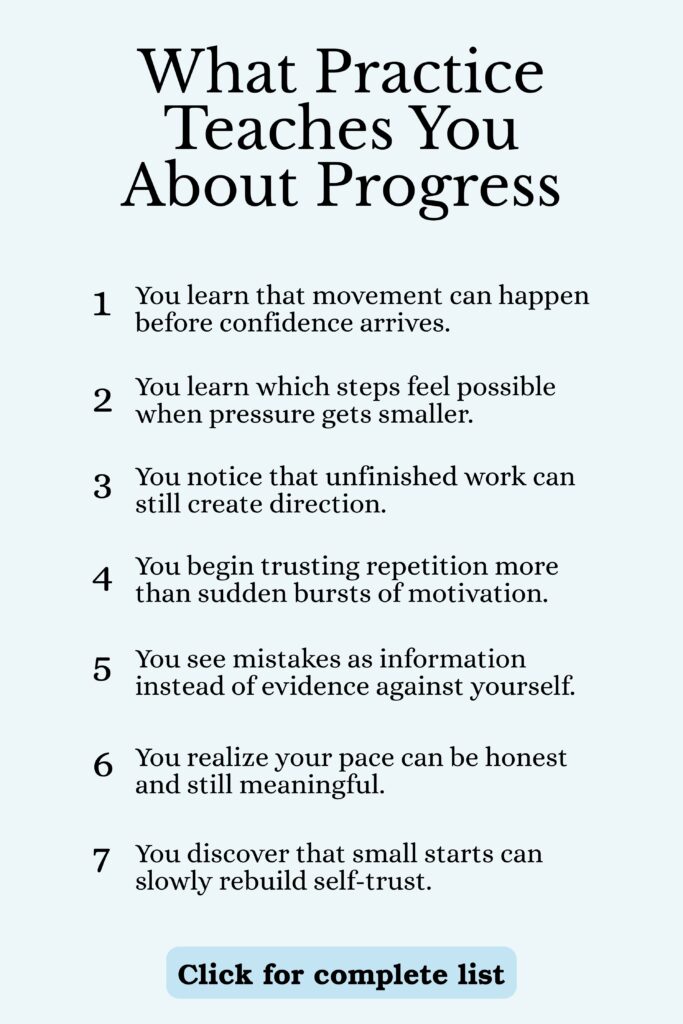
3. Use a Five-Minute Practice Timer
When a task feels big, your brain may assume it requires a big block of time.
If you want to get more from your life, and are looking for concrete action steps to get you there, check out our Request a Coach page. It’s a “cut the fence-sitting and take action” way to tackle your issues and actually find success. To get off the fence and start to take action, click or tap here.
That is one reason starting becomes so difficult. You imagine needing an uninterrupted afternoon, a clear mind, a perfect setup, and enough energy to finish the whole thing. If you do not have all that, you delay.
A five-minute practice timer breaks that pattern.
The point is not to pretend five minutes can complete every goal. The point is to make starting small enough that your brain stops treating it like a threat.
Five minutes is useful because it is short enough to feel safe, but long enough to create movement. You can write a messy paragraph. You can sort a few notes. You can open the project and identify the next step. You can send one message. You can make the task less mysterious.
Set the timer before you negotiate: Choose five minutes and begin before your brain creates a full argument against it.
Pick one visible action: Choose something you can see when it is done, such as three bullets, one paragraph, one list, one folder cleaned up, or one message drafted.
Stop when the timer ends if you need to: You are allowed to continue, but you do not have to. The win is that you practiced beginning.
This matters because perfectionism often demands a complete, polished session. The five-minute timer teaches your brain that partial progress still counts.
If you want to get more from your life, and are looking for concrete action steps to get you there, check out our Request a Coach page. It’s a “cut the fence-sitting and take action” way to tackle your issues and actually find success. To get off the fence and start to take action, click or tap here.
A simple five-minute practice might look like this:
- Minute 1: Open the task and write the practice prompt
- Minute 2: List what you already know
- Minute 3: Choose the next tiny action
- Minute 4: Do the action roughly
- Minute 5: Write what the next step would be
That last minute is important. It makes it easier to return later because you are not leaving yourself with a blank page or a vague task.
After the timer ends, ask:
- What is clearer now?
- What exists now that did not exist five minutes ago?
- What would be easier to do next?
This helps you notice progress instead of only noticing what remains unfinished.
Five minutes will not solve everything. But it can interrupt the avoidance loop.
And sometimes, that is the real first win.
4. Add a Gentle Practice Prompt
A practice prompt is a short sentence that tells your brain what today is for.
This matters because perfectionism often starts talking before you do. It sets the tone with thoughts like, “This better be good,” “You are behind,” or “You need to get this right.” If you do not replace that voice, it can frame the entire task as a performance.
If you want to get more from your life, and are looking for concrete action steps to get you there, check out our Request a Coach page. It’s a “cut the fence-sitting and take action” way to tackle your issues and actually find success. To get off the fence and start to take action, click or tap here.
A gentle practice prompt gives you a better opening line.
Try this sentence:
“Today I am only practicing ______.”
The word “only” is useful here. It lowers the stakes. It reminds you that you are not trying to solve your entire life, finish the full goal, or become a different person in one sitting.
You are practicing one thing.
For example:
- “Today I am only practicing starting.”
- “Today I am only practicing writing before judging.”
- “Today I am only practicing making one decision.”
- “Today I am only practicing asking for clarification.”
- “Today I am only practicing returning to the task.”
The prompt works best when it is specific.
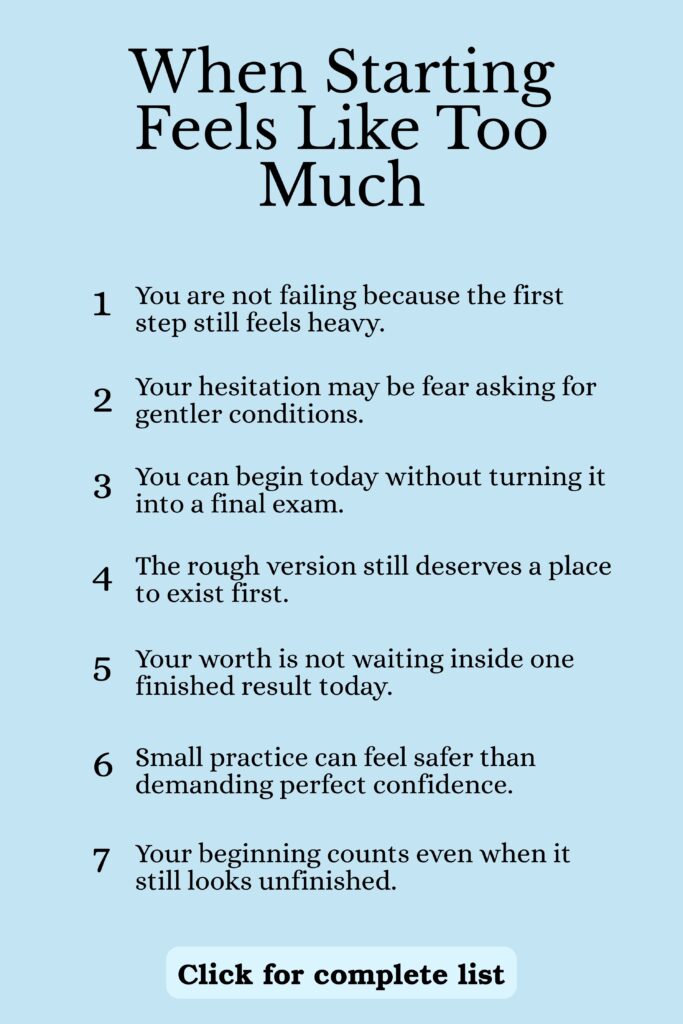
“Today I am practicing productivity” is too broad. It gives your brain too much room to turn the task into another performance.
If you want to get more from your life, and are looking for concrete action steps to get you there, check out our Request a Coach page. It’s a “cut the fence-sitting and take action” way to tackle your issues and actually find success. To get off the fence and start to take action, click or tap here.
“Today I am practicing opening the document and writing five rough bullets” is clearer. You know exactly what practice looks like.
Choose the skill inside the task: Ask what this task is asking you to rehearse. Is it focus, communication, consistency, planning, follow-through, or decision-making?
Write the prompt where you can see it: Put it at the top of the document, on a sticky note, in your planner, or beside the task on your list.
Repeat it before you start: Say it once before the five-minute timer begins, especially if you feel the pressure rising.
You can also use this prompt after a difficult moment.
If you made a mistake, you might write, “Today I am practicing learning without spiraling.”
If you are behind, you might write, “Today I am practicing restarting without making it dramatic.”
If you feel exposed at work, you might write, “Today I am practicing sharing a draft before it is perfect.”
If you want to get more from your life, and are looking for concrete action steps to get you there, check out our Request a Coach page. It’s a “cut the fence-sitting and take action” way to tackle your issues and actually find success. To get off the fence and start to take action, click or tap here.
A good prompt does not magically remove discomfort. It simply gives you a kinder frame for moving through it.
That frame can be enough to help you begin.
5. Keep a Tiny Practice Log
A practice log helps you collect evidence that you are showing up.
This is different from a performance tracker. A performance tracker can easily become another place to judge yourself. You start measuring whether you did enough, how well you did it, and whether your progress looks impressive.
A practice log has a gentler job.
It records the fact that you practiced.
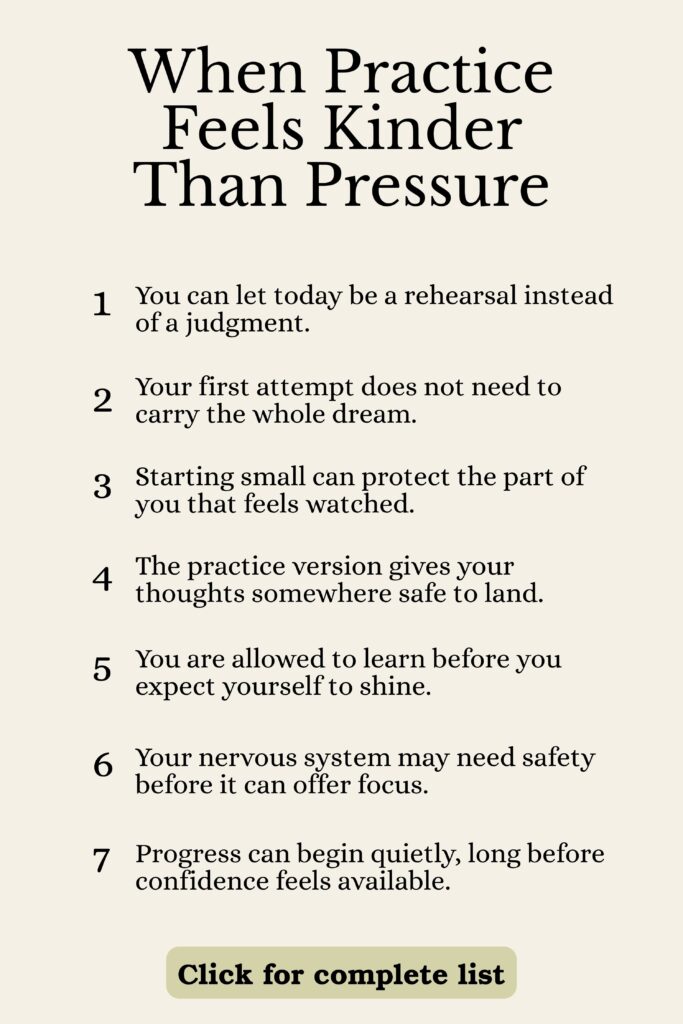
That matters because perfectionism often makes you forget every small attempt that did not produce a perfect result. You may be making more progress than you realize, but because the progress feels ordinary or unfinished, your brain dismisses it.
A tiny practice log makes the invisible visible.
If you want to get more from your life, and are looking for concrete action steps to get you there, check out our Request a Coach page. It’s a “cut the fence-sitting and take action” way to tackle your issues and actually find success. To get off the fence and start to take action, click or tap here.
Keep it simple. One line per practice round is enough.
You might write:
- “Practiced starting before I felt ready.”
- “Practiced drafting without editing.”
- “Practiced sending a clear update.”
- “Practiced working for five minutes.”
- “Practiced choosing the next step instead of overthinking.”
Do not turn this into a complicated system. The more effort the log requires, the more likely it becomes another task to avoid.
Write what you practiced: Focus on the skill, not the outcome. This keeps the log connected to habit building instead of perfectionism.
Keep the entry short: One sentence, one checkbox, or one phrase is enough.
Review for patterns once a week: Look for what helps you return to the goal. Do not use the log to criticize yourself.
The review is where the log becomes especially useful.
You might notice that you start more easily in the morning. You might notice that writing a rough list first reduces pressure. You might see that certain tasks need a smaller first step than you expected.
If you want to get more from your life, and are looking for concrete action steps to get you there, check out our Request a Coach page. It’s a “cut the fence-sitting and take action” way to tackle your issues and actually find success. To get off the fence and start to take action, click or tap here.
You may also notice that you are more consistent when you allow imperfect sessions.
That is important evidence.
A perfectionist brain often believes that pressure creates progress. But your log may show something different. It may show that gentleness, clarity, and small practice rounds help you act more often.
The goal is not to build a perfect streak.
The goal is to build trust with yourself.
Every short entry says, “I came back.”
And coming back is a real skill.
6. Reframe Mistakes as Practice Data
Mistakes feel different when you treat them as data instead of proof.
If you want to get more from your life, and are looking for concrete action steps to get you there, check out our Request a Coach page. It’s a “cut the fence-sitting and take action” way to tackle your issues and actually find success. To get off the fence and start to take action, click or tap here.
When you are in performance mode, a mistake can feel personal. You missed the deadline, so you tell yourself you are unreliable. You sent an awkward email, so you tell yourself you are bad at communication. You procrastinated, so you tell yourself you have no discipline.
That kind of thinking does not help you improve. It usually makes the next attempt feel even heavier.
Practice mode gives you another option.
A mistake becomes information about the system, the task, the timing, the instructions, or the next adjustment you need to make.
That does not mean you pretend mistakes do not matter. It means you look at them in a way that helps you keep moving.
Describe what happened neutrally: Use plain, factual language. For example, “I waited until the end of the day to start,” or “I tried to edit while drafting,” or “I did not clarify the next step.”
Look for the friction point: Ask where the task became harder. Was the first step too vague? Was the deadline unclear? Were you trying to make it perfect too early?
Choose one small adjustment: Pick something useful for the next practice round, such as starting with a timer, asking a question sooner, making a checklist, or creating a rough draft first.
If you want to get more from your life, and are looking for concrete action steps to get you there, check out our Request a Coach page. It’s a “cut the fence-sitting and take action” way to tackle your issues and actually find success. To get off the fence and start to take action, click or tap here.
This process is especially helpful for perfectionists because it interrupts the shame spiral.
Instead of asking, “What is wrong with me?” ask, “What did this practice round teach me?”
That question keeps you in motion.
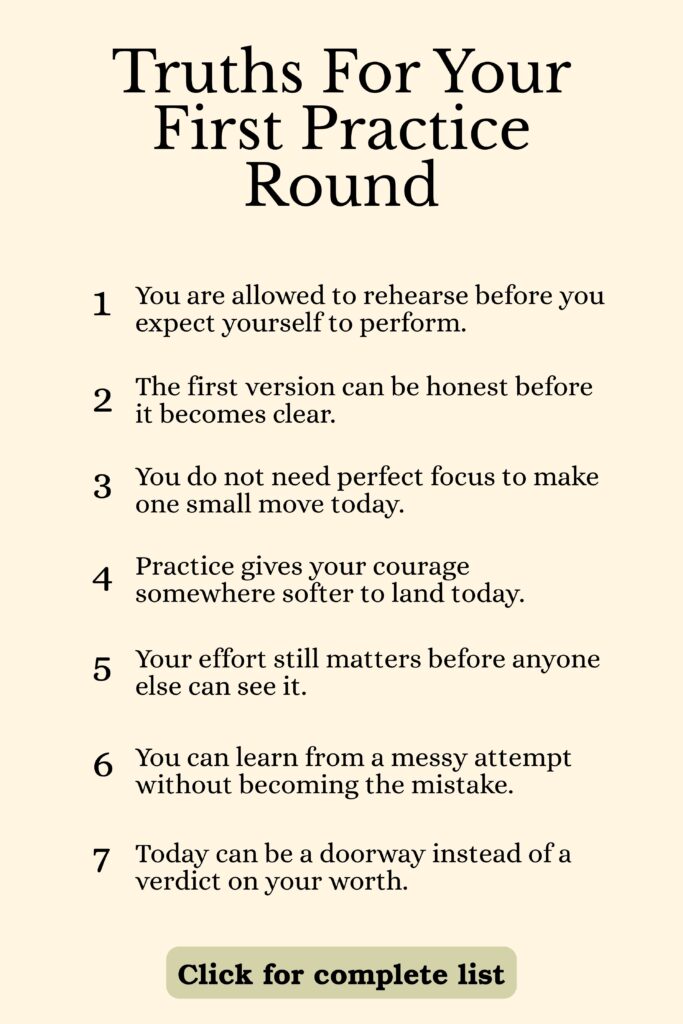
For example, if you avoided a work task all day, the lesson might be that the task was too undefined. Next time, your first practice move could be writing the question, “What exactly needs to happen first?”
If you over-edited an email for thirty minutes, the lesson might be that you need a two-step process. First draft the message. Then edit it once. Then send it.
If you quit because the first attempt looked bad, the lesson might be that you need to label early versions more clearly. Call it a rough draft. Call it notes. Call it version one.
Mistakes are not pleasant, but they are useful.
They show you where the next practice round needs support.
If you want to get more from your life, and are looking for concrete action steps to get you there, check out our Request a Coach page. It’s a “cut the fence-sitting and take action” way to tackle your issues and actually find success. To get off the fence and start to take action, click or tap here.
7. Use This at Work When You Feel Watched or Judged
Work can make perfectionism louder.
Even ordinary tasks can feel high-stakes when other people might read, review, question, or respond to your work. A simple update can start to feel like a performance. A meeting can feel like a test. A first draft can feel like evidence of your ability.
That pressure can make you slow down in ways that look like procrastination, but are really self-protection.
The practice reframe helps because it separates the early stage from the final stage. Not every work moment is a delivery moment. Some moments are for thinking, sketching, drafting, preparing, and clarifying.
You can treat those moments as practice.
Label the first pass privately: Before you begin, tell yourself, “This is only the practice version.” That can make it easier to create something rough without judging it immediately.
Build a low-risk draft: Start with notes, bullets, talking points, or a messy outline before trying to create the polished version.
Decide what stage the task is in: Ask whether this is a thinking stage, drafting stage, review stage, or final delivery stage. Do not demand final-stage quality from a thinking-stage task.
If you want to get more from your life, and are looking for concrete action steps to get you there, check out our Request a Coach page. It’s a “cut the fence-sitting and take action” way to tackle your issues and actually find success. To get off the fence and start to take action, click or tap here.
This is especially helpful for emails, presentations, project plans, reports, and difficult conversations.
For example, if you need to send a work email, your practice round might be writing the message badly on purpose. Not to send, just to get the point out. Then you can clean it up.
If you need to prepare for a meeting, your practice round might be listing the three things you want to say. You are not scripting the entire meeting. You are rehearsing clarity.
If you need to start a project, your practice round might be creating a simple “knowns and unknowns” list. That gives you a place to begin without pretending everything is figured out.
The important part is to stop treating every first attempt like it is being graded.
At work, quality still matters. But quality usually improves through stages.
Practice mode lets you move through those stages instead of freezing at the start.
8. How a Coach Can Help You Practice Without Over-Performing
A goal-setting coach or organizational coach can be especially helpful if you understand the practice reframe but struggle to apply it consistently.
If you want to get more from your life, and are looking for concrete action steps to get you there, check out our Request a Coach page. It’s a “cut the fence-sitting and take action” way to tackle your issues and actually find success. To get off the fence and start to take action, click or tap here.
That is because perfectionism often feels logical from inside your own head. You may believe you are just being responsible, thorough, or ambitious. And sometimes you are. But there is a point where high standards stop helping and start blocking action.
A coach can help you notice that line.
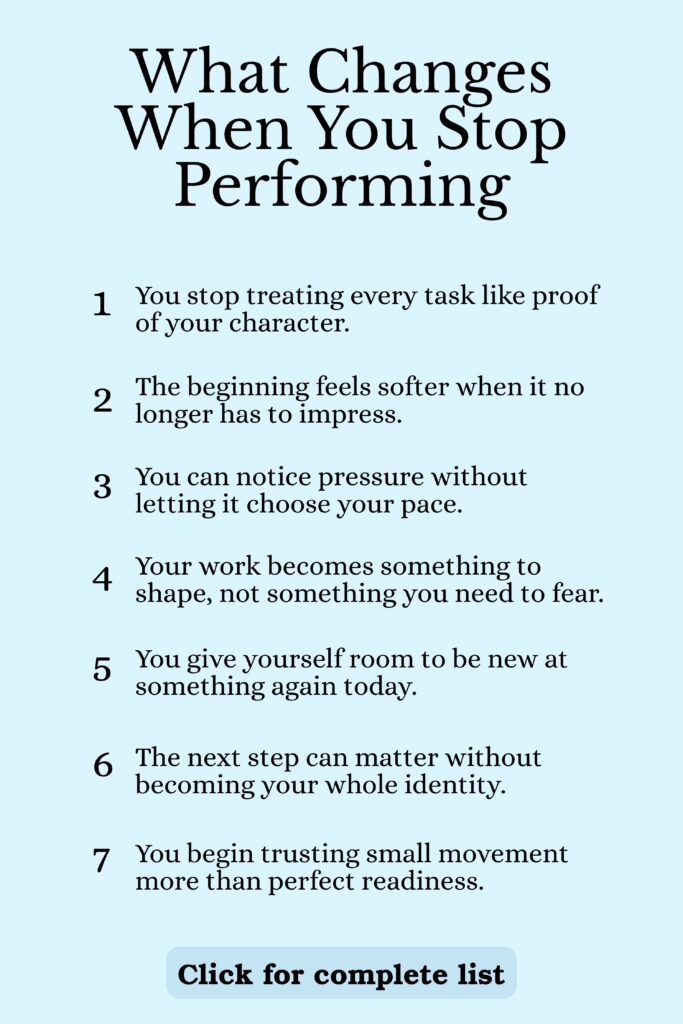
They can also help you turn a vague goal into a practice-based plan. Instead of saying, “I need to get better at follow-through,” you can define the specific behaviors that build follow-through over time.
For example:
- Starting with five minutes
- Creating a weekly review habit
- Sending earlier drafts
- Breaking goals into practice rounds
- Noticing avoidance patterns
- Building a realistic accountability system
Identify the perfectionism pattern: A coach can help you spot where you tend to freeze, overwork, overthink, delay, or restart from scratch.
Turn goals into practice steps: Instead of focusing only on the final outcome, a coach can help you define the repeated actions that make the outcome more likely.
Review progress without self-attack: A coach can help you look at what worked and what did not without turning every missed step into a personal failure.
This kind of support is not about lowering your standards. It is about building a process that lets you act before everything feels perfect.
If you want to get more from your life, and are looking for concrete action steps to get you there, check out our Request a Coach page. It’s a “cut the fence-sitting and take action” way to tackle your issues and actually find success. To get off the fence and start to take action, click or tap here.
A coach might ask questions like:
- What would the practice version of this goal look like?
- What is the smallest repeatable action?
- Where does the pressure usually spike?
- What are you making this task mean about you?
- What would make the next attempt easier?
Those questions can help you move from self-judgment into strategy.
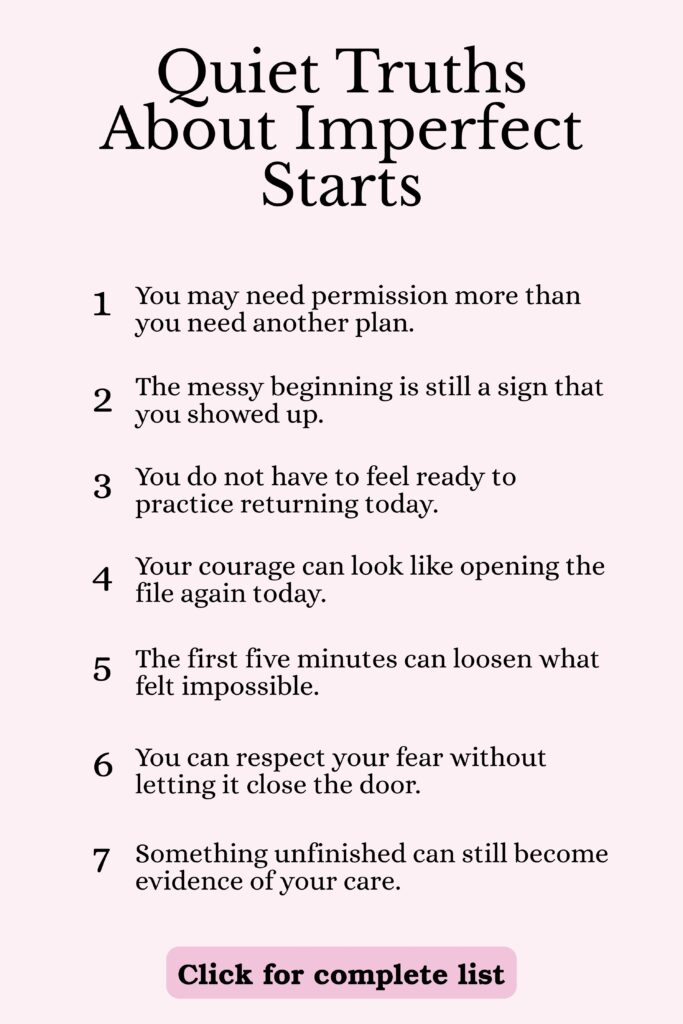
Coaching can also create a safer space to practice imperfect action. If you tend to hide messy drafts, avoid asking for help, or wait too long to share progress, a coach can help you rehearse those moments in a lower-pressure way.
Sometimes what you need is not more motivation.
Sometimes you need a better way to practice.
9. Follow-Up Practice: Create a “Good Enough to Continue” Standard
Perfectionism often moves the finish line.
You start with a reasonable goal, but once you begin, your brain keeps adding requirements. The quick outline now needs to be detailed. The simple email now needs to sound flawless. The five-minute task now needs to become a full productivity session.
By the end, the task feels too big again.
If you want to get more from your life, and are looking for concrete action steps to get you there, check out our Request a Coach page. It’s a “cut the fence-sitting and take action” way to tackle your issues and actually find success. To get off the fence and start to take action, click or tap here.
A “good enough to continue” standard helps prevent that.
This standard defines what counts before you start. It gives you a clear stopping point, so you do not keep raising the bar while you work.
The phrase is important. You are not deciding what is good enough forever. You are deciding what is good enough to continue.
That might mean:
- A rough outline is good enough to continue tomorrow
- Three bullets are good enough to clarify the idea
- One sent message is good enough to restart momentum
- Five minutes is good enough to keep the habit alive
- A messy first draft is good enough to edit later
Define the minimum useful version: Ask, “What would make this task easier to return to?” That is often your real practice goal.
Write the standard before starting: Put it somewhere visible so your brain cannot quietly change the rules halfway through.
Stop when the practice goal is met: Pause and acknowledge that you completed the practice round, even if the full task is not finished.
This is powerful because it trains you to respect small completions.
If you want to get more from your life, and are looking for concrete action steps to get you there, check out our Request a Coach page. It’s a “cut the fence-sitting and take action” way to tackle your issues and actually find success. To get off the fence and start to take action, click or tap here.
Perfectionists often struggle with this. They finish one small piece and immediately discount it because there is more to do. But every big goal is built from smaller pieces that are allowed to count.
A good enough standard might sound like:
- “Good enough is five rough ideas.”
- “Good enough is a draft I can revise.”
- “Good enough is choosing the next action.”
- “Good enough is sending the update clearly.”
- “Good enough is practicing for five minutes.”
The standard should be practical, not dramatic.
You are not trying to convince yourself that poor work is excellent. You are simply giving yourself permission to keep moving through the stages.
Good enough to continue is how imperfect work becomes better work.
It gives you something to improve from.
10. Follow-Up Practice: Build a Repeatable Starting Ritual
If starting always depends on your mood, energy, confidence, or motivation, it will feel unpredictable.
A starting ritual makes the first few steps easier because you do not have to decide how to begin every time. You use the same small pattern until your brain starts to recognize it.
If you want to get more from your life, and are looking for concrete action steps to get you there, check out our Request a Coach page. It’s a “cut the fence-sitting and take action” way to tackle your issues and actually find success. To get off the fence and start to take action, click or tap here.
This is where practice becomes a habit.
The ritual does not need to be beautiful, elaborate, or aesthetic. In fact, it is better if it is simple. The goal is to reduce friction, not create another thing to perfect.
A basic starting ritual might look like this:
- Sit down
- Open the task
- Write the practice prompt
- Set a five-minute timer
- Complete one small action
- Write the next step
That is enough.
Choose a reliable cue: Attach the ritual to something that already happens, such as opening your laptop, starting your workday, finishing coffee, or sitting at your desk.
Repeat the same first action: Make the first action so familiar that you do not have to think about it. Opening the document or writing the prompt can become the bridge into the task.
Reward the return: Give yourself credit for beginning again, not just for finishing everything.
This matters because motivation often grows after action begins, not before. If you wait to feel motivated, you may wait a long time. But if you create a small ritual that gets you into motion, motivation has something to attach to.
If you want to get more from your life, and are looking for concrete action steps to get you there, check out our Request a Coach page. It’s a “cut the fence-sitting and take action” way to tackle your issues and actually find success. To get off the fence and start to take action, click or tap here.
A repeatable ritual also helps on low-energy days.
You do not have to ask, “How do I tackle this whole thing?” You only have to ask, “What is the first step of my ritual?”
That keeps the day from becoming a debate.
For perfectionists, the ritual should include permission for roughness. You might write, “Practice version first” at the top of every draft. You might keep a note beside your desk that says, “Do the first pass badly enough to begin.”
The wording can be simple. The effect can be big.
When starting feels safe and familiar, you are more likely to return.
And when you return often enough, progress becomes less dependent on pressure.
Make Starting Feel Safe Again
Want to try this at home? No worries! Download a copy of our SMART Goals PDF Worksheet.
If you want to get more from your life, and are looking for concrete action steps to get you there, check out our Request a Coach page. It’s a “cut the fence-sitting and take action” way to tackle your issues and actually find success. To get off the fence and start to take action, click or tap here.
Need some in depth help with goal settings, motivation or productivity ? Drop on by our directories choc full of productivity coaches, accountability coaches, and goal-setting coaches, and start reaching those goals! Or click here to have us match you to the best.
You do not need to turn every goal into a test of your character.
Some days are not for proving yourself. Some days are for practicing the next move. That is not laziness, and it is not lowering your standards. It is how people build skills without crushing themselves under the weight of the final version.
When you treat today as practice, you give yourself room to begin before you feel fully ready.
You can write the rough draft. You can make the messy list. You can send the simple update. You can ask the basic question. You can return for five minutes without turning it into a full identity review.
That is how momentum often starts.
Not with a perfect plan.
Not with a flawless mood.
If you want to get more from your life, and are looking for concrete action steps to get you there, check out our Request a Coach page. It’s a “cut the fence-sitting and take action” way to tackle your issues and actually find success. To get off the fence and start to take action, click or tap here.
Not with a dramatic burst of confidence.
Just with one practice round that feels safe enough to try.
The more you practice this, the more your relationship with goals can change. You stop seeing every task as a moment where you either succeed or fail. You start seeing each attempt as information, repetition, and growth.
A missed day becomes something to learn from.
A messy draft becomes something to edit.
A small start becomes something worth counting.
The next time a goal feels heavy, ask yourself one question:
“What would this look like if today were only practice?”
If you want to get more from your life, and are looking for concrete action steps to get you there, check out our Request a Coach page. It’s a “cut the fence-sitting and take action” way to tackle your issues and actually find success. To get off the fence and start to take action, click or tap here.
Then make the answer small enough to do.
Set the timer. Write the prompt. Choose the first move. Let the first version be imperfect.
You can always improve something that exists.
And today, existing might be the whole point.
If you want to get more from your life, and are looking for concrete action steps to get you there, check out our Request a Coach page. It’s a “cut the fence-sitting and take action” way to tackle your issues and actually find success. To get off the fence and start to take action, click or tap here.
Read this next

Why Procrastination is Bad: Stop Procrastinating About Procrastination!
How to overcome procrastination
Read More
Personal Growth Challenge & Questions (Coaching Tips)
Do you have a plan to grow? Ask your self “How did this building we are in come about?”In what order were the parts of the building made or built?Why […]
Read More
4 Steps to Reaching Life’s Mountain Peaks
Facing obstacles It is no secret that WE ALL experience obstacles that come into our lives or we must face during our lifetime. Often, these obstacles appear to be bigger […]
Read More