






Keep Quitting Your Goals? How to Spot the Exact Reason You’ll Quit and Build a Plan Around It
Want to try this at home? No worries! Download a copy of our SMART Goals PDF Worksheet.
****
Most goal plans begin with optimism. You imagine the finished project, the better routine, the completed application, the launched offer, the cleaned-up system, or the version of yourself who finally follows through.
That is useful. But optimism alone does not protect the goal when real life gets messy.
A project pre-mortem helps you do something most people skip: predict the point where the goal is most likely to fall apart before it actually does. Instead of waiting until you are behind, discouraged, distracted, or quietly avoiding the work, you look ahead and ask, “What could make me quit?”
This is not about being negative. It is about being prepared.
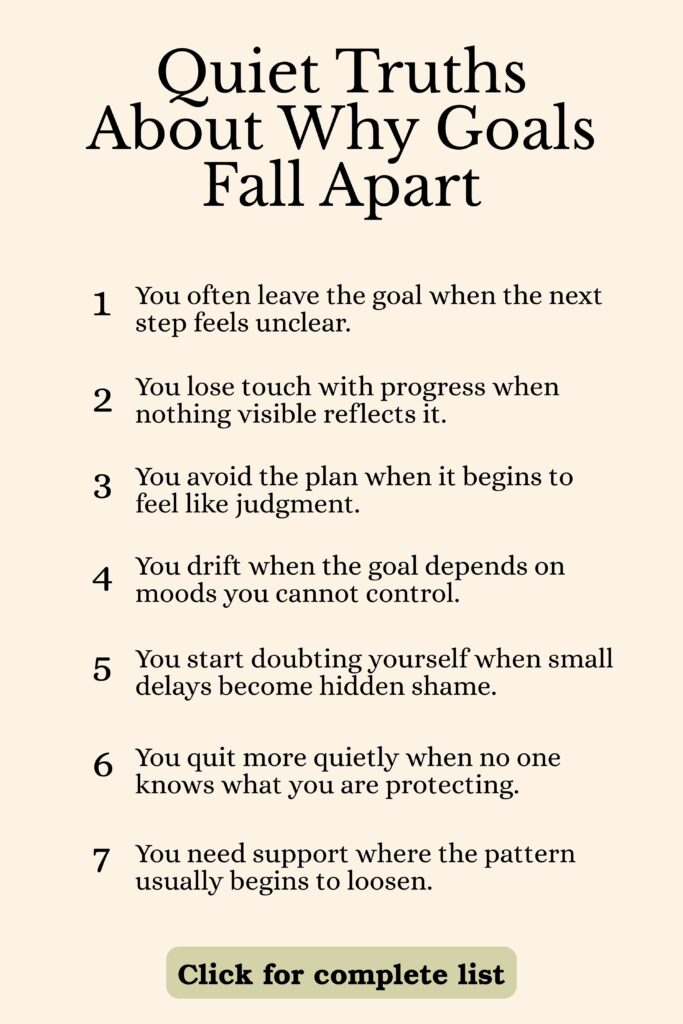
A pre-mortem gives you a way to spot weak points early. Maybe your goal usually breaks because the first step is too vague. Maybe you lose momentum when progress is invisible. Maybe you stop when one missed day turns into a full week. Maybe nobody knows you are working on it, so there is no real accountability.
Need some in depth help with goal settings, motivation or productivity ? Drop on by our directories choc full of productivity coaches, accountability coaches, and goal-setting coaches, and start reaching those goals! Or click here to have us match you to the best.
If you want to get more from your life, and are looking for concrete action steps to get you there, check out our Request a Coach page. It’s a “cut the fence-sitting and take action” way to tackle your issues and actually find success. To get off the fence and start to take action, click or tap here.
The point is not to shame yourself for those patterns. The point is to design around them.
In about 15 minutes, you can create a simple plan that includes:
- The goal you are protecting
- The most likely reasons it could fail
- The warning signs that it is starting to slip
- The safeguards you will use when things get hard
- The tracking or accountability system that keeps it visible
This works for almost any goal. A work project. A health habit. A personal reset. A creative idea. A coaching program. A new routine. A business task you keep delaying.
The best time to do this is before you start, when your brain is still clear enough to be honest. Once you are already tired or behind, it is much harder to think strategically.
Think of this as a practical checkpoint. Before you depend on motivation, you build the support structure motivation will need later.
1. Name the Goal Clearly Before You Predict What Could Go Wrong
A project pre-mortem only works if the goal is clear enough to examine. If the goal is vague, the risks will be vague too. “Get my life together” is too broad to protect. “Spend 15 minutes every weekday clearing my inbox before lunch” is much easier to plan around.
Start by writing the goal in one sentence. Make it plain, specific, and easy to recognize when it is done.
Write the goal in one sentence: Choose a clear outcome, such as “finish the first draft by Friday,” “apply to five jobs this month,” “complete three workouts per week,” or “organize the client onboarding process by the end of the week.”
If you want to get more from your life, and are looking for concrete action steps to get you there, check out our Request a Coach page. It’s a “cut the fence-sitting and take action” way to tackle your issues and actually find success. To get off the fence and start to take action, click or tap here.
This step matters because vague goals create hidden escape routes. When you do not know exactly what you are trying to do, it becomes easy to delay, revise, overthink, or convince yourself you are still “working on it” when you are actually circling the task.
Next, connect the goal to a reason that matters. Not the polished reason you would say out loud. The real one.
Add the real reason it matters: Write why this goal is worth protecting, especially when motivation drops. Maybe it will reduce stress, create income, help a client, free up time, build confidence, or prove that you can trust yourself again.
Then define what finished means. This is where many goals quietly fall apart. If “done” keeps changing, the goal starts to feel endless.
Define what “done” looks like: Decide what counts as complete. Is it a submitted draft? A scheduled call? Ten pages written? A cleaned desktop? A weekly routine followed for one month?
Finally, shrink the starting point.
Set the smallest starting version: Choose the first tiny action that proves the goal has begun. This might be opening the document, creating the checklist, blocking one work session, sending one message, or gathering the materials.
This first section gives the pre-mortem something solid to work with. You are not trying to protect a wish. You are protecting a specific action path.
If you want to get more from your life, and are looking for concrete action steps to get you there, check out our Request a Coach page. It’s a “cut the fence-sitting and take action” way to tackle your issues and actually find success. To get off the fence and start to take action, click or tap here.
2. Imagine the Goal Failed and Write the Honest Story
Now comes the part most people avoid. Imagine the goal did not work.
Not because you are hopeless. Not because you are trying to talk yourself out of it. Because your future obstacles are usually more predictable than they seem.
Picture yourself two weeks, one month, or one quarter from now. The project did not get finished. The routine disappeared. The plan got postponed. The excitement faded.
Then ask: what probably happened?
Fast-forward to the quitting point: Choose a realistic future date and imagine the goal has stalled. Do not make the story dramatic. Make it believable.
Maybe you got busy at work. Maybe one missed day became three. Maybe the task felt too big, so you kept waiting for a better time. Maybe you did not know the next step. Maybe the project became boring once the newness wore off.
The goal here is honesty, not self-criticism.
Write the failure story plainly: Describe the most likely way the goal could fall apart. Use simple language, such as “I stopped tracking it,” “I avoided the hardest step,” “I let other people’s priorities take over,” or “I lost interest once progress felt slow.”
If you want to get more from your life, and are looking for concrete action steps to get you there, check out our Request a Coach page. It’s a “cut the fence-sitting and take action” way to tackle your issues and actually find success. To get off the fence and start to take action, click or tap here.
Avoid turning the story into a character judgment. “I am lazy” is not useful. “I do not have a clear fallback plan when my schedule changes” is useful.
Avoid blaming your character: Focus on patterns and conditions instead of identity. You are looking for fixable weak points, not reasons to feel bad.
Then look for repetition. Most quitting patterns are not new. They have shown up before in different outfits.
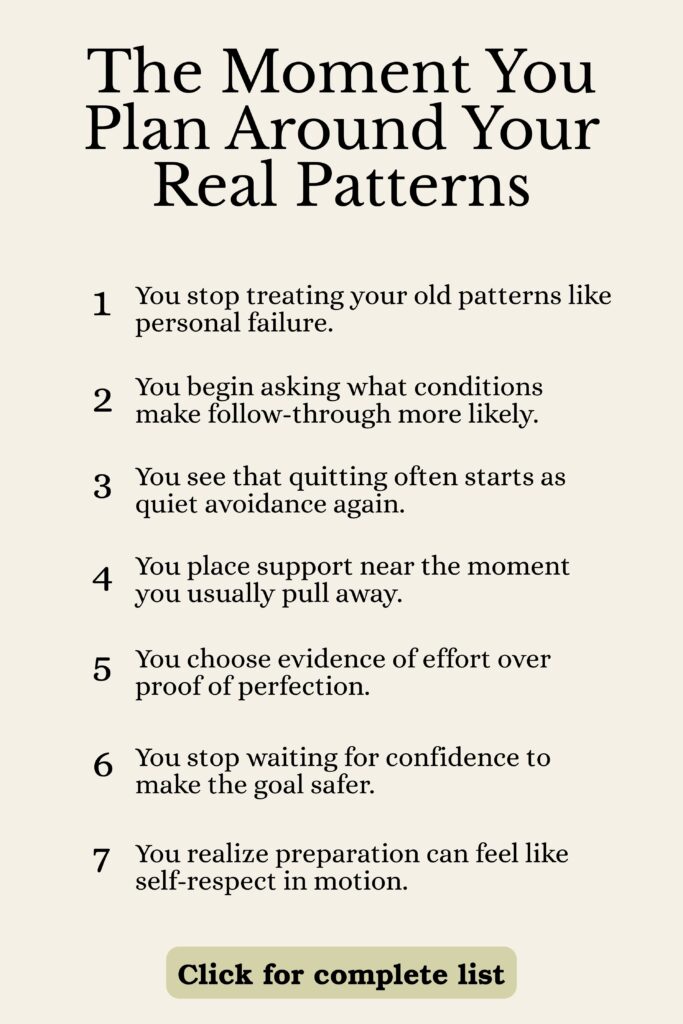
Look for the repeat pattern: Ask where this has happened before. Do you usually quit when you miss one day? When the task gets public? When you have to ask for help? When the reward is too far away?
This section is powerful because it turns failure from a mystery into a map. Once you know the likely story, you can interrupt it before it becomes true.
3. Sort the Risks Into Categories So You Know What You’re Solving
Once you have the failure story, sort the risks into categories. This keeps the pre-mortem from becoming one messy list of worries.
Different risks need different safeguards. A time problem does not need the same solution as a confidence problem. A motivation problem does not need the same solution as a missing-tool problem.
Start with the practical risks.
If you want to get more from your life, and are looking for concrete action steps to get you there, check out our Request a Coach page. It’s a “cut the fence-sitting and take action” way to tackle your issues and actually find success. To get off the fence and start to take action, click or tap here.
List the practical risks: Write down the real-world issues that could block the goal. These might include time conflicts, missing information, unclear steps, money, tools, workload, scheduling problems, or competing priorities.
Examples:
- “I do not have a clear time slot.”
- “I need someone else’s approval before moving forward.”
- “The first step has too many pieces.”
- “I do not have the template or tool ready.”
Next, look at motivation risks. These are the places where the goal might stop feeling rewarding.
List the motivation risks: Identify the points where excitement may fade, progress may feel invisible, or the goal may start to feel less urgent than everything else.
Examples:
- “I will get bored after the first week.”
- “I will stop if I do not see results quickly.”
- “I will choose easier tasks instead.”
- “I will forget why this mattered.”
Then name the emotional risks. These are easy to overlook because they often hide behind productivity issues.
List the emotional risks: Notice where frustration, perfectionism, comparison, embarrassment, fear of judgment, or fear of doing it wrong could make you pull back.
Examples:
If you want to get more from your life, and are looking for concrete action steps to get you there, check out our Request a Coach page. It’s a “cut the fence-sitting and take action” way to tackle your issues and actually find success. To get off the fence and start to take action, click or tap here.
- “I will avoid sharing the draft because it might not be good enough.”
- “I will compare my progress to someone else’s.”
- “I will feel behind and stop checking the plan.”
- “I will over-edit instead of finishing.”
Finally, list accountability risks.
List the accountability risks: Identify where nobody will know if you stop, delay, or quietly lower the standard.
This sorting process helps you see what the goal really needs. Maybe you do not need more motivation. Maybe you need a smaller first step, a clearer tracker, a deadline, or a person who checks in before you disappear.
4. Turn Each Risk Into a Safeguard
A risk is only useful if you turn it into a safeguard. Otherwise, the pre-mortem becomes a list of reasons the goal might fail.
The simplest way to do this is to pair each risk with an “if this happens, then I will do this” response.
Pair every risk with a backup move: Take each likely obstacle and write a specific action you will use if it shows up.
For example:
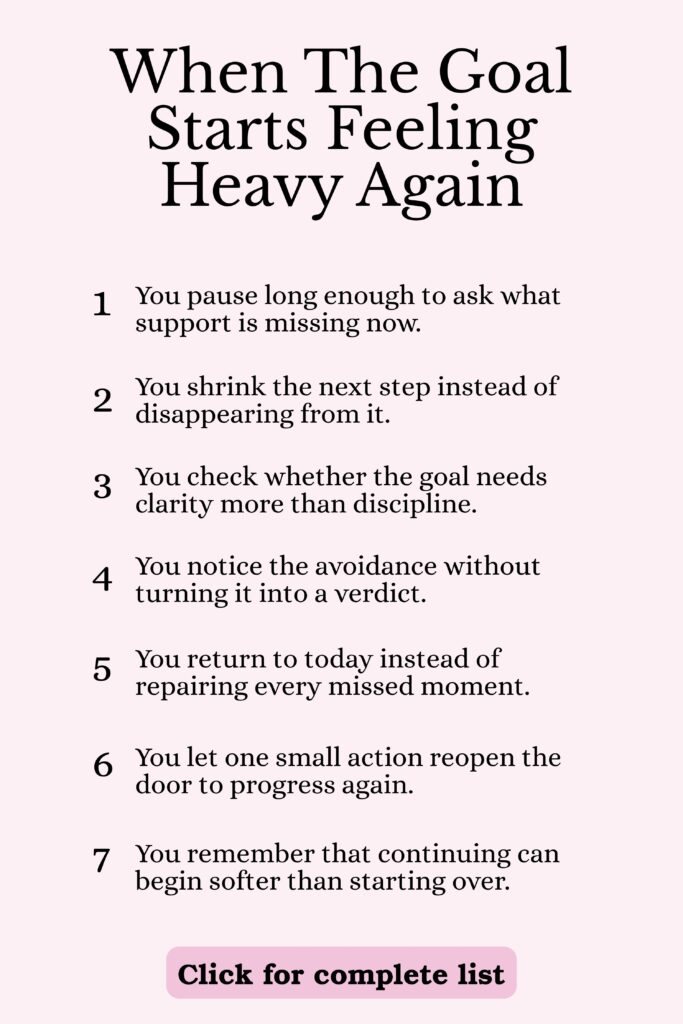
- If I miss one workout, I will do a 10-minute version the next day.
- If I avoid the draft, I will write one messy paragraph before editing anything.
- If I feel unclear, I will list the next three decisions instead of trying to solve the whole project.
- If I stop tracking, I will restart with today only, not try to fill in the missing days.
This works because it removes decision-making from the hardest moment. When you are already tired, behind, or frustrated, you do not want to invent a plan. You want to follow one.
If you want to get more from your life, and are looking for concrete action steps to get you there, check out our Request a Coach page. It’s a “cut the fence-sitting and take action” way to tackle your issues and actually find success. To get off the fence and start to take action, click or tap here.
The best safeguard is smaller than your original ambition. That is what makes it usable.
Make the safeguard smaller than your ambition: Choose backup actions that still count on imperfect days. A 10-minute session, one email, one checklist item, one paragraph, or one reset block can keep the goal alive.
This is not lowering the standard forever. It is protecting continuity. A small version keeps the door open.
Next, place the safeguard where the goal usually breaks.
Protect the first friction point: Identify whether you usually stall at starting, deciding, asking for help, tracking, continuing after a missed day, or finishing. Put support directly there.
For some people, the safeguard is a calendar block. For others, it is a checklist. For others, it is a text to an accountability partner.
Use simple tools only: Choose tools you will actually use. A sticky note, phone reminder, habit tracker, shared doc, weekly review question, or calendar alert is often enough.
The safeguard should feel almost too simple. That is the point. When motivation is low, complicated systems become one more reason to stop.
If you want to get more from your life, and are looking for concrete action steps to get you there, check out our Request a Coach page. It’s a “cut the fence-sitting and take action” way to tackle your issues and actually find success. To get off the fence and start to take action, click or tap here.
5. Create Warning Signs That Tell You the Goal Is Slipping
Most goals do not fail all at once. They drift.
You skip one session. Then you stop opening the tracker. Then you delay the next step. Then you avoid thinking about it because it already feels behind. By the time you admit the goal has slipped, it may feel easier to start over later than return now.
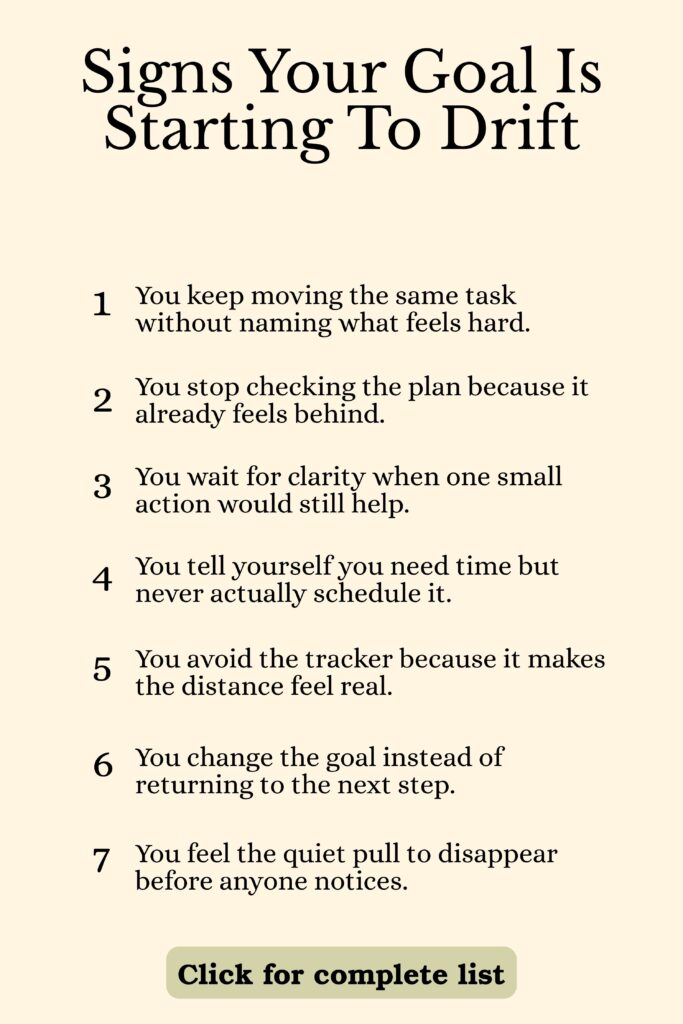
Warning signs help you catch the drift early.
Choose three early warning signs: Pick behaviors that tell you the goal is starting to slip before it fully falls apart.
Good warning signs are specific. They are things you can actually notice.
Examples:
- “I skip two planned sessions in a row.”
- “I stop updating the tracker for more than three days.”
- “I keep moving the same task to tomorrow.”
- “I avoid opening the document.”
- “I say I need more time, but I do not schedule any.”
- “I start changing the goal instead of taking the next step.”
Avoid vague warning signs like “I feel unmotivated.” That may be true, but it is hard to act on. A behavior is easier to catch.
Make the signs observable: Choose actions, delays, or avoidance patterns you can see. This turns the warning sign into a practical signal instead of a mood.
If you want to get more from your life, and are looking for concrete action steps to get you there, check out our Request a Coach page. It’s a “cut the fence-sitting and take action” way to tackle your issues and actually find success. To get off the fence and start to take action, click or tap here.
Once you have the signs, attach a reset action to each one.
Attach each warning sign to a reset action: Decide what you will do when the signal appears. You might shrink the next step, ask for help, review the reason the goal matters, clear one blocker, or schedule a short reset session.
For example:
- If I skip two sessions, I restart with a 15-minute version.
- If I stop tracking, I only log today.
- If I avoid the task, I write the next physical action on a sticky note.
Finally, review these signs weekly.
Check the signs weekly: Set a recurring moment to ask, “Is this goal still active, or is it starting to drift?”
This is where the pre-mortem becomes protective. You are not waiting for the goal to collapse. You are listening for the small signs that it needs support.
6. Build an Accountability Loop Before You Need It
Accountability works best when you set it up before you are already avoiding the goal.
When you wait until you are behind, asking for support can feel embarrassing. You may feel like you need to explain yourself, catch up first, or prove you are serious again. That delay can make the goal slip further.
If you want to get more from your life, and are looking for concrete action steps to get you there, check out our Request a Coach page. It’s a “cut the fence-sitting and take action” way to tackle your issues and actually find success. To get off the fence and start to take action, click or tap here.
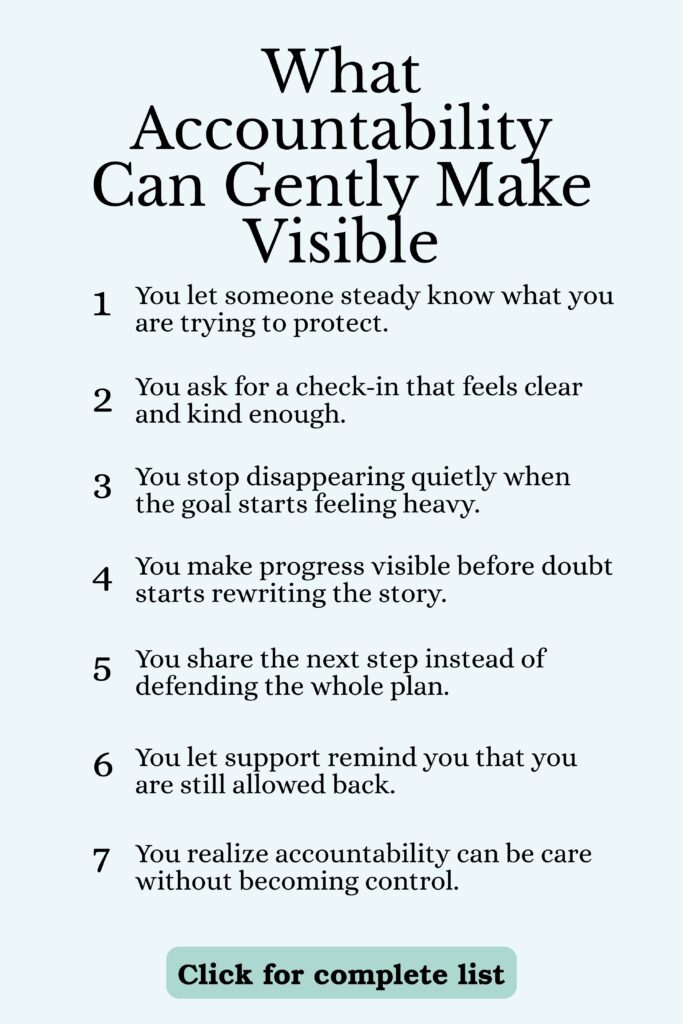
A simple accountability loop makes follow-through more visible from the beginning.
Choose the right accountability person: Pick someone steady, honest, and supportive. This could be a coach, colleague, friend, peer, mentor, or project partner.
The right person is not always the most intense person. You do not need someone who makes the goal feel heavier. You need someone who can help you stay connected to the plan without turning it into guilt.
Next, tell them exactly what to check.
Tell them what to check: Give them one clear action, deadline, or progress signal. Do not ask them to “keep me accountable” in a vague way.
Better examples:
- “Ask me every Friday if I completed my three writing blocks.”
- “Check whether I sent the proposal by Wednesday.”
- “Ask me what safeguard I used if I miss a session.”
- “Have me send one screenshot of my tracker every Sunday.”
A simple update format also helps. It makes accountability easier because you do not have to think of what to say each time.
Send a simple update format: Use a repeatable template like:
If you want to get more from your life, and are looking for concrete action steps to get you there, check out our Request a Coach page. It’s a “cut the fence-sitting and take action” way to tackle your issues and actually find success. To get off the fence and start to take action, click or tap here.
- This week I planned to:
- I completed:
- I got stuck on:
- Next I am doing:
- The support I need is:
Then decide what happens if you disappear.
Decide what happens if you disappear: Give your accountability person permission to send one direct check-in if you miss an update or stop responding.
That message can be simple: “Do you want to restart with the smallest version this week?”
This matters because many people do not quit loudly. They quit quietly. A good accountability loop makes quiet quitting harder.
7. Make Progress Visible So Motivation Has Something to Hold Onto
Motivation fades faster when progress is invisible.
You may be doing the work, but if you cannot see the progress, the goal can still feel stuck. That is especially true with goals that take time, such as building a habit, finishing a project, growing a business, learning a skill, or improving a system.
A visible tracker gives your motivation something concrete to hold onto.
Choose one simple tracking method: Use a checkbox list, progress bar, calendar mark, scorecard, spreadsheet, weekly note, or project board.
If you want to get more from your life, and are looking for concrete action steps to get you there, check out our Request a Coach page. It’s a “cut the fence-sitting and take action” way to tackle your issues and actually find success. To get off the fence and start to take action, click or tap here.
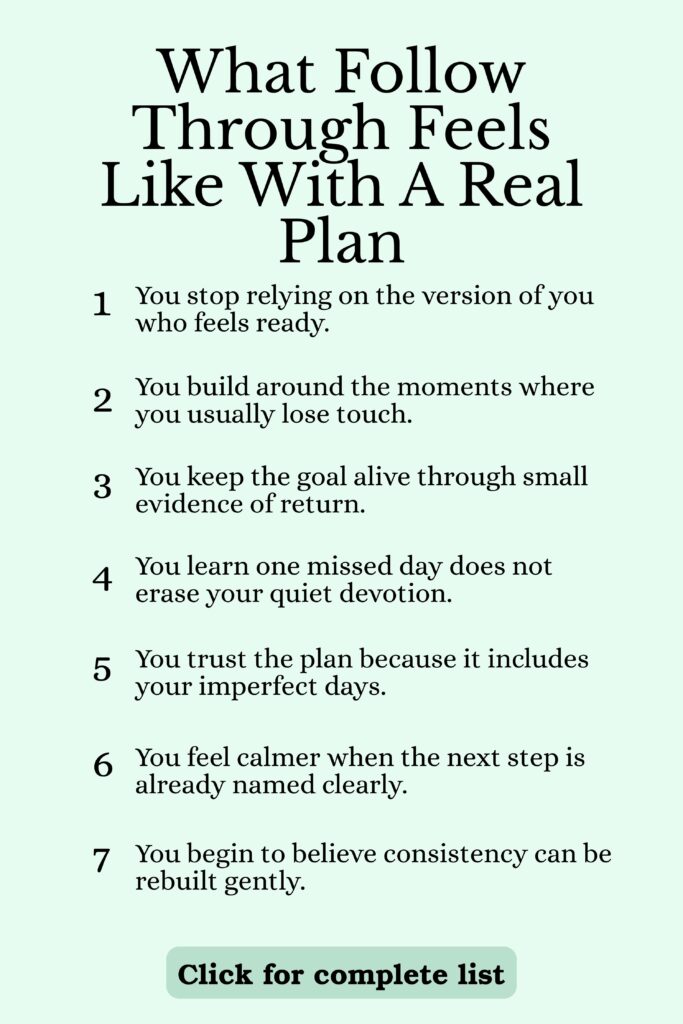
The tracker does not need to be pretty. It needs to be easy to update.
Track actions before outcomes. Outcomes can take time, and they are not always fully under your control. Actions tell you whether you are still showing up.
Track actions before outcomes: Focus on behaviors you can control. This might include sessions completed, pages drafted, applications sent, workouts done, calls made, lessons finished, or tasks checked off.
For example, instead of tracking “feel confident,” track “practiced for 15 minutes.” Instead of tracking “get more clients,” track “sent three follow-up messages.” Instead of tracking “finish the project,” track “completed one project block.”
Then add a review rhythm.
Add a small review rhythm: Once a week, ask three questions:
- What moved forward?
- What slipped?
- What safeguard needs adjusting?
This turns tracking into feedback, not judgment.
You also want to mark small wins. Not in a forced or cheesy way. Just enough to show your brain that effort is producing evidence.
If you want to get more from your life, and are looking for concrete action steps to get you there, check out our Request a Coach page. It’s a “cut the fence-sitting and take action” way to tackle your issues and actually find success. To get off the fence and start to take action, click or tap here.
Celebrate evidence of follow-through: Notice completions, returns, restarts, and small actions. A goal becomes easier to continue when you can see that you are still in motion.
This is especially useful if inconsistency is one of your main barriers. The tracker helps you see the difference between “I failed” and “I missed a day, then came back.”
That distinction can save the goal.
8. Use the 15-Minute Project Pre-Mortem Worksheet
The easiest way to use a project pre-mortem is to keep it short. If the exercise becomes too complicated, you may turn it into another task you avoid.
Set a timer for 15 minutes and work through the core prompts.
Set a timer for 15 minutes: Keep the process contained. You are not trying to solve your whole life. You are trying to protect one goal before it starts slipping.
Start with the goal.
Prompt 1: What goal am I protecting?
If you want to get more from your life, and are looking for concrete action steps to get you there, check out our Request a Coach page. It’s a “cut the fence-sitting and take action” way to tackle your issues and actually find success. To get off the fence and start to take action, click or tap here.
Write one clear sentence. Include the outcome and the time frame if there is one.
Example: “I will complete the first draft of the workshop outline by Friday at 3 p.m.”
Next, write the failure story.
Prompt 2: If this goal failed, what probably happened?
Be honest. Maybe you avoided the hard part. Maybe your schedule filled up. Maybe you did not ask for feedback. Maybe the goal was too big for the available time.
Then choose the top risks.
Prompt 3: What are the top three risks?
Pick only three. Too many risks can make the goal feel doomed. Choose the ones most likely to matter.
If you want to get more from your life, and are looking for concrete action steps to get you there, check out our Request a Coach page. It’s a “cut the fence-sitting and take action” way to tackle your issues and actually find success. To get off the fence and start to take action, click or tap here.
Prompt 4: What safeguard will I use for each risk?
Write one backup action for each risk. Make it specific and small enough to use when things are not ideal.
Prompt 5: What warning signs will tell me this is slipping?
Choose behaviors you can notice early. Missed sessions, skipped tracking, repeated delays, avoidance, or confusion about the next step.
Then add accountability.
Choose one accountability action: Decide who you will tell, what you will send, or what reminder will create follow-through outside your own head.
Finally, end with action.
End with the next obvious step: Choose the first thing you can do today. Not tomorrow. Not when you feel more ready. One small action today.
If you want to get more from your life, and are looking for concrete action steps to get you there, check out our Request a Coach page. It’s a “cut the fence-sitting and take action” way to tackle your issues and actually find success. To get off the fence and start to take action, click or tap here.
This worksheet works because it turns insight into a plan. You are not just predicting why you might quit. You are designing the support that helps you keep going.
How a Coach Can Help You Catch the Failure Pattern Faster
A coach can be especially useful during a project pre-mortem because they help you see patterns you may be too close to notice.
When you plan alone, it is easy to focus on the surface problem. You might think, “I just need to be more disciplined,” when the real issue is unclear priorities, unrealistic time estimates, low accountability, or a goal that is too vague to act on.
A coach can help separate the goal from the obstacle.
Name the pattern with outside perspective: A coach can help you notice whether you usually stall at the same point. Maybe you start strong but do not maintain. Maybe you plan well but avoid visibility. Maybe you stay busy with easy tasks while the important step remains untouched.
That outside perspective can be useful because quitting patterns often feel personal when they are actually structural.
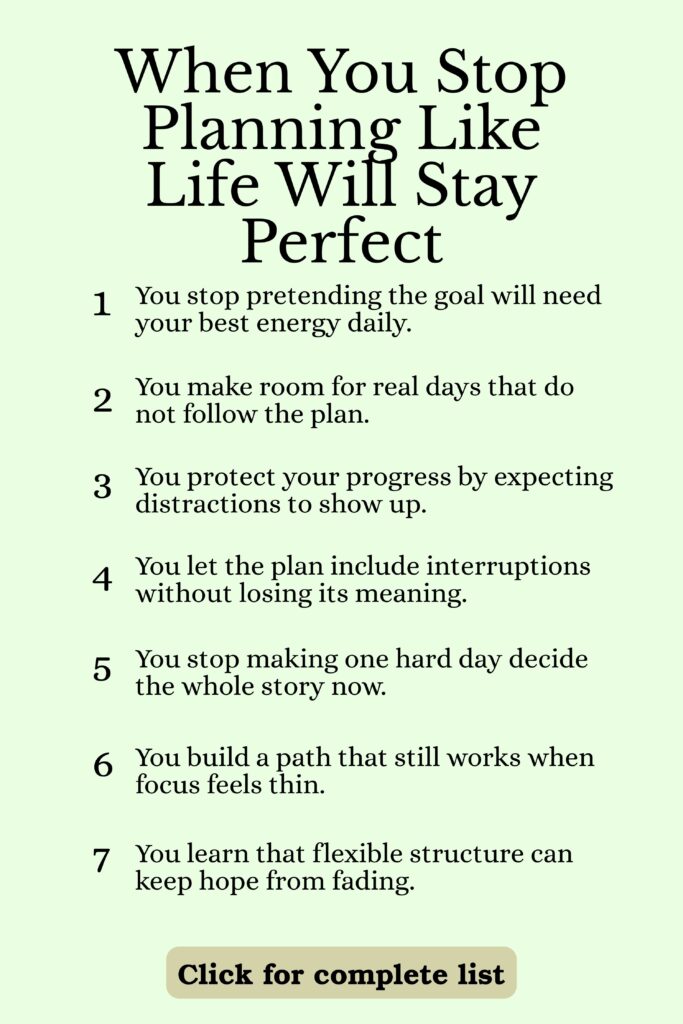
Separate the goal from the obstacle: A coach can help you identify whether the real issue is motivation, planning, accountability, energy, fear, perfectionism, or lack of tracking.
For example, someone who thinks they have a motivation problem may actually have a sequencing problem. They do not need to want the goal more. They need a clearer first step.
If you want to get more from your life, and are looking for concrete action steps to get you there, check out our Request a Coach page. It’s a “cut the fence-sitting and take action” way to tackle your issues and actually find success. To get off the fence and start to take action, click or tap here.
Someone who thinks they are inconsistent may need a better restart plan. Missing one day is not the real failure point. The real failure point is having no plan for the day after.
Design better safeguards: A coach can help turn vague intentions into specific support. Instead of “I will try harder,” the safeguard becomes “I will send a Friday update,” “I will use a 10-minute fallback,” or “I will review the tracker every Monday.”
Coaching also creates a rhythm of review.
Create a review rhythm: Regular check-ins help you adjust the goal before it quietly disappears. A coach can ask what worked, what slipped, what needs simplifying, and what support would make the next step easier.
This is not about needing someone to push you constantly. It is about building a structure where the goal remains visible, honest, and easier to return to.
Common Pre-Mortem Mistakes That Make the Exercise Less Useful
A project pre-mortem is simple, but a few mistakes can make it less helpful.
The first mistake is turning it into a worst-case scenario spiral. You do not need to imagine every possible disaster. You only need to identify the most likely ways the goal could break.
Do not only list worst-case scenarios: Focus on realistic failure points. “I get busy and stop tracking” is more useful than “everything goes wrong and the whole project collapses.”
If you want to get more from your life, and are looking for concrete action steps to get you there, check out our Request a Coach page. It’s a “cut the fence-sitting and take action” way to tackle your issues and actually find success. To get off the fence and start to take action, click or tap here.
The second mistake is writing safeguards that are too vague. “Stay focused” sounds nice, but it does not tell you what to do when you are distracted. “Try harder” is not a plan. “Do the 10-minute version at 4 p.m.” is a plan.
Do not write vague safeguards: Replace broad intentions with a specific action, time, tool, person, or fallback version.
Another common mistake is skipping the tracking step. This usually happens when people think tracking is extra work. But without tracking, progress can disappear from view.
Do not skip the tracking step: Choose one simple way to make progress visible. A checklist, calendar mark, or weekly note is enough.
The fourth mistake is making the backup plan too ambitious. A safeguard should work on a bad day. If it only works when you are energized, organized, and fully available, it is not really a safeguard.
Do not make the backup plan too big: Keep the fallback version small enough that you can do it when the day is messy.
Finally, do not use the pre-mortem as proof that the goal is too hard. The point is not to scare yourself away from action. The point is to make action easier to continue.
A good pre-mortem should leave you feeling clearer, not defeated. You should know what might get in the way, and you should also know what you will do when it happens.
If you want to get more from your life, and are looking for concrete action steps to get you there, check out our Request a Coach page. It’s a “cut the fence-sitting and take action” way to tackle your issues and actually find success. To get off the fence and start to take action, click or tap here.
That is the difference between worrying and preparing.
Make Quitting Harder Before Motivation Fades
The real power of a project pre-mortem is that it treats inconsistency as something you can plan for.
You do not have to pretend you will feel motivated every day. You do not have to build a plan that only works when your schedule is perfect. You do not have to restart from zero every time you miss a step.
Instead, you can ask better questions before the goal begins.
Where am I most likely to stall?
What usually makes me drift?
What warning signs show up first?
What tiny action keeps the goal alive?
Who or what can help me return faster?
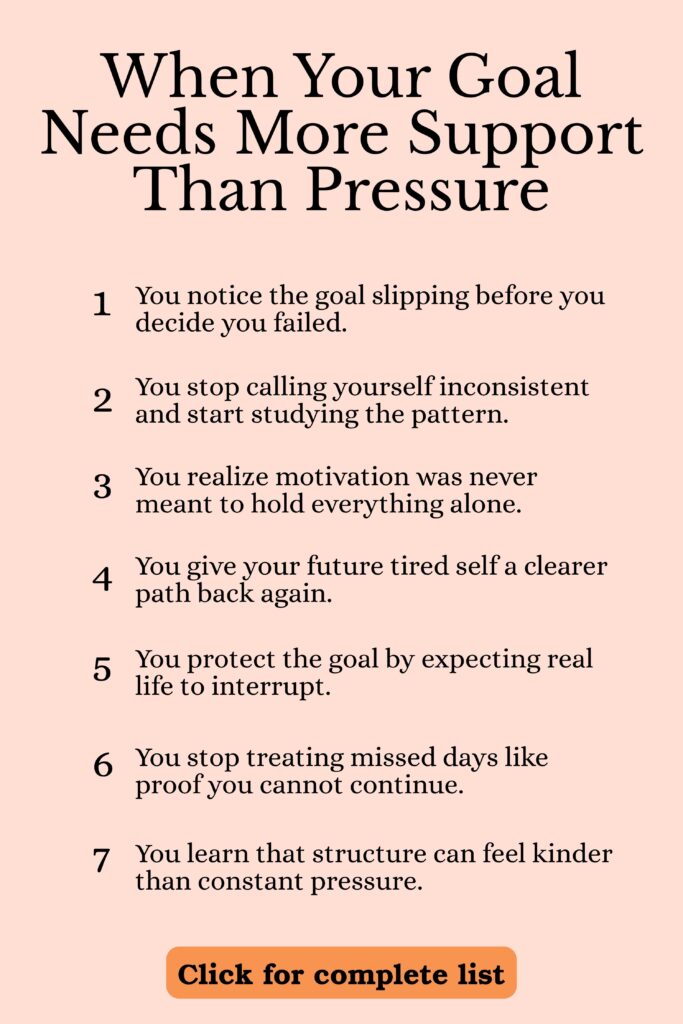
This is how you make quitting harder. Not by relying on pressure, but by removing some of the easiest ways the goal can fall apart.
A strong pre-mortem gives you:
- A clear goal
- A realistic failure story
- A short list of likely risks
- Simple safeguards
- Observable warning signs
- A tracking method
- An accountability loop
- A next step you can take today
Want to try this at home? No worries! Download a copy of our SMART Goals PDF Worksheet.
If you want to get more from your life, and are looking for concrete action steps to get you there, check out our Request a Coach page. It’s a “cut the fence-sitting and take action” way to tackle your issues and actually find success. To get off the fence and start to take action, click or tap here.
Need some in depth help with goal settings, motivation or productivity ? Drop on by our directories choc full of productivity coaches, accountability coaches, and goal-setting coaches, and start reaching those goals! Or click here to have us match you to the best.
That is much more useful than motivation alone.
Motivation is great when it shows up. But structure is what helps when it does not.
Before you start your next meaningful goal, give yourself 15 minutes to run the pre-mortem. Imagine the goal failed. Tell the truth about why. Then build the safeguards that would help you stay with it anyway.
You are not predicting failure because you expect to quit.
You are predicting the quit point so you can meet it with a plan.
If you want to get more from your life, and are looking for concrete action steps to get you there, check out our Request a Coach page. It’s a “cut the fence-sitting and take action” way to tackle your issues and actually find success. To get off the fence and start to take action, click or tap here.
Read this next

It’s All About Your Journey: An Empowerment Speech for Young Girls
Remember you’ve got your whole life journey—stretching out ahead of you.
Read More
I Need Motivation! How to Fight for a Better and Brighter Life
Motivation for procrastinators ready to create massive momentum.
Read More
What Does it Mean to Hold Someone Accountable (Accountability Coach Tips)
There’s more to holding another person accountable than just said person owning up to their actions.
Read More