


Talk to a coach about Confidence coaching

Crystal Faulk
ACC
I help overwhelmed women in transition gain clarity, confidence, and...

Charity Archie
Several Life Coaching Certifications-Intentional Holistic Life Coach
Charity Aumora dedicated to promoting a positive clear & intentional...

Menna Jones
Certified Health & Wellness Coach (Real Balance Global Wellness)
Health & Wellness Coaching For Women Going Through Menopause
Daryll Mackey
Coach, speaker and DISC Practitioner JohnC. Maxwell
Empowering growth through knowledge and connection. Unlock your potential and...

Alena Zhaliazniak
MSc, holistic life coach, PQ Positive Intelligence
"A ray of light shining through iron" is the meaning...

Mak Estill
Anxiety, Panic & Life Coach dedicated to coaching you into a life of lesser and lighter anxiety!
Founder and owner of Actionable Anxiety, a private coaching practice...

Stephanie Peers
Somatic Coach | Midlife Transitions, Self-Trust & Personal Growth
Body-led coaching for midlife women ready to trust themselves, set...

Maria J Brando
Psychosynthesis Life Coach and Financial Coach. BCC, MBA.
Reconnect with your intuition. Look within, listen deeply, and discover...



The Body Language Mistakes That Instantly Make You Look Less Confident
Master your body language to improve confidence
Wanna known a secret? The way that you move your body and walk has an enormous effect on the way that you feel and your confidence!
Key Takeaways
- Body language can influence how confidence feels and looks. Posture, movement, expression, gaze, gestures, and vocal pace can affect your delivery while also shaping the impression other people form.
- One gesture never tells the whole story. Read behavior through context, the person’s usual baseline, and clusters of signals rather than treating crossed arms or limited eye contact as a verdict.
- Confident behavior should fit the situation. A presentation may call for visible energy and larger gestures, while a difficult conversation may require slower speech, softer expression, and more physical stillness.
- Matching signals make a message easier to trust. When your words invite openness but your tone, timing, or posture appears closed, people often respond to the contradiction.
- Specific practice creates useful change. Record a real interview answer, presentation opening, or difficult statement, review one behavior, adjust it, and repeat instead of trying to change everything at once.
How Does Body Language Affect Confidence?
Body language affects confidence by influencing how you move through a situation and how other people respond to you. Your posture, facial expression, gestures, gaze, movement, and voice can support the message you want to communicate or work against it.
Changing your posture will not create confidence out of nowhere. It can, however, help you speak with more energy, occupy space more deliberately, and interrupt physical habits that reinforce hesitation.
The goal is not to copy one supposedly confident pose. It is to choose behavior that fits the situation, feels natural enough to maintain, and matches what you are saying.
What Does Confident Body Language Look Like?
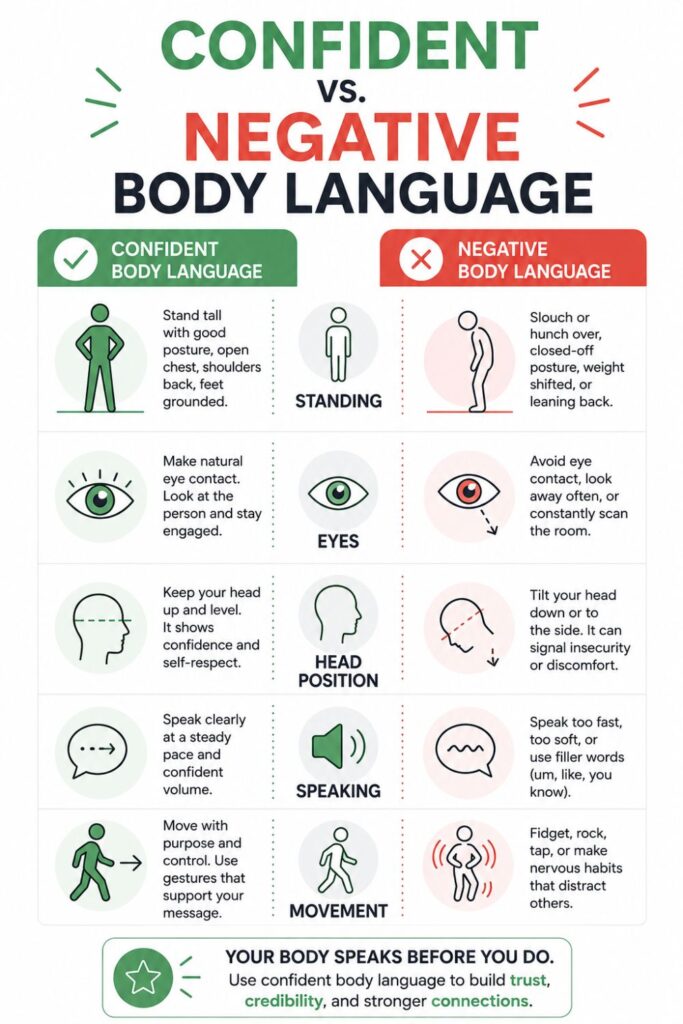
Lets start with an exercise.
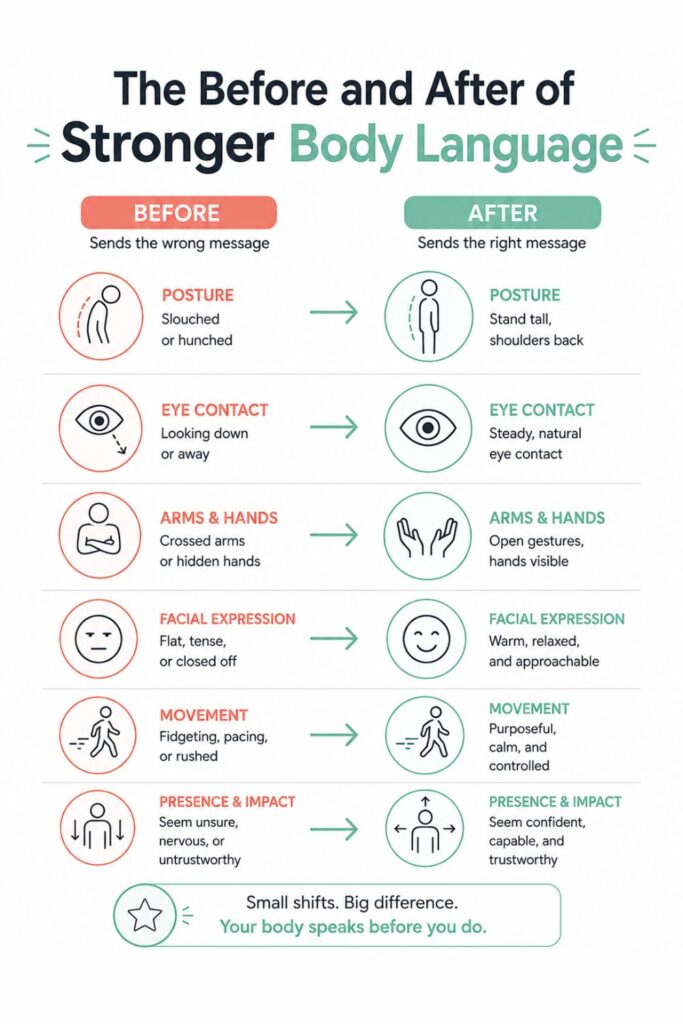
Imagine there are two people standing in front of you – one with “negative body language” and one with “positive body language”. I’d now like you to write down what you are observing with each of these people.
|
POSITIVE |
NEGATIVE | |
|---|---|---|
|
How are they standing? |
|
|
|
Where are their eyes looking? | ||
|
Where have they got their head? | ||
|
How are they talking? | ||
|
How are they moving? |
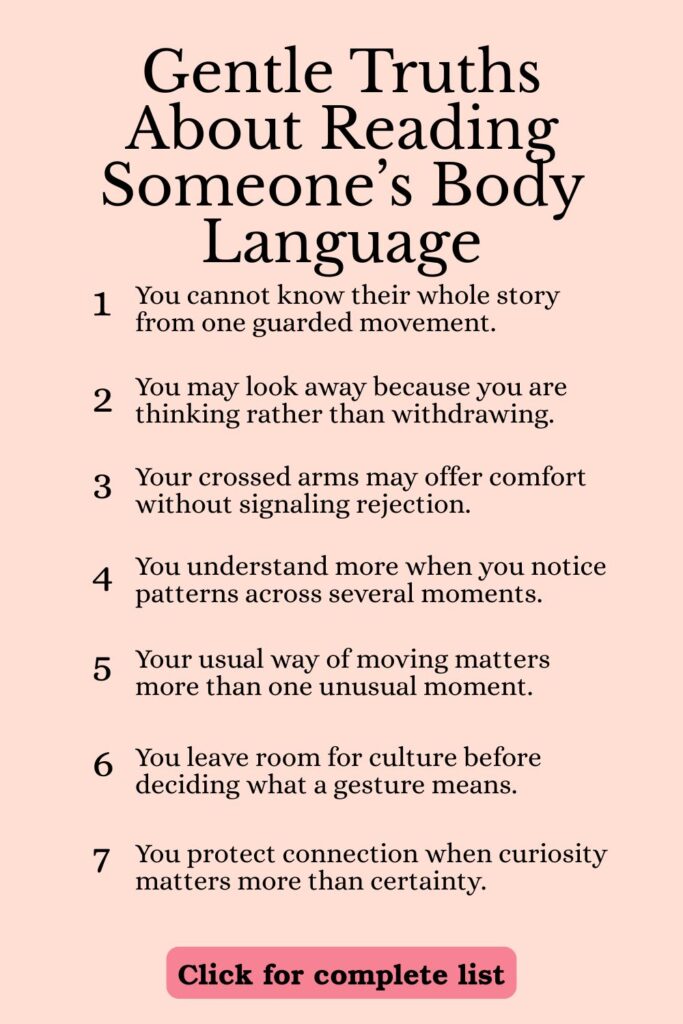
How Can You Read Body Language Without Jumping to Conclusions?
Body language should be read as a pattern, not decoded from one isolated gesture. Crossed arms, looking away, shifting in a chair, or speaking quietly can each have several possible explanations.
If you want to get more from your life, and are looking for concrete action steps to get you there, check out our Request a Coach page. It’s a “cut the fence-sitting and take action” way to tackle your issues and actually find success. To get off the fence and start to take action, click or tap here.
Use three checks before deciding what someone’s behavior means:
- Context: What is happening around the person? They may cross their arms because the room is cold, not because they reject what you are saying.
- Baseline: How does this person usually behave? A quiet person becoming unusually animated may tell you more than their normal level of eye contact.
- Cluster: Which signals are appearing together? A tight jaw, clipped answers, turned body, and repeated glances at the door form a more useful pattern than one gesture alone.
Imagine that someone looks down while you are speaking. That could signal discomfort, concentration, tiredness, respect, or an attempt to find the right words.
Instead of deciding, “They are not interested,” test your interpretation with a neutral question:
“Would you like a moment to think about that?”
A communication or relationship coach might review a difficult exchange this way. The work is not about guessing what another person secretly felt. It is about separating what you actually observed from the story you attached to it.
How Do Culture, Personality, and Neurodiversity Affect Body Language?
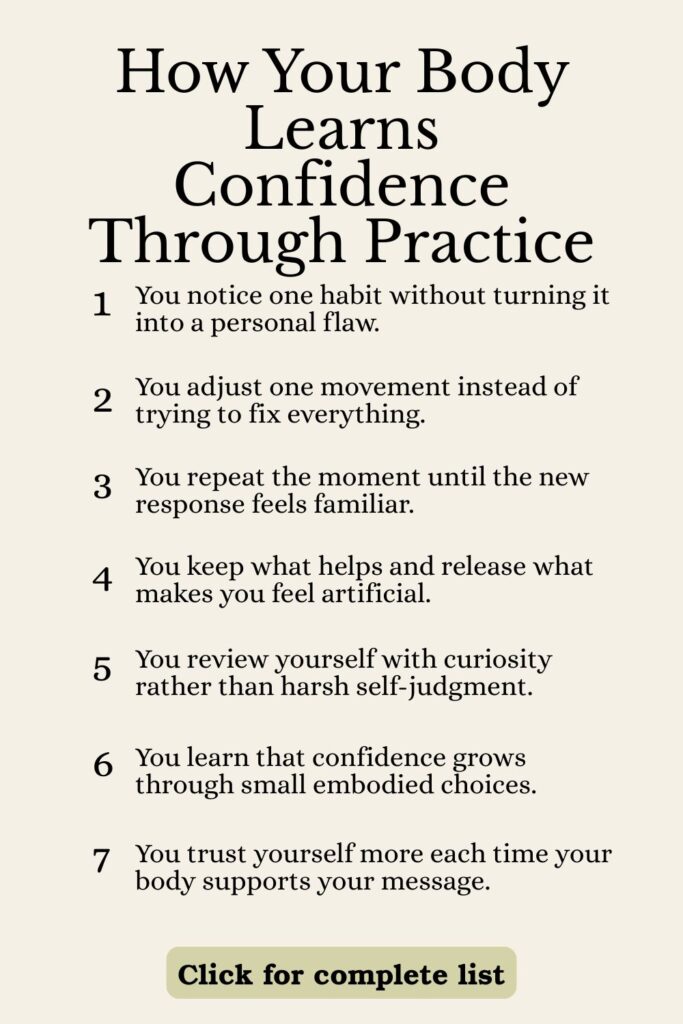
Confident body language does not have one universal appearance. Eye contact, movement, facial expression, personal space, speaking pace, and gesture size can vary across cultures, personalities, and neurotypes.
For one person, looking directly at someone helps them concentrate. Another person may listen more carefully while looking slightly away.
Stillness can appear composed in one setting and distant in another. Animated gestures may communicate enthusiasm, or they may simply be part of someone’s natural communication style.
If you want to get more from your life, and are looking for concrete action steps to get you there, check out our Request a Coach page. It’s a “cut the fence-sitting and take action” way to tackle your issues and actually find success. To get off the fence and start to take action, click or tap here.
That is why forcing yourself to maintain constant eye contact or use unfamiliar gestures can backfire. You may become so focused on performing confidence that you stop listening.
A more useful approach is to choose one behavior that supports your message without fighting the way you naturally process a conversation. You might make brief eye contact when stating your main point, then look away naturally while thinking.
A career coach can help distinguish between a behavior that is genuinely weakening an interview and a harmless personal habit that does not need to be corrected. The aim is not to erase individuality. It is to make your intentions easier to understand.
How Does the Body Language Feedback Loop Work?
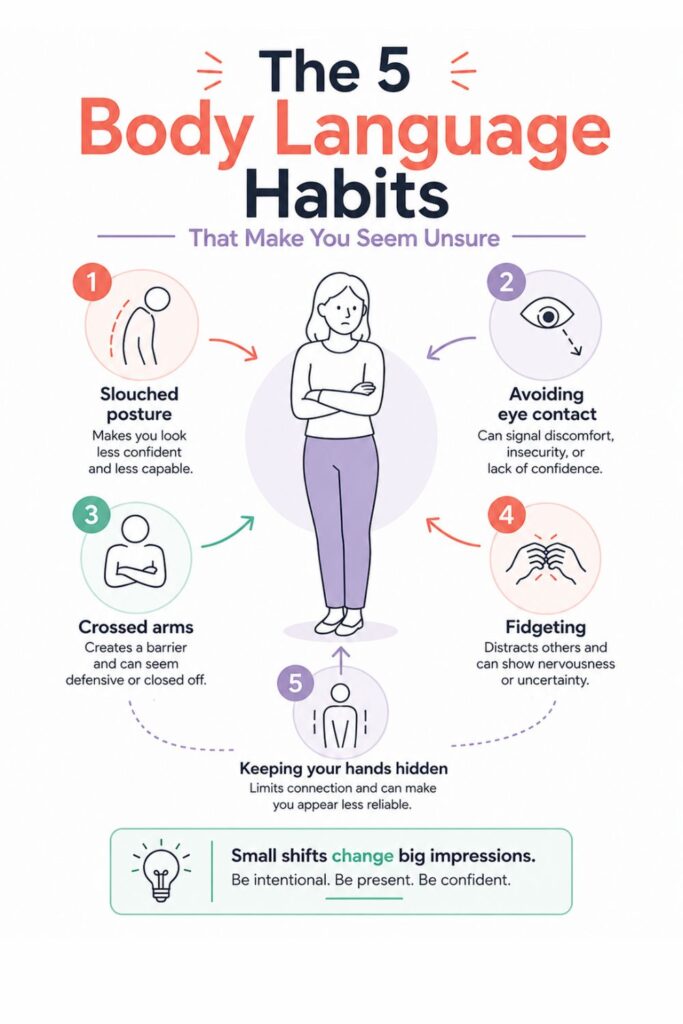
Body language works as a feedback loop: notice, align, test, and review. This gives you a practical way to adjust your behavior without trying to manufacture a new personality.
- Notice: Identify what your body is doing. Are your shoulders pulled forward? Are you rushing your words? Are your hands hidden or tightly clasped?
- Align: Decide what you want to communicate. Confidence, openness, authority, interest, or reassurance may each require a different adjustment.
- Test: Change one observable behavior. Slow your first sentence, place both feet on the floor, lift your gaze, or let your hands move naturally as you explain a point.
- Review: Notice what changed in your delivery and in the other person’s response. Keep the adjustment if it helped. Change it if it felt distracting or forced.
Posture can also affect how you experience a stressful moment. In a 2015 randomized trial published in Health Psychology, Shwetha Nair and her colleagues found that participants assigned to an upright seated posture during a stressful speech task reported higher self-esteem, better mood, greater alertness, and less fear than participants assigned to a slumped posture.
That finding does not mean sitting upright automatically produces confidence. It suggests that posture can become one part of how you respond when you are under pressure.
Suppose you are about to answer an interview question. You notice that your chest has collapsed, your eyes are fixed on the floor, and you are speaking before you have formed your answer.
You do not need to fix your whole body. Place your feet firmly on the floor, pause, and deliver your first sentence at a slower pace. Then review whether the adjustment helped you think and speak more clearly.
If you want to get more from your life, and are looking for concrete action steps to get you there, check out our Request a Coach page. It’s a “cut the fence-sitting and take action” way to tackle your issues and actually find success. To get off the fence and start to take action, click or tap here.
How Does Movement Affect Your Energy and Emotions?
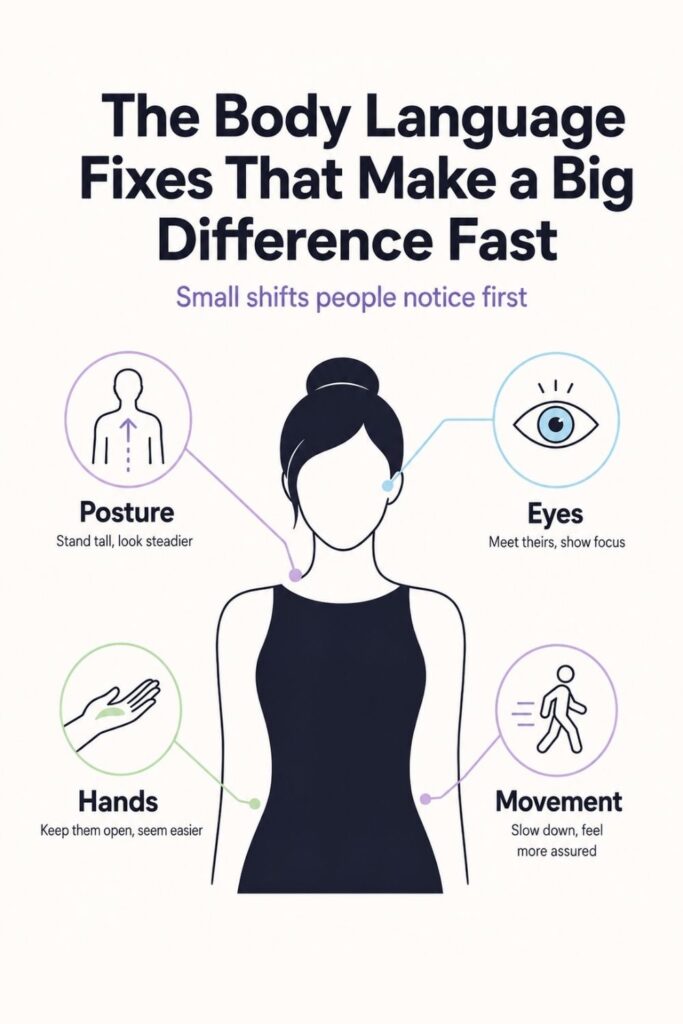
Emotion is created by motion. If you sit still for a long period of time your natural energy levels automatically lower. And what happens when you get up, walk around and return to your seat? Yes, you have more energy and you’re given a boost.
I can’t stress how important it is to move and act confidently and positively. You will give off all the right vibes to everyone around you and it will make them think that you are confident even if you’re not feeling it inside. Yes, that’s right. Even if you’re not feeling confident, act as though you are.
So, how do you do this?
Posture may also affect how you respond during a stressful task. In a randomized study published in Health Psychology, Shwetha Nair and her colleagues found that participants assigned to sit upright during a stressful speech task reported higher self-esteem, better mood, greater alertness, and less fear than participants assigned to a slumped posture.
This does not mean that sitting upright automatically creates confidence. It suggests that posture can be one practical part of how you manage your energy and emotional response under pressure.
How Can You Convey Confidence Without Looking Forced?
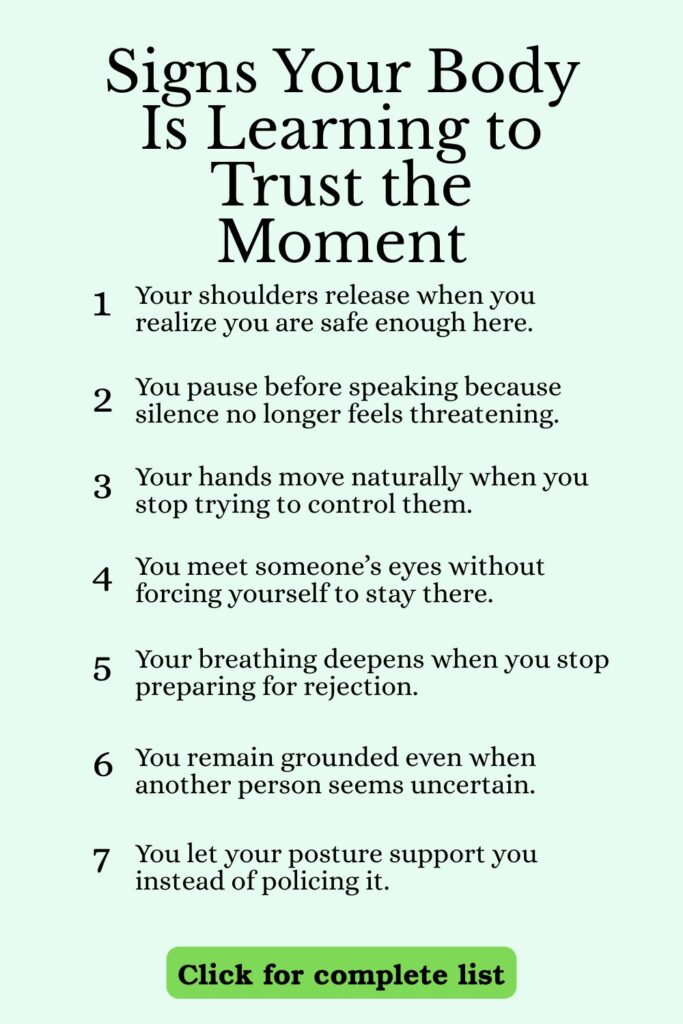
- Walk fast and with a purpose. Don’t saunter along. Walk like you know exactly where you are going and when you get there you mean business!
- Gesture with your hands as you talk, it will create motion and you know what that leads to – EMOTION! The right gestures also have a major impact on building rapport as long as you’re not shaking your fist!
- All it takes is a smile! Think for a moment about your confidence role model. One thing that she and confident people in general have in common is that they all probably smile a lot and are happier than their negative counterparts. It may sound silly, but there is a lot of power associated with a smile.
Start smiling more often. Now, that doesn’t mean that you have to walk around with a silly grin on your face all of the time. But smile as you walk down the street, when you talk to someone, even when you look in the mirror at yourself. You will be surprised at how much better you will feel for it, and it will project a positive image to others – one that will attract opportunities and people.
Remember that confident people are happy people and negative people are not. Happy people are also seen as more attractive than unhappy and sad people so that is an added bonus!
How Should Confident Body Language Change by Situation?
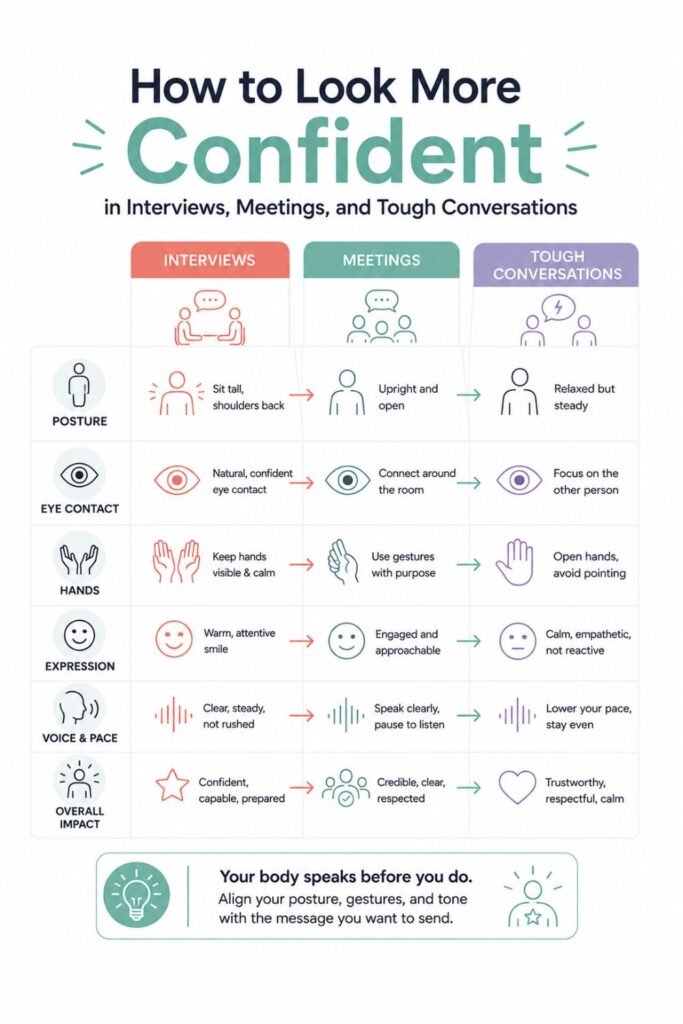
Confident body language should match what the situation requires you to communicate. The behavior that helps during a presentation may be completely wrong for a sensitive personal conversation.
If you want to get more from your life, and are looking for concrete action steps to get you there, check out our Request a Coach page. It’s a “cut the fence-sitting and take action” way to tackle your issues and actually find success. To get off the fence and start to take action, click or tap here.
During a job interview, confidence may look like:
- Sitting in an alert but comfortable position
- Looking at the interviewer when making a central point
- Keeping your hands visible
- Pausing briefly before answering
- Listening without planning your next sentence while the other person speaks
During a presentation, confidence may look like:
- Standing with your weight evenly distributed
- Moving only when the movement serves a purpose
- Using gestures large enough for the room
- Looking across different parts of the audience
- Allowing a pause after an important statement
During a difficult conversation, confidence may look quieter:
- Lowering your speaking pace
- Keeping your hands relaxed
- Avoiding sudden or forceful movements
- Allowing the other person to finish
- Facing them without crowding their space
During a leadership update, confidence may require both authority and openness. You may need a steady voice when explaining the decision, followed by a more receptive posture when inviting questions.
A leadership coach might role-play the same announcement twice. In the first version, the manager focuses on clarity and authority. In the second, they practice receiving disagreement without folding their arms, interrupting, or retreating into a defensive tone.
There is no single confident pose. There is only behavior that either supports or distracts from the job you need to do.
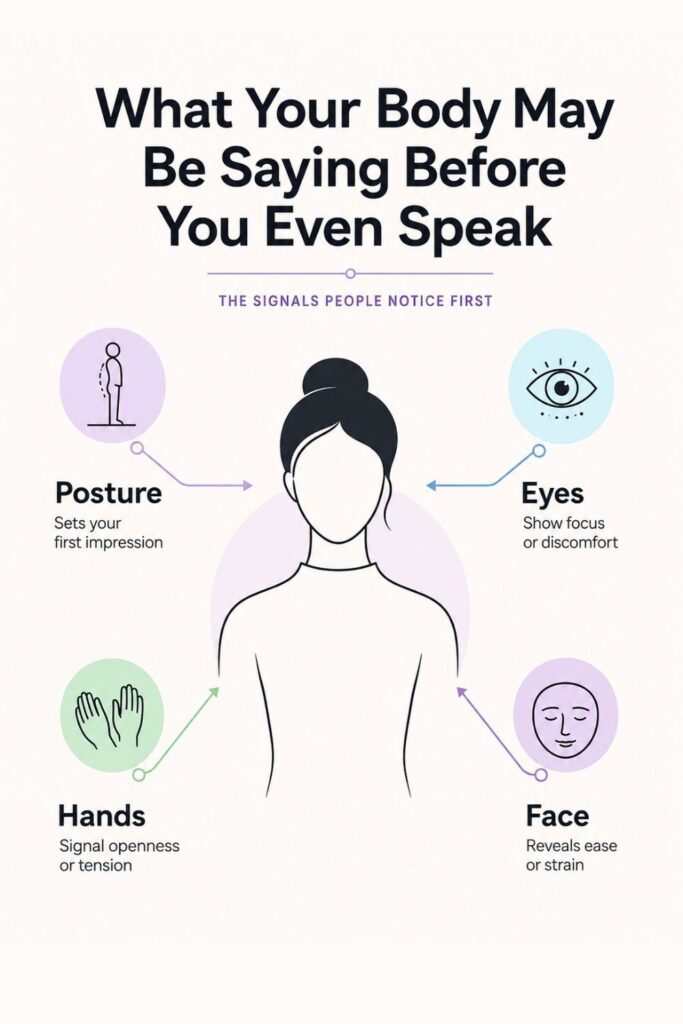
How Does Nonverbal Communication Shape Your Message?
The way that we communicate in our appearance, posture, gesture, gaze and expression can be such a powerful tool in the way that we feel and when communicating with others. Effective communication is vital if you are going to succeed no matter what you are doing.
The way in which we communicate with people is broken down into component parts, and it is popularly believed that people we are speaking with understand what we say by interpreting these different elements in varying proportions
If you want to get more from your life, and are looking for concrete action steps to get you there, check out our Request a Coach page. It’s a “cut the fence-sitting and take action” way to tackle your issues and actually find success. To get off the fence and start to take action, click or tap here.
What Happens When Your Words, Tone, and Body Language Do Not Match?
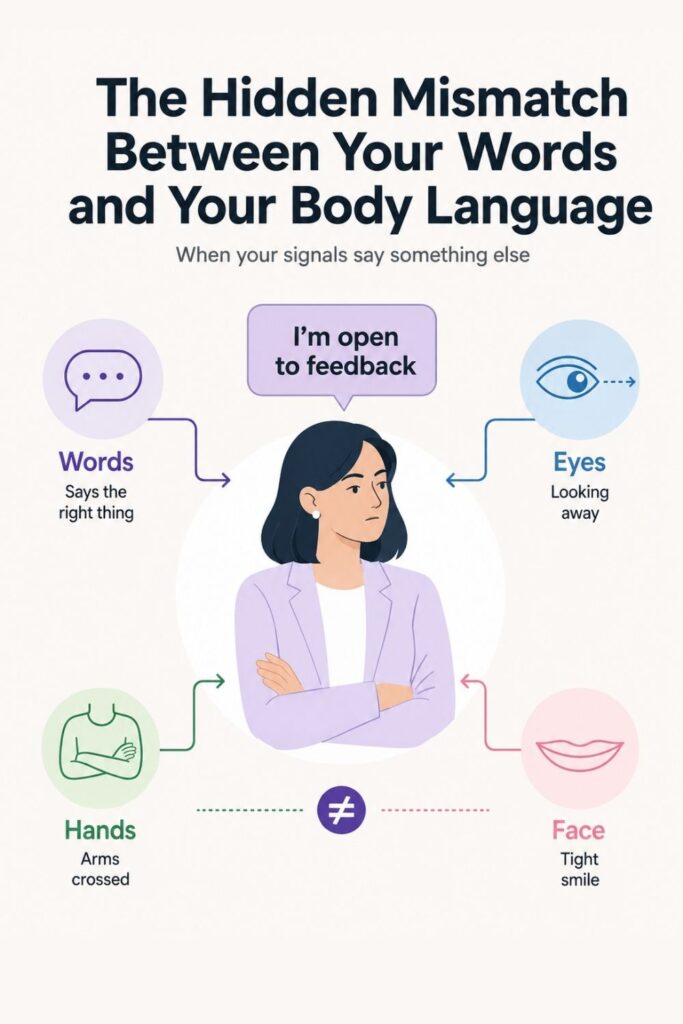
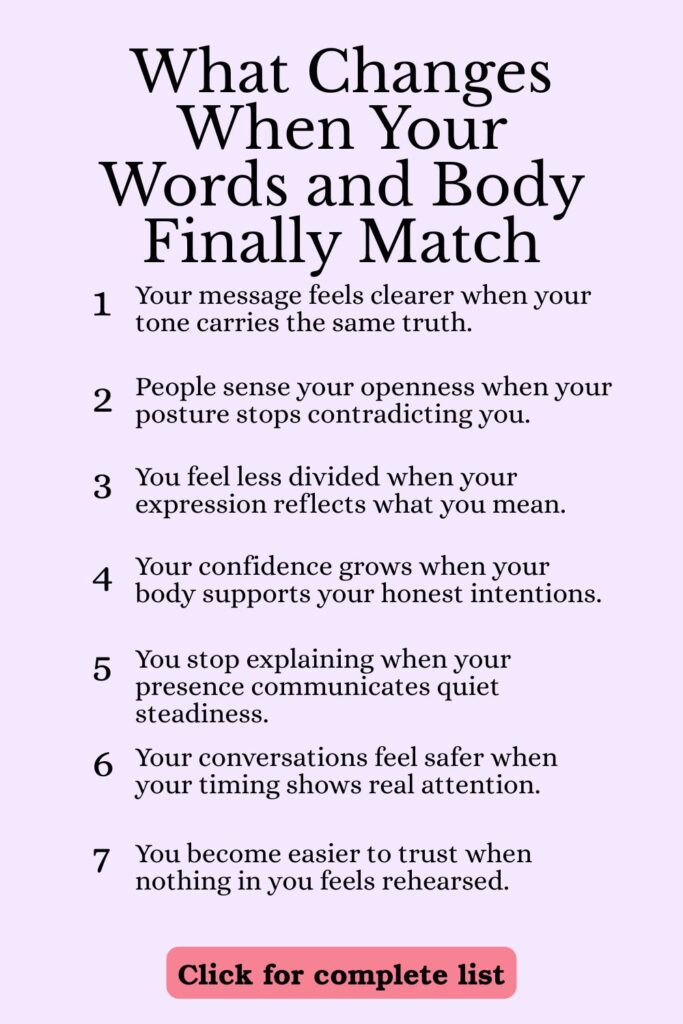
People are more likely to question a message when the words, tone, expression, and behavior point in different directions. The issue is not that body language always matters more than words. The issue is contradiction.
Imagine a manager saying:
“I genuinely want your honest feedback.”
At the same time, the manager keeps looking at the clock, interrupts the employee, and answers every concern with a defensive explanation. The invitation sounds open, but the visible behavior discourages honesty.
This is sometimes called nonverbal congruence. Your communication is congruent when the different parts of your message support the same intention.
Check three areas:
- Words and voice: Does your pace and tone support the meaning of your words?
- Words and behavior: Does your posture appear open when you are asking someone to speak freely?
- Intention and timing: Are you giving the person enough time and attention to respond?
The familiar claim that 7 percent of communication comes from words, 38 percent from voice, and 55 percent from body language is often applied far beyond the research that produced it.
Albert Mehrabian states that these figures came from experiments involving the communication of feelings and attitudes, specifically like and dislike. They do not provide a universal formula for ordinary conversation, instructions, facts, or complex ideas.
If you want to get more from your life, and are looking for concrete action steps to get you there, check out our Request a Coach page. It’s a “cut the fence-sitting and take action” way to tackle your issues and actually find success. To get off the fence and start to take action, click or tap here.
The more useful lesson is about mismatch. When someone’s words express one attitude but their voice or facial expression communicates another, people may pay closer attention to the conflicting signals.
You do not need a percentage to recognize a mismatch. If you say, “Take your time,” while tapping your foot and repeatedly checking your phone, your behavior weakens the message.
A communication coach may record a practice conversation and ask one useful question: Does your visible behavior support what you want the other person to believe?
How Can You Practice Body Language Before a High-Stakes Moment?
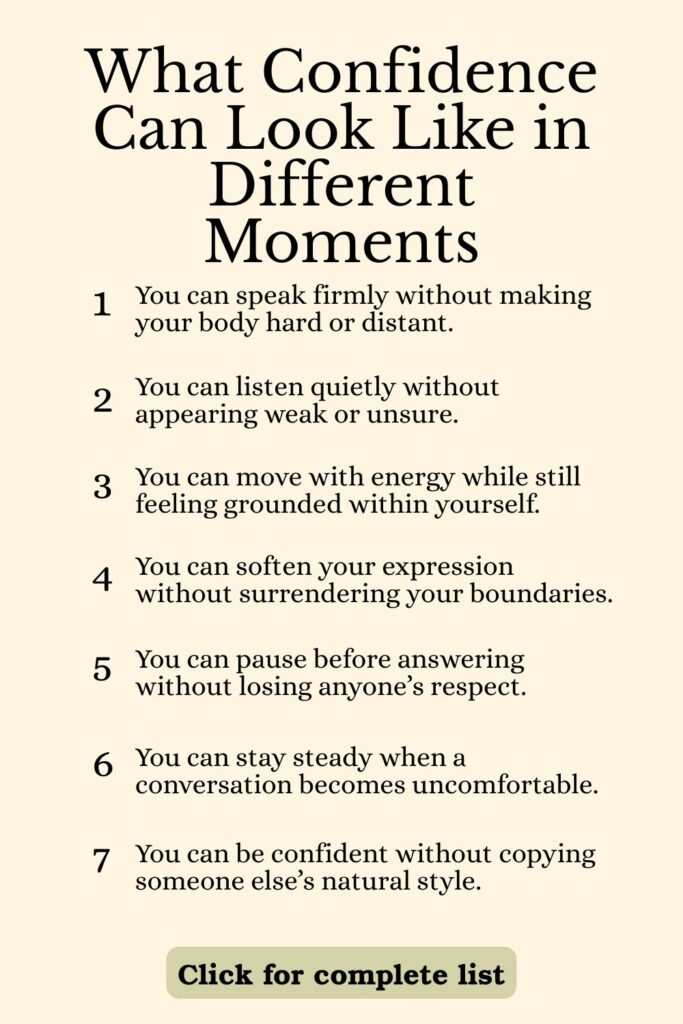
Body language improves fastest when you rehearse a real situation and change one observable behavior at a time. Trying to monitor your posture, hands, face, voice, feet, and eye contact all at once usually makes you look less natural.
Use a simple Record, Review, Adjust, Repeat process.
1. Record a real response
Choose something you will actually need to say. Record a 60-second interview answer, presentation opening, client explanation, or difficult request.
2. Watch without sound
If you want to get more from your life, and are looking for concrete action steps to get you there, check out our Request a Coach page. It’s a “cut the fence-sitting and take action” way to tackle your issues and actually find success. To get off the fence and start to take action, click or tap here.
Look only at visible behavior.
Ask:
- Where are your eyes?
- What are your hands doing?
- Does your posture change when you become uncertain?
- Are you moving with purpose or from nervous energy?
- Does your expression fit the subject?
3. Listen without watching
Focus on the voice.
Notice:
- Speaking pace
- Volume
- Pauses
- Repeated filler words
- Sentences that fade at the end
- Sudden changes in pitch
4. Choose one adjustment
Do not rebuild the entire performance. Choose one change, such as keeping your hands visible or pausing before the first sentence.
5. Record the same response again
If you want to get more from your life, and are looking for concrete action steps to get you there, check out our Request a Coach page. It’s a “cut the fence-sitting and take action” way to tackle your issues and actually find success. To get off the fence and start to take action, click or tap here.
Use the same words so you can compare the delivery rather than the content.
6. Keep what works
An adjustment should make the message clearer without consuming all your attention. If it feels so unnatural that you lose your train of thought, make it smaller.
A career coach might use this process for interview preparation. A leadership coach might use it before a difficult team announcement. A relationship coach might rehearse the opening sentence of a boundary-setting conversation.
Specific feedback is more useful than being told to “look confident.” You need to know which behavior is helping, which behavior is distracting, and what you will do differently next time.
Frequently Asked Questions About Body Language and Confidence
What are the main signs of confident body language?
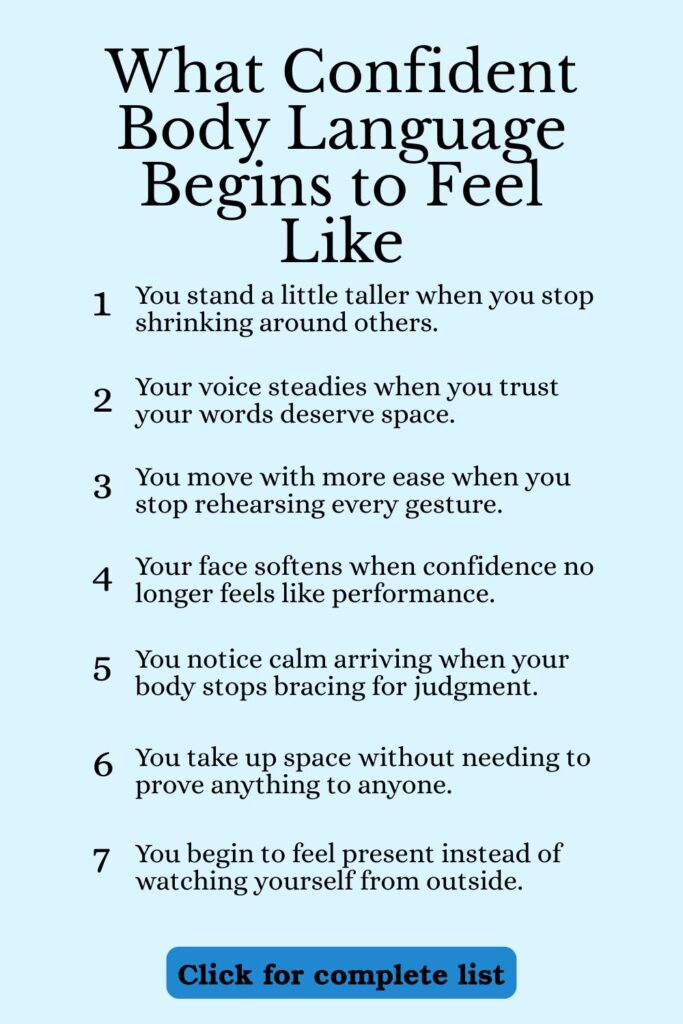
Confident body language usually looks purposeful, open, and appropriate to the situation. Common signs include an alert posture, visible hands, a steady speaking pace, natural eye contact, and movements that support rather than interrupt the message.
No single behavior proves confidence. Look at the complete pattern and the demands of the situation.
Can changing your posture really make you feel more confident?
Changing your posture may influence how you feel during some stressful situations, but it is not an instant confidence switch. A randomized study by Shwetha Nair and her colleagues found that upright and slumped posture groups reported different emotional responses during a stressful speech task.
If you want to get more from your life, and are looking for concrete action steps to get you there, check out our Request a Coach page. It’s a “cut the fence-sitting and take action” way to tackle your issues and actually find success. To get off the fence and start to take action, click or tap here.
Posture is one variable you can adjust. Preparation, experience, physical comfort, thoughts, and the reactions of other people also affect confidence.
How much of communication is body language?
There is no reliable universal percentage showing how much of all communication comes from body language. The widely repeated 7, 38, and 55 percent figures came from narrow studies involving feelings and attitudes when different parts of a message were inconsistent.
Albert Mehrabian has explicitly clarified that the figures do not apply to ordinary communication in general.
How can I make eye contact without staring?
Use natural, intermittent eye contact rather than holding another person’s gaze continuously. Look toward them when making or receiving a central point, then allow your gaze to move naturally while you think.
Aim to show attention, not to win a staring contest.
What should I do with my hands when I am speaking?
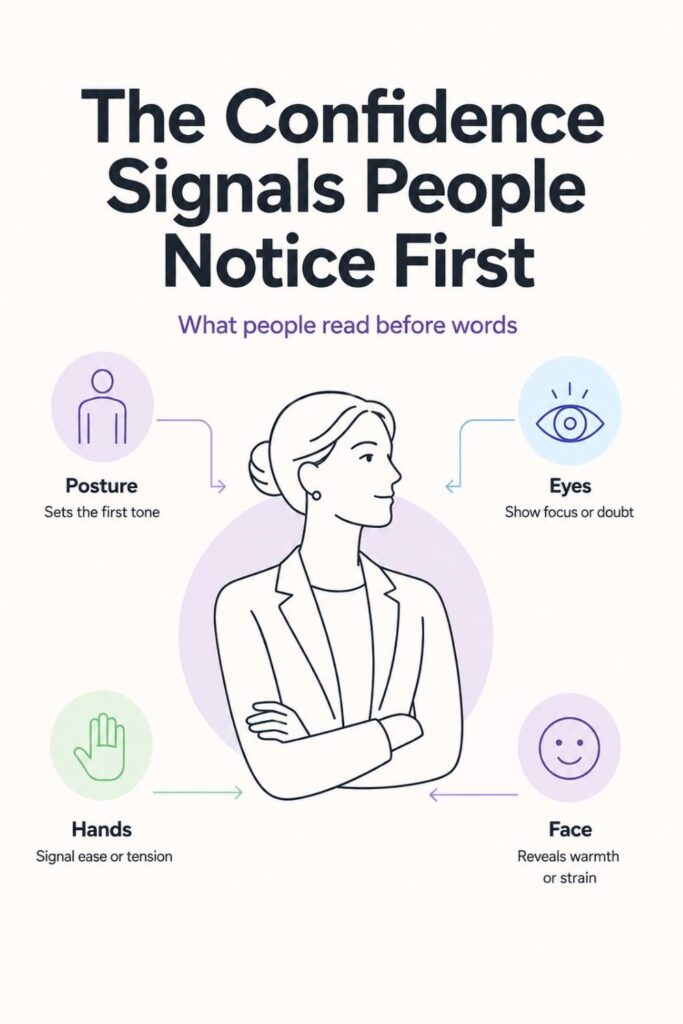
Keep your hands visible and let them gesture naturally when they help explain your point. Avoid locking them into one position if that makes your shoulders and voice tense.
When you are not gesturing, let your hands rest in a comfortable neutral position.
How can I stop looking nervous during an interview or presentation?
Reduce one visible nervous habit at a time. Record yourself, identify the behavior that distracts most from your message, and rehearse one alternative.
If you want to get more from your life, and are looking for concrete action steps to get you there, check out our Request a Coach page. It’s a “cut the fence-sitting and take action” way to tackle your issues and actually find success. To get off the fence and start to take action, click or tap here.
For example, replace repeated swaying with a balanced stance or replace immediate answers with one deliberate pause.
What does it mean when someone crosses their arms?
Crossed arms do not have one fixed meaning. The person may be cold, comfortable, concentrating, protecting an injury, feeling defensive, or simply following a familiar habit.
Check the context, their normal baseline, and the other signals appearing at the same time.
Can body language mean different things in different cultures?
Yes, body language can carry different meanings across cultures and social settings. Eye contact, touch, gesture size, physical distance, and facial expression may be interpreted differently depending on the people and situation involved.
Avoid judging a person’s confidence or honesty from one culturally variable behavior.
How Can You Practice Confident Body Language Today?
If you are ever feeling down, just have a look at your body language and change it immediately. Even if it has to be false – YOU WILL start to feel better and more confident immediately.
First impressions count – so when you are going to meet people for the first time, think what first impression you want to give them. A smiling face? A good remark?
Take more notice of others’ body language. You can normally tell what others are feeling by the way that they are moving and using their body too. You can use this to your advantage when you are more aware of it.
If you want to get more from your life, and are looking for concrete action steps to get you there, check out our Request a Coach page. It’s a “cut the fence-sitting and take action” way to tackle your issues and actually find success. To get off the fence and start to take action, click or tap here.
What can you do to positively change your body language today? Let me know in the comments below!
Sources
Nair, Shwetha, et al. “Do Slumped and Upright Postures Affect Stress Responses? A Randomized Trial.” Health Psychology, vol. 34, no. 6, 2015, pp. 632–641. American Psychological Association, https://doi.org/10.1037/hea0000146.
Mehrabian, Albert. “Silent Messages: A Wealth of Information About Nonverbal Communication.” Albert Mehrabian, 2016, https://www.kaaj.com/psych/smorder.html.
Mehrabian, Albert, and Susan R. Ferris. “Inference of Attitudes from Nonverbal Communication in Two Channels.” Journal of Consulting Psychology, vol. 31, no. 3, 1967, pp. 248–252. American Psychological Association, https://doi.org/10.1037/h0024648.
Mehrabian, Albert, and Morton Wiener. “Decoding of Inconsistent Communications.” Journal of Personality and Social Psychology, vol. 6, no. 1, 1967, pp. 109–114. American Psychological Association, https://doi.org/10.1037/h0024532.
If you want to get more from your life, and are looking for concrete action steps to get you there, check out our Request a Coach page. It’s a “cut the fence-sitting and take action” way to tackle your issues and actually find success. To get off the fence and start to take action, click or tap here.
Read this next

Your Brain on Autopilot: Cognitive Distortions 101
Our brain is composed of about 100 billion neurons. Each neuron has one to ten thousand connections to other neurons. Our brain can perform 100 trillion calculations/sec. This is a […]
Read More
Three Barriers to Making Good Decisions (Plus 2 More to Look Out For)
The ability to make effective decisions is a worthy skill to learn despite the hurdles likely to be encountered
Read More
Unlock the Secrets of Color Theory to Transform Your Fall Going Out Wardrobe
Fall is the perfect season to experiment with color. The deeper tones, the dramatic lighting, and the chance to layer make every outfit feel like a statement. But if you’ve […]
Read More