





How to Manage Client Expectations in Coaching

Picture this scenario. You’ve just signed up a coaching client for a flat fee of £200 per month. Then you start getting emails and calls from the client every day, often more than once a day. You end up having to tell the client that you can’t spend so much time coaching. Before you know it, nasty posts about you are popping up in forums from your disgruntled client.
Is the client being unreasonable? Sure. But it was your responsibility to find out their expectations and set your own before you signed anything or received payment.
Key Takeaways
- Clarify expectations before accepting payment. Ask what the client expects from sessions, support between sessions, and the outcomes they hope to achieve. Check whether those needs fit your services.
- Put the coaching arrangement in writing. Specify session length, frequency, communication limits, response times, cancellation rules, payment terms, and responsibilities so neither party has to guess.
- Set clear boundaries around access to you. Explain when and how clients may contact you, what counts as additional coaching, and how requests beyond the agreed package will be handled.
- Measure progress without guaranteeing results. Agree on client-led actions and observable milestones, then review the evidence together rather than promising a promotion, new job, or other specific outcome.
- Revisit expectations as coaching develops. Schedule check-ins, document agreed changes, and address complaints against what was actually promised and delivered before misunderstandings become serious disputes.
How Do You Manage Client Expectations in Coaching?
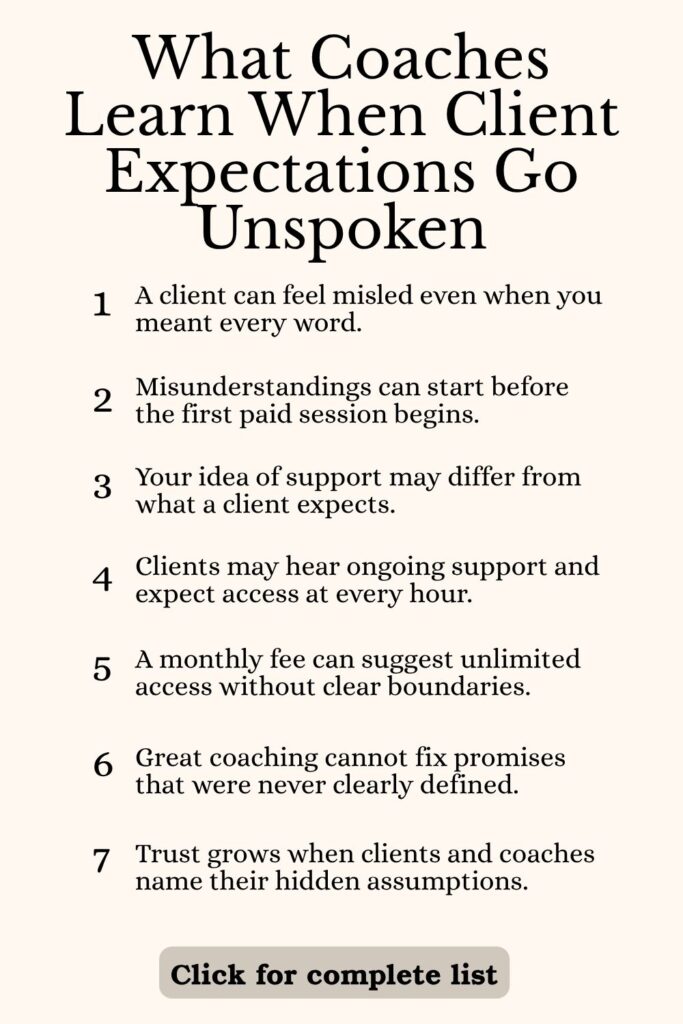
Managing client expectations in coaching means agreeing on what the coach will provide, what the client is responsible for, and how the coaching relationship will work before services begin. This includes defining the scope of coaching, session frequency, communication boundaries, payment terms, and the outcomes you will work toward.
Start by asking prospective clients what they expect, then explain exactly what your coaching package includes. Put those details in a written agreement, clarify what falls outside your services, and establish how progress will be reviewed.
Continue checking expectations throughout the coaching relationship. When a client’s goals or support needs change, discuss whether the original arrangement still works and agree on any adjustments before providing additional services.
Why Is Setting Client Expectations So Important?
Setting clear expectations with your coaching clients from the start involves finding out what they expect and letting them know exactly what you will be providing. It ensures that you can actually provide what they expect, and they understand what they’ll be getting. You can clear up any misunderstandings before you start and avoid having an unhappy customer.
SEE ALSO: If you’re a coach looking to streamline your administrative tasks and save time, check out our Coaching Administration Software. It’s a simple, effective solution designed to help you focus less on paperwork and more on what matters—coaching your clients. From scheduling to client management, our software gives you the tools to run your business efficiently. Ready to reclaim your time and boost productivity? Click or tap here.
On the flip side of that, you get the opportunity to over-deliver if you want. There’s nothing quite like giving a customer more than they expected. Those are the ones that give testimonials and refer you to everyone they know.
The distinction is between giving clients additional value and accidentally committing to more work than you’ve been paid to provide. A useful extra worksheet or a thoughtful progress review can exceed expectations without creating an obligation to be available around the clock.
How Do You Uncover Client Expectations Before Coaching Begins?
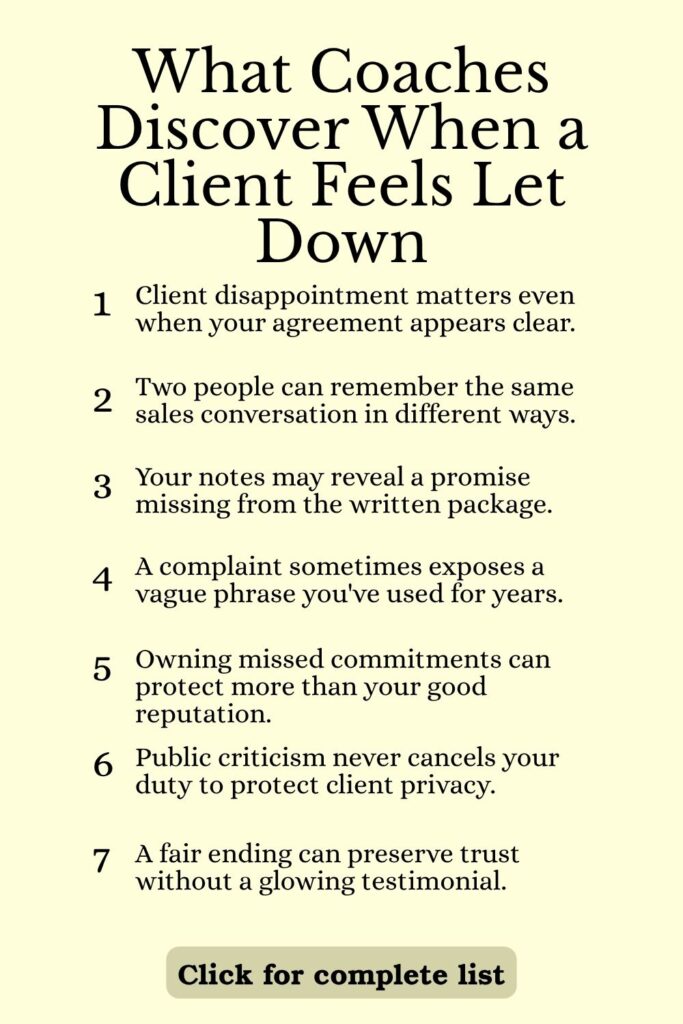
The simplest way to uncover client expectations is to ask specific questions during your discovery call, then compare the answers with the coaching services you actually provide.
Clients don’t always understand how coaching works. One person might expect help developing their own solutions, while another assumes you’ll tell them exactly what to do. Someone paying a monthly fee might also assume they can contact you whenever they have a problem.
You need to find out what they’re expecting before either of you commits.
Start with five questions:
SEE ALSO: If you’re a coach looking to streamline your administrative tasks and save time, check out our Coaching Administration Software. It’s a simple, effective solution designed to help you focus less on paperwork and more on what matters—coaching your clients. From scheduling to client management, our software gives you the tools to run your business efficiently. Ready to reclaim your time and boost productivity? Click or tap here.
- What would make coaching worthwhile for you? Find out what the client hopes will change and how they expect to recognize success.
- What kind of support are you looking for? Ask whether they want accountability, reflection, practical guidance, or direct advice.
- How much contact do you expect between sessions? Establish whether they’re anticipating occasional check-ins or frequent access to you.
- What do you believe is included in the coaching fee? Ask them to describe their understanding of the package rather than simply asking whether they’ve read the details.
- What would disappoint you about the coaching experience? This can reveal assumptions that haven’t surfaced in the rest of the conversation.
Pay particular attention when a client’s expectations don’t match your approach.
For example, suppose you’re a career coach offering two 60-minute sessions each month, supported by worksheets and action items. Your prospective client says they need daily motivation, immediate feedback on workplace decisions, and someone to review every job application.
You have a clear mismatch. You can explain what your package includes, discuss whether another arrangement would be appropriate, or decide that you’re not the right coach for their needs.
It’s much easier to have that conversation before receiving payment than after the client has started relying on you for daily support.
The goal isn’t to convince every prospect that your coaching is right for them. It’s to make sure the people who become clients understand what they’re buying.
That clarity should start even before the discovery call. An accurate description of your services on your website or free life coach directory listing can help prospective clients understand your specialties and approach before contacting you.
SEE ALSO: If you’re a coach looking to streamline your administrative tasks and save time, check out our Coaching Administration Software. It’s a simple, effective solution designed to help you focus less on paperwork and more on what matters—coaching your clients. From scheduling to client management, our software gives you the tools to run your business efficiently. Ready to reclaim your time and boost productivity? Click or tap here.
What Kind of Expectations Do You Need to Set With Your Clients?
Depending on the type of coaching you’re providing, you’ll need to set expectations on everything from price to the number of email exchanges you provide and how long it will take you to respond. Here are a few suggested areas:
- Focus of the coaching. Make it clear what you can and can’t help with. For example, maybe you can give advice on email marketing, but not on how to analyze your financials.
- How much one-on-one time vs. other interaction. You might want to set specific limits on your time, especially if the price is low. For example, you might say the coaching involves a 30-minute one-on-one session once a week and unlimited email access. Base it both on the price and the needs of your clients.
- Type of interaction and materials. How will you be doing the actual coaching? Through a membership site with instructional materials and email exchanges? Weekly webinars and video calls? A mix of media can work well. Just make it clear what your clients will be getting.
- What happens if they’re not happy? Particularly with high-ticket coaching programs, prospects will want to know what happens if they’re not satisfied with results. Is this a no-refunds program? Is there a money-back guarantee? Establish the details and communicate any time limits and refund policies, subject to applicable consumer laws.
What Should You Include in a Coaching Agreement?
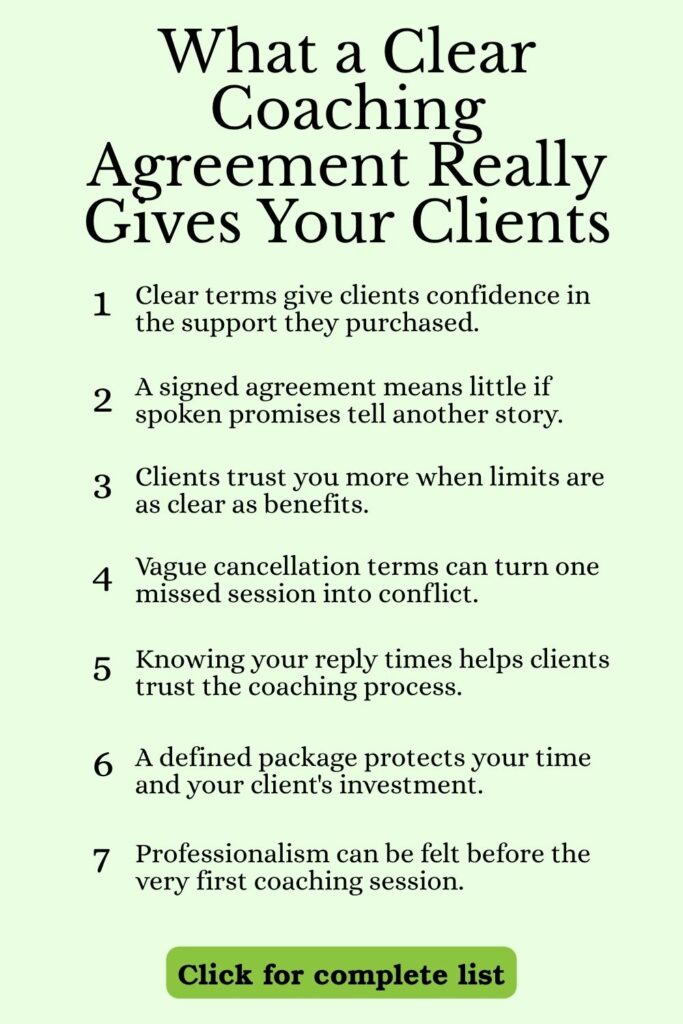
A coaching agreement should explain exactly what the client is purchasing, what each person is responsible for, and what happens when the arrangement needs to change.
A conversation about expectations is a good starting point, but it isn’t enough by itself. If the details are never written down, you and your client may leave the conversation with completely different interpretations.
The International Coaching Federation’s 2025 Code of Ethics calls for coaches to establish agreements covering roles, responsibilities, confidentiality, financial arrangements, and other aspects of the engagement before coaching begins.
Your agreement should cover six areas:
- Coaching scope. What problems will you help the client work on? What services fall outside your expertise or the agreed package?
- Sessions and deliverables. How many sessions are included, how long do they last, and what additional materials or activities will the client receive?
- Communication boundaries. Which channels can clients use, how often can they contact you, and when should they expect a reply?
- Payments and package terms. What is the price, when are payments due, what happens if payment is missed, and how long does the package remain valid?
- Cancellations and refunds. What notice is required to reschedule or cancel? How are missed sessions handled? Under what conditions can either party end the relationship?
- Responsibilities and confidentiality. What must the client do between sessions? What are you responsible for providing? How will personal information be handled?
Be especially careful with vague descriptions.
SEE ALSO: If you’re a coach looking to streamline your administrative tasks and save time, check out our Coaching Administration Software. It’s a simple, effective solution designed to help you focus less on paperwork and more on what matters—coaching your clients. From scheduling to client management, our software gives you the tools to run your business efficiently. Ready to reclaim your time and boost productivity? Click or tap here.
For example, suppose you advertise a £200 monthly coaching package that includes “weekly coaching and ongoing support.”
Does weekly coaching mean four sessions every calendar month, or one session every seven days? Does ongoing support mean a brief email question, detailed written feedback, or access whenever the client needs help?
A more precise description might specify four 30-minute sessions during each monthly billing period, one brief email question between sessions, and replies within two business days.
Now both parties have something concrete to work with.
Your agreement should also match what you say during sales conversations. If you promise a prospect additional sessions or special access to you, those promises should be reflected in the written arrangement.
A useful companion resource is this guide to professional client onboarding for coaches, which explains how agreements, intake questions, and first-session preparation fit together.
SEE ALSO: If you’re a coach looking to streamline your administrative tasks and save time, check out our Coaching Administration Software. It’s a simple, effective solution designed to help you focus less on paperwork and more on what matters—coaching your clients. From scheduling to client management, our software gives you the tools to run your business efficiently. Ready to reclaim your time and boost productivity? Click or tap here.
You can organize these documents using LCH Core. Its Welcome Package can include your welcome letter, coaching agreement with electronic signature, and intake forms. The Welcome Package setup guide explains how to customize and send those materials.
How Do You Set Boundaries Around Client Communication?
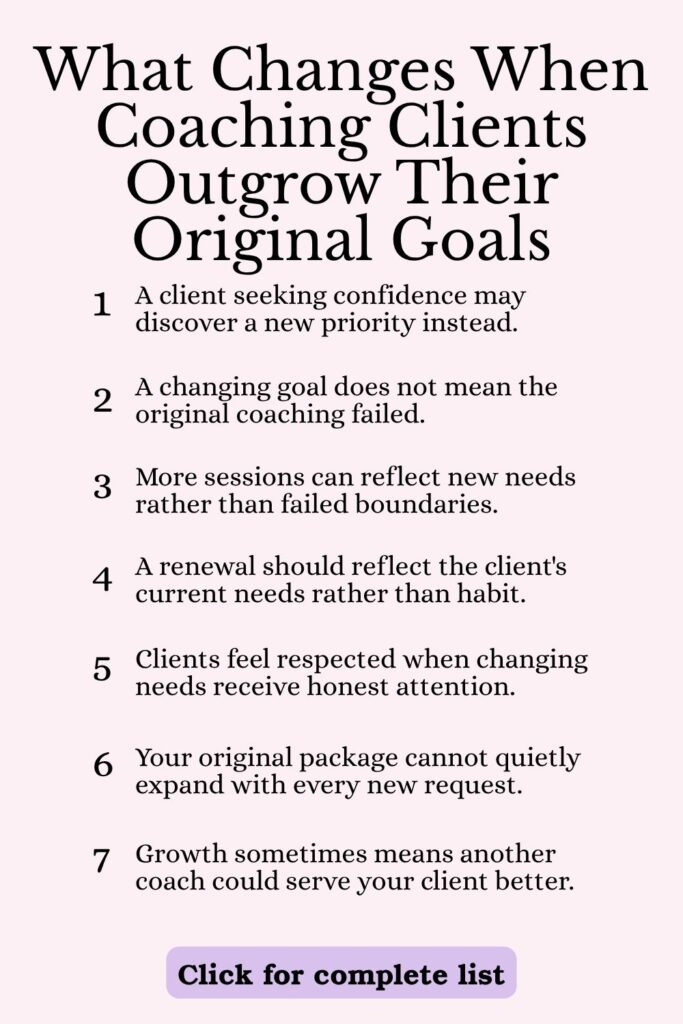
You set effective communication boundaries by telling clients exactly when, why, and how they can contact you between coaching sessions.
This matters particularly when you’re selling monthly packages. A client may interpret a recurring payment as an ongoing right to your attention, even when the package is designed around a specific number of sessions.
Go back to the client paying £200 per month who starts calling and emailing several times every day.
The immediate problem isn’t necessarily how often they’re contacting you. It’s that the coach and client may never have agreed on what the monthly payment actually covers.
Before coaching begins, define three things.
SEE ALSO: If you’re a coach looking to streamline your administrative tasks and save time, check out our Coaching Administration Software. It’s a simple, effective solution designed to help you focus less on paperwork and more on what matters—coaching your clients. From scheduling to client management, our software gives you the tools to run your business efficiently. Ready to reclaim your time and boost productivity? Click or tap here.
First, distinguish coaching sessions from between-session support.
A quick question about an assigned worksheet is different from requesting a detailed conversation about a new problem.
For example, a client might email to ask whether they should complete a reflection exercise before Thursday’s appointment. That’s a straightforward administrative question.
But if they email a two-page account of a workplace conflict and expect detailed coaching feedback that evening, they’re requesting something more substantial.
Second, establish response times and availability.
You might explain that you review coaching-related emails on weekdays and generally respond within two business days. If you don’t work weekends, tell clients that explicitly.
Avoid describing support as “unlimited” unless you’ve explained precisely what unlimited means. Unlimited questions do not automatically mean unlimited coaching time or immediate replies.
Third, explain what happens when a client needs more support.
Sometimes a client’s needs genuinely change.
SEE ALSO: If you’re a coach looking to streamline your administrative tasks and save time, check out our Coaching Administration Software. It’s a simple, effective solution designed to help you focus less on paperwork and more on what matters—coaching your clients. From scheduling to client management, our software gives you the tools to run your business efficiently. Ready to reclaim your time and boost productivity? Click or tap here.
A leadership coaching client preparing for a major presentation might temporarily need more frequent sessions. That doesn’t mean you must rearrange your calendar or provide additional unpaid coaching.
You can discuss an extra paid session, a different package, or another appropriate arrangement.
If a client repeatedly crosses an agreed boundary, address it promptly and professionally.
You might say, “I can see that you’d like more frequent feedback than our current package includes. We agreed to cover these issues during our scheduled sessions, so let’s look at whether that arrangement still meets your needs.”
That gives the client a clear explanation and an opportunity to make a decision.
Boundaries work best when they’re part of the service description, not rules introduced after a client has already become frustrated.
SEE ALSO: If you’re a coach looking to streamline your administrative tasks and save time, check out our Coaching Administration Software. It’s a simple, effective solution designed to help you focus less on paperwork and more on what matters—coaching your clients. From scheduling to client management, our software gives you the tools to run your business efficiently. Ready to reclaim your time and boost productivity? Click or tap here.
Why Shouldn’t You Guarantee Coaching Results?
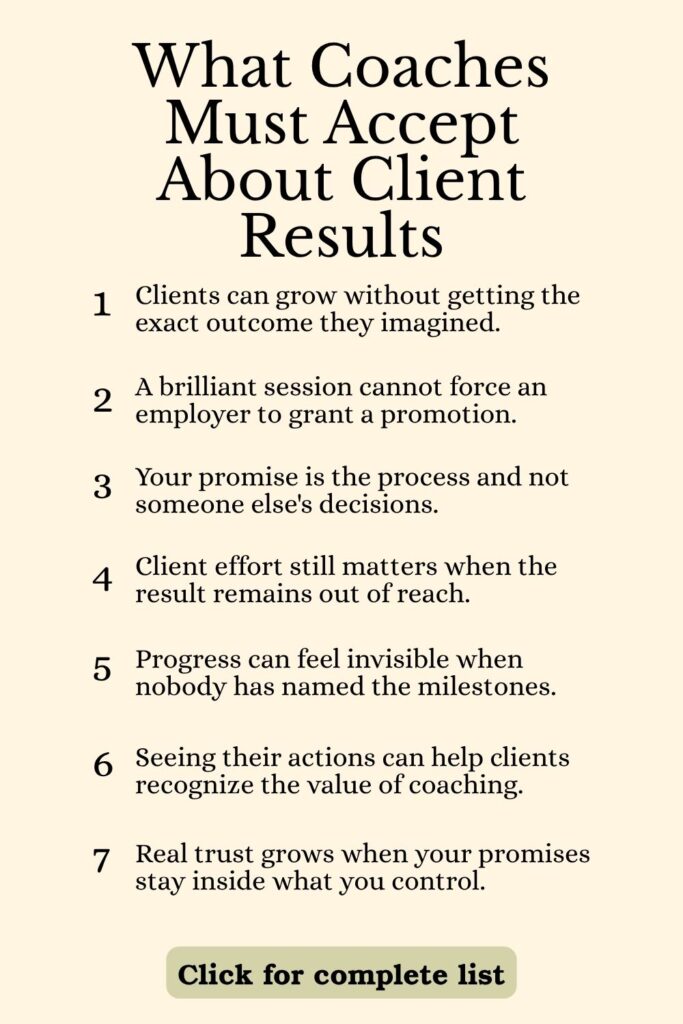
Whatever you do, avoid guarantees of specific results. Everything that a client achieves in a coaching program will depend in part on the actions they actually take and the circumstances they’re working within.
You can provide excellent coaching, but if your client doesn’t act on what they’ve learned, they may not make the progress they hoped for. That’s why some coaches have a screening process before accepting a client.
You also need to distinguish between what you can control and what you cannot.
You can promise to deliver the agreed coaching sessions, provide the materials you’ve included in your package, and support the client in developing and reviewing their action plans.
You cannot promise that another person will give your client a promotion, that their business will hit a particular revenue target, or that every obstacle will disappear within a set number of weeks.
How Do You Measure Coaching Progress Without Promising Outcomes?
You can measure coaching progress by agreeing on observable goals, tracking the actions clients take, and reviewing what changes over time, without guaranteeing a particular result.
SEE ALSO: If you’re a coach looking to streamline your administrative tasks and save time, check out our Coaching Administration Software. It’s a simple, effective solution designed to help you focus less on paperwork and more on what matters—coaching your clients. From scheduling to client management, our software gives you the tools to run your business efficiently. Ready to reclaim your time and boost productivity? Click or tap here.
The distinction is between providing a structured coaching process and controlling the final outcome.
Suppose you’re coaching someone who wants a promotion within three months.
You can’t guarantee the promotion. Their employer’s decisions, available positions, organizational priorities, and other factors are outside your control.
What you can do is help the client identify specific actions and evaluate their progress.
For example, you might agree that the client will:
- Identify three leadership behaviors they want to strengthen.
- Request feedback from their manager about promotion requirements.
- Take responsibility for a project that demonstrates those behaviors.
- Practice communicating their achievements during coaching sessions.
- Review what they’ve learned and what needs adjusting after four weeks.
These actions don’t guarantee a promotion, but they give the coaching relationship a meaningful direction.
SEE ALSO: If you’re a coach looking to streamline your administrative tasks and save time, check out our Coaching Administration Software. It’s a simple, effective solution designed to help you focus less on paperwork and more on what matters—coaching your clients. From scheduling to client management, our software gives you the tools to run your business efficiently. Ready to reclaim your time and boost productivity? Click or tap here.
It also helps to define what progress will look like at the start.
If your client says they want to become more confident at work, ask what confidence would look like in practice.
Perhaps they want to contribute during team meetings rather than staying silent. You can explore how often they currently contribute, what holds them back, and what changes they notice as coaching continues.
The 2025 ICF Core Competencies specifically include partnering with clients to define measures of success and design goals, actions, and accountability.
Don’t limit progress reviews to whether a client completed every task.
A client who attempted a difficult conversation but didn’t get the outcome they wanted may still have developed a useful skill or gained insight into what to try differently next time.
SEE ALSO: If you’re a coach looking to streamline your administrative tasks and save time, check out our Coaching Administration Software. It’s a simple, effective solution designed to help you focus less on paperwork and more on what matters—coaching your clients. From scheduling to client management, our software gives you the tools to run your business efficiently. Ready to reclaim your time and boost productivity? Click or tap here.
That learning belongs in your progress discussions, too.
LCH Core can help you organize the process with goals, action items, and worksheets. Its Progress Stream provides a place to review coaching activity and client updates rather than relying entirely on memory during the next session.
When Should You Revisit Client Expectations?
You should revisit client expectations at agreed checkpoints and whenever a client’s goals, support needs, or circumstances change significantly.
An agreement made before the first coaching session may not cover everything that happens during a three-month or six-month engagement.
A client might discover that their original goal isn’t what they actually want. They might need a different level of accountability, or they may realize that the service they purchased doesn’t match the support they now need.
A useful approach is to schedule a brief expectation review after the first few sessions and again at major package milestones.
SEE ALSO: If you’re a coach looking to streamline your administrative tasks and save time, check out our Coaching Administration Software. It’s a simple, effective solution designed to help you focus less on paperwork and more on what matters—coaching your clients. From scheduling to client management, our software gives you the tools to run your business efficiently. Ready to reclaim your time and boost productivity? Click or tap here.
For a three-month coaching package, that might mean an initial review after four weeks and another conversation before the final month.
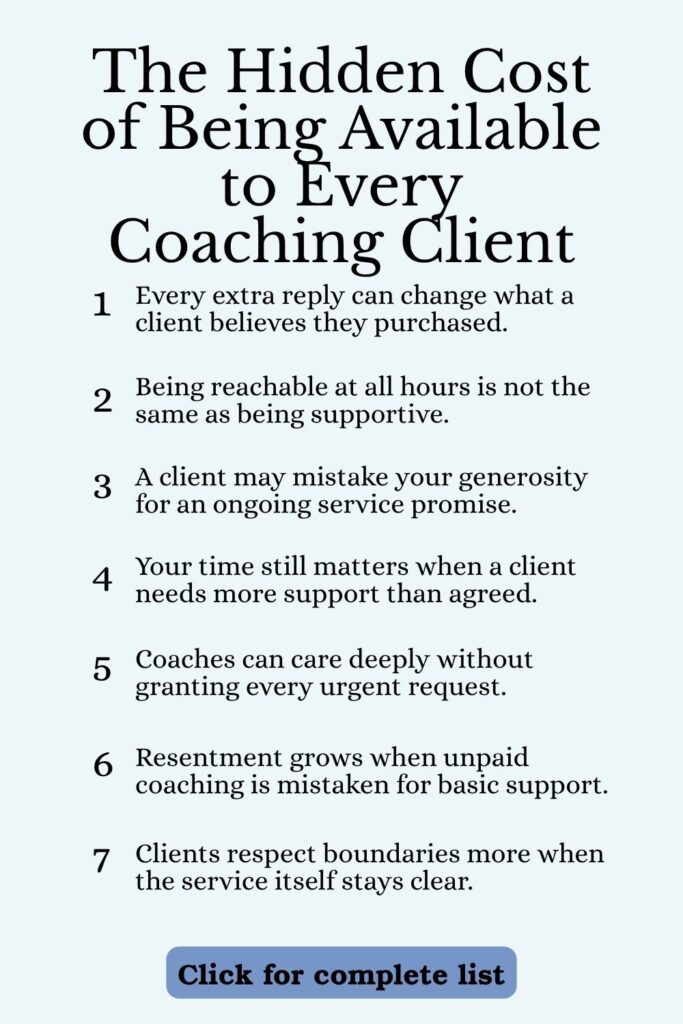
Use the review to answer four questions:
- Are we still working toward the right goal? Compare the original objective with what the client now wants to achieve.
- Is the current coaching arrangement working? Review session frequency, communication expectations, and the support being provided.
- Are both parties meeting their commitments? Discuss attendance, follow-through, agreed materials, and responsiveness without turning the review into a blame exercise.
- Does anything need to change? Identify whether the client needs a revised goal, a different package, additional sessions, or support outside your expertise.
Consider a client who originally hired you for confidence coaching but begins asking for detailed help launching a business.
If business strategy isn’t part of your coaching expertise or the original agreement, you shouldn’t quietly expand your services to accommodate every request.
Explain the distinction and discuss the client’s options. That may involve refocusing the current coaching, creating a new agreement for services you’re qualified to provide, or referring them to someone with different expertise.
The same principle applies when a client wants more access to you.
SEE ALSO: If you’re a coach looking to streamline your administrative tasks and save time, check out our Coaching Administration Software. It’s a simple, effective solution designed to help you focus less on paperwork and more on what matters—coaching your clients. From scheduling to client management, our software gives you the tools to run your business efficiently. Ready to reclaim your time and boost productivity? Click or tap here.
If a client purchased two sessions per month but now wants weekly sessions, discuss what that change would mean for scheduling and price before offering the additional time.
Reviewing expectations is also useful before a client renews their coaching package.
Rather than assuming they’ll continue under the same arrangement, review their progress, remaining goals, and whether another coaching package would genuinely serve them.
That approach fits the relationship-based thinking behind client lifetime value for coaches, where continued business comes from serving clients’ evolving needs rather than simply selling more sessions.
When managing several clients, LCH Core’s Engagement Report can help you identify changes in participation and activity that may warrant a check-in. Those signals provide a starting point for a conversation, not proof that a client is unhappy.
What Should You Do When a Client Says You Haven’t Delivered?
When a coaching client believes you haven’t delivered what was promised, start by identifying the specific expectation they believe was unmet and comparing it with the original agreement.
SEE ALSO: If you’re a coach looking to streamline your administrative tasks and save time, check out our Coaching Administration Software. It’s a simple, effective solution designed to help you focus less on paperwork and more on what matters—coaching your clients. From scheduling to client management, our software gives you the tools to run your business efficiently. Ready to reclaim your time and boost productivity? Click or tap here.
Don’t immediately assume the client is being unreasonable. Equally, don’t promise additional services or a refund before you understand what happened.
A practical resolution process involves five steps.
1. Ask the client to explain the problem.
Find out what they expected and what they believe they received instead.
A complaint such as “I haven’t had enough support” is too vague to resolve without asking what kind of support they were expecting.
2. Review the original agreement and your communication.
Check the coaching package description, written agreement, payment terms, and any additional promises made during the sales process.
For example, perhaps the client signed up for four monthly sessions but believes unlimited email access was also included. Look at the actual wording rather than relying on what either of you remembers.
SEE ALSO: If you’re a coach looking to streamline your administrative tasks and save time, check out our Coaching Administration Software. It’s a simple, effective solution designed to help you focus less on paperwork and more on what matters—coaching your clients. From scheduling to client management, our software gives you the tools to run your business efficiently. Ready to reclaim your time and boost productivity? Click or tap here.
3. Identify where the mismatch occurred.
There are several possibilities.
The client may have misunderstood a clearly defined service. Your explanation may have been ambiguous. The client’s needs may have changed, or you may genuinely have failed to deliver something you promised.
Each situation calls for a different response.
4. Discuss a reasonable resolution.
If the client misunderstood the package, explain the agreed terms and discuss how to move forward.
If your description was unclear, acknowledge that and consider a fair adjustment.
If you failed to deliver an agreed session or resource, take responsibility for correcting the omission. Depending on the circumstances, an appropriate solution might involve providing the missing service, changing the arrangement, or discussing a refund.
SEE ALSO: If you’re a coach looking to streamline your administrative tasks and save time, check out our Coaching Administration Software. It’s a simple, effective solution designed to help you focus less on paperwork and more on what matters—coaching your clients. From scheduling to client management, our software gives you the tools to run your business efficiently. Ready to reclaim your time and boost productivity? Click or tap here.
Check applicable consumer laws and the agreement before making decisions about refunds or termination. A no-refunds statement doesn’t automatically settle every dispute.
5. Document the outcome and improve your process.
After resolving the issue, record what was agreed and any changes to the coaching arrangement.
If the complaint revealed a weakness in your package description, intake questions, or communication policies, correct it before onboarding your next client.
For example, if several clients assume “ongoing support” includes evening and weekend access, that language needs changing.
The purpose isn’t to create an agreement so detailed that nobody wants to read it. It’s to remove uncertainty about the commitments that matter most.
And if a client leaves dissatisfied, keep your response professional. Don’t disclose confidential coaching information in a public argument, even if the client has criticized you online.
SEE ALSO: If you’re a coach looking to streamline your administrative tasks and save time, check out our Coaching Administration Software. It’s a simple, effective solution designed to help you focus less on paperwork and more on what matters—coaching your clients. From scheduling to client management, our software gives you the tools to run your business efficiently. Ready to reclaim your time and boost productivity? Click or tap here.
A coaching relationship can end without both parties agreeing on every detail. The important thing is that you’ve handled the disagreement fairly, respected your obligations, and learned what needs to change.
Where LCH Core Fits

LCH Core can support client expectation management by keeping onboarding documents, client information, agreed goals, and progress records connected throughout the coaching relationship.
The practical process begins before the first paid session and continues as the client works through their coaching package.
A simple workflow looks like this:
- Clarify the client’s expectations. Use intake forms to collect goals, coaching preferences, and background information before beginning the engagement.
- Document the arrangement. Use a Welcome Package containing a welcome letter, coaching agreement with electronic signature, and relevant forms.
- Define and organize the service. Use coaching packages, scheduling, payments, and billing to keep the agreed services and financial arrangements organized.
- Support follow-through. Assign goals, action items, journals, worksheets, or resources that match the client’s coaching objectives.
- Review the relationship. Use the Progress Stream to examine progress and the Engagement Report to identify engagement changes that may call for a conversation.
This gives you a consistent process for managing client expectations instead of reconstructing what was agreed from separate documents and emails.
The same system can support clients with different packages without requiring you to recreate every form or worksheet each time.
SEE ALSO: If you’re a coach looking to streamline your administrative tasks and save time, check out our Coaching Administration Software. It’s a simple, effective solution designed to help you focus less on paperwork and more on what matters—coaching your clients. From scheduling to client management, our software gives you the tools to run your business efficiently. Ready to reclaim your time and boost productivity? Click or tap here.
For example, a career coaching client might receive a different intake form and set of goals from a leadership coaching client, while both follow the same basic agreement, onboarding, and progress-review process.
You can find more information about these capabilities in the LCH Core coaching software overview and the LCH Core video tutorials.
Frequently Asked Questions About Coaching Client Expectations
What should a life coach include in a client agreement?
A life coach should include the scope of coaching, session frequency and length, fees, payment terms, cancellation policies, communication boundaries, confidentiality, and the responsibilities of both parties. The agreement should also explain how changes or termination will be handled.
How do you explain coaching boundaries to a new client?
Explain coaching boundaries by describing exactly what support is included, when you are available, and how the client can contact you. Give examples of requests that belong in scheduled sessions and those suitable for brief between-session communication.
Should life coaches offer unlimited email or messaging support?
Life coaches can offer unlimited messaging support, but they should clearly define what that means. Unlimited messages shouldn’t be left open to interpretation as unlimited coaching time, immediate responses, or availability outside business hours.
How quickly should a coach respond to client messages?
A coach should respond within the timeframe agreed with the client. For example, a coach might commit to replying within two business days, excluding weekends and holidays. The specific timeframe should reflect the package being sold and the coach’s actual availability.
SEE ALSO: If you’re a coach looking to streamline your administrative tasks and save time, check out our Coaching Administration Software. It’s a simple, effective solution designed to help you focus less on paperwork and more on what matters—coaching your clients. From scheduling to client management, our software gives you the tools to run your business efficiently. Ready to reclaim your time and boost productivity? Click or tap here.
Can a life coach guarantee specific results?
A life coach should not guarantee outcomes that depend on client actions or outside circumstances. Coaches can commit to delivering the agreed services, supporting goal development, and reviewing progress, but they cannot control decisions made by employers, partners, customers, or other people.
What should you do if a client asks for services outside their coaching package?
Explain which requested services fall outside the original agreement and discuss whether additional support would be appropriate. You can offer a separate session, propose a revised package, or refer the client elsewhere if the request falls outside your expertise.
How often should coaches review client goals and expectations?
Coaches should review expectations at agreed milestones and whenever the client’s circumstances or goals change. An initial review after several sessions, followed by progress reviews at major package checkpoints, helps identify misunderstandings before they become bigger problems.
How should a coach handle a client who wants a refund?
A coach should review the client’s complaint, the agreed services, the terms of the coaching agreement, and what was actually delivered. Explain the available options clearly and handle the request in accordance with the agreement and applicable consumer laws. If the coach failed to provide a promised service, that should be addressed directly.
Don’t put yourself in the precarious position of having a client who expects more than you’d planned to offer. By providing complete details of what your coaching clients will get from your services, you will be far more likely to have happy, successful customers who recommend you to their friends.
Sources
International Coaching Federation. “ICF Code of Ethics.” International Coaching Federation, effective 1 Apr. 2025, https://coachingfederation.org/credentialing/coaching-ethics/icf-code-of-ethics/.
SEE ALSO: If you’re a coach looking to streamline your administrative tasks and save time, check out our Coaching Administration Software. It’s a simple, effective solution designed to help you focus less on paperwork and more on what matters—coaching your clients. From scheduling to client management, our software gives you the tools to run your business efficiently. Ready to reclaim your time and boost productivity? Click or tap here.
International Coaching Federation. 2025 ICF Core Competencies. International Coaching Federation, Sept. 2025, https://coachingfederation.org/wp-content/uploads/2025/09/icf-cs-core-competencies-2025.pdf.
Life Coach Hub. “How to Onboard Your Clients Professionally with a Welcome Package.” Life Coach Hub, https://lifecoachhub.com/support/coaches/welcome-packages-and-agreements/how-to-onboard-your-clients-professionally-with-a-welcome-package/.
Life Coach Hub. “What Is the Progress Stream?.” Life Coach Hub, https://lifecoachhub.com/support/coaches/client-management/what-is-the-progress-stream/.
Life Coach Hub. “How to Use the Engagement Report to Manage Client Health.” Life Coach Hub, https://lifecoachhub.com/support/coaches/client-management/how-to-use-the-engagement-report-to-manage-client-health/.
Read this next

7 Best Coaching Business Models Proven To Boost Your Success
Adopt a profitable coaching business model today and let your company thrive!
Read More
How to Choose the Right Coaching Style For Starting your Coaching Business
Eliminate the overwhelm and intimidation by learning how to choose the right coaching style for your personality.
Read More
The Truth About Building A Coaching Business
Thinking of starting a career as a coach? Learn from my mistakes first!
Read More