





How to Choose the Right Coaching Style For Starting your Coaching Business

Deciding which coaching model to choose can be fun and easy.
As you begin your own coaching practice it is easy to become completely overwhelmed. There are so many options to choose from!
You can coach one-on-one or what is called ‘private’, you can coach completely online, or you can coach groups. With so many options it’s hard to pick the right one as you begin your personal journey to coaching success.
As you progress, you will eventually use a combination of all of these coaching options but at the beginning it’s important that you don’t spread yourself too thin. Think of it like a magnifying glass in the sun… You want to focus all of your energy and efforts on one precise point to have the greatest chance of success.
This article will show you how to pick the right coaching modality for your initial efforts. We’ll delve into the specifics of each modality, the pros, the cons, the possibilities, and so much more. By the end you’ll have a solid understanding of the different options available to you and a good idea of where you would like to focus your efforts.
Let’s jump right in!
SEE ALSO: If you’re a coach looking to streamline your administrative tasks and save time, check out our Coaching Administration Software. It’s a simple, effective solution designed to help you focus less on paperwork and more on what matters—coaching your clients. From scheduling to client management, our software gives you the tools to run your business efficiently. Ready to reclaim your time and boost productivity? Click or tap here.
Key Takeaways
- Choose your coaching style around the work clients need. Private, asynchronous, and group coaching create different levels of access, personalization, interaction, and accountability.
- Run the capacity math before choosing a model. One-on-one coaching can support premium pricing, but every client also creates preparation, administration, follow-up, and delivery time.
- Online coaching is a delivery channel, not one fixed coaching style. You can coach privately by video, asynchronously through written interaction, or combine live sessions with between-session coaching tools.
- Group coaching works best when part of your method is repeatable. Clients should share enough of the same problem or process to benefit from learning together.
- Test your model before committing to it. A small pilot with real clients gives you better evidence than choosing solely according to what sounds appealing.
How Do You Choose the Right Coaching Style for Your Business?
Choose a coaching style by matching the client’s problem, the level of individual attention required, your available capacity, the economics of the offer, and the way the coaching needs to be delivered. Your personality matters, but it should not be the only deciding factor.
Private coaching is a strong fit when clients need highly individualized attention. Asynchronous coaching can work when clients benefit from reflection and support between scheduled conversations. Group coaching becomes more practical when several clients can move through a shared process and benefit from one another’s questions, experiences, and accountability.
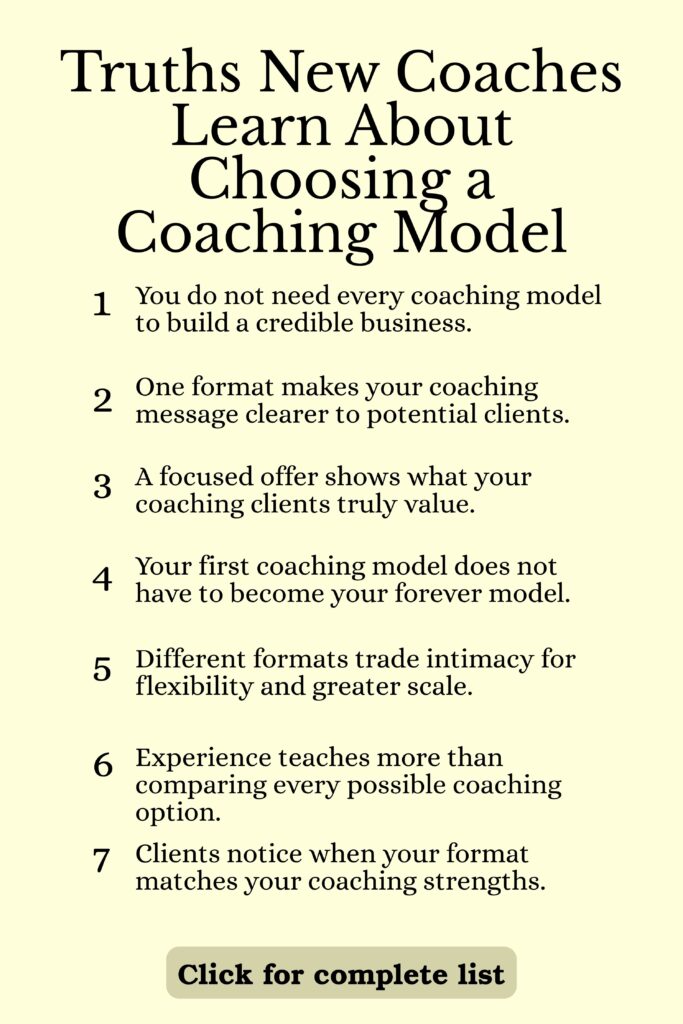
You also do not have to choose one model forever. Start with the format that fits the clients and offer you can serve now, learn how it performs in practice, then add another delivery model when there is a clear reason to do it.
How Do Private, Online, and Group Coaching Compare?
Below you’ll find a quick comparison of the three different coaching modalities: Private, online, and group coaching. You’ll find the pros, cons, and interesting points of each. The table highlights the main points and later on we’ll discuss each in much greater detail.
- Private Coaching: One-on-one coaching with a client using verbal communication by phone or Skype
- Online Coaching: One-on-one coaching with a client using typed communication comparable to email
- Group Coaching: One-on-many coaching with multiple clients using verbal communication with the group by phone or by webinars
All coaching modalities use the plethora of tools and resources available on Life Coach Hub
Quick comparison of coaching styles
|
COACHING STYLE |
PROS |
CONS |
|---|---|---|
|
PRIVATE COACHING |
|
|
|
ONLINE COACHING |
|
|
|
GROUP COACHING |
|
|
This chart gives you a quick snapshot of the differences between the three coaching styles.
SEE ALSO: If you’re a coach looking to streamline your administrative tasks and save time, check out our Coaching Administration Software. It’s a simple, effective solution designed to help you focus less on paperwork and more on what matters—coaching your clients. From scheduling to client management, our software gives you the tools to run your business efficiently. Ready to reclaim your time and boost productivity? Click or tap here.
Now we’ll delve into these specific points so you can have an even clearer vision of where you wish to take your coaching practice.
Personal coaching allows an intimate connection with your client. Photo by Gianmaria Zanotti
What Should Actually Determine Your Coaching Style?
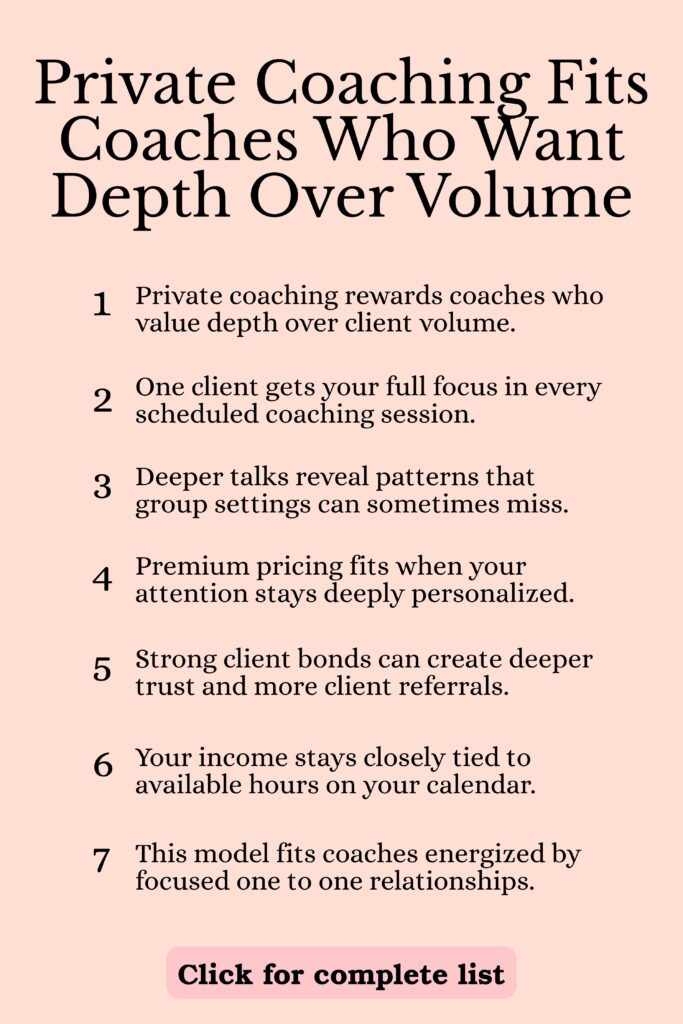
The right coaching style should fit five things: the client’s need, interaction depth, your capacity, the economics of the offer, and the way the work needs to be delivered.
Use these five questions before choosing:
- What does the client actually need? Does the problem require individualized discussion, or can several clients work through the same process?
- How much personal interaction creates value? Does progress depend on a private conversation, ongoing written reflection, peer discussion, or some combination?
- How many clients can you serve well? Count preparation, follow-up, notes, administration, and between-session support, not just time spent on calls.
- How does the offer make financial sense? Look at price, delivery time, client capacity, and the work required for each additional client.
- What delivery rhythm can you sustain? A model that works on paper can become difficult if it requires more scheduled calls, written feedback, or group facilitation than you realistically want to provide.
Consider a career coach who specializes in interview preparation. A senior executive preparing for a high-stakes panel interview may need private coaching built around that person’s role, history, answers, and communication habits.
The same coach might also have a repeatable job-search method covering resumes, networking, interview preparation, and follow-up. That material could lend itself to a group program, with individual coaching reserved for issues that genuinely need private attention.
SEE ALSO: If you’re a coach looking to streamline your administrative tasks and save time, check out our Coaching Administration Software. It’s a simple, effective solution designed to help you focus less on paperwork and more on what matters—coaching your clients. From scheduling to client management, our software gives you the tools to run your business efficiently. Ready to reclaim your time and boost productivity? Click or tap here.
This is also why your software should not dictate your coaching model. LCH Core supports client management, scheduling, payments, coaching packages, coaching tools, progress tracking, courses, and digital products, so you can change how you deliver your coaching without rebuilding the administrative side of your business from scratch.
What Is Private Coaching?
Private coaching, or one-on-one coaching, is the most common form of coaching and probably the type that you are most familiar with. In private coaching you work one-on-one with a client to improve his or her quality of life.
This type of coaching is called ‘private’ because of its intimate nature. You chat with your client on regularly scheduled times and days over the phone, in person, or using an internet tool such as Skype.
Your client will complete their Coaching Plan before their session to allow you to plan, and give you a Follow-Up after. You’ll be able to take private notes during each session. All these details will be stored securely in your dashboard, as a kind of living document you can continue to refer to. Your client will have their own document within their Coaching Pad. You’ll also be able to assign any other coaching tools based on the content of your sessions, such as journaling, goals, action items and assessments.
Private coaching is a valuable style of coaching and is perhaps most beneficial to your potential clients. The one-on-one individualized focus provides immense value to those that you are working with.
What Are the Advantages of Private Coaching?
There are a number of things that make private coaching a great choice for your initial coaching efforts.
SEE ALSO: If you’re a coach looking to streamline your administrative tasks and save time, check out our Coaching Administration Software. It’s a simple, effective solution designed to help you focus less on paperwork and more on what matters—coaching your clients. From scheduling to client management, our software gives you the tools to run your business efficiently. Ready to reclaim your time and boost productivity? Click or tap here.
Private coaching is all about developing a strong relationship with your client.
In a private coaching relationship, your client will place their trust in you, and you will do all that you are capable of doing in order to assist them in their growth and development. This intimate relationship is the major benefit of private coaching and this is what makes it stand out from the other coaching modalities.
Through this relationship your client will become more and more committed to the sessions and their own success. It is natural that clients who sign up for private coaching are initially more serious about coaching in general and more committed to sticking with it for the long haul.
Since you are spending your time directly with a client and focusing your full attention on them, you are able to charge a premium for your services. Your rates will vary drastically depending on your experience but more importantly, your capabilities as a coach; they can range anywhere from $50-$500 per hour. You are a valuable coach and have a lot to offer your client. When you focus on one individual at a time you can have a dramatic effect upon their quality of life.
A one-on-one private coaching relationship also fosters quick progress as you are able to work through challenges verbally and without any distractions. In essence, you are giving yourself completely to your client for the length of your session (typically 30-60 minutes), using your entire stock of knowledge and abilities to do the best you can for their improvement in quality of life.
Key Benefit: The strength of the relationship you will cultivate with your client.
SEE ALSO: If you’re a coach looking to streamline your administrative tasks and save time, check out our Coaching Administration Software. It’s a simple, effective solution designed to help you focus less on paperwork and more on what matters—coaching your clients. From scheduling to client management, our software gives you the tools to run your business efficiently. Ready to reclaim your time and boost productivity? Click or tap here.
This results in:
- More trust
- More commitment
- Deeper friendship
- More fun
- Faster growth
- More referrals and recommendations
However, just like with any choice, there are two sides to the coin. Let’s discuss some of the cons.
What Are the Drawbacks of Private Coaching?
Though there aren’t many negatives about private coaching there are a few that are worth being aware of.
First and foremost, you only have a limited amount of time in your day; therefore, you only have a limited amount of time to coach your clientele one-on one. When you factor in sleep, you only have 16 hours left in your day and you can’t spend all of that time coaching no matter how badly you want to.
This seriously limits the amount of people you are able to help. The upside though is that you build a much stronger relationship through your personal interaction as I discussed above. You can then focus on having a great impact on each client and allow the ripple effect to take place. The ripple effect occurs when your clients experience so much growth that they naturally help those around them.
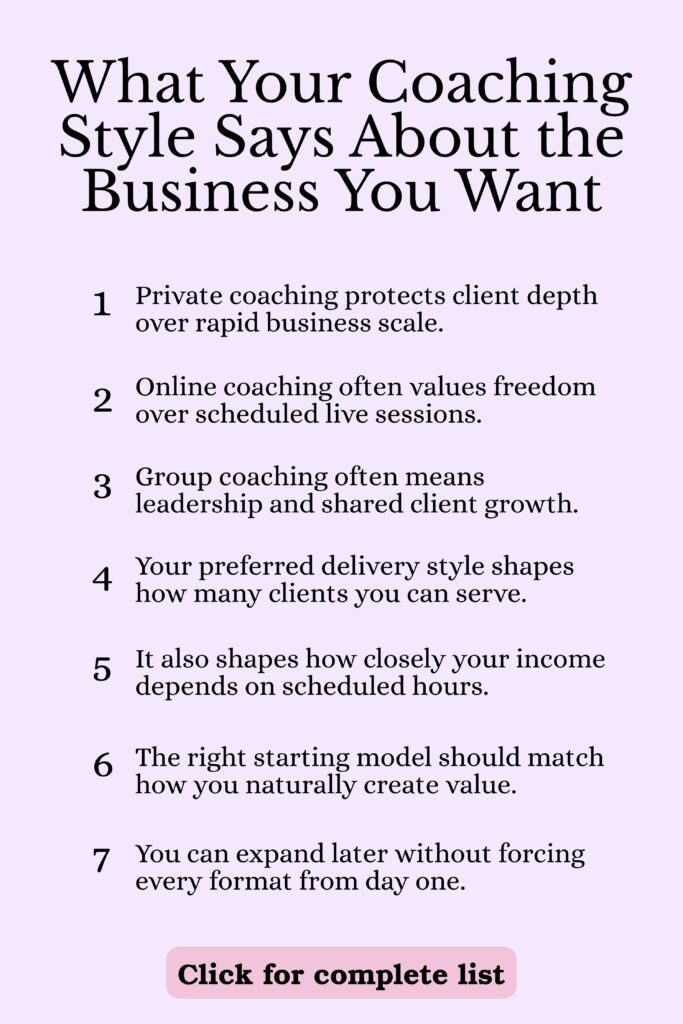
Secondly, you are earning income actively. This means that you must work and put in the time in order to earn your living. With private coaching you are trading your time for money. This is the typical model of income generation but there are other options available to you. You could earn income passively through different coaching delivery methods but not with private coaching. This means that you will have to consistently work to consistently earn money. Not a bad thing unless you like the idea of earning a passive income.
SEE ALSO: If you’re a coach looking to streamline your administrative tasks and save time, check out our Coaching Administration Software. It’s a simple, effective solution designed to help you focus less on paperwork and more on what matters—coaching your clients. From scheduling to client management, our software gives you the tools to run your business efficiently. Ready to reclaim your time and boost productivity? Click or tap here.
When Does Private Coaching Make the Most Sense?
From the above pros and cons, you can see that there are great reasons to focus on private coaching and also some reasons to focus on another coaching style. Ultimately, your decision all comes down to your particular personality and preferences.
Private coaching allows you to develop an intimate relationship with a serious client that is willing to shell out the big bucks for your valuable service. On the flip side however, you are also limited in how many people you can help at one time and you must always be working in order to generate revenue.
Private coaching is a great option to begin with and that is what many new professionals are doing.
Let’s take a look at another style now and see if it may be a better fit for what you have in mind.
Online coaching plugs you in to your client at times that fit your schedule.Photo by photosteve101
What Does the Math of One-on-One Coaching Look Like?
The real capacity of a one-on-one coaching business is determined by total client workload, not the number of session slots on your calendar.
SEE ALSO: If you’re a coach looking to streamline your administrative tasks and save time, check out our Coaching Administration Software. It’s a simple, effective solution designed to help you focus less on paperwork and more on what matters—coaching your clients. From scheduling to client management, our software gives you the tools to run your business efficiently. Ready to reclaim your time and boost productivity? Click or tap here.
Start with the simplest version:
Available coaching hours × realistic number of paid sessions = live delivery capacity
Then add the work surrounding those sessions.
A 60-minute coaching session may also require reviewing client information, preparing questions or tools, writing notes, assigning an action item, answering a message, processing payment, or handling scheduling. Ten one-hour sessions therefore do not necessarily equal ten hours of work.
This matters because private coaching can support substantial fees, but the session fee is not the same thing as your effective hourly revenue.
According to the International Coaching Federation’s 2023 ICF Global Coaching Study, the average reported fee for a one-hour coaching session in 2022 was $244 globally. Active coach practitioners averaged 11.9 coaching hours per week and 12.2 active clients.
SEE ALSO: If you’re a coach looking to streamline your administrative tasks and save time, check out our Coaching Administration Software. It’s a simple, effective solution designed to help you focus less on paperwork and more on what matters—coaching your clients. From scheduling to client management, our software gives you the tools to run your business efficiently. Ready to reclaim your time and boost productivity? Click or tap here.
Those are benchmarks, not instructions for what you should charge or how many clients you should carry. Your niche, market, experience, geography, offer, client type, and the work surrounding each session all affect your own numbers.
For example, suppose you have 15 hours a week available for client work. If eight hours are spent in sessions and another four are regularly disappearing into preparation, follow-up, scheduling, and administration, you have only three hours of spare client capacity. Adding seven more sessions because there appear to be seven blank hours on your calendar would create a very different workload from the one you calculated.
This is also why packages can be more useful to analyze than isolated hourly rates. Look at the total revenue from a coaching relationship against the total work required to deliver it. The same principle sits behind the math of client lifetime value for coaches.
If administration is eating into that capacity, tools such as a Public Booking Page, coaching packages, billing, client profiles, and reusable coaching resources can reduce the amount of repeated work surrounding each client. LCH Core’s Public Booking Page setup guide shows how prospects can book selected sessions against the availability you set.
What Is Online Coaching?
Online coaching is a little different from private coaching but not by much. In online coaching you are still working one-on-one with a client but you are not communicating verbally. This means that all communication is done online through messages and plain text. You won’t have regular sessions with your client where you have verbal conversation about their current situation but rather an ongoing communication with your client completely online.
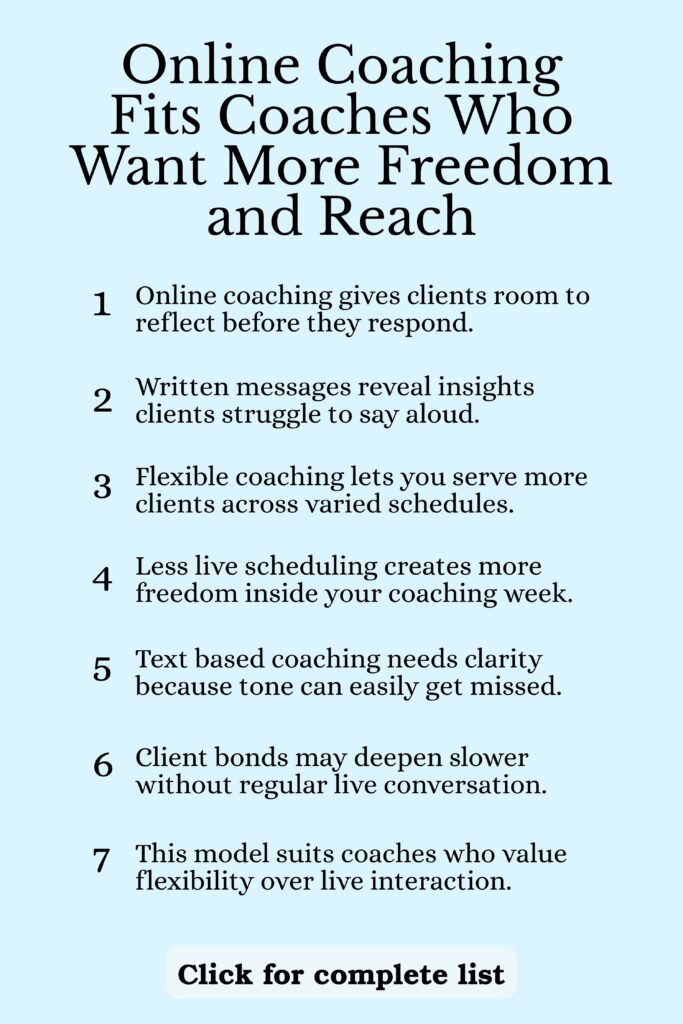
Your client will submit progress reports to you on regular dates that you both select and from there you will comment on their progress and use a variety of tools to help accelerate their growth.
SEE ALSO: If you’re a coach looking to streamline your administrative tasks and save time, check out our Coaching Administration Software. It’s a simple, effective solution designed to help you focus less on paperwork and more on what matters—coaching your clients. From scheduling to client management, our software gives you the tools to run your business efficiently. Ready to reclaim your time and boost productivity? Click or tap here.
Just like private coaching, there are numerous pros and cons to online coaching. Let’s take a look.
What Are the Advantages of Asynchronous Online Coaching?
The biggest advantage to providing online coaching is the freedom that it allows both you and your client. Instead of having regular sessions where you must both have an opening in your schedule, you can each access the coaching material at any convenient time. This allows you to work when you want and where you want as you no longer have to account for time zone differences and hectic schedules.
With online coaching you don’t have traditional sessions with your client as you do in private coaching. Here you have your client submit progress reports and other coaching tools (such as journals, goals, action items, and assessments) instead of having an individual session and you then comment on their progress. This enables you to take on many more clients than you could with private coaching and thus have a greater impact on the world around you.
Online coaching is much more passive than private coachinsg. Using the resources that your Life Coach Hub dashboard offers you, you can put in the time up front to create value and manage the intervals at which it is sent to your client. You can then sit back once your client signs up and simply comment upon what they submit. You’ll then have more freedom within your own life to pursue your other interests or hobbies.
This is a beautiful leveraging of technology that allows you to help more people, earn more money, and free up your personal life.
Key Benefit: You obtain freedom within your work life.
SEE ALSO: If you’re a coach looking to streamline your administrative tasks and save time, check out our Coaching Administration Software. It’s a simple, effective solution designed to help you focus less on paperwork and more on what matters—coaching your clients. From scheduling to client management, our software gives you the tools to run your business efficiently. Ready to reclaim your time and boost productivity? Click or tap here.
This results in:
- This results in:
- Less stress
- More enjoyment
- Productivity
- Happiness
- Peak performance
Just as with private coaching, there are some negative aspects that you should be aware of.
What Are the Drawbacks of Asynchronous Online Coaching?
There aren’t many cons regarding online coaching but there are a couple worth mentioning.
Firstly, it’s going to be much more difficult to build a deep relationship with your client. In private coaching you have the benefit of actually speaking with your client and that goes a long way towards building a trusting relationship. With online coaching however, you don’t have the benefit of such interaction. The only interaction you have is through messages and plain ‘ol text. Now it’s not impossible to establish a strong relationship but it will take some work to do so.
Secondly, your rates are going to be much lower than if you choose private coaching. Since the interaction is much more limited within online coaching, you can’t justify charging the premium rates you would charge in private coaching. This may be a huge benefit to your client if they are tight on money so this could also be stated as a pro of online coaching. Just understand up front that you will charge much less for your online coaching than you would for your private coaching.
Lastly, the results that your client will achieve will typically come about more slowly than they would in private coaching. It takes longer to communicate through text and work through real challenges than it does verbally. You can account for this issue however and ensure your success by learning to communicate effectively and precisely through your messages. You can also use all the coaching tools at your disposal so you can have your value delivered in more effective ways.
SEE ALSO: If you’re a coach looking to streamline your administrative tasks and save time, check out our Coaching Administration Software. It’s a simple, effective solution designed to help you focus less on paperwork and more on what matters—coaching your clients. From scheduling to client management, our software gives you the tools to run your business efficiently. Ready to reclaim your time and boost productivity? Click or tap here.
All in all, the negative aspects of online coaching can be accounted for up front. This pre-planning will eliminate the obvious roadblocks to your running a successful coaching practice.
When Does Asynchronous Coaching Make the Most Sense?
Online coaching is a great opportunity for you to leverage technology to deliver your services so you can enjoy more freedom of time and money in your life. This option is less of a burden on you and your client’s schedules allowing for more relaxed interaction and an optimal pace of growth.
Once again I want to reiterate that your choice of primary coaching modality relies heavily upon you as an individual and what you would prefer in your own coaching business. There is no right or wrong choice as every method is an effective method that will inspire much growth.
We’ve covered both private and online coaching and now it’s about time we covered group coaching.
Group coaching connects people from all over to help them grow. Photo by linh.ngan
Does Online Coaching Have to Mean Text-Only Coaching?
Online coaching does not have to mean text-only coaching because “online” describes where coaching happens, while private, asynchronous, and group describe how the coaching relationship is structured.
SEE ALSO: If you’re a coach looking to streamline your administrative tasks and save time, check out our Coaching Administration Software. It’s a simple, effective solution designed to help you focus less on paperwork and more on what matters—coaching your clients. From scheduling to client management, our software gives you the tools to run your business efficiently. Ready to reclaim your time and boost productivity? Click or tap here.
That distinction gives you more options than choosing between a phone call and written messages.
You could run:
- Private one-on-one coaching through live video calls.
- Asynchronous coaching using written reflections and coach responses.
- Private live sessions with journals or action items between calls.
- A group program with live sessions and individual exercises between meetings.
- A course or structured learning resource supported by coaching sessions.
Think about a leadership coach working with a new manager. A live private session may be the right place to unpack a difficult conversation with an employee. A worksheet could help the manager plan the conversation afterward. An action item could capture what they agreed to try before the next session.
Those are different delivery mechanisms serving the same coaching relationship.
This distinction matters when you design your offer. Instead of asking, “Am I an online coach?” ask, “Which interactions need to happen live, which can happen between sessions, and which can be reused?”
LCH Core can support that kind of mixed delivery with journals, worksheets, goals, action items, and resources. The LCH Core coaching tools tutorials show how those tools can be assigned around client sessions, while the Progress Stream brings sessions, notes, and coaching-tool activity together.
SEE ALSO: If you’re a coach looking to streamline your administrative tasks and save time, check out our Coaching Administration Software. It’s a simple, effective solution designed to help you focus less on paperwork and more on what matters—coaching your clients. From scheduling to client management, our software gives you the tools to run your business efficiently. Ready to reclaim your time and boost productivity? Click or tap here.
What Is Group Coaching?
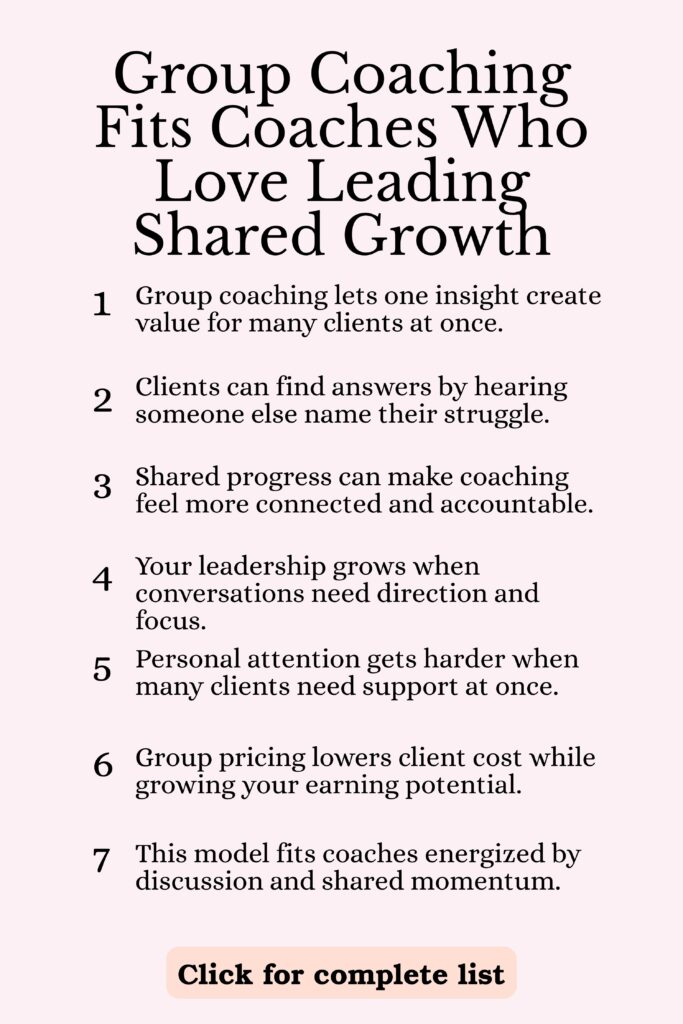
Group coaching is the odd one out of the three primary coaching modalities. Group coaching throws in the added dynamic of assisting multiple people at the same time. It is an awesome way to multiply your influence and ignite valuable discussions between the members of your group.
What Are the Advantages of Group Coaching?
Group coaching is truly a special way of offering your coaching services.
Personally, I have a ton of background experience with team sports and this dynamic plays nicely into group coaching. It’s magnificent to see a group of individuals so invested in each other’s success and development. It gives you that warm fuzzy feeling to witness the natural goodness that is at the core of our being.
The online environment of your group members’ coaching dashbord allows them to interact 24/7 and really cultivates the appropriate environment for growth. It is extremely valuable to have so many minds converging for the singular purpose of growth. You will be amazed at the ideas and solutions that result from such discussions. This is my favorite aspect of coaching a group of people.
You also get to practice your skills as a leader. Since you are interacting with a group of people it’s important that you learn how to guide the conversations in the correct direction. This is valuable in and of itself not to mention the beauty of helping those around you!
Group coaching is a really wonderful way to deliver your services. If you like interacting with multiple people at one time and leading a group towards new discoveries and solutions, this may be the modality for you.
SEE ALSO: If you’re a coach looking to streamline your administrative tasks and save time, check out our Coaching Administration Software. It’s a simple, effective solution designed to help you focus less on paperwork and more on what matters—coaching your clients. From scheduling to client management, our software gives you the tools to run your business efficiently. Ready to reclaim your time and boost productivity? Click or tap here.
Key Benefit: The team atmosphere
This results in:
- More fun
- Experience as a leader
- A plethora of valuable ideas and solutions
- Mutual support
- A great overall experience
- Multiplied effectiveness and reach
Just like the other options there are some potential draw backs to group coaching and that’s what we’ll discover next.
What Are the Drawbacks of Group Coaching?
There are only a couple of potentially negative side effects of serving a group of clients at one time.
First, you won’t be able to give your undivided attention to one person. Your attention will be spread among your entire group which therefore limits the personalization of coaching you could achieve with either private or online coaching. This is a potential benefit as well because group coaching tends to attract those that are intelligent enough to take the concepts you provide and fill in the specifics in their own life. This makes the coaching process easier but there are still those times when somebody just needs the extra individual attention and that is limited with group coaching.
Secondly, you won’t be able to charge as much per person as you would were you to offer your services via private or online coaching. Since your attention is spread it is usually understood by all parties that the cost will be less. You can however make up for this rather easily by attracting a decent number of members to your coaching group. You have the potential to earn much more per hour if you have multiple people in your group.
SEE ALSO: If you’re a coach looking to streamline your administrative tasks and save time, check out our Coaching Administration Software. It’s a simple, effective solution designed to help you focus less on paperwork and more on what matters—coaching your clients. From scheduling to client management, our software gives you the tools to run your business efficiently. Ready to reclaim your time and boost productivity? Click or tap here.
Thirdly, it can be quite difficult to schedule group calls or webinars that fit nicely into everybody’s schedule. Often, you won’t have all of your members present and this is okay. The nice thing about your coaching dashboard is that you can select multiple options for the group call and you can see which time slot works the best – Super valuable tool to have when you are trying to coordinate and lead of group of individuals. You can make up for this slight drawback by recording your calls or webinars and then making them available to your group members so they don’t miss out on any of the important information.
When Does Group Coaching Make the Most Sense?
Group coaching can be an exciting way to deliver your coaching services. The group dynamics serve to mix things up and keep the discussions lively and interesting. You’ll get to witness and participate in a sort of master mind group where everybody is deeply interested in every other member’s success.
There are only minor inconveniences to group coaching and those can be avoided by some thinking and pre-planning.
All-in-all group coaching is one of the best ways to offer your services. You’ll multiply your influence and extend the impact you are able to have on the world around you – Some major benefits if you ask me!
All the pieces will come together easily once you get started. Photo by kenteegardin
How Can You Test a Coaching Style Before Building Your Business Around It?
The safest way to choose a coaching style is to run a small real-world pilot and measure what actually happens.
SEE ALSO: If you’re a coach looking to streamline your administrative tasks and save time, check out our Coaching Administration Software. It’s a simple, effective solution designed to help you focus less on paperwork and more on what matters—coaching your clients. From scheduling to client management, our software gives you the tools to run your business efficiently. Ready to reclaim your time and boost productivity? Click or tap here.
For private or asynchronous coaching, you might test the model with three to five clients. For group coaching, run one short cohort around a clearly defined outcome rather than immediately building a large flagship program.
Track what happens across the full delivery cycle:
- How much time did preparation actually take?
- How much time did delivery and follow-up require?
- Which parts of the process did you repeat?
- Did clients complete the work between sessions?
- Where did clients need more individual attention?
- Did clients continue, renew, or ask for another way to work with you?
- Did the price make sense once you counted the real delivery time?
- Did you want to deliver another round in the same format?
That final question matters. A model can be financially viable and still be a poor long-term fit if you dislike the work it requires every week.
Imagine a coach testing a six-person group. The content works, clients make progress, and the economics look attractive. But three participants repeatedly need private help with situations that cannot be handled appropriately in the group.
That does not automatically mean the group failed. It may mean the offer needs a hybrid structure, such as group sessions plus a limited number of private sessions.
Use the pilot to make one of three decisions: keep the model, modify the model, or replace the model. You are looking for evidence, not trying to prove your first idea was correct.
SEE ALSO: If you’re a coach looking to streamline your administrative tasks and save time, check out our Coaching Administration Software. It’s a simple, effective solution designed to help you focus less on paperwork and more on what matters—coaching your clients. From scheduling to client management, our software gives you the tools to run your business efficiently. Ready to reclaim your time and boost productivity? Click or tap here.
If you manage the pilot through LCH Core, the Progress Stream can help you review client activity over time, while the Engagement Report can help you see engagement patterns rather than relying only on your memory of the sessions.
Which Coaching Style Should You Start With?
When it comes to deciding how to deliver your coaching services, it can be a little overwhelming at times.
You have three primary options:
- Private Coaching
- Online Coaching
- Group Coaching
Your choice should depend entirely on your particular personality and preferences.
For example: If you love the relationship aspect of coaching then you should decide on private coaching. If you love your freedom then you should decide on online coaching. If you love working in a team and being a leader then you should decide on group coaching.
The above are simple examples but they show you how to make your decision. Look within yourself and ask yourself what you would really enjoy. Ultimately, your effectiveness as a coach comes down to how much you enjoy what you are doing. This liveliness infects all of your interactions and your clients can really tell when you are in love with what you are doing.
SEE ALSO: If you’re a coach looking to streamline your administrative tasks and save time, check out our Coaching Administration Software. It’s a simple, effective solution designed to help you focus less on paperwork and more on what matters—coaching your clients. From scheduling to client management, our software gives you the tools to run your business efficiently. Ready to reclaim your time and boost productivity? Click or tap here.
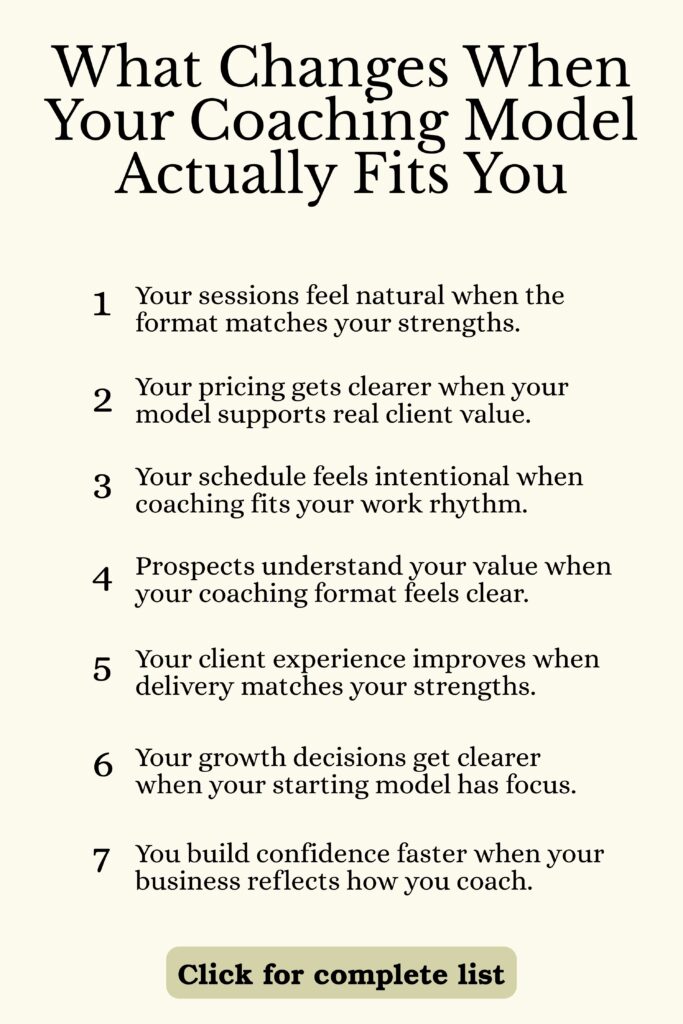
If you still can’t decide, just pick one. There’s no law that says you have to get it right on the first try! Pick a modality that you think would be a great fit for you and try it out for a while. As you gain some experience you’ll come to your own conclusions, extend into other modalities. The more options you can provide your clients, the more people you’ll be serving. The important thing is that you just get started. The details will always fill in as you go.
Don’t take this choice too seriously. Have fun with the possibilities of each option and just go with your gut instinct. Correct course as you go along and your coaching practice will blossom and flourish in such astounding ways. It’s a beautiful thing.
Where LCH Core Fits
LCH Core fits after you decide how you want to coach because the technology should support your delivery model, not choose it for you.
For a private coaching practice, client profiles and notes can keep individual work organized, while the Public Booking Page handles scheduling and coaching packages and billing keep the commercial side connected. A Welcome Package can bring together the welcome letter, coaching agreement with electronic signature, and forms you want completed before the work begins. You can see how Welcome Packages work for coaching clients here.
For coaching that continues between sessions, journals, worksheets, goals, action items, and resources give you ways to structure that work without turning every interaction into another scheduled call. The Progress Stream and Engagement Report then give you ways to review client activity and engagement.
For coaches developing more repeatable offers, coaching packages, courses, and digital products create additional ways to package the work. The Public Store can hold courses and digital products alongside other offers, and the Public Store guide explains how coaches can make those offers available from one public location.
SEE ALSO: If you’re a coach looking to streamline your administrative tasks and save time, check out our Coaching Administration Software. It’s a simple, effective solution designed to help you focus less on paperwork and more on what matters—coaching your clients. From scheduling to client management, our software gives you the tools to run your business efficiently. Ready to reclaim your time and boost productivity? Click or tap here.
Your delivery model is only one part of the business, of course. People still need a way to discover you and take a next step. A free life coach directory listing can give you an additional visibility point, while lead magnets and a Public Booking Page can give interested prospects a concrete next action. If you want to map that wider journey, this guide to coaching funnels breaks down the path from initial visibility through conversion and longer-term client relationships.
The goal is not to add technology for its own sake. It is to have a system that matches the coaching business you have deliberately chosen to build.
Frequently Asked Questions
What is the best coaching style for a new coach?
The most useful starting style is the one that matches your clients’ needs while remaining simple enough for you to deliver consistently. For many new coaches, private coaching provides direct exposure to client questions, objections, goals, and patterns that can later help shape a repeatable group or asynchronous offer.
Should I start with one-on-one or group coaching?
Start with one-on-one coaching when the work is still highly individualized, and consider group coaching when you can identify a repeatable process shared by several clients. A group becomes much easier to design once you know what clients consistently need and what genuinely benefits from peer interaction.
Can I offer both private and group coaching?
Yes, private and group coaching can sit within the same coaching business. You might use a group for the shared process and offer private coaching for clients who need more individualized attention.
What is the difference between online coaching and one-on-one coaching?
Online coaching describes the delivery channel, while one-on-one coaching describes the relationship between one coach and one client. A one-on-one coach can work online through live video, asynchronous written coaching, or a combination of live sessions and between-session activities.
SEE ALSO: If you’re a coach looking to streamline your administrative tasks and save time, check out our Coaching Administration Software. It’s a simple, effective solution designed to help you focus less on paperwork and more on what matters—coaching your clients. From scheduling to client management, our software gives you the tools to run your business efficiently. Ready to reclaim your time and boost productivity? Click or tap here.
Is asynchronous coaching the same as passive income?
No, asynchronous coaching is not automatically passive income because personalized client feedback still requires your time and attention. Reusable worksheets, resources, courses, and digital products can reduce repeated delivery work, but personalized coaching remains an active service whenever you are reviewing and responding to individual clients.
When should a coach move from one-on-one to group coaching?
A coach should consider group coaching when several clients repeatedly need the same core process and can gain something useful from working alongside one another. Look for repeated questions, exercises, milestones, and problems before turning private work into a group offer.
Which coaching model is easiest to scale?
Coaching models become more scalable when additional clients do not require an equal increase in the coach’s delivery hours. Groups, courses, digital products, and reusable resources can change that relationship, but scalability should not come at the expense of the individual attention required to produce the intended coaching experience.
How do I know whether a coaching format is working for my clients?
A coaching format is working when clients participate in the process, complete relevant actions, make observable progress toward their goals, and can use the level of access the format provides. Track those signals alongside your actual delivery time, client continuation, and the parts of the process that repeatedly require more support.
What Coaching Style Will You Test First?
How are you choosing to coach and use Life Coach Hub? What’s your experience so far?
Sources
International Coaching Federation and PricewaterhouseCoopers. 2023 ICF Global Coaching Study: Executive Summary. International Coaching Federation, 2023. International Coaching Federation.
SEE ALSO: If you’re a coach looking to streamline your administrative tasks and save time, check out our Coaching Administration Software. It’s a simple, effective solution designed to help you focus less on paperwork and more on what matters—coaching your clients. From scheduling to client management, our software gives you the tools to run your business efficiently. Ready to reclaim your time and boost productivity? Click or tap here.

Read this next
The Benefits Of Online Coaching
Online therapy is taking the internet by storm with many preferring to have coaching from the comfort of their home.
Read More
Starting a Coaching Business Checklist – Your Ultimate Guide as a Life Coach
Set up your coaching business the right way, the first time. Use this ultimate guide to gear you towards success.
Read More
The Nuts and Bolts of Telephone Coaching: What Type of Equipment to Consider
With the right kind of equipment, you will be able to start your own coaching business.
Read More