







The Root of the Problem in Coaching

How Do You Get to the Root of a Problem in Coaching?
Sometimes it’s good to get to the root of a problem, before you can come up with a solution to the problem.
Key Takeaways
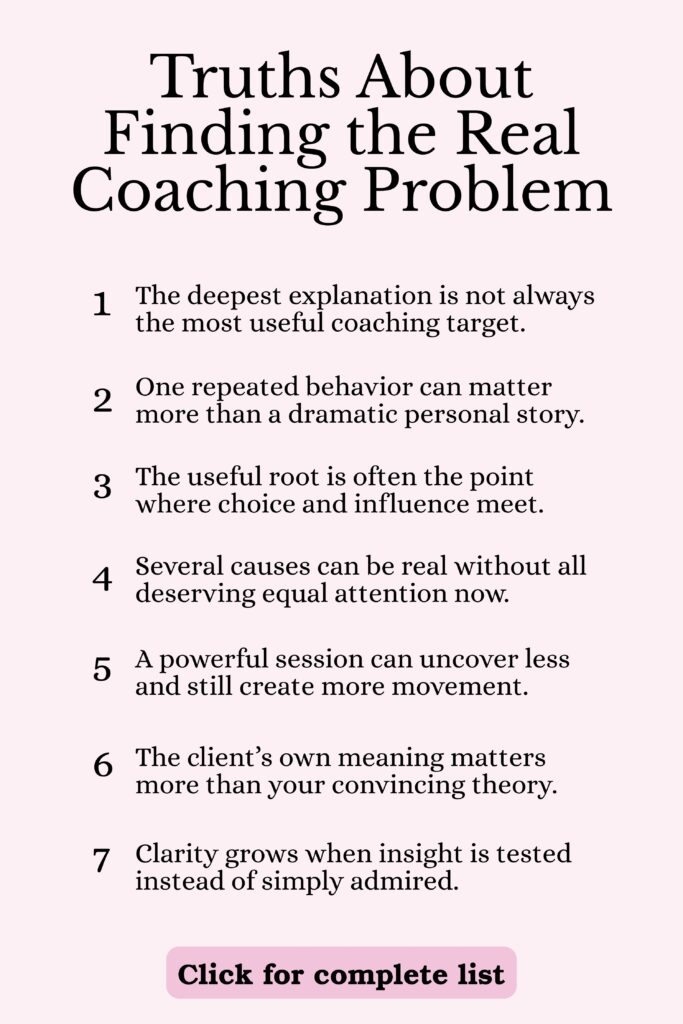
- The first problem named is not always the useful coaching target. A client may complain about time management while the repeating pattern is overcommitting, avoiding decisions, or failing to protect priorities.
- Look for patterns before declaring causes. Compare what happens, when it happens, what the client does next, and what stays consistent across several situations.
- The client should generate the meaning. Powerful questions help clients notice beliefs, choices, constraints, and patterns without the coach diagnosing them or deciding what the “real” problem is.
- Insight needs a behavioral test. Turn the working hypothesis into one specific action, one measure, and a review point so you can see whether changing the suspected driver changes the outcome.
- Stop digging when exploration stops serving forward movement. Coaching should convert useful awareness into client-owned goals and action, while staying within the boundaries of the coaching relationship.
How Do You Get to the Root of a Problem in Coaching?
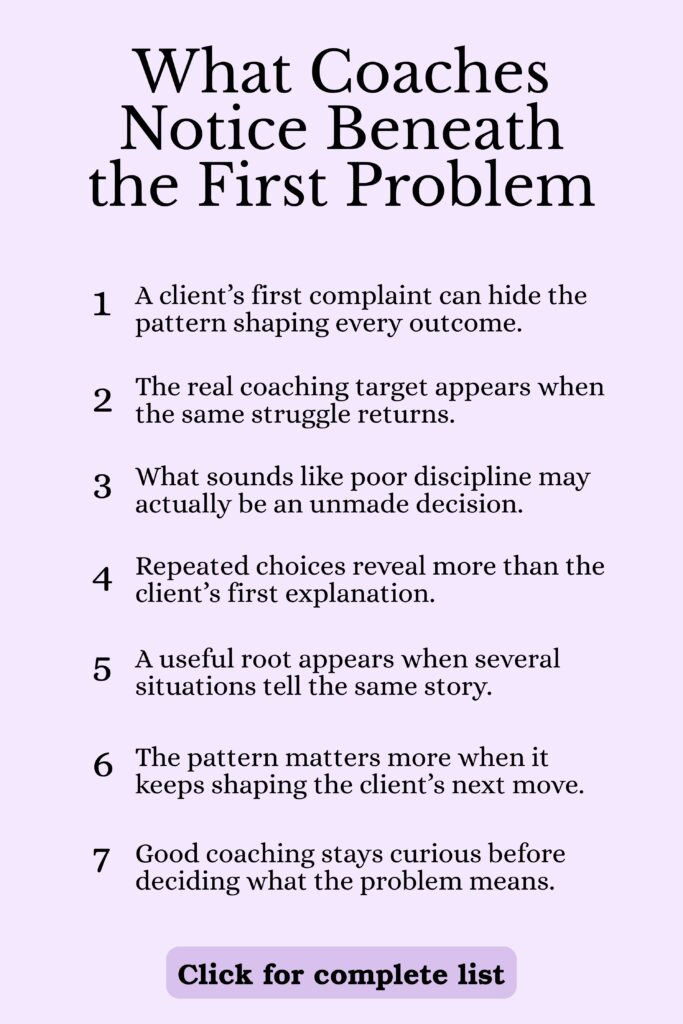
Getting to the root of a problem in coaching means helping the client move from the problem they first describe to the recurring pattern underneath it, then identifying a plausible driver that can be explored through action. The coach does not diagnose a hidden cause or announce what is “really wrong.”
A practical sequence is Presenting Problem → Recurring Pattern → Root Driver → Action Experiment → Review. You first clarify what is happening, notice where the same pattern repeats, explore what may be influencing it, agree on a concrete behavioral experiment, then review what actually changed.
That last step matters. A powerful insight can feel convincing in a session and still turn out to be incomplete. The client’s real-world behavior gives you additional information.
What Does Getting to the Root Look Like in Practice?
Getting to the root works best when exploration leads toward something the client can understand, influence, and act on.
- Allow the person to open up about themselves
- Draw up a complete detail about what you hear that is needed to help them to move forward
- Create a plan of action
- Create a solid foundation to solve the problem to overcome the issues they may be facing
- Encourage them to create short term and long term personal development goals that are not overwhelming for them to complete
The mistake is treating those as five disconnected tasks. They work better as a sequence.
SEE ALSO: If you’re a coach looking to streamline your administrative tasks and save time, check out our Coaching Administration Software. It’s a simple, effective solution designed to help you focus less on paperwork and more on what matters—coaching your clients. From scheduling to client management, our software gives you the tools to run your business efficiently. Ready to reclaim your time and boost productivity? Click or tap here.
Opening up gives you the presenting problem. Listening across examples helps reveal a recurring pattern. Exploring that pattern may uncover a root driver. Planning converts the insight into an action experiment. Short-term and long-term goals give you something concrete to review.
Who Owns the Change in Coaching?
The client owns the change, while the coach owns the quality of the coaching process.
Sometimes you also have to get the person to see the real areas that they may need help in. What area of their life needs the work, in order for them to really get what they need out of coaching. You can not do all the talking and you can not do all the work for them. In order for a person to want change they have to want to at least change something within themselves that will affect the positive and get rid of the negative that is within them and around them.
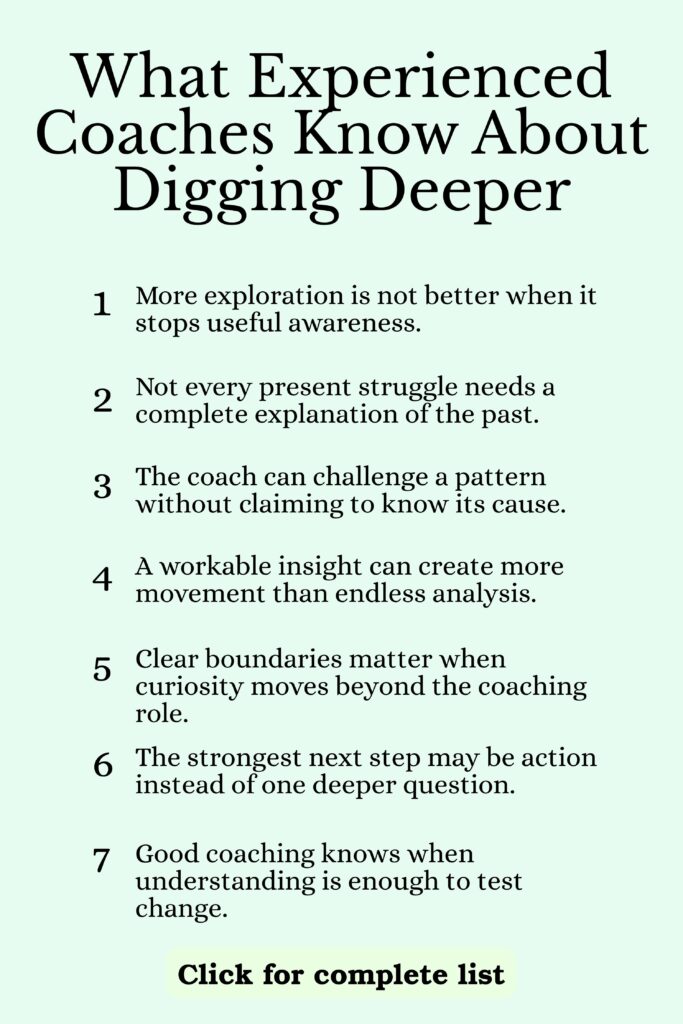
That does not mean you have to sit passively until the client happens upon an insight. You can reflect contradictions, ask sharper questions, point out patterns, and challenge assumptions.
The distinction is ownership. The International Coaching Federation’s updated competency model describes Evokes Awareness as helping clients explore beyond their current thinking and identify factors influencing patterns. It then describes Facilitates Client Growth as partnering with clients to turn learning into goals and action while supporting client autonomy.
You can illuminate the path. The client still has to decide what it means and whether to walk it.
SEE ALSO: If you’re a coach looking to streamline your administrative tasks and save time, check out our Coaching Administration Software. It’s a simple, effective solution designed to help you focus less on paperwork and more on what matters—coaching your clients. From scheduling to client management, our software gives you the tools to run your business efficiently. Ready to reclaim your time and boost productivity? Click or tap here.
Is the Client Naming the Root Problem, or Just the Symptom?
A client’s first description is often the presenting problem, not necessarily the most useful coaching target.
Suppose a client says, “I need to manage my time better.” You could immediately move into calendars, priorities, and productivity techniques.
But first, look at what is actually happening.
The client misses deadlines because she keeps accepting work that she does not have capacity to complete. She agrees to projects while already knowing her week is full. When somebody asks for help, she answers immediately rather than checking her commitments.
“Poor time management” describes the outcome. Overcommitting may be the recurring pattern.
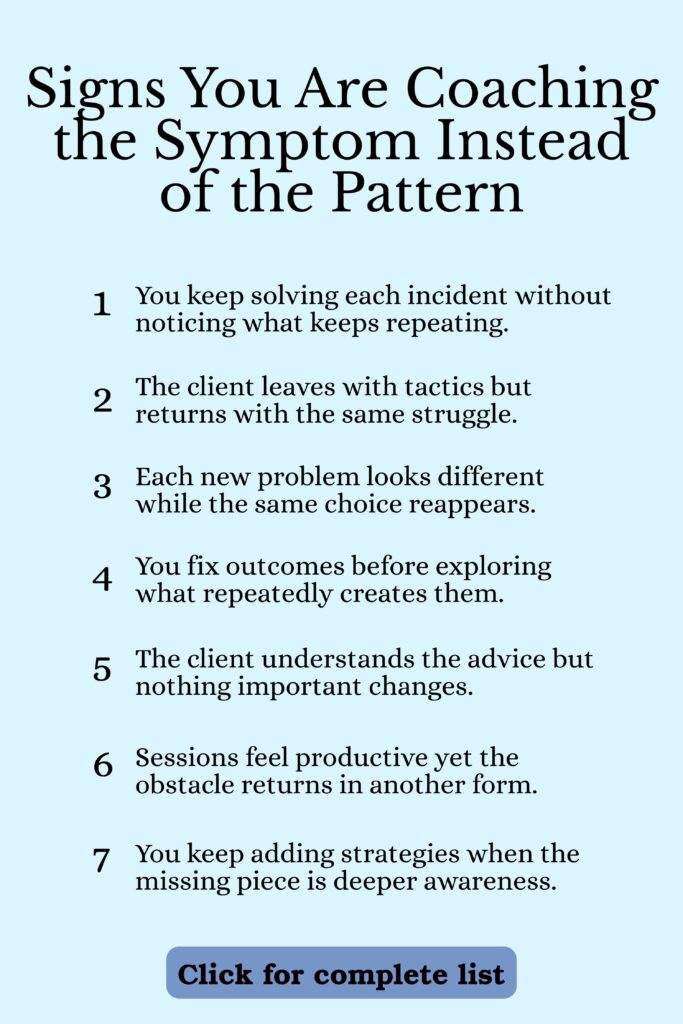
Now explore what seems to drive that pattern. She might believe that saying no will make colleagues see her as unhelpful. Or she may simply lack a decision rule for accepting new work. Those two drivers would lead to very different coaching conversations.
SEE ALSO: If you’re a coach looking to streamline your administrative tasks and save time, check out our Coaching Administration Software. It’s a simple, effective solution designed to help you focus less on paperwork and more on what matters—coaching your clients. From scheduling to client management, our software gives you the tools to run your business efficiently. Ready to reclaim your time and boost productivity? Click or tap here.
A useful distinction is:
Presenting problem: What does the client say is wrong?
Recurring pattern: What keeps happening before, during, or after the problem?
Root driver: What belief, choice, behavior, constraint, or condition appears to keep the pattern going?
Treat the root driver as a working hypothesis, not a verdict.
This is where good records become useful across a longer engagement. In LCH Core, client profiles, notes, and intake forms can help you compare what a client originally wanted help with against patterns that emerge across later sessions. The record supports your attention. It does not decide what the pattern means.
SEE ALSO: If you’re a coach looking to streamline your administrative tasks and save time, check out our Coaching Administration Software. It’s a simple, effective solution designed to help you focus less on paperwork and more on what matters—coaching your clients. From scheduling to client management, our software gives you the tools to run your business efficiently. Ready to reclaim your time and boost productivity? Click or tap here.
What Questions Help You Find the Root Without Leading the Client?
The strongest root-finding questions help the client examine evidence, repetition, and influence without smuggling the coach’s explanation into the question.
A simple questioning sequence is What happened? → What keeps happening? → What seems to be driving it?
Start with observable detail.
“What happened just before you changed your mind?”
“What did you do next?”
“What was the decision you actually made?”
SEE ALSO: If you’re a coach looking to streamline your administrative tasks and save time, check out our Coaching Administration Software. It’s a simple, effective solution designed to help you focus less on paperwork and more on what matters—coaching your clients. From scheduling to client management, our software gives you the tools to run your business efficiently. Ready to reclaim your time and boost productivity? Click or tap here.
Then look for repetition.
“Where else does this happen?”
“What tends to be true each time?”
“What do you notice yourself doing when this situation comes up?”
Then explore possible drivers.
“What makes that choice feel necessary in the moment?”
SEE ALSO: If you’re a coach looking to streamline your administrative tasks and save time, check out our Coaching Administration Software. It’s a simple, effective solution designed to help you focus less on paperwork and more on what matters—coaching your clients. From scheduling to client management, our software gives you the tools to run your business efficiently. Ready to reclaim your time and boost productivity? Click or tap here.
“What are you protecting when you do that?”
“What belief or assumption seems to be operating there?”
“What might change if that assumption were not true?”
Compare that with a question such as, “Are you doing this because you’re afraid of success?”
That question may sound insightful, but it hands the client the coach’s conclusion. A more open question would be, “What seems to make moving forward difficult when the opportunity becomes real?”
ICF’s updated Evokes Awareness competency specifically includes asking about a client’s thinking, values, needs, wants, and beliefs, helping clients explore beyond their current thinking, and identifying factors that influence patterns of behavior, thinking, or emotion.
SEE ALSO: If you’re a coach looking to streamline your administrative tasks and save time, check out our Coaching Administration Software. It’s a simple, effective solution designed to help you focus less on paperwork and more on what matters—coaching your clients. From scheduling to client management, our software gives you the tools to run your business efficiently. Ready to reclaim your time and boost productivity? Click or tap here.
Some clients also think more clearly after the conversation has ended. An assigned journal or worksheet can give them space to notice the pattern during the week rather than forcing an answer inside one session. The Coaching Tools support guide explains how journals, worksheets, action items, goals, and resources can be used between sessions.
What If There Is More Than One Root Cause?
When several factors appear to be contributing to a problem, choose the one that gives the client the strongest combination of influence and leverage rather than trying to solve everything at once.
Use a simple Control × Leverage test.
Control asks: Can the client meaningfully influence this factor?
Leverage asks: If this factor changes, is it likely to change the recurring pattern?
Imagine a career coaching client who repeatedly abandons plans to apply for senior roles.
SEE ALSO: If you’re a coach looking to streamline your administrative tasks and save time, check out our Coaching Administration Software. It’s a simple, effective solution designed to help you focus less on paperwork and more on what matters—coaching your clients. From scheduling to client management, our software gives you the tools to run your business efficiently. Ready to reclaim your time and boost productivity? Click or tap here.
Several factors emerge:
- Her workload leaves little time for applications.
- She is unclear about which jobs she actually wants.
- She worries about being more visible at work.
- Family responsibilities make certain roles impractical.
All four may be real.
You do not need to choose which one is the “true” cause. Instead, ask which factor is both actionable and capable of changing what happens next.
If the client has not decided what type of role she wants, greater clarity may have high leverage. Applying productivity techniques before solving that question could simply help her complete the wrong applications faster.
Alternatively, if she knows exactly what she wants but never submits applications because she repeatedly revises them when the deadline approaches, the useful coaching target may be the pattern that appears at the point of visibility.
One problem can have several contributors. Coaching becomes clearer when you choose the next useful leverage point rather than trying to explain the client’s entire life.
SEE ALSO: If you’re a coach looking to streamline your administrative tasks and save time, check out our Coaching Administration Software. It’s a simple, effective solution designed to help you focus less on paperwork and more on what matters—coaching your clients. From scheduling to client management, our software gives you the tools to run your business efficiently. Ready to reclaim your time and boost productivity? Click or tap here.
When Should a Coach Stop Digging?
A coach should stop digging when further exploration is no longer producing useful awareness that can support the client’s goals, choices, or forward movement.
A client does not have to uncover the deepest possible explanation for every behavior before making a change.
Suppose a client repeatedly avoids difficult conversations with employees. You discover that she anticipates conflict, delays feedback, then eventually gives a rushed and overly blunt response when the issue becomes urgent.
That pattern may already give you enough to coach.
You can work on noticing the avoidance earlier, preparing feedback before frustration builds, and testing a clearer conversation structure. You do not automatically need to trace her discomfort with conflict back through every earlier relationship in her life.
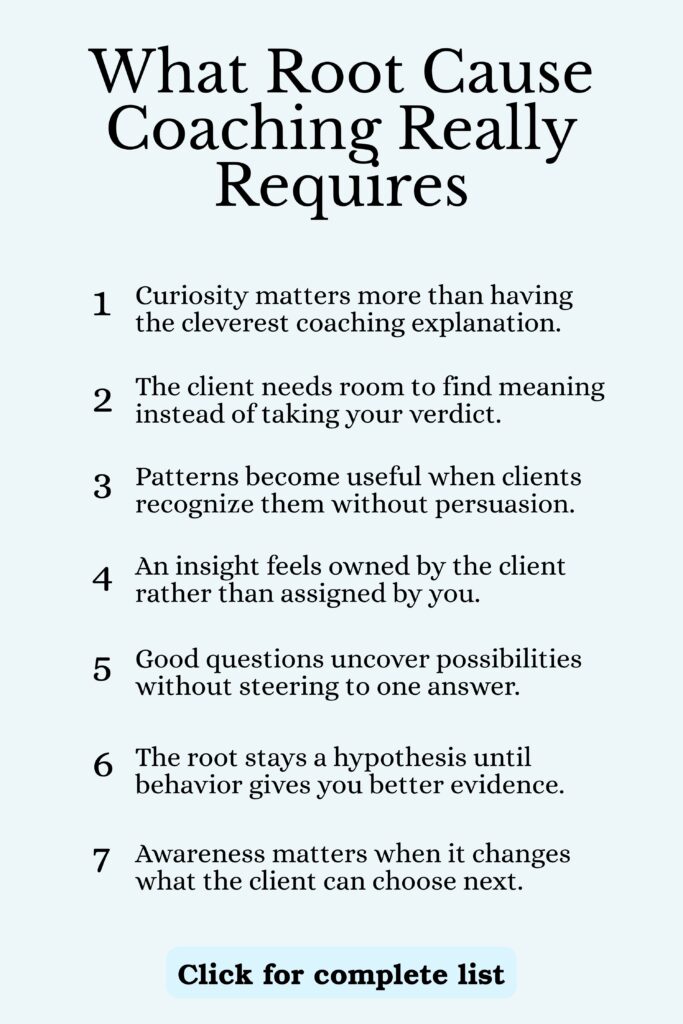
ICF’s competency model puts awareness and action next to each other for a reason. Evokes Awareness focuses on client-generated insight, while Facilitates Client Growth focuses on integrating the learning into behavior, goals, action, and accountability.
SEE ALSO: If you’re a coach looking to streamline your administrative tasks and save time, check out our Coaching Administration Software. It’s a simple, effective solution designed to help you focus less on paperwork and more on what matters—coaching your clients. From scheduling to client management, our software gives you the tools to run your business efficiently. Ready to reclaim your time and boost productivity? Click or tap here.
There is also a professional boundary to protect. The current ICF Code of Ethics requires coaches to work within their level of competency and to recognize when another professional or resource may be more appropriate.
If the work has shifted away from coaching goals and into needs that fall outside your competence or professional role, the answer is not to dig harder. Clarify the boundary and help the client consider the appropriate next resource.
How Do You Turn Root Insight Into a Coaching Action Plan?
A useful root insight should become a specific experiment the client can carry into real life.
Use four parts:
One hypothesis. What does the client currently think may be driving the pattern?
One behavior. What will the client do differently?
SEE ALSO: If you’re a coach looking to streamline your administrative tasks and save time, check out our Coaching Administration Software. It’s a simple, effective solution designed to help you focus less on paperwork and more on what matters—coaching your clients. From scheduling to client management, our software gives you the tools to run your business efficiently. Ready to reclaim your time and boost productivity? Click or tap here.
One measure. What observable result will you look for?
One review date. When will you examine what happened?
Return to the client who keeps overcommitting.
Her working hypothesis might be: “I say yes immediately because I assume people will think I am difficult if I ask for time to check my capacity.”
Her experiment could be simple. For the next two weeks, she will not accept a new request immediately. She will say, “Let me check my commitments and get back to you this afternoon.”
The measure is not “feel more confident.” It might be:
SEE ALSO: If you’re a coach looking to streamline your administrative tasks and save time, check out our Coaching Administration Software. It’s a simple, effective solution designed to help you focus less on paperwork and more on what matters—coaching your clients. From scheduling to client management, our software gives you the tools to run your business efficiently. Ready to reclaim your time and boost productivity? Click or tap here.
How many requests did she pause before answering?
How many did she eventually decline or renegotiate?
Did the number of missed priorities change?
This gives both coach and client something more useful than an inspiring conversation.
Locke and Latham’s influential review of 35 years of goal-setting research describes a substantial empirical foundation for the relationship between goals, task motivation, feedback, and performance. The coaching implication is straightforward: once awareness has been created, turn it into something sufficiently concrete that the client can act on it and evaluate what happened.
If you use LCH Core, goals can hold the larger outcome while action items capture the specific commitment between sessions. The LCH Core coaching tutorial library includes guidance on using these coaching tools and tracking client follow-through.
SEE ALSO: If you’re a coach looking to streamline your administrative tasks and save time, check out our Coaching Administration Software. It’s a simple, effective solution designed to help you focus less on paperwork and more on what matters—coaching your clients. From scheduling to client management, our software gives you the tools to run your business efficiently. Ready to reclaim your time and boost productivity? Click or tap here.
How Do You Know Whether You Found the Right Root?
You know a working root hypothesis is useful when changing it produces a meaningful change in the recurring pattern or gives the client better evidence about what is actually driving the problem.
Do not measure success by how profound the insight sounded.
Measure what happens next.
Suppose a client concludes that perfectionism is causing her to delay launching a workshop. You agree that she will send the registration page to ten existing contacts before she considers the page “finished.”
At the next session, there are several possibilities.
She sent it, received registrations, and discovered that publishing before everything felt perfect was tolerable. The experiment weakened the old pattern.
SEE ALSO: If you’re a coach looking to streamline your administrative tasks and save time, check out our Coaching Administration Software. It’s a simple, effective solution designed to help you focus less on paperwork and more on what matters—coaching your clients. From scheduling to client management, our software gives you the tools to run your business efficiently. Ready to reclaim your time and boost productivity? Click or tap here.
She sent it but still spent six hours making unnecessary changes first. The hypothesis may be partly right, but the behavior needs more examination.
She never sent it because she realized she does not actually want to offer that workshop. The apparent execution problem may have been masking a decision problem.
This is why Review belongs in the root-finding process. The client is not trying to prove your interpretation correct. You are both gathering better information.
For coaches managing several clients, the Progress Stream can make this review easier by keeping client activity connected over time. Life Coach Hub’s client data, notes, and progress support guide explains how notes, goals, action items, worksheets, journals, and Progress Stream activity can be reviewed as part of the client record.
Where LCH Core Fits
LCH Core fits after the coaching thinking, not in place of it.
The coach still has to listen, notice patterns, ask useful questions, challenge carefully, and let the client make meaning from what emerges. Software cannot decide that a client’s complaint about productivity is really a boundary problem or that apparent procrastination is actually indecision.
SEE ALSO: If you’re a coach looking to streamline your administrative tasks and save time, check out our Coaching Administration Software. It’s a simple, effective solution designed to help you focus less on paperwork and more on what matters—coaching your clients. From scheduling to client management, our software gives you the tools to run your business efficiently. Ready to reclaim your time and boost productivity? Click or tap here.
What a system can do is keep the evidence from disappearing between sessions.
Client profiles, notes, and intake forms can preserve the original presenting problem and relevant context. Journals and worksheets can extend reflection beyond the live session. Goals and action items can turn insight into an agreed next step. The Progress Stream and Engagement Report can support review across the coaching relationship.
That creates a useful trail:
What did the client originally want to change?
What pattern did you begin to notice?
What did the client decide might be influencing it?
SEE ALSO: If you’re a coach looking to streamline your administrative tasks and save time, check out our Coaching Administration Software. It’s a simple, effective solution designed to help you focus less on paperwork and more on what matters—coaching your clients. From scheduling to client management, our software gives you the tools to run your business efficiently. Ready to reclaim your time and boost productivity? Click or tap here.
What action did they test?
What happened afterward?
For a broader look at how those tools fit into an organized coaching practice, see Best Coaching Software for Life Coaches: What to Look For Before You Choose and the Life Coach Hub support library.
The value of LCH Core in this process is simple: the insight, action, and follow-through can remain connected instead of being scattered across memory, emails, documents, and separate notes.
Frequently Asked Questions
How do coaches identify the root cause of a client’s problem?
Coaches identify a useful root issue by looking for recurring patterns and exploring what appears to influence those patterns with the client. Start with the presenting problem, compare several real situations, and look for repeated choices, beliefs, constraints, or behaviors.
Treat any proposed root as a working hypothesis. The client’s response and subsequent behavior provide more information.
SEE ALSO: If you’re a coach looking to streamline your administrative tasks and save time, check out our Coaching Administration Software. It’s a simple, effective solution designed to help you focus less on paperwork and more on what matters—coaching your clients. From scheduling to client management, our software gives you the tools to run your business efficiently. Ready to reclaim your time and boost productivity? Click or tap here.
What questions help uncover the root of a problem in coaching?
Questions that examine events, repetition, and influence are most useful for uncovering a root issue. Ask what happened, what keeps happening, what tends to precede the pattern, and what the client believes or needs in that moment.
Avoid questions that contain your conclusion, such as “Is this because you fear rejection?” Ask, “What seems to make this difficult?” instead.
How can you tell the difference between a symptom and a root issue?
A symptom describes what is going wrong, while a useful root issue helps explain what repeatedly contributes to that outcome. “I never have enough time” may be a symptom. Automatically agreeing to work without checking capacity may be the recurring behavior underneath it.
The distinction becomes clearer when you examine several examples rather than relying on one incident.
What if a client’s problem has several possible root causes?
Choose the factor with the strongest combination of client influence and practical leverage. You do not need to solve every contributing factor simultaneously.
Ask which factor the client can affect and which change would give you the most useful information about the repeating pattern.
SEE ALSO: If you’re a coach looking to streamline your administrative tasks and save time, check out our Coaching Administration Software. It’s a simple, effective solution designed to help you focus less on paperwork and more on what matters—coaching your clients. From scheduling to client management, our software gives you the tools to run your business efficiently. Ready to reclaim your time and boost productivity? Click or tap here.
How do you know when to stop exploring and start taking action?
Start taking action once the client has enough useful awareness to design a meaningful experiment. More exploration is not automatically better.
If you have a reasonable hypothesis, a behavior the client can change, and a way to observe the result, you have enough information to test the idea.
When does root-cause exploration go beyond the scope of coaching?
Root-cause exploration goes beyond coaching when the client’s needs move outside the coach’s competence or the agreed coaching role. Coaches need to recognize their professional boundaries and consider another qualified professional or resource when appropriate.
You do not need to diagnose a client or explain their history in order to help them work with an observable present-day pattern.
How do you turn a coaching insight into a practical goal?
Turn the insight into one behavior the client will change, one observable measure, and a specific point when you will review the outcome. This keeps the action connected to the insight that produced it.
The goal should tell the client what to do next, not merely restate the realization they had during the session.
SEE ALSO: If you’re a coach looking to streamline your administrative tasks and save time, check out our Coaching Administration Software. It’s a simple, effective solution designed to help you focus less on paperwork and more on what matters—coaching your clients. From scheduling to client management, our software gives you the tools to run your business efficiently. Ready to reclaim your time and boost productivity? Click or tap here.
How can a coach tell whether addressing the root issue is working?
Look for changes in the behavior or outcome that originally brought the client to coaching. Review what the client did, what happened as a result, and whether the recurring pattern changed.
If nothing changes, do not force the original explanation to fit. Revise the hypothesis and continue learning from the evidence.
Sources
International Coaching Federation, et al. Review and Update of a Coaching Competency Model. International Coaching Federation, 2025. International Coaching Federation competency model.
International Coaching Federation. ICF Code of Ethics. International Coaching Federation, effective 1 Apr. 2025. ICF Code of Ethics.
Locke, Edwin A., and Gary P. Latham. “Building a Practically Useful Theory of Goal Setting and Task Motivation: A 35-Year Odyssey.” American Psychologist, vol. 57, no. 9, Sept. 2002, pp. 705-717. doi:10.1037/0003-066X.57.9.705. PubMed record.

Read this next

The GROW Model Worksheet for Life Coaches (Downloadable PDF)
Effectively conduct your coaching sessions with the GROW Model in 4 simple steps!
Read More
Three Tips for Making People Love Your Courses: Catering for Diversity in Training
Discover three key tips for helping your individual course members get the most out of your courses.
Read More
Killer Coaching Questions: 36 Powerful Queries by Niche (+ PDF)
Being an effective life coach requires asking the right things. Make sure to stock up with killer coaching questions!
Read More