


Talk to a coach about Confidence coaching

Crystal Faulk
ACC
I help overwhelmed women in transition gain clarity, confidence, and...

Charity Archie
Several Life Coaching Certifications-Intentional Holistic Life Coach
Charity Aumora dedicated to promoting a positive clear & intentional...

Alena Zhaliazniak
MSc, holistic life coach, PQ Positive Intelligence
"A ray of light shining through iron" is the meaning...

Mak Estill
Anxiety, Panic & Life Coach dedicated to coaching you into a life of lesser and lighter anxiety!
Founder and owner of Actionable Anxiety, a private coaching practice...

Maria J Brando
Psychosynthesis Life Coach and Financial Coach. BCC, MBA.
Reconnect with your intuition. Look within, listen deeply, and discover...

Josh Dolin
Certified Life Coach (100% Online) | Purpose Pathfinder™ | Personal Growth & Fulfillment Coach
Helping people rediscover purpose, gain clarity, and create meaningful change.

A.C. Pickard
Emotion Mastery Coach | Creator of the M.A.S.T.E.R. Method™ | Certified Emotional Intelligence Life Coach | B.S. Social Sciences
Emotion Mastery Coach for thoughtful adults who know better and...

Vibeke Pedersen
Certified Life Coach / ThetaHealer®
Crush 2025

What Actually Builds Self-Esteem? The Research Is More Surprising Than You Think
Do People Like You More Than You Think?
Key Takeaways
- Self-esteem is an evaluation, not a permanent fact. Your opinion of yourself can change as you gather more accurate evidence about your relationships, abilities, choices, and progress.
- The gap between who you are and who you want to be needs inspection. Some gaps point toward meaningful growth, while others come from inherited expectations that do not reflect what you actually value.
- One difficult moment does not define your overall worth. Criticism, rejection, embarrassment, and failure can produce a temporary drop in self-esteem without proving a global conclusion about who you are.
- Relationships and self-esteem influence each other. Feeling accepted can support your self-esteem, while your expectations and reactions can affect the quality of your relationships.
- Competence grows through specific practice and evidence. Repeated action, useful feedback, and observable improvement give you a stronger basis for confidence than broad positive statements alone.
How Can You Improve Your Self-Esteem?
You can improve your self-esteem by replacing broad negative judgments with more accurate evidence, questioning unrealistic standards, strengthening reciprocal relationships, preparing for predictable setbacks, and practicing skills that matter to you.
The goal is not to convince yourself that you are flawless. It is to develop a fairer and more stable view of yourself, one that can hold both strengths and limitations without turning every mistake into a verdict on your worth.
Lasting change usually comes through repeated experiences. You respond differently to criticism. You keep a promise to yourself. You practice a skill until it becomes more familiar. Each experience gives you new evidence about what you can handle and how you deserve to be treated.
How Can You Assess Your Self-Esteem?
- Think about your perception of your actual self – how you view yourself to be right now.
- Now think about your perception of your desired self – how you believe you should be.
- Then ask yourself:
- How well do these two self-concepts compare with each other?
- Is there a large or small discrepancy between the two?
The difference between these two concepts is what researchers say determines your self-esteem. The greater the discrepancy, the lower the self-esteem.
Is Your Ideal Self a Goal or a “Should”?

Your ideal self can guide meaningful growth, but a borrowed “should” can lower your self-esteem without giving you a useful direction.
Psychologist E. Tory Higgins’s self-discrepancy theory distinguishes between different versions of the person you compare yourself with.
- Your actual self: The person you believe you are today.
- Your ideal self: The person you genuinely hope or aspire to become.
- Your ought self: The person you believe you are required to be.
Those standards can look similar on the surface while producing very different decisions.
If you want to get more from your life, and are looking for concrete action steps to get you there, check out our Request a Coach page. It’s a “cut the fence-sitting and take action” way to tackle your issues and actually find success. To get off the fence and start to take action, click or tap here.
You might want to become more confident during presentations because speaking clearly would help you contribute at work. That is a personally meaningful ideal.
You might also believe you must appear confident at all times because competent people never hesitate. That is an inflexible “should” that leaves no room for learning, preparation, or normal nerves.
Before trying to close a gap, examine it:
- What quality do I believe I am missing?
- What observable behavior would represent that quality?
- Where did this standard come from?
- Would I still want it if nobody else were watching?
- Is the standard realistic in the situation I am facing?
“I should be more successful” gives you almost nothing to act on.
“I want to apply for one leadership opportunity this quarter” gives you a clear behavior to practice.
A career or confidence coach might help you separate a goal you genuinely value from a standard you inherited from a parent, workplace, partner, or social group. From there, you can choose a specific action instead of repeatedly judging your entire identity.
What Is Self-Esteem?
Rowland Miller, Professor of Psychology and relationship expert, states that self-esteem is defined as how a person evaluates him or herself. When you judge your own skills and traits as favorable and positive, you’ll have a greater likelihood of a higher self-esteem.
Miller and his colleagues have also found that we measure our self-esteem by the quality of relationships we have with others. When others like us, we tend to like ourselves. When we feel we don’t interest other people, then our self-esteem will tend to be lower.
If you want to get more from your life, and are looking for concrete action steps to get you there, check out our Request a Coach page. It’s a “cut the fence-sitting and take action” way to tackle your issues and actually find success. To get off the fence and start to take action, click or tap here.
Joshua D. Sparrow, Associate Clinical Professor of Psychiatry at the Harvard Medical School, states “A healthy self-esteem allows us to go on trying things we’ve failed at, to strive when we haven’t reached our full potential, and to take on new challenges”.
These things are important when we are working toward achieving our goals!
So if you have low self-esteem, what can you do right now to increase it to live a happier and more fulfilling life? Research gives us lots of options, and I will discuss a few here.
Are You Measuring Self-Esteem or Reacting to One Bad Day?
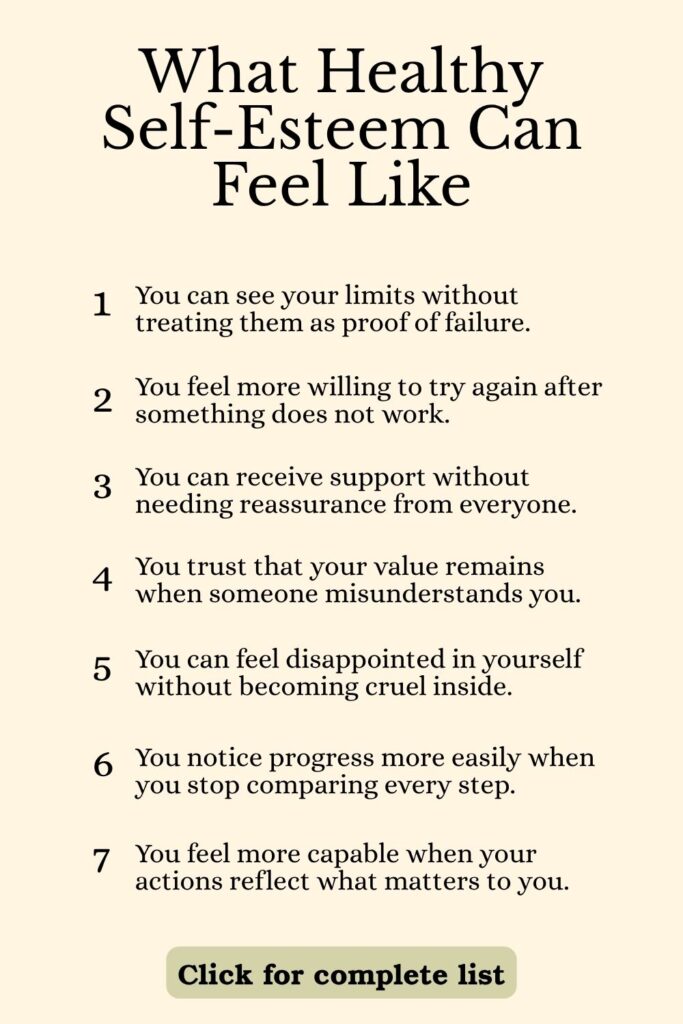
A temporary drop in how you feel about yourself is not the same as having permanently low self-esteem.
Your immediate self-evaluation can change after criticism, rejection, conflict, embarrassment, or poor performance. Researchers Todd Heatherton and Janet Polivy developed a state self-esteem measure specifically to examine these shorter changes in social, performance, and appearance-related self-evaluation.
Imagine receiving one difficult comment during a performance review.
A temporary reaction might sound like, “I feel embarrassed, and I am questioning my ability right now.”
A global judgment sounds like, “I am incompetent, and I always disappoint people.”
If you want to get more from your life, and are looking for concrete action steps to get you there, check out our Request a Coach page. It’s a “cut the fence-sitting and take action” way to tackle your issues and actually find success. To get off the fence and start to take action, click or tap here.
The first statement describes an experience. The second turns that experience into an identity.
Track the difference for one week:
- Event: What happened?
- Immediate conclusion: What did you decide it meant about you?
- Scope: Was the conclusion about one behavior or your whole identity?
- Evidence: What facts support or contradict the conclusion?
- Next action: What can you practice, repair, clarify, or learn?
The Rosenberg Self-Esteem Scale is a widely used 10-item research measure of general self-esteem, but a score is only a snapshot. It is not a diagnosis and cannot explain why your self-evaluation changes.
Look for patterns across situations and time. Perhaps your confidence stays stable at work but drops sharply around dating. Perhaps criticism from authority figures affects you more than feedback from friends.
That pattern gives you a more useful target than the statement, “I need better self-esteem.”
A leadership coach, relationship coach, or confidence coach could help you examine the specific situations that trigger global judgments. The work might include reviewing feedback, practicing a response, or separating one imperfect behavior from your overall worth.
How Can Positive Connections Strengthen Self-Esteem?

People with chronic low self-esteem often have a history of receiving insufficient acceptance and appreciation from others (or at least feeling that way!) according to Rowland Miller.
Stephanie Steese has found that a great way to improve self-esteem is to build positive connections with others. One way to go about this is to join a support group for people with similar experiences or feelings as yourself. Accepting comfort from others is a healthy way to build self-esteem because it lets you know that someone else understands what you are going through.
If you want to get more from your life, and are looking for concrete action steps to get you there, check out our Request a Coach page. It’s a “cut the fence-sitting and take action” way to tackle your issues and actually find success. To get off the fence and start to take action, click or tap here.
Not only that, but support groups also help you develop better empathic listening skills. Miller and his colleagues have discovered that individuals with low self-esteem tend to make a big deal out of things that individuals with high self-esteem would shrug off. Those with low self-esteem tend to respond with self-defeating hurt and anger that causes an adverse reaction in others instead of the reassurance they crave.
By learning to listen empathically, you can learn to respond better to others in a more positive way. This in turn will help create a more positive connection and interaction with other individuals.
I offer Self-Esteem Building support group conducted through Google messenger on-line hangouts! Contact me to discuss how I might help build your self esteem.
Why Can Fear of Rejection Create the Reaction You Fear?
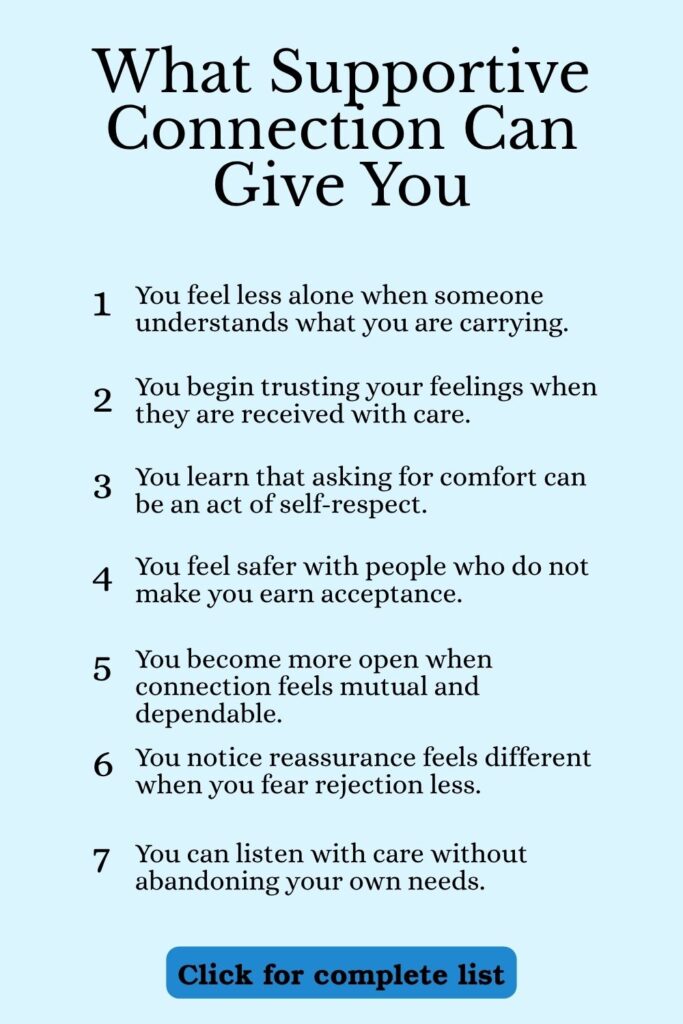
Fear of rejection can create a self-reinforcing loop when you treat an uncertain situation as proof that someone dislikes or is abandoning you.
The loop often looks like this:
- Something ambiguous happens. A friend does not answer your message.
- You add a meaning. You decide they are annoyed or losing interest.
- You react to the meaning. You send an accusatory message, withdraw, or ask repeatedly for reassurance.
- The other person reacts. They become defensive, uncomfortable, or distant.
- The distance feels like proof. You conclude that your original fear was correct.
The problem began before you had enough information.
Research on the “liking gap” found that after conversations, people often underestimated how much their conversation partners liked them and enjoyed their company.
That does not mean every interaction goes well. It means your anxious interpretation is not automatically an accurate reading of another person’s mind.
If you want to get more from your life, and are looking for concrete action steps to get you there, check out our Request a Coach page. It’s a “cut the fence-sitting and take action” way to tackle your issues and actually find success. To get off the fence and start to take action, click or tap here.
Research also suggests that self-esteem and social relationships can influence each other over time. Supportive relationships may strengthen self-esteem, while your expectations and behavior can affect how relationships develop.
When you notice the rejection loop starting, pause and ask:
- What actually happened?
- What meaning did I add?
- What are two other plausible explanations?
- What response would protect both the relationship and my self-respect?
Instead of writing, “Clearly you do not want to talk to me,” you might write, “I have not heard from you, so I wanted to check whether this is still a good week to talk.”
A relationship or communication coach might role-play these moments with you. You can practice asking for clarification, tolerating a delayed response, and expressing what you need without turning uncertainty into an accusation.
How Does Resilience Support Self-Esteem?
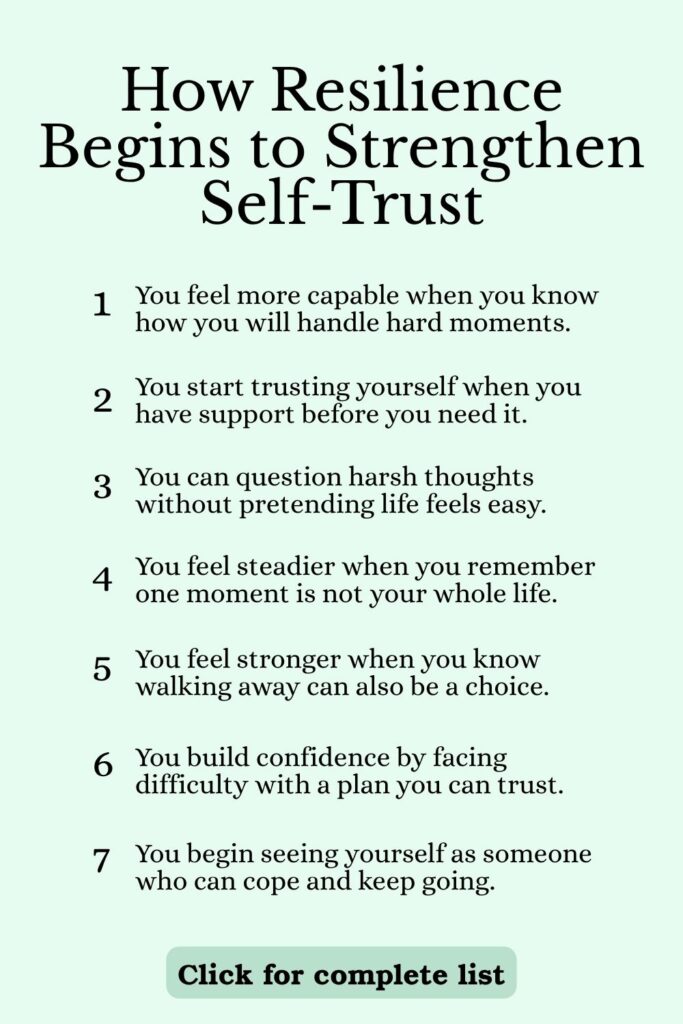
Another way to increase self-esteem is by developing resiliency. One study found that participating in just six half-hour activities geared toward developing trust and coping strategies (like life-coaching) can seriously increase your self-esteem!
Some coping strategies include suggestions like seeking help from someone you trust, self-talk to overcome negative thought patterns, increasing optimism, considering the big picture, honing your communication skills, and even simply walking away from a situation.
The key is to have a plan in place before you need it so that you have it to use when needed. When you know how to get through a tough situation, you feel more competent and confident.
What Is Your Plan for the Moment Confidence Drops?
You are more likely to respond constructively during a difficult moment when you decide what you will do before the moment arrives.
If you want to get more from your life, and are looking for concrete action steps to get you there, check out our Request a Coach page. It’s a “cut the fence-sitting and take action” way to tackle your issues and actually find success. To get off the fence and start to take action, click or tap here.
Psychologist Peter Gollwitzer calls this type of preparation an implementation intention. It uses a specific “if, then” plan to connect a predictable trigger with a chosen response.
A useful confidence plan has four parts:
- Trigger: What situation usually produces the drop?
- Immediate response: What will stop you from reacting impulsively?
- Evidence check: What question will bring you back to the facts?
- Next action: What useful behavior will you take?
For example:
If I receive critical feedback at work, then I will wait 20 minutes before replying. I will identify the exact behavior being discussed and write one clarifying question.
If someone declines a date, then I will describe the event accurately. One person chose not to continue. I will not turn that decision into “Nobody will want me.”
If I lose my place during a presentation, then I will pause, look at my notes, and continue with the next point. I will review the mistake after I finish, not while I am still speaking.
Your response does not need to make the discomfort disappear. It needs to stop the discomfort from controlling your next decision.
Write one plan for a situation you expect to face this week. Keep the trigger observable and the response small enough to use under pressure.
If you want to get more from your life, and are looking for concrete action steps to get you there, check out our Request a Coach page. It’s a “cut the fence-sitting and take action” way to tackle your issues and actually find success. To get off the fence and start to take action, click or tap here.
A career or confidence coach might help you identify the trigger, test the plan through role-play, and revise it after a real situation. The plan becomes stronger when it reflects what you actually do, not what sounds impressive on paper.
Can Building Skills Improve Self-Esteem?
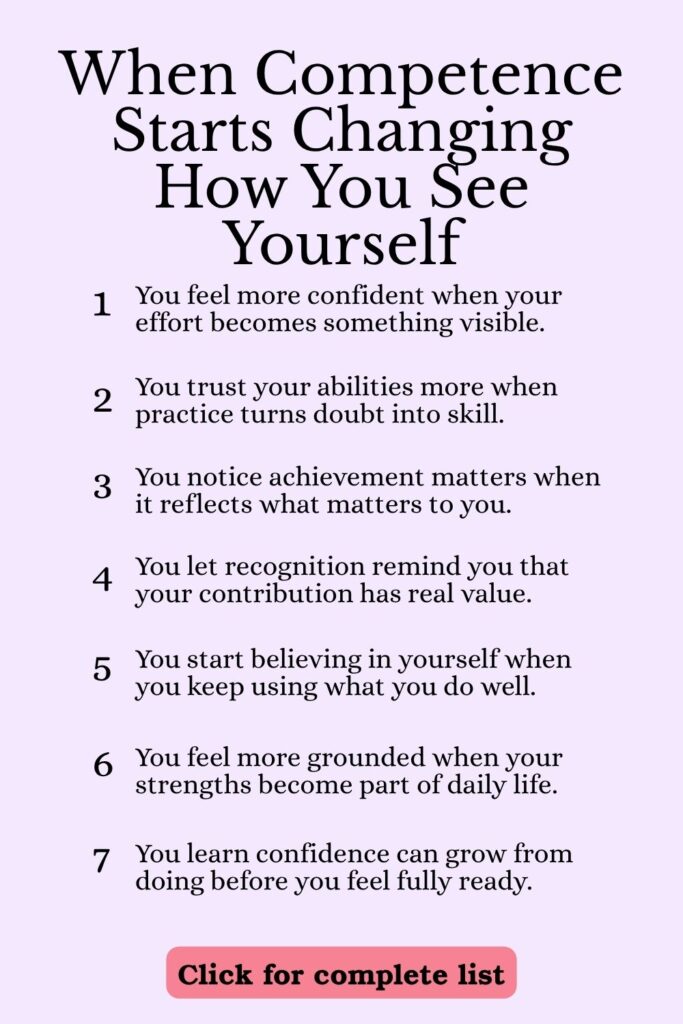
Roy Baumeister, Francis Eppes Professor in Social Psychology, says that research shows a strong correlation between high self-esteem and high performance levels. High performance leads to high self-esteem and not the other way around as some might believe.
This means that you can immediately raise your level of self-esteem by doing well at work, attaining a desired achievement, or being recognized for something you have accomplished. Also try honing your skills for a particular task or thinking about how you are good at something (and actually doing what you are good at).
The more we feel we have something positive to contribute or that we are evaluated positively by others, the more self-esteem we will have.
Frequently Asked Questions About Self-Esteem
What Causes Low Self-Esteem?
Low self-esteem can develop through repeated criticism, rejection, exclusion, failure, unrealistic standards, harmful relationships, or environments where acceptance feels conditional.
It can also be maintained by current patterns, such as discounting successes, treating mistakes as identity statements, avoiding situations that could build competence, or assuming that uncertain social cues mean rejection.
How Do I Know If I Have Low Self-Esteem?
Low self-esteem often appears as a repeated pattern of judging your overall worth negatively, especially after ordinary mistakes, criticism, or comparison.
You might dismiss praise, avoid challenges, tolerate poor treatment, seek constant reassurance, or assume that one weak performance reveals who you are. Look for repetition across time rather than diagnosing yourself from one difficult day.
If you want to get more from your life, and are looking for concrete action steps to get you there, check out our Request a Coach page. It’s a “cut the fence-sitting and take action” way to tackle your issues and actually find success. To get off the fence and start to take action, click or tap here.
Can Self-Esteem Improve in Adulthood?
Self-esteem can improve in adulthood through changes in thinking, behavior, relationships, coping skills, and experiences of competence.
A systematic review and meta-analysis led by Daniel Kolubinski found that cognitive behavioral interventions based on the Fennell model showed promise for people experiencing low self-esteem, although the number of available studies was limited.
What Is the Difference Between Self-Esteem and Self-Confidence?
Self-esteem is your broader evaluation of your worth, while self-confidence usually describes how capable you feel in a particular situation.
You can have strong professional confidence and still question your worth in relationships. You can also value yourself as a person while feeling inexperienced and uncertain about a new skill.
Why Does Rejection Affect Self-Esteem So Strongly?
Rejection affects self-esteem because social acceptance is one of the signals people use when evaluating their place and value within relationships.
The effect becomes stronger when you interpret one rejection as a universal conclusion. “This person did not choose me” describes an event. “Nobody will ever choose me” makes a prediction that the event cannot support.
Do Positive Affirmations Improve Self-Esteem?
Positive affirmations do not reliably improve self-esteem when the statement feels unbelievable or directly contradicts how you currently see yourself.
In two experiments, Joanne Wood and her colleagues found that repeating an extremely positive self-statement could leave some participants with low self-esteem feeling worse. Balanced, believable statements are more useful.
If you want to get more from your life, and are looking for concrete action steps to get you there, check out our Request a Coach page. It’s a “cut the fence-sitting and take action” way to tackle your issues and actually find success. To get off the fence and start to take action, click or tap here.
Try, “I can handle this perfectly,” only if you believe it. Otherwise, use something grounded: “I feel nervous, and I can still take the next step.”
When Should I See a Therapist Rather Than a Coach?
A therapist is the appropriate choice when low self-esteem is connected to persistent depression, trauma, severe anxiety, disordered eating, self-harm, suicidal thoughts, or serious disruption to daily life.
Coaching is better suited to goals such as practicing communication, preparing for specific situations, building accountability, improving a skill, or following through on a behavior plan. The National Institute of Mental Health recommends seeking professional help when symptoms are severe, persistent, worsening, or interfering with normal activities.
Which Self-Esteem Strategy Will You Try First?
Which of these self esteem tips can you apply right now, today? Let me know in the comments!
Sources
Baumeister, R. F., Campbell, J. D., Krueger, J. I., & Vohs, K. D. (2003). Does high self-esteem cause better performance, interpersonal success, happiness, or healthier lifestyles? Psychological Science in the Public Interest, 4(1), 1-44.
Miller, R. S., Perlman, D., & Brehm, S. S. (2006). Intimate Relationships (4th ed.). Boston, MA: McGraw-Hill Higher Education.
Sparrow, J. (2005). Self-esteem. Scholastic Parent & Child, 13(1), 60-63.
Steese, S., Dollette, M., Phillips, W., Hossfeld, E., Matthews, G., & Taormina, G. (2006, Spring). Understanding girls’ circle as an intervention on perceived social support, body image, self-efficacy, locus of control, and self-esteem. Adolescence, 41(161), 55-74.
If you want to get more from your life, and are looking for concrete action steps to get you there, check out our Request a Coach page. It’s a “cut the fence-sitting and take action” way to tackle your issues and actually find success. To get off the fence and start to take action, click or tap here.
Wick, D. T., Wick, J. K., & Peterson, N. (1997, October). Improving self-esteem with Adlerian adventure therapy. Professional School Counseling, 1(1), 56-56.
Boothby, Erica J., Gus Cooney, Gillian M. Sandstrom, and Margaret S. Clark. “The Liking Gap in Conversations: Do People Like Us More Than We Think?” Psychological Science, vol. 29, no. 11, 2018, pp. 1742-1756. Sage Journals, https://doi.org/10.1177/0956797618783714.
Gollwitzer, Peter M. “Implementation Intentions: Strong Effects of Simple Plans.” American Psychologist, vol. 54, no. 7, 1999, pp. 493-503. https://doi.org/10.1037/0003-066X.54.7.493.
Harris, Michelle A., and Ulrich Orth. “The Link between Self-Esteem and Social Relationships: A Meta-Analysis of Longitudinal Studies.” Journal of Personality and Social Psychology, vol. 119, no. 6, 2020, pp. 1459-1477. PubMed, https://pubmed.ncbi.nlm.nih.gov/31556680/.
Heatherton, Todd F., and Janet Polivy. “Development and Validation of a Scale for Measuring State Self-Esteem.” Journal of Personality and Social Psychology, vol. 60, no. 6, 1991, pp. 895-910. https://doi.org/10.1037/0022-3514.60.6.895.
Higgins, E. Tory. “Self-Discrepancy: A Theory Relating Self and Affect.” Psychological Review, vol. 94, no. 3, 1987, pp. 319-340. PubMed, https://pubmed.ncbi.nlm.nih.gov/3615707/.
Kolubinski, Daniel C., Daniel Frings, Ana V. Nikčević, Jacqueline A. Lawrence, and Marcantonio M. Spada. “A Systematic Review and Meta-Analysis of CBT Interventions Based on the Fennell Model of Low Self-Esteem.” Psychiatry Research, vol. 267, 2018, pp. 296-305. PubMed, https://pubmed.ncbi.nlm.nih.gov/30201116/.
Marsh, Herbert W., and Andrew J. Martin. “Academic Self-Concept and Academic Achievement: Relations and Causal Ordering.” British Journal of Educational Psychology, vol. 81, no. 1, 2011, pp. 59-77. Wiley Online Library, https://doi.org/10.1348/000709910X503501.
If you want to get more from your life, and are looking for concrete action steps to get you there, check out our Request a Coach page. It’s a “cut the fence-sitting and take action” way to tackle your issues and actually find success. To get off the fence and start to take action, click or tap here.
National Institute of Mental Health. “My Mental Health: Do I Need Help?” U.S. Department of Health and Human Services, https://www.nimh.nih.gov/health/publications/my-mental-health-do-i-need-help. Accessed 5 Aug. 2026.
Rosenberg, Morris. Society and the Adolescent Self-Image. Princeton UP, 1965. JSTOR, https://www.jstor.org/stable/j.ctt183pjjh.
Wood, Joanne V., W. Q. Elaine Perunovic, and John W. Lee. “Positive Self-Statements: Power for Some, Peril for Others.” Psychological Science, vol. 20, no. 7, 2009, pp. 860-866. PubMed, https://pubmed.ncbi.nlm.nih.gov/19493324/.
If you want to get more from your life, and are looking for concrete action steps to get you there, check out our Request a Coach page. It’s a “cut the fence-sitting and take action” way to tackle your issues and actually find success. To get off the fence and start to take action, click or tap here.
Read this next

You Don’t Have To Be Perfect
It’s time be to yourself and embrace your imperfections.
Read More
Crying Doesn’t Indicate That You Are Weak
Life coaching quote of the day: Crying doesn’t indicate that you are weak. Ever since you were born it’s been a sign that you are alive. If you want to […]
Read More
How to Become Certain When You’re Uncertain
Uncertainty stops us from moving forward. Learn to become certain so that you start getting what you want!
Read More