


Talk to a coach about Organizational coaching

Crystal Faulk
ACC
I help overwhelmed women in transition gain clarity, confidence, and...

Terrie Hein
Certified Life Coach, Certified Insight Coach Practitioner
Coaching to declutter your life, organize your goals, and cook...

Dr Charlene Ashley
Doctorate - Behaviours
I coach individuals to design fulfilling lives through structure, clarity,...

Paloma Chiara

Lana's Gymnastics Club
"Where the best in gymnastics meets fun. Where every child is a star"
lgclubny.com

Anna Sosnina
ICF (ACC)
ICF ACC certified coach, founder of EssorVie Coaching, passionate about...

Tyler Fink
B.A. in Religion, Anthropology, and Philosophy. Master of Divinity (M.Div.) in Missiology
Pastor, husband, and father helping Christian men pursue faithful growth...

Travis Brown
Professional Life coach
With experience in guiding clients to achieve goals, build confidence,...
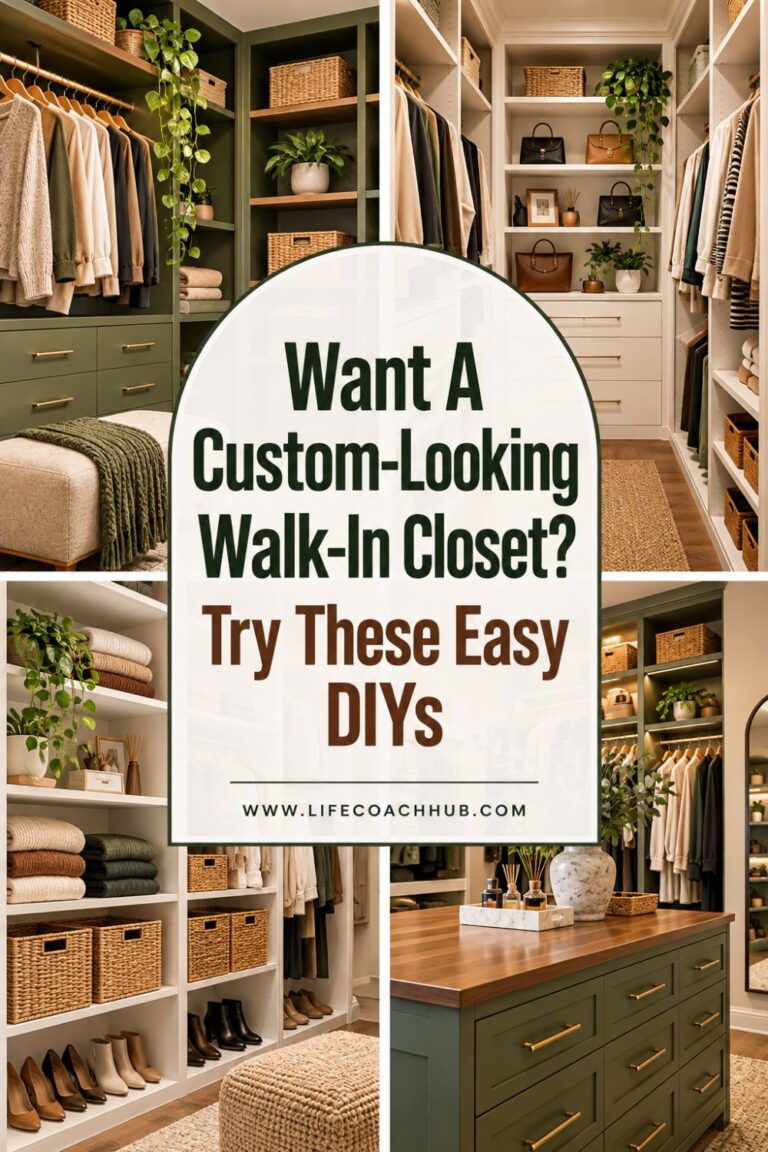

Boutique-Style Accessory Station for Jewelry, Belts, and Sunglasses
Are you all about style, decor and organization? Download a copy of our Clutter Reset Guide.
*****
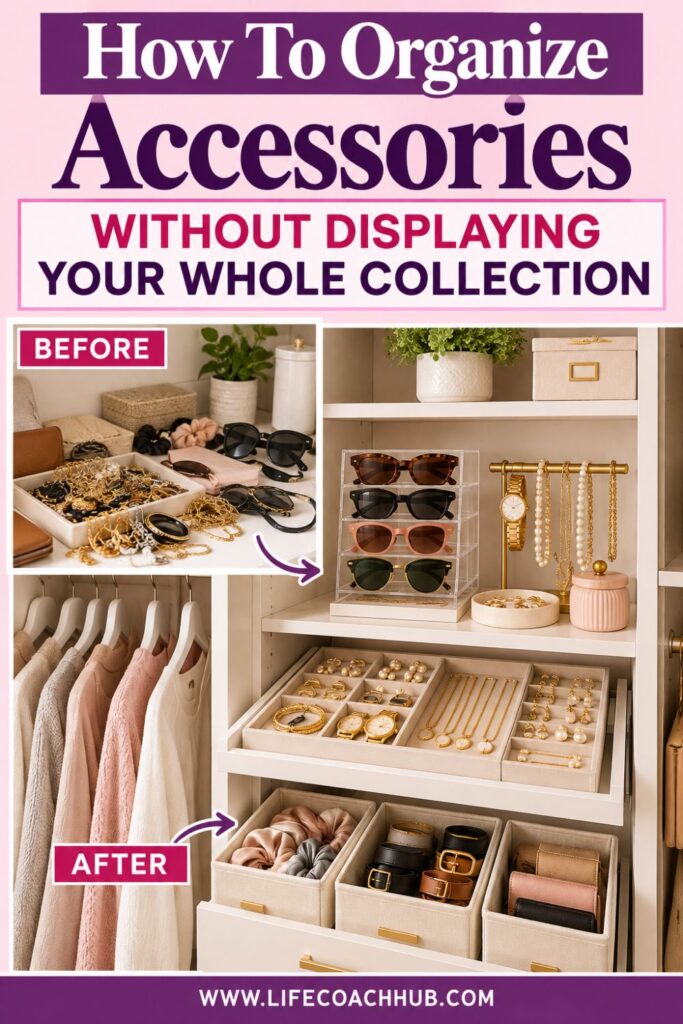
Turn Scattered Accessories Into One Polished Getting-Dressed Zone
Small accessories have a way of creating a surprising amount of closet clutter. Earrings collect on shelves, sunglasses get tossed into drawers, belts end up looped over random hangers, and watches disappear underneath folded clothes.
The frustrating part is that these pieces are usually small. Individually, they do not take up much room. The problem is that they often have no dedicated place to go, so they spread across several surfaces and storage areas.
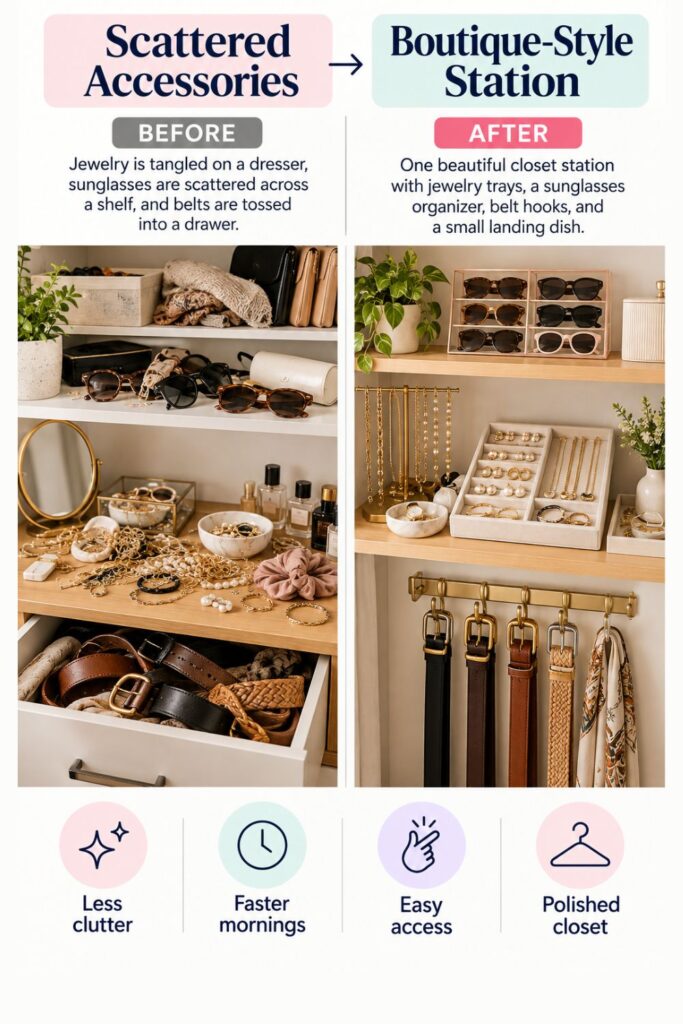
A boutique-style accessory station fixes that by bringing the things you reach for while getting dressed into one clearly defined zone.
Instead of creating separate storage systems in different corners of the closet, you build one central station for items such as:
- Everyday jewelry
- Sunglasses
- Watches
- Belts
- Hair accessories
- Lightweight scarves
- Small finishing pieces
The goal is not to put your entire accessory collection on display. A functional station should hold the items you actually use while giving everything a clear home.
That distinction matters because boutique-style organization is less about decorating and more about editing. Stores look polished because products are grouped intentionally, displays have breathing room, and shoppers can immediately see what is available.
If you want to get more from your life, and are looking for concrete action steps to get you there, check out our Request a Coach page. It’s a “cut the fence-sitting and take action” way to tackle your issues and actually find success. To get off the fence and start to take action, click or tap here.
You can use the same principle at home.
A shallow tray might hold your everyday jewelry. Sunglasses can sit in divided compartments. Belts can hang vertically from a short rail or hooks. A small dish can catch the watch or earrings you remove at the end of the day.
Once each category has a specific place, getting dressed becomes easier and putting things away takes less thought.
The best part is that this can be a mostly one-time setup. You will need to sort what you own, choose the right location, and create the storage zones at the beginning. After that, maintenance should require only a few minutes at a time.
The result is a closet that feels more intentional without becoming difficult to live with.
Need some in depth help with organization and productivity ? Drop on by our directories choc full of productivity coaches, minimalist coaches, and work/life balance coaches to get your life organized! Or click here to have us match you to the best.
1. Choose the Right Spot Before You Buy Any Organizers
The biggest mistake you can make is buying attractive organizers first and trying to find somewhere to put them afterward. Your accessory station should begin with your routine, not with a shopping trip.
Think about what happens when you get dressed.
If you want to get more from your life, and are looking for concrete action steps to get you there, check out our Request a Coach page. It’s a “cut the fence-sitting and take action” way to tackle your issues and actually find success. To get off the fence and start to take action, click or tap here.
Where do you choose your clothes? Where do you stand when you put on jewelry? Where are you when you realize you need a belt or sunglasses?
That path tells you where the accessory station should go.
Trace your getting-dressed path: Walk through your normal routine and notice where you naturally reach for finishing pieces. A shelf, narrow dresser, drawer top, cubby, or small section of wall near that spot is usually more useful than a beautiful but inconvenient corner.
Prioritize easy reach: Keep your most frequently worn accessories between roughly waist and eye level whenever possible. Prime closet space should go to things you use often.
Measure the available area: Write down the width, depth, and height of the space before buying trays, hooks, or stands. This prevents you from ending up with organizers that technically fit but make the station feel crowded.
Also pay attention to the type of space you have.
A shallow shelf may work well for jewelry trays and sunglasses. A narrow wall could be ideal for belts and long necklaces. A small dresser top might support several compact zones.
If you have plenty of vertical space, you may be able to stack functions rather than spreading everything across one surface.
If you want to get more from your life, and are looking for concrete action steps to get you there, check out our Request a Coach page. It’s a “cut the fence-sitting and take action” way to tackle your issues and actually find success. To get off the fence and start to take action, click or tap here.
For example:
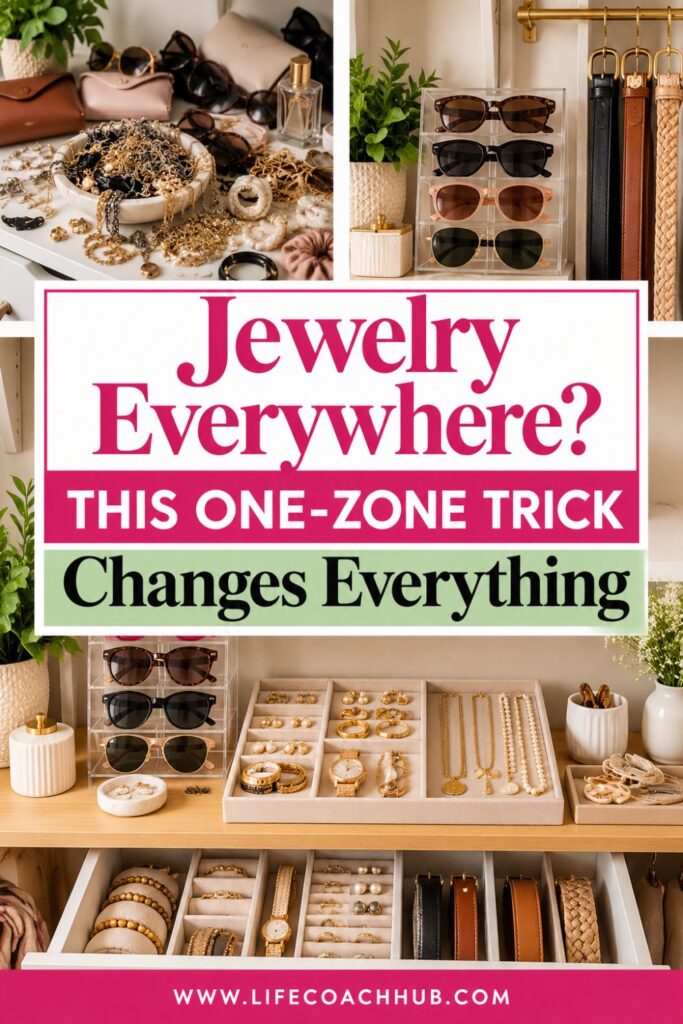
- Hang belts above the station.
- Place sunglasses at eye level.
- Keep jewelry trays below.
- Use a drawer underneath for overflow.
Try to leave some empty space around the finished setup. Filling every inch may technically increase storage, but it often makes the station harder to use.
Boutique-style organization works because the eye can quickly understand what belongs where.
Choose the location first. Once the spot supports the way you already move through your closet, choosing organizers becomes much easier.
2. Edit the Accessories Before You Design the Station
A polished accessory station starts with less, not more.
If you try to display every necklace, belt, pair of sunglasses, watch, bracelet, and hair clip you own, the station can quickly become another crowded storage area. The first step is deciding what actually needs to be there.
Gather everything together: Bring your small accessories into one place before organizing. Include the items hiding in drawers, handbags, jewelry boxes, closet shelves, and bathroom counters.
Seeing the complete collection helps you understand how much storage you truly need.
If you want to get more from your life, and are looking for concrete action steps to get you there, check out our Request a Coach page. It’s a “cut the fence-sitting and take action” way to tackle your issues and actually find success. To get off the fence and start to take action, click or tap here.
Next, separate the pieces according to how often you use them.
Create an everyday group: Pull out the accessories you reach for weekly or frequently. These are the best candidates for the main station because visibility makes them faster to grab and easier to return.
Move occasional pieces elsewhere: Formal jewelry, sentimental pieces, seasonal accessories, and rarely worn items can live in secondary storage.
That does not mean you need to get rid of them. They simply do not need to compete for prime space.
You may also find items that need a decision.
Set aside accessories that are:
- Broken
- Uncomfortable
- Scratched or damaged
- No longer your style
- Missing a pair
- Waiting to be repaired
Do not let undecided items take over the active station.
Once you have edited the collection, group the remaining items according to how you use them.
If you want to get more from your life, and are looking for concrete action steps to get you there, check out our Request a Coach page. It’s a “cut the fence-sitting and take action” way to tackle your issues and actually find success. To get off the fence and start to take action, click or tap here.
For example, keep earrings together, sunglasses together, belts together, and watches together. This may sound obvious, but accessory clutter often happens because several unrelated categories get dropped into one drawer or tray.
Finally, decide how much space each category deserves.
If you have room for eight pairs of sunglasses in the active station, that becomes a natural limit. If the tray comfortably holds twelve everyday jewelry pieces, you do not need to squeeze twenty into it.
The station should feel slightly spacious when you finish.
That breathing room makes accessories easier to see and gives you room to use the system without constantly rearranging it.
3. Divide the Station Into Clear Boutique-Style Zones
Once you know what belongs in the station, divide the area into smaller zones.
This is what keeps a single accessory station from turning into one large mixed collection. Each type of accessory should have a storage method that suits its shape and the way you use it.
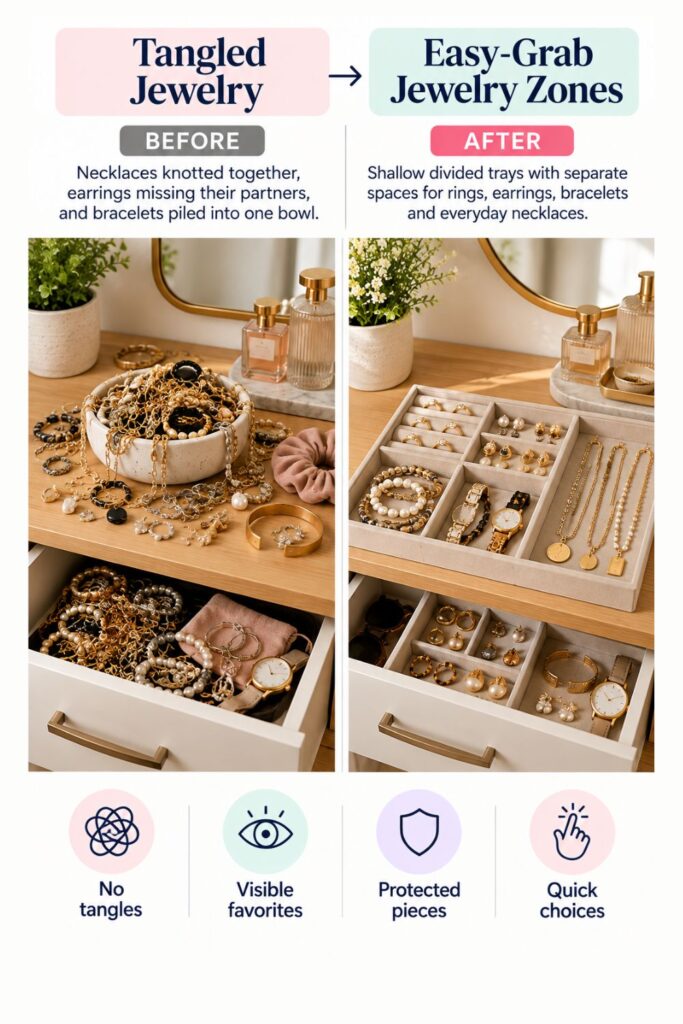
Create a jewelry zone: Use a shallow tray, divided insert, small stand, or combination of these for earrings, rings, bracelets, watches, and necklaces.
If you want to get more from your life, and are looking for concrete action steps to get you there, check out our Request a Coach page. It’s a “cut the fence-sitting and take action” way to tackle your issues and actually find success. To get off the fence and start to take action, click or tap here.
Small jewelry pieces need visibility. Deep boxes often encourage stacking, which makes it difficult to see what is underneath.
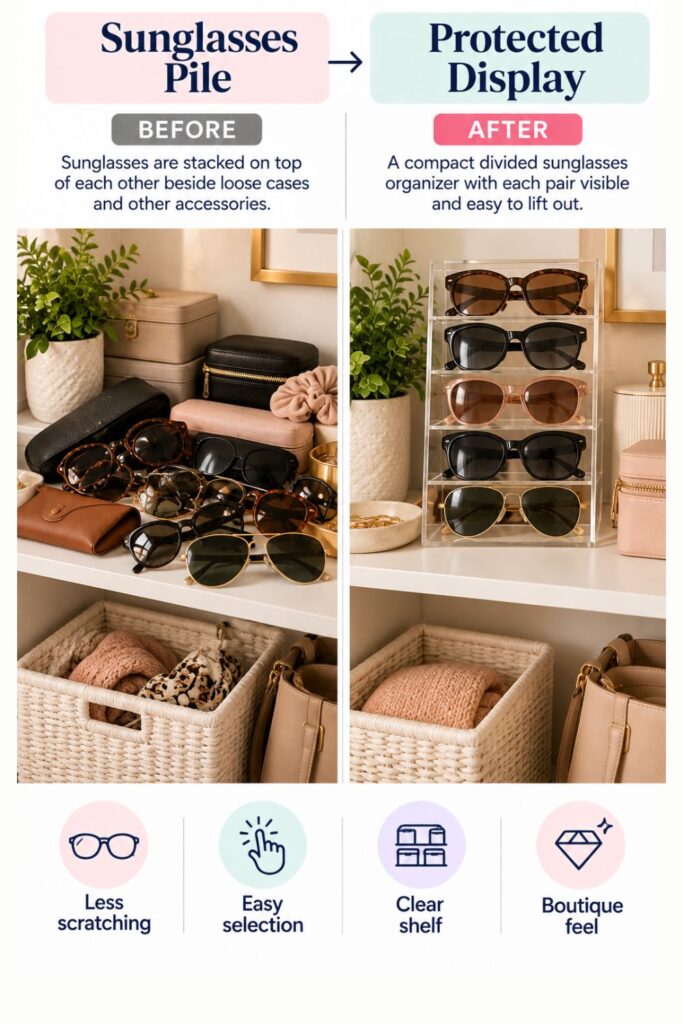
Create a sunglasses zone: Store sunglasses in individual slots or in a neat row. The goal is to see each pair without moving several others out of the way.
If you own cases, keep most of them in secondary storage unless you regularly use them.
Create a belt zone: Belts usually work better hanging vertically than rolled into a deep container. A row of hooks or a short rail makes buckles visible and prevents you from digging through a pile.
Then add one small zone for miscellaneous finishing pieces.
This might include:
- A favorite watch
- A scarf ring
- A brooch
- Hair clips
- A compact wallet
- A small perfume atomizer
Keep this area intentionally small so it does not become a catchall.
The most important part is making the boundaries between zones obvious.
If you want to get more from your life, and are looking for concrete action steps to get you there, check out our Request a Coach page. It’s a “cut the fence-sitting and take action” way to tackle your issues and actually find success. To get off the fence and start to take action, click or tap here.
You should be able to look at the station and know where something belongs without thinking.
That might mean one tray for jewelry, one divided holder for sunglasses, and five hooks for belts. The containers do not need labels if the layout is visually clear.
Try not to create too many tiny categories.
An overly complicated system can look impressive on setup day but become tiring to maintain. Your goal is to make putting things away almost automatic.
If you can return each accessory to its zone in one simple movement, the station is much more likely to stay organized.
4. Match the Organizer to the Accessory Instead of Making Everything Match
It can be tempting to buy a matching set of organizers and use them for every accessory. Unfortunately, identical storage is not always functional storage.
Different accessories behave differently.
A ring needs a very different type of home than a belt. Sunglasses need more protection and visibility than a lightweight scarf. Long necklaces need enough space to avoid tangling.
If you want to get more from your life, and are looking for concrete action steps to get you there, check out our Request a Coach page. It’s a “cut the fence-sitting and take action” way to tackle your issues and actually find success. To get off the fence and start to take action, click or tap here.
Instead of asking, “Which organizers match?” ask, “What storage method makes this easiest to use?”
Use shallow trays for small jewelry: Rings, stud earrings, bracelets, and watches are easier to scan when they sit in shallow compartments.
If the tray is too deep, pieces begin stacking on top of one another.
Use vertical storage for flexible accessories: Belts, long necklaces, and lightweight scarves often work well on hooks or rails.
Vertical storage also makes better use of empty wall space.
Use divided storage for sunglasses: A compartment for each pair helps protect frames while keeping the collection easy to see.
You can also use a tiered organizer if you have enough depth on the shelf.
Add height carefully: If items in the back disappear behind items in the front, use a small riser or tiered stand.
If you want to get more from your life, and are looking for concrete action steps to get you there, check out our Request a Coach page. It’s a “cut the fence-sitting and take action” way to tackle your issues and actually find success. To get off the fence and start to take action, click or tap here.
The purpose is visibility, not decoration.
You can still make the station feel coordinated without forcing everything into identical containers. Choose two or three finishes that work together, such as wood, matte metal, and clear acrylic.
Repeating those finishes helps the station feel intentional.
You might use:
- A wood tray for jewelry
- Matte metal hooks for belts
- Clear dividers for sunglasses
- A small ceramic dish for everyday earrings
The organizers are different, but the overall look still feels cohesive.
Function should come first because this is a working part of your closet.
When each accessory has storage suited to its shape, it becomes easier to grab, easier to return, and less likely to become damaged.
5. Arrange the Station Like a Boutique Display Without Making It Fussy
Once the storage is functional, you can make the station feel polished.
If you want to get more from your life, and are looking for concrete action steps to get you there, check out our Request a Coach page. It’s a “cut the fence-sitting and take action” way to tackle your issues and actually find success. To get off the fence and start to take action, click or tap here.
The trick is to borrow the visual principles of a boutique without turning your closet into a display you are afraid to touch.
Start with accessibility.
Put your most-used pieces closest to your hand: Everyday earrings, your usual watch, favorite sunglasses, or go-to belt should occupy the easiest positions.
Do not give the best spot to an item simply because it looks beautiful.
Next, think about height.
Place taller items toward the back and lower trays toward the front. If you use a necklace stand or vertical sunglasses display, make sure it does not hide smaller pieces behind it.
You can create a simple arrangement such as:
- Back: taller stand or hanging pieces
- Middle: sunglasses or watches
- Front: rings, earrings, or small trays
This makes the entire station easier to scan.
If you want to get more from your life, and are looking for concrete action steps to get you there, check out our Request a Coach page. It’s a “cut the fence-sitting and take action” way to tackle your issues and actually find success. To get off the fence and start to take action, click or tap here.
Give statement pieces breathing room: If you have one beautiful watch, bracelet, or pair of sunglasses, leaving a little open space around it can make the station feel more deliberate.
You do not need to fill every gap.
Boutique-style organization works partly because the display is edited.
Keep practical supplies nearby but not necessarily visible. Spare cases, jewelry cleaning cloths, extra watch straps, repair kits, and other functional items can live in a drawer or small bin below the station.
That keeps the main surface focused on the accessories you actually wear.
You also do not need perfect symmetry.
A station can look balanced without placing identical trays on both sides. Instead, spread visual weight across the space so one side does not feel crowded while the other feels empty.
Most importantly, allow yourself to use the station.
If you want to get more from your life, and are looking for concrete action steps to get you there, check out our Request a Coach page. It’s a “cut the fence-sitting and take action” way to tackle your issues and actually find success. To get off the fence and start to take action, click or tap here.
A successful setup should still look good after you have removed a watch or pair of sunglasses.
If the arrangement only works when every item is positioned perfectly, it is probably too complicated for everyday life.
6. Build a Return System That Keeps the Station Looking Polished
Setting up the accessory station is only half the job.
The real test is whether your accessories return to their homes after you use them. If putting something away takes too many steps, clutter will slowly return.
Start by making each return point obvious.
Give every category one home: Earrings go in one tray. Sunglasses go in one holder. Belts return to one set of hooks.
Avoid creating multiple possible homes for the same category.
If sunglasses sometimes go in a drawer, sometimes on a shelf, and sometimes in a handbag, the system becomes harder to maintain.
If you want to get more from your life, and are looking for concrete action steps to get you there, check out our Request a Coach page. It’s a “cut the fence-sitting and take action” way to tackle your issues and actually find success. To get off the fence and start to take action, click or tap here.
Make putting away easier than dropping: Whenever possible, use storage that requires one simple action.
Open trays, hooks, slots, and shallow compartments usually work better for everyday accessories than boxes with lids or organizers hidden behind several drawers.
You can also include one very small landing spot.
A dish or shallow tray can hold the watch, earrings, or hair clip you remove quickly at the end of the day.
The key word is small.
If the landing area is large, it can quickly become a dumping zone for receipts, hair ties, loose change, tags, and anything else you happen to be holding.
Set a simple reset rule.
For example:
If you want to get more from your life, and are looking for concrete action steps to get you there, check out our Request a Coach page. It’s a “cut the fence-sitting and take action” way to tackle your issues and actually find success. To get off the fence and start to take action, click or tap here.
- Clear the landing tray every Sunday.
- Return stray accessories while putting away laundry.
- Spend three minutes resetting the station before choosing outfits for the week.
You do not need a major weekly organizing session.
A good accessory station should require very little maintenance.
Pay attention when one category repeatedly spills beyond its assigned space. That is useful information.
Instead of immediately buying another organizer, ask whether everything in the category still deserves prime closet space.
Your storage capacity can act as a natural boundary.
When the station has clear limits and easy return points, maintaining it becomes part of your normal routine instead of another household project.
7. Make the Station Work in a Small or Narrow Walk-In Closet
You do not need a large closet island or custom cabinetry to create an accessory station.
In fact, narrow walk-in closets often benefit the most from this type of system because small accessories can otherwise spread across limited shelves and surfaces.
If you want to get more from your life, and are looking for concrete action steps to get you there, check out our Request a Coach page. It’s a “cut the fence-sitting and take action” way to tackle your issues and actually find success. To get off the fence and start to take action, click or tap here.
Start by looking for unused vertical space.
Use a narrow wall strip: A short rail, hooks, or compact hanging organizer can turn a small section of wall into storage for belts, necklaces, or lightweight scarves.
You may only need a few inches of width.
Borrow part of an existing shelf: You do not have to dedicate an entire shelf to accessories.
A shallow jewelry tray and sunglasses holder can occupy one end while folded clothing or handbags use the rest.
If you have several accessory categories, stack them vertically rather than spreading them horizontally.
For example:
- Belts hang above.
- Sunglasses sit at eye level.
- Jewelry occupies a shelf below.
- Overflow lives in a drawer underneath.
This creates a complete station without taking up much floor or shelf space.
If you want to get more from your life, and are looking for concrete action steps to get you there, check out our Request a Coach page. It’s a “cut the fence-sitting and take action” way to tackle your issues and actually find success. To get off the fence and start to take action, click or tap here.
You can also use the inside of suitable cabinet doors if your closet has them. Lightweight hooks or shallow organizers may work for certain accessories, provided they do not interfere with hinges or prevent the door from closing.
The smaller the station, the more important editing becomes.
Trying to squeeze every accessory you own into a narrow closet usually makes the area harder to use.
Instead, keep your active collection limited to the pieces you wear regularly.
Store seasonal, sentimental, or occasional pieces somewhere less accessible.
A small station can still look polished if the storage boundaries are clear.
Choose fewer organizers, avoid excessively deep bins, and preserve some visual breathing room.
You may be surprised by how little space you actually need once everything has a defined home.
If you want to get more from your life, and are looking for concrete action steps to get you there, check out our Request a Coach page. It’s a “cut the fence-sitting and take action” way to tackle your issues and actually find success. To get off the fence and start to take action, click or tap here.
The goal is not to make your closet hold the largest possible number of accessories. It is to make the accessories you use easiest to find, wear, and put away.
8. Use the Station to Make Getting Dressed Faster
An accessory station can do more than make your closet look organized.
When it is set up intentionally, it can reduce some of the small decisions involved in getting dressed.
Start by paying attention to what you actually wear.
Most people have a relatively small group of accessories they reach for repeatedly, even if they own many more.
Identify your repeat pieces: Notice which earrings, watches, belts, sunglasses, or bracelets appear most often in your outfits.
Give those items the most visible positions in the station.
You can also group compatible pieces loosely.
If you want to get more from your life, and are looking for concrete action steps to get you there, check out our Request a Coach page. It’s a “cut the fence-sitting and take action” way to tackle your issues and actually find success. To get off the fence and start to take action, click or tap here.
Perhaps you usually wear one belt with work trousers or tend to pair a particular watch with certain earrings.
You do not need to create formal outfit kits, but keeping frequently combined items close together can make getting ready faster.
Use visibility to your advantage.
Accessories that stay hidden in deep drawers are easy to forget. Rotate a few underused pieces into a more visible spot occasionally and see whether you start wearing them again.
If they still go untouched, that tells you something.
You can also use the station to prepare for the following day.
A small landing tray can temporarily hold:
- Tomorrow’s earrings
- A watch
- A belt
- Sunglasses
- A hair accessory
This works especially well if you already choose your clothes the night before.
If you want to get more from your life, and are looking for concrete action steps to get you there, check out our Request a Coach page. It’s a “cut the fence-sitting and take action” way to tackle your issues and actually find success. To get off the fence and start to take action, click or tap here.
Instead of making several small styling decisions in the morning, the finishing pieces are ready to go.
The station can also help you notice buying habits.
If you consistently reach for the same three pairs of earrings while twenty others sit untouched, you may not need more earrings.
Over time, your accessory station becomes a visual record of what you actually use.
That information can help you edit your closet, shop more intentionally, and create a collection that reflects your real life rather than an imagined version of it.
Good organization does not simply store more things. It helps you use what you already own more effectively.
9. How an Organizational Coach Can Help When Your Systems Never Stick
Sometimes the problem is not that you do not know how to organize.
You may have bought trays, labeled bins, rearranged shelves, and reset the closet several times. Yet a few weeks later, the accessories are scattered again.
If you want to get more from your life, and are looking for concrete action steps to get you there, check out our Request a Coach page. It’s a “cut the fence-sitting and take action” way to tackle your issues and actually find success. To get off the fence and start to take action, click or tap here.
That can be a sign that the system does not match your behavior.
An organizational coach can help you look beyond the storage products and identify why the setup keeps breaking down.
Identify the real friction point: The issue might be too many accessories, storage that is inconvenient to reach, categories that are overly complicated, or a routine that requires too many steps.
Once you know the actual problem, you can change the system rather than repeating the same reset.
Design around what you already do: If you always remove jewelry near the closet door, your storage should probably be close to that location.
If belts repeatedly end up on a chair, perhaps the belt hooks are too far away or difficult to use.
A coach can help you notice those patterns.
They can also help you establish realistic limits.
If you want to get more from your life, and are looking for concrete action steps to get you there, check out our Request a Coach page. It’s a “cut the fence-sitting and take action” way to tackle your issues and actually find success. To get off the fence and start to take action, click or tap here.
For example, you might decide that:
- Everyday jewelry fits in one tray.
- Sunglasses stay within one organizer.
- Belts stay on six hooks.
- Anything beyond those limits goes into secondary storage.
These boundaries make it easier to see when the system needs editing.
Coaching can also help if your closet organization tends to follow an all-or-nothing pattern.
Instead of waiting until everything feels messy enough to justify a major overhaul, you can build a tiny reset into your routine.
That might be five minutes every Friday or a quick reset while putting away laundry.
Your needs can change too.
A new job, a change in style, a different morning routine, or a seasonal wardrobe shift may require the station to evolve.
A useful organization system should adapt with you.
If you want to get more from your life, and are looking for concrete action steps to get you there, check out our Request a Coach page. It’s a “cut the fence-sitting and take action” way to tackle your issues and actually find success. To get off the fence and start to take action, click or tap here.
The goal is not to maintain a perfect closet. It is to create a system that requires little enough effort that you can realistically keep using it.
A Closet That Looks Polished Because It Works
A boutique-style accessory station does not require custom cabinetry, an enormous walk-in closet, or a collection of expensive matching organizers.
The polished look comes from making a series of practical decisions.
You edit what deserves prime space. You group accessories according to how they are used. You choose storage that fits the shape of each category, and you make every return point obvious.
When those pieces work together, the station naturally looks more intentional.
The simplest version might include:
- One shallow jewelry tray
- One sunglasses organizer
- A few belt hooks
- One small landing dish
- A nearby drawer for overflow
That is enough to create a clear getting-dressed zone.
The most important part is keeping the active station focused on what you actually wear.
If you want to get more from your life, and are looking for concrete action steps to get you there, check out our Request a Coach page. It’s a “cut the fence-sitting and take action” way to tackle your issues and actually find success. To get off the fence and start to take action, click or tap here.
A closet often becomes frustrating when frequently used items compete with sentimental pieces, occasional accessories, repair projects, packaging, and things you are not sure whether to keep.
Separating those categories makes everyday organization much easier.
Remember that empty space is useful too.
You do not need to fill every compartment, hook, or inch of shelf space. A little breathing room makes your accessories easier to see and gives the station room to function during a busy week.
After the initial setup, maintenance should be simple.
Return accessories to their zones, clear the small landing tray regularly, and edit a category when it starts overflowing.
That is much easier than repeatedly reorganizing the entire closet.
The result is more than a prettier shelf.
If you want to get more from your life, and are looking for concrete action steps to get you there, check out our Request a Coach page. It’s a “cut the fence-sitting and take action” way to tackle your issues and actually find success. To get off the fence and start to take action, click or tap here.
You create one reliable place to finish getting dressed, find the accessories you actually enjoy wearing, and put everything away without having to make another decision.
That is what makes the station feel boutique-style while still working in real life.
*****
Are you all about style, decor and organization? Download a copy of our Clutter Reset Guide.
Need some in depth help with organization and productivity ? Drop on by our directories choc full of productivity coaches, minimalist coaches, and work/life balance coaches to get your life organized! Or click here to have us match you to the best.
If you want to get more from your life, and are looking for concrete action steps to get you there, check out our Request a Coach page. It’s a “cut the fence-sitting and take action” way to tackle your issues and actually find success. To get off the fence and start to take action, click or tap here.
Read this next
Before & After: Tiny Bathroom Transformations You Can Do in a Day
If your small bathroom feels more like a daily source of stress than a soothing space, you’re not alone. Tiny bathrooms have a way of collecting clutter, swallowing storage, and […]
Read More
The Galentine’s Formula: Decor, Tables, and Activities That Just Work
Are you all about style, decor and organization? Download a copy of our Decluttering Workbook. ***Galentine’s Day has become one of those rare gatherings that people genuinely enjoy planning for […]
Read More
How to Develop Organizational Skills
Learn how to develop organizational skills in order to reduce your stress.
Read More