


Talk to a coach about Organizational coaching

Crystal Faulk
ACC
I help overwhelmed women in transition gain clarity, confidence, and...

Terrie Hein
Certified Life Coach, Certified Insight Coach Practitioner
Coaching to declutter your life, organize your goals, and cook...

Dr Charlene Ashley
Doctorate - Behaviours
I coach individuals to design fulfilling lives through structure, clarity,...

Paloma Chiara

Lana's Gymnastics Club
"Where the best in gymnastics meets fun. Where every child is a star"
lgclubny.com

Anna Sosnina
ICF (ACC)
ICF ACC certified coach, founder of EssorVie Coaching, passionate about...

Travis Brown
Professional Life coach
With experience in guiding clients to achieve goals, build confidence,...

Lynn Yang
Certified Christian Leadership Coaching (CCLC)
I will help you gain new insights, habits, and plans...





The Surprisingly Simple Formula Behind a Formal Thanksgiving Table
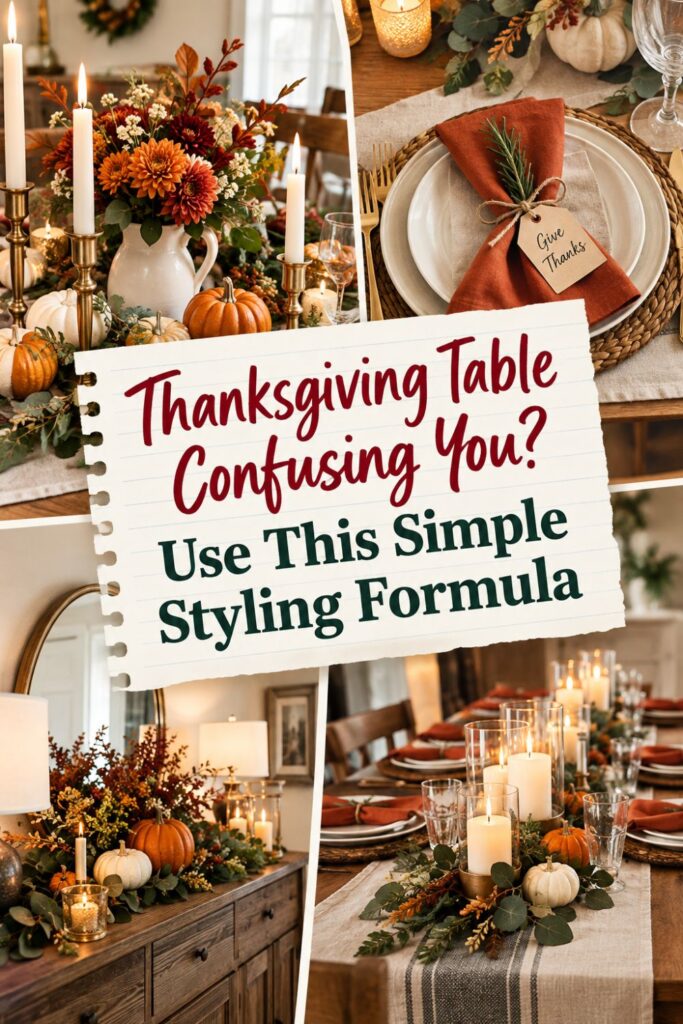
How to Create a Formal White, Cream and Gold Table Without Hiring Anyone
A formal Thanksgiving table can look complicated when you see the finished version. There are layers of plates, folded napkins, candles, florals, glassware, metallic details, and carefully arranged seasonal accents. It can easily seem like the kind of table that requires a decorator, a florist, and a much bigger holiday budget than you planned.
Fortunately, an elegant Thanksgiving tablescape is less about buying expensive pieces and more about knowing how to combine simple ones.
White, cream, and gold work especially well because the palette already feels polished. White provides the clean foundation, cream adds warmth, and gold introduces just enough shine to make the table feel special. When those three elements are repeated consistently, even inexpensive dishes and simple decorations can look surprisingly luxurious.
The key is to think in layers rather than individual decorations. Instead of shopping for a collection of random Thanksgiving items, build the table in a specific order.
A simple formula looks like this:
- Start with a white or cream foundation.
- Layer coordinated place settings.
- Repeat a small amount of gold.
- Create one clear centerpiece.
- Add subtle Thanksgiving details.
- Finish with candlelight and natural texture.
This approach also makes decorating much easier when Thanksgiving already comes with a long list of things to do. You can prepare most of the table ahead of time, reuse pieces you already own, and avoid spending Thanksgiving morning rearranging decorations.
Formal does not have to mean fussy, either. Your guests should still be able to talk across the table, reach their glasses, and enjoy the meal comfortably.
Think of the goal as polished rather than perfect. A few intentional layers, repeated consistently from one end of the dining table to the other, can create the kind of elegant Thanksgiving tablescape that looks professionally styled without requiring anyone but you to put it together.
If you want to get more from your life, and are looking for concrete action steps to get you there, check out our Request a Coach page. It’s a “cut the fence-sitting and take action” way to tackle your issues and actually find success. To get off the fence and start to take action, click or tap here.
Need some help with style or organization? Drop on by our directories choc full of image coaches, organization coaches and minimalist coaches to help make your spaces beautiful. Or click here to have us match you to the best.
1. Build Your White-and-Cream Foundation Before Adding Any Gold
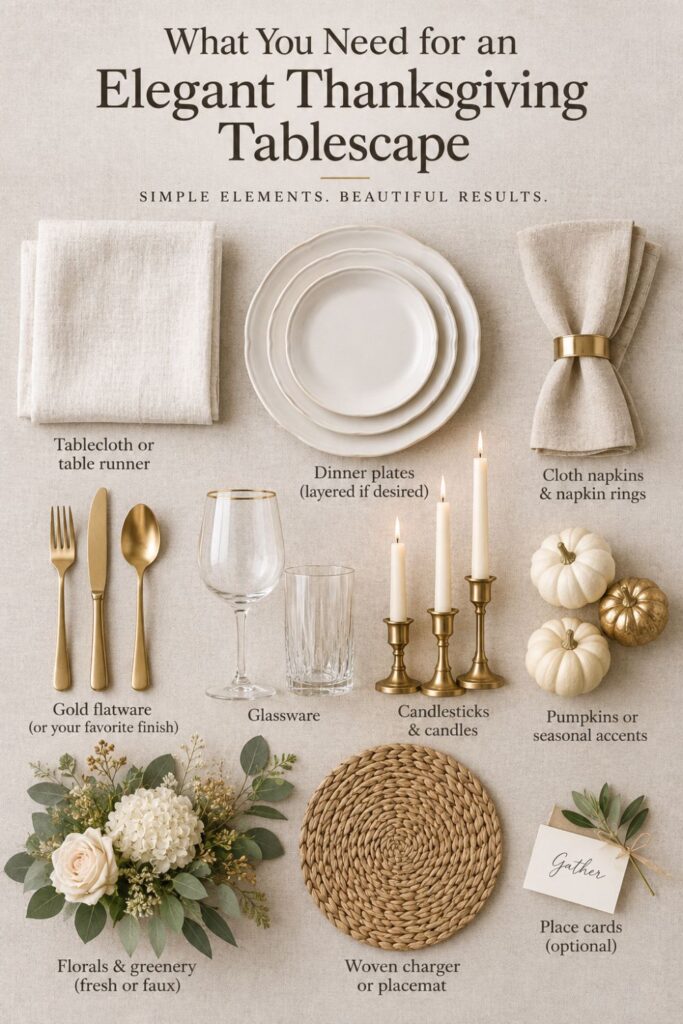
The easiest way to make a Thanksgiving table feel sophisticated is to simplify the color palette before you begin decorating. White and cream create a calm background that allows every later layer to feel deliberate.
Start by deciding which neutral will dominate. If you have a crisp white tablecloth, use white as your base and bring cream in through napkins, candles, dishes, or a runner. If your dining table has beautiful natural wood, you may prefer to leave some of it exposed and use a soft cream runner down the center.
Texture becomes especially important when you are decorating mostly with neutrals. Without texture, white and cream can look flat rather than elegant.
Try combining materials such as:
- Linen or linen-look napkins
- Matte ceramic plates
- Woven placemats
- Cotton runners
- Ribbed or fluted glassware
- Natural wood
- Softly textured candles
You do not need every one of these elements. Two or three different textures are usually enough to keep the table visually interesting.
Before adding anything metallic, remove pieces that interrupt the palette. Bright orange placemats, heavily patterned fall linens, colorful serving pieces, and novelty Thanksgiving decor can quickly compete with a formal white-and-gold look.
That does not mean the table needs to become completely colorless. Natural greenery, muted brown branches, pale pumpkins, wheat, or soft beige accents can add warmth while still fitting comfortably into the neutral color story.
If you want to get more from your life, and are looking for concrete action steps to get you there, check out our Request a Coach page. It’s a “cut the fence-sitting and take action” way to tackle your issues and actually find success. To get off the fence and start to take action, click or tap here.
Once your base is arranged, step several feet away from the table and look at the entire surface. Check whether one end feels heavier than the other and whether the runner, placemats, or tablecloth sit evenly.
This small pause matters. It is much easier to correct the foundation now than after the table is covered with plates, candles, and centerpiece pieces.
If the base already looks calm and balanced, you have created the most important part of the tablescape. Everything that comes next will have a cleaner backdrop, which is what helps inexpensive pieces look intentional instead of random.
2. Use Gold Like Jewelry Instead of Covering the Table With It
Gold is what gives this neutral Thanksgiving table its formal finish, but it works best when used sparingly. Think of gold the same way you would think about jewelry with an outfit. A few deliberate accents can make everything look polished, while too much can compete for attention.
Choose two or three places where gold will appear. Flatware, napkin rings, chargers, candleholders, or small centerpiece vessels are all good options.
For example, your gold plan might be:
- Gold flatware at every place setting
- Two or three gold candleholders in the centerpiece
- A simple gold napkin ring at each seat
That is already enough to create repetition throughout the table.
Try to keep the finish reasonably consistent. Antique brass, brushed gold, and highly polished yellow gold can each look beautiful, but mixing several dramatically different metallic finishes can make a simple tablescape feel less cohesive.
If you want to get more from your life, and are looking for concrete action steps to get you there, check out our Request a Coach page. It’s a “cut the fence-sitting and take action” way to tackle your issues and actually find success. To get off the fence and start to take action, click or tap here.
You do not need to purchase matching pieces from the same collection. Just look for metals that feel visually related.
Spacing also matters. If all of the gold is clustered in the middle of the table, the centerpiece may look disconnected from the place settings. Repeating small touches from one end to the other helps your eye move naturally across the dining table.
Allow the white and cream pieces to remain dominant. Your dinner plates, linens, candles, and larger decorative elements can do most of the visual work while gold acts as the finishing detail.
If you are working with a tight decorating budget, this is especially useful. You do not need gold-rimmed dishes, gold glasses, gold chargers, gold placemats, and gold serving pieces all at once.
Choose the element that will make the biggest difference and repeat it consistently.
One inexpensive set of napkin rings or a few gold candleholders can completely change the mood of a table when everything around them is intentionally neutral.
The restraint is part of what makes the tablescape feel elegant. When metallic details are limited, each one becomes more noticeable and the table feels styled rather than decorated simply for the sake of adding more.
3. Build Formal Place Settings With a Simple Layering Formula
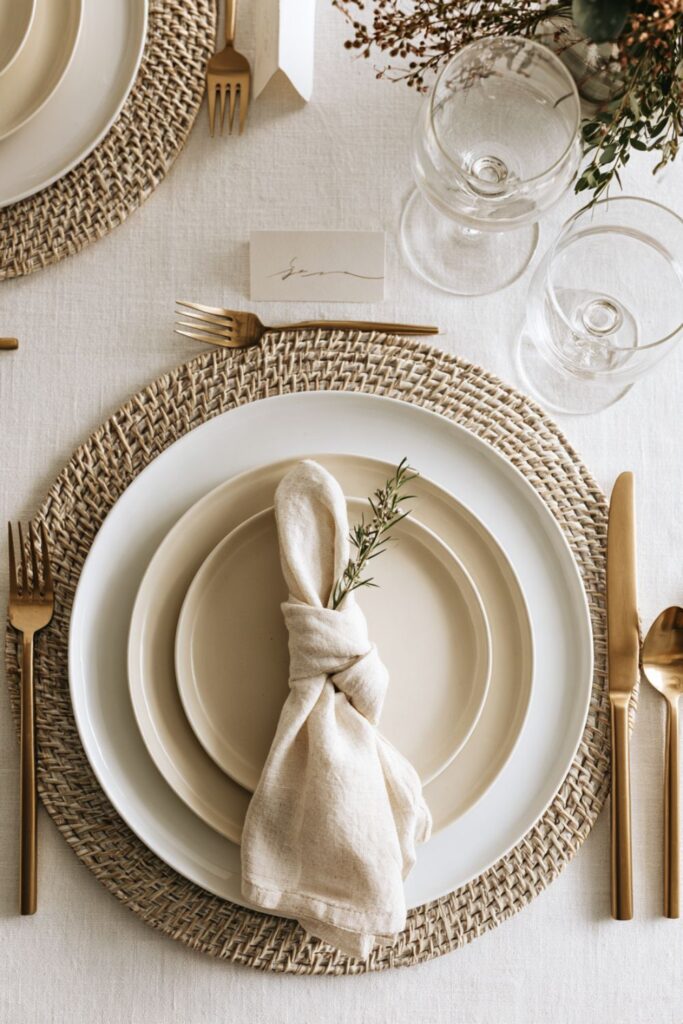
Formal place settings often look complicated because several pieces are stacked together. In reality, you can create the same visual effect with a very simple formula and only the dishes your guests actually need.
If you want to get more from your life, and are looking for concrete action steps to get you there, check out our Request a Coach page. It’s a “cut the fence-sitting and take action” way to tackle your issues and actually find success. To get off the fence and start to take action, click or tap here.
Begin by giving each person a clear visual space. A charger or placemat makes this easy, but neither is required. A dinner plate placed consistently at every seat can create enough structure on its own.
Next, add only the layers that make sense for the meal.
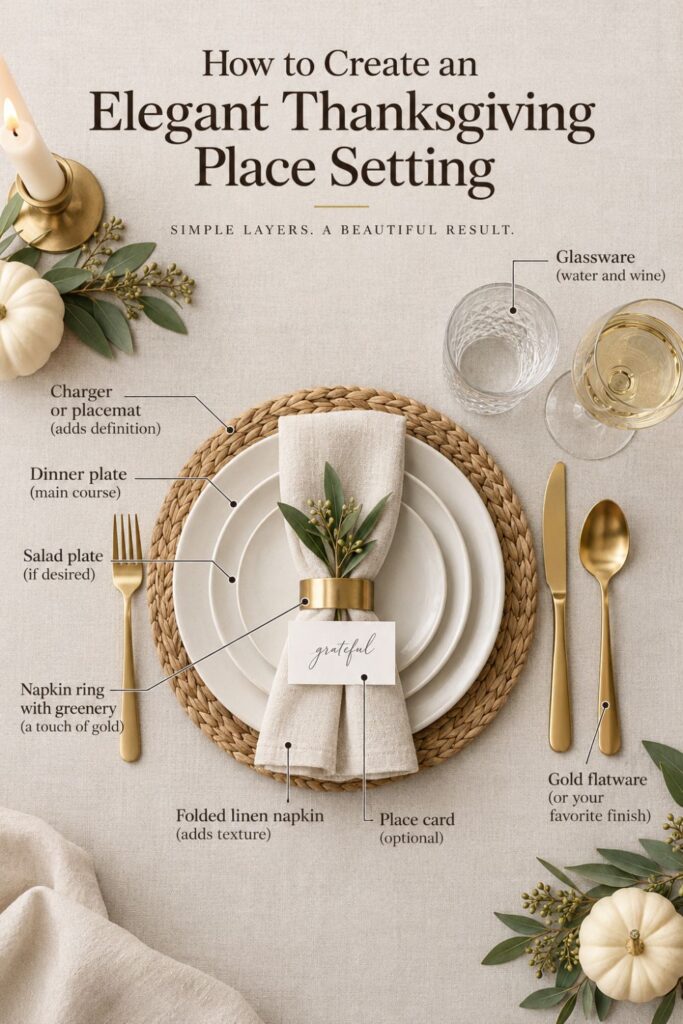
Your place-setting formula might include:
- One charger or placemat
- One dinner plate
- One smaller plate or bowl
- One folded napkin
- Flatware
- One or two glasses
- One small decorative detail
The goal is repetition. If each setting follows the same formula, the entire table immediately feels more formal.
Napkins are one of the easiest ways to add another design layer without spending much. Fold a cream napkin across the plate, place it underneath the flatware, or use a simple napkin ring.
Avoid complicated folds unless you genuinely enjoy making them. A clean rectangular fold often looks more sophisticated than an elaborate shape.
Pay attention to alignment as you work. Plates should sit roughly the same distance from the edge of the table. Glasses should appear in similar positions at every setting, and flatware should be placed consistently.
These tiny details cost nothing, but they make a noticeable difference.
If you want to get more from your life, and are looking for concrete action steps to get you there, check out our Request a Coach page. It’s a “cut the fence-sitting and take action” way to tackle your issues and actually find success. To get off the fence and start to take action, click or tap here.
Finish each place setting with one restrained Thanksgiving element. This could be a handwritten name card, a small dried leaf, a sprig of greenery, a tiny neutral pumpkin, or a piece of ribbon.
Choose one idea and repeat it. Using several different seasonal decorations at every setting can quickly make the table feel busy.
Most importantly, give people enough room to eat comfortably. Formal styling should not leave guests carefully moving decorations every time they reach for their water.
If your table is small, skip unnecessary layers. A beautiful dinner plate, folded napkin, coordinated flatware, and one small detail can look just as polished as a setting with five stacked plates.
Consistency creates the formal appearance. Quantity does not.
4. Create a Low Thanksgiving Centerpiece That Looks Professionally Styled
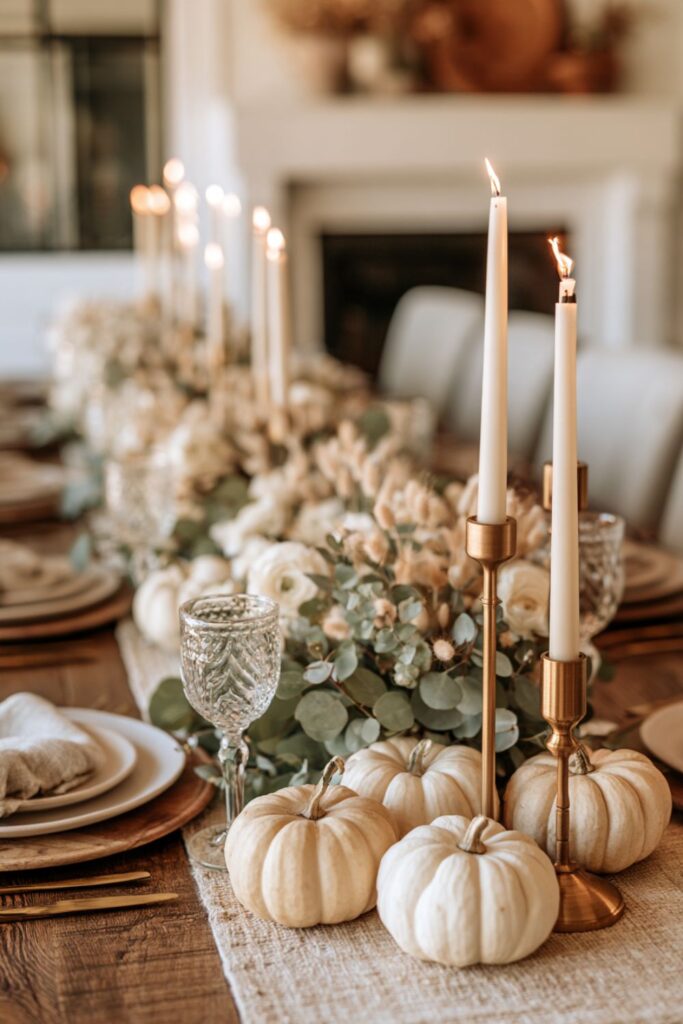
The centerpiece is usually the first thing people notice when they see a Thanksgiving table, but it does not need to be enormous or expensive. In fact, a lower centerpiece is often more elegant because it allows the table itself to remain part of the design.
Start by deciding on the overall shape before choosing individual objects.
For a rectangular dining table, a long arrangement running through the center usually works well. You can create it with several smaller pieces rather than one large floral arrangement.
If you want to get more from your life, and are looking for concrete action steps to get you there, check out our Request a Coach page. It’s a “cut the fence-sitting and take action” way to tackle your issues and actually find success. To get off the fence and start to take action, click or tap here.
For a round table, one compact centerpiece often feels more balanced.
Build most of the arrangement using affordable neutral materials such as:
- White or cream pumpkins
- Greenery
- Pale flowers
- Dried grasses
- Branches
- Taper candles
- Pillar candles
- Clear glass vessels
- Neutral ceramic vases
Begin with your largest or most visually important pieces. Then fill around them using smaller items.
Varying height helps the arrangement feel professionally styled, but avoid placing tall decorations directly where guests need to see one another. Taller candles can work because they are narrow, while large floral arrangements often block conversation.
A useful test is to sit in one of the dining chairs while you are decorating. Look across the table. If you would need to lean sideways to speak to someone, lower the centerpiece.
Repeat the gold finish you selected earlier through one or two centerpiece details. Gold candleholders are particularly useful because they introduce metallic shine without taking over the arrangement.
Leave some empty space, too. A centerpiece does not need to cover every inch of the runner.
Those open areas give the eye somewhere to rest and make it easier to place serving dishes, water bottles, or additional food on the table.
If you want to get more from your life, and are looking for concrete action steps to get you there, check out our Request a Coach page. It’s a “cut the fence-sitting and take action” way to tackle your issues and actually find success. To get off the fence and start to take action, click or tap here.
The finished centerpiece should look like part of the tablescape rather than a separate decoration sitting in the middle. Pulling colors, metals, and textures from the place settings into the centerpiece creates that connection.
When those elements repeat naturally, a collection of simple objects can look like one carefully planned arrangement.
5. Use Symmetry and Repetition to Make Budget Pieces Look More Expensive
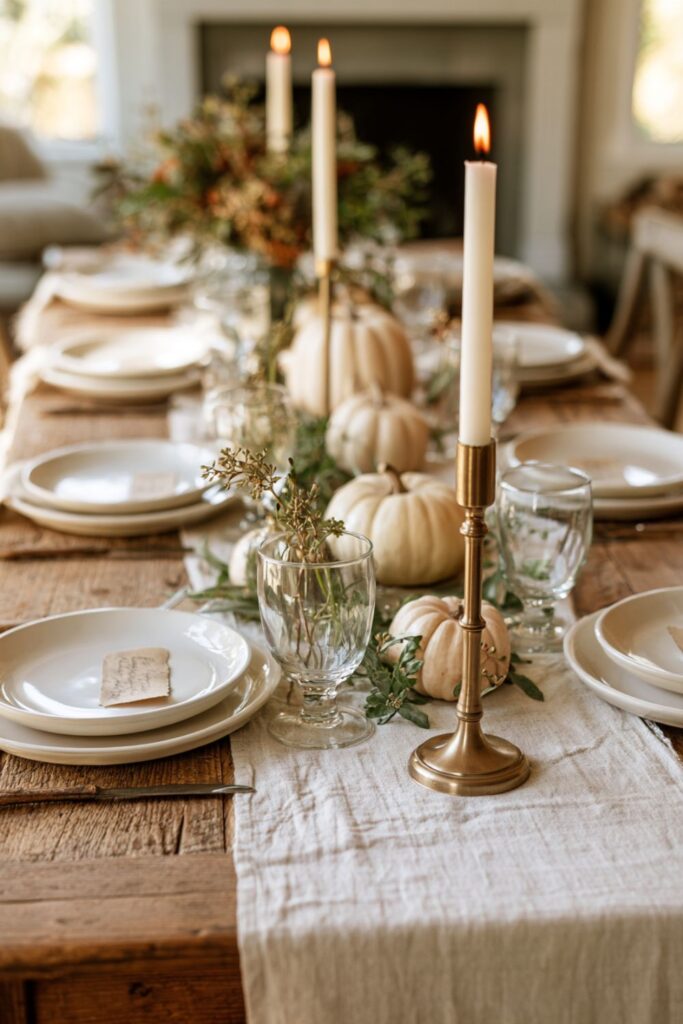
One of the easiest ways to make inexpensive decor look polished is to repeat it. Professional-looking tables often feel cohesive because the same shapes, colors, and materials appear in a predictable rhythm.
Instead of spending your decorating budget on one large statement piece, consider buying or gathering several smaller matching items.
Three inexpensive candleholders, for example, can have more impact than one elaborate centerpiece decoration. Six small glass vases filled with simple greenery can create a beautiful table arrangement without requiring expensive flowers.
Symmetry can help, too.
Try creating loose pairs across the table:
- Matching candleholders near each end
- Similar vases on opposite sides
- Two groups of mini pumpkins
- Repeated napkin details
- Identical candles spaced evenly
- Similar greenery running along both sides of the centerpiece
The arrangement does not need to be perfectly mirrored. The goal is simply to create enough balance that the eye understands the pattern.
If you want to get more from your life, and are looking for concrete action steps to get you there, check out our Request a Coach page. It’s a “cut the fence-sitting and take action” way to tackle your issues and actually find success. To get off the fence and start to take action, click or tap here.
Spacing is another detail that can dramatically change the finished look.
Instead of placing candles and decorative items wherever there happens to be room, arrange them at fairly even intervals. A few extra seconds spent adjusting spacing can make basic decor appear much more intentional.
This is also where editing becomes important. When a tablescape looks unfinished, the instinct is often to add another decoration.
Sometimes the opposite works better.
Remove one object and look again. White space around a candle, vase, or plate gives that piece more visual importance.
A crowded table can make even expensive items disappear into the clutter. A restrained table gives modest items room to stand out.
If you are mixing things you already own, repetition can help them feel connected. Maybe the vases are different shapes, but they all contain the same greenery. Perhaps the candleholders are different heights, but every candle is cream.
Look for one feature you can repeat.
If you want to get more from your life, and are looking for concrete action steps to get you there, check out our Request a Coach page. It’s a “cut the fence-sitting and take action” way to tackle your issues and actually find success. To get off the fence and start to take action, click or tap here.
Budget luxe decorating is rarely about hiding the fact that individual pieces are inexpensive. It is about arranging ordinary pieces with enough consistency that the overall composition feels considered.
That is often what your eye reads as expensive.
6. Add Warmth So the Formal Table Still Feels Like Thanksgiving
A white, cream, and gold table can look beautifully formal, but without a few warm details it can also start to resemble a wedding or formal dinner party rather than Thanksgiving.
The solution is not necessarily adding bright orange everywhere. Instead, bring warmth into the table through texture, natural materials, candlelight, and subtle seasonal details.
Cream is particularly useful here. White feels crisp, while cream softens the overall palette.
You might introduce warmth through:
- Ivory napkins
- Beeswax or cream candles
- Natural wood
- Wheat
- Dried grasses
- Muted autumn leaves
- Pale pumpkins
- Pears
- Greenery
- Brown or beige branches
Choose one or two seasonal elements rather than using everything on the list.
For example, a table with cream linens, white plates, gold flatware, greenery, and a few pale pumpkins will still clearly feel seasonal. It does not need turkey-shaped decorations or bright fall colors to communicate Thanksgiving.
If you want to get more from your life, and are looking for concrete action steps to get you there, check out our Request a Coach page. It’s a “cut the fence-sitting and take action” way to tackle your issues and actually find success. To get off the fence and start to take action, click or tap here.
Natural elements also make formal styling feel more relaxed. A branch that is slightly irregular or greenery that falls loosely down a runner prevents the table from feeling too rigid.
Candlelight is another powerful tool.
Place several candles through the center of the table and turn them on or light them shortly before dinner. Warm light softens white dishes and causes gold details to reflect gently rather than look overly shiny.
Consider the practical side of warmth as well. Thanksgiving is a family holiday, and your table should feel inviting enough that people are comfortable using it.
Leave room for elbows. Make sure glasses are easy to reach. Avoid delicate decorations that guests will be worried about touching.
If children will be seated at the table, flameless candles may be easier than open flames.
The most elegant Thanksgiving tables often balance two ideas at once. They look formal when guests first walk into the room, but once everyone sits down, the table still feels comfortable and welcoming.
That balance is what keeps a neutral tablescape from feeling cold.
If you want to get more from your life, and are looking for concrete action steps to get you there, check out our Request a Coach page. It’s a “cut the fence-sitting and take action” way to tackle your issues and actually find success. To get off the fence and start to take action, click or tap here.
7. Follow This Order on Thanksgiving Day So You Aren’t Styling at the Last Minute
A beautiful Thanksgiving table becomes much less enjoyable when you are still arranging napkins while food is cooking and guests are arriving.
The easiest solution is to separate decorating tasks from Thanksgiving Day itself.
Start several days ahead with anything that does not involve fresh flowers or food. Wash glasses, clean candleholders, check your dishes, iron or steam linens, prepare place cards, and gather all of the decorative pieces you plan to use.
This is also the time to notice anything missing.
Two or three days before Thanksgiving, create a small staging area for your tablescape. Keep everything together so you are not searching different cabinets for napkin rings, candles, and serving pieces.
The night before Thanksgiving, complete as much of the table as possible.
You can usually set out:
- Tablecloths and runners
- Chargers or placemats
- Plates
- Flatware
- Glassware
- Napkins
- Candleholders
- Nonperishable centerpiece pieces
- Place cards
Cover dishes or glasses lightly if you are worried about dust or pets.
If you want to get more from your life, and are looking for concrete action steps to get you there, check out our Request a Coach page. It’s a “cut the fence-sitting and take action” way to tackle your issues and actually find success. To get off the fence and start to take action, click or tap here.
Save only the genuinely time-sensitive elements for Thanksgiving Day. Fresh flowers, cut greenery, fruit, or other perishable centerpiece pieces can be added shortly before guests arrive.
Once the table is finished, take a quick photo.
This may seem unnecessary, but Thanksgiving tables have a habit of being temporarily rearranged. Someone needs space for a serving dish, a child moves a name card, or you borrow a candleholder for another room.
A photograph gives you an instant reference if you want to put everything back.
It also gives you a useful starting point next year.
Most importantly, establish a stopping point. Decide when the table is finished and resist the temptation to keep adjusting tiny details while you should be focusing on food, guests, or your own preparation.
A well-planned tablescape should make Thanksgiving feel easier, not create another project that needs constant attention.
Preparing it in stages gives you the polished result without sacrificing the holiday itself.
If you want to get more from your life, and are looking for concrete action steps to get you there, check out our Request a Coach page. It’s a “cut the fence-sitting and take action” way to tackle your issues and actually find success. To get off the fence and start to take action, click or tap here.
8. Use This White, Cream and Gold Tablescape Template for Any Table Size
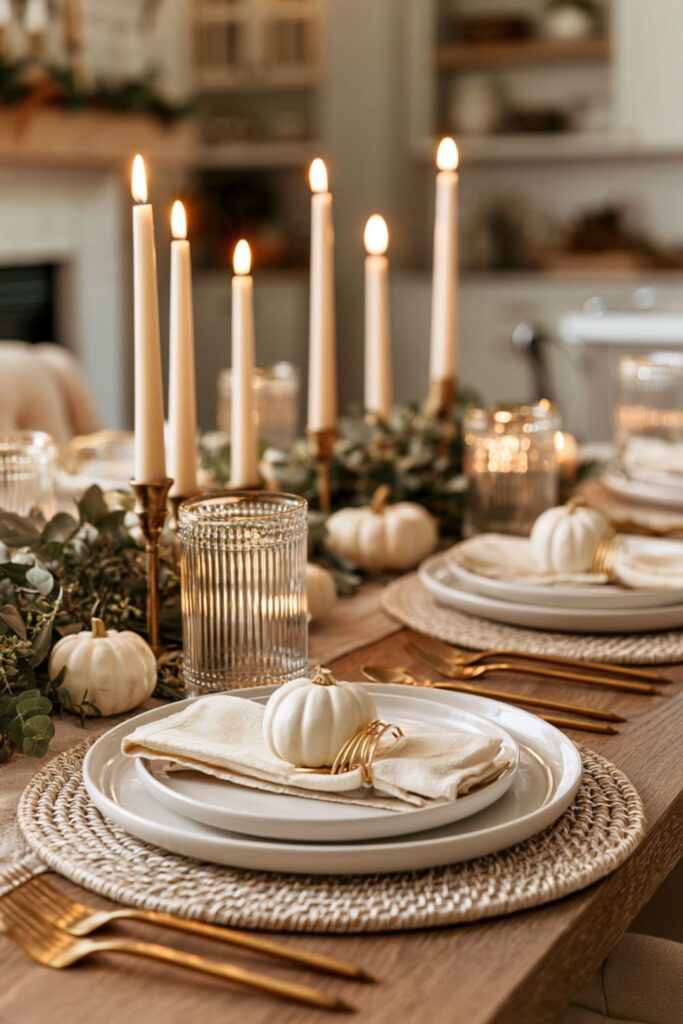
Once you understand the layers, you can use the same tablescape formula whether you are setting a small table for four or a long dining table for twelve.
The exact decorations can change. The structure stays the same.
Use this repeatable formula:
Foundation: Choose white, cream, natural wood, or a combination of those as the background.
Place-setting base: Repeat the same dinner plate, charger, or placemat structure at each seat.
Soft layer: Add a coordinated napkin to every setting.
Gold accent: Choose one primary metallic detail and repeat it throughout the table.
Center line: Build one low centerpiece or a series of smaller arrangements through the center.
If you want to get more from your life, and are looking for concrete action steps to get you there, check out our Request a Coach page. It’s a “cut the fence-sitting and take action” way to tackle your issues and actually find success. To get off the fence and start to take action, click or tap here.
Seasonal detail: Add one subtle Thanksgiving element.
Warmth: Finish with candles, natural texture, or both.
For a small table, scale the centerpiece down first. Do not sacrifice guest space just to preserve a large decorative arrangement.
One vase, two candleholders, and a few seasonal accents may be enough.
For a long table, repeat smaller centerpiece groupings rather than trying to create one enormous arrangement. Three small clusters often feel more balanced and are usually easier to assemble.
If you suddenly need to add more guests, concentrate on repeating the place-setting formula. You do not have to redesign the centerpiece every time the guest count changes.
The same principle helps when you are working with a limited budget.
Protect the elements that create the strongest visual consistency. Keep the neutral foundation, coordinated napkins, repeated gold detail, and central arrangement. Simplify anything else.
If you want to get more from your life, and are looking for concrete action steps to get you there, check out our Request a Coach page. It’s a “cut the fence-sitting and take action” way to tackle your issues and actually find success. To get off the fence and start to take action, click or tap here.
This template can also be reused for other formal dinners. Remove the Thanksgiving-specific seasonal element and replace it with something appropriate for Christmas, Easter, an anniversary, or another celebration.
That is why investing in neutral pieces can be so useful.
Instead of storing an entire set of decorations that work for only one day each year, you are building a flexible foundation that can be restyled.
Once you know the formula, creating an elegant table becomes less about inspiration and more about following a system you already understand.
9. Decide What to Buy, Borrow, Repurpose, or DIY Before You Shop
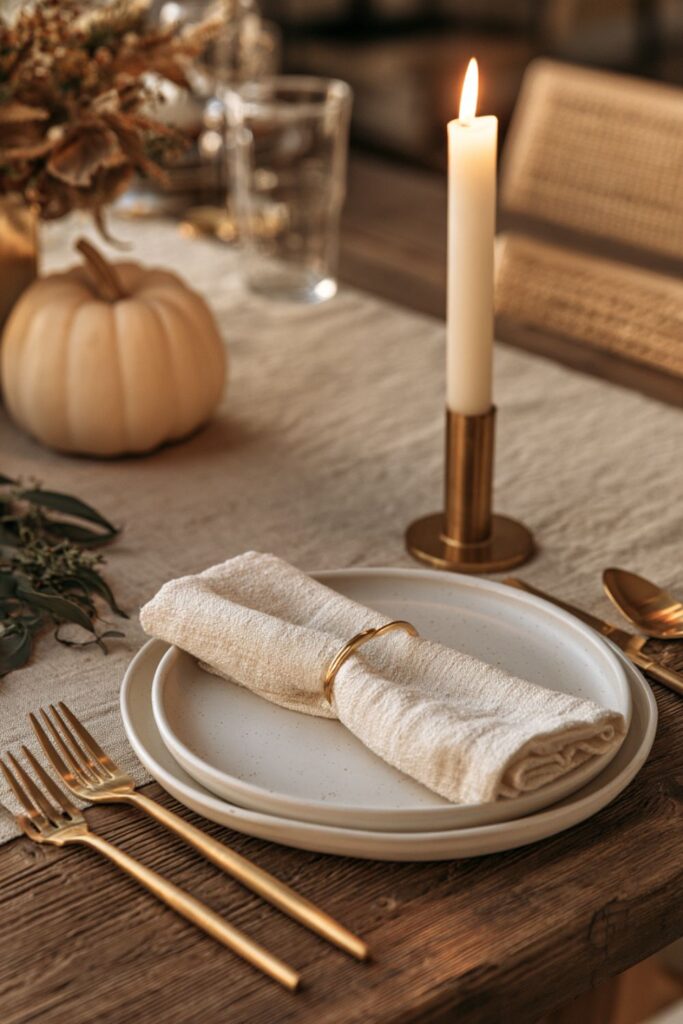
The phrase “budget Thanksgiving decor” can be misleading because buying lots of inexpensive items can still become surprisingly expensive.
Before purchasing anything, gather what you already own.
Pull out white plates, plain glassware, neutral linens, candles, glass jars, serving dishes, small vases, trays, metallic pieces, and anything else that might work within the white, cream, and gold palette.
Place everything where you can see it together.
If you want to get more from your life, and are looking for concrete action steps to get you there, check out our Request a Coach page. It’s a “cut the fence-sitting and take action” way to tackle your issues and actually find success. To get off the fence and start to take action, click or tap here.
You may discover that you already have most of the table.
Next, sort what is missing into four categories:
- Buy
- Borrow
- Repurpose
- DIY
Buy pieces when consistency matters and you expect to reuse them. Neutral napkins, simple candleholders, or basic white dinnerware can continue working for many future occasions.
Borrow pieces that you need only because of guest count. If you normally own six white dinner plates but need ten for Thanksgiving, borrowing four matching or similar plates may make much more sense than purchasing another complete set.
Repurpose household items whenever possible.
Small drinking glasses can become bud vases. Glass jars can hold candles. A neutral scarf may work as a narrow table runner if the material is safe and appropriate for the table.
DIY is most useful for small decorative touches rather than complicated projects that create more holiday work.
Good DIY options include:
If you want to get more from your life, and are looking for concrete action steps to get you there, check out our Request a Coach page. It’s a “cut the fence-sitting and take action” way to tackle your issues and actually find success. To get off the fence and start to take action, click or tap here.
- Handwritten place cards
- Simple ribbon napkin rings
- Printed menu cards
- Small paper name tags
- Natural greenery arrangements
- Painted neutral pumpkins
Before beginning any DIY project, ask whether making it yourself is actually saving time or money. A project that requires six craft-store purchases may cost more than buying one finished item.
Finally, decide where you are willing to spend a little more.
If your budget allows one special purchase, choose something you can reuse year after year. Good flatware, neutral linens, or classic candleholders will usually provide more long-term value than Thanksgiving-specific novelty decorations.
The goal is not to create the cheapest possible table. It is to create a table that looks thoughtfully put together without paying for things that add very little to the final effect.
10. Create a Thanksgiving Table Kit You Can Reuse Next Year
One of the easiest ways to make future holiday decorating simpler is to stop treating every Thanksgiving table as a brand-new project.
When the holiday is over, save the parts of the setup that worked and turn them into a reusable Thanksgiving table kit.
Start with the physical pieces.
Store table-specific items together whenever possible, including:
If you want to get more from your life, and are looking for concrete action steps to get you there, check out our Request a Coach page. It’s a “cut the fence-sitting and take action” way to tackle your issues and actually find success. To get off the fence and start to take action, click or tap here.
- Napkin rings
- Place cards or holders
- Gold accents
- Candleholders
- Table runner
- Decorative ribbon
- Small centerpiece pieces
- Reusable seasonal decor
If the linens are stored elsewhere, add a note to the container telling you exactly which tablecloth, runner, and napkins you used.
Then save the plan.
Write down the number of guests, how many chairs fit comfortably, how many candles you used, and roughly how long the centerpiece was. If you discovered that one serving dish had nowhere to go, make a note of that too.
Photos are especially helpful.
Take one picture from directly above or from a high angle so you can see the spacing. Take another from across the room so you can remember how the entire dining area looked.
Next year, those pictures become your personal decorating template.
You can also create a short checklist and store it with the decor:
- Steam linens.
- Set plates and glasses.
- Fold napkins.
- Add gold accents.
- Build centerpiece.
- Add seasonal pieces.
- Add candles.
- Leave room for serving dishes.
This small amount of organization can eliminate a surprising amount of decision-making next Thanksgiving.
If you want to get more from your life, and are looking for concrete action steps to get you there, check out our Request a Coach page. It’s a “cut the fence-sitting and take action” way to tackle your issues and actually find success. To get off the fence and start to take action, click or tap here.
You will still be able to change the table if you want something different. The kit simply gives you a reliable starting point.
Maybe next year you change the napkin fold or replace pumpkins with pears. Perhaps you add greenery or use different candles.
The foundation is already solved.
Instead of asking, “How am I going to decorate the table this year?” you can ask, “What one thing do I want to change?”
That is a much easier question during an already busy holiday season.
11. Make the Table Work for the Way Your Family Actually Celebrates
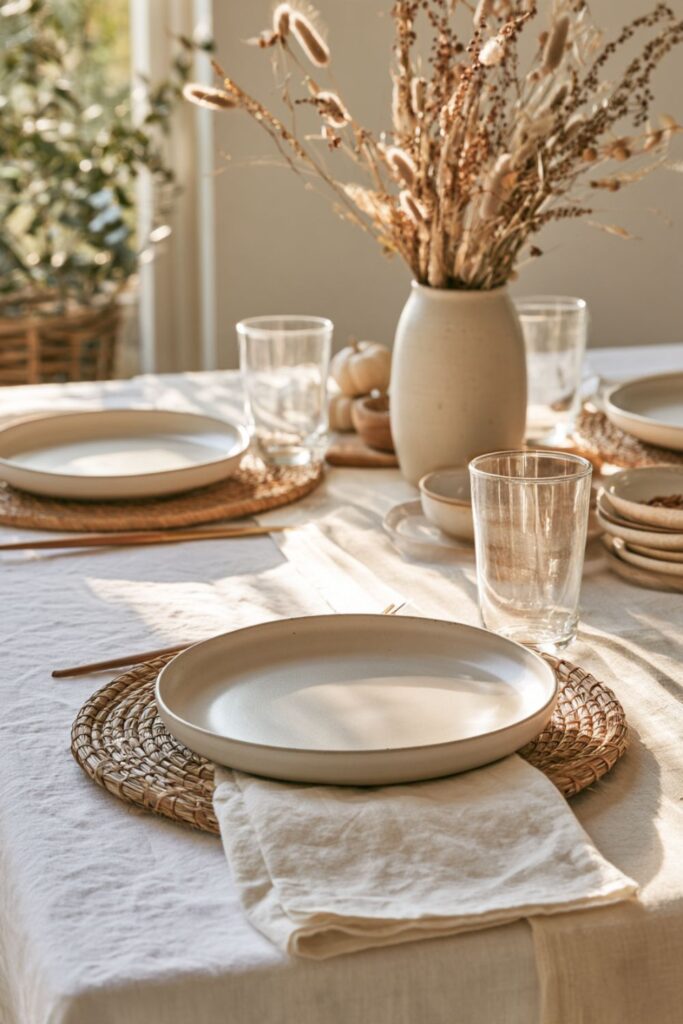
A tablescape can be beautiful in photographs and still be frustrating during dinner. Before you declare the table finished, think about how your family actually eats Thanksgiving dinner.
Do you place all of the food on the dining table? If so, your centerpiece needs to leave considerably more open space than it would for a buffet-style meal.
Do people pass dishes from person to person? Keep fragile decorations and candles away from those pathways.
If you want to get more from your life, and are looking for concrete action steps to get you there, check out our Request a Coach page. It’s a “cut the fence-sitting and take action” way to tackle your issues and actually find success. To get off the fence and start to take action, click or tap here.
If young children will be seated at the table, think about what they can safely reach. Tall glasses, open flames, delicate ornaments, and unstable mini arrangements may need to be adjusted.
You can still keep the formal look while making practical changes.
For example:
- Use flameless taper candles instead of open flames.
- Place smaller children at settings with fewer decorative layers.
- Move serving dishes to a nearby console or kitchen island.
- Use washable napkins instead of delicate specialty linens.
- Keep the centerpiece lower near conversation areas.
- Leave decorative objects off the ends where dishes are frequently passed.
Consider accessibility as well.
Older relatives may appreciate more room around their chairs. Guests with limited mobility may need an easier route to their seat. A beautiful tablescape should never make the dining space harder to navigate.
This practical thinking actually supports the elegant look.
Tables often become cluttered because decorative pieces and functional pieces are competing for the same space. Planning for serving bowls, water, wine, bread, condiments, and other dinner necessities prevents that last-minute pileup.
Before guests arrive, do a quick rehearsal.
If you want to get more from your life, and are looking for concrete action steps to get you there, check out our Request a Coach page. It’s a “cut the fence-sitting and take action” way to tackle your issues and actually find success. To get off the fence and start to take action, click or tap here.
Sit in several chairs. Reach for the water glass. Imagine passing a large bowl. Look across the centerpiece at the person sitting opposite you.
If anything feels awkward, adjust it.
The best Thanksgiving tablescape is not the one with the most layers or decorations. It is the one that looks beautifully put together when guests enter the room and continues working once everyone actually sits down to eat.
12. How an Organizing Coach Could Make Holiday Hosting Easier
Holiday decorating is often only one small part of Thanksgiving stress. The table may be competing with grocery shopping, cooking, cleaning, family schedules, overnight guests, children, work, and dozens of other decisions.
This is where an organizing coach can be useful.
The goal would not necessarily be to tell you which napkins to choose. Instead, a coach can help create a system that makes the entire holiday easier to manage.
One useful approach is to separate Thanksgiving into categories.
For example:
If you want to get more from your life, and are looking for concrete action steps to get you there, check out our Request a Coach page. It’s a “cut the fence-sitting and take action” way to tackle your issues and actually find success. To get off the fence and start to take action, click or tap here.
- Food
- Dining table
- Cleaning
- Guest preparation
- Grocery shopping
- Family logistics
- Personal preparation
- After-dinner cleanup
Once those categories are visible, each one can be broken into smaller tasks and assigned a realistic time.
The table becomes one manageable project instead of another vague item on a giant holiday to-do list.
An organizing coach may also help you work backward from the time dinner will be served.
If dinner is at 5:00 p.m., ask what absolutely needs to happen that afternoon, what can happen that morning, what can be completed the night before, and what can be finished several days earlier.
The dining table is an excellent candidate for advance preparation.
Coaching can also help identify tasks that do not need to be done at all.
Perhaps nobody cares whether every guest has a handwritten menu. Maybe a family member can bring dessert. Perhaps decorating three rooms is unnecessary when everyone spends most of the evening in the dining room and kitchen.
Simplifying is not the same as lowering your standards.
If you want to get more from your life, and are looking for concrete action steps to get you there, check out our Request a Coach page. It’s a “cut the fence-sitting and take action” way to tackle your issues and actually find success. To get off the fence and start to take action, click or tap here.
It means deciding where your effort has the greatest impact.
After Thanksgiving, a coach can also help turn what worked into a reusable system. Save the menu, decorating checklist, shopping timeline, seating plan, and table photographs.
Next year, you start with a tested plan rather than an empty page.
That kind of organization can make an elegant Thanksgiving feel much more achievable, especially for busy parents or anyone who tends to carry most of the holiday planning themselves.
13. A Formal Thanksgiving Table You Can Actually Recreate

The secret to an elegant Thanksgiving tablescape is not having access to expensive decorations. It is knowing which details create the biggest visual impact and repeating them consistently.
Start with the foundation. White and cream give you a clean, flexible base that immediately feels calmer than a table filled with competing colors and patterns.
Then add structure through repeated place settings.
Bring in gold carefully rather than everywhere. Use it as the finishing detail through flatware, candleholders, napkin rings, or another element you can repeat from one end of the table to the other.
If you want to get more from your life, and are looking for concrete action steps to get you there, check out our Request a Coach page. It’s a “cut the fence-sitting and take action” way to tackle your issues and actually find success. To get off the fence and start to take action, click or tap here.
Keep the centerpiece low and intentional. Add enough height and texture to create interest without building a wall between your guests.
Then bring Thanksgiving back into the neutral palette through subtle seasonal details, natural textures, and warm candlelight.
Your final formula can stay wonderfully simple:
- White and cream foundation
- Coordinated place settings
- One repeated gold accent
- Low centerpiece
- One seasonal element
- Warm candlelight
- Plenty of usable table space
If something does not contribute to that formula, you probably do not need it.
That is particularly helpful when you are trying to create a formal table on a realistic budget. Instead of buying more, focus on arranging what you have more intentionally.
Borrow what you need for additional guests. DIY the small details that are genuinely easy to make. Purchase only the pieces that will improve the overall table and can be reused.
Most importantly, remember who the table is for.
Thanksgiving is not a decorating competition. The tablescape is simply the setting for the people who are going to sit there, eat together, tell stories, laugh, and probably leave a few crumbs behind.
If you want to get more from your life, and are looking for concrete action steps to get you there, check out our Request a Coach page. It’s a “cut the fence-sitting and take action” way to tackle your issues and actually find success. To get off the fence and start to take action, click or tap here.
A table can feel formal without feeling untouchable.
When the colors are restrained, the layers are repeated, the centerpiece is practical, and the preparation happens ahead of time, you can create an elegant white, cream, and gold Thanksgiving table that looks beautifully styled without hiring anyone to do it for you.
Need some help with style or organization? Drop on by our directories choc full of image coaches, organization coaches and minimalist coaches to help make your spaces beautiful. Or click here to have us match you to the best.
If you want to get more from your life, and are looking for concrete action steps to get you there, check out our Request a Coach page. It’s a “cut the fence-sitting and take action” way to tackle your issues and actually find success. To get off the fence and start to take action, click or tap here.
Read this next

8 Gorgeous Holiday Color Schemes That Reveal Your Style (Which One Are You?)
Are you all about style, decor and organization? Download a copy of our Decluttering Workbook. **** Holiday décor goes far beyond what looks pretty.It’s also one of the easiest ways […]
Read More
Why Your Vision Board Aesthetic Matters More Than You Think
A vision board that looks good but fades fast needs this simple aesthetic fix. See why calm design keeps your goals impossible to ignore.
Read More
6 Small Closet Layout Fixes That Actually Work
Small closet feeling impossible? These layout fixes help you find hidden space, improve flow, and make every inch work harder.
Read More