


Talk to a coach about Motivational coaching

Robert Bradley Singleton
Certified Master Spiritual Life Coach, Neuropsychologist, and Existential Therapist
Train with the best to be the best you! Don't...

Diana Davis-Nanasi
ICF Certified Coach, helping clients overcome self-doubt, low confidence, stress managment
I understand life can become overwhelming; I am excited to...

Robert B Singleton, MCMA, MSc.
MSc. Metaphysical Sciences; B. Div., Divinity: Mindfulness and Positive Psychology fanatic
Positive Psychology and Mindfulness Specialties; NeuroScience and Trauma-informed

Dr. Kate Watson
B.A Psychology, M.Ed. Psychological Counseling, Dr.PH in Public Health, Certified Health Coach, Certified Life Coach, Certified Mind and Body Specialist, Certified Women's Empowerment Coach, Certified Neurodiversity Coach
Dr. Kate Watson helps people with boundaries, coping strategies, and...

Stephanie Peers
Somatic Coach | Midlife Transitions, Self-Trust & Personal Growth --> (Download my free Body-Led Clarity Guide in My Store!)
Body-led coaching for midlife women ready to trust themselves, set...

Claudia Silver
HDIP CBH - Cognitive Behavioural Hypnotherapist (UK Higher Diploma)
Certified Hypnotherapist for evidence-based help with stress, specific fears and...

Mak Estill
Anxiety, Panic & Life Coach dedicated to coaching you into a life of lesser and lighter anxiety!
Founder and owner of Actionable Anxiety, a private coaching practice...

Elise Boren
Certified Life Coach, Communication Specialist and Sound Healer
Through listening and discussion we will create a plan to...

Distracted All Day? Try the 25-Minute Sprint Focus Setup That Gets You Moving Fast
Want to try this at home? No worries! Download a copy of our SMART Goals PDF Worksheet.
****
Overwhelm makes everything feel important at the same time.
You sit down meaning to make progress, but instead you bounce between tabs, half-finished thoughts, and tasks that somehow all feel urgent. By the end, you were busy, but nothing really moved.
That is where a 25-minute sprint helps.
It gives you a smaller container. It lowers the pressure. It helps you stop asking, “How do I handle all of this?” and start asking, “What is the single next step?”
This method is not about fixing your whole life in one sitting.
It is about creating traction. When you narrow your focus and work inside a short, structured block, it becomes much easier to get out of your head and into action.
This article will show you how to use a 25-minute sprint in a way that actually works when you are at home, distracted, and trying to stay consistent.
If you want to get more from your life, and are looking for concrete action steps to get you there, check out our Request a Coach page. It’s a “cut the fence-sitting and take action” way to tackle your issues and actually find success. To get off the fence and start to take action, click or tap here.
What makes this method useful:
- It reduces decision overload
- It gives you a clear place to start
- It helps you work even when your energy is just okay
- It builds momentum without needing a huge burst of motivation
If you tend to freeze because the whole goal feels too big, this is a much better place to begin.
Need some in depth help with goal settings, motivation or productivity ? Drop on by our directories choc full of productivity coaches, accountability coaches, and goal-setting coaches, and start reaching those goals! Or click here to have us match you to the best.
See what is actually making you stall
Before you start a sprint, figure out what is actually slowing you down.
A lot of people label everything as overwhelm, but that word hides different problems. You might be dealing with too many choices. You might be distracted. You might be avoiding a task that feels emotionally heavy. You might not know what the real next step is.
If you do not know the real problem, you will probably choose the wrong fix.
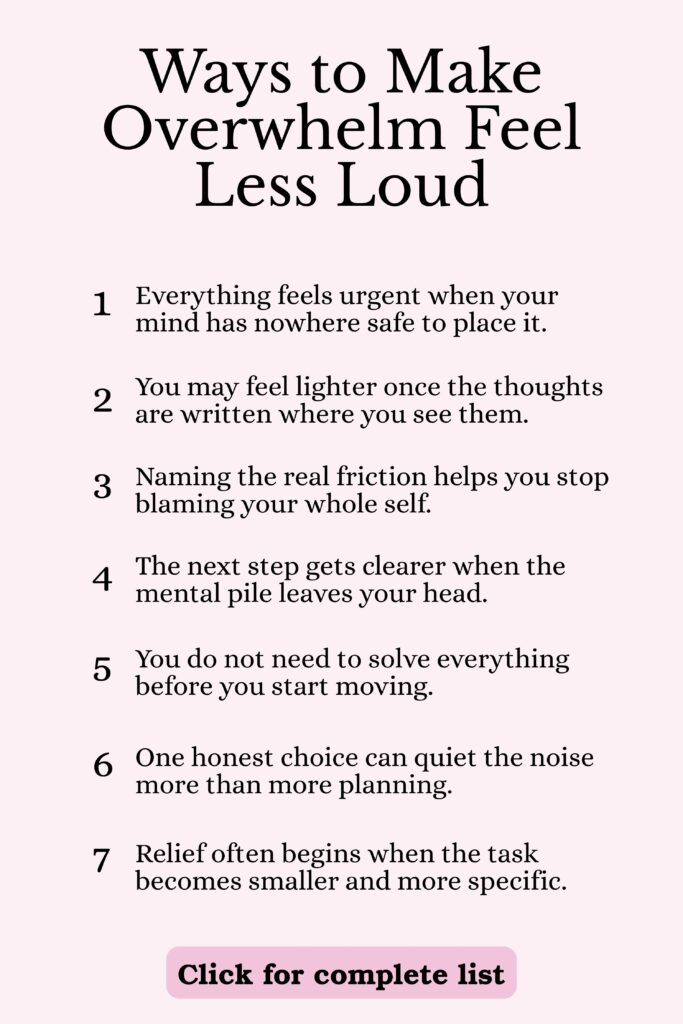
Start with a quick mental unload.
Write down everything related to the goal that is taking up space in your head. Do not organize it yet. Just get it out where you can see it.
If you want to get more from your life, and are looking for concrete action steps to get you there, check out our Request a Coach page. It’s a “cut the fence-sitting and take action” way to tackle your issues and actually find success. To get off the fence and start to take action, click or tap here.
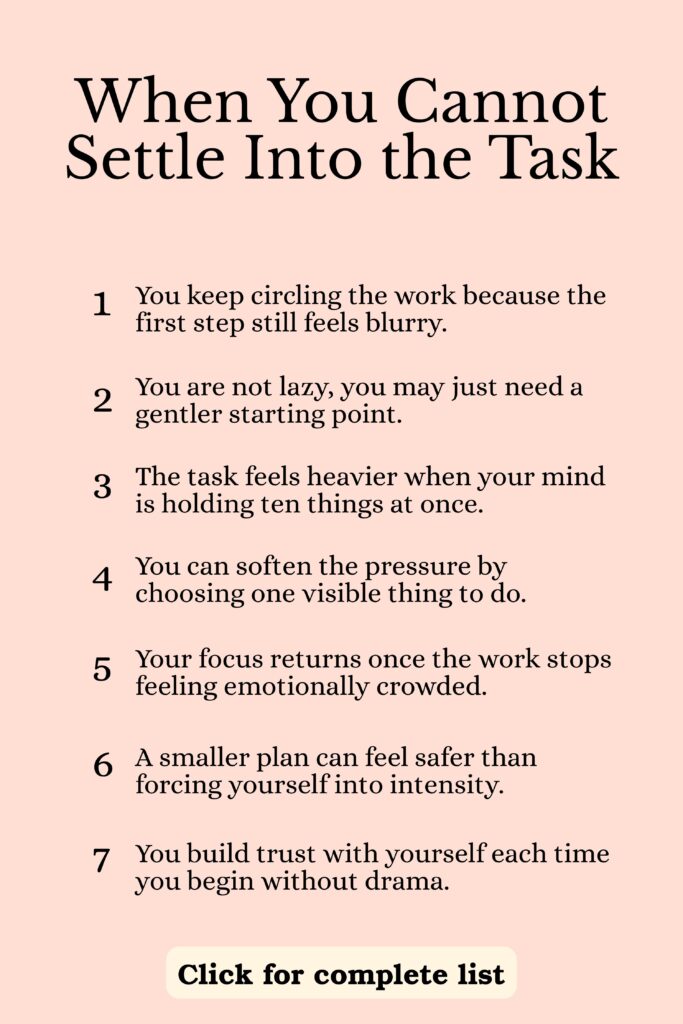
That might include:
- unfinished tasks
- reminders
- worries
- decisions you keep postponing
- small errands connected to the goal
- things you feel guilty about not doing
This step matters because everything feels louder when it stays in your head.
Once the list is out, look for the items creating the most drag. Usually those are the ones that feel:
- too vague
- too big
- emotionally loaded
- strangely easy to avoid
That pattern tells you something important.
The issue usually is not laziness. It is friction.
Sometimes the goal is clear, but the task is fuzzy. Sometimes the task is clear, but your environment keeps interrupting you. Sometimes the step is small, but you have built it up in your mind because you have been avoiding it for too long.
Ask yourself:
- Am I confused about what to do?
- Am I resisting because the task feels unpleasant?
- Am I distracted by my environment?
- Am I trying to do too much at once?
You do not need a long self-analysis session.
If you want to get more from your life, and are looking for concrete action steps to get you there, check out our Request a Coach page. It’s a “cut the fence-sitting and take action” way to tackle your issues and actually find success. To get off the fence and start to take action, click or tap here.
You just need enough honesty to name the friction. Once you know why you are stalling, you can stop treating yourself like the problem and start fixing the actual issue.
That makes the sprint much more effective.
Choose the single next step
Once you know what is slowing you down, the next move is choosing one step that is small enough to start and useful enough to matter.
This is where a lot of people go wrong.
They choose something too big, too vague, or too ambitious for the moment. Then the sprint starts feeling heavy before it even begins.
The goal is not to choose the most impressive task.
The goal is to choose the task that creates movement.
A real next step is something concrete. Not “work on my business.” Not “get healthy.” Not “sort my life out.” Those are categories, not actions.
If you want to get more from your life, and are looking for concrete action steps to get you there, check out our Request a Coach page. It’s a “cut the fence-sitting and take action” way to tackle your issues and actually find success. To get off the fence and start to take action, click or tap here.
A good next step sounds more like:
- draft the first three bullet points
- reply to one important email
- fold the clothes on the chair
- outline the first section
- list the ingredients I need
- check the top three calendar items for this week
That is the level of clarity you want.
A good test is simple: when you read the step, do you instantly know what doing it looks like?
If not, it is still too big.
It also helps to choose the task that will make the rest of the goal feel clearer. Sometimes the best next step is not the hardest one. It is the one that cuts through confusion and makes the path easier to see.
When choosing your step, aim for something that:
- can be started immediately
- does not require extra setup
- has a visible action attached to it
- helps reduce fog around the larger goal
You also need to decide what this sprint is not for.
That part matters more than people think. If you leave ten options open, your attention will keep wandering between them. If you choose one thing clearly, you give your brain a much easier job.
If you want to get more from your life, and are looking for concrete action steps to get you there, check out our Request a Coach page. It’s a “cut the fence-sitting and take action” way to tackle your issues and actually find success. To get off the fence and start to take action, click or tap here.
That is why this method works.
It turns a cloud of pressure into one doable move. That shift often seems small, but it is usually the exact moment when overwhelm starts to loosen.
Build a 25-minute sprint that protects focus
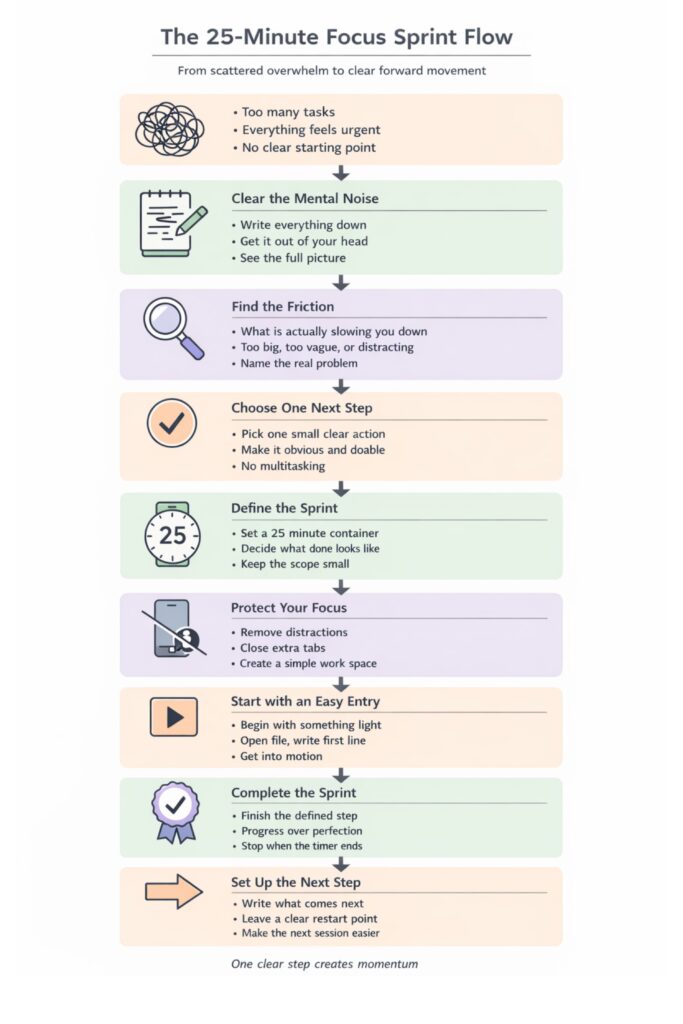
Once you know the next step, build the sprint in a way that protects your attention.
A sprint works because it creates edges. It gives your brain a beginning, a defined task, and an end point you can trust.
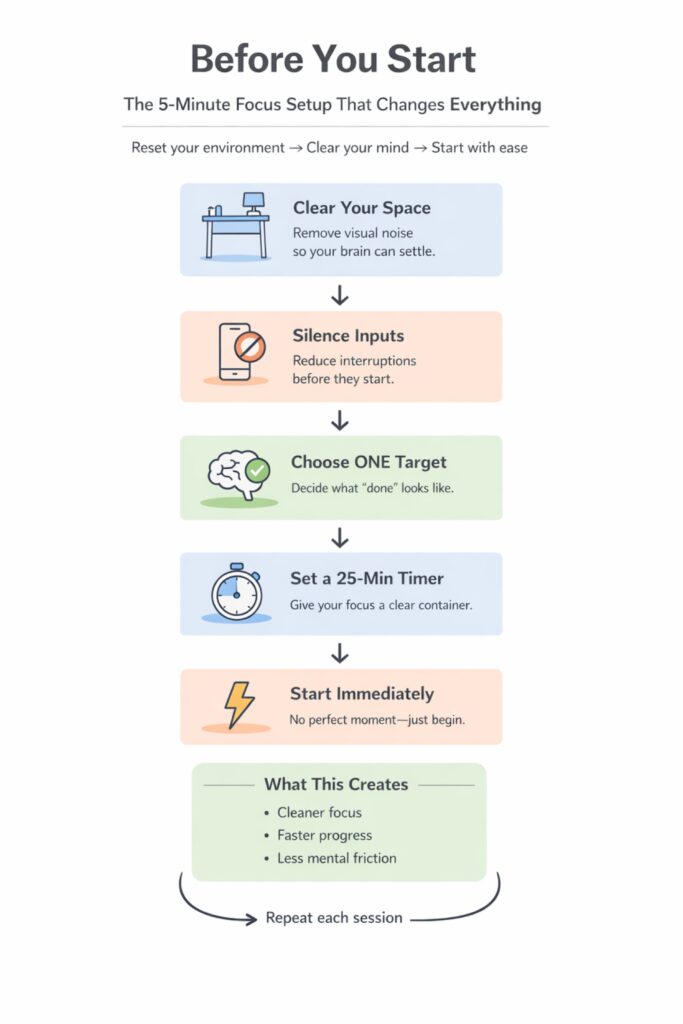
Start by writing down exactly what the 25 minutes is for.
Keep it simple. For example:
- For the next 25 minutes, I am outlining the first section
- For the next 25 minutes, I am sorting the top shelf only
- For the next 25 minutes, I am replying to the three most important emails
This matters because vague work expands fast. A clear sentence keeps the sprint contained.
Next, decide what “done for now” looks like.
If you want to get more from your life, and are looking for concrete action steps to get you there, check out our Request a Coach page. It’s a “cut the fence-sitting and take action” way to tackle your issues and actually find success. To get off the fence and start to take action, click or tap here.
That might be:
- one paragraph drafted
- one drawer sorted
- one list completed
- one decision made
- one document reviewed
Without that boundary, your brain keeps turning a short session into a giant assignment. That is exactly what you are trying to avoid.
Then protect the space.
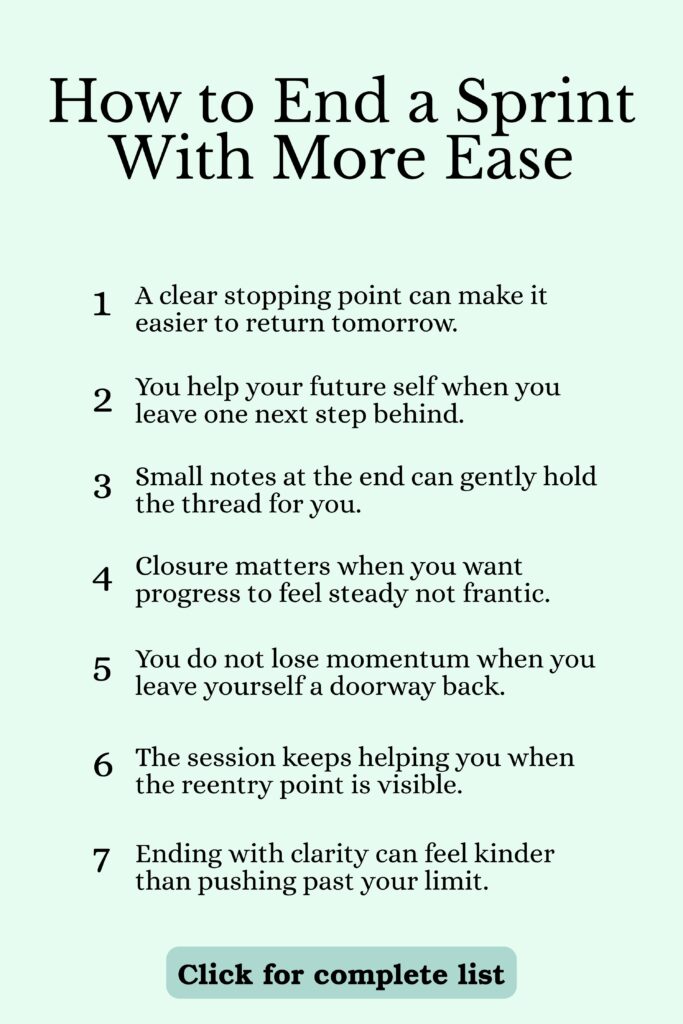
If you are at home, distractions are usually not dramatic. They are constant little pulls that chip away at attention. Before you start, remove the obvious ones.
Do this first:
- put your phone out of reach
- close unrelated tabs
- silence notifications
- clear enough space to work
- gather what you need before the timer starts
You do not need a perfect environment.
You just need less friction.
It also helps to begin with an easy entry move. Do not start with the hardest part if you are already feeling resistant. Start with something that gets you in motion.
If you want to get more from your life, and are looking for concrete action steps to get you there, check out our Request a Coach page. It’s a “cut the fence-sitting and take action” way to tackle your issues and actually find success. To get off the fence and start to take action, click or tap here.
Examples:
- open the file
- write the heading
- lay out the materials
- reread your notes
- move the items onto the table
A lot of focus problems are really starting problems.
When the setup is clear, you do not need to rely on a huge burst of discipline. The structure does some of the work for you. It lowers the pressure, narrows your options, and makes it easier to stay with the task once you begin.
That is what you want.
Not perfect focus. Just a better path into it.
Stay with the task when your attention drifts
Even with a good setup, your attention will drift.
That does not mean the sprint failed.
A lot of people think focus means staying locked in the entire time. That is not realistic, especially if you are tired, overstimulated, or used to switching between things all day.
If you want to get more from your life, and are looking for concrete action steps to get you there, check out our Request a Coach page. It’s a “cut the fence-sitting and take action” way to tackle your issues and actually find success. To get off the fence and start to take action, click or tap here.
Focus is not about never drifting.
It is about returning faster.
That is the skill that matters.
When your mind wanders, try not to turn it into a judgment about yourself. The moment you start thinking, “This is why I never get anything done,” you create more resistance than the distraction itself.
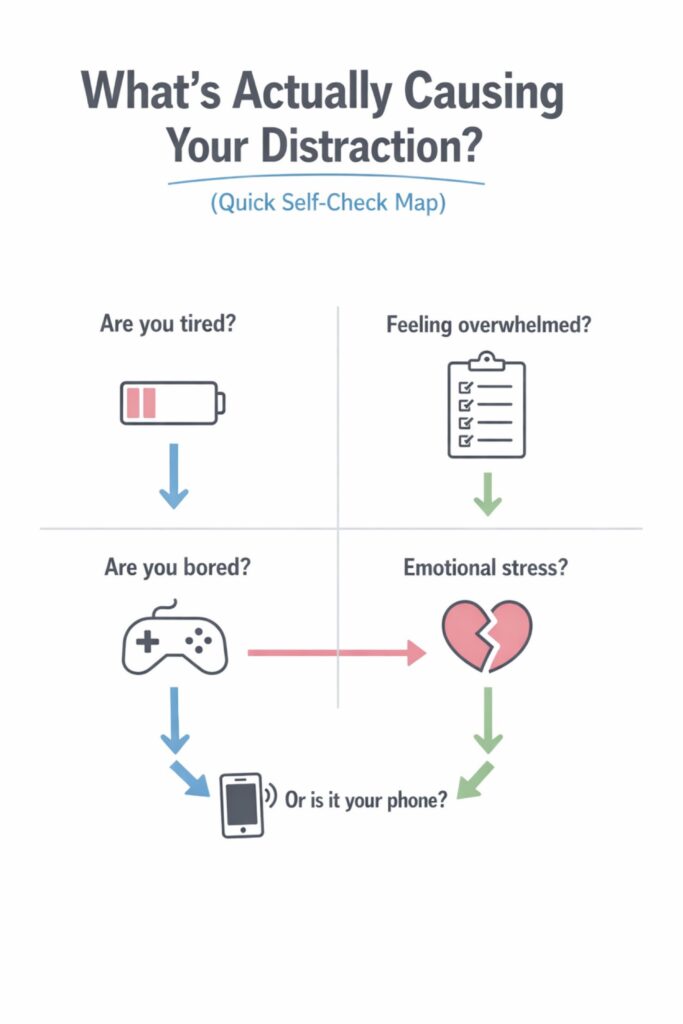
Instead, expect the wobble.
Build that into the method. Assume there will be moments when you want to:
- check your phone
- switch to an easier task
- tidy something random
- open another tab
- think about a different problem
That is normal.
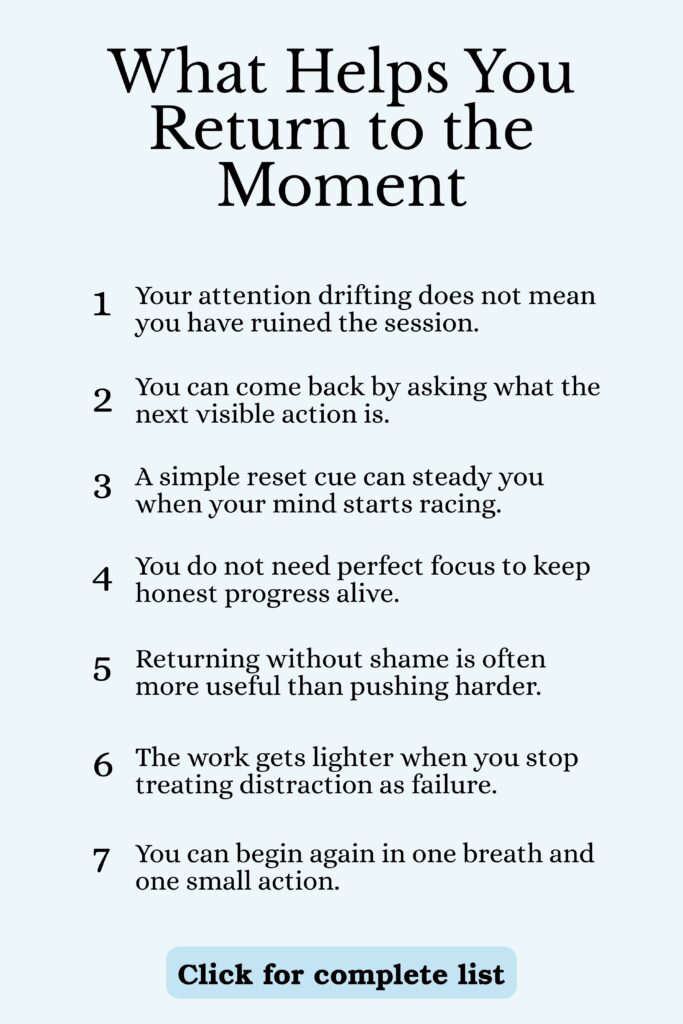
What matters is having a simple way back. Choose one reset cue before the sprint starts so you do not have to figure it out in the moment.
If you want to get more from your life, and are looking for concrete action steps to get you there, check out our Request a Coach page. It’s a “cut the fence-sitting and take action” way to tackle your issues and actually find success. To get off the fence and start to take action, click or tap here.
A reset cue could be:
- reread your one-sentence sprint goal
- ask, “What was I doing one minute ago?”
- take one breath and do the next visible action
- look at your list and restart from the top item
The cue does not need to be deep. It just needs to be repeatable.
It also helps to keep returning to one question: what is the next visible action?
That question keeps you close to the work. It stops you from zooming out too far and getting swallowed by the whole project again.
For example:
- write the next sentence
- move the next item
- open the next note
- send the reply
- make the first edit
That is enough.
You do not need perfect discipline to finish a 25-minute sprint well. You just need the ability to come back without drama. Every time you return instead of quitting, you strengthen trust in yourself.
That is a big part of consistency.
If you want to get more from your life, and are looking for concrete action steps to get you there, check out our Request a Coach page. It’s a “cut the fence-sitting and take action” way to tackle your issues and actually find success. To get off the fence and start to take action, click or tap here.
Not flawless sessions. Repeated recovery.
End the sprint in a way that makes the next one easier
The end of the sprint matters more than most people realize.
If you stop the timer and walk away without leaving yourself any notes, the next session starts with confusion. You have to remember where you were, what you did, and what comes next. That makes re-entry harder than it needs to be.
A better ending creates a bridge.
Start by writing down what moved during the sprint. Keep it plain and specific.
You might note:
- what you finished
- what became clearer
- what decision you made
- what is still unfinished
- where you stopped
This is not about making the session sound bigger than it was.
It is about giving yourself proof that progress happened. Small progress is easy to dismiss when you are focused on how much is left.
If you want to get more from your life, and are looking for concrete action steps to get you there, check out our Request a Coach page. It’s a “cut the fence-sitting and take action” way to tackle your issues and actually find success. To get off the fence and start to take action, click or tap here.
Then name the next starting point before you leave.
Write one sentence for future you, such as:
- Next: draft the second section
- Next: sort the bottom shelf
- Next: compare the top three options
- Next: send the follow-up email
This is one of the simplest ways to make consistency easier.
You remove the need to figure out the next move from scratch. That lowers resistance the next time you sit down.
It also helps to leave a visible breadcrumb. Make it easier to restart by keeping some continuity in place.
That could mean:
- leaving the document open
- keeping the materials together
- putting the note on your desk
- saving the task in a visible place
- keeping your checklist where you will see it
The goal is not to stay surrounded by unfinished work.
The goal is to make re-entry easier.
If you want to get more from your life, and are looking for concrete action steps to get you there, check out our Request a Coach page. It’s a “cut the fence-sitting and take action” way to tackle your issues and actually find success. To get off the fence and start to take action, click or tap here.
That is what turns the sprint into a repeatable tool instead of a one-time rescue. You stop depending on a burst of motivation every time. You already know what happened, where to begin, and what to do next.
That kind of closure keeps momentum alive.
Use the sprint on different kinds of goals
One of the best things about the 25-minute sprint is that it works across different kinds of goals.
It is not only for work.
It can help with anything that feels important but hard to begin. Overwhelm shows up in lots of places, and the same core problem often sits underneath it: the task feels too big, too vague, or too mentally noisy.
That is why this method travels well.
For work goals, you might use a sprint to:
- outline a document
- review one small batch of tasks
- reply to priority messages
- update one client record
- draft one section of content
For personal goals, you might use it to:
If you want to get more from your life, and are looking for concrete action steps to get you there, check out our Request a Coach page. It’s a “cut the fence-sitting and take action” way to tackle your issues and actually find success. To get off the fence and start to take action, click or tap here.
- prep part of a meal
- sort one surface
- gather paperwork
- do one short workout
- begin a journal entry
- organize one shelf
The specific task changes, but the structure stays the same. Choose one visible next step. Protect a short block of time. Stay with it long enough to create movement.
This method also works well in ordinary energy seasons.
You do not need to feel highly motivated. In fact, it is especially helpful when your energy is just okay. Not terrible. Not amazing. Just enough to do one focused block if the path is clear.
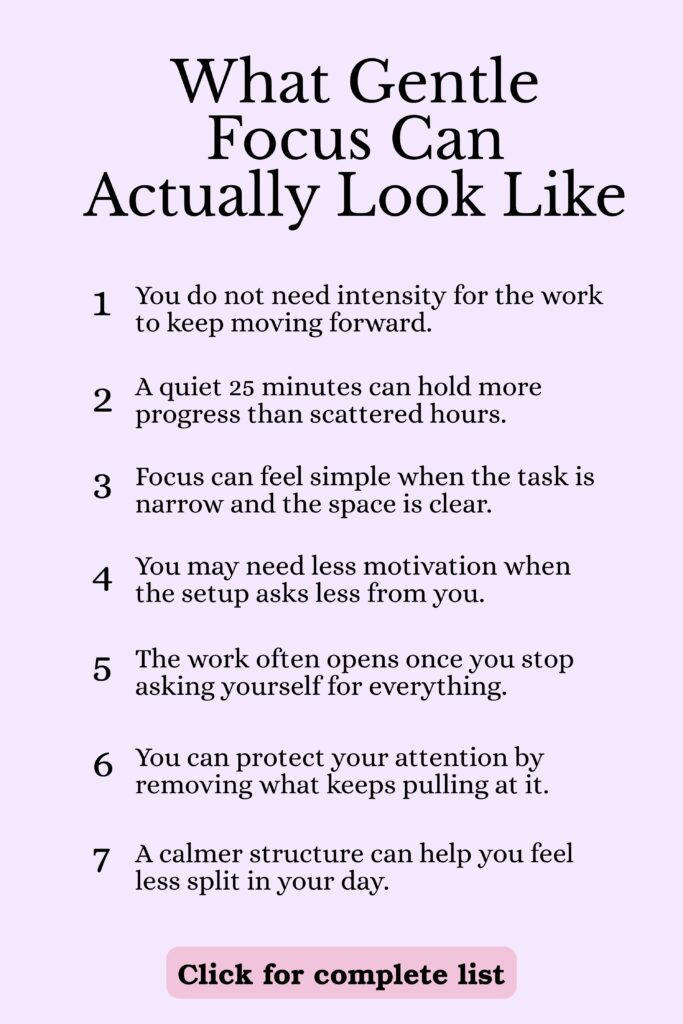
That is what makes it practical.
It fits real life better than systems that assume you always have long stretches of time and full mental energy. It lets you work with the day you actually have.
It also gives you room to adjust based on the season you are in.
If life feels heavy, choose a stabilizing task. If you have more energy, choose something that needs deeper focus. The point is not to force the same output every day. It is to stay in motion in a way that still feels possible.
That flexibility is part of the value.
If you want to get more from your life, and are looking for concrete action steps to get you there, check out our Request a Coach page. It’s a “cut the fence-sitting and take action” way to tackle your issues and actually find success. To get off the fence and start to take action, click or tap here.
It means the sprint is not just for ideal days. It can support progress on normal days too, which is where consistency is really built.
Make this a consistency habit, not a one-time rescue
The 25-minute sprint is useful in a stressful moment, but it becomes much more powerful when you use it regularly.
That is when it stops being a rescue tool and starts becoming part of how you stay connected to your goals. Instead of waiting until everything feels urgent, you build a rhythm that helps you make steady progress in smaller pieces.
Consistency usually grows from cues more than motivation.
That is why it helps to attach the sprint to something already built into your day. Put it near a stable moment so it becomes easier to repeat.
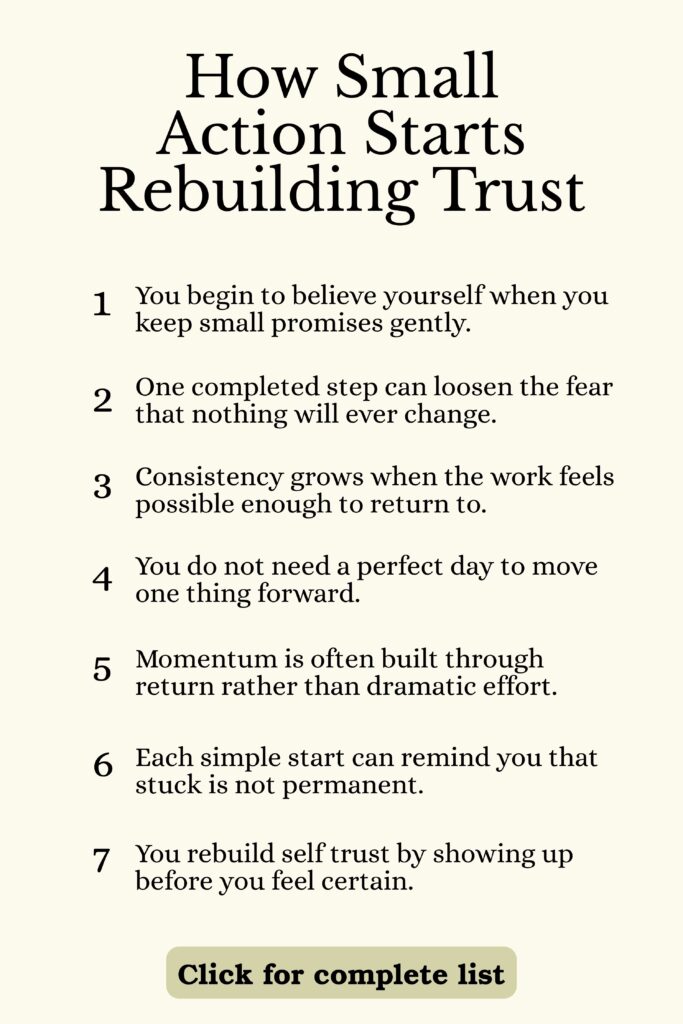
Good cues might be:
- after your morning coffee
- before checking messages
- after lunch
- after school drop-off
- at the start of your work block
The cue matters because it reduces debate.
You are not deciding from scratch every day whether now is a good time. You already know where the sprint belongs.
If you want to get more from your life, and are looking for concrete action steps to get you there, check out our Request a Coach page. It’s a “cut the fence-sitting and take action” way to tackle your issues and actually find success. To get off the fence and start to take action, click or tap here.
It also helps to measure the habit the right way. Do not judge success only by how much you completed or how focused you felt.
Track things like:
- Did I do the sprint?
- Did I choose one clear next step?
- Did I return when I drifted?
- Did I leave myself a next step for later?
These are better markers of consistency than intensity.
That matters if you tend to dismiss small wins. Small wins are not separate from consistency. They are how consistency is built. Every time you sit down, choose one next step, and follow through, you reinforce trust in yourself.
You become someone who knows how to begin.
That changes the emotional tone of goal pursuit. Progress starts to feel less dramatic and more normal. Less like waiting for the perfect day, more like using the time you have well.
Not every sprint will feel impressive.
Some will feel flat. Some will feel messy. Some will only move one small thing. But those still count. They keep the thread alive, and that matters more than people think.
If you want to get more from your life, and are looking for concrete action steps to get you there, check out our Request a Coach page. It’s a “cut the fence-sitting and take action” way to tackle your issues and actually find success. To get off the fence and start to take action, click or tap here.
One next step can change the whole day
Want to try this at home? No worries! Download a copy of our SMART Goals PDF Worksheet.
Need some in depth help with goal settings, motivation or productivity ? Drop on by our directories choc full of productivity coaches, accountability coaches, and goal-setting coaches, and start reaching those goals! Or click here to have us match you to the best.
Overwhelm tells you that you need more time, more energy, or a better plan before you can begin.
Often, what you really need is a smaller starting point.
That is the power of a 25-minute sprint. It takes a goal that feels too heavy and turns it into something your brain can actually enter. One clear step. One short container. One simple way to return when your attention drifts.
That may seem small, but small is often what works.
This method does not ask you to finish everything. It asks you to create movement. And movement changes how the whole day feels.
Instead of staying stuck in pressure, you get traction.
If you want to get more from your life, and are looking for concrete action steps to get you there, check out our Request a Coach page. It’s a “cut the fence-sitting and take action” way to tackle your issues and actually find success. To get off the fence and start to take action, click or tap here.
Instead of staring at the whole mountain, you take one visible step.
That one step often leads to more than you expect:
- the task feels less intimidating
- the next move becomes clearer
- your confidence rises a little
- the goal feels active again instead of frozen
That is the real value here.
Not that life suddenly becomes easy, but that you have a practical way to re-enter momentum. You do not have to wait until you feel perfectly ready. You can work with the energy and clarity you have right now.
So the next time everything feels like too much, do not ask how to handle all of it.
Ask:
- What is the next visible step?
- What can I do in 25 minutes?
- What would make this feel lighter to start?
Then begin there.
One short sprint may be enough to change the direction of the day.
If you want to get more from your life, and are looking for concrete action steps to get you there, check out our Request a Coach page. It’s a “cut the fence-sitting and take action” way to tackle your issues and actually find success. To get off the fence and start to take action, click or tap here.
If you want to get more from your life, and are looking for concrete action steps to get you there, check out our Request a Coach page. It’s a “cut the fence-sitting and take action” way to tackle your issues and actually find success. To get off the fence and start to take action, click or tap here.
Read this next

Three Steps to Getting Motivated
Be motived discusses a few ways motivation can help you succeed
Read More
Moving Past Limitations
How I got through my personal limitations and started to live my life purposefully
Read More
5 Self Care Goals for the New Year (from a Motivational Coach)
Can 2023 be a great year? Are you looking forward to having a new year full of positive changes, and the ability to increase self-care, commitment, and happiness? Here are […]
Read More