






Make Your Students More Receptive
Sometimes you have to change more than the material if you want people to become more receptive to what you are teaching.
Whether you run a coaching course, deliver group training, or work one-to-one with clients, simply presenting useful information does not mean the learner will process it. People can watch, listen, nod, and still walk away without being able to explain or apply what they heard.
The stronger question is not simply, “How do I get their attention?” It is, “What am I asking them to do with what I teach?”
That shift changes the way you design sessions, exercises, feedback, and follow-up.
Key Takeaways
- Receptivity requires participation. Listening and watching can introduce an idea, but clients learn more deeply when they explain, apply, test, discuss, or build on it.
- Interaction should make the client think. Useful feedback goes beyond praise by asking the learner to clarify reasoning, connect ideas, or decide what happens next.
- Assignments need a cognitive job. “Read this” is weaker than asking a client to compare options, make a prediction, explain a choice, or apply a framework to a real decision.
- Variety matters, but learning-style labels do not. Choose video, diagrams, discussion, practice, and worksheets according to what the material requires rather than labeling someone a visual or auditory learner.
- Participation needs to produce evidence. Ask clients to retrieve, explain, or apply what they learned so you can see whether the lesson actually carried beyond the session.
How Do You Make Coaching Clients More Receptive to Learning?
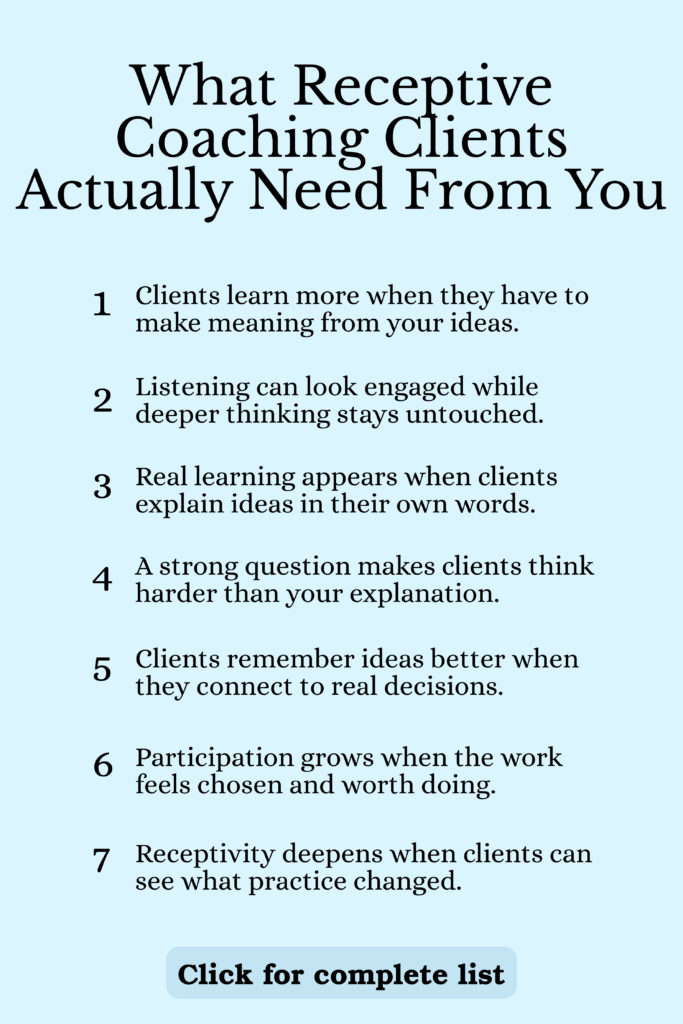
Coaching clients become more receptive when they have to actively work with an idea rather than simply receive it. Ask them to explain concepts in their own words, make choices, connect new ideas to their situation, apply frameworks, test actions, and discuss what happened.
A useful way to design this is the ICAP framework from researchers Michelene Chi and Ruth Wylie. It distinguishes Passive, Active, Constructive, and Interactive engagement, with the framework predicting deeper learning as learners move toward constructive and interactive activity.
SEE ALSO: If you’re a coach looking to streamline your administrative tasks and save time, check out our Coaching Administration Software. It’s a simple, effective solution designed to help you focus less on paperwork and more on what matters—coaching your clients. From scheduling to client management, our software gives you the tools to run your business efficiently. Ready to reclaim your time and boost productivity? Click or tap here.
For a coach, that means a client listening to your explanation may be useful, but a client explaining how the idea changes Tuesday’s conversation with their manager is doing substantially more with it.
What Does Receptive Learning Actually Look Like?
Receptive learning is visible when a client does something meaningful with an idea, not merely when they listen politely.
Chi and Wylie’s ICAP framework gives you a concrete way to spot the difference.
Passive engagement means receiving information. Your client listens to you explain a concept, reads a handout, or watches a lesson.
Active engagement means physically doing something with the information. They highlight an important sentence, select an answer, make notes, or complete a structured task.
Constructive engagement means producing something that goes beyond what you gave them. They explain an idea in their own words, connect it to a previous experience, identify an implication, or develop a plan from it.
SEE ALSO: If you’re a coach looking to streamline your administrative tasks and save time, check out our Coaching Administration Software. It’s a simple, effective solution designed to help you focus less on paperwork and more on what matters—coaching your clients. From scheduling to client management, our software gives you the tools to run your business efficiently. Ready to reclaim your time and boost productivity? Click or tap here.
Interactive engagement means two or more people build understanding together. A client gives an interpretation, you challenge one assumption, they revise their thinking, and the conversation produces an insight neither of you simply stated at the beginning.
This is useful for coaching because it gives you something concrete to design for.
If you have just explained a decision-making framework, do not stop at, “Does that make sense?”
Ask, “Which part of this framework changes the way you see the decision you are facing right now?”
Now the client has to construct an answer.
Which Training Strategies Make Learners More Receptive?
The most useful training strategies change what the learner is required to do, not simply what the coach is required to present.
SEE ALSO: If you’re a coach looking to streamline your administrative tasks and save time, check out our Coaching Administration Software. It’s a simple, effective solution designed to help you focus less on paperwork and more on what matters—coaching your clients. From scheduling to client management, our software gives you the tools to run your business efficiently. Ready to reclaim your time and boost productivity? Click or tap here.
If you teach online, for example, adding more slides will not automatically improve engagement. Neither will making a lesson longer or adding more information.
Instead, look at the learner’s behavior.
Are they only watching?
Are they choosing between possibilities?
Are they producing an explanation?
Are they applying the idea to something real?
SEE ALSO: If you’re a coach looking to streamline your administrative tasks and save time, check out our Coaching Administration Software. It’s a simple, effective solution designed to help you focus less on paperwork and more on what matters—coaching your clients. From scheduling to client management, our software gives you the tools to run your business efficiently. Ready to reclaim your time and boost productivity? Click or tap here.
Are they discussing and revising their thinking?
A simple audit of those behaviors can tell you much more than asking whether your material feels “engaging.”
How Often Should You Interact With Learners?
Interact often enough to move the learner’s thinking forward, not so often that feedback becomes noise.
Clients are more likely to stay mentally involved when they know their work will lead somewhere. That makes feedback useful, but the quality of that feedback matters.
Suppose a client completes a journal exercise about why they keep postponing difficult conversations.
“Great reflection” acknowledges the work.
SEE ALSO: If you’re a coach looking to streamline your administrative tasks and save time, check out our Coaching Administration Software. It’s a simple, effective solution designed to help you focus less on paperwork and more on what matters—coaching your clients. From scheduling to client management, our software gives you the tools to run your business efficiently. Ready to reclaim your time and boost productivity? Click or tap here.
“What do the three situations you described have in common?” makes them process it again.
The second response creates another learning event.
The same principle applies to worksheets, goals, and action items. You do not need to comment on every sentence. Look for the point where a question, challenge, or observation will make the client examine their thinking more closely.
If you use LCH Core, journals, worksheets, goals, action items, and reusable resources can give that between-session work a consistent place to live. The guide to keeping clients engaged between sessions shows how those tools can be used without assigning everything to every client.
How Do You Turn Passive Content Into Active Coaching?
You turn passive content into active coaching by adding a task that requires the learner to select, explain, apply, predict, or discuss something.
Take a 15-minute training video.
SEE ALSO: If you’re a coach looking to streamline your administrative tasks and save time, check out our Coaching Administration Software. It’s a simple, effective solution designed to help you focus less on paperwork and more on what matters—coaching your clients. From scheduling to client management, our software gives you the tools to run your business efficiently. Ready to reclaim your time and boost productivity? Click or tap here.
Watching it is passive.
Watching it and identifying the most important idea introduces active engagement.
Explaining why that idea applies to a current problem becomes constructive.
Bringing that explanation into a coaching conversation where you test the assumption together becomes interactive.
The same upgrade works with almost any coaching material.
A PDF about boundaries becomes more useful when the client identifies one boundary they are currently failing to communicate.
SEE ALSO: If you’re a coach looking to streamline your administrative tasks and save time, check out our Coaching Administration Software. It’s a simple, effective solution designed to help you focus less on paperwork and more on what matters—coaching your clients. From scheduling to client management, our software gives you the tools to run your business efficiently. Ready to reclaim your time and boost productivity? Click or tap here.
A lesson about career values becomes more useful when the client compares two real opportunities against those values.
A module about procrastination becomes more useful when the client predicts which task they will avoid this week, explains why, tests one intervention, and reports back.
You do not necessarily need more content. You often need a better job for the learner to do with the content you already have.
How Do Calls to Action Deepen Learning?
A learning call to action works best when it tells the client what kind of thinking or behavior should happen next.
“Complete this worksheet before Friday” is a task.
“Complete this worksheet, then circle the answer that surprised you most and bring one question about it to our next session” is a learning task.
SEE ALSO: If you’re a coach looking to streamline your administrative tasks and save time, check out our Coaching Administration Software. It’s a simple, effective solution designed to help you focus less on paperwork and more on what matters—coaching your clients. From scheduling to client management, our software gives you the tools to run your business efficiently. Ready to reclaim your time and boost productivity? Click or tap here.
The difference is small, but the second instruction tells the client how to process what they uncover.
You can use the same approach after a session.
Instead of saying, “Think about what we discussed,” ask the client to test one decision.
Instead of saying, “Read this resource,” ask them to identify the part they disagree with.
Instead of saying, “Work on your confidence,” ask them to initiate one conversation they would normally avoid and record what actually happened.
Good calls to action turn ideas into observable behavior.
SEE ALSO: If you’re a coach looking to streamline your administrative tasks and save time, check out our Coaching Administration Software. It’s a simple, effective solution designed to help you focus less on paperwork and more on what matters—coaching your clients. From scheduling to client management, our software gives you the tools to run your business efficiently. Ready to reclaim your time and boost productivity? Click or tap here.
Why Do Choice, Challenge, and Connection Increase Buy-In?
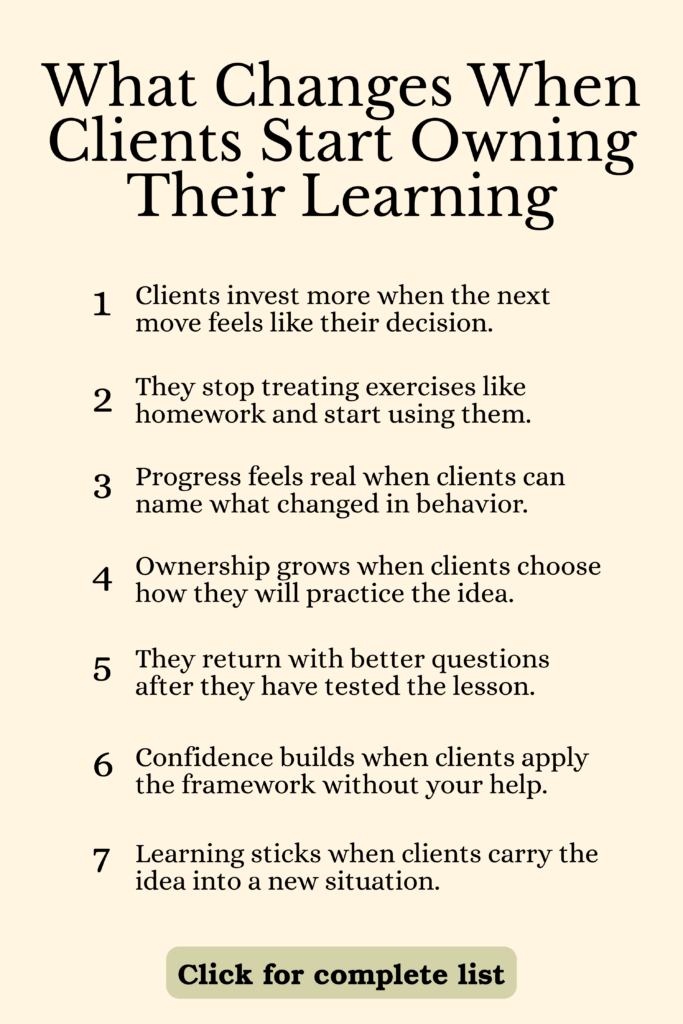
Clients are more likely to participate when the work supports autonomy, competence, and relatedness rather than making them feel managed.
These three needs sit at the center of Self-Determination Theory. Richard Ryan and Edward Deci describe autonomy, competence, and relatedness as fundamental psychological needs connected with self-motivation and effective functioning.
For coaches, the application can be very practical.
Autonomy means the client has meaningful ownership. You might offer two ways to explore the same issue rather than prescribing the same exercise every time.
Competence means the task feels possible but worthwhile. A client who has avoided networking for six months may learn more from initiating two conversations this week than from receiving an assignment to contact 30 people.
Relatedness means the work stays connected to another person who understands its significance. Asking what happened, noticing progress, and exploring setbacks tells the client the assignment was part of the coaching process, not paperwork sent into a void.
SEE ALSO: If you’re a coach looking to streamline your administrative tasks and save time, check out our Coaching Administration Software. It’s a simple, effective solution designed to help you focus less on paperwork and more on what matters—coaching your clients. From scheduling to client management, our software gives you the tools to run your business efficiently. Ready to reclaim your time and boost productivity? Click or tap here.
Imagine two clients working on leadership confidence.
One receives a generic confidence worksheet.
The other chooses between reviewing a recent meeting or preparing for an upcoming one, identifies one behavior to practice, tries it, and discusses the result with the coach.
The second experience gives the learner more ownership, a realistic challenge, and a clear feedback loop.
How Can You Make Learning Memorable Without Turning It Into Clickbait?
Learning becomes more memorable when something unexpected makes the learner stop, predict, compare, or rethink an assumption.
You do not need to manufacture anger, shock, or drama.
SEE ALSO: If you’re a coach looking to streamline your administrative tasks and save time, check out our Coaching Administration Software. It’s a simple, effective solution designed to help you focus less on paperwork and more on what matters—coaching your clients. From scheduling to client management, our software gives you the tools to run your business efficiently. Ready to reclaim your time and boost productivity? Click or tap here.
A better approach is to create a useful information gap and then make the learner work with it.
Suppose you are teaching a client how habits change.
Before explaining your framework, give them three possible interventions and ask which one they think will work best for a real scenario.
Then teach the framework.
Now they have something to compare against their original prediction.
You can do the same with case studies.
SEE ALSO: If you’re a coach looking to streamline your administrative tasks and save time, check out our Coaching Administration Software. It’s a simple, effective solution designed to help you focus less on paperwork and more on what matters—coaching your clients. From scheduling to client management, our software gives you the tools to run your business efficiently. Ready to reclaim your time and boost productivity? Click or tap here.
“Here is a client who kept missing deadlines even after creating a detailed weekly plan. What would you investigate first?”
The learner has to commit to an interpretation before receiving yours.
Surprise now serves the learning rather than competing with it.
How Do You Know Whether the Learning Actually Stuck?
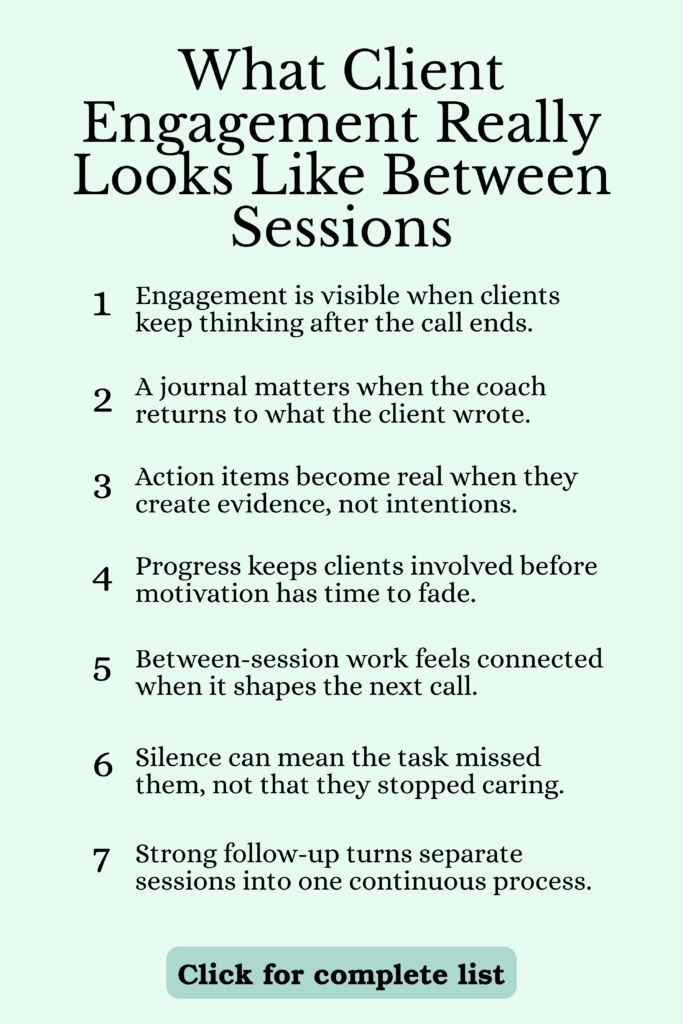
The clearest way to check learning is to ask the client to retrieve or apply the idea without simply rereading what you gave them.
A client may enjoy a session and still struggle to explain the concept two days later. That is why apparent engagement and usable learning are not the same thing.
A simple check might be:
SEE ALSO: If you’re a coach looking to streamline your administrative tasks and save time, check out our Coaching Administration Software. It’s a simple, effective solution designed to help you focus less on paperwork and more on what matters—coaching your clients. From scheduling to client management, our software gives you the tools to run your business efficiently. Ready to reclaim your time and boost productivity? Click or tap here.
Explain it: “Without looking at your notes, how would you describe the framework we used last week?”
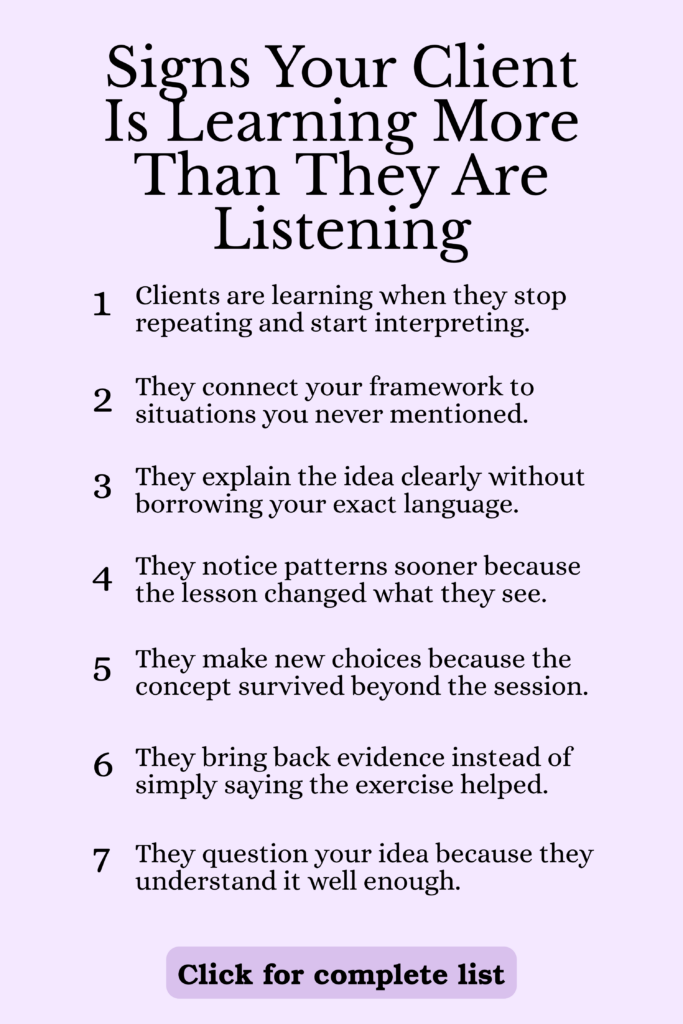
Apply it: “Which part of the framework applies to the decision you are making now?”
Transfer it: “Where else in your work or life do you see the same pattern?”
Act on it: “What will you do differently before our next session?”
A major review by John Dunlosky and colleagues rated practice testing and distributed practice among the highest-utility learning techniques they examined. In practical terms, retrieving an idea later can be more informative than repeatedly rereading it.
For a coaching business, this also creates useful evidence of progress.
SEE ALSO: If you’re a coach looking to streamline your administrative tasks and save time, check out our Coaching Administration Software. It’s a simple, effective solution designed to help you focus less on paperwork and more on what matters—coaching your clients. From scheduling to client management, our software gives you the tools to run your business efficiently. Ready to reclaim your time and boost productivity? Click or tap here.
If a client can explain a framework more clearly, complete a previously avoided action, recognize a pattern earlier, or make a different decision in a recurring situation, you have something concrete to discuss.
That evidence can also improve progress and renewal conversations. The broader business logic is explored in A Bird in the Hand: The Simple Math of Client Lifetime Value for Coaches, which looks at retention, progress visibility, and the value of longer client relationships.
Should You Teach to Different Learning Styles?
You should vary learning activities, but there is not a strong evidence base for matching instruction to labels such as “visual learner,” “auditory learner,” or “kinesthetic learner.”
The popular learning-styles approach suggests that someone identified as a visual learner will learn more effectively when material is delivered visually, while an auditory learner should receive the same material primarily through sound.
A major review by Harold Pashler, Mark McDaniel, Doug Rohrer, and Robert Bjork concluded that there was no adequate evidence base for incorporating this kind of learning-style matching into general educational practice.
That does not mean you should teach everything in one format.
SEE ALSO: If you’re a coach looking to streamline your administrative tasks and save time, check out our Coaching Administration Software. It’s a simple, effective solution designed to help you focus less on paperwork and more on what matters—coaching your clients. From scheduling to client management, our software gives you the tools to run your business efficiently. Ready to reclaim your time and boost productivity? Click or tap here.
It means the task should determine the format.
Use a diagram when relationships are easier to see than describe.
Use a demonstration when the learner needs to observe a process.
Use practice when the client needs to perform a behavior.
Use a worksheet when structured comparison will help.
Use discussion when assumptions need to be surfaced and challenged.
SEE ALSO: If you’re a coach looking to streamline your administrative tasks and save time, check out our Coaching Administration Software. It’s a simple, effective solution designed to help you focus less on paperwork and more on what matters—coaching your clients. From scheduling to client management, our software gives you the tools to run your business efficiently. Ready to reclaim your time and boost productivity? Click or tap here.
Use reflection when the client needs to connect an idea to personal experience.
You can still change things up. Just change things for a learning reason rather than because someone has been assigned a learner type.
What Should You Do When a Coaching Client Stops Participating?
Treat falling participation as something to diagnose before assuming the client simply lacks motivation.
Start with what the client is actually being asked to do.
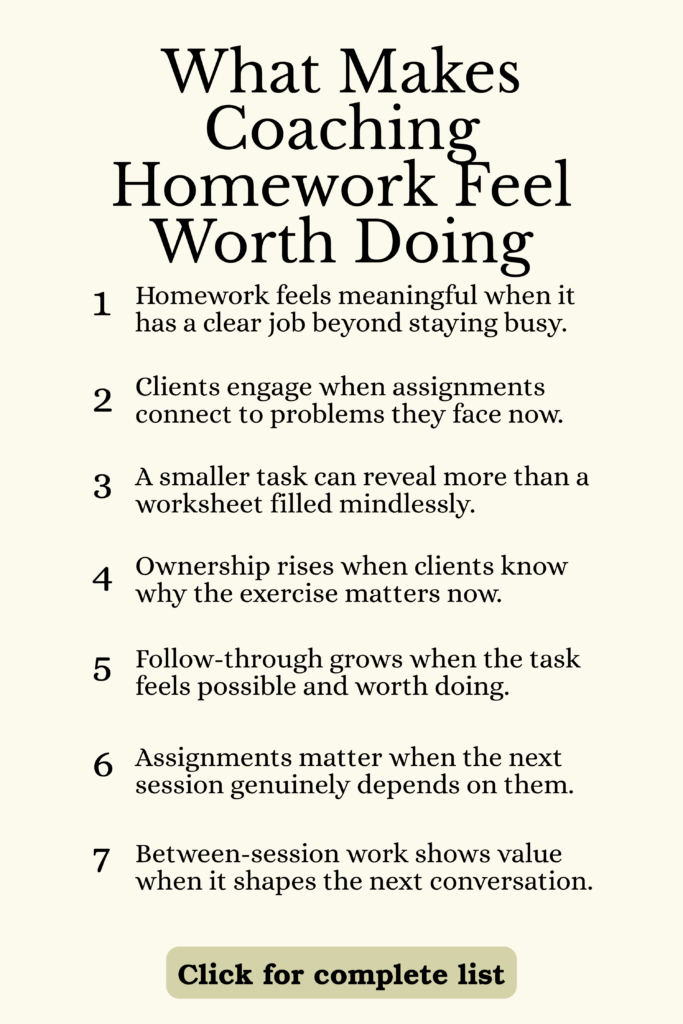
If they are watching lessons but never applying anything, the work may be too passive.
If they understand the assignment but repeatedly postpone it, the task may be too large, poorly timed, or disconnected from a goal they actually value.
SEE ALSO: If you’re a coach looking to streamline your administrative tasks and save time, check out our Coaching Administration Software. It’s a simple, effective solution designed to help you focus less on paperwork and more on what matters—coaching your clients. From scheduling to client management, our software gives you the tools to run your business efficiently. Ready to reclaim your time and boost productivity? Click or tap here.
If they submit work but give superficial answers, you may need a more constructive prompt.
If they complete meaningful work and hear nothing back, the feedback loop may be broken.
A client in a career program might stop completing a weekly networking worksheet, for example.
You could send another reminder.
Or you could ask what is happening.
Perhaps the worksheet contains ten questions every week and has become repetitive. Perhaps the client already understands the concept but is avoiding the actual networking conversation. Perhaps their original career target has changed.
SEE ALSO: If you’re a coach looking to streamline your administrative tasks and save time, check out our Coaching Administration Software. It’s a simple, effective solution designed to help you focus less on paperwork and more on what matters—coaching your clients. From scheduling to client management, our software gives you the tools to run your business efficiently. Ready to reclaim your time and boost productivity? Click or tap here.
Each diagnosis calls for a different response.
A useful reset is to shrink the work and restore ownership: “Which one action would give us useful information before our next session?”
Then review what happened.
This is where progress data can support your judgment rather than replace it. The Progress Stream support guide explains how client sessions, notes, and coaching tools can be reviewed together, while the Engagement Report can provide another view of engagement patterns.
Where LCH Core Fits
LCH Core fits when you want the learning and follow-through you design for clients to remain connected between sessions.
A conversation can create the insight. The system behind it can help preserve what happens next.
SEE ALSO: If you’re a coach looking to streamline your administrative tasks and save time, check out our Coaching Administration Software. It’s a simple, effective solution designed to help you focus less on paperwork and more on what matters—coaching your clients. From scheduling to client management, our software gives you the tools to run your business efficiently. Ready to reclaim your time and boost productivity? Click or tap here.
Journals can carry reflection beyond the call.
Worksheets can turn an idea into structured thinking.
Goals can hold the larger outcome in view.
Action items can capture the behavior a client committed to completing.
Reusable resources can hold frameworks, explanations, videos, or exercises you use repeatedly.
The Progress Stream can help you review client activity across sessions and coaching tools, rather than treating each coaching call as an isolated event. The Engagement Report provides another way to review client engagement.
SEE ALSO: If you’re a coach looking to streamline your administrative tasks and save time, check out our Coaching Administration Software. It’s a simple, effective solution designed to help you focus less on paperwork and more on what matters—coaching your clients. From scheduling to client management, our software gives you the tools to run your business efficiently. Ready to reclaim your time and boost productivity? Click or tap here.
If you create coaching courses, the same principle applies. Lessons can be paired with worksheets, goals, resources, and action items rather than functioning only as material to consume. The LCH guide to coaching tools for courses explains how those tools can be used alongside course content.
The point is not to introduce a tool every time you teach something. It is to give the activities that genuinely matter a consistent home and a clear follow-up process.
For the broader business system around these features, Best Coaching Software for Life Coaches: What to Look For Before You Choose explains how client management, coaching delivery, scheduling, progress tracking, and scalable offers fit together.
FAQ
How do I keep coaching clients engaged between sessions?
Keep coaching clients engaged between sessions by giving them a specific piece of meaningful work that connects directly to the last session and the next one. A focused action item, journal prompt, worksheet, or experiment is usually more useful than assigning several unrelated exercises.
How can I tell whether a coaching client actually understands what I taught?
Ask the client to explain or apply the idea without simply repeating your wording. If they can use the concept to interpret a new situation, make a decision, or explain what they would do differently, you have stronger evidence that they understand it.
What should I do when a coaching client stops doing the exercises?
Find out what is blocking participation before adding more reminders. Check whether the task is too passive, too large, unclear, repetitive, disconnected from the client’s goal, or missing a useful feedback loop.
SEE ALSO: If you’re a coach looking to streamline your administrative tasks and save time, check out our Coaching Administration Software. It’s a simple, effective solution designed to help you focus less on paperwork and more on what matters—coaching your clients. From scheduling to client management, our software gives you the tools to run your business efficiently. Ready to reclaim your time and boost productivity? Click or tap here.
Are visual, auditory, and kinesthetic learning styles real?
People certainly have preferences, but research does not provide adequate support for the claim that people learn better when teaching is matched to a visual, auditory, or kinesthetic learning-style label. Choose the format that best fits what the learner needs to understand or practice.
How often should coaches give clients feedback?
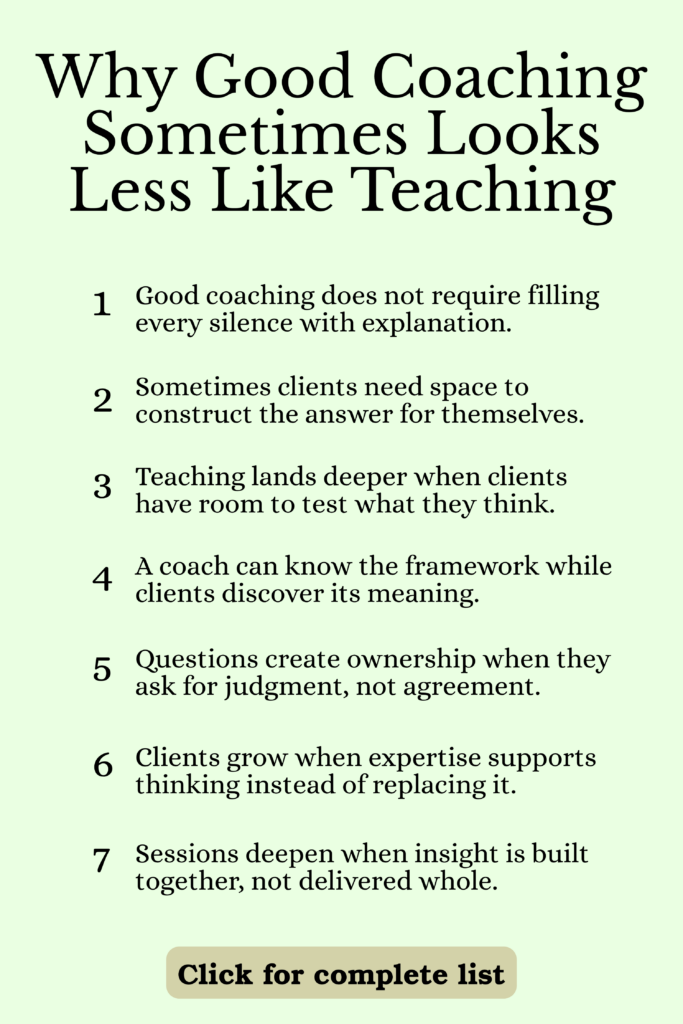
Give feedback when it helps the client think, decide, correct, or continue. You do not need to comment on everything they submit. Focus on moments where your response can deepen the work.
How can I make an online coaching course more engaging?
Make an online coaching course more engaging by adding activities that require learners to explain, apply, predict, practice, and discuss what they are learning. A video followed by a real decision or experiment creates more involvement than another video alone.
How do I make coaching worksheets and homework more effective?
Make worksheets and homework more effective by giving each assignment a specific job. Ask the client to compare options, identify a pattern, test a behavior, prepare a decision, or produce something you will genuinely use in the next coaching conversation.
What Ultimately Makes Learners More Receptive?
Learners become more receptive when they are expected to participate in their own learning.
Your enthusiasm still matters. So does clarity, relevance, and the relationship you build with the client.
SEE ALSO: If you’re a coach looking to streamline your administrative tasks and save time, check out our Coaching Administration Software. It’s a simple, effective solution designed to help you focus less on paperwork and more on what matters—coaching your clients. From scheduling to client management, our software gives you the tools to run your business efficiently. Ready to reclaim your time and boost productivity? Click or tap here.
But enthusiasm cannot do the learner’s thinking for them.
Give clients ideas worth considering. Then give them something meaningful to do with those ideas.
Ask them to explain.
Ask them to choose.
Ask them to test.
Ask them what changed.
SEE ALSO: If you’re a coach looking to streamline your administrative tasks and save time, check out our Coaching Administration Software. It’s a simple, effective solution designed to help you focus less on paperwork and more on what matters—coaching your clients. From scheduling to client management, our software gives you the tools to run your business efficiently. Ready to reclaim your time and boost productivity? Click or tap here.
Then use what they bring back to make the next conversation stronger.
That is how a lesson stops being information and starts becoming part of the client’s behavior.
If you want one place to assign that follow-through, keep client work organized, and review progress over time, you can explore LCH Core.
Sources
Chi, Michelene T. H., and Ruth Wylie. “The ICAP Framework: Linking Cognitive Engagement to Active Learning Outcomes.” Educational Psychologist, vol. 49, no. 4, 2014, pp. 219-243. Taylor & Francis
Dunlosky, John, et al. “Improving Students’ Learning With Effective Learning Techniques: Promising Directions From Cognitive and Educational Psychology.” Psychological Science in the Public Interest, vol. 14, no. 1, 2013, pp. 4-58. Association for Psychological Science
Pashler, Harold, et al. “Learning Styles: Concepts and Evidence.” Psychological Science in the Public Interest, vol. 9, no. 3, 2008, pp. 105-119. Journal article
SEE ALSO: If you’re a coach looking to streamline your administrative tasks and save time, check out our Coaching Administration Software. It’s a simple, effective solution designed to help you focus less on paperwork and more on what matters—coaching your clients. From scheduling to client management, our software gives you the tools to run your business efficiently. Ready to reclaim your time and boost productivity? Click or tap here.
Ryan, Richard M., and Edward L. Deci. “Self-Determination Theory and the Facilitation of Intrinsic Motivation, Social Development, and Well-Being.” American Psychologist, vol. 55, no. 1, 2000, pp. 68-78. PubMed

Read this next
New Amazing Coaching Techniques Of 2026
A compilation of new coaching techniques from 2018 that will come in handy for beginner coaches as well as for professionals.
Read More
Transparency and Heart: Two Best Practice Coaching Tips
Trust, transparency and heart as a life coach will take you far.
Read More
The Simple Assessment System That Shows Clients How Far They’ve Come
Assessments should be a vital part of your coaching business as they are highly beneficial and can be eye-opening.
Read More