


Talk to a coach about Organizational coaching

Crystal Faulk
ACC
I help overwhelmed women in transition gain clarity, confidence, and...

Terrie Hein
Certified Life Coach, Certified Insight Coach Practitioner
Coaching to declutter your life, organize your goals, and cook...

Dr Charlene Ashley
Doctorate - Behaviours
I coach individuals to design fulfilling lives through structure, clarity,...

Paloma Chiara

Lana's Gymnastics Club
"Where the best in gymnastics meets fun. Where every child is a star"
lgclubny.com

Anna Sosnina
ICF (ACC)
ICF ACC certified coach, founder of EssorVie Coaching, passionate about...

Tyler Fink
B.A. in Religion, Anthropology, and Philosophy. Master of Divinity (M.Div.) in Missiology
Pastor, husband, and father helping Christian men pursue faithful growth...

Travis Brown
Professional Life coach
With experience in guiding clients to achieve goals, build confidence,...




The Easy Thanksgiving Table Trick You’ll Wish You Tried Before Buying More Decor
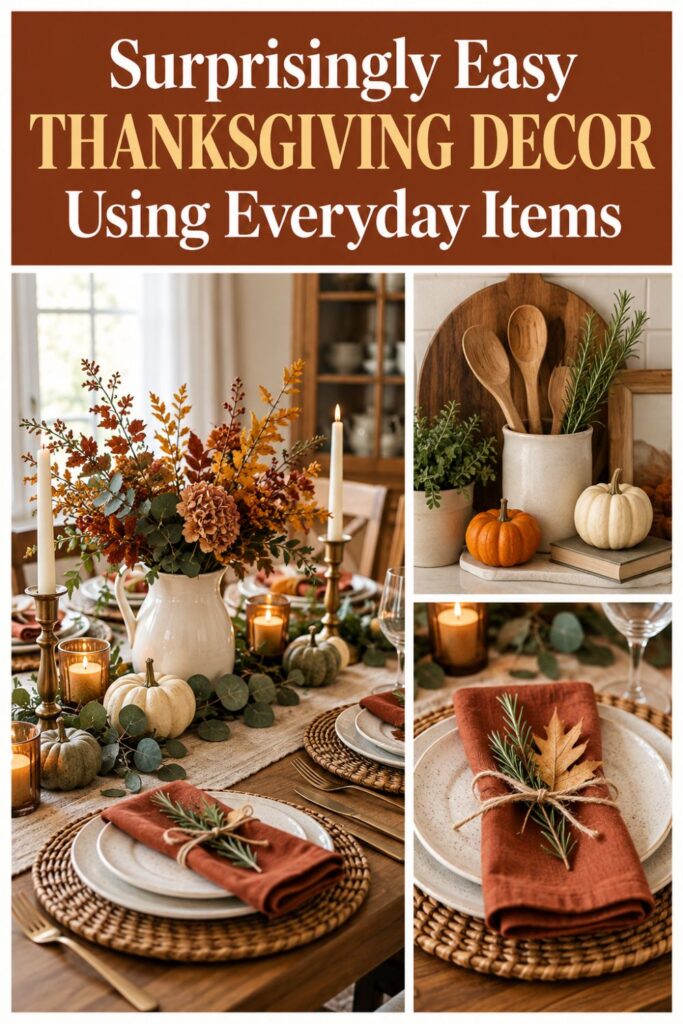
Thanksgiving decorating can get complicated surprisingly fast. You start looking for one centerpiece idea, and suddenly it seems like you need new napkins, matching plates, decorative pumpkins, special candleholders, and an entirely different set of glassware just to make the table feel festive.
You really do not need all of that.
A beautiful Thanksgiving table can come together in under an hour when you stop thinking about individual decorations and start thinking about a few simple layers. The easiest tables usually have a clear color palette, a focal point through the center, repeated details, and enough open space for people to actually eat.
Better still, most of those layers can come from things you already own.
Look around your kitchen, linen closet, dining room, and even your yard before buying anything. Serving bowls can become centerpieces. Cutting boards can become decorative bases. Scarves can work as runners. Pears, apples, herbs, branches, candles, glass jars, and everyday dishes can all look intentionally seasonal when they are repeated in the right way.
The goal is not to create a table that looks like it came out of a premade Thanksgiving decorating kit. It is to create something warm, welcoming, and pulled together without turning table decorating into another major holiday task.
Before you begin, use this simple formula:
- Choose two or three earthy fall colors.
- Pick one main centerpiece idea.
- Repeat one or two materials around the table.
- Keep the arrangement low enough for conversation.
- Leave space for food, drinks, and serving dishes.
- Stop decorating once the table feels connected.
The following Thanksgiving tablescapes are designed to be flexible. Use the version that makes the most sense for what is already in your home, then adjust the details to fit your table, dinnerware, and Thanksgiving plans.
If you want to get more from your life, and are looking for concrete action steps to get you there, check out our Request a Coach page. It’s a “cut the fence-sitting and take action” way to tackle your issues and actually find success. To get off the fence and start to take action, click or tap here.
Need some help with style or organization? Drop on by our directories choc full of image coaches, organization coaches and minimalist coaches to help make your spaces beautiful. Or click here to have us match you to the best.
1. The 10-Minute Tablescape That Starts With Your Fruit Bowl
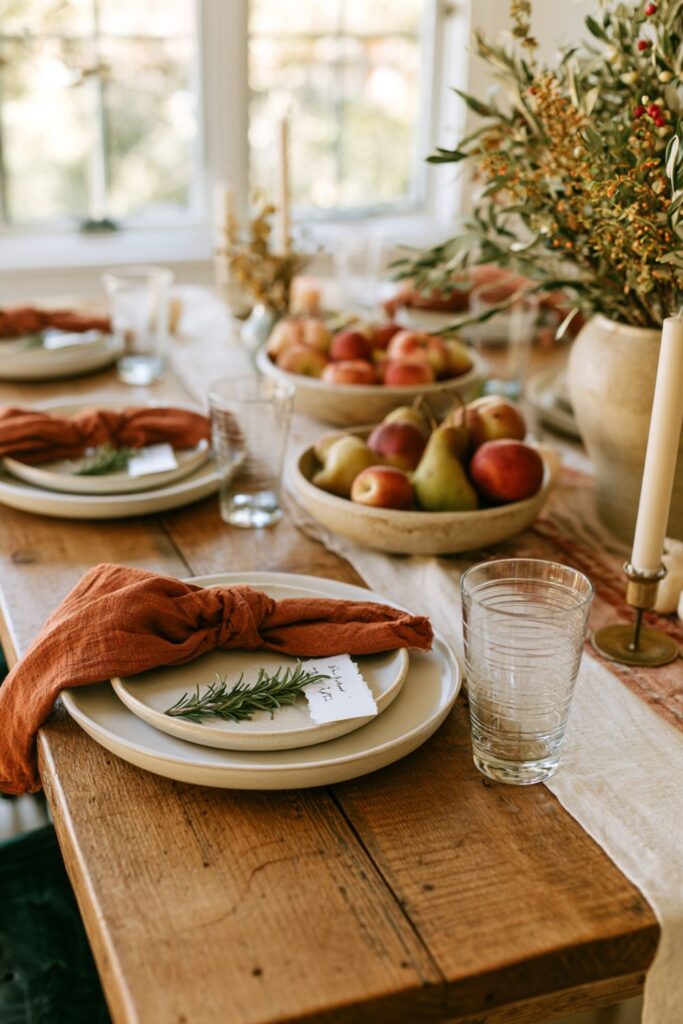
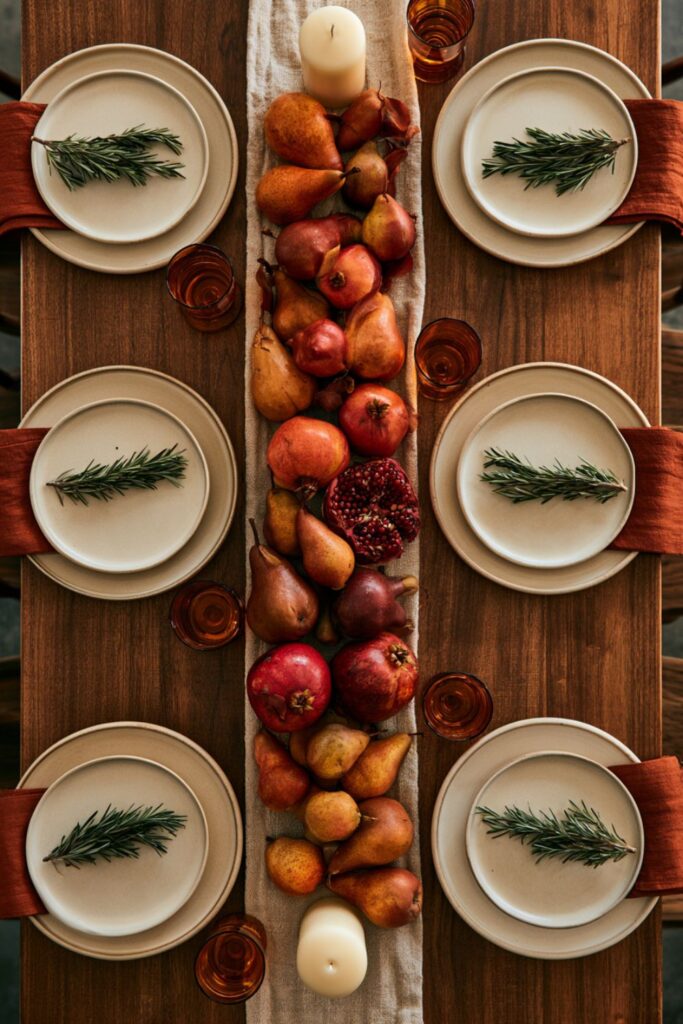
If Thanksgiving dinner is approaching and you have not planned a centerpiece, start in the kitchen. A bowl of everyday fruit can become one of the easiest seasonal focal points on the table, especially when you choose produce in warm fall colors.
You do not need miniature decorative pumpkins or specialty Thanksgiving objects. Apples, pears, pomegranates, squash, nuts, or even a combination of produce already waiting to be used can create the same rich autumn feeling.
Choose your centerpiece container: Look for a wooden bowl, ceramic serving dish, shallow basket, cake stand, or wide platter. Choose something that feels substantial enough to anchor the center of the table without taking up the entire surface.
Build an earthy fall color mix: Combine produce in rust, olive, burgundy, gold, cream, and warm brown tones. You do not need every color represented. Two or three shades repeated together will usually look more intentional.
Create a natural arrangement: Place larger pieces toward the middle and allow smaller fruit, nuts, or leaves to fill the gaps. Avoid arranging everything too perfectly. A slightly loose composition feels relaxed and makes ordinary grocery items look decorative.
Repeat one ingredient at the place settings: Put a pear, small apple, leaf, or herb sprig near several plates. Repeating one element from the centerpiece instantly connects the center of the table to the individual settings.
Add candlelight: Place two or three candles around the bowl if there is room. Keep flames well away from leaves, paper, fabric, and other combustible materials, or use flameless candles for an easier option.
If you want to get more from your life, and are looking for concrete action steps to get you there, check out our Request a Coach page. It’s a “cut the fence-sitting and take action” way to tackle your issues and actually find success. To get off the fence and start to take action, click or tap here.
The best part of this setup is that nothing needs to be stored afterward as special Thanksgiving decor. The fruit can be eaten, the bowl can go back into the kitchen, and the candles can return to wherever you normally use them.
It is simple, practical, and still feels like you made an effort.
2. Turn Something You Already Own Into the Table Runner
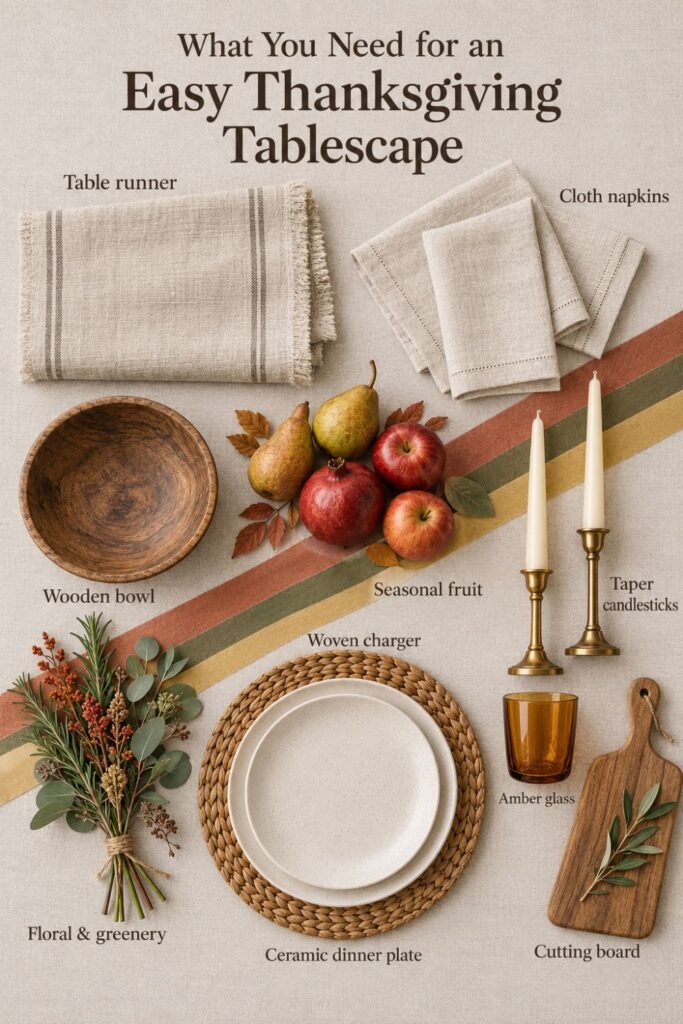
A table runner creates an instant visual line through the center of a dining table, but you do not need an actual table runner to get the effect.
Before buying one, look through your linen closet and bedroom. You may already have a scarf, narrow throw, folded tablecloth, piece of fabric, or other textile that can do the job just as well.
The trick is choosing something that looks intentional once it is placed on the table.
Search your home before shopping: Look for fabrics with warm neutrals, soft checks, woven textures, muted stripes, or earthy fall colors. Rust, olive, cream, brown, mustard, and beige all work especially well for Thanksgiving.
Fold oversized fabric into shape: A tablecloth or throw may be much wider than you need. Fold it lengthwise until it creates a narrow strip down the middle while leaving plenty of tabletop visible on either side.
Let texture create the interest: Linen, cotton, gauze, woven fabric, or even simple kraft paper can create a strong base. You do not need turkey prints, Thanksgiving slogans, or complicated patterns to make the table look seasonal.
If you want to get more from your life, and are looking for concrete action steps to get you there, check out our Request a Coach page. It’s a “cut the fence-sitting and take action” way to tackle your issues and actually find success. To get off the fence and start to take action, click or tap here.
Build your centerpiece along the line: Place candles, small bowls, fruit, jars, branches, or other objects along the runner. Keep the arrangement relatively narrow so plates and serving dishes still have room.
Check the practical space: Before finishing, imagine the actual dinner on the table. If large serving dishes will be passed around, make sure the runner and centerpiece are not occupying every useful inch.
One reason this approach works so well is that the runner does much of the visual organizing for you. Even unrelated objects start to look connected once they are positioned along the same central line.
When the table feels sparse, resist the urge to keep adding more decor. Try adjusting the spacing first.
A little breathing room between the objects often makes the entire tablescape feel calmer, more deliberate, and more expensive than a table crowded with decorations.
3. The Cutting-Board Centerpiece Trick
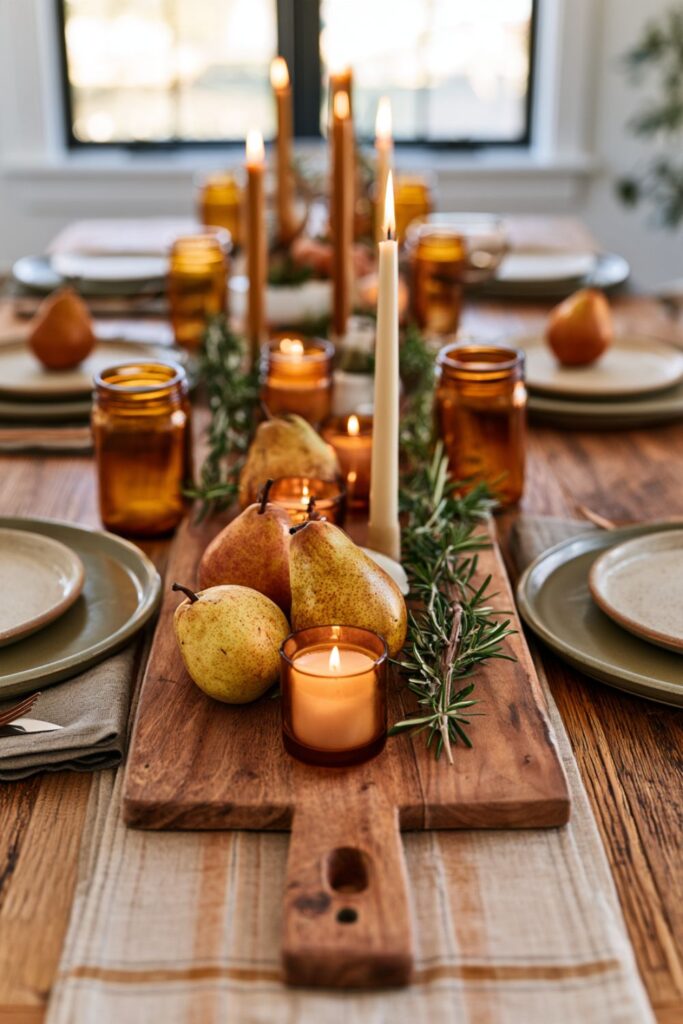
If you have several small decorative pieces but cannot figure out how to make them look connected, put them on a board.
A wooden cutting board, cheese board, serving tray, or large platter can turn a handful of ordinary objects into one defined centerpiece. Instead of looking like you scattered random things across the table, the collection suddenly reads as a single styled arrangement.
It is also extremely practical for Thanksgiving.
If you want to get more from your life, and are looking for concrete action steps to get you there, check out our Request a Coach page. It’s a “cut the fence-sitting and take action” way to tackle your issues and actually find success. To get off the fence and start to take action, click or tap here.
Choose a strong base: Look for a board or tray with enough size to hold several objects but not so much width that it interferes with place settings. Warm wood works particularly well with an earthy fall palette.
Create three simple layers: Start with the board. Add one larger object such as a bowl, vase, candleholder, or jar. Then fill around it with smaller pieces such as pears, nuts, leaves, herbs, pinecones, or a few decorative objects you already own.
Vary the heights: Include something low, something medium, and one slightly taller element. This gives the arrangement dimension without creating a tall centerpiece that makes conversation difficult.
Repeat the wood elsewhere: If possible, echo the cutting board with wooden serving spoons, woven placemats, brown napkins, or another natural material. Repetition makes the board feel like part of the tablescape instead of an emergency kitchen substitute.
Keep the edges loose: Avoid filling every inch of the board. A little visible space between objects helps each piece stand out and keeps the centerpiece from looking cluttered.
There is another reason this method works especially well for Thanksgiving. When it is time to bring out a large turkey platter, casserole dish, or serving bowl, you can lift the entire centerpiece off the table in one movement.
That means you can create a fully decorated table before dinner without worrying about dismantling an elaborate arrangement once the food arrives.
After dinner, place the board back on the table if you want the room to continue feeling festive.
If you want to get more from your life, and are looking for concrete action steps to get you there, check out our Request a Coach page. It’s a “cut the fence-sitting and take action” way to tackle your issues and actually find success. To get off the fence and start to take action, click or tap here.
One board, a few household objects, and ten or fifteen minutes of arranging can do a surprising amount of work.
4. The Candle-Cluster Table for When You Have Almost Nothing Else
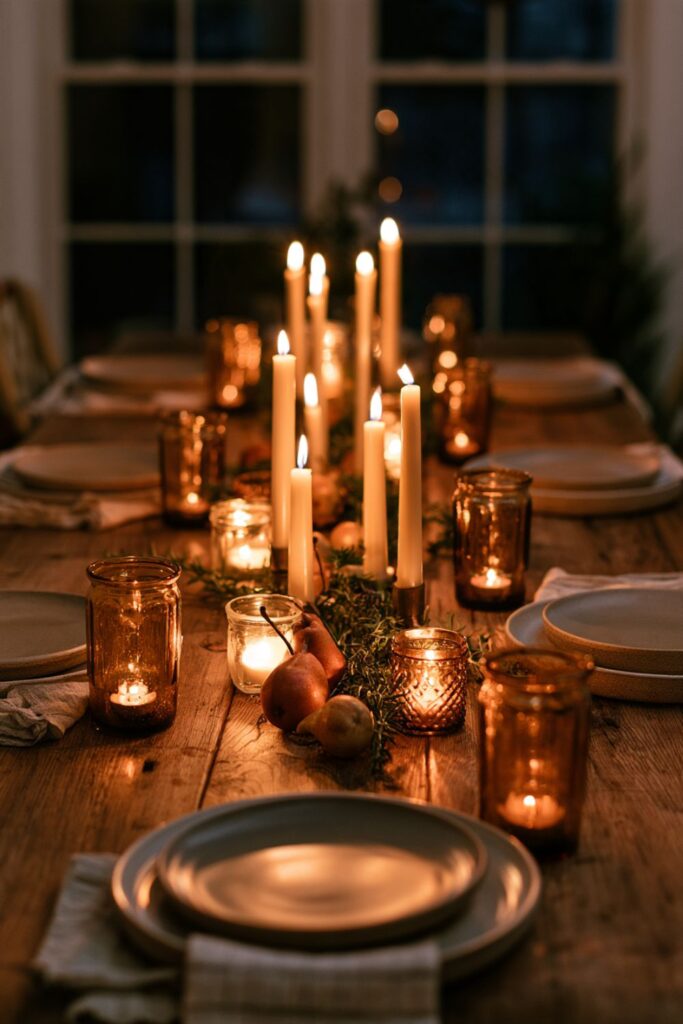
When you do not have much seasonal decor, use light.
Candles can make an ordinary dining table feel warmer almost immediately, and you do not necessarily need a matching collection. A mixture of tapers, pillars, votives, glass jars, or flameless candles can look deliberate when you arrange them in groups.
The key is to create repetition instead of randomness.
Gather what you already own: Pull candles from the dining room, bedroom, bathroom, living room, or storage. Look for pieces that share a similar feeling, such as warm white wax, amber glass, cream tones, brass accents, or simple clear holders.
Create small clusters: Instead of scattering individual candles everywhere, arrange them in groups of two or three. Several defined clusters are easier for the eye to understand and usually look more polished.
Vary the heights: Pair a taller taper with a shorter votive or mix medium and low candleholders. Repeating this variation down the length of the table creates rhythm without needing a traditional centerpiece.
Add one natural detail: Place a pear, small branch, herb sprig, pinecone, or a few leaves between the clusters. This gives the candle arrangement a stronger Thanksgiving feeling without requiring additional purchased decorations.
If you want to get more from your life, and are looking for concrete action steps to get you there, check out our Request a Coach page. It’s a “cut the fence-sitting and take action” way to tackle your issues and actually find success. To get off the fence and start to take action, click or tap here.
Check everything from a seated position: Sit in one of the dining chairs before you finish. Move anything that blocks the view across the table or feels too close to plates, sleeves, serving dishes, or guests.
Open flames deserve extra care during a busy meal. Keep candles well away from dry leaves, napkins, table runners, paper place cards, and other materials that could catch fire.
Flameless candles are a useful alternative, especially if children will be at the table or if you want to place lights close to natural materials.
This tablescape works because candlelight itself becomes the decoration. You are not trying to fill every empty area.
A few carefully grouped lights, some natural texture, and ordinary place settings can make the whole table feel warm enough for Thanksgiving.
5. The Everyday-Dishes Thanksgiving Tablescape
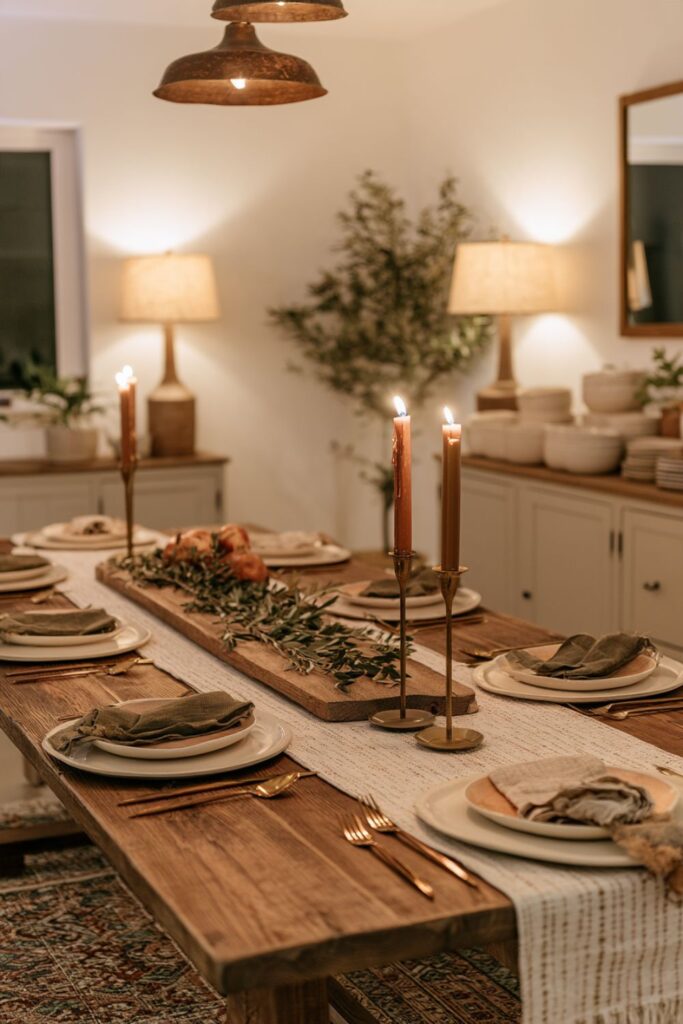
One of the easiest ways to overspend on holiday decorating is to assume that your everyday dishes are not festive enough.
They probably are.
White plates, cream stoneware, black dinnerware, simple glassware, or mismatched ceramic pieces can all work beautifully for Thanksgiving. Instead of asking the dishes to provide the seasonal feeling, let the colors and textures around them do that work.
If you want to get more from your life, and are looking for concrete action steps to get you there, check out our Request a Coach page. It’s a “cut the fence-sitting and take action” way to tackle your issues and actually find success. To get off the fence and start to take action, click or tap here.
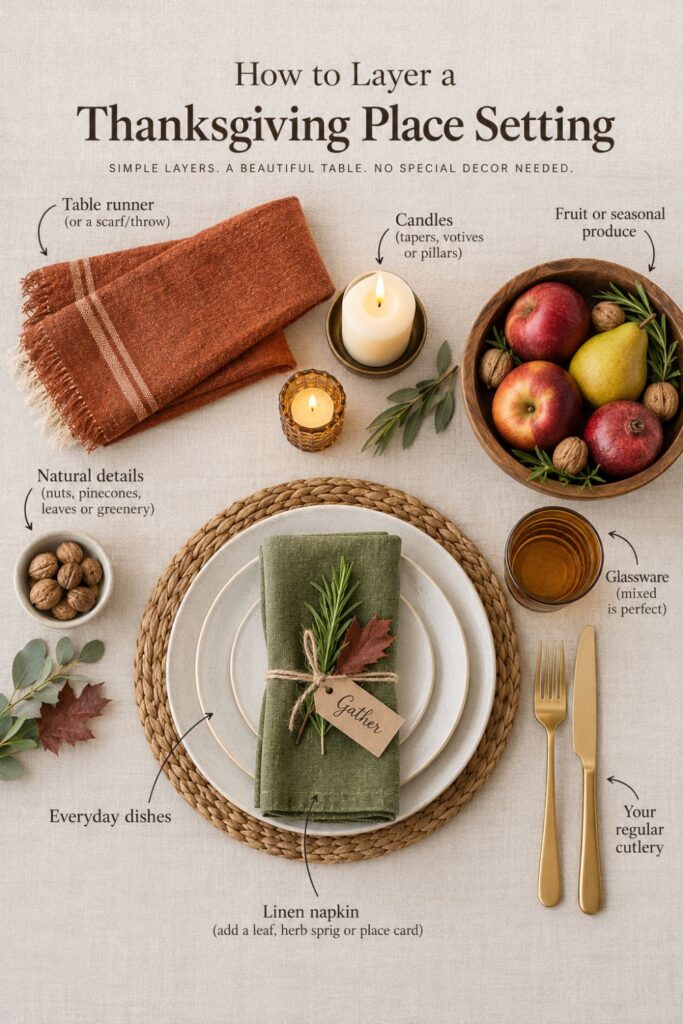
Keep the plates you already use: Start with your regular dinnerware instead of building the table around seasonal plates. Simple dishes create a neutral foundation that makes fall-colored details more noticeable.
Choose one main accent color: Pick rust, olive, mustard, warm brown, burgundy, or gold. Use that color in several places, such as napkins, candles, glasses, fruit, leaves, or the centerpiece.
Layer only what dinner requires: Avoid adding extra bowls, plates, or utensils purely to make each place setting look elaborate. Thanksgiving tables already get crowded once food arrives, so functional simplicity matters.
Make the napkin a decorative feature: Place it across the plate, beneath the fork, or loosely folded beside the setting. Add a rosemary sprig, leaf, piece of twine, or small handwritten place card if you want an extra detail.
Repeat your accent three times: Carry the same color or material into the centerpiece, place settings, and at least one additional object. For example, rust-colored napkins might be repeated through apples in the centerpiece and warm-toned candles.
This repetition is what makes ordinary pieces feel coordinated.
If the table still seems unfinished, do not immediately add more things. First look for something that appears only once. A single gold object or one green glass may feel random, while repeating that color elsewhere can make the entire table feel more cohesive.
The result does not need to scream Thanksgiving.
If you want to get more from your life, and are looking for concrete action steps to get you there, check out our Request a Coach page. It’s a “cut the fence-sitting and take action” way to tackle your issues and actually find success. To get off the fence and start to take action, click or tap here.
It only needs to feel warm, intentional, and ready for a long meal with people you care about.
6. The Mixed-Glass Thanksgiving Table That Looks Collected on Purpose
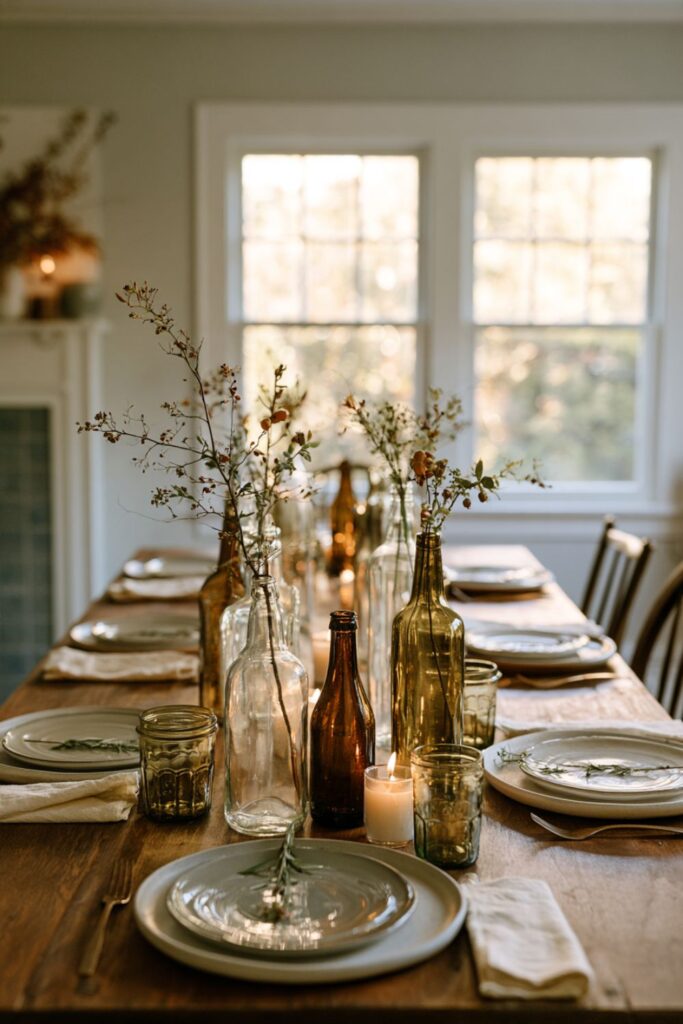
Matching glassware is lovely, but it is not required for a beautiful Thanksgiving table.
In fact, mixed jars, bottles, glasses, and candleholders can create a relaxed, collected look that feels warmer than a perfectly matching set. The trick is giving the mixture some kind of visual connection.
Color is one of the easiest ways to do that.
Gather glass by mood: Look for clear glass, amber bottles, green jars, brown glass, old candleholders, small vases, or drinking glasses that you are comfortable using decoratively. They can be different shapes as long as several pieces share a similar tone.
Give each piece a purpose: Use tall bottles for a branch or two, short jars for herbs or flowers, and appropriate heat-safe holders for candles. Avoid including objects purely because you need to fill space.
Repeat similar heights: If you have three small jars, spread them along the table instead of grouping all three at one end. Repeat taller pieces in the same way so the collection creates a loose pattern.
Keep the contents simple: One branch, a few grasses, rosemary, eucalyptus, or another small natural element can be enough. You are trying to create repeated little moments, not several miniature floral arrangements.
If you want to get more from your life, and are looking for concrete action steps to get you there, check out our Request a Coach page. It’s a “cut the fence-sitting and take action” way to tackle your issues and actually find success. To get off the fence and start to take action, click or tap here.
Leave empty space between groups: Mixed pieces need breathing room. When every inch is filled, the collection begins to look like storage instead of styling.
This approach is especially useful when you are hosting more people than usual and suddenly realize you do not have enough matching glasses or vases.
Instead of hiding the differences, make them part of the look.
You can even carry the idea into drinking glasses if the pieces are suitable for serving. Clear and colored glass mixed across the table can feel intentional when the rest of the tablescape stays simple.
Keep the plates relatively neutral, repeat one earthy color, and use the glass collection as the visual interest.
The final table should feel gathered over time, not assembled from a single seasonal shopping trip.
7. The Bare-Table Tablescape for Beautiful Wood
Sometimes the best thing you can put on a dining table is less.
If your table has warm wood, visible grain, or a finish you already love, covering the entire surface with linens can hide one of your strongest decorative elements. For an easy Thanksgiving tablescape, let the table itself become part of the color palette.
If you want to get more from your life, and are looking for concrete action steps to get you there, check out our Request a Coach page. It’s a “cut the fence-sitting and take action” way to tackle your issues and actually find success. To get off the fence and start to take action, click or tap here.
Warm wood already works beautifully with rust, olive, cream, brown, and soft gold.
Start with the surface: Clear the table completely and look at it before adding anything. If the wood already brings warmth and texture, decide whether you really need a tablecloth at all.
Create one narrow center line: Use candles, a low bowl, a cutting board centerpiece, seasonal fruit, or several small jars through the middle. Keep the arrangement contained so plenty of wood remains visible.
Add softness at each seat: Napkins, simple placemats, or a small fabric detail can soften the hard surface without covering it. Natural linen, cream cotton, muted checks, and warm earthy colors work particularly well.
Keep the palette limited: Choose roughly three main tones and let the wood count as one of them. For example, wood, cream, and olive can create an entire Thanksgiving table without another strong color.
Use spacing as decoration: Keep place settings lined up consistently and repeat candles or centerpiece elements at regular intervals. Order and repetition create visual calm even when the table contains very few objects.
This style is particularly helpful when Thanksgiving food will be served family-style.
A table packed with decorative objects may look beautiful before dinner, but it quickly becomes frustrating when casseroles, gravy, bread, drinks, and serving utensils arrive.
If you want to get more from your life, and are looking for concrete action steps to get you there, check out our Request a Coach page. It’s a “cut the fence-sitting and take action” way to tackle your issues and actually find success. To get off the fence and start to take action, click or tap here.
The bare-table approach gives everything more room.
It can also make cleanup easier because there are fewer decorative layers to shake out, fold, wash, or store afterward.
If the table feels too simple once everything is set, add candlelight before adding more objects.
Very often, that is all it needs.
8. The Use-What’s-Outside Thanksgiving Tablescape
If your yard, balcony, neighborhood, or garden has seasonal materials available, you may already have most of your Thanksgiving centerpiece waiting outside.
Branches, fallen leaves, pinecones, herbs, grasses, and garden clippings can create a natural tablescape without requiring a trip to the decor aisle.
The important part is editing what you bring in.
Choose clean, usable natural materials: Look for branches, leaves, pinecones, herbs, or clippings that are dry, clean, pest-free, and appropriate to bring indoors. Avoid anything treated with chemicals or anything you cannot confidently identify as safe to handle.
If you want to get more from your life, and are looking for concrete action steps to get you there, check out our Request a Coach page. It’s a “cut the fence-sitting and take action” way to tackle your issues and actually find success. To get off the fence and start to take action, click or tap here.
Repeat one material: Instead of gathering ten different things, choose one or two natural elements and use them several times. A row of similar branches or repeated leaves usually looks more deliberate than a random pile of outdoor finds.
Create a loose center line: Lay greenery or branches gently through the middle of the table rather than trying to construct a dense garland. The imperfect shape is part of what makes the arrangement feel natural.
Add household objects for structure: Use existing candles, bowls, jars, serving boards, or glassware as anchor points. Natural materials look more intentional when they are placed around recognizable objects rather than scattered alone.
Keep dry materials away from flames: Leaves, grasses, twigs, and other dried items can be combustible. Maintain generous distance from open candles or use flameless candles instead.
Once the natural centerpiece is in place, keep the rest of the table restrained.
Everyday dishes, simple napkins, and a few warm colors are enough because the texture in the middle already provides plenty of visual interest.
You can also repeat one small natural detail at each place setting. A rosemary sprig, small leaf, or tiny clipping placed beside the napkin connects the individual seats to the centerpiece.
This approach works particularly well when you want Thanksgiving decor to feel seasonal without looking themed.
If you want to get more from your life, and are looking for concrete action steps to get you there, check out our Request a Coach page. It’s a “cut the fence-sitting and take action” way to tackle your issues and actually find success. To get off the fence and start to take action, click or tap here.
Nothing has a turkey printed on it. Nothing needs a Thanksgiving label.
The season itself becomes the decoration.
The Under-an-Hour Thanksgiving Table Checklist
If you tend to keep adjusting the table because you are never quite sure when it is finished, give yourself a deadline.
An hour is plenty of time for a pulled-together Thanksgiving table when you work in a specific order. The biggest mistake is decorating one tiny area perfectly before deciding what the rest of the table needs.
Instead, build the whole table in layers.
Minutes 0 to 10, shop your house: Gather dishes, napkins, candles, bowls, boards, jars, glasses, placemats, and anything else that could work. Put everything in one place before choosing the final pieces.
Minutes 10 to 15, choose your palette: Pick two or three colors that naturally appear in what you gathered. Rust, olive, cream, brown, burgundy, and warm gold are easy Thanksgiving options.
Minutes 15 to 25, build the centerpiece: Choose one focal idea. This might be a fruit bowl, cutting-board arrangement, candle clusters, branches, or a line of mixed glassware.
If you want to get more from your life, and are looking for concrete action steps to get you there, check out our Request a Coach page. It’s a “cut the fence-sitting and take action” way to tackle your issues and actually find success. To get off the fence and start to take action, click or tap here.
Minutes 25 to 40, set the places: Put down the actual plates, glasses, cutlery, and napkins needed for the meal. This immediately shows you how much decorative space is truly available.
Minutes 40 to 50, repeat key details: Carry one color, material, or natural element from the center into the individual place settings.
Minutes 50 to 55, remove something: Look for objects that block conversation, crowd the plates, or repeat an idea that is already clear.
Minutes 55 to 60, test dinner reality: Think about where the turkey, side dishes, water, gravy, condiments, and serving utensils will go.
That final step matters.
A Thanksgiving table is not finished when the centerpiece looks good. It is finished when the room looks welcoming and dinner can still happen comfortably.
If you reach the one-hour mark and the table feels simple, resist starting another decorating project.
Light the candles, straighten the chairs, and move on.
If you want to get more from your life, and are looking for concrete action steps to get you there, check out our Request a Coach page. It’s a “cut the fence-sitting and take action” way to tackle your issues and actually find success. To get off the fence and start to take action, click or tap here.
Do This the Night Before If Thanksgiving Day Is Already Packed
The fastest Thanksgiving tablescape is the one you do not have to create from scratch while dinner is cooking.
If Thanksgiving Day tends to feel hectic, use the night before to remove as many decisions as possible. You do not necessarily need to fully decorate the table early. You simply want everything staged so assembly becomes easy.
Pull everything into one area: Gather your plates, glassware, napkins, candles, centerpiece container, serving pieces, cutlery, and decorative elements. Keep them together so you are not searching multiple cupboards the next day.
Set safe items early: Plates, napkins, cutlery, placemats, table runners, empty candleholders, and place cards can usually be arranged ahead of time. Leave anything perishable or particularly fragile until later.
Prepare the centerpiece structure: Put out the cutting board, bowl, tray, jars, or other base you plan to use. You can add fresh fruit, herbs, branches, or flowers the next day if needed.
Choose where food will go: Make a rough plan for the turkey platter, casseroles, bread basket, drinks, gravy, and condiments. If serving dishes will occupy the middle of the table, keep your decor narrow or easy to move.
Create one backup plan: Decide what you will remove first if the table feels crowded once dinner appears. A centerpiece on a tray or cutting board is ideal because it can be lifted away quickly.
This preparation is less about decorating early and more about protecting your time.
If you want to get more from your life, and are looking for concrete action steps to get you there, check out our Request a Coach page. It’s a “cut the fence-sitting and take action” way to tackle your issues and actually find success. To get off the fence and start to take action, click or tap here.
When the table has already been planned, Thanksgiving morning does not include another series of tiny decisions about napkin colors, candle placement, or which bowl should hold the centerpiece.
You simply finish the pieces that need finishing.
You can even take a quick photo of the table after staging it. If something gets moved while cleaning or cooking, the photo gives you a visual reference for putting it back.
The goal is to make the final setup almost automatic.
How an Organizing Coach Would Make Next Thanksgiving Even Easier
A good organizing system does not necessarily mean owning more containers or creating a complicated holiday storage area.
For Thanksgiving, the most useful system may simply reduce how many decisions you have to make next year.
That is where an organizing-coach mindset can be helpful. Instead of asking how to create a completely different Thanksgiving table every year, you can identify the choices that worked and make them easier to repeat.
Choose your default palette: Decide on a simple color combination that works with your existing home. Rust, cream, and wood or olive, brown, and warm gold are easy examples.
If you want to get more from your life, and are looking for concrete action steps to get you there, check out our Request a Coach page. It’s a “cut the fence-sitting and take action” way to tackle your issues and actually find success. To get off the fence and start to take action, click or tap here.
Notice what actually helped: After Thanksgiving, pay attention to which objects earned their place. Maybe the wooden board made it easy to move the centerpiece, or the simple candle clusters created enough atmosphere that you did not need anything else.
Store useful seasonal pieces together: If you do own dedicated Thanksgiving linens, place cards, candles, or small decor items, keep them in one clearly defined location. Avoid spreading them across several unrelated storage areas.
Save a photo of the finished table: Take one picture from above and one from seated height. Next year, you can quickly recreate the spacing and proportions without trying to remember what worked.
Keep a simple checklist: Store the under-an-hour setup steps with your Thanksgiving supplies or save them somewhere easy to find. The process becomes much faster when you do not have to reinvent the order.
The point is not to create a rigid decorating formula you can never change.
It is to create a reliable starting point.
Next year, you can still swap the centerpiece, change the napkin color, or try a different natural element. You simply will not be starting from an empty table and an endless list of possibilities.
That small reduction in decision-making can make holiday preparation feel noticeably calmer.
If you want to get more from your life, and are looking for concrete action steps to get you there, check out our Request a Coach page. It’s a “cut the fence-sitting and take action” way to tackle your issues and actually find success. To get off the fence and start to take action, click or tap here.
Thanksgiving decor becomes something you assemble from a system you already understand, rather than one more project demanding your attention at the busiest possible time.
A Thanksgiving Table Can Feel Special Without Starting With a Shopping Cart

A memorable Thanksgiving table does not have to begin with buying Thanksgiving decor.
It can begin with a bowl you already use, candles pulled from another room, a wooden cutting board, everyday plates, a scarf from the linen closet, or branches collected outside.
What makes those objects feel festive is not the label attached to them. It is how you combine them.
Choose the easiest starting point: Look at what you already own and identify the strongest element. Maybe it is beautiful wooden table, a collection of amber glass, a stack of neutral dishes, or several candleholders.
Pick one focal idea: Build the table around a fruit bowl, cutting-board centerpiece, candle clusters, mixed glass, or a simple natural arrangement. Avoid trying to use every idea at once.
Repeat your materials: Carry one or two colors or textures from the center of the table into the place settings. Repetition is what makes separate objects feel like one tablescape.
Protect the function of the table: Leave room for plates, elbows, drinks, serving dishes, and conversation. A Thanksgiving table should help the gathering feel comfortable, not make guests nervous about touching anything.
If you want to get more from your life, and are looking for concrete action steps to get you there, check out our Request a Coach page. It’s a “cut the fence-sitting and take action” way to tackle your issues and actually find success. To get off the fence and start to take action, click or tap here.
Give yourself permission to stop: Once the centerpiece, place settings, and colors feel connected, you are done. More decor does not automatically make the table more beautiful.
That final rule may be the most important one.
Thanksgiving already asks a lot of the person hosting. Decorating should not become another elaborate performance that has to be completed before anyone can enjoy the day.
A simple table can still feel thoughtful.
Warm colors, candlelight, natural texture, familiar dishes, and a few repeated details are often enough to change the atmosphere of the entire room.
Use what you own. Give yourself an hour. Make the table welcoming.
Then save your energy for the part of Thanksgiving that actually matters: sitting down together.
Need some help with style or organization? Drop on by our directories choc full of image coaches, organization coaches and minimalist coaches to help make your spaces beautiful. Or click here to have us match you to the best.
If you want to get more from your life, and are looking for concrete action steps to get you there, check out our Request a Coach page. It’s a “cut the fence-sitting and take action” way to tackle your issues and actually find success. To get off the fence and start to take action, click or tap here.
If you want to get more from your life, and are looking for concrete action steps to get you there, check out our Request a Coach page. It’s a “cut the fence-sitting and take action” way to tackle your issues and actually find success. To get off the fence and start to take action, click or tap here.
Read this next

My Secret Sauce for Good Organization
Why am I always so well organised and never miss a deadline? Find out im this short video! If you want to get more from your life, and are looking […]
Read More
The DIY Christmas Wreaths Formula for Busy Holiday Weekends
Are you all about style, decor and organization? Download a copy of our Decluttering Workbook. Why We Love a Quick Holiday Project There’s something magical about creating a Christmas wreath […]
Read More
Vision Board Examples: How to Use Them in a Way That Actually Helps
Vision board examples can either distract you or make your next steps feel obvious. Here’s how to use them in a way that actually helps.
Read More