


Talk to a coach about Motivational coaching

Robert Bradley Singleton
Certified Master Spiritual Life Coach, Neuropsychologist, and Existential Therapist
Train with the best to be the best you! Don't...

Diana Davis-Nanasi
ICF Certified Coach, helping clients overcome self-doubt, low confidence, stress managment
I understand life can become overwhelming; I am excited to...

Robert B Singleton, MCMA, MSc.
MSc. Metaphysical Sciences; B. Div., Divinity: Mindfulness and Positive Psychology fanatic
Positive Psychology and Mindfulness Specialties; NeuroScience and Trauma-informed

Dr. Kate Watson
B.A Psychology, M.Ed. Psychological Counseling, Dr.PH in Public Health, Certified Health Coach, Certified Life Coach, Certified Mind and Body Specialist, Certified Women's Empowerment Coach, Certified Neurodiversity Coach
Dr. Kate Watson helps people with boundaries, coping strategies, and...

Angela Inman
Board Certified Coach
Coach with a Board Certified Coach to gain clarity, confidence,...

Claudia Silver
HDIP CBH - Cognitive Behavioural Hypnotherapist (UK Higher Diploma)
Certified Hypnotherapist for evidence-based help with stress, specific fears and...

Mak Estill
Anxiety, Panic & Life Coach dedicated to coaching you into a life of lesser and lighter anxiety!
Founder and owner of Actionable Anxiety, a private coaching practice...

Elise Boren
Certified Life Coach, Communication Specialist and Sound Healer
Through listening and discussion we will create a plan to...




The 3-Number Weekly Review for People Who’ll Never Keep a Habit Tracker

Want to try this at home? No worries! Download a copy of our SMART Goals PDF Worksheet.
*****
The Weekly Review for People Who Hate Daily Tracking
Habit trackers sound great until you actually have to use them.
At first, they feel motivating. You make the chart, pick the colors, decide what counts, and imagine how satisfying it will feel to check off every little box. Then real life happens. You forget one day, then two. Suddenly the tracker feels less like support and more like proof that you are behind.
That is exactly why a weekly review can work better than a daily habit tracker for some people.
Instead of logging every habit every day, this method asks you to look at just three numbers once a week. That is it. Three numbers that tell you whether your routine is helping, where it is breaking down, and what needs to change next.
This is not about becoming the kind of person who tracks everything. It is for people who want useful feedback without turning their whole life into a spreadsheet.
The goal is simple: use three numbers to answer one question.
If you want to get more from your life, and are looking for concrete action steps to get you there, check out our Request a Coach page. It’s a “cut the fence-sitting and take action” way to tackle your issues and actually find success. To get off the fence and start to take action, click or tap here.
Is this routine actually working?
That question matters because many people keep trying to fix their goals with more motivation, when the real issue is the routine itself. Maybe the plan is too big. Maybe the timing is wrong. Maybe the first step is unclear. Maybe the habit is fine, but the environment around it keeps getting in the way.
A 3-number weekly review helps you see that faster.
You are not trying to measure every detail. You are looking for a signal. A pattern. A small clue that tells you what to keep, what to adjust, and what to stop forcing.
This method works especially well for goals like:
- Building a workout routine
- Improving focus
- Making mornings easier
- Staying consistent with meals
- Keeping up with a personal project
- Following through on weekly priorities
- Creating a routine that feels less chaotic
By the end of the article, you will know how to choose your three numbers, review them once a week, and use them to make one realistic adjustment. No daily logging required.
Need some in depth help with goal settings, motivation or productivity ? Drop on by our directories choc full of productivity coaches, accountability coaches, and goal-setting coaches, and start reaching those goals! Or click here to have us match you to the best.
1. Choose the One Routine You Actually Want to Improve
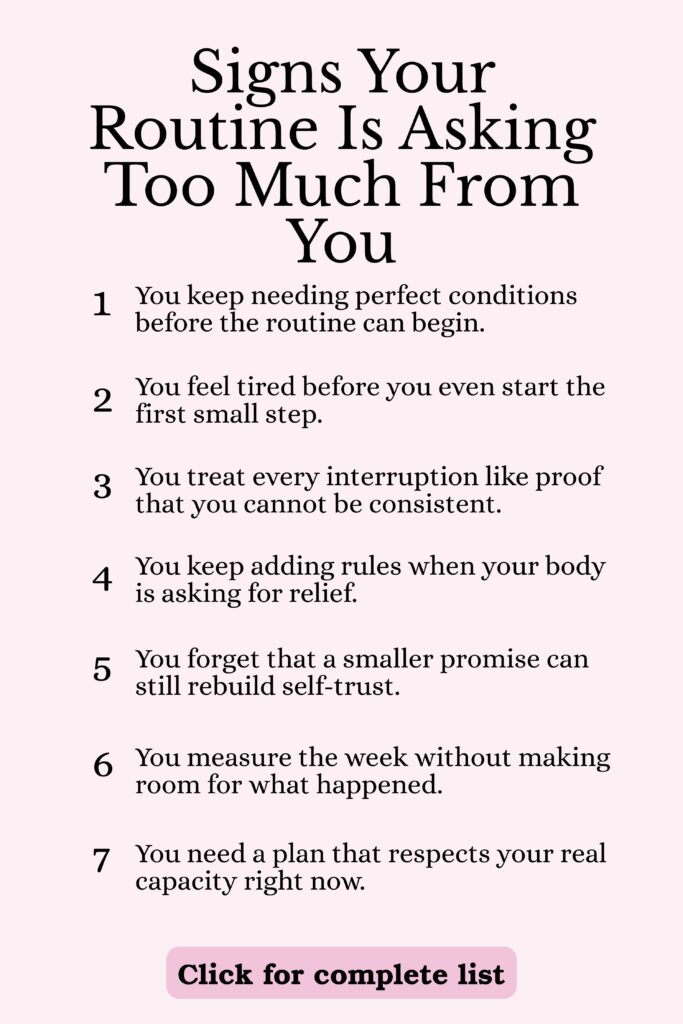
Before you pick your three numbers, choose the routine you want to understand better.
If you want to get more from your life, and are looking for concrete action steps to get you there, check out our Request a Coach page. It’s a “cut the fence-sitting and take action” way to tackle your issues and actually find success. To get off the fence and start to take action, click or tap here.
This part matters because a lot of goal tracking fails when it becomes too broad. If you try to measure your entire life at once, you end up with too much information and not enough clarity. The weekly review works best when it has one clear focus.
Start by choosing one area that keeps feeling harder than it should.
It might be your mornings, your work focus, your workouts, your meals, your cleaning routine, your sleep schedule, or your weekly planning. The best place to start is usually the area that creates the most repeated friction.
Not the biggest dream. Not the most impressive goal. The thing that keeps making the week feel messier.
- Pick one focus area: Choose one part of your life that keeps feeling inconsistent, frustrating, or harder to maintain than expected.
- Keep it narrow enough to review: Instead of choosing “be more productive,” choose “finish my top three work priorities each week.”
- Look for repeated friction: Notice where the same issue keeps coming back, like rushed mornings, unfinished tasks, skipped workouts, or planning that never happens.
- Avoid choosing everything at once: The system works because it reduces noise, so do not turn it into a full life audit.
For example, “get healthy” is too broad. You could measure sleep, exercise, meals, water, steps, energy, mood, and a dozen other things. That gets overwhelming quickly.
A better focus might be “make my weekday meals easier” or “move my body three times a week.” Those are specific enough to review without needing a complicated system.
The same applies to productivity. “Be better with time” is hard to measure. “Start work with one focused block before checking messages” is much easier to review.
Think of the routine as the experiment. You are not judging yourself. You are testing whether the routine is set up in a way that real life can support.
If you want to get more from your life, and are looking for concrete action steps to get you there, check out our Request a Coach page. It’s a “cut the fence-sitting and take action” way to tackle your issues and actually find success. To get off the fence and start to take action, click or tap here.
Once you have one routine in mind, the three numbers become much easier to choose.
2. Pick Your Three Numbers
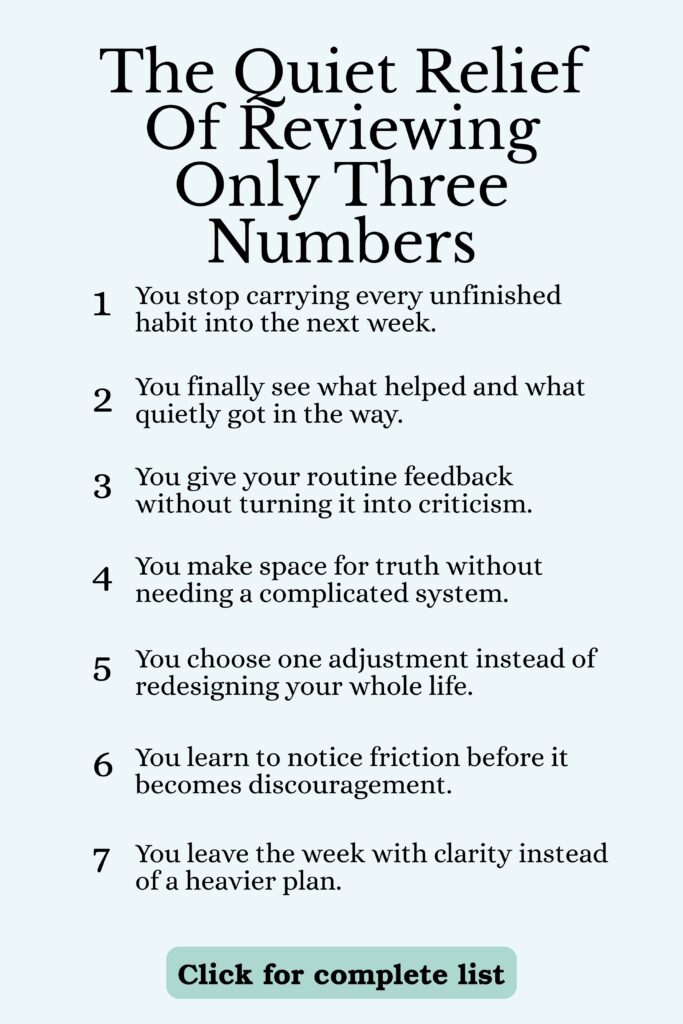
The heart of this method is choosing three numbers that tell the story of your week.
You do not need a perfect dashboard. You do not need every possible metric. You only need three numbers that show effort, outcome, and friction.
That combination is useful because effort alone can be misleading. You might work hard but get poor results because the strategy is wrong. Outcome alone can also be misleading because a good result might happen during an unusually easy week. Friction matters because it shows what is making the routine harder to repeat.
Think of the three numbers like this:
- Choose one effort number: This shows whether you showed up.
- Choose one outcome number: This shows whether the routine helped.
- Choose one friction number: This shows what got in the way.
For a workout routine, your three numbers might be:
- Workouts completed
- Average energy after workouts
- Skipped workout starts
For a work focus routine, they might be:
- Focus blocks completed
- Important tasks finished
- Distraction resets
For a meal routine, they might be:
If you want to get more from your life, and are looking for concrete action steps to get you there, check out our Request a Coach page. It’s a “cut the fence-sitting and take action” way to tackle your issues and actually find success. To get off the fence and start to take action, click or tap here.
- Simple meals made
- Takeout orders
- Times you had no plan at mealtime
The effort number should be something you can count easily. It might be the number of workouts, writing sessions, planning sessions, prepared lunches, or focused work blocks.
The outcome number should connect to the reason you care about the routine. If the goal is better mornings, the outcome might be on-time starts. If the goal is focus, it might be important tasks completed. If the goal is energy, it might be an average energy rating.
The friction number is the hidden gem. This is the number most people skip, but it often explains everything.
Friction might include:
- Late nights
- Skipped starts
- Distractions
- Missing supplies
- Unplanned spending
- Times you had to redo work
- Days you felt rushed
- Moments when the routine broke before it began
Keep each number simple enough to estimate honestly. You are not trying to run a research study. You are trying to get a clear snapshot of the week.
If a number takes too much work to find, choose a different one.
3. Set a Weekly Review Time That Is Too Easy to Avoid
A weekly review only works if it is easy enough to repeat.
This is where people often accidentally make the system too heavy. They create a long review ritual, add a journal prompt, build a spreadsheet, make a color code, and then wonder why they avoid it after two weeks.
If you want to get more from your life, and are looking for concrete action steps to get you there, check out our Request a Coach page. It’s a “cut the fence-sitting and take action” way to tackle your issues and actually find success. To get off the fence and start to take action, click or tap here.
For this method, the review should feel almost too simple.
You are going to write down three numbers, look at what they mean, and choose one small adjustment for next week. That is the whole process.
The best review time is one that fits naturally into your week. Sunday evening works for some people because it helps them prepare for Monday. Friday afternoon works for others because the workweek is still fresh. Monday morning can also work if you like reviewing the past week before planning the new one.
- Choose a repeatable weekly slot: Pick a time you can use most weeks, such as Sunday evening, Friday afternoon, or Monday morning.
- Keep the review under 10 minutes: If it feels like a big task, you will eventually avoid it.
- Attach it to something you already do: Pair it with coffee, calendar planning, a weekly reset, or a desk cleanup.
- Use the same place every week: Keep your review in one note, planner page, spreadsheet, or paper card.
- Lower the standard on busy weeks: A two-minute review is still better than skipping it.
The review does not need to look impressive. In fact, it probably should not.
A plain note on your phone can work. A single page in a planner can work. A tiny spreadsheet can work. A sticky note can work if that is what you will actually use.
What matters is that you do not have to set up the system every time you review.
Try using the same basic format each week:
- Effort:
- Outcome:
- Friction:
- What this tells me:
- One adjustment for next week:
That is enough.
If you want to get more from your life, and are looking for concrete action steps to get you there, check out our Request a Coach page. It’s a “cut the fence-sitting and take action” way to tackle your issues and actually find success. To get off the fence and start to take action, click or tap here.
The easier the review is to start, the more likely you are to keep doing it.
4. Score the Week Without Turning It Into a Judgment
Once you have your three numbers, the next step is to score the week without making it personal.
This is important because numbers can trigger a lot of unnecessary self-criticism. You might see “1 workout” and immediately think, “I am so inconsistent.” You might see “2 focus blocks” and decide you are bad at discipline.
That is not what this review is for.
The numbers are not a character report. They are information about how the routine performed in real life.
Start by writing the three numbers down before interpreting anything. Keep it factual. If you completed two workouts, write two. If you ordered takeout four times, write four. If you had three late nights that disrupted your mornings, write three.
Then look at the week around the numbers.
Was there a deadline? Did you travel? Were you tired? Did you have extra family responsibilities? Did your schedule change? Did something emotional or unexpected take up more energy than usual?
If you want to get more from your life, and are looking for concrete action steps to get you there, check out our Request a Coach page. It’s a “cut the fence-sitting and take action” way to tackle your issues and actually find success. To get off the fence and start to take action, click or tap here.
Context does not excuse everything, but it explains a lot.
- Write down the three numbers first: Start with the facts before adding a story.
- Compare the numbers to your real week: Notice what was happening around the routine.
- Look at how the numbers relate: Ask whether effort led to the outcome, or whether friction blocked the result.
- Avoid labeling the week as good or bad: The goal is to understand the routine, not judge yourself.
- Find one useful signal: You only need one insight that can guide next week.
For example, maybe your effort number was low because the routine depended on mornings, but your friction number shows four late nights. That does not mean you are lazy. It means the morning routine is being decided the night before.
Or maybe your effort number was high, but your outcome did not improve. That might mean you are working hard on the wrong part of the problem.
This is where the method becomes helpful. You are not asking, “Did I succeed or fail?”
You are asking, “What is this routine showing me?”
That question is much more useful.
5. Use the Numbers to Find the Weak Spot in Your Routine
After you score the week, look for the weak spot.
The weak spot is the part of the routine that keeps making follow-through harder than it needs to be. It is not always obvious until you compare the three numbers.
If you want to get more from your life, and are looking for concrete action steps to get you there, check out our Request a Coach page. It’s a “cut the fence-sitting and take action” way to tackle your issues and actually find success. To get off the fence and start to take action, click or tap here.
If your effort number is low, the routine might be too ambitious, too vague, or too easy to forget. If your outcome number is low even when effort is high, the routine may not be solving the right problem. If your friction number is high, your environment, schedule, or setup may be working against you.
This is why three numbers are more useful than one.
A single number tells you what happened. Three numbers can help you understand why it happened.
- Find the number that explains the week best: Look for the number that gives the clearest clue about the routine.
- Ask what made that number move: Identify the specific situation behind it, such as late nights, unclear priorities, missing supplies, or too many steps.
- Separate motivation problems from setup problems: Forgetting, avoiding, and running out of time often need different fixes.
- Watch for repeated patterns: One weird week may not mean much, but the same number repeating for three weeks deserves attention.
- Choose one weak spot only: Do not turn every insight into a new rule.
For example, if your goal is to do three focused work blocks each week, your numbers might look like this:
- Effort: 2 focus blocks
- Outcome: 3 important tasks finished
- Friction: 5 distraction resets
That tells you the routine is partly working, but distractions are making it harder. The weak spot is probably not your desire to focus. It may be your start routine, phone placement, notification settings, or the way you choose tasks.
Or maybe your numbers look like this:
- Effort: 4 workouts
- Outcome: Low energy most days
- Friction: 4 nights of poor sleep
In that case, the workout routine might not be the main issue. Sleep may be limiting the outcome.
The weak spot is where your next adjustment should go.
If you want to get more from your life, and are looking for concrete action steps to get you there, check out our Request a Coach page. It’s a “cut the fence-sitting and take action” way to tackle your issues and actually find success. To get off the fence and start to take action, click or tap here.
6. Make One Small Adjustment for Next Week
The weekly review is only useful if it changes something.
But the change should be small. Very small. Smaller than your ambition wants it to be.
This is where people often overcorrect. They see a disappointing week and create a huge new plan. They add stricter rules, more tracking, earlier wakeups, longer workouts, meal prep, a new planner, and a promise that next week will be different.
That can feel motivating for a few hours. It usually does not last.
A better move is to make one small adjustment based on what the numbers showed you.
- Pick one change based on the numbers: Let the review tell you where to adjust.
- Make the adjustment smaller than your ambition: Choose something repeatable, not something dramatic.
- Protect the routine from the main friction: Fix the thing that keeps interrupting the routine.
- Write the adjustment as a clear action: Make it specific enough that you know exactly what to do.
- Review the adjustment next week: See whether it helped before adding another change.
If your effort number was low, your adjustment might be to reduce the target. Instead of four workouts, aim for two. Instead of writing five days, aim for three short sessions. Instead of planning every meal, plan only lunches.
If your friction number was high, your adjustment might be environmental. Put your phone in another room. Lay out workout clothes the night before. Decide tomorrow’s first task before ending work. Keep simple meal ingredients visible.
If your outcome number did not improve, your adjustment might be strategic. Maybe you need a different type of workout, a clearer work priority, a simpler morning routine, or a better definition of what progress means.
If you want to get more from your life, and are looking for concrete action steps to get you there, check out our Request a Coach page. It’s a “cut the fence-sitting and take action” way to tackle your issues and actually find success. To get off the fence and start to take action, click or tap here.
A good weekly adjustment sounds like this:
- “Next week, I will do one focused work block before checking messages on Monday, Wednesday, and Friday.”
- “Next week, I will lay out workout clothes before bed on two nights.”
- “Next week, I will plan three easy lunches before grocery shopping.”
- “Next week, I will choose my top three work priorities every Monday morning.”
One adjustment is enough.
The point is not to redesign your life every week. The point is to make the routine slightly easier to repeat.
7. Example 3-Number Reviews for Different Goals
The easiest way to understand this method is to see how it looks in real life.
The three numbers will change depending on the goal, but the structure stays the same. You need one effort number, one outcome number, and one friction number.
For a workout routine, your review might be:
- Effort: Workouts completed
- Outcome: Average energy after workouts
- Friction: Skipped starts
If you completed one workout, felt better afterward, and skipped three planned starts, the issue may not be the workout itself. The issue may be getting started. Next week’s adjustment could be making the first step easier, such as changing clothes right after work or doing a 10-minute version.
For work focus, your review might be:
If you want to get more from your life, and are looking for concrete action steps to get you there, check out our Request a Coach page. It’s a “cut the fence-sitting and take action” way to tackle your issues and actually find success. To get off the fence and start to take action, click or tap here.
- Effort: Focus blocks completed
- Outcome: Important tasks finished
- Friction: Distraction resets
If you completed four focus blocks but only finished one important task, the weak spot may be task selection. You might be focusing, but not on the right work. Next week, your adjustment could be choosing the task before the focus block begins.
For easier mornings, your review might be:
- Effort: Night-before prep completed
- Outcome: On-time starts
- Friction: Late nights
This kind of review can quickly show whether the morning problem actually starts at night. If late nights are high, adding more morning motivation may not help. You may need a smaller evening reset instead.
For meals, your review might be:
- Effort: Simple meals made
- Outcome: Takeout orders avoided
- Friction: No-plan mealtimes
If the friction number is high, the problem may not be cooking skill or discipline. It may be decision fatigue. Next week’s adjustment could be choosing three fallback meals before the week begins.
For a personal project, your review might be:
- Effort: Work sessions completed
- Outcome: Visible progress made
- Friction: Avoidance moments
If avoidance is high, the next step may be too unclear. Your adjustment could be writing the first tiny step before each session.
These examples show the point of the system: you are not tracking to collect numbers. You are tracking to find the next useful adjustment.
If you want to get more from your life, and are looking for concrete action steps to get you there, check out our Request a Coach page. It’s a “cut the fence-sitting and take action” way to tackle your issues and actually find success. To get off the fence and start to take action, click or tap here.
8. How a Goal Setting Coach Could Help You Use This Better
You can absolutely use the 3-number weekly review on your own.
But if you are working with a goal setting coach, productivity coach, life coach, or organizational coach, this framework can become even more useful. A coach can help you choose better numbers, interpret patterns, and turn the review into realistic next steps.
This is especially helpful if you tend to overcomplicate goals or blame yourself too quickly when a routine does not stick.
A coach can help you slow down and ask better questions.
- Clarify which numbers actually matter: A coach can help you choose numbers that reflect the real goal, not just the easiest thing to count.
- Spot patterns you might normalize: You may overlook repeated friction because it feels like “just how life is.”
- Turn numbers into next steps: A coach can help you move from insight to action without overthinking it.
- Keep the system from becoming too complicated: If you start adding too many rules, a coach can bring the review back to the simple version.
- Support follow-through without shame: The review becomes a practical check-in, not a weekly self-criticism session.
For example, you might think your problem is discipline because you keep skipping a writing goal. A coach might notice that your effort number drops every week you have unclear next steps. The issue may not be discipline. It may be decision-making.
Or you might think you need a stricter schedule, but your friction number shows that your current schedule is already overloaded. A coach could help you design a smaller routine that fits your actual capacity.
The value of coaching is not that someone forces you to follow the plan. The value is having someone help you understand why the plan is not working yet.
That distinction matters.
If you want to get more from your life, and are looking for concrete action steps to get you there, check out our Request a Coach page. It’s a “cut the fence-sitting and take action” way to tackle your issues and actually find success. To get off the fence and start to take action, click or tap here.
A good coach will not just ask, “Did you do it?” They will help you ask:
- What made it easier?
- What made it harder?
- What pattern keeps repeating?
- What is the smallest useful adjustment?
- What would make this routine easier to continue?
That is exactly what the 3-number review is designed to reveal.
9. What to Do When the Numbers Look Bad
Some weeks, the numbers will look bad.
That does not mean the method failed. It usually means the method is doing its job.
Bad numbers are not fun to see, but they can be very useful. They show you where the routine breaks when life gets busy, stressful, unpredictable, or simply normal.
The mistake is treating bad numbers like a verdict.
If you see a low effort number, you might assume you did not care enough. If you see a poor outcome number, you might assume the goal is not working. If you see a high friction number, you might feel like everything is too messy to fix.
Pause before you make that leap.
If you want to get more from your life, and are looking for concrete action steps to get you there, check out our Request a Coach page. It’s a “cut the fence-sitting and take action” way to tackle your issues and actually find success. To get off the fence and start to take action, click or tap here.
- Assume the system needs adjusting first: Low numbers may mean the routine is too big, too vague, or poorly timed.
- Check whether the goal fits your current season: A routine that worked last month may not fit this week’s schedule.
- Reduce the scope before quitting: Shrink the routine until it becomes repeatable again.
- Keep one number stable for another week: Do not change everything at once if you still need clearer information.
- Use bad weeks as data points: The weeks that go sideways often reveal the most important clues.
For example, if your goal was three workouts and you did zero, that might feel discouraging. But your friction number may show that you had four nights of poor sleep and two late workdays. That tells you something practical. The workout plan may need a different time, a shorter version, or a recovery-based option.
If your work focus numbers look bad, maybe the issue was not focus. Maybe your week had too many meetings and no protected time. That points to a calendar adjustment, not a personality flaw.
When the numbers look bad, ask:
- What made this week harder than usual?
- Was the target realistic?
- Did the routine have a clear starting point?
- Did I depend on motivation at the hardest moment?
- What would make the next attempt easier?
A bad week does not mean you need to start over.
It means you have better information than you had before.
10. Make the Review Visual Enough to Understand Fast
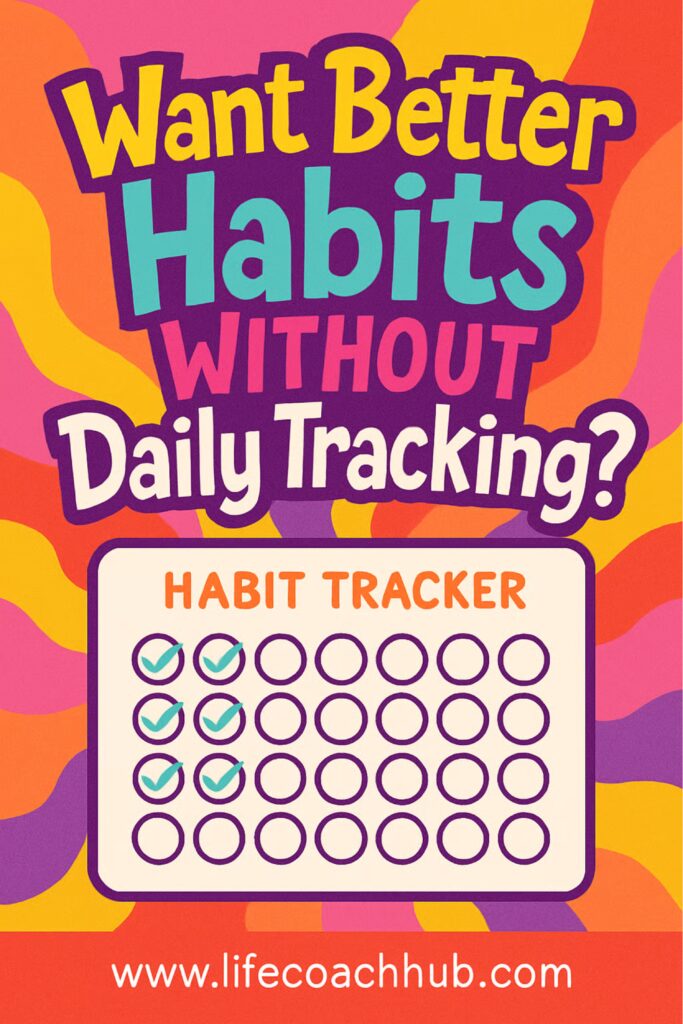
The 3-number weekly review should be easy to see at a glance.
This does not mean you need a beautiful tracker. In fact, making it too decorative can backfire. If the system becomes something you have to design, update, and maintain, it can turn into the exact kind of habit tracker you were trying to avoid.
The visual part should support clarity, not perfection.
If you want to get more from your life, and are looking for concrete action steps to get you there, check out our Request a Coach page. It’s a “cut the fence-sitting and take action” way to tackle your issues and actually find success. To get off the fence and start to take action, click or tap here.
A simple three-column layout works well because it lets you compare effort, outcome, and friction without reading through a long journal entry. You can use a notebook, digital note, spreadsheet, whiteboard, or printable page.
Try a format like this:
- Effort:
- Outcome:
- Friction:
- Main signal:
- One adjustment:
That is enough for most weeks.
You can also add a simple arrow next to each number:
- Up
- Down
- Same
This helps you see direction over time. If your effort number is slowly rising, that matters. If your friction number keeps rising too, that matters as well. The pattern is often more useful than a single week.
- Use a simple three-column layout: Put effort, outcome, and friction side by side.
- Add a weekly arrow: Mark each number as up, down, or steady compared with last week.
- Highlight the number that explains the week: Circle, bold, or underline the clearest signal.
- Keep notes short and specific: Use one sentence to explain what happened.
- Make the page visually boring on purpose: The less effort it takes to maintain, the better.
Your notes might be as simple as:
“Late nights made mornings harder.”
“Phone away helped focus.”
If you want to get more from your life, and are looking for concrete action steps to get you there, check out our Request a Coach page. It’s a “cut the fence-sitting and take action” way to tackle your issues and actually find success. To get off the fence and start to take action, click or tap here.
“Meal plan was too ambitious.”
“Two workouts felt doable.”
“Task list was unclear before starting.”
Those short notes are powerful because they keep the review from becoming vague. You do not need to write a full reflection unless you want to. You only need enough detail to help next week’s adjustment make sense.
A good visual review should answer the question quickly:
What is working, what is getting in the way, and what needs to change next?
A Routine You Can Actually Keep Reviewing
The best tracking system is not the one that captures every detail.
It is the one you will actually use when life is full, busy, and imperfect.
If you want to get more from your life, and are looking for concrete action steps to get you there, check out our Request a Coach page. It’s a “cut the fence-sitting and take action” way to tackle your issues and actually find success. To get off the fence and start to take action, click or tap here.
That is why the 3-number weekly review works. It does not ask you to become a daily tracker. It does not require you to log every habit, rate every mood, or keep a perfect streak. It simply asks you to pause once a week and look at three useful signals.
Those signals help you understand your routine without overcomplicating it.
One number shows whether you showed up. One number shows whether the routine helped. One number shows what got in the way.
Together, they give you enough information to make a better decision.
That decision does not need to be dramatic. Most of the time, the best next step is small. Move the routine to a better time. Lower the target. Remove one obstacle. Prepare one thing in advance. Make the first step easier. Choose the next task before you sit down.
Small adjustments are not a downgrade. They are how routines become repeatable.
The weekly review also helps you stop treating every inconsistent week like a personal failure. When you can see the numbers, you can ask better questions. Was the plan too big? Was the timing wrong? Was the outcome realistic? Did the friction start earlier than you thought?
That is much more useful than simply telling yourself to try harder.
If you want to get more from your life, and are looking for concrete action steps to get you there, check out our Request a Coach page. It’s a “cut the fence-sitting and take action” way to tackle your issues and actually find success. To get off the fence and start to take action, click or tap here.
You do not need a perfect habit tracker to make progress. You need a way to notice what is happening and respond before the routine falls apart completely.
So choose one routine. Pick three numbers. Review them once a week. Make one adjustment.
That is enough to start seeing whether your routine is actually working.
*****
Want to try this at home? No worries! Download a copy of our SMART Goals PDF Worksheet.
Need some in depth help with goal settings, motivation or productivity ? Drop on by our directories choc full of productivity coaches, accountability coaches, and goal-setting coaches, and start reaching those goals! Or click here to have us match you to the best.
If you want to get more from your life, and are looking for concrete action steps to get you there, check out our Request a Coach page. It’s a “cut the fence-sitting and take action” way to tackle your issues and actually find success. To get off the fence and start to take action, click or tap here.
Read this next

You Become What You Believe
Life coaching quote of the day: You become what you believe. If you want to get more from your life, and are looking for concrete action steps to get you […]
Read More
Vision Board Ideas That Actually Help You Stay Focused on Your Goals
Try these vision board ideas that make goal setting feel clearer, calmer, and way easier to stick with every day.
Read More
Building Mental Toughness
Build real mental toughness with simple shifts that train discipline, confidence, and follow-through when motivation fades.
Read More