








I Lost 10 Pounds and Read More Books by Tracking These Two Things
“If you can’t measure it, you can’t manage it.”
-Peter Drucker
What Do You Want to Change?
I hopped on the scale and saw a number a bit smaller than it was before. I looked myself up and down in the mirror, and I could see some noticeable differences. As I got dressed, my clothes weren’t as snug. Since the beginning of this year, I’ve lost about 10 pounds. I’ve shed the post-wedding “I’ll be eating whatever I want today because I’m a newlywed” weight, which was definitely the goal. Now that I’m at a weight that I’m comfortable walking around at, I’ve taken the time to reflect on what got me here.
Over the course of the year, I’ve been on what you might call a “crusade of change.”
- I’ve invested more time in reading and learning
- I’ve made more conscious efforts in my health and fitness (hence the 10 pound drop)
- I do my best to incorporate practices into my life that improve its quality.
Prior to this year, I was completely content on resting on my laurels of “I’m a pretty good, likable guy who does his best.” Not terrible laurels to rest on, but I had this inkling that I could improve myself and be a better man.
- Maybe it was a natural maturation that led me to that breaking point of wanting to be and do more.
- Maybe it was the impression that being a married man left on me; the sense of duty towards my wife to be the best I could for our new family.
I’d guess more of the latter, but I’m grateful for whatever helped me arrive at that point. Still, though, those reasons cover the why I have wanted change, but what about the how?
Key Takeaways
- Start with a baseline. Record what is happening now before choosing a target. A real starting point turns “do better” into a change you can compare.
- Measure actions and outcomes. Track both the result you want and the repeatable behaviors that influence it, such as weight and logged meals, or savings and recorded spending.
- Review patterns, not isolated numbers. One missed workout, expensive week, or higher weigh-in says little by itself. A consistent review schedule reveals whether the plan is working.
- Adjust one variable at a time. When progress stalls, confirm the data, check whether the actions happened, then change one meaningful part of the plan and review again.
- Use observable evidence for subjective goals. Confidence, gratitude, and connection are difficult to count directly, but specific behaviors, feedback, and simple ratings can show whether they are changing.
How Do You Measure Progress Toward a Goal?
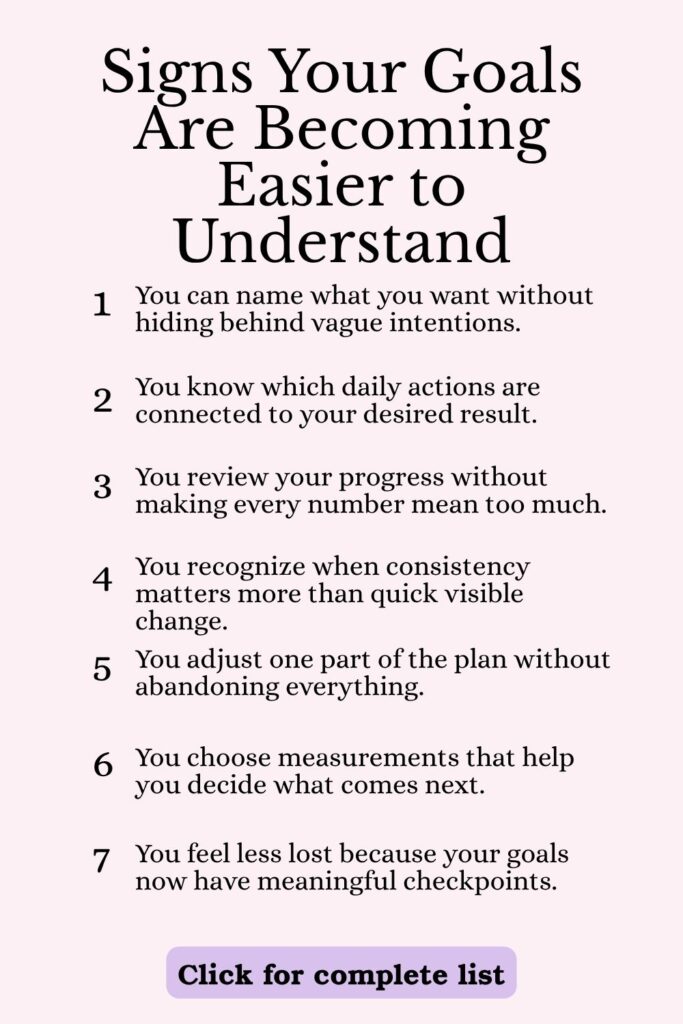
You measure progress by defining the result you want, recording your starting point, and choosing a few actions and outcomes to track. Record them in the same way over a set period, then review the pattern and decide whether to continue, adjust, or replace the plan.
A useful measurement does more than tell you what happened. It helps you decide what to do next. If your savings total stays flat, for example, your spending records should help you see whether restaurants, subscriptions, or unplanned purchases are responsible.
If you want to get more from your life, and are looking for concrete action steps to get you there, check out our Request a Coach page. It’s a “cut the fence-sitting and take action” way to tackle your issues and actually find success. To get off the fence and start to take action, click or tap here.
A 2016 meta-analysis by Benjamin Harkin and colleagues reviewed 138 studies involving 19,951 participants. The researchers found that interventions designed to increase progress monitoring also improved goal attainment, with stronger effects when progress was physically recorded or reported to others.
What Is Your Starting Baseline?
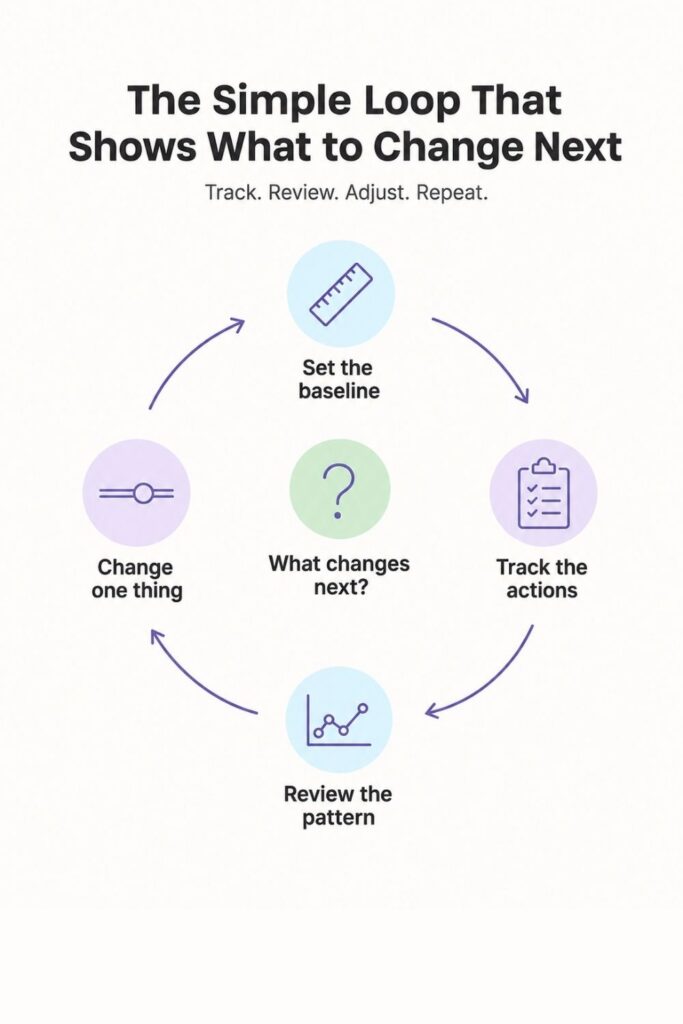
Your baseline is a clear record of what is happening before you change the plan. Without it, you may know that you improved, but you will not know how much changed or which action produced the difference.
A useful baseline answers three questions:
- What is happening now? Record the current behavior or result.
- What should change? Choose a specific target.
- When will you review it? Set a date or measurement period.
Suppose you want to watch less television. Before cutting your viewing time, record seven ordinary evenings. You may discover that you watch one hour on work nights but four hours on Friday and Saturday. That gives you a more useful target than guessing that you watch “too much.”
The same approach works with money. Categorize one month of spending before creating a strict budget. If most of the unnecessary spending comes from delivery meals rather than shopping, you know where the first adjustment belongs.
A goal-setting coach might help a client separate an actual baseline from a rough impression. “I hardly ever exercise” may turn out to mean one long walk each weekend, which is a starting behavior that can be expanded rather than ignored.
How Do You Want to Change?
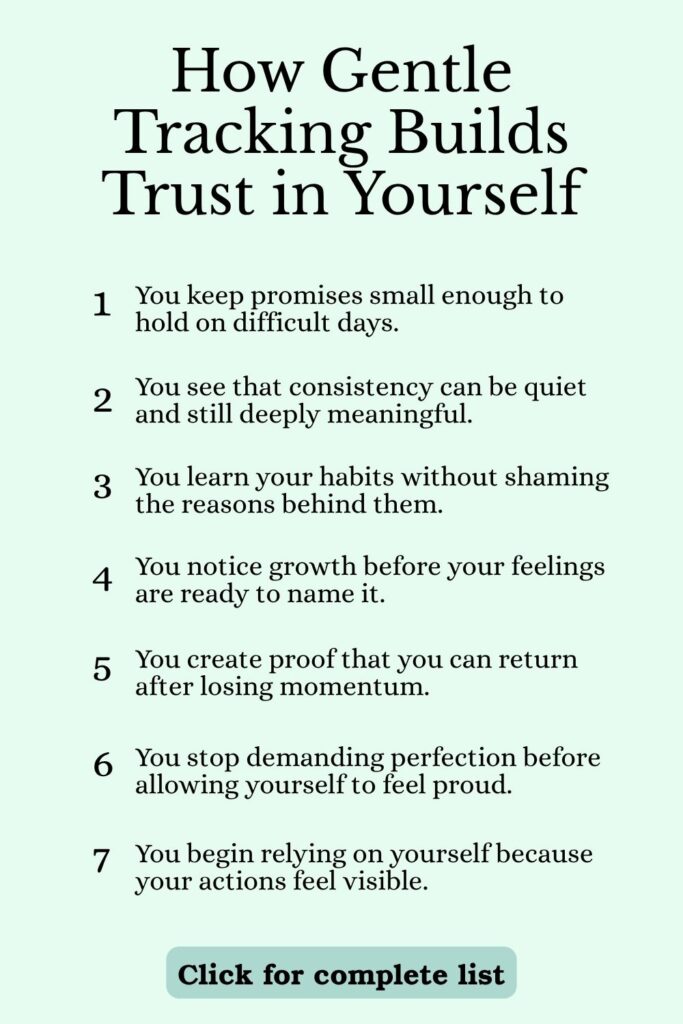
What I think it comes down to is this: I found things that I could measure and put them into action.
If I would have said, “I’d like to lose some weight” or “I want to be a better man” and left it at that, I don’t think I would have made much progress.
If you want to get more from your life, and are looking for concrete action steps to get you there, check out our Request a Coach page. It’s a “cut the fence-sitting and take action” way to tackle your issues and actually find success. To get off the fence and start to take action, click or tap here.
In terms of weight, I knew I wanted to get back to my pre-wedding weight of about 185 pounds. That’s a concrete number. From that number, I could devise a plan to incrementally work towards it. This took a different meaning in each stage of the weight loss mission. It started with tracking my calorie intake and my macronutrient ratios. I diligently used MyFitnessPal to measure how much I was taking in each day.
Weight loss is about burning more calories than you consume, so by tracking my intake, I was ensuring that I knew exactly what I was taking into my body. If I wasn’t losing weight, or if I hit a plateau, I could experiment a bit and try to find a breakthrough.
Without the knowledge of the information I was measuring, I wouldn’t know what to adjust or change. The second piece that I incorporated into my attempt at losing weight was an increase in cardio. More specifically, I began training for a half-marathon (Mr. Matiash Goes Running), so I started running three times a week. Up until that point, I had relied heavily on anaerobic training with weights and sprints. Increasing the amount of aerobic training, both in time and distance, allowed my body to burn more calories. This extra burn produced more weight loss. Each time I ran I used the MapMyRun app to measure my distance, time and progress. The combination of tracking my calorie/macronutrient intake and tracking my half-marathon training have provided a perfect storm of progress reports that have kept me driven to keep moving in the direction that I am. In both cases, I can clearly see how much has changed and how much growth has occurred.
A 2011 systematic review by Lora E. Burke, Jing Wang, and Mary Ann Sevick examined 22 behavioral weight-loss studies involving the self-monitoring of diet, physical activity, or body weight. The review found evidence connecting these forms of self-monitoring with weight-loss outcomes, although the authors noted limitations in the designs of the available studies.
Health and fitness aren’t the only categories of life that we can measure, though. I also wanted to read more so that I could develop some weaknesses and further strengthen some things I am already good at. Again, if I addressed that goal with an ambiguous phrase like, “I’d like to read more,” I would’ve stalled out long ago. Instead, I chose to set the goal of finishing three books every month. This gave me a clear number to shoot for, and something I could measure against. Every month since then I have hit my goal, with the exception of October (I bit off more than I could chew there. I tried to read Tony Robbins’ Money: Master The Game, which is 500-600 pages, along with two other lengthy books).
Are You Measuring the Result or the Actions?
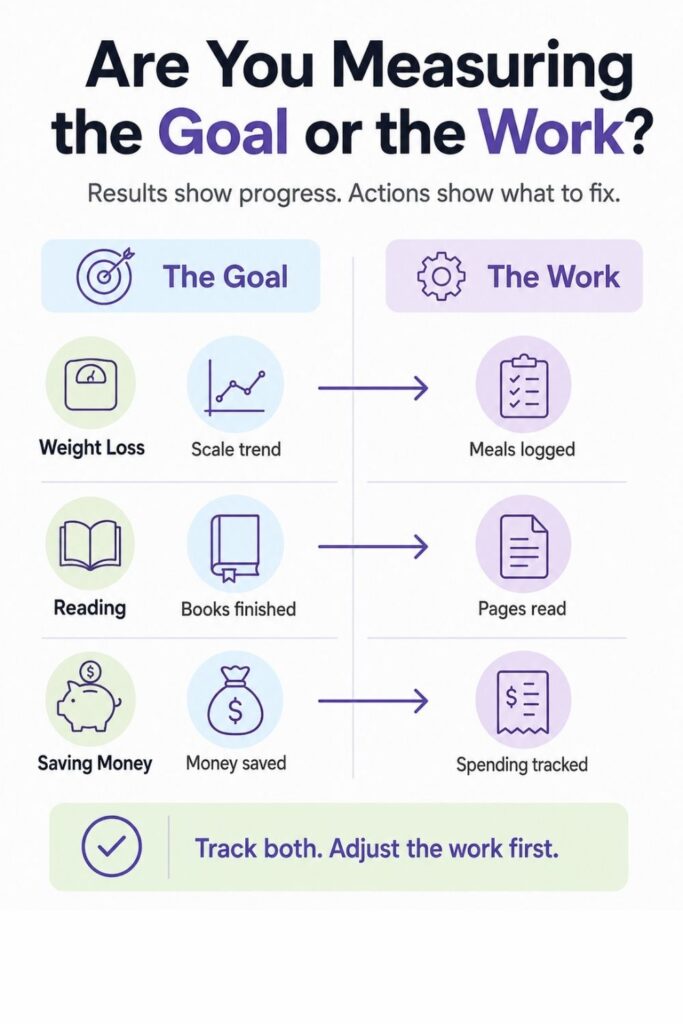
You need to measure both the result you want and the actions you can control. The result shows whether you are moving in the right direction. The actions show whether you are following the plan that is supposed to get you there.
For weight loss, the result might be your average weekly weight. The actions might include meals logged, planned workouts completed, or miles run.
For reading, books completed is a result. Pages read or minutes spent reading are actions. This distinction matters when one book is 180 pages and another is nearly 600. Missing a three-book target may reflect the books you selected rather than a drop in effort.
If you want to get more from your life, and are looking for concrete action steps to get you there, check out our Request a Coach page. It’s a “cut the fence-sitting and take action” way to tackle your issues and actually find success. To get off the fence and start to take action, click or tap here.
The same pattern appears in other goals:
- Saving money: Track the amount saved and the number of planned transfers completed.
- Watching less television: Track total viewing time and the number of evenings kept within your limit.
- Improving a relationship: Track your partner’s feedback and the intentional actions you completed.
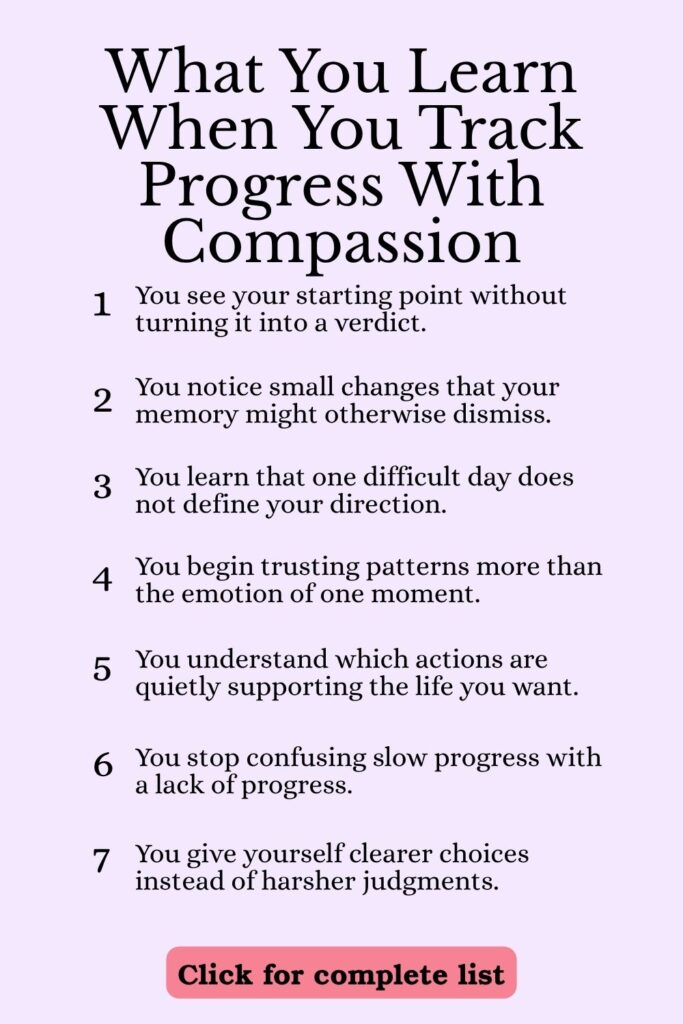
This combination also gives you a fairer way to interpret slow progress. If your actions are consistent but the result is moving slowly, the plan may need more time or a strategic adjustment. If the actions are not happening, the first problem is execution.
A 2011 systematic review by Lora Burke, Jing Wang, and Mary Ann Sevick examined self-monitoring of diet, exercise, and body weight across 22 behavioral weight-loss studies. The review found that more consistent self-monitoring was generally associated with better weight-loss outcomes, although the authors also noted limitations in the available study designs.
An accountability coach may review the action measurements before discussing the final result. That keeps one disappointing number from erasing the work that was completed and makes the next decision more specific.
How Do You Set Measurable Goals?
The list of things that you can numerate and measure is lengthy.
- Do you want to make sure your wife knows that you love her? Instead of saying “I’d like to show my wife love”, say “I’m going to do (insert kind and loving act) for my wife at least once every day.” Now you have a measuring system. You can give yourself a pass/fail at the end of the day based on your results.
- Would you like to save more money instead of spending it on things you never use? Create a budget and measure your spending habits over the next month or so to see if you’ve measured up to your new plan.
- Would you like to watch less TV so you have more time for the important things in life? Measure how much time you watch TV now, then set a goal to decrease that amount incrementally. If you watch 3 hours a night now, shoot for 2 hours a night next week. Track your progress and see where it goes from there.
As soon as you have information and statistics regarding your progress, you can chart the best course of action to reach your goals.
How Often Should You Review Your Progress?
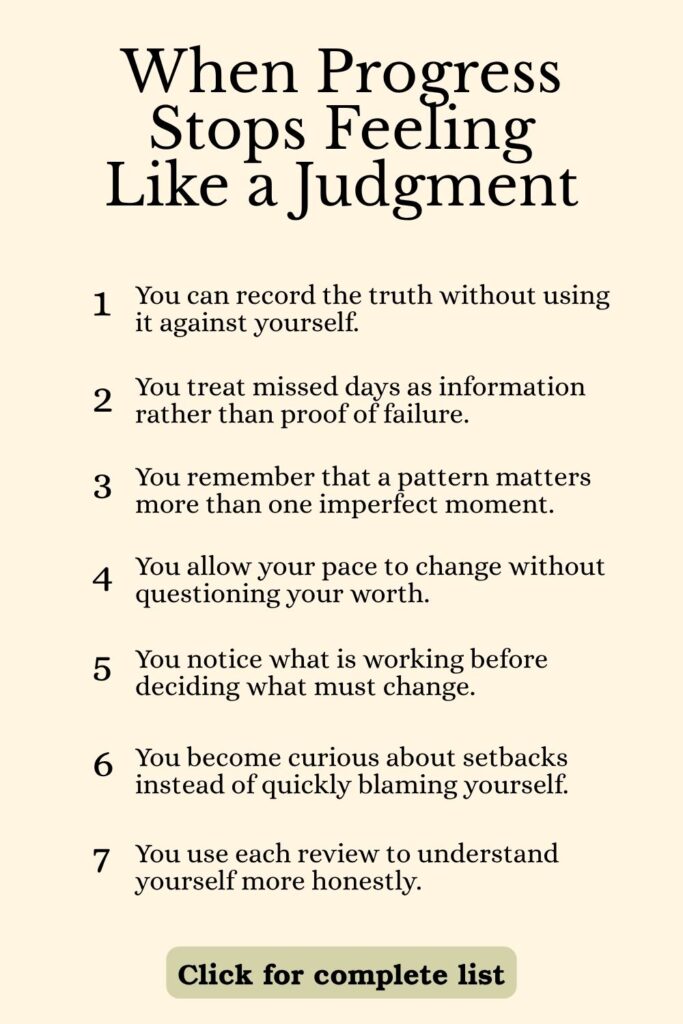
Record actions frequently, but review results on a schedule that matches how quickly they can meaningfully change. Looking too rarely allows problems to continue. Looking too often can make normal fluctuations feel like major setbacks.
A practical review schedule might look like this:
- Daily: Record meals, exercise, spending, reading, or screen time.
- Weekly: Check whether the planned actions were completed consistently.
- Monthly: Review larger outcomes such as weight trends, savings, books completed, or hours recovered.
- At a milestone: Evaluate the complete plan after a training phase, spending cycle, or defined personal experiment.
The measurement period matters. One higher weigh-in does not establish a weight trend. One expensive grocery trip does not prove that the monthly budget has failed. One missed reading session does not cancel three consistent weeks.
If you want to get more from your life, and are looking for concrete action steps to get you there, check out our Request a Coach page. It’s a “cut the fence-sitting and take action” way to tackle your issues and actually find success. To get off the fence and start to take action, click or tap here.
Look for repeated patterns. If you miss the same workout every Thursday, Thursday may be poorly scheduled. If restaurant spending rises every weekend, the problem may be the absence of a weekend plan rather than a lack of discipline.
A coach might use a weekly review built around five questions:
- What did you plan to do?
- What did you actually do?
- What pattern is appearing?
- What should remain unchanged?
- What is the smallest useful adjustment?
That turns accountability into a decision process rather than a pass-or-fail judgment.
What Should You Change When Progress Stalls?
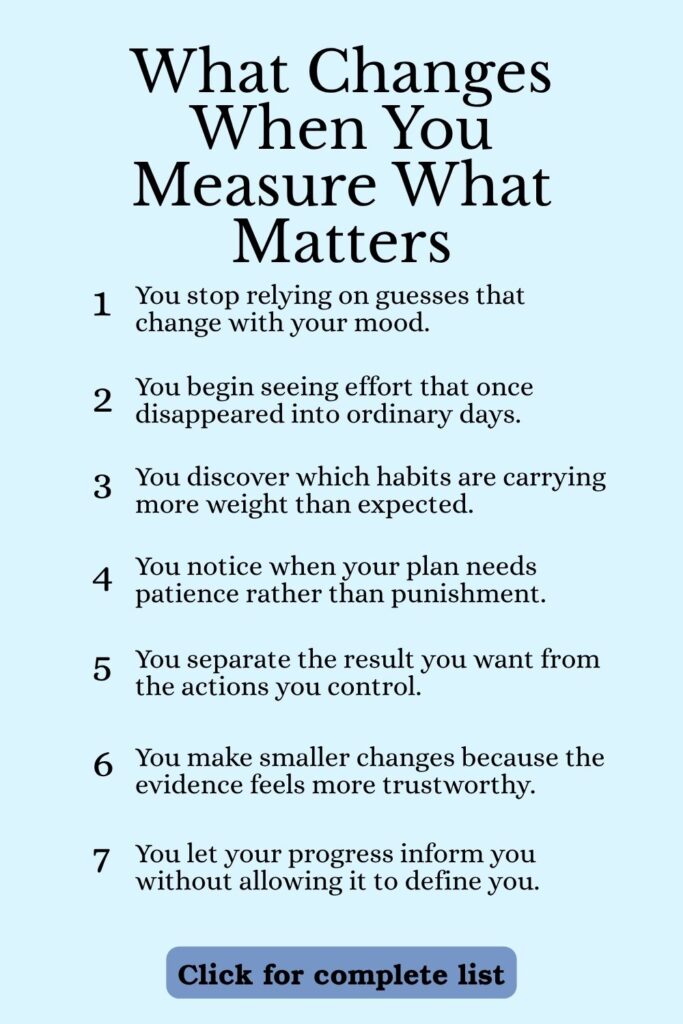
When progress stalls, confirm the measurements and completed actions before changing the plan. A plateau does not automatically mean that the goal is unrealistic or that every part of the method has failed.
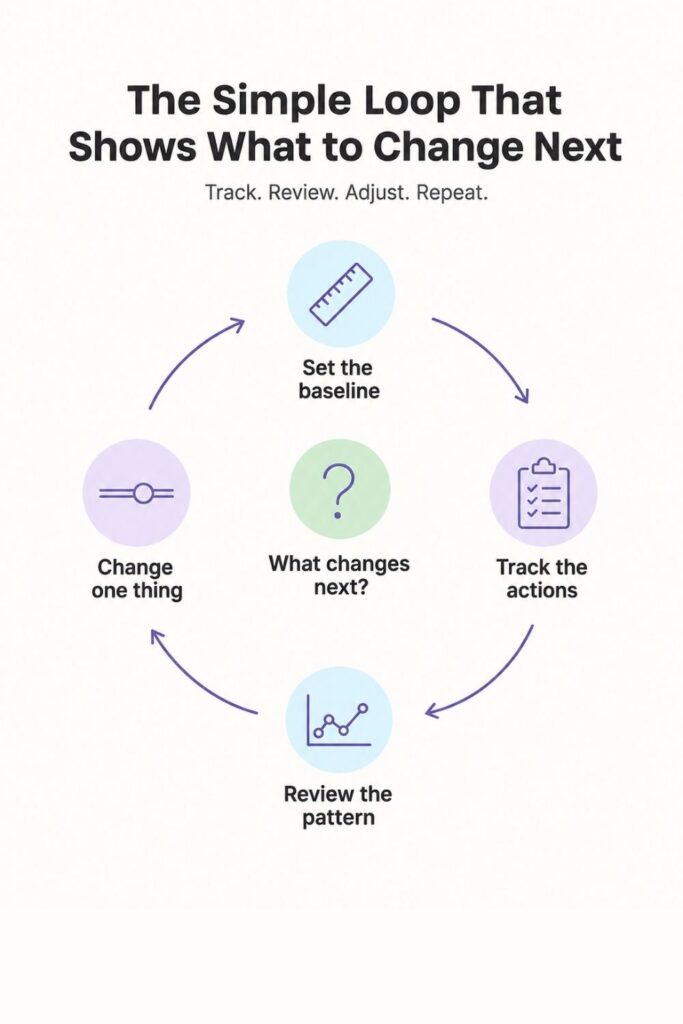
Use a simple adjustment process:
- Check the data. Make sure measurements were recorded consistently.
- Check the actions. Compare what was planned with what actually happened.
- Review the trend. Look beyond one difficult day or week.
- Choose one variable. Change the factor most likely to matter.
- Keep the rest stable. Avoid rebuilding the entire plan at once.
- Review again. Give the adjustment a defined test period.
Suppose you are trying to finish three books per month. You consistently read for 30 minutes each evening, but you complete only two books. The action is happening. The problem may be that book count is a poor measurement when the books vary dramatically in length.
You could switch the outcome to pages completed, chapters completed, or total reading hours. That preserves the useful habit while improving the measurement.
A budget plateau needs the same kind of diagnosis. If you repeatedly exceed your “food” budget, divide that category into groceries, restaurants, coffee, and delivery. The larger category may be hiding the decision that needs to change.
If you want to get more from your life, and are looking for concrete action steps to get you there, check out our Request a Coach page. It’s a “cut the fence-sitting and take action” way to tackle your issues and actually find success. To get off the fence and start to take action, click or tap here.
Change one variable when possible. If you cut calories, double your running distance, change your sleep schedule, and add another workout at the same time, you will not know which change helped or which one created a new problem.
A performance or career coach may help a client distinguish an execution problem from a strategy problem. Role-play, feedback, and short experiments can test a new approach without discarding the entire goal.
How Do You Measure What Seems Immeasurable?
Alright, so if I’m being honest here, there are some things that you either can’t measure or are too complex to try and measure.
- It’s hard to measure how much confidence you have. You can certainly feel how much confidence you have, but it’s hard to put a number on it.
- It’s equally hard to measure love, hate, gratitude or indifference.
These traits and characteristics, however, are byproducts of the action you took towards your measurable goals. By losing weight and getting healthy, chances are your confidence will rise. By showing your wife love every day through conscious and measurable action, you and your wife will likely feel a noticeable difference in the love shared between the two of you.
The things that you can’t measure are simply a result of things that you can measure. There are so many things that you can construct a measurable and actionable plan around. If you can attach these measurements to a goal, you are certain to see the progress (or lack thereof in some cases) you’ve created. Through this progress report, you can adjust, pivot, and try something else if need be.
Which Observable Behaviors Can Stand In for an Immeasurable Quality?
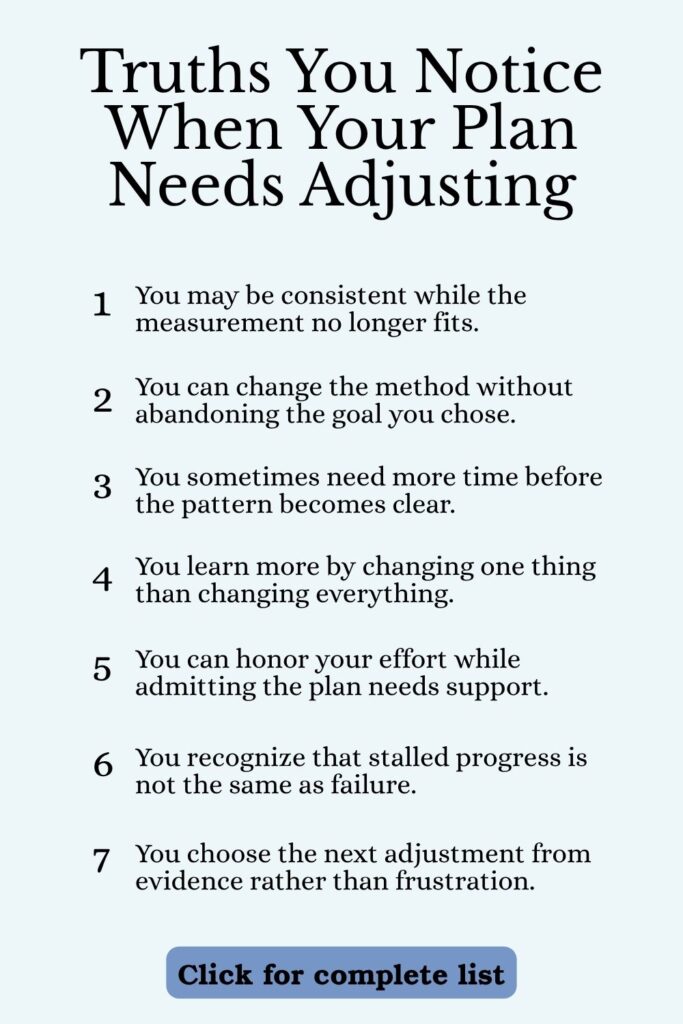
Subjective qualities become easier to assess when you track behaviors that would be visible if the quality were growing. The behaviors are not perfect measurements of confidence, love, or gratitude. They are evidence you can examine.
Confidence can be tracked through action.
You might record whether you spoke during a team meeting, initiated a difficult conversation, applied for a position, or made a clear request. You can also rate your anticipated discomfort before the action and compare it with what you experienced afterward.
Someone who reports feeling no more confident but has spoken in four consecutive meetings has still produced evidence of change. The feeling may be developing more slowly than the behavior.
If you want to get more from your life, and are looking for concrete action steps to get you there, check out our Request a Coach page. It’s a “cut the fence-sitting and take action” way to tackle your issues and actually find success. To get off the fence and start to take action, click or tap here.
Relationship connection needs feedback as well as effort.
Counting loving actions can be useful, but completion alone does not show whether your spouse felt supported. Add observable evidence such as intentional conversations, repaired disagreements, clearly expressed appreciation, and direct feedback about what felt meaningful.
A relationship coach might help a couple replace a vague goal like “be closer” with a weekly conversation, one specific request from each partner, and a brief review of what helped them feel heard.
Gratitude can be linked to specific practices.
You might track gratitude entries, thank-you messages, or positive events you deliberately noticed. A weekly rating becomes more useful when you support it with examples rather than choosing a number from memory.
The goal is not to turn every feeling into a spreadsheet. It is to identify enough evidence to tell whether your actions are creating the kind of change you intended.
Frequently Asked Questions About Measuring Progress
How do you measure progress toward a goal?
Measure progress by recording a baseline, choosing a specific outcome, tracking the actions that influence it, and reviewing the results on a consistent schedule. The measurements should help you decide whether to continue or adjust the plan.
What is the difference between a measurable goal and a vague goal?
A measurable goal defines observable evidence of completion or improvement. “Read more” is vague, while “read for 30 minutes five evenings per week” identifies an action you can record.
What are some examples of measurable personal goals?
Measurable personal goals include saving $200 each month, walking three times per week, reading 20 pages each day, or limiting television to two hours per evening. Each goal identifies a number, behavior, or review period.
What is the difference between an outcome measurement and an action measurement?
An outcome measurement tracks the result, while an action measurement tracks the behavior intended to produce it. Weight lost is an outcome. Workouts completed and meals logged are actions.
If you want to get more from your life, and are looking for concrete action steps to get you there, check out our Request a Coach page. It’s a “cut the fence-sitting and take action” way to tackle your issues and actually find success. To get off the fence and start to take action, click or tap here.

How often should you track your progress?
Track repeatable actions daily or whenever they occur, then review patterns weekly or monthly. Slower outcomes, such as savings or weight changes, usually become clearer across a longer period.
What should you do when you are working consistently but not seeing results?
Review whether the selected actions are capable of producing the result, then change one meaningful variable. Keep the other parts of the plan stable long enough to judge whether the adjustment helped.
Can confidence, love, or personal growth be measured?
Confidence, love, and personal growth can be assessed through observable behaviors, feedback, and supported self-ratings. These measurements do not capture the entire quality, but they provide evidence that change is or is not becoming visible.
Can tracking goals become counterproductive?
Goal tracking becomes counterproductive when recording data takes more effort than acting on it or when every fluctuation triggers a major change. Reduce the number of measurements and keep only those that influence a real decision.
Don’t let your goals overwhelm you. Break them down into small measurements that you can take some realistic action on. You are in control of where you want to go, but you’re going to need some checkpoints along the way. Without them, you’re a hopeless wanderer.
Sources
Harkin, Benjamin, Thomas L. Webb, Betty P. I. Chang, Andrew Prestwich, Mark Conner, Ian Kellar, Yael Benn, and Paschal Sheeran. “Does Monitoring Goal Progress Promote Goal Attainment? A Meta-Analysis of the Experimental Evidence.” Psychological Bulletin, vol. 142, no. 2, 2016, pp. 198–229. Free author manuscript.
Burke, Lora E., Jing Wang, and Mary Ann Sevick. “Self-Monitoring in Weight Loss: A Systematic Review of the Literature.” Journal of the American Dietetic Association, vol. 111, no. 1, 2011, pp. 92–102. DOI: 10.1016/j.jada.2010.10.008.
If you want to get more from your life, and are looking for concrete action steps to get you there, check out our Request a Coach page. It’s a “cut the fence-sitting and take action” way to tackle your issues and actually find success. To get off the fence and start to take action, click or tap here.
If you want to get more from your life, and are looking for concrete action steps to get you there, check out our Request a Coach page. It’s a “cut the fence-sitting and take action” way to tackle your issues and actually find success. To get off the fence and start to take action, click or tap here.
Read this next

How to Avoid Negative Thoughts
Why do bad things happen to good people? It’s all in your mindset.
Read More
Cognitive Distortions: Recognize and Challenge Them
Learn to recognize and challenge your cognitive distortions – thought processes which affect us in negative ways.
Read More
Grief & Mourning during COVID-19
For many COVID-19 have impacted the way they grieve and mourn the loss of a loved one.
Read More