


Talk to a coach about Relationship coaching

Dr Soraya Sawicki, DSW, CPC, RMT
DSW, CPC, CSC, RMT
Personalized wellness coaching for stress relief, energy, and inner harmony.

Daniel Herron
CPLC
You know what it's like to avoid, to push away....

Dr. Kate Watson
B.A Psychology, M.Ed. Psychological Counseling, Dr.PH in Public Health, Certified Health Coach, Certified Life Coach, Certified Mind and Body Specialist, Certified Women's Empowerment Coach, Certified Neurodiversity Coach
Dr. Kate Watson helps people with boundaries, coping strategies, and...

Lisa Brewer
Certified Grief & Loss Coach
Supporting one’s own grief & loss journey alongside stress mgmt...

Chavisa Horemans
MA, CDC, CTRC, ICF
Effective empowering coaching support for women navigating trauma, divorce &...

Josh Dolin
Certified Life Coach (100% Online) | Purpose Pathfinder™ | Personal Growth & Fulfillment Coach
Helping people rediscover purpose, gain clarity, and create meaningful change.

A.C. Pickard
Emotion Mastery Coach | Creator of the M.A.S.T.E.R. Method™ | Certified Emotional Intelligence Life Coach | B.S. Social Sciences
Emotion Mastery Coach for thoughtful adults who know better and...

Lee Wilson
Master Diploma, Marriage Counseling
Breakup recovery & relationship coach with 20+ yrs experience and...





Why Going Back to Your Ex Feels Right… But Fails Every Time
Need some help with your relationship or dating life? Drop on by our directories choc full of relationship coaches, dating coaches, breakup coaches and divorce coaches to help make your love life the best it can be. Or click here to have us match you to the best.
What Happened During My Own Breakup?
Before I get into the meat and potatoes of this article, let me tell you a bit about my journey, which is closely related to this topic of dealing with a breakup.
My story started as a double-barrelled relationship breakdown. I was working for a company in Brighton, on a business trip to the Middle East. During this time, I was in a relationship that was far from perfect. In fact it was at its end, but I didn’t want to let it go. Especially since the girl i was with is the mother of my son, but there comes a time when things just don’t work and you must call it quits before things get worse, or so that is what I thought.

Anyway, there I was in a hotel in Riyadh Saudi Arabia, when a message popped up on my Facebook messenger saying “hi stranger.” It turns out that this was from an ex-girlfriend. Way back in the early 80’s, we were dating, but hadn’t seen each other for over 20 years. Fast forwarding a little, it also turned out that we worked close to each other and lived nearby without knowing over the years.
Immediately, we struck up a friendship and because this girl had been through a breakdown of her own marriage recently, she was aware of what I was going through. She was someone who shared my pain, understood and listened.
Once I got back, my relationship broke down and I ended up leaving the family home.
This girl from my past was there to help, be an ear and we spent time together as friends supporting each other. Over time, we got closer and we had no secrets from each other, or so I thought, and we ended up getting married.
Life was good again, in fact it was the best it has ever been. I had a beautiful wife, home, family. Although of course, there were challenges as with any family.
If you want to get more from your life, and are looking for concrete action steps to get you there, check out our Request a Coach page. It’s a “cut the fence-sitting and take action” way to tackle your issues and actually find success. To get off the fence and start to take action, click or tap here.
Key Takeaways
- Familiarity can feel like proof. Missing an ex often reflects attachment, routine, shared history, and relief from loss, not evidence that the relationship is now healthier or ready to restart.
- Effort must be mutual. One person can improve their behavior, but lasting reconciliation needs two people taking responsibility, communicating honestly, and investing consistently over time.
- Patterns matter more than promises. Unless the triggers, reactions, communication habits, and expectations change, the same relationship loop is likely to restart under familiar pressure.
- Self-development must belong to you. Changes made only to win someone back are harder to sustain than changes connected to your own values, purpose, relationships, and future.
- Reconciliation needs a new structure. Before returning, both people need clear agreements about conflict, boundaries, communication, accountability, and the behaviors that cannot continue.
Why Does Going Back to Your Ex Usually Fail?
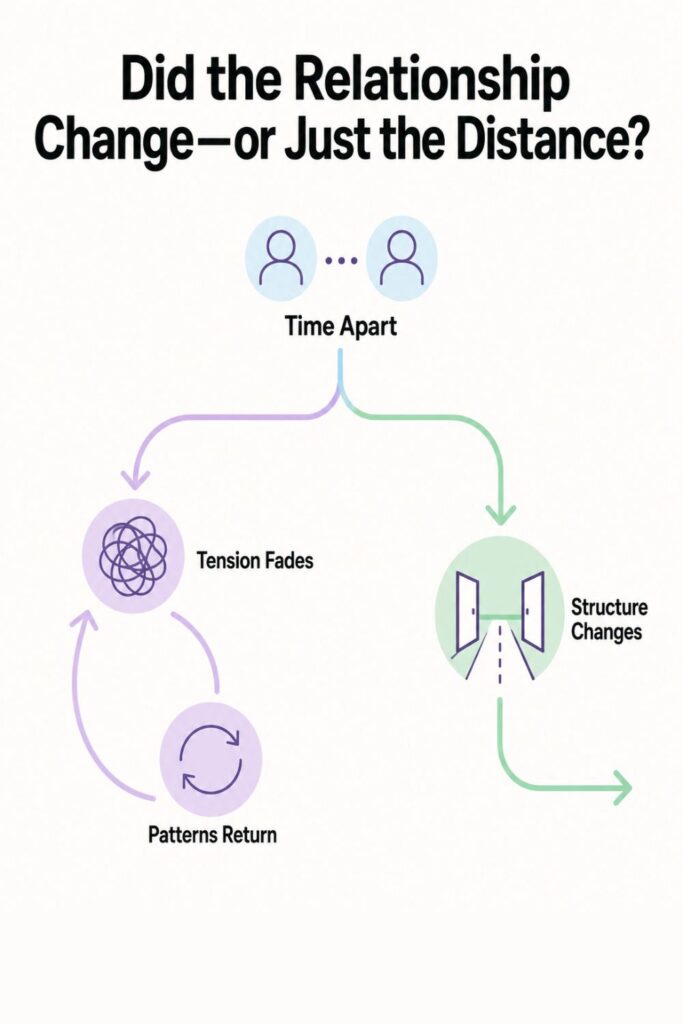
Going back to an ex often fails when the relationship resumes before the underlying patterns, expectations, and conflict habits have changed. Familiarity can create immediate relief, but relief is not evidence that the relationship has become healthier.
Reconciliation has a stronger foundation when both people can name what ended the relationship, accept responsibility for their part, make observable behavioral changes, and agree on a different structure for communication, boundaries, conflict, and accountability. Without those changes, the reunion usually restores the old dynamic.
Research supports approaching relationship cycling carefully. René M. Dailey and colleagues found that lingering feelings and uncertainty about the breakup were common reasons people renewed relationships. J. Kale Monk, Brian G. Ogolsky, and Christopher Maniotes found that on-off relationship cycling was associated with psychological distress and changes in distress over time.
What Can a Breakup Teach You About Self-Awareness?

Through my experiences, I realized that if your relationship is in a stage of breakup, it’s for a reason, and part of that is down to you. I know you don’t want to hear that, but it’s the truth. Very rarely is one person to blame when a relationship fails.
Going back to my story, this relationship, which sounds like a happily ever after, was doomed for failure, and I have to take full responsibility for that. Not all the blame, but the responsibility. You see, I got lazy in the relationship, I took my wife for granted, I didn’t do what I was supposed to do to ensure a strong relationship. We both suffered from depression, which was in part caused by my own personality.
How Do You Evaluate Yourself After a Breakup?

And so, after church one Sunday, she told me she didn’t want us to be together anymore. It felt like my world had ended, much like some of you may be feeling now. This was where I started to take a long hard look at myself and found the failings in my character that were contributing factors to the breakdown of this once fabulous relationship.

I moved out of the house and was miserable… deeply miserable because I didn’t know why she had given up on our marriage. Then, I started to learn about myself, what I was like as a person. And I found out that I was…
- Lazy
- Angry
- Self-centred
- Needy
- Jealous
- Resentful
- Had no life purpose
- Had no positive career
Not a good basis for a relationship, I’m sure you will agree.
If you want to get more from your life, and are looking for concrete action steps to get you there, check out our Request a Coach page. It’s a “cut the fence-sitting and take action” way to tackle your issues and actually find success. To get off the fence and start to take action, click or tap here.
This is why I urge you to find out what you are like, and what you need to work on to be the best you can be for you. Don’t do it for someone else, as that is a cop out. It has to be a self development process for you.
How Do You Rebuild Yourself After a Breakup?
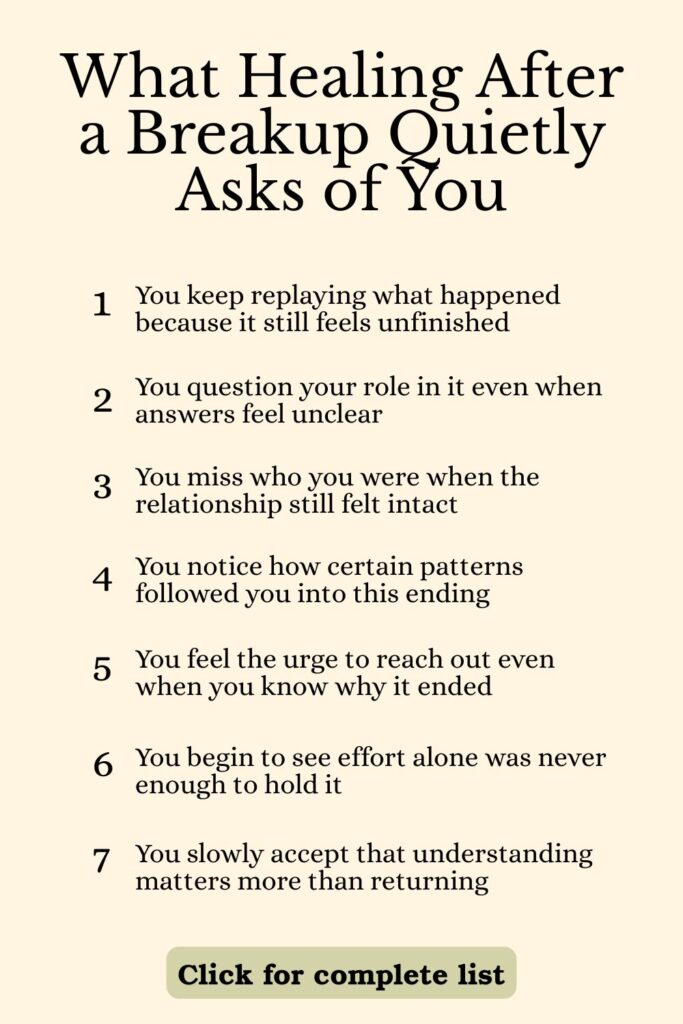
There we were, living apart, but finally talking and dating again. We are trying to work towards the future of being together. This girl gave me a list of what she needed me to do, so that we could be together again and she set a time that it had to be done in.
Yes, it was a form of control, but I thought that I could deal with it and work with that situation.
Much to her surprise, I did everything she wanted me to do. I got a good job, stopped being lazy and focused on making her feel wanted. I loved her in a way that hadn’t been there for a long time. We even went away for a spa weekend and had a fabulous time together, but it wasn’t enough.
As it turns out, there was something else that she wasn’t telling me, and the hard work I was putting in was all for nothing. She gave up a short time later and filed for divorce.
Why Does Reconciliation Take Two People?

So what’s the point of me telling you this story?
There are times, when it doesn’t matter how much work you put into a relationship, if it’s one-sided, it won’t work. Two people have to work at it and want the same thing. If you haven’t seen my article on relationships, check it out. Learn to see these signals and work on yourself to be the best you can be for you.
Here is the biggest and what may be the hardest part of this process of dealing with a breakup. You will be saying the same as I did, that if she would just take me back it would all be ok. Well, I hate to say it, but it won’t. Whatever you do, don’t go back to your ex. If you do, you will undo all that hard work.
If you want to get more from your life, and are looking for concrete action steps to get you there, check out our Request a Coach page. It’s a “cut the fence-sitting and take action” way to tackle your issues and actually find success. To get off the fence and start to take action, click or tap here.
You will slip back in to homeostasis (I’ll talk about that in another article). You will slip back to your old ways and won’t develop yourself. The relationship will fail again. Unless, you both work on improving yourselves together for each of your own benefit. Bit of a paradox, isn’t it?
Some may be able to relate to this story and if you can, I know what you are going through and you’re not alone. Don’t let your relationship get to this state.
What Is the Relationship Homeostasis Loop?
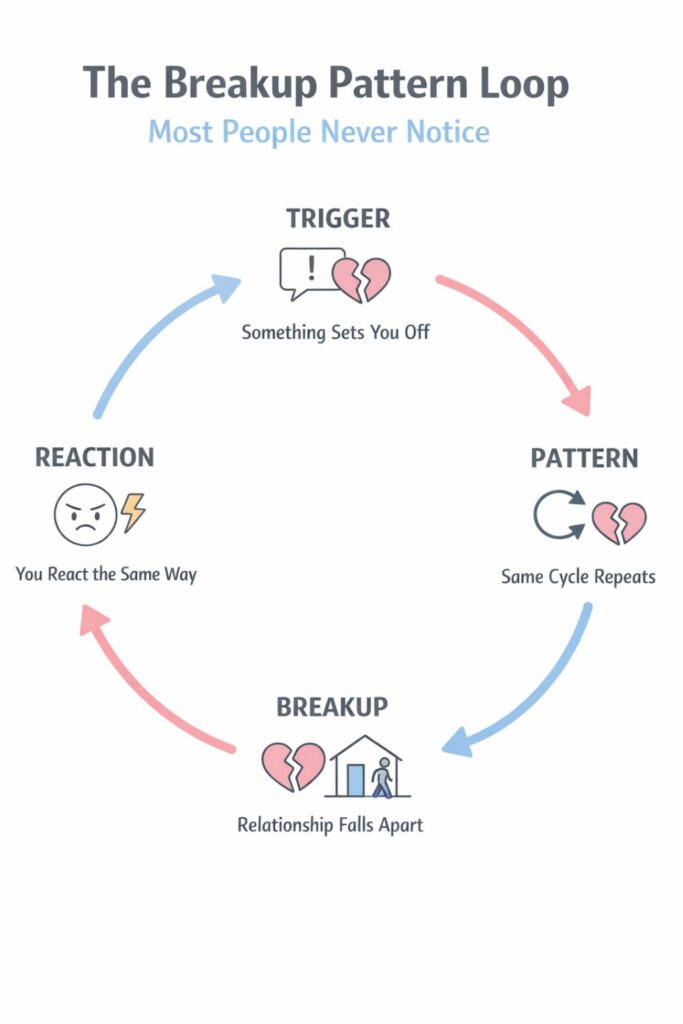
You mentioned homeostasis earlier. This is where most people get stuck without realizing it.
It’s not just “falling back into old ways.” It’s a loop.
Here’s what it actually looks like:
- Trigger: Something happens
- Reaction: You respond in your usual way
- Pattern: That response creates the same dynamic
- Result: The relationship deteriorates in the same way
- Reset: You promise to change… until the next trigger
Example.
Your partner becomes distant.
You feel insecure.
You become needy or controlling.
They pull away even more.
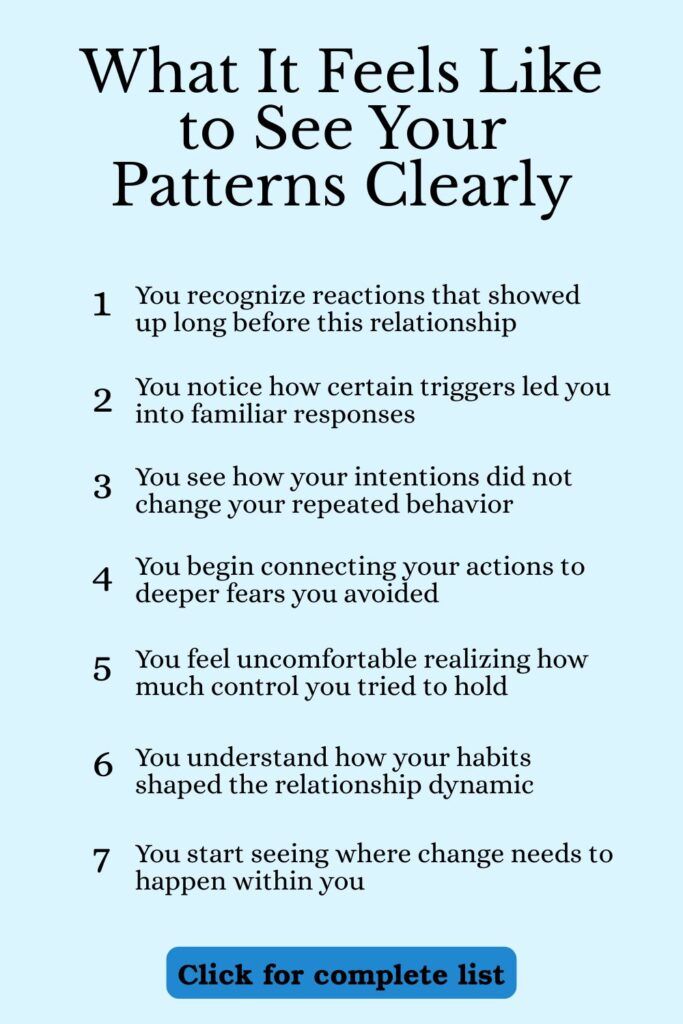
And just like that, you’re back where you started.
This is exactly what I did. Different details, same loop.
If you want to get more from your life, and are looking for concrete action steps to get you there, check out our Request a Coach page. It’s a “cut the fence-sitting and take action” way to tackle your issues and actually find success. To get off the fence and start to take action, click or tap here.
A relationship coach will often map this out with you step by step. Not theory. Actual moments from your past arguments. You start to see your patterns, not just your intentions.
And once you see the loop clearly, you can finally interrupt it.
Why Didn’t Working Harder Save the Relationship?
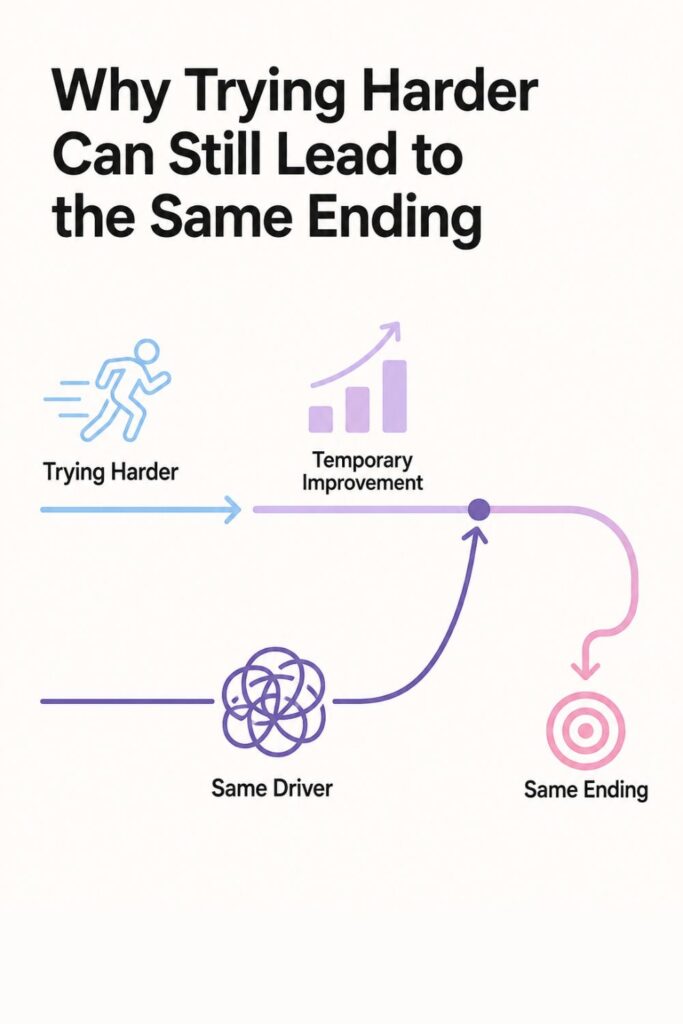
This is the part that hurts the most.
You put the work in. You changed. You showed up differently.
And it still ended.
That’s because effort is not the same as alignment.
There’s a simple test most people ignore.
The 2-Sided Investment Test:
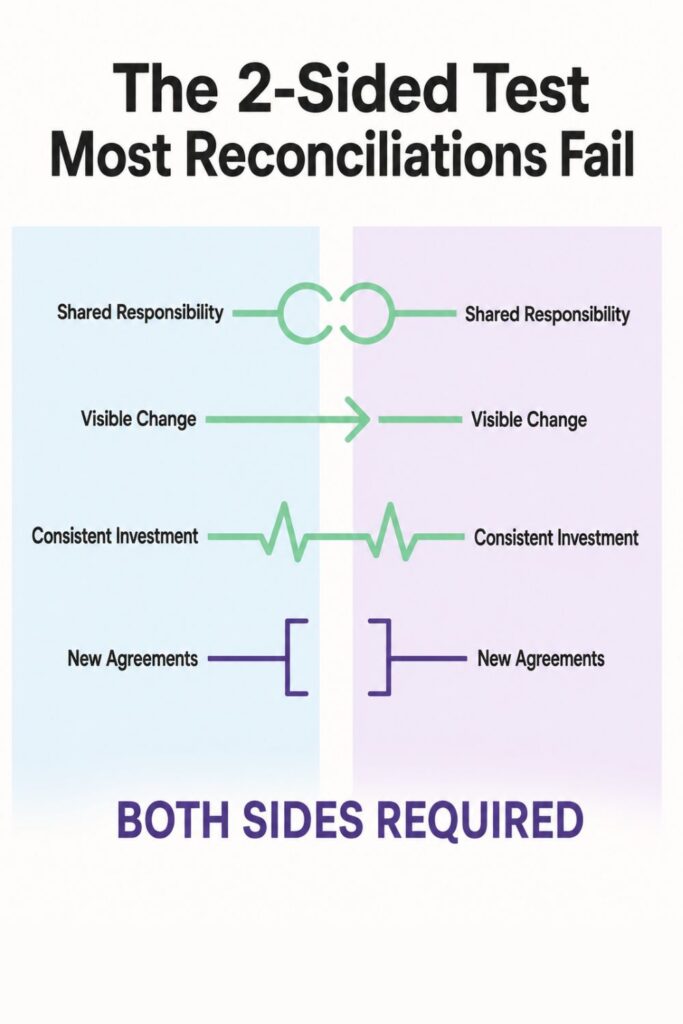
- Are both people taking responsibility
- Are both people changing behaviour, not just talking
- Are both people investing consistently over time
If one side is doing all the work, the outcome is already decided.
If you want to get more from your life, and are looking for concrete action steps to get you there, check out our Request a Coach page. It’s a “cut the fence-sitting and take action” way to tackle your issues and actually find success. To get off the fence and start to take action, click or tap here.
In my case, I did everything she asked.
Got the job.
Changed my habits.
Showed up better.
But she had already emotionally checked out.
No amount of effort fixes that.
A relationship coach would call this out early. They don’t just look at what you’re doing. They look at what both people are doing. Week by week.
Why Is Fixing Yourself for Them a Trap?
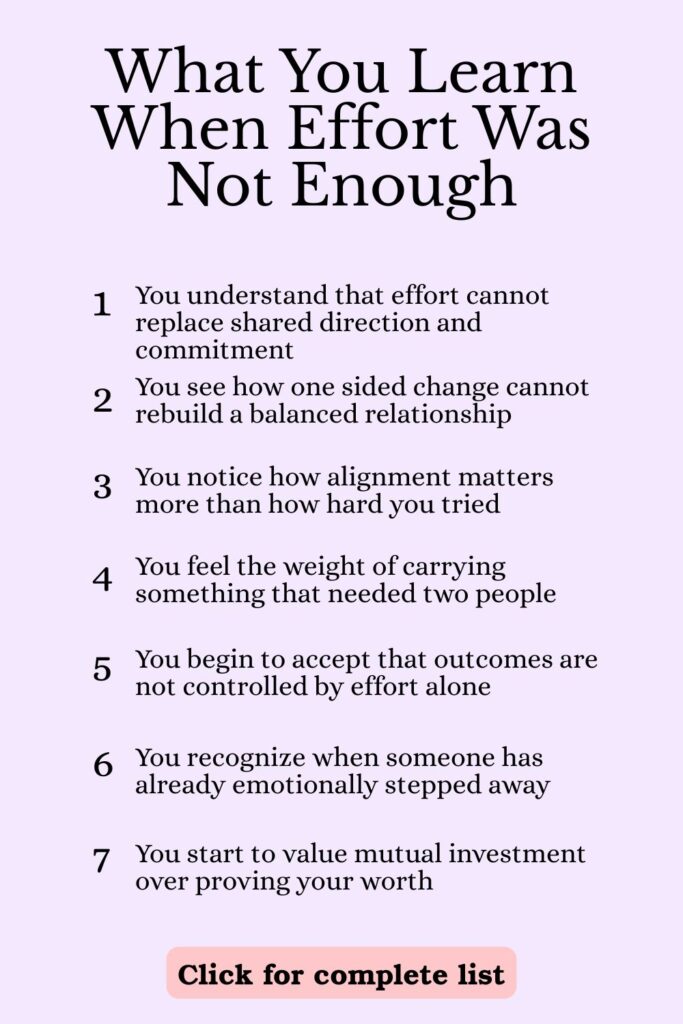
When you change for someone else, it rarely sticks.
Because you’re performing. Not transforming.
You can force behaviour for a while.
If you want to get more from your life, and are looking for concrete action steps to get you there, check out our Request a Coach page. It’s a “cut the fence-sitting and take action” way to tackle your issues and actually find success. To get off the fence and start to take action, click or tap here.
- You act more attentive
- You try harder
- You say the right things
But underneath, nothing has really shifted.
The resentment is still there.
The insecurity is still there.
The same reactions are waiting.
Eventually, you slide back.
That’s why people say, “I don’t know what happened, I was doing so well.”
You were performing for a result. Not becoming someone new.
A good coach will push you here. Not “what do you need to do to win them back?” but “who do you need to become so this pattern doesn’t repeat?”
Big difference.
What Signs Do You Miss When You’re Trying to Save the
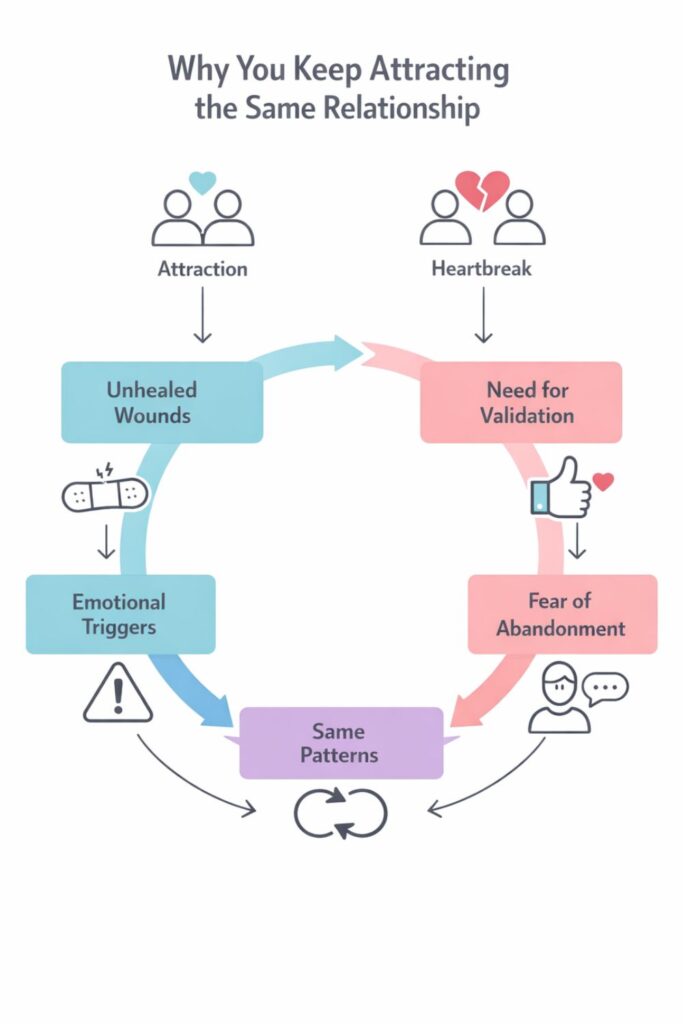
When you’re trying to hold a relationship together, you stop seeing clearly.
If you want to get more from your life, and are looking for concrete action steps to get you there, check out our Request a Coach page. It’s a “cut the fence-sitting and take action” way to tackle your issues and actually find success. To get off the fence and start to take action, click or tap here.
You look for hope. You ignore signals.
There are usually three signs the relationship is already ending.
1. Decisions are made without you
You’re no longer part of the process. You’re being informed, not included.
2. Emotional withdrawal
Less curiosity. Fewer questions. Even arguments disappear.
Silence replaces tension.
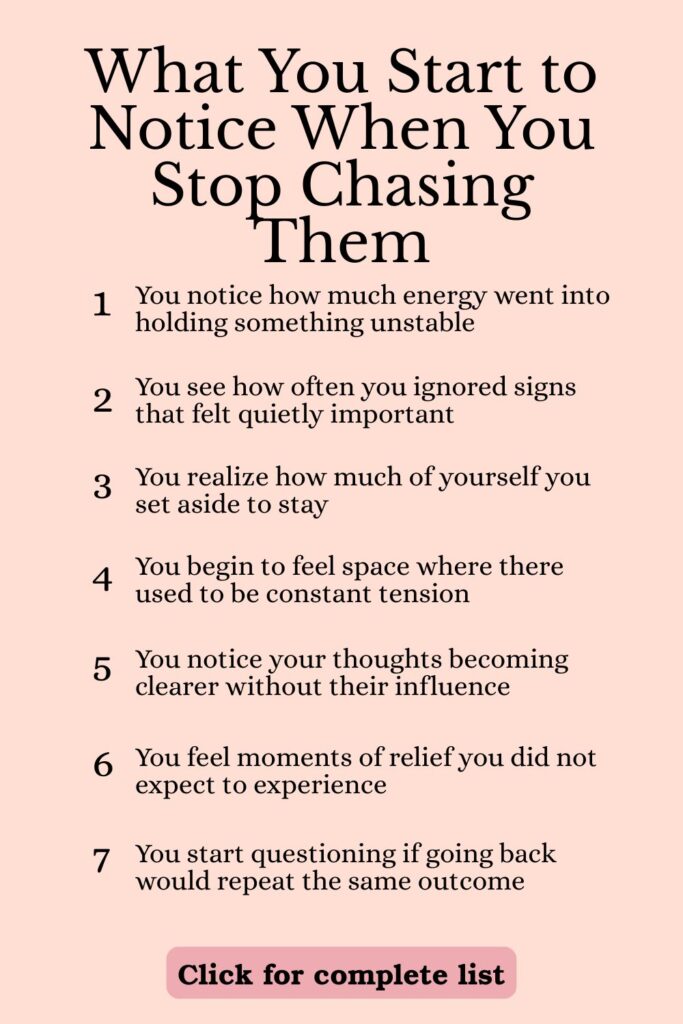
3. The future disappears
No more “we.” No more plans. Everything becomes short-term.
Looking back, these signs were there for me.
But I was focused on fixing things. Not reading what was actually happening.
If you want to get more from your life, and are looking for concrete action steps to get you there, check out our Request a Coach page. It’s a “cut the fence-sitting and take action” way to tackle your issues and actually find success. To get off the fence and start to take action, click or tap here.
A communication coach would often role-play these conversations with you. You hear your partner’s responses clearly, without emotion clouding it.
And suddenly it’s obvious.
How Do You Actually Evaluate Yourself?
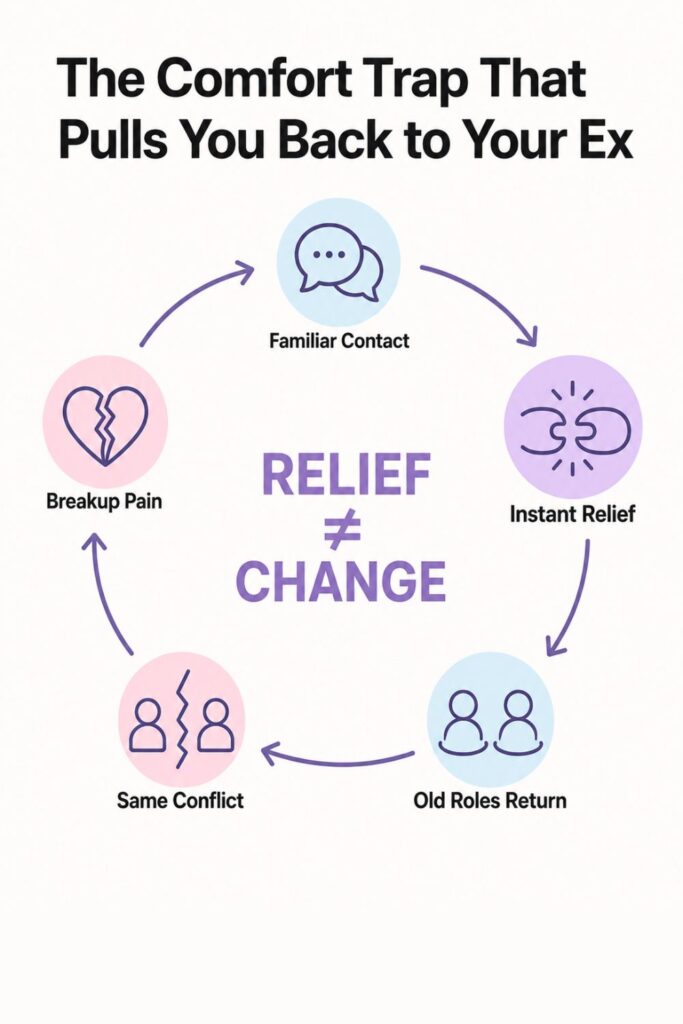
Listing your flaws is easy.
Lazy. Angry. Jealous.
That’s not where the real work is.
You need to go deeper.
Use a simple 3-layer breakdown:
- Behaviour: What did you do
- Pattern: What keeps repeating
- Driver: Why you react that way
Example.
- Behaviour: You get jealous
- Pattern: You try to control when you feel uncertain
- Driver: Fear of being abandoned or replaced
Now you have something real to work with.
If you want to get more from your life, and are looking for concrete action steps to get you there, check out our Request a Coach page. It’s a “cut the fence-sitting and take action” way to tackle your issues and actually find success. To get off the fence and start to take action, click or tap here.
A practical way to do this is journaling one situation at a time.
Write it like this:
“When this happened, I did this, because I believed this.”
That last part is where the truth sits.
A coach will challenge those beliefs directly. Not gently. Clearly. Because that’s where change actually happens.
Why Can Going Back Reset Everything?
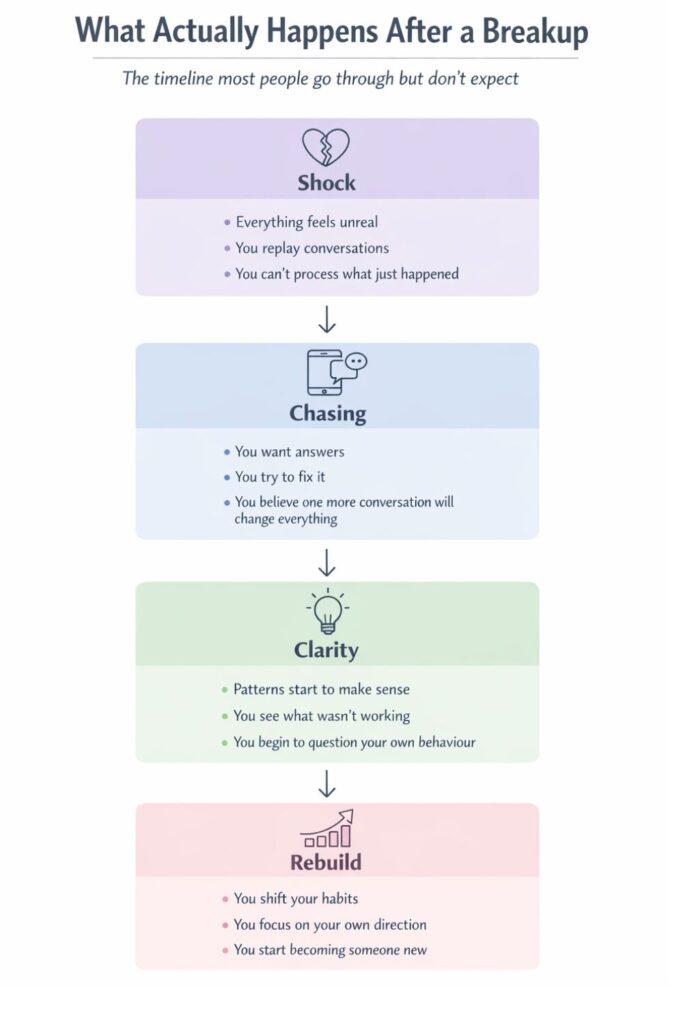
Going back feels like relief.
Familiar voice. Familiar space. Familiar routines.
But that familiarity is the problem.
If you want to get more from your life, and are looking for concrete action steps to get you there, check out our Request a Coach page. It’s a “cut the fence-sitting and take action” way to tackle your issues and actually find success. To get off the fence and start to take action, click or tap here.
Because your patterns are tied to that environment.
Same person. Same triggers. Same roles.
You don’t start fresh. You pick up where you left off.
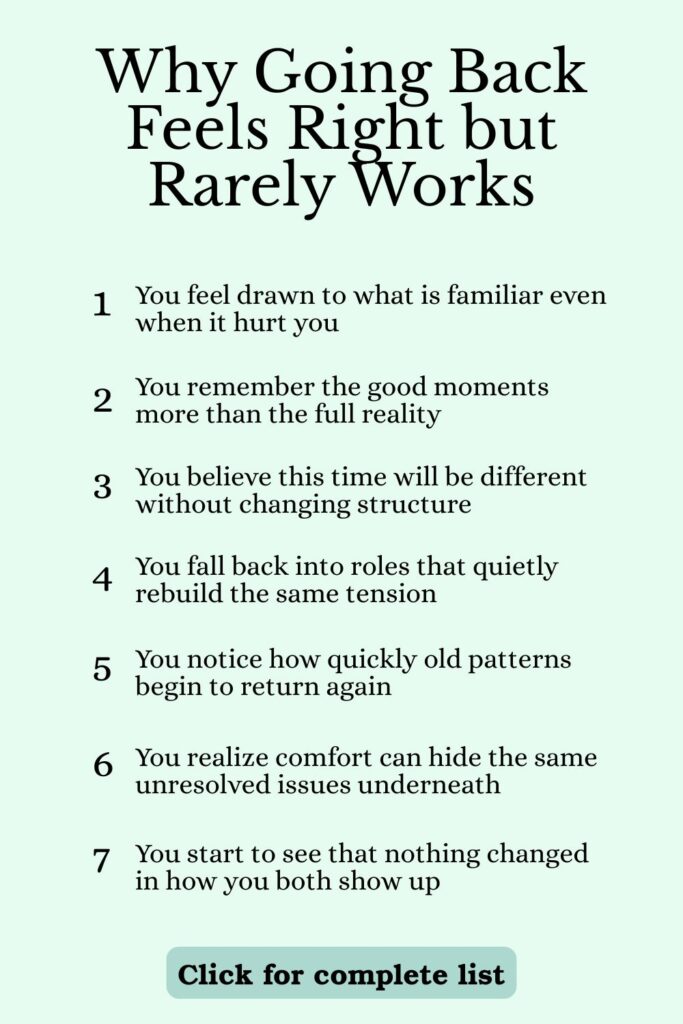
Within weeks, you’ll often see:
- The same arguments
- The same reactions
- The same emotional distance
Nothing changed structurally.
That’s the key word. Structure.
If the structure doesn’t change, the outcome won’t either.
Structure means:
If you want to get more from your life, and are looking for concrete action steps to get you there, check out our Request a Coach page. It’s a “cut the fence-sitting and take action” way to tackle your issues and actually find success. To get off the fence and start to take action, click or tap here.
- How you communicate
- How you handle conflict
- What standards you hold
- What behaviours are acceptable
Without new structure, you’re just replaying the old relationship.
A relationship coach will usually insist on new rules before any reconciliation. Not vague promises. Clear agreements and consistent check-ins.
What Does Moving Forward Actually Look Like?
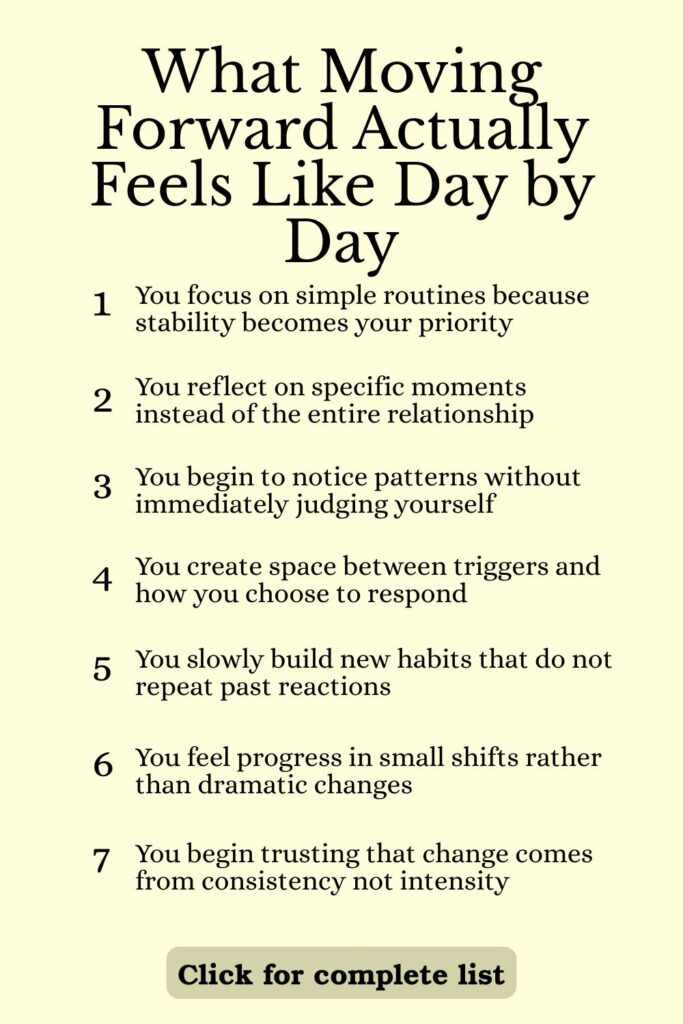
“Move forward” sounds nice. It’s vague though.
What does it actually look like in real life?
It’s a process. Not a feeling.
A simple way to approach it is in phases.
Days 1–30: Stabilise
- No contact
- Basic routine (sleep, food, work)
- Reduce emotional triggers
This is about getting steady. Not solving everything.
Days 30–60: Understand your patterns
- Write down key moments from the relationship
- Identify your repeated reactions
- Start spotting your drivers
Now you’re building awareness that actually leads somewhere.
If you want to get more from your life, and are looking for concrete action steps to get you there, check out our Request a Coach page. It’s a “cut the fence-sitting and take action” way to tackle your issues and actually find success. To get off the fence and start to take action, click or tap here.
Days 60–90: Rebuild
- Introduce new habits
- Change your environment where needed
- Focus on purpose, not just distraction
This is where real change begins.
Not dramatic. Not instant.
But solid.
A coach can be incredibly useful here for one reason. Accountability.
Not just talking about change. Tracking it. Week by week. Making sure you don’t drift back into the same loop.
Because that’s what most people do.
They feel better. Then they repeat the pattern.
And the cycle starts again.
If you want to get more from your life, and are looking for concrete action steps to get you there, check out our Request a Coach page. It’s a “cut the fence-sitting and take action” way to tackle your issues and actually find success. To get off the fence and start to take action, click or tap here.
Frequently Asked Questions
Is getting back with an ex ever a good idea?
Getting back with an ex can work when both people understand why the relationship ended and have made sustained changes that address those problems. Missing each other, feeling lonely, or promising to try harder does not create a different relationship on its own.
How do you know whether getting back with an ex will work?
You are more likely to build a healthier relationship when the changes are already visible before reconciliation. Look for consistent behavior, shared responsibility, honest conversations, clear boundaries, and a realistic plan for handling the problems that previously caused the breakup.
Why does going back to an ex feel so comforting?
Going back to an ex feels comforting because the person, routines, memories, and emotional connection are familiar. Research by Dailey and colleagues found that lingering feelings were a predominant reason people returned to on-again, off-again relationships.
How long should you wait before getting back with an ex?
Wait until both people have had enough time to understand the breakup and demonstrate meaningful change outside the relationship. A specific number of days cannot replace evidence that the original patterns have genuinely changed.
Can an on-again, off-again relationship become healthy?
An on-again, off-again relationship can become healthier only when the breakup and reconciliation cycle stops. Research has associated continued relationship cycling with psychological distress over time, making deliberate decisions and stable changes especially important.
Should you get back together if only one person has changed?
You should not restart the relationship based only on one person’s progress. One person can improve their own behavior, but a healthy relationship requires mutual responsibility, participation, and investment.
Does no contact help before deciding whether to reconcile?
No contact can create enough distance to evaluate the relationship without constant emotional reinforcement. Use that space to examine the actual relationship patterns, not simply whether you miss the person.
If you’re reading this either you have been through a breakup, or you are feeling that there is a challenge in your relationship. Tackle it now, talk to someone who will have some ideas on how to repair a less than perfect relationship. It’s not too late to take action and save it.
If you want to get more from your life, and are looking for concrete action steps to get you there, check out our Request a Coach page. It’s a “cut the fence-sitting and take action” way to tackle your issues and actually find success. To get off the fence and start to take action, click or tap here.
So, be the best you can be for you, and move forward with a new outlook that will lead to a beautiful and happy life.
Here’s to your eternal happiness.
Cheers
Ian
Coach
Partner To Success
Sources
Dailey, René M., et al. “On-Again/Off-Again Dating Relationships: What Keeps Partners Coming Back?” The Journal of Social Psychology, vol. 151, no. 4, 2011, pp. 417–440. Taylor & Francis Online, https://doi.org/10.1080/00224545.2010.503249/.
Monk, J. Kale, Brian G. Ogolsky, and Christopher Maniotes. “On-Off Relationship Instability and Distress Over Time in Same- and Different-Sex Relationships.” Family Relations, vol. 71, no. 2, Apr. 2022, pp. 630–643. Wiley Online Library, https://doi.org/10.1111/fare.12614/.
Rhoades, Galena K., et al. “Breaking Up Is Hard to Do: The Impact of Unmarried Relationship Dissolution on Mental Health and Life Satisfaction.” Journal of Family Psychology, vol. 25, no. 3, June 2011, pp. 366–374. PubMed Central, https://pmc.ncbi.nlm.nih.gov/articles/PMC3115386/.
If you want to get more from your life, and are looking for concrete action steps to get you there, check out our Request a Coach page. It’s a “cut the fence-sitting and take action” way to tackle your issues and actually find success. To get off the fence and start to take action, click or tap here.
Read this next
Keys to a Healthy Relationship
Healthy relationships require a healthy start! How does your measure up?
Read More
How to Craft the Perfect Boo Basket that Matches His Unique Hobbies
The fun of a “boo basket” lies in its mix of surprise, creativity, and coziness. But what really makes it special is the thoughtfulness behind it. Instead of a generic […]
Read More
Was I Wrong About The No Contact Rule
In a candid and introspective session, renowned relationship coach, Coach Lee, revisits one of the pillars of his coaching advice – The No Contact Rule. After years of advocating for […]
Read More