






Learn How to Declutter Your House: What is Your Clutter Personality?

Are you all about style, decor and organization? Download a copy of our Clutter Reset Guide.
****
Are you drowning in clutter?
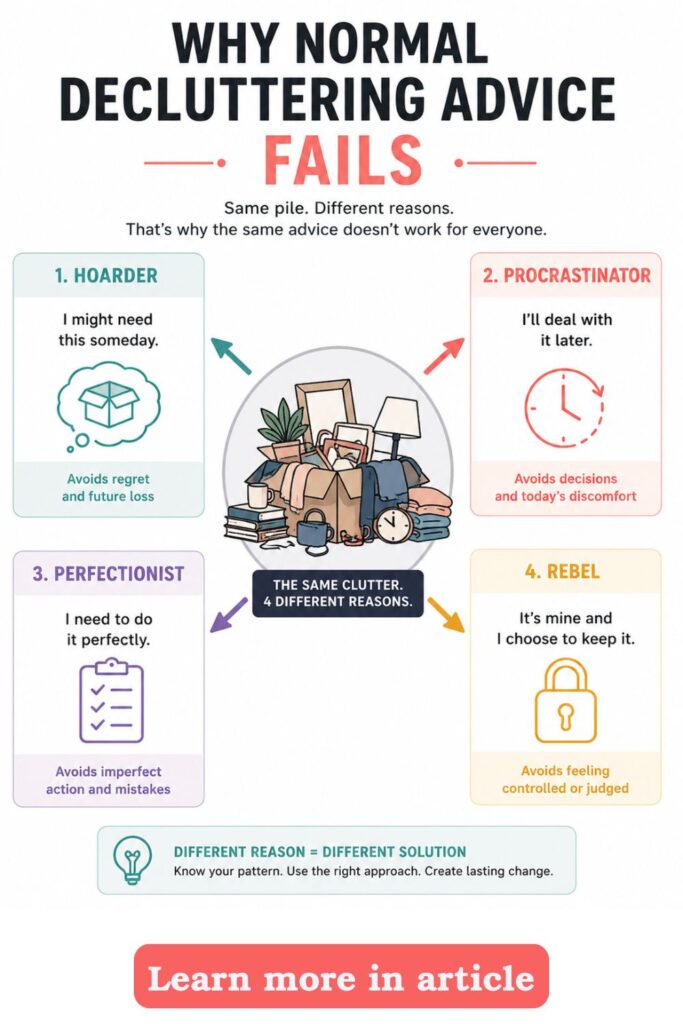
What is your clutter personality? Are you a hoarder? A Procrastinator? A Perfectionist? Or A Rebel? Follow these tips to learn how to declutter your house.
- Hoarders are gripped by fear of letting go of possessions in case they might need them someday;
- Procrastinators don’t like to make decisions so things are not dealt with right away;
- Perfectionists want to make it all perfect or they won’t even start the job;
- Rebels just keep something because it is theirs, and they want it even if it serves no purpose
Here are some quick tips for each type to get you started.
Need some in depth help with organization and productivity ? Drop on by our directories choc full of productivity coaches, minimalist coaches, and work/life balance coaches to get your life organized! Or click here to have us match you to the best.
Clutter personality 1: Hoarders
If you have the tendencies of a hoarder, try these tips to declutter your house:
- Think about selling items on consignment. That way, although you are getting rid of the item, you are getting something for it.
- Cut back on collections. Do you have every picture your child has ever drawn? Pick one from each year that is special and make a scrap book. Treasure that memory book.
- Put unused items in a box. If you don’t use it for six months, toss the whole box.
Clutter personality 2: Procrastinators
Procrastinators set everything aside for later…dishes in the sink…piles of newspapers…mail left unopened. These are procrastinators. Here’s how you can declutter your house.
If you want to get more from your life, and are looking for concrete action steps to get you there, check out our Request a Coach page. It’s a “cut the fence-sitting and take action” way to tackle your issues and actually find success. To get off the fence and start to take action, click or tap here.
- Accept that tomorrow has no more time than today. Just start dealing with things and you will gain momentum.
- Create a bag of clothes you don’t use and put them in your trunk. You will get sick of that bag and go to a recycle bin.
- Deal with things right away. Have papers to file, bills to pay? Do it right away and don’t let things pile up.
Clutter personality 3: Perfectionist
Perfectionists want it all done perfectly or they won’t do it at all and this is how they get their clutter. You would think a perfectionist would have everything perfect but the all or nothing thinking is where they get tripped up and it leads to clutter.
If this is you, try these tips to decultter your house:
- Force yourself to just do something. Clear one junk drawer, organize just one shelf in your cabinet. Letting yourself do things that are “good enough” with your clutter will help you in other areas too.
- Donating helps for perfectionists. Put things you have not worn in the last year in a bag and bring them to a donation bin.
- Set a timeframe for magazines and newspapers. Perfectionists want to go through them cover to cover. They will keep them until they have done just that. Set a timeframe for yourself and if you have not reviewed them, give them to a friend or throw them away.
Clutter personality 4: Rebels
Rebels keep things because they want to be in control and not told what to do by others. “It’s mine and I can keep it.”
If this is you, maybe this will help to declutter your house:
- Decide how you want your closet to look – and make it happen.
- Find a productive, less cluttered way of holding on to things. Make a collage of old birthday cards that are special.
- If you have to keep it, become an organization Queen. Get things organized and labeled so that you are not surrounded by stressful clutter. Once you take the step to organize, you may decide on your own that some things are just not worth the effort.
These tips will also help reduce stress in your life. Having too much waiting for tomorrow can be very stressful and more things always come up the next day!
What Your Clutter Personality Is Really Trying to Avoid
Most clutter is not random. It usually follows a pattern.
Once you know the pattern, you can stop treating every pile like the same problem.
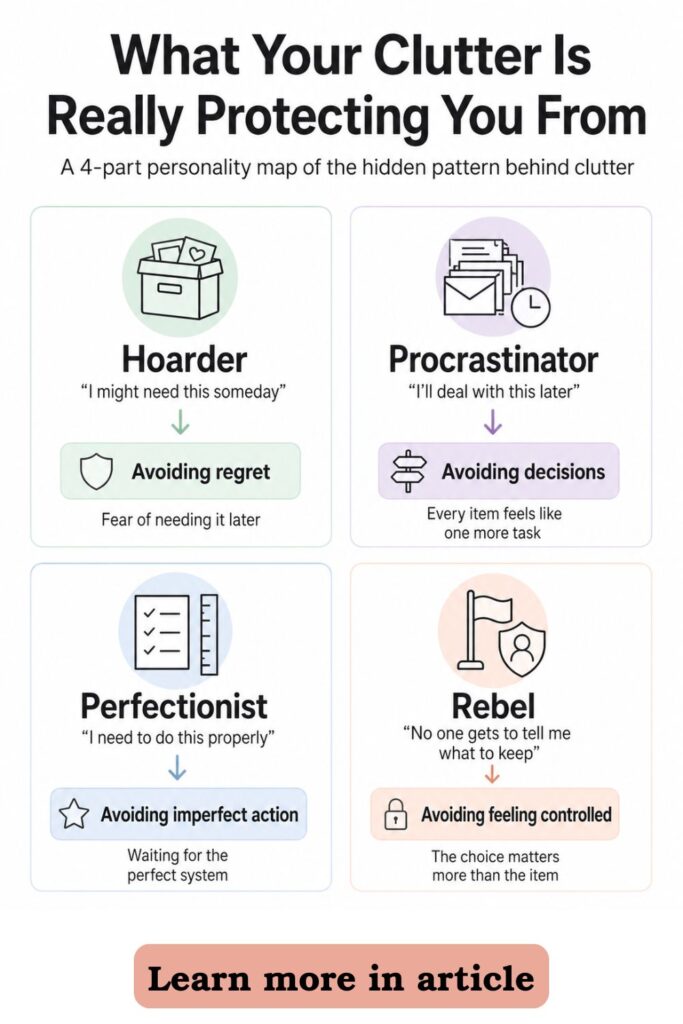
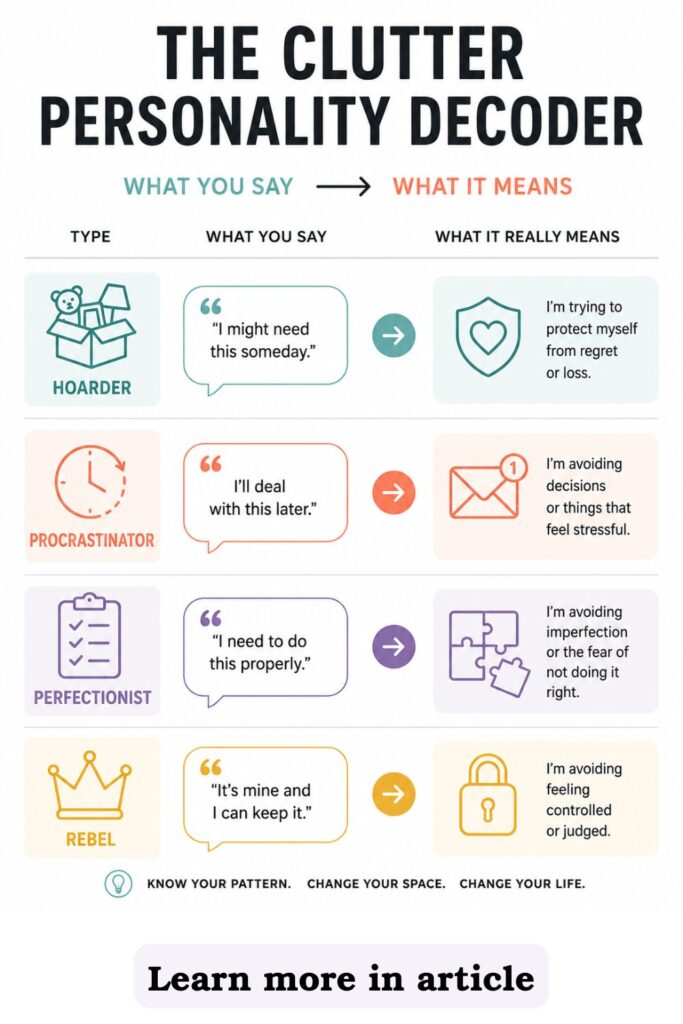
Hoarders often avoid regret. The thought is, “What if I need this later?” So the broken lamp, the old phone charger, the jeans from five years ago, and the stack of gift bags all stay.
If you want to get more from your life, and are looking for concrete action steps to get you there, check out our Request a Coach page. It’s a “cut the fence-sitting and take action” way to tackle your issues and actually find success. To get off the fence and start to take action, click or tap here.
Procrastinators often avoid decisions. The mail sits unopened because every envelope asks for something. Pay this. File that. Call someone. Choose a plan.
Perfectionists often avoid imperfect action. They do not want to clear one shelf because the whole pantry needs a system. They do not want to sort one drawer because the labels are not ready yet.
Rebels often avoid feeling controlled. If someone says, “Why do you still have that?” the answer becomes, “Because it’s mine.” The item may not matter much, but the choice does.
This is why the same decluttering tip works for one person and completely fails for another.
A life coach, ADHD coach, or home organization coach may help you spot which pattern keeps repeating so you are not just moving clutter from one place to another.
How to Tell Which Clutter Personality You Are
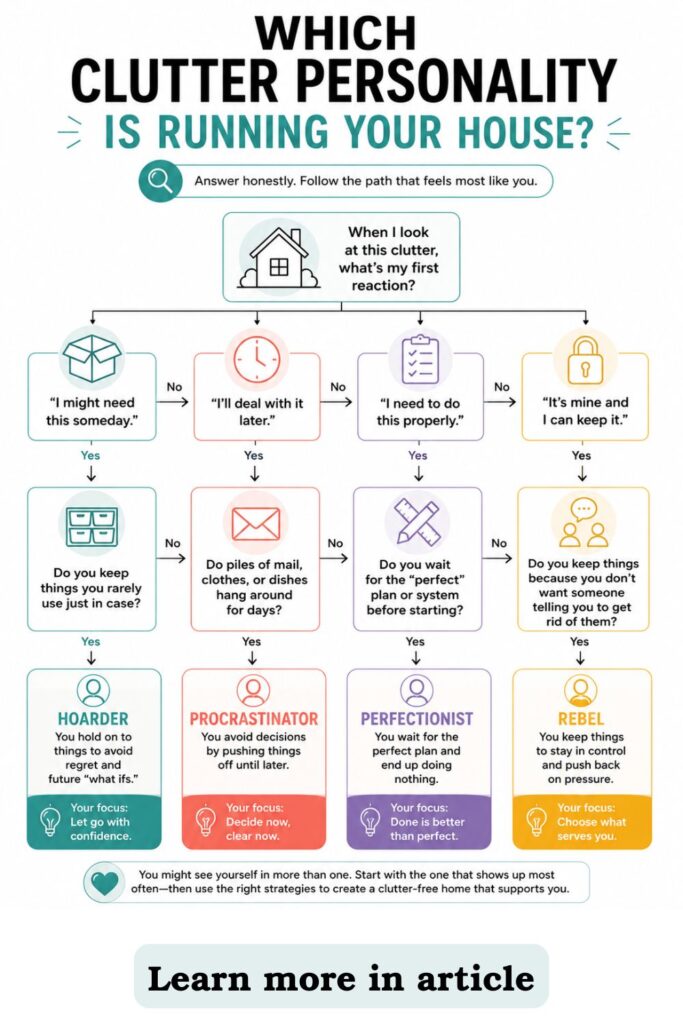
Look at the sentences you say when you are standing in front of the pile.
If you say, “I might need this someday,” you may have Hoarder tendencies.
This often shows up in closets, garages, basements, junk drawers, craft supplies, cords, boxes, tools, and old paperwork.
If you want to get more from your life, and are looking for concrete action steps to get you there, check out our Request a Coach page. It’s a “cut the fence-sitting and take action” way to tackle your issues and actually find success. To get off the fence and start to take action, click or tap here.
If you say, “I’ll deal with this later,” you may be a Procrastinator.
This often shows up as unopened mail, laundry that never gets put away, dishes left by the sink, returns that never make it back to the store, and bags by the door that have been there for weeks.
If you say, “I need to do this properly,” you may be a Perfectionist.
This often shows up when you buy storage bins before sorting anything, research the best filing system, save every magazine because you still want to read it, or wait for a full free weekend before starting.
If you say, “No one gets to tell me what to keep,” you may be a Rebel.
This often shows up in arguments about shared spaces, closets, garages, inherited items, or anything a partner, parent, or roommate has criticized.
You may be a mix of more than one type. That is normal.
The useful question is not “Which label fits me perfectly?” It is “Which pattern shows up most often when I try to let go?”
If you want to get more from your life, and are looking for concrete action steps to get you there, check out our Request a Coach page. It’s a “cut the fence-sitting and take action” way to tackle your issues and actually find success. To get off the fence and start to take action, click or tap here.

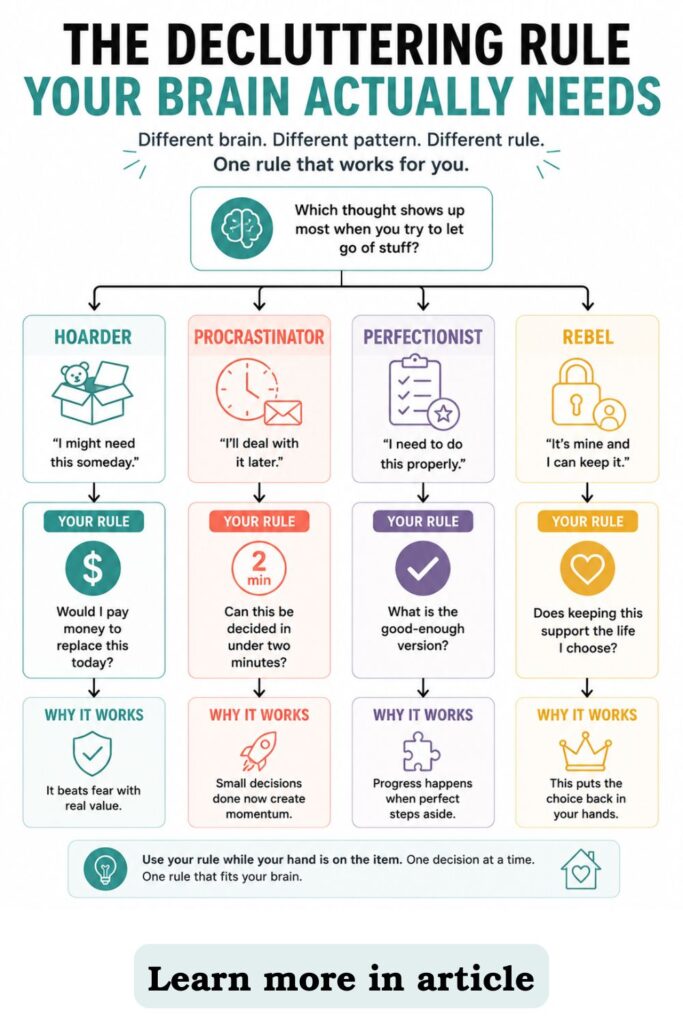
The One Decision Rule Each Clutter Personality Needs
Each clutter personality needs a different decision rule.
Not a vague promise to “get organized.” A rule you can use while your hand is on the item.
For Hoarders, ask:
“Would I pay money to replace this today?”
If the answer is no, the item may not be as useful as your fear says it is. This works well for duplicate kitchen tools, old clothes, books you will not reread, and supplies from hobbies you no longer do.
For Procrastinators, ask:
“Can this be decided in under two minutes?”
If yes, decide now. Recycle the flyer. Open the envelope. Put the receipt in one place. Throw away the empty bottle.
If you want to get more from your life, and are looking for concrete action steps to get you there, check out our Request a Coach page. It’s a “cut the fence-sitting and take action” way to tackle your issues and actually find success. To get off the fence and start to take action, click or tap here.
For Perfectionists, ask:
“What is the good-enough version?”
Good enough might mean clearing one drawer, not designing the perfect drawer system. It might mean putting all tax papers in one folder, even if the folder is not beautifully labeled yet.
For Rebels, ask:
“Does keeping this support the life I choose?”
That puts the decision back in your hands. Not your partner’s. Not your mother’s. Not the person who keeps commenting on your garage.
A coach may use this kind of rule as an accountability tool. You choose the rule before the session, then practice applying it to real items instead of debating every object from scratch.
Where Each Clutter Type Gets Stuck Room by Room
Clutter looks different depending on where it lands.
If you want to get more from your life, and are looking for concrete action steps to get you there, check out our Request a Coach page. It’s a “cut the fence-sitting and take action” way to tackle your issues and actually find success. To get off the fence and start to take action, click or tap here.
In the kitchen, Procrastinators often struggle with expired food, mystery containers, old takeout menus, counters full of mail, and dishes that never quite make it back to their place.
A useful action is to choose one category, not the whole kitchen. For example, clear only the fridge door. Or only the containers with no lids.
In the closet, Hoarders often keep clothes for imagined future moments.
The dress for a party that may never happen. The jeans for a body from ten years ago. The jacket that cost too much to donate.
A concrete rule helps here: if you would not wear it this month, and you would not buy it again today, it does not deserve prime closet space.
In the home office, Perfectionists often get trapped by papers.
They keep documents because the filing system is not ready. They leave piles because they want to sort everything correctly. They delay because one mistake feels like failure.
Start with three piles only:
If you want to get more from your life, and are looking for concrete action steps to get you there, check out our Request a Coach page. It’s a “cut the fence-sitting and take action” way to tackle your issues and actually find success. To get off the fence and start to take action, click or tap here.
- Action
- Keep
- Recycle
No color coding. No perfect folders. Just a first pass.
In the garage or storage area, Rebels often keep things because the space has become a battleground.
Old paint cans. Sports gear. Boxes from a move years ago. Broken items that someone else keeps asking about.
A better starting point is one self-chosen zone. One shelf. One corner. One bin. The goal is not to obey someone else’s standard. The goal is to make the space work for you.
Common Decluttering Mistakes Each Personality Makes
Hoarders often start with sentimental items too soon.
That is the hardest category. Do not begin with baby clothes, letters, family photos, gifts, or inherited items. Start with low-emotion objects like expired products, duplicates, chipped mugs, worn towels, or old instruction manuals.
Procrastinators often make the project too big.
“Clean the whole house” is too vague. “Open today’s mail before dinner” is concrete. “Put one bag of donations in the car” is concrete.
If you want to get more from your life, and are looking for concrete action steps to get you there, check out our Request a Coach page. It’s a “cut the fence-sitting and take action” way to tackle your issues and actually find success. To get off the fence and start to take action, click or tap here.
Perfectionists often organize before they discard.
That creates tidy clutter. The bins look better, but the same unused items remain. First reduce. Then organize what is left.
Rebels often turn decluttering into a power struggle.
If someone says, “You need to get rid of this,” the item suddenly feels more valuable. Even if it is a cracked plastic storage tub.
A relationship coach may help when clutter has become a repeated argument. Not by deciding what you should keep, but by helping both people agree on shared-space rules, private-space rules, and what actually needs to change.
A 15-Minute Decluttering Method for Each Type
You do not need a full weekend to start.
You need the right 15 minutes.
If you are a Hoarder, pick 10 low-emotion items.
If you want to get more from your life, and are looking for concrete action steps to get you there, check out our Request a Coach page. It’s a “cut the fence-sitting and take action” way to tackle your issues and actually find success. To get off the fence and start to take action, click or tap here.
Not photos. Not gifts. Not keepsakes.
Try:
- Expired medicine
- Old makeup
- Pens that do not work
- Socks with holes
- Food past its date
- Empty boxes
- Duplicate plastic containers
The point is to practice letting go without triggering the hardest fear first.

If you are a Procrastinator, set a timer and make only yes-or-no decisions.
Do not rearrange. Do not deep clean. Do not leave the room to start another task.
Pick one pile and decide:
- Trash
- Recycle
- File
- Pay
- Put away
If you are a Perfectionist, clear one visible surface badly on purpose.
A nightstand. A bathroom counter. One kitchen counter. One desk corner.
If you want to get more from your life, and are looking for concrete action steps to get you there, check out our Request a Coach page. It’s a “cut the fence-sitting and take action” way to tackle your issues and actually find success. To get off the fence and start to take action, click or tap here.
Do not buy anything. Do not make labels. Do not plan the final system.
Just make that one surface usable.
If you are a Rebel, choose the area that annoys you most.
Not the area someone else keeps complaining about.
Maybe it is the drawer that jams every morning. The entryway where your keys disappear. The closet floor where shoes pile up.
Choose it because you want the result. That makes the action yours.
When Clutter Is About More Than Stuff
Sometimes clutter keeps coming back because the real problem is not the object.
It is the decision attached to it.
If you want to get more from your life, and are looking for concrete action steps to get you there, check out our Request a Coach page. It’s a “cut the fence-sitting and take action” way to tackle your issues and actually find success. To get off the fence and start to take action, click or tap here.
Unopened mail may mean you are avoiding a money decision. A packed closet may mean you are holding on to an old identity. A garage full of boxes may mean a move, divorce, death, new baby, or career change never got fully processed.
Sometimes the pattern is practical.
For example, someone with ADHD-style task initiation problems may know exactly what needs to happen but cannot get started without structure. In that case, “just clean it up” is not useful. A body-doubling session, timed reset, or simple checklist may work better.
Sometimes the pattern is relational.
One person wants clear counters. The other sees clear counters as cold or controlling. One person wants to donate old toys. The other feels guilty letting them go.
That is where a coach can be useful in a very practical way.
A life coach might help you choose one weekly reset routine. An ADHD coach might help you build a visual system for mail, laundry, and daily items. A relationship coach might help you talk through shared-space decisions without turning every object into an argument.
The goal is not to become a different person.
If you want to get more from your life, and are looking for concrete action steps to get you there, check out our Request a Coach page. It’s a “cut the fence-sitting and take action” way to tackle your issues and actually find success. To get off the fence and start to take action, click or tap here.
The goal is to stop making the same clutter decision 40 times.
****
Are you all about style, decor and organization? Download a copy of our Clutter Reset Guide.
Need some in depth help with organization and productivity ? Drop on by our directories choc full of productivity coaches, minimalist coaches, and work/life balance coaches to get your life organized! Or click here to have us match you to the best.
If you want to get more from your life, and are looking for concrete action steps to get you there, check out our Request a Coach page. It’s a “cut the fence-sitting and take action” way to tackle your issues and actually find success. To get off the fence and start to take action, click or tap here.
Read this next

Before & After: Tiny Bathroom Transformations You Can Do in a Day
If your small bathroom feels more like a daily source of stress than a soothing space, you’re not alone. Tiny bathrooms have a way of collecting clutter, swallowing storage, and […]
Read More
The Galentine’s Activities Everyone Ends Up Talking About
Plan Galentine’s activities that spark laughter, easy conversation, and the kind of moments guests keep talking about.
Read More
8 Small Closet Fixes That Instantly Create More Space
Tiny closet? These simple layout fixes help you find extra room, clear clutter, and make your closet feel bigger fast.
Read More