


Talk to a coach about Confidence coaching

Crystal Faulk
ACC
I help overwhelmed women in transition gain clarity, confidence, and...

Charity Archie
Several Life Coaching Certifications-Intentional Holistic Life Coach
Charity Aumora dedicated to promoting a positive clear & intentional...

Menna Jones
Certified Health & Wellness Coach (Real Balance Global Wellness)
Health & Wellness Coaching For Women Going Through Menopause

Daryll Mackey
Coach, speaker and DISC Practitioner JohnC. Maxwell
Empowering growth through knowledge and connection. Unlock your potential and...

Alena Zhaliazniak
MSc, holistic life coach, PQ Positive Intelligence
"A ray of light shining through iron" is the meaning...

Mak Estill
Anxiety, Panic & Life Coach dedicated to coaching you into a life of lesser and lighter anxiety!
Founder and owner of Actionable Anxiety, a private coaching practice...

Stephanie Peers
Somatic Coach | Midlife Transitions, Self-Trust & Personal Growth
Body-led coaching for midlife women ready to trust themselves, set...

Maria J Brando
Psychosynthesis Life Coach and Financial Coach. BCC, MBA.
Reconnect with your intuition. Look within, listen deeply, and discover...




7 Signs You Are Measuring Your Worth With the Wrong Scorecard

Be happy with who you are, and confidence will follow.
Today I want to tackle a question that I think is crucial when we look at improving core confidence.
We live in a world full of other people just like us. We meet these people every day, interact with them, and build much of our experience through those interactions.
Most of these experiences have the potential to be brilliant. But when our confidence suffers, it is often because an interaction has activated doubt, comparison, blame, or an old belief about who we are.
Key Takeaways
- Core confidence comes from an internal scorecard. It grows when you judge yourself by your values, choices, effort, and progress instead of another person’s appearance, status, knowledge, or approval.
- Comparison is a trigger, not a verdict. You can notice the comparison, name the story you attached to it, and choose a response that creates useful evidence about who you are.
- Confidence needs proof you can observe. A list of positive qualities becomes stronger when each quality is connected to a recent action, decision, boundary, conversation, or promise you kept.
- Accepting imperfection does not mean avoiding responsibility. Some traits need acceptance, some behavior needs repair, some skills need practice, and some impossible standards need to be released.
- Not every confidence problem is a thought problem. Sometimes you need to challenge an interpretation. Sometimes you need practice or feedback. Sometimes the environment itself is disrespectful, unsafe, or damaging.
How Do You Build Core Confidence?
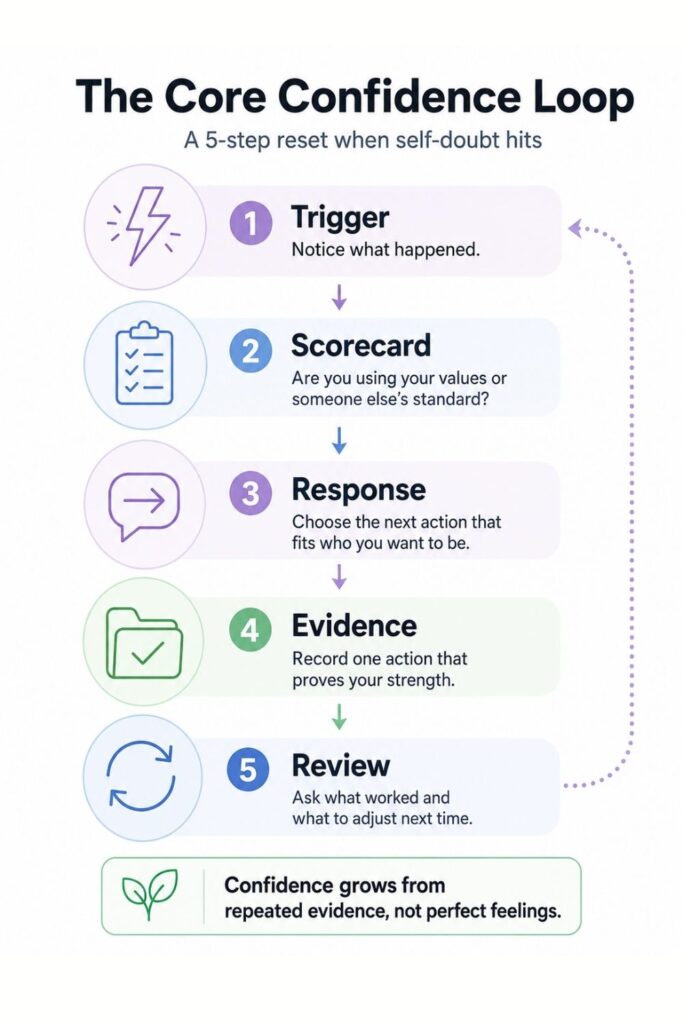
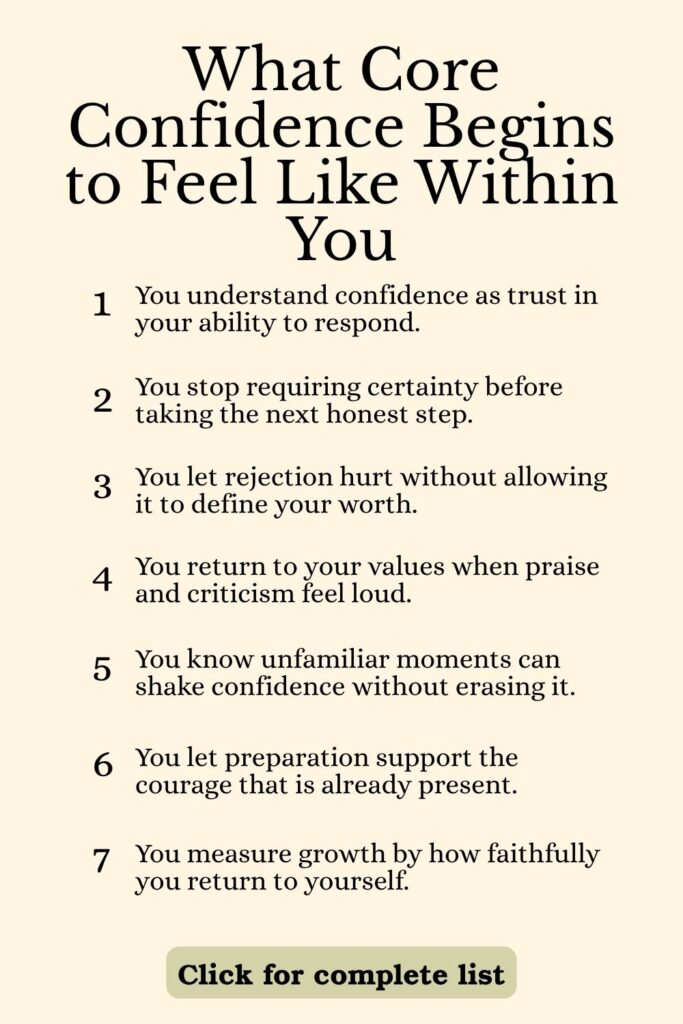
You build core confidence by developing a stable view of yourself that is not completely controlled by praise, criticism, comparison, appearance, or recent performance.
That stability grows through a simple process: notice what triggered your doubt, identify the standard you are using, choose a response that reflects your values, and record the evidence created by that response.
Core confidence does not mean feeling certain in every situation. It means that a mistake, rejection, awkward conversation, or difficult day does not get to define your entire identity.
How Is Core Confidence Different From Situational Confidence?
Core confidence remains connected to your worth and values, while situational confidence changes according to the task, environment, and level of preparation.
If you want to get more from your life, and are looking for concrete action steps to get you there, check out our Request a Coach page. It’s a “cut the fence-sitting and take action” way to tackle your issues and actually find success. To get off the fence and start to take action, click or tap here.
You might feel confident coaching a long-term client because you know their history and understand the work. The next day, you might feel nervous introducing yourself at a large networking event.
That nervousness does not mean your core confidence has disappeared. It may simply mean the situation is unfamiliar or that a particular skill needs more practice.
Situational confidence often increases through repetition, preparation, and feedback. A career coach might help someone rehearse an interview, while a communication coach might record a practice presentation and review the speaker’s pace, posture, and answers.
Core confidence has a different job. It allows you to practice without treating every imperfect attempt as proof that you are inadequate.
Why Do Blame and Comparison Erode Confidence?
Blame and comparison weaken confidence when they move your attention away from what you can understand, choose, or change.
Egos can clash. Negative emotions can generate comparison and blame. We compare ourselves with other people, blame them for what happens to us, or do both at the same time.
Those patterns complicate relationships because they turn another person into either a threat or the cause of everything we feel.
Our core confidence relies partly on how much we value ourselves. That influences how we interpret situations and how we react to the people we encounter.
If you want to get more from your life, and are looking for concrete action steps to get you there, check out our Request a Coach page. It’s a “cut the fence-sitting and take action” way to tackle your issues and actually find success. To get off the fence and start to take action, click or tap here.
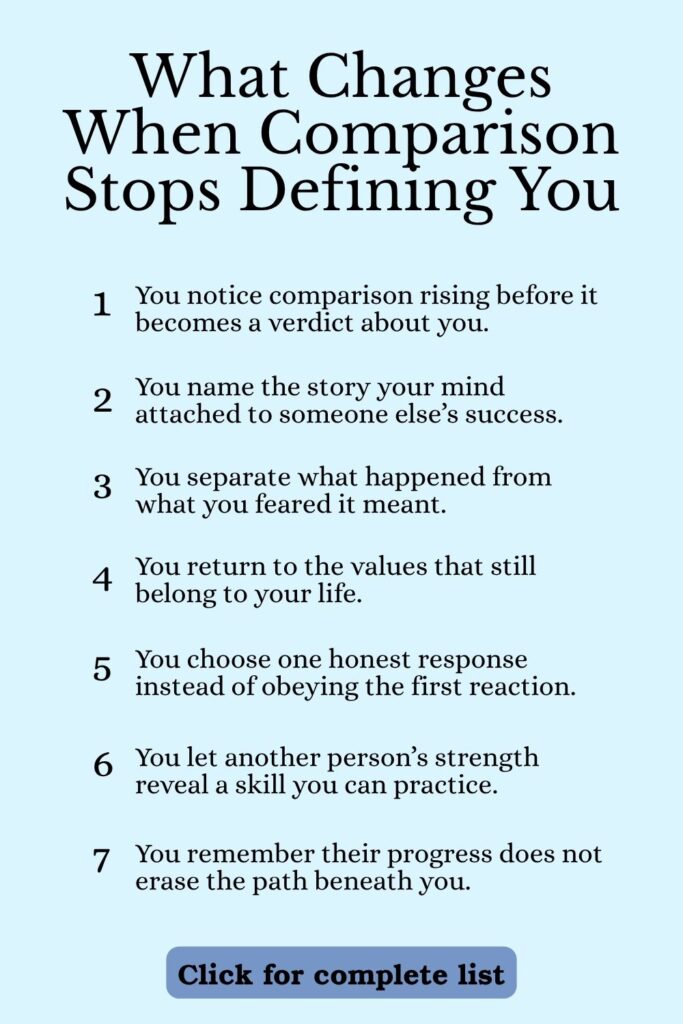
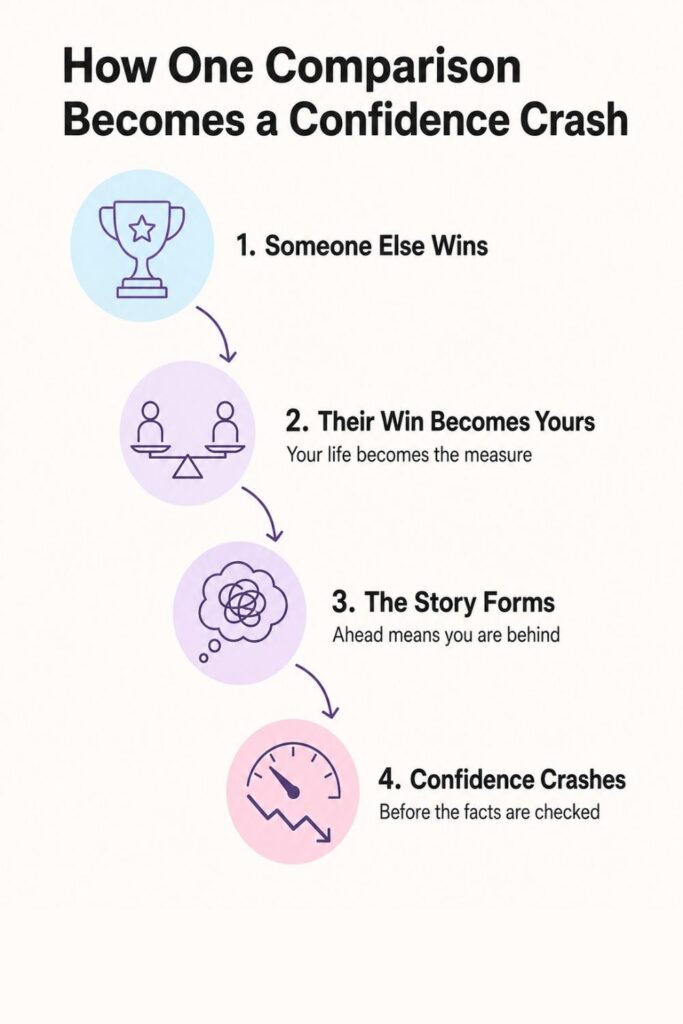
Comparison is not automatically harmful. It becomes damaging when another person’s life becomes the standard used to judge your entire worth.
Blame has a similar effect. It can identify genuine wrongdoing, but it becomes unhelpful when it prevents you from examining your own choices, boundaries, or next move.
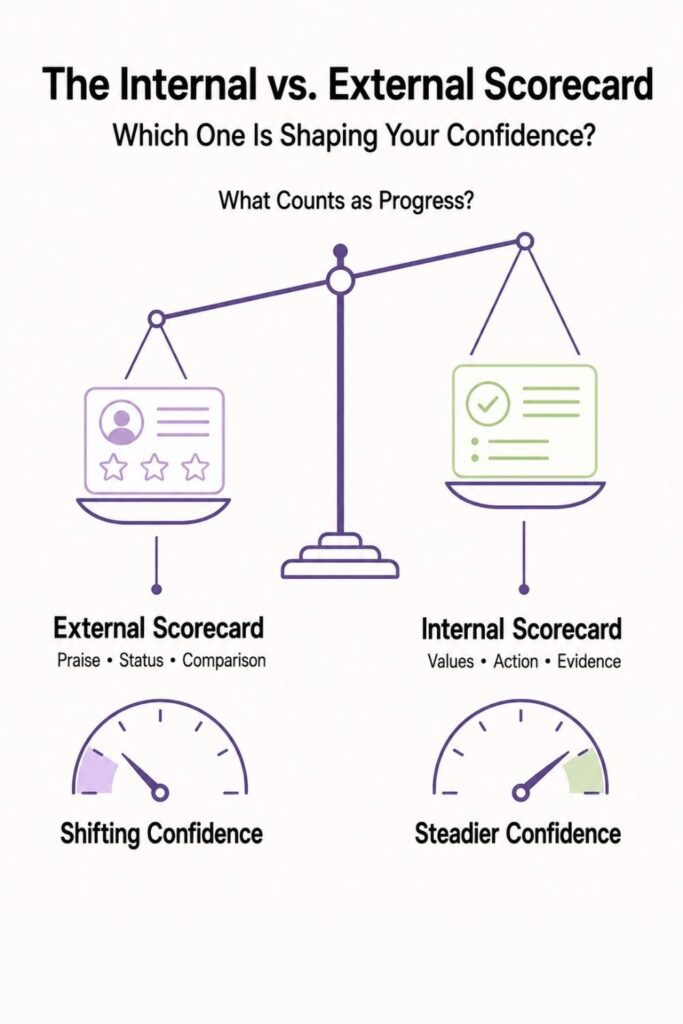
Whose Scorecard Are You Using to Measure Yourself?
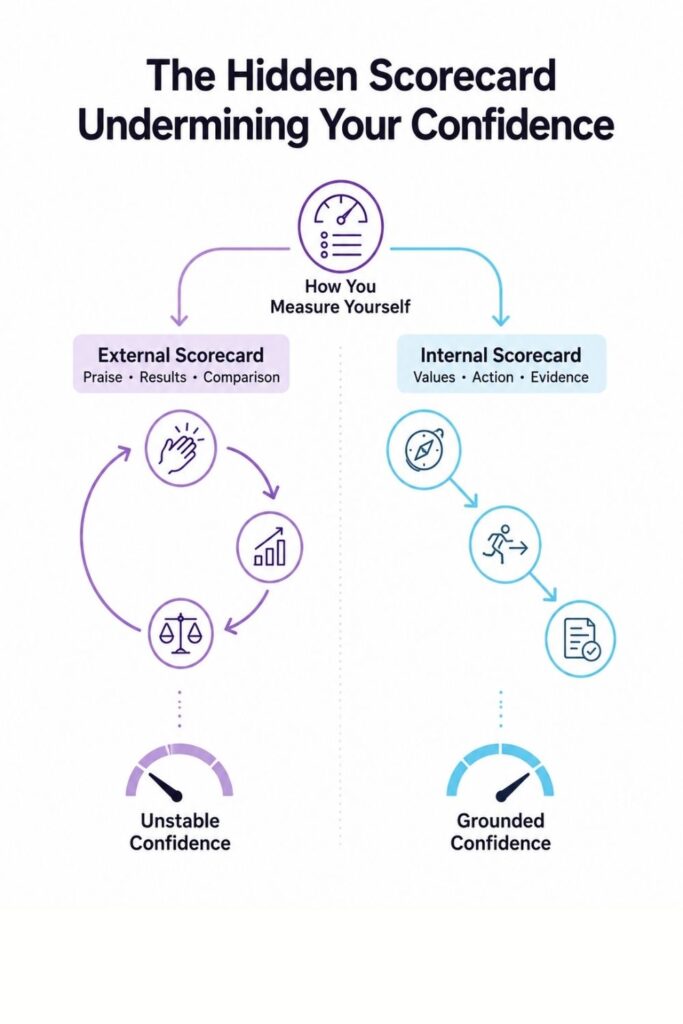
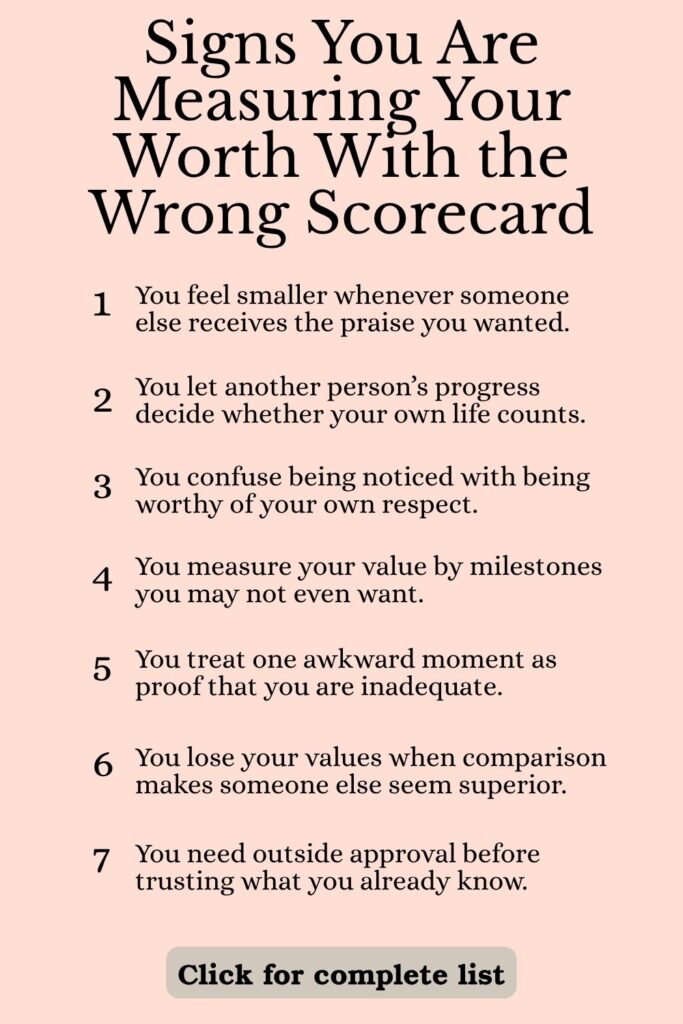
Your confidence becomes unstable when you measure yourself with a scorecard built around somebody else’s life.
An external scorecard may include:
- Who earns more money
- Who receives more praise
- Who appears more attractive
- Who has the larger home, audience, or social circle
- Who reached a milestone first
- Who seems more knowledgeable in one particular setting
An internal scorecard looks at different evidence:
- Did I act according to my values?
- Did I prepare properly?
- Did I speak honestly?
- Did I handle the setback better than I would have a year ago?
- Did I keep the boundary I decided to set?
- Did I take the next useful step?
A 2018 meta-analysis by Jerry P. Gerber, Ladd Wheeler, and Jerry Suls reviewed more than 60 years of social comparison research and found that comparisons can shape both self-evaluation and emotional reactions. The effect is not always negative, which is why the person you compare yourself with and the meaning you give the comparison both matter.
That distinction matters. Seeing someone perform well might reveal a skill you want to develop. It does not have to become evidence that you have less value.
Suppose a colleague receives a promotion. An external scorecard says, “They moved ahead, so I must be falling behind.”
If you want to get more from your life, and are looking for concrete action steps to get you there, check out our Request a Coach page. It’s a “cut the fence-sitting and take action” way to tackle your issues and actually find success. To get off the fence and start to take action, click or tap here.
An internal scorecard asks, “Do I actually want that role? What experience would I need? What is the next action available to me?”
The second response creates information. The first creates a verdict.
How Do You Interrupt the Comparison-and-Blame Loop?
You interrupt comparison and blame by separating what happened from the meaning you immediately attached to it.
Use this four-part loop:
- Trigger: What happened?
- Interpretation: What did you tell yourself it meant?
- Reaction: What did you do next?
- Aligned response: What action would reflect your values and serve you better?
Imagine that a friend talks excitedly about buying a house.
The trigger is the announcement. Your interpretation might be, “Everyone is progressing except me.” Your reaction might be to withdraw, criticize their decision, or spend the evening searching property listings you cannot currently afford.
An aligned response would be more specific. You might congratulate your friend, admit privately that the news brought up disappointment, and review your own financial goal the next morning.
The same loop works during conflict.
If you want to get more from your life, and are looking for concrete action steps to get you there, check out our Request a Coach page. It’s a “cut the fence-sitting and take action” way to tackle your issues and actually find success. To get off the fence and start to take action, click or tap here.
Your partner responds sharply to a question. You interpret the tone as proof that they do not respect you. You respond with another sharp comment, and the conversation gets worse.
A more aligned response might be, “That sounded dismissive to me. Can we start that answer again?”
A relationship or communication coach might role-play that sentence with you until you can say it directly, without attacking or retreating.
The point is not to suppress your reaction. It is to stop the first reaction from making every decision for you.
What Makes You Who You Are?
Who you are is built from qualities, values, experiences, choices, limitations, and the way you respond when life does not go to plan.
To strengthen and maintain core confidence, consider these questions seriously:
What makes you who you are? What qualities and ideas do you know are true about you?
These qualities are fuel for confidence, but only when they are grounded in something real.
If you want to get more from your life, and are looking for concrete action steps to get you there, check out our Request a Coach page. It’s a “cut the fence-sitting and take action” way to tackle your issues and actually find success. To get off the fence and start to take action, click or tap here.
What tends to happen is that we forget to look at our own qualities. We search outside ourselves for the standard of what society considers acceptable.
That is how we lose sight of who we are and what we bring to the world.
What is within us can often be adapted, developed, or understood more clearly. Other people can influence how we feel, especially when they criticize, exclude, manipulate, or disrespect us. But they do not get the final word on what their behavior means about our worth.
There will always be someone thinner or better looking than us.
There will always be someone who seems more appealing, more successful, or more knowledgeable about a particular subject.
But is that enough to stop us believing in who we really are?
How Do You Build a Confidence Evidence Bank?
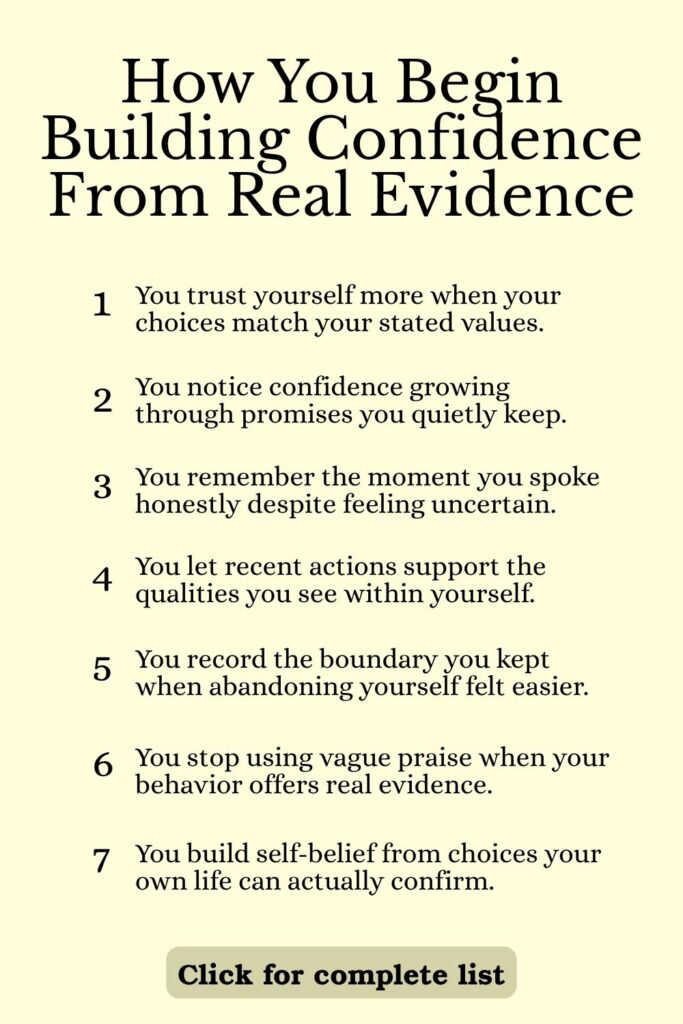
You build a confidence evidence bank by connecting every quality you claim to an action you can actually observe.
Writing “I am strong” may feel encouraging, but it is vague. Your mind can argue with it the moment something goes wrong.
If you want to get more from your life, and are looking for concrete action steps to get you there, check out our Request a Coach page. It’s a “cut the fence-sitting and take action” way to tackle your issues and actually find success. To get off the fence and start to take action, click or tap here.
A stronger record would look like this:
- Quality: I am dependable.
- Evidence: I completed the work I promised, even after the deadline became difficult.
- Recent example: I prepared the client notes before Monday’s session.
- Next evidence: I will send the follow-up document by 3 p.m. tomorrow.
Try the same process with other qualities:
- “I am courageous” becomes “I raised a concern with my manager even though I was nervous.”
- “I am thoughtful” becomes “I asked a follow-up question instead of assuming I understood.”
- “I am disciplined” becomes “I completed three practice sessions this week.”
- “I respect myself” becomes “I ended a conversation after the other person repeatedly insulted me.”
This evidence matters because confidence is easier to trust when it is attached to behavior.
You can keep the record in a notebook or a note on your phone. Add one example whenever you make a choice that reflects the person you want to be.
A confidence or career coach may challenge a label that is too general and ask, “What did you do that demonstrates that quality?” That question turns a hopeful description into something concrete.
Why Are Imperfections Part of Core Confidence?
Imperfection is part of core confidence because confidence does not require you to deny weaknesses, mistakes, or unfinished growth.
Everything we are and can be is within us. We need to look within, identify what is really there, and act in line with our values and life compass.
We forget that we are not meant to be perfect.
If you want to get more from your life, and are looking for concrete action steps to get you there, check out our Request a Coach page. It’s a “cut the fence-sitting and take action” way to tackle your issues and actually find success. To get off the fence and start to take action, click or tap here.
For me, being human is an opportunity to take our imperfections and work with them through learning, repair, and adaptation.
We never really reach perfection because the standard keeps changing. A new job, relationship, responsibility, or stage of life will always expose something else we have not mastered.
That does not make the journey a failure. It keeps the journey moving.
How Do You Accept Imperfection Without Excusing Avoidance?
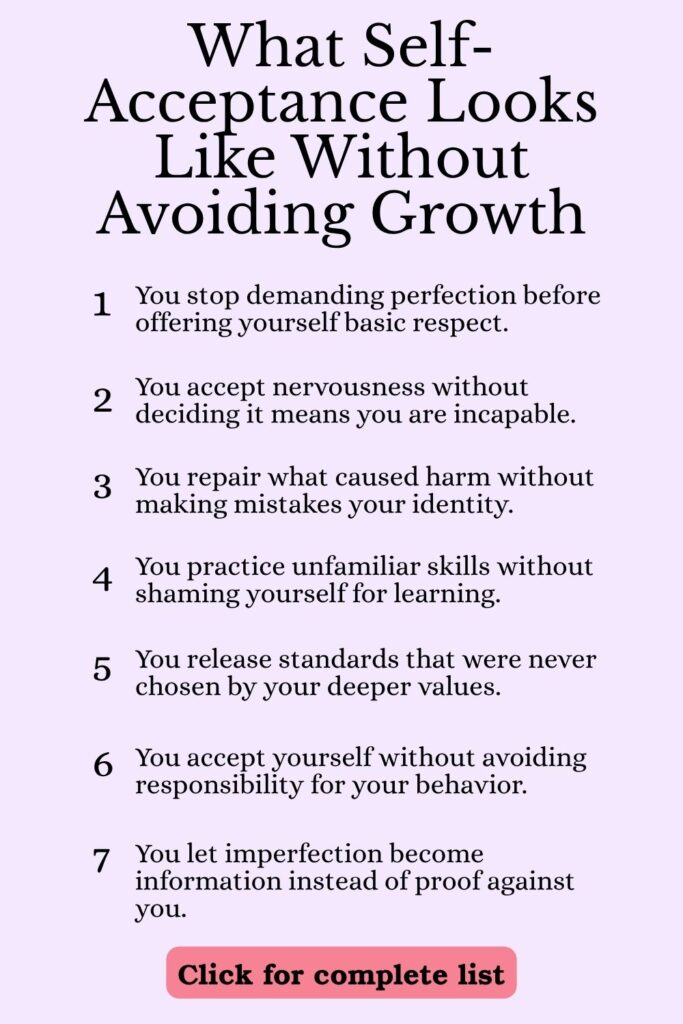
You can accept imperfection without becoming complacent by deciding whether the issue needs acceptance, repair, practice, or release.
Use these four categories:
- Accept: This is a neutral, human, or unchangeable part of me.
- Repair: My behavior affected someone, and I need to address it.
- Practice: This is a skill I can develop through repetition and feedback.
- Release: This standard is impossible, irrelevant, or not truly mine.
Suppose you become nervous while speaking in front of a group.
You might accept that your body produces an adrenaline response. You might repair the situation if nerves caused you to speak dismissively to a colleague.
You could practice your opening until it feels familiar. You might also release the belief that a capable speaker never pauses, forgets a word, or feels nervous.
If you want to get more from your life, and are looking for concrete action steps to get you there, check out our Request a Coach page. It’s a “cut the fence-sitting and take action” way to tackle your issues and actually find success. To get off the fence and start to take action, click or tap here.
These categories prevent two common mistakes. The first is attacking yourself for something human. The second is calling every avoidable behavior “self-acceptance.”
In four experiments published in Personality and Social Psychology Bulletin, Juliana G. Breines and Serena Chen found that responding to weaknesses and failures with self-compassion increased several forms of motivation to improve. Participants showed outcomes such as greater motivation to correct a weakness, make amends after a mistake, and spend more time preparing after poor performance.
Acceptance gives you an accurate starting point. Responsibility determines what happens next.
What Questions Reveal Your Core Confidence?
The questions that reveal core confidence focus on who you are, what evidence supports that view, and how you respond when doubt appears.
Start with this:
What makes you who you are?
Write it down. It may feel strange, but making the answer visible forces you to become specific.
List the qualities you like and the qualities you find difficult. Include contradictions.
You might be generous but poor at asking for help. Ambitious but easily distracted. Patient with clients but impatient with family. Quiet in groups but direct in one-to-one conversations.
If you want to get more from your life, and are looking for concrete action steps to get you there, check out our Request a Coach page. It’s a “cut the fence-sitting and take action” way to tackle your issues and actually find success. To get off the fence and start to take action, click or tap here.
It is all information.
Then ask:
- Which qualities are supported by recent behavior?
- Which qualities do I want to strengthen?
- Which weaknesses need acceptance?
- Which behaviors need repair?
- Which skills need practice?
- Which standards need to be released?
- What do I do when someone appears to outperform me?
- What would my internal scorecard say about this situation?
If you compare yourself with another person and it does not feel good, interrupt the thought process.
Name the quality you believe the other person possesses. Then decide whether you truly want to develop it, or whether you are simply reacting to their visibility, praise, appearance, or status.
For example, you may envy someone who speaks confidently in meetings. Instead of repeating, “They are better than me,” identify the behavior.
Perhaps they prepare two points before every meeting and speak within the first ten minutes. Those are actions you can test.
Your next step might be to prepare one question and make one contribution at the next meeting. That action creates new evidence for your confidence bank.
Is This a Thought Problem, a Skill Gap, or an Environment Problem?
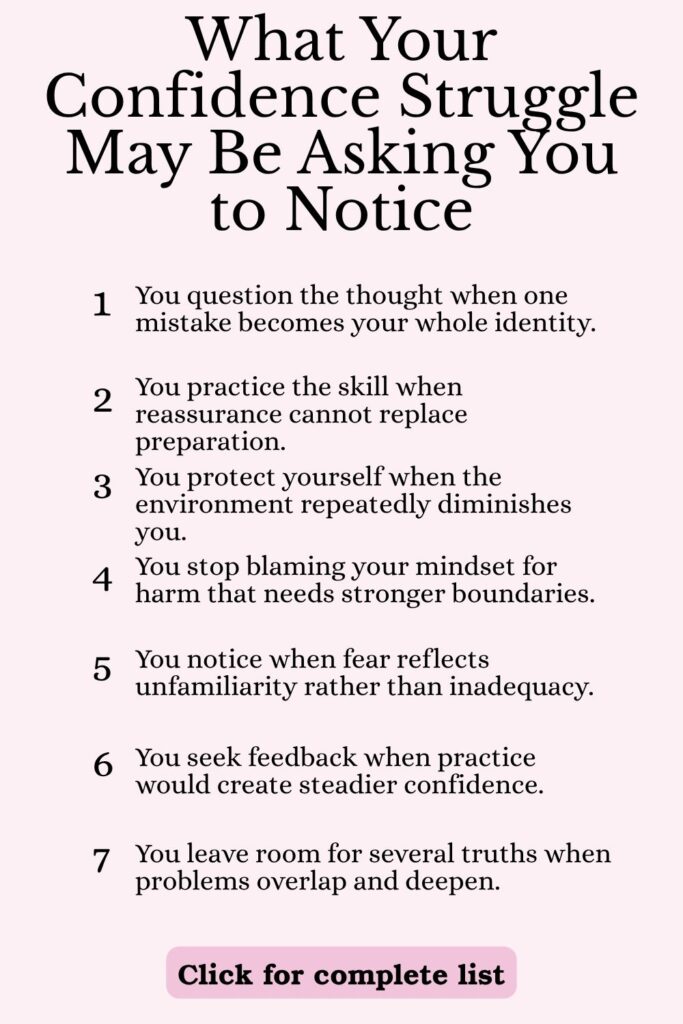
A confidence problem usually needs a different response depending on whether it comes from an unhelpful thought, a missing skill, or a damaging environment.
If you want to get more from your life, and are looking for concrete action steps to get you there, check out our Request a Coach page. It’s a “cut the fence-sitting and take action” way to tackle your issues and actually find success. To get off the fence and start to take action, click or tap here.
Use this three-way check before trying to think more positively.
A thought problem occurs when your interpretation goes beyond the available evidence.
You make one mistake during a presentation and decide, “I am terrible at public speaking.” The mistake happened. The global conclusion is an interpretation.
A skill gap occurs when you have not yet developed the ability the situation requires.
You may struggle to answer interview questions because you have not practiced explaining your experience clearly. Repeating affirmations will not replace rehearsal, feedback, and another attempt.
An environment problem occurs when the setting repeatedly undermines, humiliates, excludes, manipulates, or threatens you.
A manager who mocks employees in meetings is not simply exposing a confidence weakness. A partner who repeatedly insults you is not offering constructive feedback.
That kind of situation may require documentation, boundaries, outside support, a formal complaint, or a plan to leave.
If you want to get more from your life, and are looking for concrete action steps to get you there, check out our Request a Coach page. It’s a “cut the fence-sitting and take action” way to tackle your issues and actually find success. To get off the fence and start to take action, click or tap here.
The three categories can overlap.
A difficult environment can create unhelpful thought patterns. A skill gap can make a challenging situation feel more threatening. A harsh interpretation can discourage you from practicing the skill you need.
The diagnosis determines the next move:
- Challenge the thought.
- Practice the skill.
- Change or protect yourself from the environment.
A career coach might help you separate interview anxiety from an actual preparation gap. A relationship coach might help you rehearse a boundary and identify what you will do if the boundary is ignored.
Can You Change the Thoughts That Weaken Confidence?
You can change many confidence-damaging thoughts by examining them, testing them against evidence, and practicing a more accurate response.
You are responsible for your choices, including some choices that happen so quickly they barely feel deliberate.
Your thoughts are part of that process, but you do not have to believe every thought that appears.
Try this short sequence:
If you want to get more from your life, and are looking for concrete action steps to get you there, check out our Request a Coach page. It’s a “cut the fence-sitting and take action” way to tackle your issues and actually find success. To get off the fence and start to take action, click or tap here.
- Catch it: What did I just tell myself?
- Check it: What evidence supports or contradicts that thought?
- Correct it: What would be more precise?
- Create evidence: What action would support the corrected thought?
“I always fail when I speak up” might become, “I lost my train of thought once during today’s meeting. I can prepare my first sentence before the next one.”
The corrected thought is not blindly positive. It is narrower, more accurate, and connected to action.
Guided meditation can also be useful when it helps you slow down enough to notice a recurring thought, direct your attention, or rehearse a different response.
For example, you might listen to a short recording before a difficult conversation and mentally practice speaking slowly, naming the issue, and staying with your point.
Consistency matters because the new response needs repetition. But the aim is not to force yourself to feel confident overnight.
The aim is to think more accurately and behave in ways that gradually give confidence something solid to stand on.
Frequently Asked Questions About Core Confidence
What is core confidence?
Core confidence is a stable belief that you have worth, agency, and the ability to respond to challenges. It does not require constant certainty, success, or approval.
How do you build confidence from within?
You build confidence from within by using your values, choices, behavior, and progress as your main scorecard. Recording specific evidence helps make that confidence more believable.
If you want to get more from your life, and are looking for concrete action steps to get you there, check out our Request a Coach page. It’s a “cut the fence-sitting and take action” way to tackle your issues and actually find success. To get off the fence and start to take action, click or tap here.
What is the difference between core confidence and self-esteem?
Core confidence describes your underlying trust in your ability to respond and act, while self-esteem usually refers more broadly to how positively you evaluate yourself. The terms can overlap, and core confidence is used here as a practical concept rather than a clinical diagnosis.
Why do I lose confidence around certain people?
You may lose confidence around certain people because they trigger comparison, fear of judgment, an old relationship pattern, or a realistic concern about how they treat you. Identifying the trigger helps distinguish an internal interpretation from an unsafe or disrespectful environment.
How do I stop comparing myself with other people?
You reduce harmful comparison by identifying the scorecard you are using and returning to evidence from your own values, actions, and progress. You can also turn useful comparison into a specific skill or behavior you want to practice.
Can confidence be learned through practice?
Confidence can grow through practice when repeated action improves your skill and creates evidence that you can handle the situation. Practice is especially useful for interviews, public speaking, boundaries, difficult conversations, and unfamiliar responsibilities.
How do I become confident without pretending?
You become confident without pretending by acknowledging what you do not know while acting on what you do know. Honest preparation and small acts of follow-through are more sustainable than performing certainty you do not feel.
How long does it take to rebuild confidence?
Rebuilding confidence takes repeated experiences that challenge the old belief and create new evidence. The timeline will be affected by the original cause, the environment, the skill involved, and how often you can practice a different response.
Core confidence is not built by becoming better than everybody around you.
It grows when you know what you value, recognize what you bring, accept what is human, and take responsibility for the next choice available to you.
If you want to get more from your life, and are looking for concrete action steps to get you there, check out our Request a Coach page. It’s a “cut the fence-sitting and take action” way to tackle your issues and actually find success. To get off the fence and start to take action, click or tap here.
Think about the questions above and notice what comes up. Write down one quality you value in yourself, one recent example that supports it, and one action that will strengthen it this week.
I would love to know what you discover.
Alida x
Sources
Breines, Juliana G., and Serena Chen. “Self-Compassion Increases Self-Improvement Motivation.” Personality and Social Psychology Bulletin, vol. 38, no. 9, 2012, pp. 1133–1143. https://doi.org/10.1177/0146167212445599.
Gerber, Jerry P., Ladd Wheeler, and Jerry Suls. “A Social Comparison Theory Meta-Analysis 60+ Years On.” Psychological Bulletin, vol. 144, no. 2, 2018, pp. 177–197. https://doi.org/10.1037/bul0000127.
If you want to get more from your life, and are looking for concrete action steps to get you there, check out our Request a Coach page. It’s a “cut the fence-sitting and take action” way to tackle your issues and actually find success. To get off the fence and start to take action, click or tap here.
Read this next
What Most People Get Wrong About Learning From Failure
You can learn a lot from your failures, which will lead you to success
Read More
Importance of a Balanced Self-Esteem
What is self-esteem? How does it affect your life? What can you do to improve yours?
Read More
This Is Your Sign to Try a Head-to-Toe White Outfit
When it comes to fashion, white outfits are a timeless choice that can make you look effortlessly stylish. Whether you’re dressing for a casual day out or a fancy event, […]
Read More