


Talk to a coach about Organizational coaching

Crystal Faulk
ACC
I help overwhelmed women in transition gain clarity, confidence, and...

Terrie Hein
Certified Life Coach, Certified Insight Coach Practitioner
Coaching to declutter your life, organize your goals, and cook...

Dr Charlene Ashley
Doctorate - Behaviours
I coach individuals to design fulfilling lives through structure, clarity,...

Paloma Chiara

Lana's Gymnastics Club
"Where the best in gymnastics meets fun. Where every child is a star"
lgclubny.com

Anna Sosnina
ICF (ACC)
ICF ACC certified coach, founder of EssorVie Coaching, passionate about...

Travis Brown
Professional Life coach
With experience in guiding clients to achieve goals, build confidence,...

Lynn Yang
Certified Christian Leadership Coaching (CCLC)
I will help you gain new insights, habits, and plans...





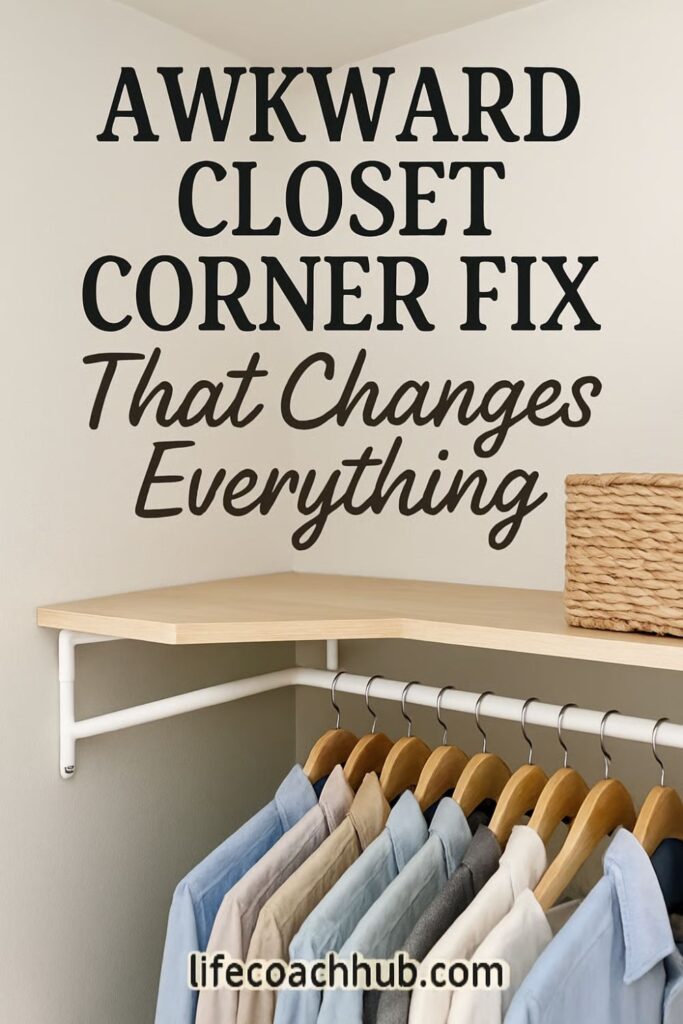
Awkward Corner Closet: Hanging Zones That Work
Are you all about style, decor and organization? Download a copy of our Clutter Reset Guide.
****
An awkward closet corner can make the whole closet feel harder to use. It is the spot where hangers get stuck, bags slide down, scarves disappear, and anything without a clear home slowly turns into a pile. The frustrating part is that the space is technically there, but it does not behave like normal closet space.
That is why an awkward corner needs a different kind of plan. Instead of trying to force it to work like the rest of the closet, you can turn it into a small hanging zone with its own purpose. Angled storage, hooks, tension rods, and slim hanging helpers can make the corner easier to reach and much easier to maintain.
The key is to stop treating the corner like leftover space. When a corner does not have a job, it becomes a dumping zone. When it has a clear job, it can hold the exact items that usually make a closet feel messy.
This setup works especially well for:
- Small closets with wasted side corners
- Closets with angled walls or odd layouts
- Bifold closets where the door blocks part of the opening
- Rental closets where drilling is not an option
- Bedrooms with limited dresser or shelf space
The goal is not to create a perfect custom closet. The goal is to make the dead corner useful with simple, practical changes.
By the end, the reader should be able to look at the awkward closet corner and know where to place everyday items, occasional items, lightweight accessories, and overflow pieces. A corner that once felt annoying can become a tidy little storage station that actually supports the rest of the closet.
If you want to get more from your life, and are looking for concrete action steps to get you there, check out our Request a Coach page. It’s a “cut the fence-sitting and take action” way to tackle your issues and actually find success. To get off the fence and start to take action, click or tap here.
Need some in depth help with organization and productivity ? Drop on by our directories choc full of productivity coaches, minimalist coaches, and work/life balance coaches to get your life organized! Or click here to have us match you to the best.
1. Map the Dead Corner Before You Add Anything
Before adding rods, hooks, bins, or organizers, start by figuring out what the corner is actually doing wrong. Most awkward closet corners fail because people try to organize them while they are still full. That makes it hard to see the shape, the reach limits, and the spots where items naturally get stuck.
Empty the awkward section first: Remove everything from the corner, including hangers, bags, shoes, boxes, loose accessories, and anything that has been shoved there temporarily. This gives you a clean view of the actual space instead of the clutter pattern.
Once the corner is empty, stand in front of the closet and notice how your body moves. Can you reach the back wall easily? Does the closet door block part of the space? Do hangers scrape the wall or hit each other when you slide them across the rod?
Find the unusable angle: Look for the exact point where the closet stops being convenient. This might be where the wall turns, where the rod ends, where the door folds inward, or where your arm has to twist awkwardly to reach the back.
A good way to test this is to place one hand in the closet and reach naturally into the corner. Wherever your hand starts to strain, that area should not hold daily-use items.
Mark the reachable zone: Use painter’s tape, sticky notes, or a folded scarf to mark the section you can reach comfortably. This becomes your prime corner zone.
Then mark the deeper section separately. That space can still be useful, but it should hold items you do not need every day.
If you want to get more from your life, and are looking for concrete action steps to get you there, check out our Request a Coach page. It’s a “cut the fence-sitting and take action” way to tackle your issues and actually find success. To get off the fence and start to take action, click or tap here.
Separate “visible” from “hidden” space: Treat the front-facing corner as active storage and the deepest part as occasional storage. This small distinction keeps the corner from turning back into a pile.
This step may feel simple, but it prevents the most common mistake: putting high-use items in the hardest-to-reach place.
2. Choose What Belongs in the Corner Zone
Once the corner is mapped, the next step is deciding what should actually live there. Not every item belongs in an awkward corner, even if it technically fits. The best corner items are flexible, lightweight, and easy to grab without disturbing the rest of the closet.
Sort by reach level: Divide items into daily-use, weekly-use, and occasional-use categories. Daily-use items should stay closest to the front. Weekly-use items can go along the side wall or angled hanging area. Occasional items can sit deeper in the corner.
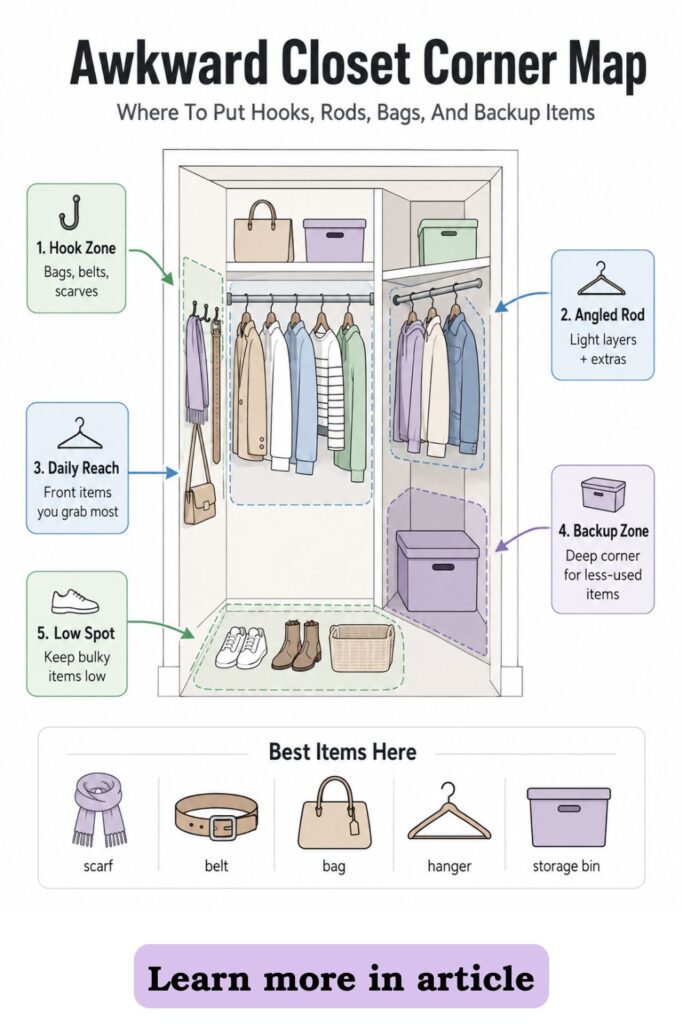
This keeps the corner from becoming annoying. If you have to fight the closet every morning to get a jacket or bag, the system will not last.
Avoid bulky pieces first: Thick coats, oversized robes, heavy garment bags, and stiff structured items usually make awkward corners worse. They block sightlines, take up swing space, and make hangers jam together.
Instead, save the corner for slimmer pieces like:
- Belts
- Scarves
- Lightweight jackets
- Tank tops
- Camisoles
- Small bags
- Hats
- Outfit planning items
- Repeat-wear clothing
Group by item behavior: Think about how items hang, not just what they are called. A scarf, belt, and thin crossbody bag may all work well together because they hang flat. A puffy coat and a structured tote may not work well together because they compete for space.
If you want to get more from your life, and are looking for concrete action steps to get you there, check out our Request a Coach page. It’s a “cut the fence-sitting and take action” way to tackle your issues and actually find success. To get off the fence and start to take action, click or tap here.
This is where the corner can become surprisingly useful. It is often better for accessories and outfit extras than for full clothing sections.
Use the corner for flexible storage: Choose items that can clip, hang, fold over a rod, or sit on hooks. Flexible items adapt to angled space much better than rigid bins or crowded stacks.
A simple rule helps: if an item needs to be pulled straight out with two hands, it probably does not belong in the deepest part of the corner. If it can be lifted, clipped, or grabbed with one hand, it is a better fit.
The corner should support the closet, not compete with it.
3. Add an Angled Tension Rod for a Second Hanging Line
A tension rod can be one of the easiest ways to make an awkward closet corner more useful, especially if the closet has two surfaces close enough to hold it securely. Instead of adding a full shelf or permanent rod, a tension rod gives you a light-duty hanging line that can sit at an angle.
Measure the diagonal span: Check the distance between the side wall, back wall, closet frame, or any sturdy surface that could hold a tension rod. The rod should fit snugly without bowing, slipping, or needing to be forced into place.
Do not install it where it blocks the main closet rod. The goal is to create a second hanging line, not make the existing one harder to use.
Use it for lightweight items only: Tension rods are useful, but they are not meant to hold everything. Use them for lighter pieces that do not put too much pressure on the rod.
If you want to get more from your life, and are looking for concrete action steps to get you there, check out our Request a Coach page. It’s a “cut the fence-sitting and take action” way to tackle your issues and actually find success. To get off the fence and start to take action, click or tap here.
Good options include:
- Scarves
- Belts on rings
- Tank tops
- Camisoles
- Lightweight purses
- Outfit prep hangers
- Empty hangers
- Soft hats
- Small fabric organizers
Avoid heavy coats, full laundry bags, heavy backpacks, or multiple loaded hangers. If the rod slips once, the setup will feel unreliable.
Place the rod below eye level: A lower angled rod often works better than one placed too high. It stays visible, it is easier to reach, and it does not compete with the main hanging rail above it.
Try placing it where you can see the items at a glance when you open the closet. If you forget the rod is there, the system will not help much.
Test the swing space: After installing the rod, move the main closet hangers back and forth. Open the door fully. Reach for a few items. If anything catches, lower the rod, shorten the hanging items, or move it slightly forward.
This small angled line can turn the corner into a useful accessory zone without requiring tools, drilling, or a full closet makeover.
4. Turn the Side Wall Into a Hook Zone
The side wall of an awkward closet corner is often wasted because it does not seem large enough for shelves or bins. But it can be perfect for hooks. Hooks are especially useful because they make vertical space visible and easy to use.
Choose removable hooks if needed: If you rent or do not want to drill, use renter-safe adhesive hooks or over-the-door hook strips. Pick hooks based on the item you plan to hang, not just the hook size. A tiny hook may hold a belt, but it may not hold a bag strap securely.
If you want to get more from your life, and are looking for concrete action steps to get you there, check out our Request a Coach page. It’s a “cut the fence-sitting and take action” way to tackle your issues and actually find success. To get off the fence and start to take action, click or tap here.
Before sticking adhesive hooks to the wall, clean the surface and let it dry. Follow the weight limits carefully. It is better to use several hooks for light items than one hook overloaded with too much.
Place hooks in a staggered pattern: Avoid lining every hook up at the same height. When hooks sit in one straight row, items overlap and create a bulky cluster.
Instead, stagger them:
- One higher hook for hats or scarves
- One mid-level hook for belts or bags
- One lower hook for repeat-wear clothing
- One easy-reach hook for tomorrow’s outfit
This makes the wall easier to read visually. Each hook gets breathing room, and items do not fight for the same space.
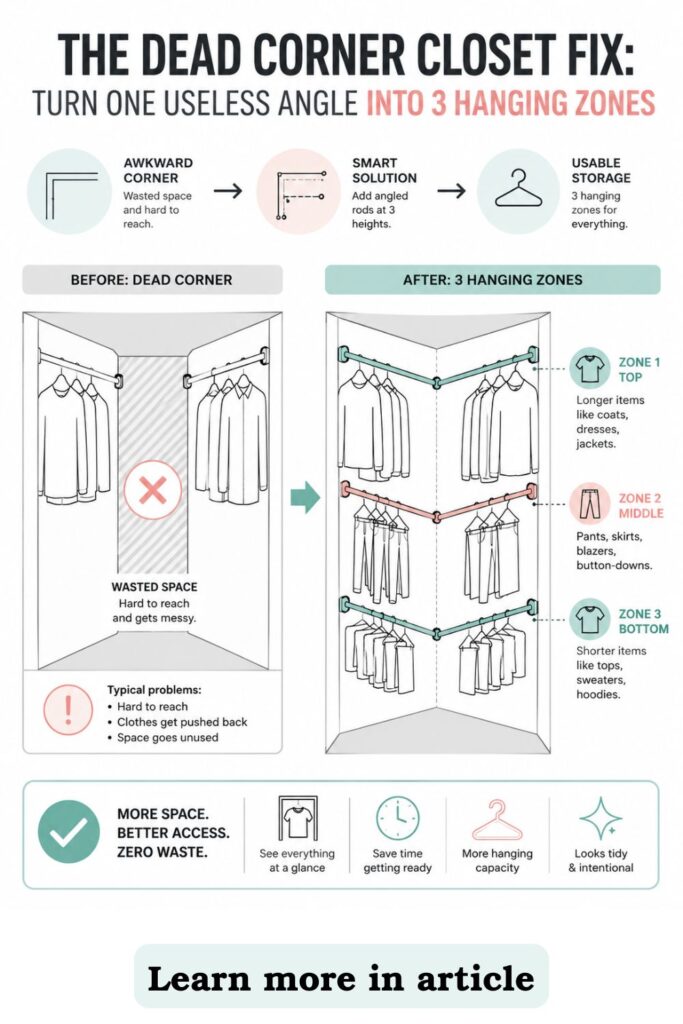
Assign each hook a job: A hook zone works best when each hook has a clear purpose. Otherwise, it becomes another drop zone.
For example:
- Hook 1: Everyday belt
- Hook 2: Current bag
- Hook 3: Outfit planned for tomorrow
- Hook 4: Light jacket or repeat-wear item
Keep the heaviest items low: Place bulkier or heavier items lower on the side wall. This makes the closet feel less crowded and reduces the chance of hooks pulling loose.
A hook zone is one of the simplest ways to make an awkward corner work harder. It also makes the closet easier to reset because every hanging item has a visible place to return.
If you want to get more from your life, and are looking for concrete action steps to get you there, check out our Request a Coach page. It’s a “cut the fence-sitting and take action” way to tackle your issues and actually find success. To get off the fence and start to take action, click or tap here.
5. Repurpose Small Items Into Hanging Helpers
You do not always need new closet organizers to fix an awkward corner. Sometimes the best solution is repurposing small items you already have. The goal is to create slim hanging helpers that group loose items without adding bulky storage.
Use shower rings for soft accessories: Shower rings can turn a rod or hanger into a mini accessory station. Clip scarves, belts, camisoles, or soft hats onto the rings, then hang them from a tension rod, closet rod, or sturdy hanger.
This works well because it keeps small items separated but still visible. Instead of digging through a bin, you can see what you have right away.
Turn clip hangers into mini stations: Skirt hangers and pant hangers are useful for more than clothing. Use the clips to hold fabric belts, gloves, folded scarves, thin pouches, or outfit add-ons.
You can also create a “next outfit” hanger by clipping the small pieces that go with tomorrow’s clothing. This is helpful in a tight closet because it keeps outfit planning vertical instead of spreading items across a chair or dresser.
Add a tote bag as a soft catchall: A sturdy fabric tote can hang from a hook and hold soft overflow items. This is useful for things that do not need to be individually displayed but still need a home.
Good tote-bag items include:
- Seasonal gloves
- Travel pouches
- Soft hats
- Extra straps
- Small fabric bags
- Occasional accessories
Avoid turning the tote into a mystery bag. Keep it limited to one category or one purpose.
If you want to get more from your life, and are looking for concrete action steps to get you there, check out our Request a Coach page. It’s a “cut the fence-sitting and take action” way to tackle your issues and actually find success. To get off the fence and start to take action, click or tap here.
Use S-hooks for flexible storage: S-hooks can hang over a rod and hold bags, baskets with handles, belts, or lightweight organizers. They are easy to move, which makes them useful when you are still testing the closet layout.
Repurposed tools are helpful because they keep the system affordable and adjustable. If your needs change, you can move the rings, clips, hooks, or tote without redesigning the whole closet.
6. Build Clear Hanging Zones So the Corner Stays Organized
The biggest difference between a closet corner that works and one that falls apart is zoning. A zone gives each part of the corner a purpose. Without zones, the corner becomes a place where unrelated items collect.
Create a front zone: The front corner should hold items you use often. This is the part of the closet you can reach quickly without pushing other things aside.
Use the front zone for:
- Current-season layers
- Everyday bags
- Workwear add-ons
- Favorite scarves
- Repeat-wear clothing
- Outfit planning pieces
This area should feel easy. If it becomes crowded, move less-used items deeper into the closet or out of the corner completely.
Create a side zone: The side wall or angled rod can hold smaller hanging items that need visibility but not prime rod space. This is where hooks, shower rings, clip hangers, and S-hooks work well.
The side zone is perfect for accessories that usually end up tangled or buried. Instead of placing them in a drawer, you can hang them in a narrow vertical strip.
If you want to get more from your life, and are looking for concrete action steps to get you there, check out our Request a Coach page. It’s a “cut the fence-sitting and take action” way to tackle your issues and actually find success. To get off the fence and start to take action, click or tap here.
Create a deep zone: The deepest corner should hold items you do not need every day. This could include seasonal accessories, backup hangers, special-occasion pieces, or extra storage bags.
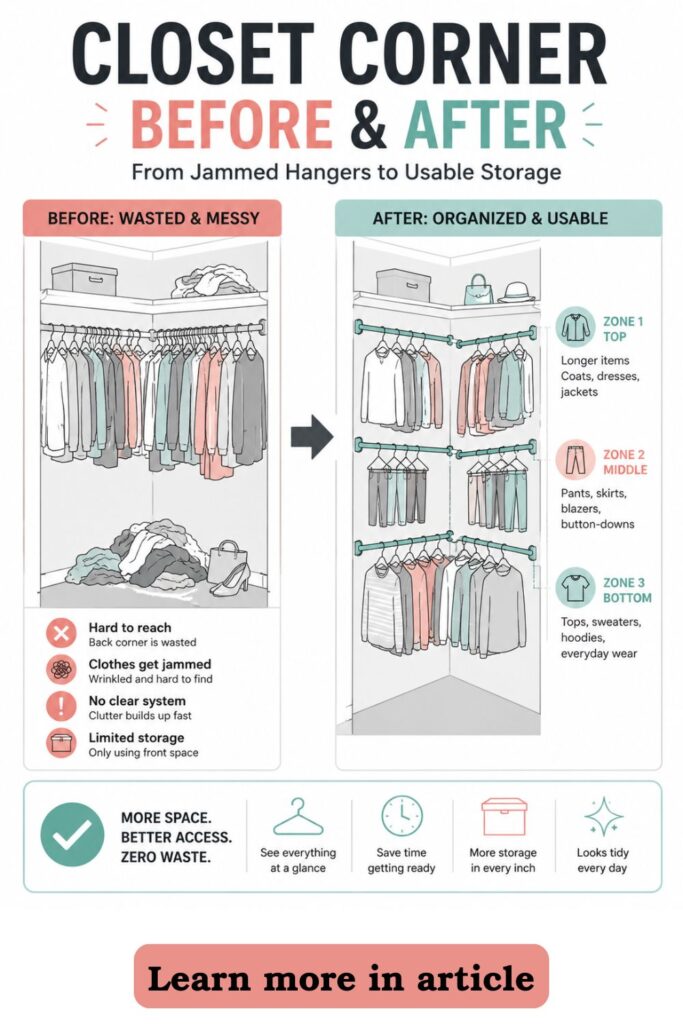
Keep this zone lighter than you think it should be. Deep closet space becomes frustrating when it is packed too tightly.
Label the zones lightly: Labels do not need to be fancy. A small tag, washi tape marker, or hanger divider can remind you what each area is for.
Possible labels include:
- Everyday
- Accessories
- Outfit Prep
- Seasonal
- Bags
- Belts
- Backup
Clear zones make cleanup faster because you are not deciding where everything belongs each time. The system does the thinking for you.
7. Use a Quick Checklist Before You Call It Done
Before you decide the corner is finished, test it like you would actually use it. A closet setup can look good for five minutes and still fail during a rushed morning. The final check helps you catch problems before they become daily annoyances.
Check for blocked access: Open the closet door fully. Slide hangers across the main rod. Reach into the corner from your normal standing position. If you have to twist, bend awkwardly, or move three things to grab one item, something needs adjusting.
A useful corner should make storage easier, not just fuller.
If you want to get more from your life, and are looking for concrete action steps to get you there, check out our Request a Coach page. It’s a “cut the fence-sitting and take action” way to tackle your issues and actually find success. To get off the fence and start to take action, click or tap here.
Check for overloaded tools: Look at every hook, rod, hanger, and ring. If anything is sagging, slipping, bending, or pulling away from the wall, reduce the weight right away.
This is especially important with adhesive hooks and tension rods. They can work beautifully when used correctly, but they should not be treated like built-in hardware.
Check for visual clutter: Step back and look at the closet with the door open. Can you tell what each corner zone is for? Or does it still look like a collection of random things?
If the corner looks confusing, simplify it. Remove one category. Space out the hooks. Group similar items together. Leave a little empty space so the system is easier to understand.
Check for daily use: Pull out one item you use often and put it back. Then do it again with a different item. This small test tells you whether the system will work in real life.
A good checklist might look like this:
- Can I reach daily items easily?
- Does the door open without hitting anything?
- Are hooks holding safely?
- Is the tension rod secure?
- Are deep-corner items used less often?
- Can I put things back without thinking too much?
If the answer is yes, the corner is ready. If not, adjust before adding more.
8. How an Organizing Coach Could Help You Make the Corner Work Long-Term
An awkward closet corner can seem like a storage problem, but sometimes it is also a habit problem. The system might work for a few days, then slowly turn messy again because the closet does not match the way you actually get dressed, put things away, or make decisions.
If you want to get more from your life, and are looking for concrete action steps to get you there, check out our Request a Coach page. It’s a “cut the fence-sitting and take action” way to tackle your issues and actually find success. To get off the fence and start to take action, click or tap here.
Spot the real storage pattern: An organizing coach can help you figure out why the corner keeps breaking down. Maybe there are too many categories in one place. Maybe the items are too hard to reach. Maybe the closet is holding things that no longer fit your routine.
Instead of simply adding more organizers, a coach can help identify the pattern behind the clutter.
For example, they might notice that:
- Bags are piling up because they do not have a visible home
- Repeat-wear clothing is landing on a chair because there is no closet hook for it
- Accessories are getting lost because they are stored too deeply
- Seasonal items are taking up prime space
- The closet has too many “just in case” pieces
Create rules for what earns closet space: A coach can help you decide what belongs in the closet and what should move elsewhere. This is especially helpful in a small or awkward closet because every inch needs to work.
A simple rule might be: daily items stay in front, weekly items go on the side, and occasional items go deep or out of the closet.
Build a maintenance habit: A coach can also help create a simple reset routine. This could be a five-minute weekly check where you rehang loose items, clear the corner floor, and move anything that does not belong.
Adjust the setup around real life: If the system stops working, it does not mean you failed. It may just mean the zones need to change. A coach can help tweak the layout so it supports your real habits instead of fighting them.
That kind of support can turn a one-time closet fix into a system that actually lasts.
If you want to get more from your life, and are looking for concrete action steps to get you there, check out our Request a Coach page. It’s a “cut the fence-sitting and take action” way to tackle your issues and actually find success. To get off the fence and start to take action, click or tap here.
9. Small Closet Corner Mistakes to Avoid
An awkward corner can hold more than you think, but it can also become messy fast if the setup is too crowded or too complicated. A few common mistakes can make the corner harder to use, even after you add organizers.
Do not overfill the deepest angle: The deepest part of the corner is usually the hardest to reach. That means it should hold fewer things, not more.
It is tempting to pack this area because it feels like “extra” space. But if you cannot see or reach what is back there, it quickly becomes forgotten storage.
Use the deep angle for items like:
- Off-season accessories
- Special-occasion pieces
- Backup hangers
- Travel bags
- Rarely used closet extras
Keep everyday items out of that zone.
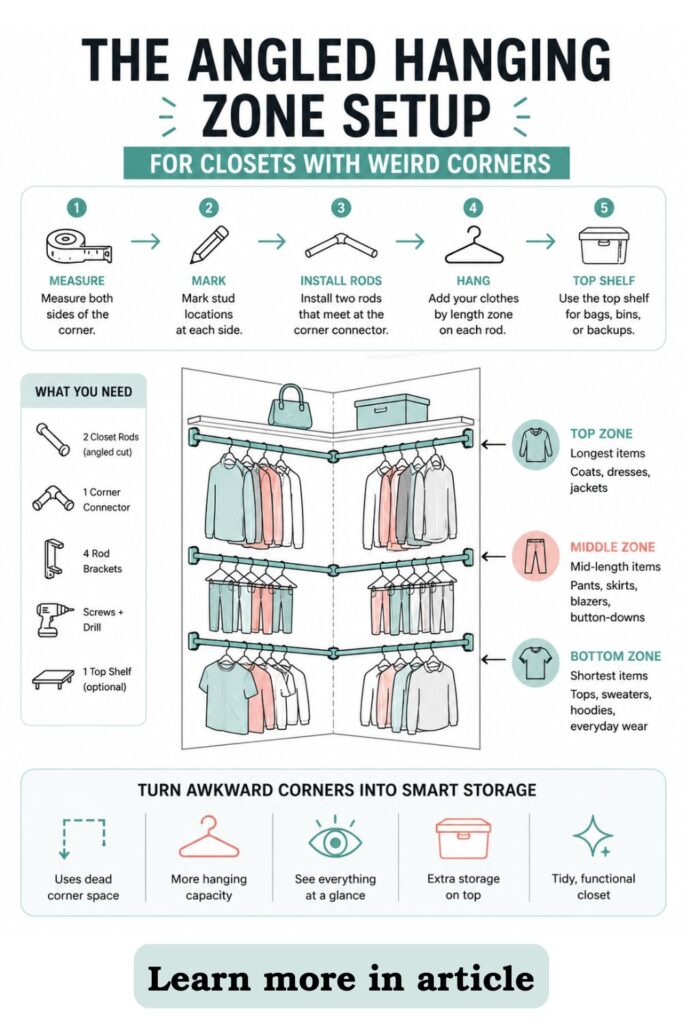
Do not hang heavy items from weak hooks: Adhesive hooks, tension rods, and lightweight hanging tools all have limits. If you use them for heavy bags, coats, or overloaded organizers, they can fall and make the closet feel unreliable.
For heavier items, use the main closet rod, a sturdy shelf, or proper installed hardware if that is an option.
Do not mix every category together: A corner can become chaotic when bags, belts, jackets, scarves, hats, and random extras all share the same few hooks.
If you want to get more from your life, and are looking for concrete action steps to get you there, check out our Request a Coach page. It’s a “cut the fence-sitting and take action” way to tackle your issues and actually find success. To get off the fence and start to take action, click or tap here.
Instead, give each category a small home. Even one hook per category can make a big difference.
Do not ignore the door swing: This is especially important with bifold doors, sliding doors, and closets near tight bedroom corners. The system should not block the door, catch on hinges, or make the closet annoying to open.
Do not make the setup too detailed: If the system has too many tiny rules, it may be hard to maintain. Keep the zones simple enough that you can use them when you are tired, busy, or putting laundry away quickly.
The best closet corner system is clear, light, and easy to reset.
A Better Corner Starts With One Clear Zone
An awkward closet corner does not need to become a wasted space forever. It also does not need a full built-in closet system to become useful. Most of the time, it needs a better job, a few lightweight tools, and a layout that matches how the corner is actually reached.
Start by mapping the dead space. Notice what you can reach easily, what gets hidden, and where hangers or doors block movement. That one step can save you from putting the wrong items in the wrong place.
Then choose items that make sense for angled storage. Flexible, lightweight pieces usually work best. Scarves, belts, small bags, repeat-wear clothing, camisoles, outfit prep items, and seasonal accessories can all work well in a closet corner when they are grouped clearly.
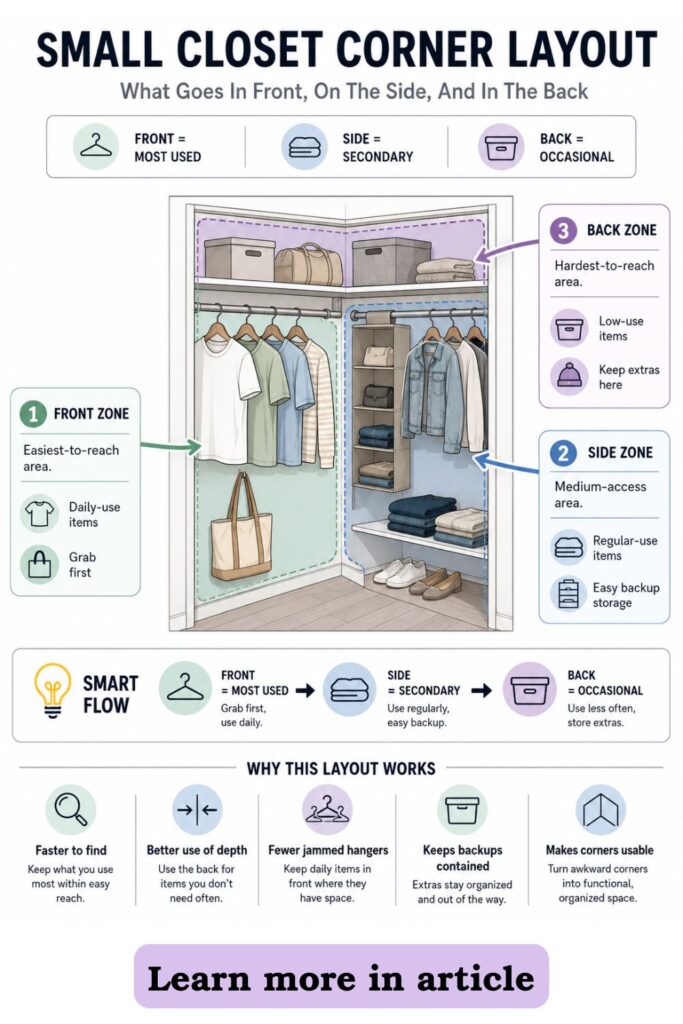
From there, add storage in layers. A tension rod can create an angled hanging line. Hooks can turn the side wall into a vertical zone. Shower rings, clip hangers, S-hooks, and fabric totes can repurpose simple items into practical hanging helpers.
If you want to get more from your life, and are looking for concrete action steps to get you there, check out our Request a Coach page. It’s a “cut the fence-sitting and take action” way to tackle your issues and actually find success. To get off the fence and start to take action, click or tap here.
The most important part is giving each section a purpose:
- Front zone for everyday items
- Side zone for accessories and slim hanging pieces
- Deep zone for occasional or seasonal storage
- Hook zone for items that need quick access
- Angled rod zone for lightweight extras
When each area has a job, the corner becomes easier to use and easier to reset. You are not just stuffing more into the closet. You are making the space more understandable.
A small closet corner may never feel perfectly square or spacious, but it can still work. With a clear plan, the awkward angle can become a useful storage station instead of the place where things disappear.
****
Are you all about style, decor and organization? Download a copy of our Clutter Reset Guide.
Need some in depth help with organization and productivity ? Drop on by our directories choc full of productivity coaches, minimalist coaches, and work/life balance coaches to get your life organized! Or click here to have us match you to the best.
If you want to get more from your life, and are looking for concrete action steps to get you there, check out our Request a Coach page. It’s a “cut the fence-sitting and take action” way to tackle your issues and actually find success. To get off the fence and start to take action, click or tap here.
Read this next

The Secret Formula for Choosing the Perfect Christmas Tree Color Palette
Are you all about style, decor and organization? Download a copy of our Decluttering Workbook.**** Choosing a Christmas tree color palette might feel intimidating, but a simple design formula makes […]
Read More
Sidecar Cart System for Desks With No Drawer Space
No desk drawers? This sidecar cart setup keeps supplies close, clears the desktop, and makes tiny workspaces feel instantly easier.
Read More
8 Gorgeous Holiday Color Schemes That Reveal Your Style (Which One Are You?)
Are you all about style, decor and organization? Download a copy of our Decluttering Workbook. **** Holiday décor goes far beyond what looks pretty.It’s also one of the easiest ways […]
Read More