


Talk to a coach about Motivational coaching

Robert Bradley Singleton
Certified Master Spiritual Life Coach, Neuropsychologist, and Existential Therapist
Train with the best to be the best you! Don't...

Dr. Kate Watson
B.A Psychology, M.Ed. Psychological Counseling, Dr.PH in Public Health, Certified Health Coach, Certified Life Coach, Certified Mind and Body Specialist, Certified Women's Empowerment Coach, Certified Neurodiversity Coach
Dr. Kate Watson helps people with boundaries, coping strategies, and...

Angela Ebejer
Board Certified Coach
Coach with a Board Certified Coach to gain clarity, confidence,...

Mak Estill
Anxiety, Panic & Life Coach dedicated to coaching you into a life of lesser and lighter anxiety!
Founder and owner of Actionable Anxiety, a private coaching practice...

Elise Boren
Certified Life Coach, Communication Specialist and Sound Healer
Through listening and discussion we will create a plan to...

Vibeke Pedersen
Certified Life Coach / ThetaHealer®
Crush 2025

Ashley Godfrey
Certified Executive Function & Resilience Coach for ADHD!
I help ADHD/Neurodivergent clients in life management, career, wellness, &...

Marie Fredericks
Masters in Education, Certified Life and Health Coach - Confidence, Motivation and Positive Habits Coach
I help clients manage stress and anxiety by building self-confidence...


Fell Off Track? The 24-Hour Goal Restart That Gets You Moving Again Without Starting Over
Want to try this at home? No worries! Download a copy of our SMART Goals PDF Worksheet.
****
Falling off track can feel bigger than it really is.
One missed habit becomes three. One messy workday turns into a week of avoidance. One goal that used to feel exciting now feels heavy, vague, and slightly embarrassing to think about.
But being “off track” does not always mean you need a dramatic reset. Most of the time, you do not need a new personality, a new planner, or a full weekend to rebuild your life. You need a small, clear way to restart before your brain turns the delay into a story.
That is what a 24-hour restart is for.
The goal is not to fix everything today. The goal is to make tomorrow easier to enter. Instead of waiting for Monday, next month, a better mood, or a perfect burst of motivation, you build one tiny bridge from where you are now to the next version of the goal.
Need some in depth help with goal settings, motivation or productivity ? Drop on by our directories choc full of productivity coaches, accountability coaches, and goal-setting coaches, and start reaching those goals! Or click here to have us match you to the best.
A 24-hour restart works because it keeps the plan small enough to act on. It is especially useful when you feel drained, inconsistent, behind, or tired of starting over.
If you want to get more from your life, and are looking for concrete action steps to get you there, check out our Request a Coach page. It’s a “cut the fence-sitting and take action” way to tackle your issues and actually find success. To get off the fence and start to take action, click or tap here.
You are not trying to make up for everything you missed. You are trying to reopen the loop.
This can work for almost any goal, including:
- Getting back into a morning routine
- Restarting a work project
- Rebuilding an exercise habit
- Returning to meal planning
- Cleaning up a messy schedule
- Catching up on admin
- Restarting a personal growth goal
- Rebuilding consistency after a busy season
The trick is to stop asking, “How do I get completely back on track?” That question is too big when your energy is low.
A better question is:
“What would make tomorrow feel like I am back in motion?”
That is the question this article will help you answer. You will make the goal smaller, identify the friction, set up your planner, prepare tonight, and give tomorrow one clear win.
Not a perfect life reset.
Just a real restart.
If you want to get more from your life, and are looking for concrete action steps to get you there, check out our Request a Coach page. It’s a “cut the fence-sitting and take action” way to tackle your issues and actually find success. To get off the fence and start to take action, click or tap here.
1. Do a 5-Minute “What Actually Happened?” Check
Before you make a new plan, take five minutes to understand what actually knocked you off track.
Most people skip this part. They jump straight into a stricter plan, a longer checklist, or a promise that they will “do better this time.” But if you do not know why the goal slipped, you may rebuild the same fragile system again.
Start with one plain sentence.
Write down the lapse without drama: Describe what happened in the most neutral way possible.
For example:
- “I stopped planning my mornings.”
- “I missed my workouts this week.”
- “I avoided the project after the first hard task.”
- “I stopped checking my planner.”
- “I fell behind on my content schedule.”
The goal is not to shame yourself. The goal is to make the problem visible.
Next, look for the friction point.
Find the reason the goal became harder: Ask what got in the way of follow-through.
If you want to get more from your life, and are looking for concrete action steps to get you there, check out our Request a Coach page. It’s a “cut the fence-sitting and take action” way to tackle your issues and actually find success. To get off the fence and start to take action, click or tap here.
It might be:
- Low energy
- A busy work week
- No clear next step
- Too many competing priorities
- A goal that was too big
- A routine that depended on motivation
- A missing tool, reminder, or setup
- All-or-nothing thinking
- Decision fatigue
This is where the restart becomes more useful. Instead of saying, “I am inconsistent,” you might realize, “I stopped because the next step was unclear.” That gives you something to fix.
Separate guilt from useful information: Notice the difference between a story and a fact.
A story sounds like:
- “I always ruin my progress.”
- “I never stick with anything.”
- “I guess I am just not disciplined.”
A fact sounds like:
- “I did not plan the next step.”
- “My routine broke when my schedule changed.”
- “I was too tired to do the full version.”
Facts help you restart. Stories keep you stuck.
Finally, choose one restart target.
Pick one area to restart first: Do not try to recover every goal in the same 24 hours.
If you want to get more from your life, and are looking for concrete action steps to get you there, check out our Request a Coach page. It’s a “cut the fence-sitting and take action” way to tackle your issues and actually find success. To get off the fence and start to take action, click or tap here.
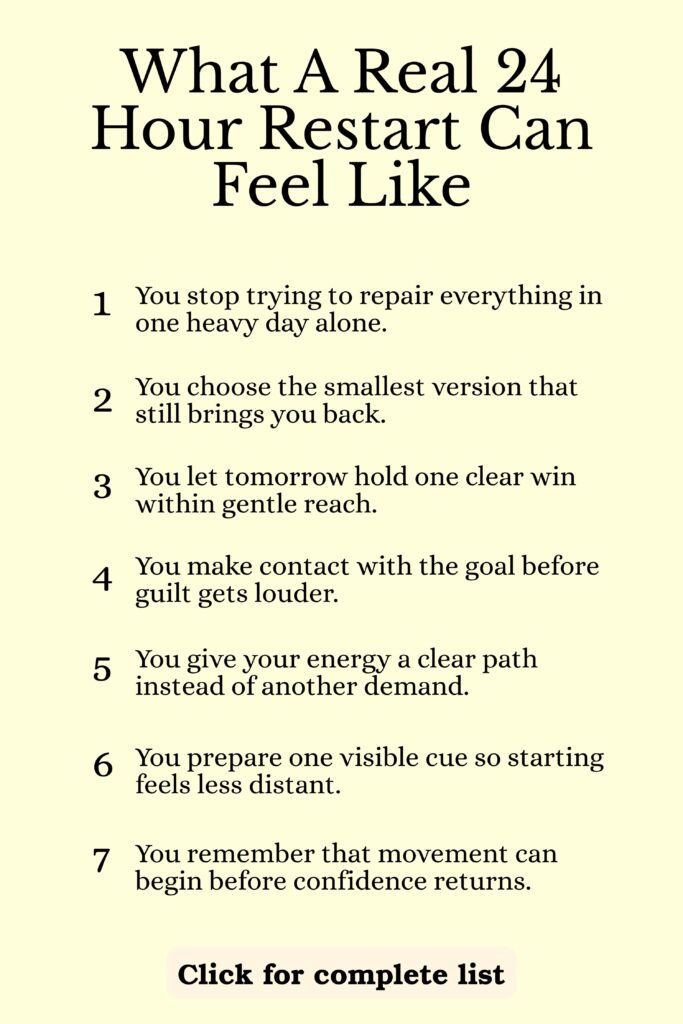
If your workout habit, planner habit, sleep routine, and work project all slipped, choose one. The fastest way back into motion is usually through one small win, not a complete personal overhaul.
Ask:
“What is the one thing that would make tomorrow feel less off track?”
That is your restart target.
2. Pick the Smallest Tomorrow Version of the Goal
Once you know what slipped, shrink the goal.
This may feel counterintuitive. When people feel behind, they usually want to make the next plan bigger. They want to catch up, compensate, and prove they are serious.
But oversized comeback plans often fail because they require the same energy you are already missing.
A 24-hour restart works better when the first version is almost laughably small.
If you want to get more from your life, and are looking for concrete action steps to get you there, check out our Request a Coach page. It’s a “cut the fence-sitting and take action” way to tackle your issues and actually find success. To get off the fence and start to take action, click or tap here.
Shrink the goal on purpose: Choose the smallest action that still counts as returning.
If your goal is exercise, tomorrow’s version might be a 10-minute walk. If your goal is writing, it might be opening the document and writing one messy paragraph. If your goal is organization, it might be clearing one surface.
The goal is not to impress yourself.
The goal is to start again.
Examples:
- Instead of “clean the whole house,” choose “clear the kitchen counter.”
- Instead of “finish the project,” choose “outline the next three tasks.”
- Instead of “restart my whole routine,” choose “plan tomorrow before bed.”
- Instead of “work out for an hour,” choose “stretch for five minutes.”
- Instead of “catch up on all emails,” choose “reply to the three most important ones.”
Make success easy to recognize: Define exactly what “back on track” means for tomorrow.
Vague goals create escape routes. “Be productive” can mean anything. “Get organized” can turn into a full-day project. “Work on my goal” gives your brain too many choices.
Instead, make the restart specific:
If you want to get more from your life, and are looking for concrete action steps to get you there, check out our Request a Coach page. It’s a “cut the fence-sitting and take action” way to tackle your issues and actually find success. To get off the fence and start to take action, click or tap here.
- “At 8:30 a.m., I will write for 10 minutes.”
- “After lunch, I will send one follow-up email.”
- “Before bed, I will plan tomorrow’s top three tasks.”
- “After coffee, I will do the 5-minute version of my routine.”
Remove the perfection trap: Remind yourself that tomorrow is not a makeup day.
You are not paying off a debt. You are rebuilding contact with the goal.
That means tomorrow does not need to be impressive. It needs to be clear enough that you can do it even if your mood is average, your energy is low, or your day gets busier than expected.
Give tomorrow one clear win: Choose a finish line you can reach.
When the action is done, let it count.
That small completed action matters because it changes the emotional direction of the goal. You move from avoidance to contact. From “I should” to “I did.” From someday to tomorrow.
That is the real restart.
3. Use a Planner to Build the 24-Hour Restart Map
A restart becomes easier when it leaves your head and lands somewhere visible.
If you want to get more from your life, and are looking for concrete action steps to get you there, check out our Request a Coach page. It’s a “cut the fence-sitting and take action” way to tackle your issues and actually find success. To get off the fence and start to take action, click or tap here.
That is where a planner helps. It does not have to be fancy. You can use a paper planner, a notebook, a sticky note, a calendar app, or a simple note on your phone.
The point is to turn the restart into a map.
When you are already feeling behind, your brain does not need more open-ended decisions. It needs a short route.
Write tonight’s reset list: Use three simple lines.
Write:
- What slipped
- Tomorrow’s tiny restart
- When it will happen
For example:
- What slipped: “I stopped planning my day.”
- Tiny restart: “Write tomorrow’s top three tasks.”
- When: “After dinner tonight and again at 8 a.m.”
Or:
- What slipped: “I avoided the proposal.”
- Tiny restart: “Open the file and write the next section header.”
- When: “9:30 a.m. before checking messages.”
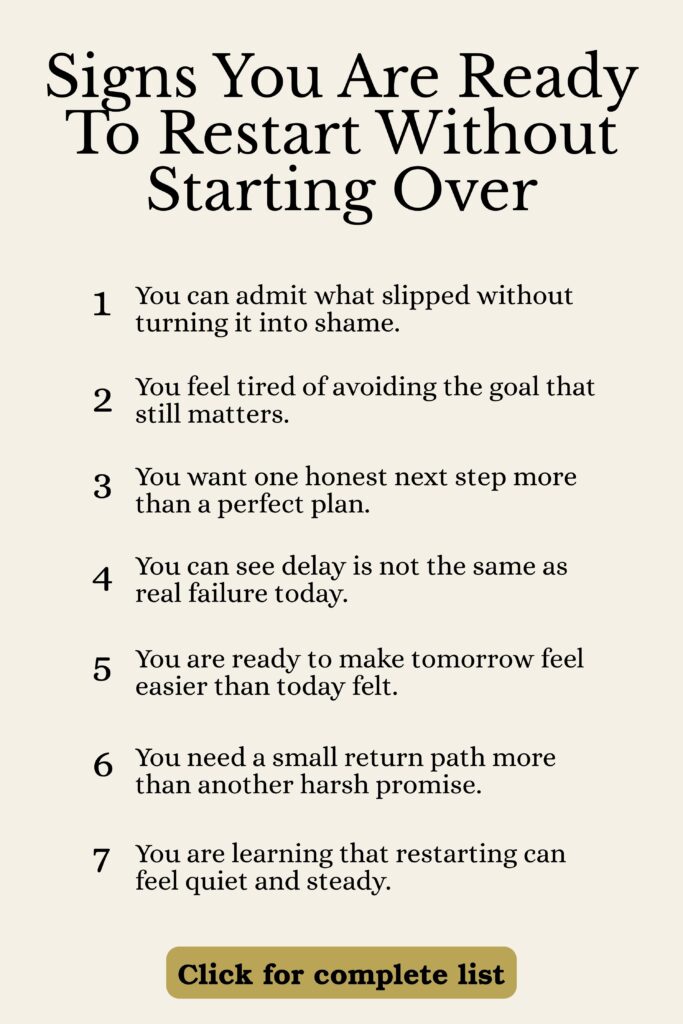
This keeps the restart practical. You are not writing a journal entry about everything that went wrong. You are deciding what happens next.
If you want to get more from your life, and are looking for concrete action steps to get you there, check out our Request a Coach page. It’s a “cut the fence-sitting and take action” way to tackle your issues and actually find success. To get off the fence and start to take action, click or tap here.
Block one restart window: Give the action a place in tomorrow’s day.
A restart without a time often becomes another vague intention. Pick a moment when you usually have some control.
Good restart windows might include:
- Before opening email
- After morning coffee
- During lunch
- Right after school drop-off
- At the start of your workday
- Before leaving your desk
- Right after dinner
- Before bed
Keep the time block short. Five to 10 minutes is enough for the first restart action.
Add one backup option: Decide what you will do if the day gets messy.
This is important because real life rarely respects a perfect plan.
Your backup might sound like:
- “If I cannot do 20 minutes, I will do five.”
- “If I miss the morning window, I will do it after lunch.”
- “If I cannot finish the task, I will open the file and write one note.”
- “If I feel too tired, I will do the setup step only.”
A backup option protects you from quitting because the original plan did not happen.
If you want to get more from your life, and are looking for concrete action steps to get you there, check out our Request a Coach page. It’s a “cut the fence-sitting and take action” way to tackle your issues and actually find success. To get off the fence and start to take action, click or tap here.
Circle the first action only: Make tomorrow’s starting point obvious.
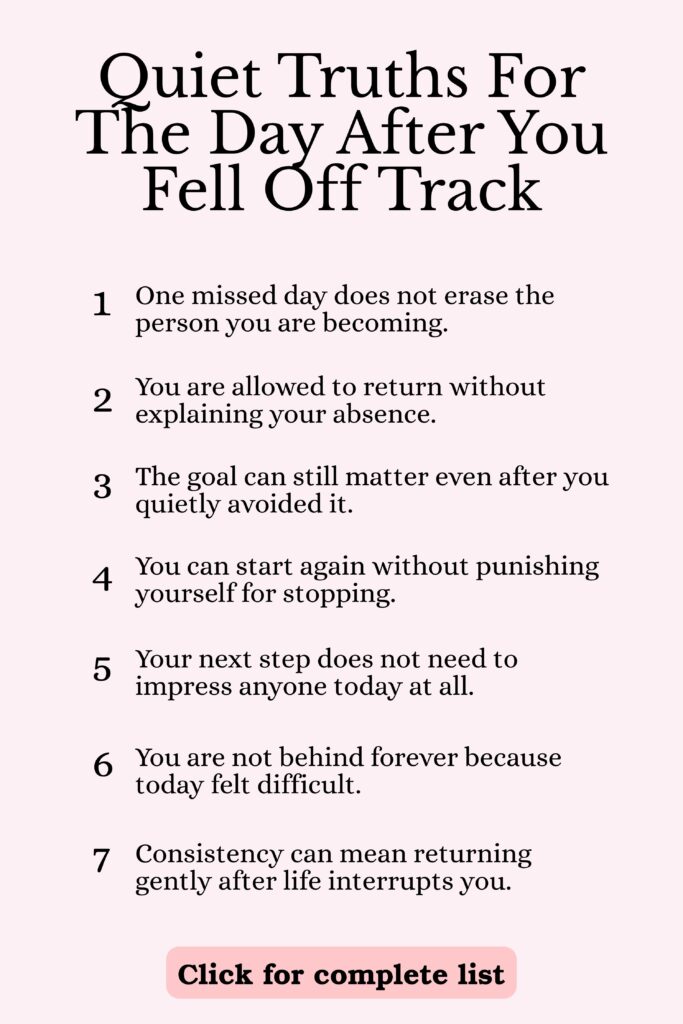
Do not circle the whole project. Do not highlight seven things. Circle the first physical action.
For example:
- Open the planner
- Put on walking shoes
- Open the document
- Clear the desk
- Start the timer
- Write the first line
- Fill the water bottle
- Check the calendar
A good restart map should make the next step so clear that you do not have to negotiate with yourself tomorrow.
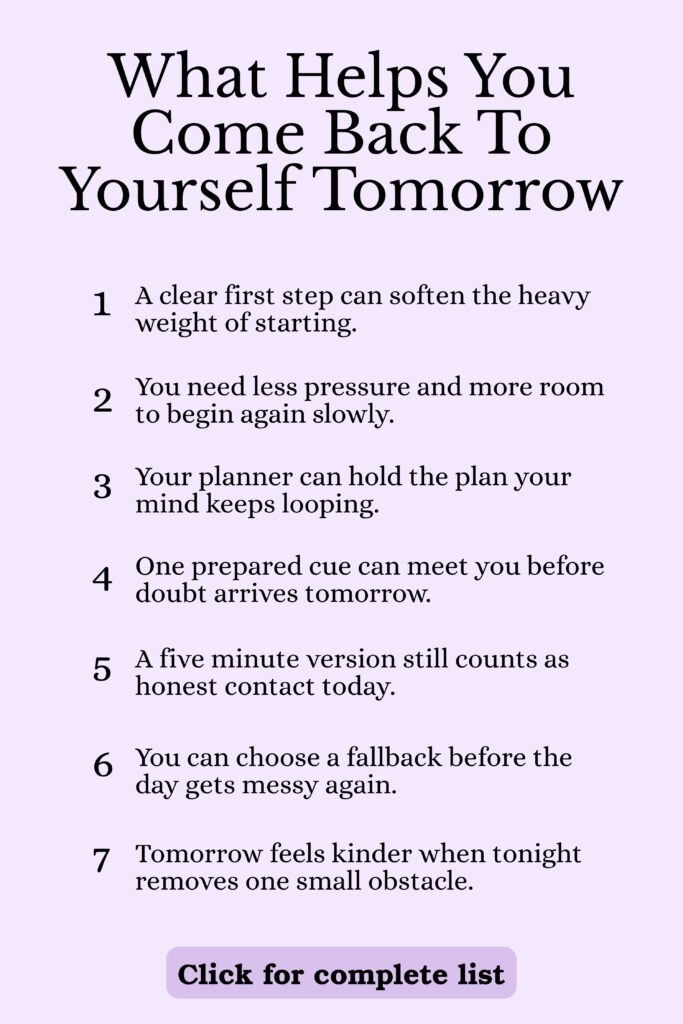
4. Set Up Tonight So Tomorrow Requires Less Willpower
The best time to make tomorrow easier is tonight.
Not by doing a huge amount. Not by staying up late trying to catch up. Just by removing one or two pieces of friction before they have a chance to stop you.
This matters because tomorrow’s motivation is not guaranteed. You may wake up tired. Work may get busy. Other people may need things from you. Your brain may try to convince you to delay the restart again.
A small setup gives your future self a shortcut.
If you want to get more from your life, and are looking for concrete action steps to get you there, check out our Request a Coach page. It’s a “cut the fence-sitting and take action” way to tackle your issues and actually find success. To get off the fence and start to take action, click or tap here.
Prepare the visible cue: Put the restart trigger where you will see it.
If you want to walk, put your shoes near the door. If you want to plan your day, place your planner on your desk or kitchen table. If you want to write, leave the document open. If you want to clean, put the supplies where the mess is.
The cue should be obvious enough that tomorrow’s version of you does not have to remember.
Examples:
- Planner open to tomorrow’s page
- Water bottle filled and on the counter
- Workout clothes placed beside the bed
- Laptop charged and ready
- Project file open on the desktop
- Sticky note on the coffee machine
- One basket ready for a quick declutter
- Meal ingredients grouped together in the fridge
Clear one tiny obstacle: Remove the most annoying blocker.
Small obstacles are powerful because they give your brain an excuse to delay.
Look for the thing that usually interrupts the action:
- Is the desk messy?
- Is the login missing?
- Is the task unclear?
- Is the planner buried?
- Is the document hard to find?
- Is the space uncomfortable?
- Is the first step too big?
- Is the reminder too easy to ignore?
Then fix one thing.
If you want to get more from your life, and are looking for concrete action steps to get you there, check out our Request a Coach page. It’s a “cut the fence-sitting and take action” way to tackle your issues and actually find success. To get off the fence and start to take action, click or tap here.
Not all of it. One thing.
Use a “next step” note: Leave yourself a short instruction.
This works especially well for work projects and goals that require thinking. When you stop for the day, write the exact next step you need to take.
Examples:
- “Open the draft and write the intro.”
- “Review the first three rows only.”
- “Send the message to Maya.”
- “Choose the workout and press play.”
- “Clear the sink, then stop.”
- “Make the list before checking email.”
This keeps you from wasting tomorrow’s energy figuring out where to begin.
Keep the setup under 10 minutes: Do not turn preparation into another project.
The setup should feel light. If it starts becoming complicated, shrink it.
Your only job tonight is to make tomorrow’s first action easier to start.
If you want to get more from your life, and are looking for concrete action steps to get you there, check out our Request a Coach page. It’s a “cut the fence-sitting and take action” way to tackle your issues and actually find success. To get off the fence and start to take action, click or tap here.
That is enough.
5. Build a Gentle Morning Re-Entry Routine
Tomorrow morning is not the time to lecture yourself.
It is the time to re-enter.
A gentle morning restart helps you take action before the day gets crowded with messages, obligations, and distractions. It gives you one small win early enough that you do not spend the whole day carrying the feeling that you are still behind.
The routine can be simple. In fact, it should be simple.
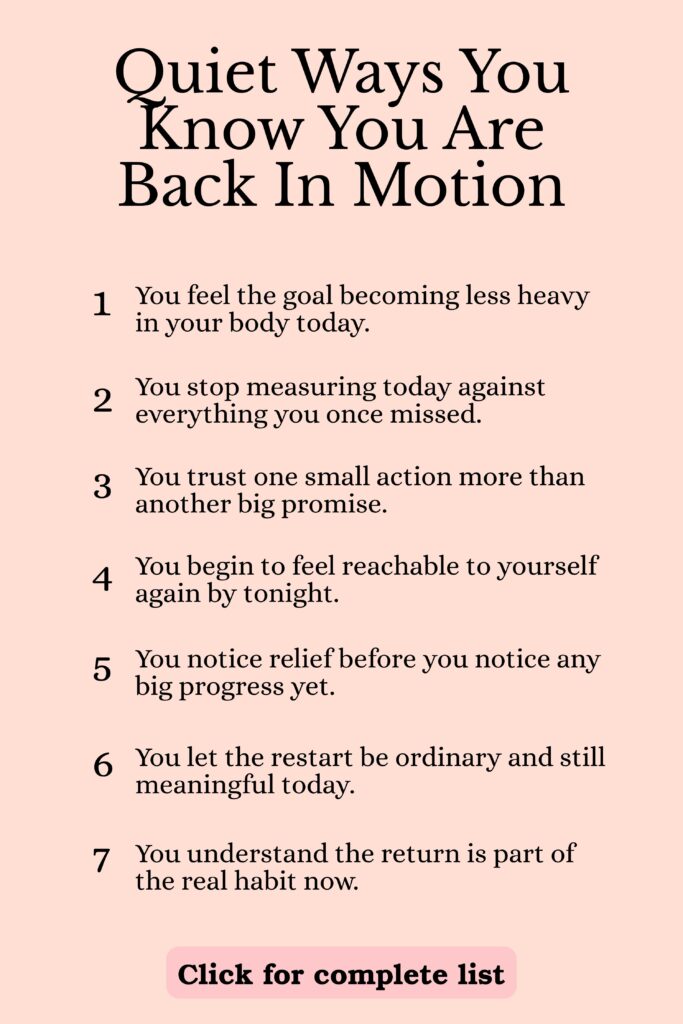
Start with a low-pressure check-in: Ask one useful question.
Try:
“What is the one thing that would make me feel back in motion today?”
If you want to get more from your life, and are looking for concrete action steps to get you there, check out our Request a Coach page. It’s a “cut the fence-sitting and take action” way to tackle your issues and actually find success. To get off the fence and start to take action, click or tap here.
This is better than asking, “How do I fix everything?” or “How do I catch up?” Those questions create pressure. The restart question creates direction.
You can answer it in one sentence.
For example:
- “I need to write my top three tasks.”
- “I need to send the first email.”
- “I need to move my body for 10 minutes.”
- “I need to clear my workspace.”
- “I need to open the project and choose the next step.”
Do the tiny restart before the day expands: Complete the smallest version early.
If possible, do it before email, social media, meetings, errands, or other people’s needs take over. The longer the restart waits, the easier it becomes to push it into “later.”
This does not mean you need a long morning routine. Even five minutes can change the direction of the day.
You might:
- Fill in your planner
- Start a 10-minute timer
- Review your goal
- Clear your desk
- Write one paragraph
- Prep one simple meal
- Send one message
- Do one small habit
Pair it with an existing habit: Attach the restart to something you already do.
If you want to get more from your life, and are looking for concrete action steps to get you there, check out our Request a Coach page. It’s a “cut the fence-sitting and take action” way to tackle your issues and actually find success. To get off the fence and start to take action, click or tap here.
This makes the action easier to remember.
For example:
- After coffee, open the planner.
- After brushing teeth, stretch for five minutes.
- After logging in, write the first task.
- After breakfast, check the calendar.
- After school drop-off, start the timer.
- After lunch, send the follow-up.
This is habit building without needing a complicated system.
Let the first win be enough: Do not immediately raise the bar.
If you complete the tiny restart, count it. You can do more if you genuinely want to, but do not make more the requirement.
The point of the morning re-entry routine is to rebuild trust with yourself.
You said you would restart.
Then you did.
If you want to get more from your life, and are looking for concrete action steps to get you there, check out our Request a Coach page. It’s a “cut the fence-sitting and take action” way to tackle your issues and actually find success. To get off the fence and start to take action, click or tap here.
That matters.
6. Use a Workday Restart If the Goal Slipped Because Life Got Busy
Sometimes the goal does not slip because you stopped caring.
It slips because life got crowded.
Work expands. Messages pile up. Meetings interrupt your focus. By the end of the day, the goal you meant to restart feels too far away, even if it still matters to you.
A workday restart helps you regain momentum inside the reality of a busy day, not outside of it.
Choose one work-safe action: Pick something that fits into your actual schedule.
The action should be small enough to do during a normal workday. You are not trying to create a perfect productivity retreat. You are trying to restart in the middle of real life.
Useful workday restart actions include:
If you want to get more from your life, and are looking for concrete action steps to get you there, check out our Request a Coach page. It’s a “cut the fence-sitting and take action” way to tackle your issues and actually find success. To get off the fence and start to take action, click or tap here.
- A 10-minute desk reset
- Writing the top three priorities
- Sending one overdue reply
- Opening the project file
- Cleaning up one calendar conflict
- Making one decision you have delayed
- Starting one focused work sprint
- Creating a short end-of-day plan
Protect one small time block: Put the restart on your calendar if you can.
Even a five-minute block can help. When the restart is visible, it is less likely to disappear under everyone else’s priorities.
You might block:
- 8:55 to 9:05 a.m. for planning
- 12:30 to 12:40 p.m. for one admin task
- 3:00 to 3:10 p.m. for project setup
- 4:50 to 5:00 p.m. for tomorrow’s plan
The smaller the block, the less resistance it creates.
Reduce open loops: Write down the unfinished tasks that are stealing attention.
Open loops make you feel scattered because your brain keeps trying to track them. Take two minutes and list them quickly.
Then choose one.
Not the easiest one necessarily. Not the loudest one. The one that would create the most useful movement.
If you want to get more from your life, and are looking for concrete action steps to get you there, check out our Request a Coach page. It’s a “cut the fence-sitting and take action” way to tackle your issues and actually find success. To get off the fence and start to take action, click or tap here.
Ask:
“Which task would make the rest of the day feel clearer?”
That is your restart task.
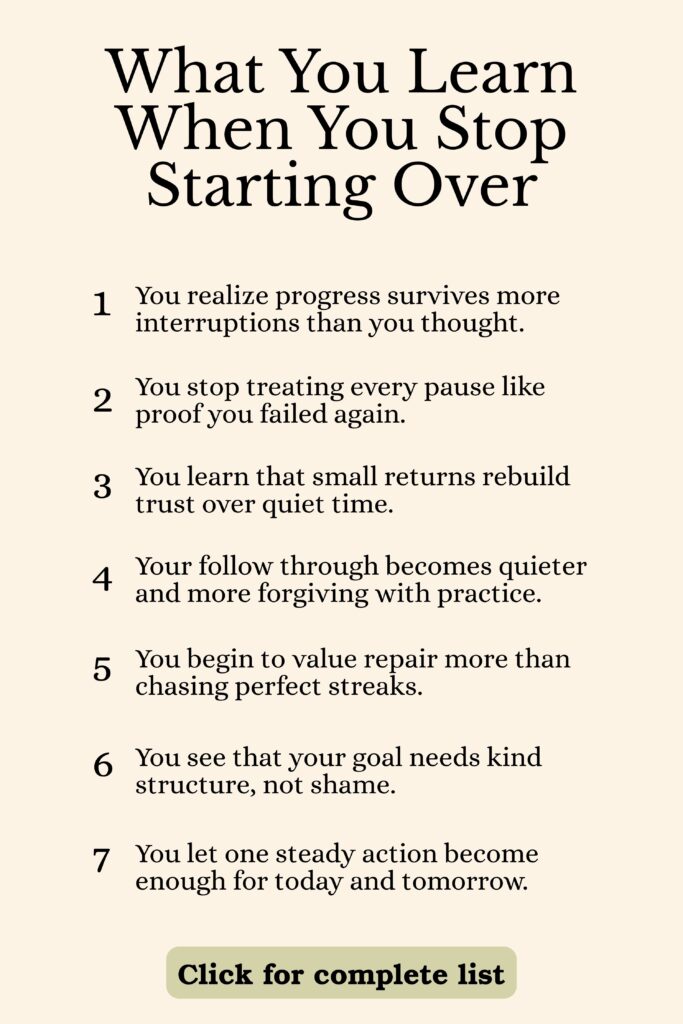
End the workday with tomorrow’s cue: Leave yourself a clean handoff.
Before you log off, set up the next action. This is one of the simplest ways to reduce inconsistency.
You can:
- Leave the document open
- Write tomorrow’s first task
- Clear your desk surface
- Put the planner on your keyboard
- Schedule the first focus block
- Write the next email subject line
- Move the most important task to the top of the list
A good workday restart does not require you to overhaul your whole schedule.
It gives momentum a place to land.
If you want to get more from your life, and are looking for concrete action steps to get you there, check out our Request a Coach page. It’s a “cut the fence-sitting and take action” way to tackle your issues and actually find success. To get off the fence and start to take action, click or tap here.
7. Create a Simple “If I Slip Again” Rule
A restart plan becomes stronger when it expects imperfect days.
That may sound negative, but it is actually freeing. If you assume you will never slip again, the next hard day feels like failure. If you already have a rule for returning, a slip becomes part of the system.
This is especially important if inconsistency is the main pattern you are trying to break.
Expect another messy day: Decide now that one missed day is not the end.
You may get tired. Your schedule may change. A work deadline may take over. You may forget. You may wake up with low energy and only manage the bare minimum.
That does not mean the restart failed.
It means the system needs a return path.
Write a restart rule: Make it simple enough to use without thinking.
If you want to get more from your life, and are looking for concrete action steps to get you there, check out our Request a Coach page. It’s a “cut the fence-sitting and take action” way to tackle your issues and actually find success. To get off the fence and start to take action, click or tap here.
Good restart rules sound like:
- “If I miss one day, I do the 5-minute version the next morning.”
- “If I skip my planner at night, I fill it in after coffee.”
- “If I avoid the project, I open it for five minutes only.”
- “If I fall behind, I choose one catch-up task, not the whole list.”
- “If my routine breaks, I restart with the smallest version.”
The rule should be kind and specific.
Not “do better.”
Not “stop being lazy.”
Not “catch up on everything.”
A good rule tells you exactly how to return.
Avoid punishment planning: Do not make the next day harder because you missed today.
This is where many restarts collapse. Someone misses one workout, so they plan a brutal double workout. They skip one planning session, so they create an intense productivity schedule. They lose one day, so they try to compensate with a perfect week.
If you want to get more from your life, and are looking for concrete action steps to get you there, check out our Request a Coach page. It’s a “cut the fence-sitting and take action” way to tackle your issues and actually find success. To get off the fence and start to take action, click or tap here.
That makes the goal feel heavier.
Instead, make the return easy.
Keep the chain easy to repair: Redefine consistency as returning quickly.
Consistency does not mean you never miss. It means you know what to do when you do.
This mindset is powerful because it removes the drama from restarting. You are no longer waiting for a perfect streak. You are building a habit that can survive real life.
The “if I slip again” rule may be the most important part of your 24-hour restart because it protects tomorrow’s progress from becoming another all-or-nothing cycle.
8. Turn the Restart Into a Repeatable Habit Loop
Once you complete the first restart, do not rush to expand it.
Let it repeat first.
If you want to get more from your life, and are looking for concrete action steps to get you there, check out our Request a Coach page. It’s a “cut the fence-sitting and take action” way to tackle your issues and actually find success. To get off the fence and start to take action, click or tap here.
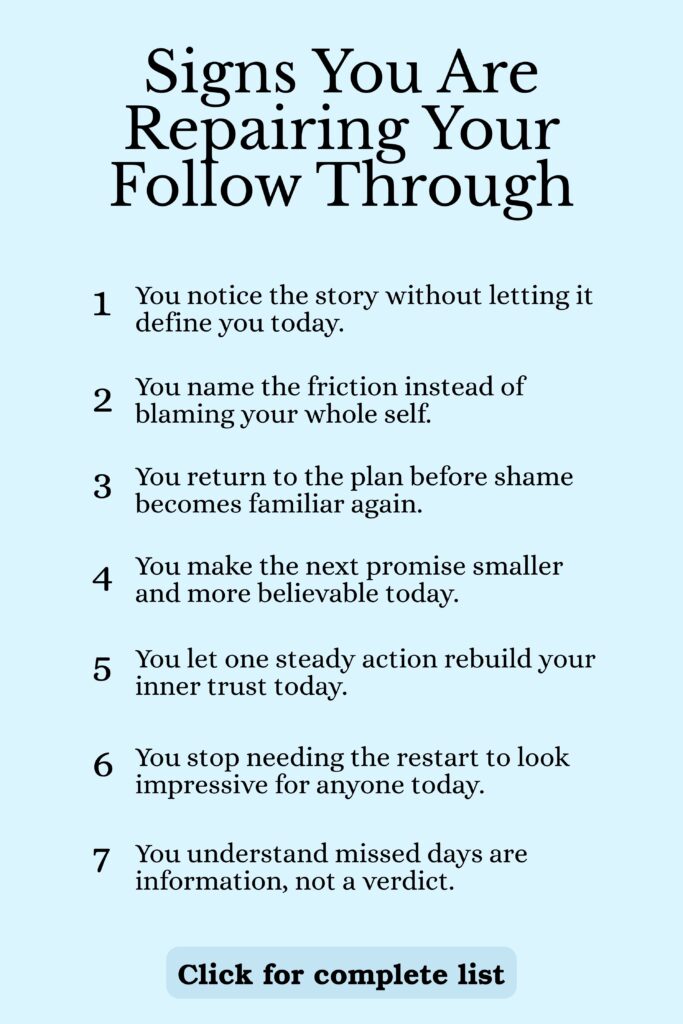
A tiny action done for three days is often more valuable than an intense action done once. The point is not to prove how much you can do when you are motivated. The point is to create a loop you can return to without rebuilding the whole plan.
Use the same restart cue for three days: Keep the timing or trigger consistent.
If you planned tomorrow after dinner, try doing that again for the next two nights. If you opened your project after coffee, repeat that same cue. If you stretched after brushing your teeth, keep that pairing.
Repetition helps your brain recognize the pattern.
The cue might be:
- After coffee
- Before email
- After lunch
- Before bed
- After dinner
- When you sit at your desk
- When you open your planner
- Before you leave work
The exact cue matters less than using it consistently.
Track completion simply: Keep the tracking light.
You do not need a complicated habit tracker unless you enjoy using one. A simple check mark is enough.
If you want to get more from your life, and are looking for concrete action steps to get you there, check out our Request a Coach page. It’s a “cut the fence-sitting and take action” way to tackle your issues and actually find success. To get off the fence and start to take action, click or tap here.
Try:
- A check in your planner
- A dot on a calendar
- A one-word note
- A quick “done” in your app
- A small mark beside the habit
Tracking helps because it gives the restart visible proof. You can see that you are not just thinking about the goal. You are touching it daily.
Review what made it easier: Notice the part of the system that helped most.
After a few days, ask:
- Did the time of day work?
- Did the smaller version help?
- Did the visible cue matter?
- Did the planner make it clearer?
- Did the backup option reduce pressure?
- Did I choose the right first action?
This helps you improve the system without judging yourself.
Build only after the tiny version feels stable: Add more slowly.
If the 5-minute version works for several days, you can increase it. But do not rush.
You might move from:
If you want to get more from your life, and are looking for concrete action steps to get you there, check out our Request a Coach page. It’s a “cut the fence-sitting and take action” way to tackle your issues and actually find success. To get off the fence and start to take action, click or tap here.
- Five minutes to 10 minutes
- One paragraph to one section
- One task to three tasks
- One walk to three walks per week
- One planning session to a full weekly review
The restart becomes a habit when it feels repeatable.
That is the win.
9. When a Coach Can Help You Restart Faster
Sometimes you can restart on your own with a planner, a checklist, and one honest look at what slipped.
Other times, the pattern keeps repeating.
You start strong, stop, feel guilty, make a new plan, then stop again. You may know what you want, but the follow-through keeps breaking somewhere between intention and action.
That is where a coach can help.
Use a coach to find the pattern: A coach can help you see what is hard to notice from inside the cycle.
For example, you may think the problem is motivation, but a coach may help you uncover that the goal is too vague, the timeline is unrealistic, or the routine does not fit your actual energy.
If you want to get more from your life, and are looking for concrete action steps to get you there, check out our Request a Coach page. It’s a “cut the fence-sitting and take action” way to tackle your issues and actually find success. To get off the fence and start to take action, click or tap here.
Sometimes the pattern is practical:
- Your goal has too many steps.
- Your schedule has no protected space.
- Your environment creates friction.
- Your plan depends on ideal days.
- Your tasks are not clearly prioritized.
Sometimes the pattern is emotional:
- You avoid starting because you fear doing it badly.
- You quit when progress feels slow.
- You set goals based on pressure, not desire.
- You treat one missed day as proof you failed.
A good coach helps turn those patterns into workable information.
Turn vague goals into clear next steps: Coaching can make the restart more specific.
Instead of “I need to get back on track,” a coach might help you define:
- What goal matters most right now
- What success looks like this week
- What obstacle keeps repeating
- What action is small enough to start
- What accountability would actually help
- What system fits your real schedule
This is especially useful for goal setting, productivity, career growth, business planning, personal organization, or habit building.
Create accountability without pressure: The right support should not feel like being scolded.
Accountability works best when it is clear, realistic, and respectful. A coach can help you check in on progress, adjust the plan, and return quickly after setbacks.
If you want to get more from your life, and are looking for concrete action steps to get you there, check out our Request a Coach page. It’s a “cut the fence-sitting and take action” way to tackle your issues and actually find success. To get off the fence and start to take action, click or tap here.
Build a restart system for real life: A coach can help you create a plan that does not collapse the second life gets busy.
That might include a weekly reset, a planner routine, a goal review system, or a simple “minimum version” for low-energy days.
The point is not to need someone forever.
The point is to learn how to restart with less confusion, less guilt, and more structure.
10. Make a Personal 24-Hour Restart Checklist
A restart gets easier when you do not have to invent it every time.
That is why a personal 24-hour restart checklist is useful. It gives you a repeatable process for the days when you feel scattered, behind, or tempted to wait for a better time.
You can keep it in a planner, phone note, journal, desk drawer, or printed worksheet.
Choose your restart trigger: Decide when you will use the checklist.
If you want to get more from your life, and are looking for concrete action steps to get you there, check out our Request a Coach page. It’s a “cut the fence-sitting and take action” way to tackle your issues and actually find success. To get off the fence and start to take action, click or tap here.
A trigger helps you act sooner. Without one, you may wait until the goal feels completely out of reach.
Your trigger might be:
- “I missed the habit twice.”
- “I avoided the task for two days.”
- “I feel scattered and unclear.”
- “I ended the day frustrated.”
- “I stopped checking my planner.”
- “I keep saying I will start tomorrow.”
- “I feel behind and do not know where to begin.”
The trigger is not a reason to panic. It is a signal to restart.
Write your five restart steps: Keep the checklist short.
Try this version:
- Name what slipped.
- Choose tomorrow’s tiny version.
- Schedule the restart window.
- Set up one visible cue.
- Pick a fallback version.
That is enough.
You can add details if you want, but the power of the checklist is its simplicity. When you are drained, you need fewer decisions, not more.
Keep it somewhere visible: Make the checklist easy to find.
If you want to get more from your life, and are looking for concrete action steps to get you there, check out our Request a Coach page. It’s a “cut the fence-sitting and take action” way to tackle your issues and actually find success. To get off the fence and start to take action, click or tap here.
The best checklist is the one you actually see when you need it.
Good places include:
- Inside your planner cover
- On your desk
- In your notes app
- On your fridge
- As a calendar reminder
- In your goal-setting folder
- On a sticky note near your laptop
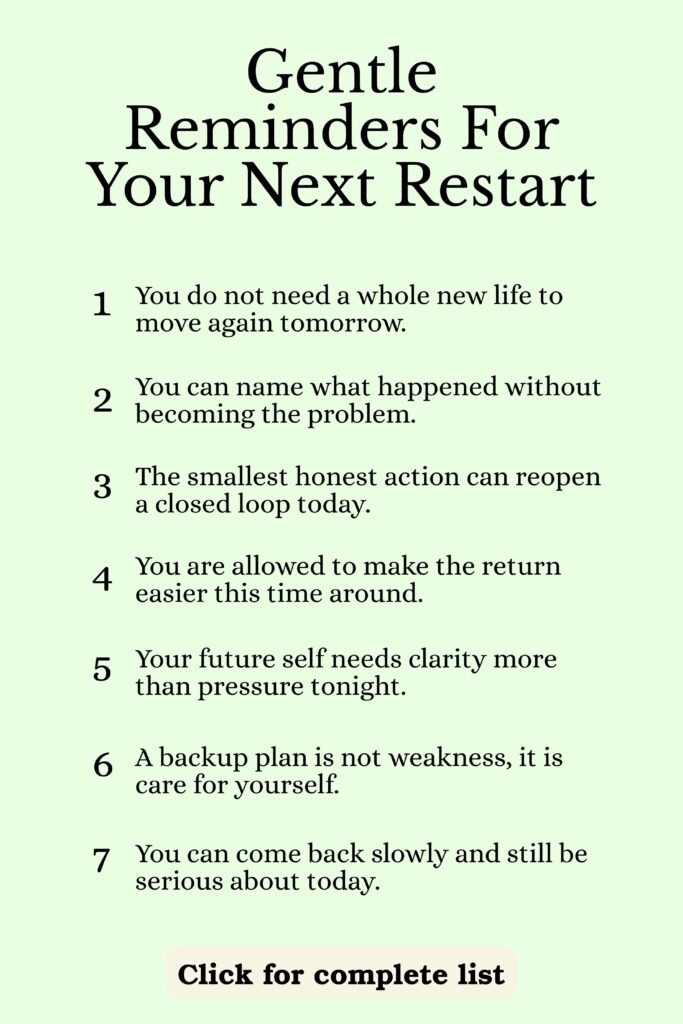
Reuse it without rewriting your life: Let the same process work again and again.
The checklist should not require a new plan every time. It should give you a familiar path back.
You can use it for work, routines, habits, health goals, creative projects, money goals, home organization, or personal development.
The question stays the same:
“What is the smallest way I can be back in motion tomorrow?”
When you can answer that, you are no longer waiting for a perfect restart.
If you want to get more from your life, and are looking for concrete action steps to get you there, check out our Request a Coach page. It’s a “cut the fence-sitting and take action” way to tackle your issues and actually find success. To get off the fence and start to take action, click or tap here.
You have one.
Your Tomorrow Starts With One Small Setup
Want to try this at home? No worries! Download a copy of our SMART Goals PDF Worksheet.
Need some in depth help with goal settings, motivation or productivity ? Drop on by our directories choc full of productivity coaches, accountability coaches, and goal-setting coaches, and start reaching those goals! Or click here to have us match you to the best.
You do not have to wait until you feel fully motivated to begin again.
You do not have to wait for Monday. You do not have to catch up on everything you missed. You do not have to turn one off-track week into a full identity crisis.
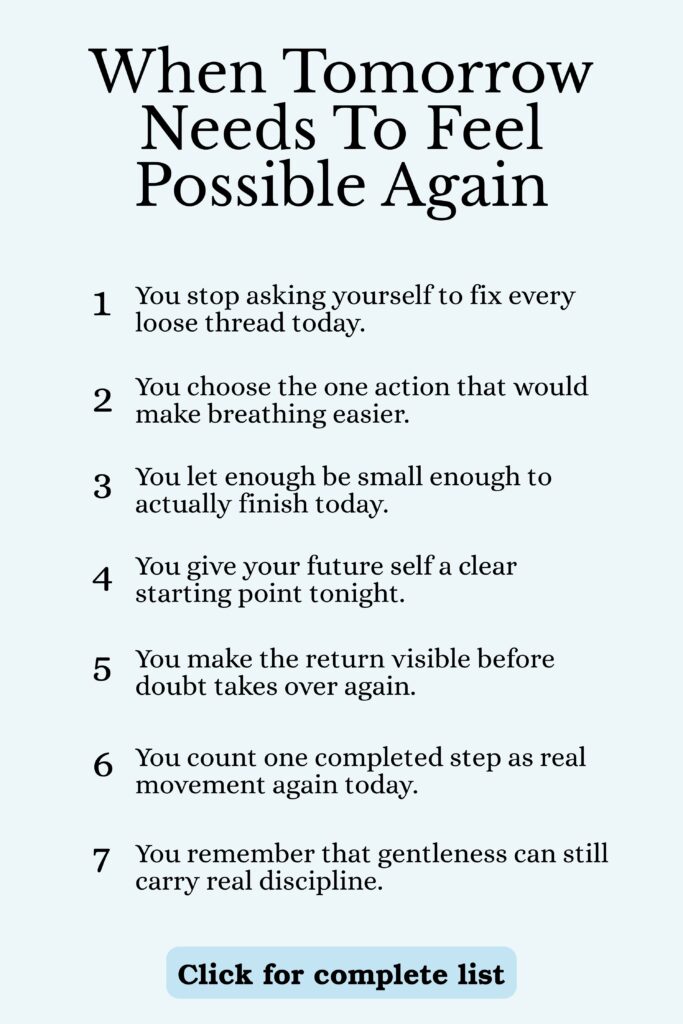
You only need one small setup that makes tomorrow easier.
That might be opening your planner. Choosing the 5-minute version. Setting out your shoes. Writing the first task. Clearing your desk. Blocking 10 minutes on your calendar. Leaving yourself a note that tells you exactly where to begin.
Small does not mean pointless.
If you want to get more from your life, and are looking for concrete action steps to get you there, check out our Request a Coach page. It’s a “cut the fence-sitting and take action” way to tackle your issues and actually find success. To get off the fence and start to take action, click or tap here.
Small is often what makes the restart possible.
When you are tired, overwhelmed, or inconsistent, the goal is not to create a perfect plan. The goal is to reduce the distance between where you are and the next action.
A 24-hour restart gives you that distance back.
Tonight, name what slipped. Choose one tiny version for tomorrow. Put it somewhere you will see it. Decide when it will happen. Give yourself a fallback plan.
Then let tomorrow be simple.
Not perfect.
Just back in motion.
If you want to get more from your life, and are looking for concrete action steps to get you there, check out our Request a Coach page. It’s a “cut the fence-sitting and take action” way to tackle your issues and actually find success. To get off the fence and start to take action, click or tap here.
Read this next
Focus on the Goal, Not the Problem
What you focus on will greatly determine your success. Learn to focus on the goal, not the problem!
Read More
This Simple Goal Setting Trick Makes Progress Finally Feel Clear and Doable
Effective goals can turn your life around! Here are six easy steps to achieving your goals.
Read More
Don’t Focus On Distractions, Focus On Life!
Stop hanging on to negative situations and events from the past that affect your outlook!
Read More